Improving Statistical Natural Language Translation with
Categories and Rules
F r a n z J o s e f O c h a n d H a n s W e b e r F A U E r l a n g e n - C o m p u t e r Science I n s t i t u t e ,
I M M D V I I I - Artificial Intelligence,
A m W e i c h s e l g a r t e n 9, 91058 E r l a n g e n - T e n n e n l o h e , G e r m a n y
{faoch,
weber}@immd8, inf
ormatik,
uni-erlangen, de
A b s t r a c t
This p a p e r describes an all level approach on statistical n a t u r a l language translation (SNLT). W i t h o u t any predefined knowledge the system learns a statistical translation lexicon (STL), word classes (WCs) and translation rules (TRs) from a parallel corpus thereby producing a gen- eralized form of a word alignment (WA). T h e translation process itself is realized as a b e a m search. In our m e t h o d example-based tech- niques enter an overall statistical approach lead- ing to a b o u t 50 percent correctly translated sentences applied to the very difficult English- G e r m a n V E R B M O B I L spontaneous speech cor- pus.
1 I n t r o d u c t i o n
In SNLT the transfer itself is realized as a max- imization process of the form
Trans(d) = argmax e P ( e [ d ) (1)
Here d is a given source language (SL) sentence which has to be translated into a target lan- guage (TL) sentence e. In order to model the distributions P ( e [ d ) all approaches in SNLT use a "divide and conquer" strategy of approximat- ing P ( e [ d ) by a combination of simpler models. T h e problem is to reduce parameters in a suffi- cient way b u t end up with a model still able to describe the linguistic facts of natural language translation.
T h e work presented here uses two approxi- mations for P ( e [ d ) . One approximation is used for to gain the relevant parameters in training while a modified formula is subject of decoding translations. In detail, we impose the following modifications with respect to approaches pub- lished in t h e last decade: 1. A refined distance weight for the STL probabilities is used which
allows for a good modeling of the effects caused by syntactic phrases. 2. In order to account for collocations a WA technique is used, where one- t o - n and n - t o - o n e WAs are allowed. 3. For the translation WCs are used which are con- structed using clustering techniques, where the STL forms a part of the optimization criterion. 4. A set of T R s is learned m a p p i n g sequences of SL WCs to sequences of T L WCs.
T h r o u g h o u t t h e p a p e r the four topics above are described in more detail. Finally we report on experimental results produced on the VERB- MOBIL corpus.
2 L e a r n i n g o f t h e T r a n s l a t i o n L e x i c o n
In order to determine the STL, we use a sta- tistical model for translation and the EM algo- r i t h m to adjust its model parameters. T h e sim- ple model 1 (Brown et al., 1993) for the trans- lation of a SL sentence d = d l . . . d t in a T L sentence e = e l . . .
em
assumes that every T L word is generated independently as a mixture of the SL words:m l
P ( e [ d ) ,,~ H ~
t(ej[di)
(2)j = l i=O
In the equation above
t(ej[di)
stands for the probability that ej is generated bydi.
T h e assumption t h a t each SL word influences every T L word with the same strength appears to be too simple. In the refined model 2 (Brown et al., 1993) alignment probabilities
a(ilj , l, m)
are included to model the effect that the po- sition of a word influences the position of its translation.
ditional alignment probabilities depend on ab- solute positions and do not take that into ac- count, as has already been noted by (Vogel et al., 1996). Therefore we developed a kind of relative weighting probability. The following model - - which we will call the model 2 ~ - - makes the weight between the words di and ej dependent on the relative distances between the words dk which generated the previous word
e j - 1 :
l
s(i]j, e j _ z , d ) ~ ~ d ( i - k]l).t(ej_z]dk) (3)
k = 0
Here d(i - kll ) is the probability that word di influences a word ej if the previous word ej-1 is influenced by dk. As an effect of such a weight a (phrase-)cluster of words being moved over a long distance receives additional 'cost' only at the ends of the cluster. So we have the final translation probability for model 2~:
m l
P ( e l d ) ~" I I ~ t(ejldi)s(i[j, e j - l , d ) (4)
j = l i = 0
The parameters involved can be determined us- ing the EM algorithm (Baum, 1972). The ap- plication of this algorithm to the basic prob- lem using a parallel bilingual corpus aligned on the sentence level is described in (Brown et al.,
1993).
3 D e t e r m i n i n g a W o r d A l i g n m e n t
The kind of WA we use is more general than the often used WA through a vector, where ev- ery TL word is generated by exactly one SL word. We use a matrix Z for every sentence pair, whose fields describe whether or not two words are aligned. In this approach, multiple words can be aligned to one TL word, which is motivated by collocation phenomena as for in- stance German compound nouns. Alignments may look like the one in figure 1 according to our method. The matrix Z contains i + 1 lines and j rows with binary values. The value zij = 1 (zij = 0) means that the word i influences (not) the word j. In figure 1 every link stands for
z i j = l .
The models 1, 2 and 2 ~ and some similar mod-
~ ~
tmontagFigure 1: Alignment example.
els can be described in the form
m l
P ( e l d ) "" 1-I ~ xij
(5)
j = l i = 0
where the value xij is the strength of the influ- ence of word di to word ej. We use a thresh- old 0 < 1 in such a way that while the sum ~ = o xi~j of the first s values is smaller than O. ~tk= o Xkj we set zi~j = O. T h e other values are set to 1. The permutation i 0 , . . . , il sorts the xij so that Xioj < ... <
Xilj.
Interestingly using such a WA technique does not in general lead to the same results when applied from TL to SL and vice versa. If we use P ( e [ d ) or P ( d l e ) we receive different WAs z~ d and z d-e. Intuitively the relation between the words of the sentences should be symmetric and there should be the same WA. It is possible to enforce the s y m m e t r y with zij = zed.
zdeij,
in order to make a link between two words only if there is a link in both WAs.It is possible to include the WA into the EM algorithm for the estimation of the model prob- abilities. This can be done by replacing t(ej Idi) by t ( e j l d i ) . z i j. The resulting STL becomes much cleaner in the sense that it does not con- tain so many wrong entries (see section 7).
4 L e a r n i n g o f T r a n s l a t i o n R u l e s
The incorporation of TRs adds an "example- based" touch to the statistical approach. In a very naive approach a T R could be represented by a translation example. T h e obvious advan- tage is an expectable good quality of the trans- lated sentences. The disadvantage is the fact that almost no sentence can be translated be- cause every corpus would have too few examples
- - the generalization capability of the naive ap-
proach is very limited.
natural to use WCs and shorter sequences to end up with a set of rather general rules. In or- der to achieve a good learning performance, all the WCs of a language are pairwise disjoint (see section 5). T h e function C(.) gives the class of a word or the sequence of WCs of a sequence of words.
Our T R s axe triples (D, E, Z) where D is a sequence of SL WCs, E is a sequence of T L WCs and Z is a WA matrix between D and E. For using one rule in the translation process we first rewrite the probability P ( e l d ) :
P ( e l d ) = ~ P ( E , Z l d ) • P ( e l E , Z , d ) (6)
E , Z
In order to simplify the maximization (equation 1) we use only the T R which gives the m a x i m u m probability.
During the learning of those T R s we count all extractable rules occurring in the aligned cor- pus and define the probability p(E, ZlC(d)) P ( E , Z l d ) in terms of the relative frequency.
We approximate P ( e l E , Z , d ) by simpler probabilities, so that we finally need a language model
p(ejle~-l),
a translation modelp(ej
Id, Z) and a probabilityp(ejlEj).
Forp(ejle~ -1)
we use a class-based polygram language model (Schukat-Talamazzini, 1994). For the transla- tion probabilityp(ej
Id, Z) we use model 1 and include the information of the WA:l
p(ejld ,
Z ) : = ~t(ejldi) . zi j
(7)i = 0
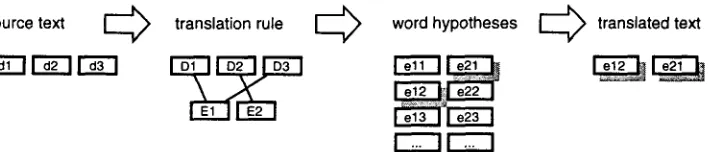
Figure 2 shows how the application of those rules works in principle. We arrive at a list of word hypotheses with probabilities for each po- sition. Neglecting the language model, the best decision would be to independently choose the most probable word for every position.
In general the translation of a sentence in- volves more t h a n one rule a n d usually there are many rules applicable. An applicable rule is one where the sequence of SL WCs matches a se- quence of WCs in the sentence. So in the gen- eral case we have to decide for a set of rules we want to apply. This set of rules has to cover the sentence, this means t h a t every word is used in a rule and that no word is used twice or more times. The next step is to decide how to ar- range the generated units to get the translated
sentence. Finally we have to decide for every position which word to use. We want all those decisions to be optimal in the sense t h a t the following p r o d u c t is maximized:
L
p ( e (jl) o . . . o e(JD) • 1-I P(z(k), E(k)IC(d(k))
k = l
• p(e (jk)
IZ (k) , E (k) , d (k)) (8)Here L is the n u m b e r of SL units, d (k) is the k-th SL unit, e (k) is the k-th T L unit and
j l , . . . , j i
is a p e r m u t a t i o n of the numbers 1 , . . . , L.
5 L e a r n i n g o f C a t e g o r y S y s t e m s
During the last decade some publications have discussed the problem of learning WCs using clustering techniques based on m a x i m u m like- lihood criteria applied to single language cor- pora. T h e question which we pose in addition is: Which WCs are suitable for translation? It seems to make sense to require t h a t the used WCs in the two languages are correlated, so that the information about the class of a SL word gives much information about the class of the generated T L word. Therefore it has been argued in (Fung and Wu, 1995) t h a t indepen- dently generated WCs are not good for the use in translation.
For the a u t o m a t i c generation of class systems exists a well known procedure (see (Kneser and Ney, 1993), (Och, 1995)) which maximizes the perplexity of the language model for a training corpus by moving one word from a class to an- other in an iterative procedure. T h e function
ML(CINw_~w, )
which has to be optimized de- pends only on the count functionNw~w,
which counts the frequency that the word w' comes after the word w.source text
translation rule [ 2
word
hypotheses
r-=-I V-r-1
[ ~
translated textFigure 2: Application of a Rule.
same way a count function
Ne-.d
can be deter- mined and we get the new optimization criterionM L ( Cd t~Ce
I Nd--+e-J- Need).
T h e resulting classes are strongly correlated, b u t rarely contain words with similar syntactic/semantic properties. To arrive at WCs having b o t h ( m e t h o d COMB), we determine T L WCs with the first m e t h o d and afterwards we determine SL WCs with the sec- ond method.So we can use the well known iterative m e t h o d to end up with WCs in different lan- guages which are correlated. From those WCs we expect that they are more suitable for build- ing the T R s from section 4 and finally result in a better overall translation performance.
6 T r a n s l a t i o n a s a S e a r c h P r o b l e m
T h e problem of finding the translation of a sen- tence can be viewed as a search problem for a p a t h with minimal cost in a tree. If we apply the negative logarithm to the p r o d u c t of proba- bilities in equation 8 we arrive at a s u m of costs which has to be minimized. T h e costs stem from the language model, the rule probabilities and the translation probabilities. In the search tree every node represents a partial translation for the first words or a full translation. T h e leaves of the tree are the nodes where the applied rules define a complete cover of the SL sentence. To reduce the search space we use additional costs for changing the order of the fragments.
We use a beam search strategy (Greer et al., 1982) to find a good p a t h in this tree. To make the search feasible we had to implement some problem specific heuristics.
7 R e s u l t s
T h e experiments in this section have all been carried out on the bilingual G e r m a n - E n g l i s h VERBMOBIL corpus. This corpus consists of spontaneous utterances from negotiation di- alogs which had originally been p r o d u c e d in
German. For training we used 11 500 r a n d o m l y chosen sentence pairs.
T h e first experiment shall be u n d e r s t o o d as an illustration for our improved technique in generating a STL using the WA in t h e EM- algorithm. We generated a STL using 10 EM- iterations for model 1 and 10 iterations for model 2q T h e whole process took about 4 hours for our corpus. Below are given some STL en- tries for G e r m a n words. T h e probabilities
t(eld )
are written in parentheses.
• Tuesday--+Dienstag (0.83), den (0.05), C O M M A (0.042), a m (0.038), dienstags (0.018), der (0.009), also (0.0069), passen (0.0019), diesem (0.0013), steht (0.0012)
• Frankfurt--+Frankfurt (0.67), nach (0.12), in (0.081), mit (0.068), u m (0.031), habe (0.02), besuchen (0.0078), w i e d e r u m
(0.0036)
T h e top positions are always plausible trans- lations. B u t there are many improper transla- tions produced. W h e n we include the WA in t h e EM algorithm as described in section 3 we can produce fewer lexicon entries of a much b e t t e r quality:
• Tuesday-+Dienstag (0.97), dienstags (0.029)
• Frankfurt--+Frankfurt (1)
T h e following two corresponding WCs (out of 600) show a typical result of the m e t h o d COMB to determine correlated WCs:
• Mittwoch, Donnerstag, Freitag, Sonnabend, Friihlingsanfang, Karsamstag, Volkstrauertag, Weihnachtsferien, Som- merschule, T h o m a s , einschlieflen
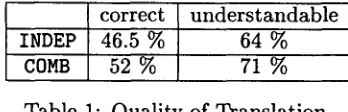
[image:4.612.131.486.51.127.2]To evaluate the complete system we translated 200 r a n d o m l y chosen sentences drawn from an i n d e p e n d e n t test corpus and checked manually how many of t h e m constituted acceptable trans- lations. Since we used a spontaneous speech corpus many sentences were grammatically in- correct. A translation is classified 'correct' if the translation is an error-free (spontaneaous speech) utterance and classified 'understand- able' if the intention of the utterance is trans- lated. T h e 100 sentences had a m e a n sentence length of 10 words. T h e used STL was gener- ated using model 2' (see section 2).
correct u n d e r s t a n d a b l e
INDEP 46.5 % 64 %
COMB 52 % 7 1 %
Table h Quality of Translation.
Some example translations:
• was h~iltst d u von zweiter Februar nachmit- tags, nach fiinfzehn U h r --4 what do you think about the second of February in the afternoon, after three o'clock
• I wanted to fix a time with you for a five- day business trip to S t u t t g a r t --4 ich wollte mit Ihnen einen Termin ausmachen fiir eine f/inft~igige Gesch£ftsreise nach S t u t t g a r t
8
C o n c l u s i o n s
We have presented a couple of improvements to SNLT. T h e most i m p o r t a n t changes are the translation model 2', the representation of WA using a matrix, a m e t h o d to determine corre- lated WCs and the use of T R s to constrain search. In the future, the rule mechanism should be extended. So far the rules learned are only loop-free finite state transducers. Still m a n y translation errors stem from t h e inability to model long distance dependencies. We intend to move to finite state cascades or context free g r a m m a r s in future work. W i t h respect to the category sets we feel that an additional morpho- logical model could further improve the transla- tion quality. As it stands the system still makes m a n y errors concerning the n u m b e r of nominals and verbs. This is especially i m p o r t a n t when t h e language pairs differ with respect to the pro- ductivity of their inflectional systems.
9
A c k n o w l e d g e m e n t s
We have to t h a n k Stefan Vogel from the RWTH Aachen explicitly, for the material he provided and G/inther G5rz for general promotion. T h e work is part of the G e r m a n Joint Project VERB- M O B I L . This work was funded by the G e r m a n Federal Ministry for Research and Technology (BMBF) in the framework of the Verbmobil Project under Grant B M B F 01 IV 701 K 5. T h e responsibility for the contents of this s t u d y lies with the authors.
R e f e r e n c e s
L.E. Baum. 1972. An Inequality and Asso- ciated Maximization Technique in Statisti- cal Estimation for Probabilistic Functions of Markov Processes. Inequalities, 3:1-8.
P. F. Brown, S. A. Della Pietra, V. J. Della Pietra, and R. L. Mercer. 1993. T h e m a t h e m a t i c s of statistical machine transla- tion: P a r a m e t e r estimation. Computational Linguistics, 19(2):263-311.
P. Fung and D. Wu. 1995. Coerced markov models for cross-lingual lexical-tag relations. In The Sixth Int. Conf on Theor. and Method- ological Issues in Machine Translation, pages 240-255, Leuven, Belgium, July.
K. Greer, B. Lowerre, and L. Wilcox. 1982. Acoustic P a t t e r n Matching and Beam Search- ing. In Proc. Int. Conf. on Acoustics, Speech, and Signal Processing, pages 1251-1254, Paris.
R. Jackendorff. 1977. X-bar-syntax: A s t u d y of phrase structure. In Linguistic Inquiry Monograph 2.
R. Kneser and H. Ney. 1993. Improved Clus- tering Techniques for Class-Based Statistical Language Modelling. In Eurospeech, pages 973-976.
F. J. Och. 1995. Maximum-Likelihood- Sch~itzung von Wortkategorien mit Verfahren der kombinatorischen Optimierung. Studien- arbeit, FAU Erlangen-Niirnberg.
E.G.
Schukat-Talamazzini. 1994. AutomatischeSpracherkennung. Vieweg, Wiesbaden. S. Vogel, H. Ney, and C. Tillmann. 1996.
[image:5.612.89.263.235.291.2]