
Chunk-Level Reordering of Source Language Sentences with
Automatically Learned Rules for Statistical Machine Translation
Yuqi Zhang and Richard Zens and Hermann Ney
Human Language Technology and Pattern Recognition Lehrstuhl f¨ur Informatik 6 – Computer Science Department
RWTH Aachen University, D-52056 Aachen, Germany
{yzhang,zens,ney}@cs.rwth-aachen.de
Abstract
In this paper, we describe a source-side reordering method based on syntac-tic chunks for phrase-based statissyntac-tical ma-chine translation. First, we shallow parse the source language sentences. Then, re-ordering rules are automatically learned from source-side chunks and word align-ments. During translation, the rules are used to generate a reordering lattice for each sentence. Experimental results are reported for a Chinese-to-English task, showing an improvement of 0.5%–1.8% BLEU score absolute on various test sets and better computational efficiency than reordering during decoding. The exper-iments also show that the reordering at the chunk-level performs better than at the POS-level.
1 Introduction
In machine translation, reordering is one of the ma-jor problems, since different languages have differ-ent word order requiremdiffer-ents. Many reordering con-straints have been used for word reorderings, such as ITG constraints (Wu, 1996), IBM constraints (Berger et al., 1996) and local constraints (Kanthak et al., 2005). These approaches do not make use of any linguistic knowledge.
Several methods have been proposed to use syn-tactic information to handle the reordering problem, e.g. (Wu, 1997; Yamada and Knight, 2001; Gildea,
2003; Melamed, 2004; Graehl and Knight, 2004; Galley et al., 2006). One approach makes use of bitext grammars to parse both the source and tar-get languages. Another approach makes use of syn-tactic information only in the target language. Note that these models have radically different structures and parameterizations than phrase-based models for SMT.
Another kind of approaches is to use syntactic in-formation in rescoring methods. (Koehn and Knight, 2003) apply a reranking approach to the sub-task of noun-phrase translation. (Och et al., 2004) and (Shen et al., 2004) describe the use of syntactic fea-tures in reranking the output of a full translation sys-tem, but the syntactic features give very small gains. In this paper, we present a strategy to reorder a source sentence using rules based on syntactic chunks. It is possible to integrate reordering rules di-rectly into the search process, but here, we consider a more modular approach: easy to exchange reorder-ing strategy. To avoid hard decisions before SMT, we generate a source-reordering lattice instead of a single reordered source sentence as input to the SMT system. Then, the decoder uses the reordered source language model as an additional feature function. A language model trained on the reordered source-side chunks gives a score for each path in the lattice. The novel ideas in this paper are:
• reordering of the source sentence at the chunk level,
• representing linguistic chunks-reorderings in a lattice.
The rest of this paper is organized as follows. tion 2 presents a review of related work. In Sec-tions 3, we review the phrase-based translation sys-tem used in this work and propose the framework of the new reordering method. In Section 4, we in-troduce the details of the reordering rules, how they are defined and how to extract them. In Section 5, we explain how to apply the rules and how to gen-erate reordering lattice. In Section 6, we present some results that show that the chunk-level source reordering is helpful for phrase-based statistical ma-chine translation. Finally, we conclude this paper and discuss future work in Section 7.
2 Related Work
Beside the reordering methods during decoding, an alternative approach is to reorder the input source sentence to match the word order of the target sen-tence.
Some reordering methods are carried out on syn-tactic source trees. (Collins et al., 2005) describe a method for reordering German for German-to-English translation, where six transformations are applied to the surface string of the parsed source sentence. (Xia and McCord, 2004) propose an ap-proach for translation from French-to-English. This approach automatically extracts rewrite patterns by parsing the source and target sides of the training corpus. These rewrite patterns can be applied to any input source sentence so that the rewritten source and target sentences have similar word order. Both methods need a parser to generate trees of source sentences and are applied only as a preprocessing step.
Another kind of source reordering methods be-sides full parsing is based on Part-Of-Speech (POS) tags or word classes. (Costa-juss`a and Fonollosa, 2006) view the source reordering as a translation task that translate the source language into a re-ordered source language. Then, the rere-ordered source sentence is taken as the single input to the standard SMT system.
(Chen et al., 2006) automatically extract rules from word alignments. These rules are defined at the POS level and the scores of matching rules are used as additional feature functions during
rescor-ing. (Crego and Mari˜no, 2006) integrate source-side reordering into SMT decoding. They automatically learn rewrite patterns from word alignment and rep-resent the patterns with POS tags. To our knowledge no work is reported on the reordering with shallow parsing.
Decoding lattices were already used in (Zens et al., 2002; Kanthak et al., 2005). Those approaches used linguistically uninformed word-level reorder-ings.
3 System Overview
In this section, we will describe the phrase-based SMT system which we use for the experiments. Then, we will give an outline of the extentions with the chunk-level source reordering model.
3.1 The Baseline Phrase-based SMT System
In statistical machine translation, we are given a source language sentence f1J = f1. . . fj. . . fJ,
which is to be translated into a target language sen-tence eI1 = e1. . . ei. . . eI.Among all possible
tar-get language sentences, we will choose the sentence with the highest probability:
ˆ
eI1ˆ = argmax I,eI
1
P r(eI1|f1J) (1)
= argmax
I,eI 1
P r(eI1)·P r(f1J|eI1) (2)
This decomposition into two knowledge sources is known as the source-channel approach to sta-tistical machine translation (Brown et al., 1990). It allows an independent modeling of the target language model P r(eI1) and the translation model P r(f1J|eI1). The target language model describes
the well-formedness of the target language sentence. The translation model links the source language sen-tence to the target language sensen-tence. Theargmax operation denotes the search problem, i.e., the gen-eration of the output sentence in the target language. A generalization of the classical source-channel approach is the direct modeling of the posterior probability P r(eI
(Och and Ney, 2002), we obtain:
P r(eI1|f1J) =
expPMm=1λmhm(eI1, f1J)
P
I′,e′I′
1
expPMm=1λmhm(e′I
′
1, f1J)
(3) The denominator represents a normalization factor that depends only on the source sentencef1J.
There-fore, we can omit it during the search process. As a decision rule, we obtain:
ˆ
eI1ˆ = argmax I,eI
1
( M
X
m=1
λmhm(eI1, f1J) )
(4)
The log-linear model has the advantage that addi-tional modelsh(·) can be easily integrated into the overall system. The model scaling factors λM1 are
trained according to the maximum entropy principle, e.g., using the GIS algorithm. Alternatively, one can train them with respect to the final translation quality measured by an error criterion (Och, 2003).
The log-linear model is a natural framework to in-tegrate many models. The baseline system uses the following models:
• phrase translation model
• phrase count features
• word-based translation model
• word and phrase penalty
• target language model (6-gram)
• distortion model (assigning costs based on the jump width)
All the experiments in the paper are evaluated with-out rescoring. More details abwith-out the baseline sys-tem can be found in (Mauser et al., 2006)
3.2 Source Sentence Reordering Framework
Encouraged by the work of (Xia and McCord, 2004) and (Crego and Mari˜no, 2006), we also reorder the source language side. Compared to reordering on the target language side, one advantage is the effi-ciency since the reordering lattice can be translated monotonically as in (Zens et al., 2002). Another ad-vantage is that there is correct sentence information
POS tagging
shallow chunking Translation Process
Standard Translation Proces
with Source Reordering
source text sentences
reordering rules
SMT system
translation output translation output
source text sentences
SMT system
[image:3.612.311.548.62.226.2]source reordering lattice
Figure 1: Illustration of the translation process with and without source reordering.
for the reordering methods, because the source sen-tences are always given. Syntactic reordering on tar-get language is difficult, since the methods will de-grade much because of the errors in hypothesis.
We apply reordering at the syntactic chunk level which can been seen as an intermediate level be-tween full parsing and POS tagging. Figure 1 shows the differences between the new translation frame-work and the standard translation process. A re-ordering lattice replaces the original source sentence as the input to the translation system. The use of a lattice avoids hard decisions before translation. To generate the reordering lattice, the source sentence is first POS tagged and chunk parsed. Then, reorder-ing rules are applied to the chunks to generate the reordering lattice.
Reordering rules are the key information for source reordering. They are automatically learned from the training data. The details of these two mod-ules will be introduced in Section 5.
4 Reordering Rules
Table 1: Examples of reordering rules. (lhs: chunk and POS tag sequence,rhs: permutation )
no. lhs rhs
1. N P0P P1 u2n3 0 1 2 3
2. N P0P P1 u2n3 3 0 1 2
3. DN P0N P1V P2 0 1 2
4. DN P0N P1V P2 1 0 2
5. DN P0N P1m2 0 1 2
6. DN P0N P1m2ad3 3 0 1 2
7. DN P0N P1m2ad3v4 4 3 0 1 2
no hierarchical structure in a rule.
4.1 Definition of Reordering Rules
First, we show some rule examples in Table 1. A re-ordering rule consists of a left-hand-side (lhs) and a right-hand-side (rhs). The left-hand-side is a syn-tactic rule (chunk or POS tags), while the right-hand-side is the reordering positions of the rule. Dif-ferent rules can share the same left-hand-side, such as rules no. 1, 2 and no. 3, 4. The rules record not only the real reordered chunk sequence, but also the monotone chunk sequences, like no. 1, 3 and 5. Note that the same tag sequence can appear mul-tiple times according to different contexts, such as
DN P0 N P1m2#0 1 2in rules no.5,6,7.
4.2 Extraction of Reordering Rules
The extraction of reordering rules is based on the word alignment and the source sentence chunks. Here, we train word alignments in both directions with GIZA++ (Och and Ney, 2003). To get align-ment with high accuracy, we use the intersection alignment here.
For a given word-aligned sentence pair (f1J, eI1, aJ1), the source word sequence f1J is
first parsed into a chunk sequence F1K.
Accord-ingly, the word-to-word alignment aJ1 is changed
to a chunk-to-word alignment ˜aK1 which is the
combination of the target words aligned to the source words in a chunk. It is defined as:
˜
ak={i|i=aj∧j∈[jk, jk+1−1]}
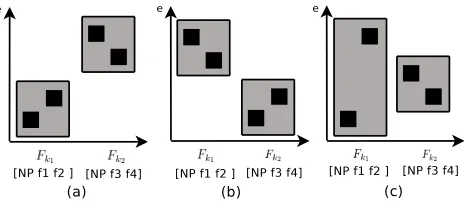
Figure 2: Illustration of three kinds of phrases: (a)monotone phrase, (b)reordering phrase, (c)cross phrase. The black box is a word-to-word alignment. The gray box is a chunk-to-word alignment.
Here,jkdenotes the position of the first source word
in kth chunk. The new alignment is 1 : m from
source chunks to target words. It also means˜akis a
set of positions of target words.
We apply the standard phrase extraction algorithm (Zens et al., 2002) to(FK
1 , eI1,˜aK1 ). Discarding the
cross phrases, we keep the other phrases as rules. In a cross phrase, at least two chunk-word alignments overlap on the target language side. An example of a cross phrase is illustrated in Figure 2(c). Fig-ure 2(a) and (b) illustrate the phrases for reordering rules, which could be monotone phrases or reorder-ing phrases.
5 Reordering Lattice Generation
5.1 Parsing the Source Sentence
The first step of chunk parsing is word segmentation. Then, a POS tagger is usually needed for further syntactic analysis. In our experiments, we use the tool of “Inst. of Computing Tech., Chinese Lexical Analysis System (ICTCLAS)” (Zhang et al., 2003), which does the two tasks in one pass.
Referring to the description of the chunking task in CoNLL-20001, instead of English, a Chinese chunker is processed and evaluated. Each word is assigned a chunk tag, which contains the name of the chunk type and ”B” for the first word of the chunk and ”I” for each other word in the chunk. The ”O” chunk tag is used for tokens which are not part of any chunk. We use the maximum entropy tool
YAS-1
[image:4.612.78.286.91.220.2]Figure 3: Example of applying rules. The left part is the used rules. The right part is the generated new orders of source words.
MET2 to learn the chunking model. The model is based on a combination of word and POS tags. Since specific training and test data are not available for Chinese chunking, we convert subtrees of the Chi-nese treebank (LDC2005T01) into chunks. As there are many ways to choose a subtree, we uses the min-imum subtree with the following constraints:
• a subtree has more than one child,
• the children of a subtree are all leaves.
Compared to chunking of English as in CoNLL-2000, there are more chunk types (24instead of 6) and no single-word chunks. These two aspects make chunking for Chinese harder.
5.2 Applying Reordering Rules
First, we search the reordering rules, in which the chunk sequence matches any tag sequence in the in-put sentence. A source sentence has many paths generated by the rules . For a word uncovered by any rules, its POS tag is used. Each path corresponds to one sentence permutation.
The left part of the Figure 3 shows seven possible coverages, the right part is the reordering for each coverage. Some of the reorderings are identical, like the permutations in line 1, 3 and 5. That is because one word sequence is memorized by several rules in different contexts.
5.3 Lattice Weighting
All reorderings of an input sentence S are com-pressed and stored in a lattice. Each path is a
possi-2http://www-i6.informatik.rwth-aachen.de/web/Software /index.html
ble reorderingS′ and is given a weightW. In this
paper, the weight is computed using a source lan-guage model p(S′). The weight is used directly in
the decoder, integrated into Equation (4). There is also a scaling factor for this weight, which is op-timized together with other scaling factors on the development data. The probability of the reordered source sentence is calculated as follows: for a re-ordered source sentencew1w2...wn, the trigram
lan-guage model is:
p(S′) =
N Y
n=1
p(wn|wn−2, wn−1) (5)
Beside a word N-gram language model, a POS tag N-gram model or a chunk tag N-gram model could be used as well.
In this paper, we use a word trigram model. The model is trained on reordered training source sen-tences. A training source sentence is parsed into chunks. In the same way as described in Section 4.2, word-to-word alignments is converted to chunk-to-word alignments. We reorder the source chunks to monotonize the chunk-to-word alignments. The chunk boundaries are kept when this reordering is done.
6 Experiments
6.1 Chunking Result
se-Table 2: Statistics of training and test corpus for chunk parsing.
train test sentences 17 785 1 000
words 486 468 21 851
chunks 105 773 4 680
[image:6.612.93.280.98.172.2]words out of chunks 244 416 10 282
Table 3: Chunk parsing result on 1000 sentences.
accuracy precision recall F-measure 74.51% 65.2% 61.5% 63.3
lected as test data. The remaining part is used for training. The corpus is from the newswire domain.
Table 2 shows the corpus statistics. For the 4 680 chunks in the test set, the chunker has found 4 414 chunks, of which 2 879 are correct. Following the criteria of CoNLL-2000, the chunker is evaluated using the F-score, which is a combination of pre-cision and recall. The result is shown in Table 3.
The accuracy is evaluated at the word level, the other three metrics are evaluated at the chunk level. The results at the chunk level are worse than at the word level, because a chunk is counted as correct only if the chunk tag and the chunk boundaries are both correct.
6.2 Translation Results
For the translation experiments, we report the two accuracy measures BLEU (Papineni et al., 2002) and NIST (Doddington, 2002) as well as the two error rates word error rate (WER) and position-independent word error rate (PER).
We perform translation experiments on the Ba-sic Traveling Expression Corpus (BTEC) for the Chinese-English task. It is a speech translation task in the domain of tourism-related information. We report results on the IWSLT 2004, 2005 and 2006 evaluation test sets. There are 16 reference trans-lations for the IWSLT 2004 and 2005 tasks and 7 reference translations for the IWSLT 2006 task.
Table 4 shows the corpus statistics of the task. A training corpus is used to train the translation model, the language model and to obtain the reordering
Table 4: Statistics of training and test corpora for the IWSLT tasks.
Chinese English Train Sentences 40k
Words 308k 377k
Dev Sentences 489
Words 5 478 6 008
Test Sentences 500
IWSLT04 Words 3 866 3 581
Test Sentences 506
IWSLT05 Words 3 652 3 579
Test Sentences 500
IWSLT06 Words 5 846 –
rules. A development corpus is used to optimize the scaling factors for the BLEU score. The English text is processed using a tokenizer. The Chinese text pro-cessing uses word segmentation with the ICTCLAS segmenter (Zhang et al., 2003). The translation is evaluated case-insensitive and without punctuation marks.
The translation results are presented in Table 5. The baseline system is a non-monotone translation system, in which the decoder does reordering on the target language side. Compared to the base-line system, the source reordering method improves the BLEU score by0.5%−1.8%absolute. It also achieves a better WER. Note that the used chun-ker here is out-of-domain 3. An improvement is
achieved even with a low F-measure for chunking. So, we could hope that larger improvement is possi-ble using a high-accuracy chunker.
Though the input is a lattice, the source reordering is still faster than the reordering during decoding, e.g. for the IWSLT 2006 test set, the baseline system took17.5minutes and the source reordering system took12.3minutes. The result also indicates that the non-monotone decoding hurts the performance in a source reordering framework. A similar conclusion is also presented in (Xia and McCord, 2004).
Additional experiments we carried out to compare POS-level and chunk-level reorderings. We delete the chunk information and keep the POS tags. Then,
[image:6.612.86.284.215.242.2]Table 5: Translation performance for the Chinese-English IWSLT task
WER[%] PER[%] NIST BLEU[%]
IWSLT04 baseline 47.3 38.2 7.78 39.1
source reordering 46.3 37.2 7.70 40.9
IWSLT05 baseline 45.0 37.3 7.40 41.8
source reordering 44.6 36.8 7.51 42.3
IWSLT06 baseline 67.4 50.0 6.65 22.4
source reordering 65.6 50.4 6.46 23.3 source reordering+non-monotone decoder 66.5 50.3 6.52 22.4
Table 6: Translation performance of reordering methods on IWSLT 2004 test set
WER PER NIST BLEU
[%] [%] [%]
Baseline 47.3 38.2 7.78 39.1
POS 46.9 37.5 7.38 39.7 Chunk 46.3 37.2 7.70 40.9
Table 7: Lattice information for the Chinese-English IWSLT 2004 test data
avg. density used translation pro sent rules time [min/sec]
POS 15.7 6 868 7:08
Chunk 8.2 3 685 3:47
we rerun the source reordering system on the IWSLT 2004 test set. The translation results are shown in Table 6. Though the accuracy of chunking is low, the chunk-level method gets better results than POS-level method. With POS tags, we get more reorder-ing rules and more paths in the lattice, since the sen-tence length is longer than with chunks. The statis-tics are shown in Table 7.
7 Conclusions and Future Work
This paper presents a source-side reordering method which is based on syntactic chunks. The reordering rules are automatically learned from bilingual data. To avoid hard decision before decoding, a reorder-ing lattice representreorder-ing all possible reorderreorder-ings is used instead of single source sentence for decoding. The experiments demonstrate that even with a very
poor chunker, the chunk-level source reordering is still helpful for a state-of-the-art statistical transla-tion system and it has better performance than the POS-level source reordering and target-side reorder-ing.
There are some directions for future work. First, we would like to try this method on larger data sets and other language pairs. Second, we are going to improve the chunking accuracy. Third, we would reduce the number of rules and prune the lattice.
Acknowledgments
This material is partly based upon work sup-ported by the Defense Advanced Research Projects Agency (DARPA) under Contract No. HR0011-06-C-0023, and was partially funded by the Deutsche Forschungsgemeinschaft (DFG) under the project “Statistische Text¨ubersetzung” (Ne572/5)
References
A. L. Berger, S. A. Della Pietra, and V. J. Della Pietra. 1996. A maximum entropy approach to natural language processing.
Computational Linguistics, 22(1):39–72, March.
P. F. Brown, J. Cocke, S. A. Della Pietra, V. J. Della Pietra, F. Jelinek, J. D. Lafferty, R. L. Mercer, and P. S. Roossin. 1990. A statistical approach to machine translation.
Com-putational Linguistics, 16(2):79–85, June.
B. Chen, M. Cettolo, and M. Federico. 2006. Reordering rules for phrase-based statistical machine translation. In
Int. Workshop on Spoken Language Translation Evaluation Campaign on Spoken Language Translation, pages 1–15,
Kyoto, Japan, November.
M. Collins, P. Koehn, and I. Kucerova. 2005. Clause restructur-ing for statistical machine translation. In Proc. of the 43rd
M. R. Costa-juss`a and J. A. R. Fonollosa. 2006. Statistical ma-chine reordering. In Proc. of the Conf. on Empirical
Meth-ods in Natural Language Processing, pages 70–76, Sydney,
Australia, July.
J. M. Crego and J. B. Mari˜no. 2006. Integration of postag-based source reordering into SMT decoding by an extended search graph. In Proc. of AMTA06, pages 29–36, Mas-sachusetts, USA, August.
G. Doddington. 2002. Automatic evaluation of machine trans-lation quality using n-gram co-occurrence statistics. In Proc.
ARPA Workshop on Human Language Technology.
M. Galley, J. Graehl, K. Knight, D. Marcu, S. DeNeefe, W. Wang, and I. Thayer. 2006. Scalable inference and train-ing of context-rich syntactic translation models. In Proc. of
the 21st Int. Conf. on Computational Linguistics and 44th Annual Meeting of the Association for Computational Lin-guistics, pages 961–968, Sydney, Australia, July.
D. Gildea. 2003. Loosely tree-based alignment for machine translation. In Proc. of the 41th Annual Meeting of the
Asso-ciation for Computational Linguistics (ACL), pages 80–87,
Sapporo, Japan, July.
J. Graehl and K. Knight. 2004. Training tree transducers. In HLT-NAACL 2004: Main Proc., pages 105–112, Boston, Massachusetts, USA, May 2 - May 7.
S. Kanthak, D. Vilar, E. Matusov, R. Zens, and H. Ney. 2005. Novel reordering approaches in phrase-based statistical ma-chine translation. In 43rd Annual Meeting of the Assoc. for
Computational Linguistics: Proc. Workshop on Building and Using Parallel Texts: Data-Driven Machine Translation and Beyond, pages 167–174, Ann Arbor, Michigan, June.
P. Koehn and K. Knight. 2003. Empirical methods for com-pound splitting. In Proc. 10th Conf. of the Europ. Chapter
of the Assoc. for Computational Linguistics (EACL), pages
347–354, Budapest, Hungary, April.
A. Mauser, R. Zens, E. Matusov, S. Hasan, and H. Ney. 2006. The RWTH Statistical Machine Translation System for the IWSLT 2006 Evaluation. In Proc. of the Int. Workshop
on Spoken Language Translation, pages 103–110, Kyoto,
Japan.
I. Melamed. 2004. Statistical machine translation by parsing. In The Companion Volume to the Proc. of 42nd Annual
Meet-ing of the Association for Computational LMeet-inguistics, pages
653–660.
S. Nießen and H. Ney. 2001. Morpho-syntactic analysis for reordering in statistical machine translation. In Proc. of MT
Summit VIII, pages 247–252.
F. J. Och and H. Ney. 2002. Discriminative training and max-imum entropy models for statistical machine translation. In
Proc. of the 40th Annual Meeting of the Association for Com-putational Linguistics (ACL), pages 295–302, Philadelphia,
PA, July.
F. J. Och and H. Ney. 2003. A systematic comparison of vari-ous statistical alignment models. Computational Linguistics, 29(1):19–51, March.
F. J. Och, D. Gildea, S. Khudanpur, A. Sarkar, K. Yamada, A. Fraser, S. Kumar, L. Shen, D. Smith, K. Eng, V. Jain, Z. Jin, and D. Radev. 2004. A smorgasbord of features for statistical machine translation. In Proc. 2004 Human
Lan-guage Technology Conf. / North American Chapter of the Association for Computational Linguistics Annual Meeting (HLT-NAACL), pages 161–168, Boston,MA.
F. J. Och. 2003. Minimum error rate training in statistical ma-chine translation. In Proc. of the 41th Annual Meeting of
the Association for Computational Linguistics (ACL), pages
160–167, Sapporo, Japan, July.
K. Papineni, S. Roukos, T. Ward, and W. J. Zhu. 2002. Bleu: a method for automatic evaluation of machine translation. In
Proc. of the 40th Annual Meeting of the Association for Com-putational Linguistics (ACL), pages 311–318, Philadelphia,
PA, July.
M. Popovi´c and H. Ney. 2006. POS-based word reorderings for statistical machine translation. In Proc. of the Fifth Int.
Conf. on Language Resources and Evaluation (LREC).
L. Shen, A. Sarkar, and F. J. Och. 2004. Discriminative rerank-ing for machine translation. In HLT-NAACL 2004: Main
Proc., pages 177–184, Boston, Massachusetts, USA, May 2
- May 7.
C. Tillmann, S. Vogel, H. Ney, and A. Zubiaga. 1997. A DP-based search using monotone alignments in statistical trans-lation. In Proc. 35th Annual Conf. of the Association for
Computational Linguistics, pages 289–296, Madrid, Spain,
July.
D. Wu. 1996. A polynomial-time algorithm for statistical ma-chine translation. In Proc. 34th Annual Meeting of the
As-soc. for Computational Linguistics, pages 152–158, Santa
Cruz, CA, June.
D. Wu. 1997. Stochastic inversion transduction grammars and bilingual parsing of parallel corpora. Computational
Lin-guistics, 23(3):377–403, September.
F. Xia and M. McCord. 2004. Improving a statistical MT sys-tem with automatically learned rewrite patterns. In Proc. of
COLING04, pages 508–514, Geneva, Switzerland, Aug 23–
Aug 27.
K. Yamada and K. Knight. 2001. A syntax-based statistical translation model. In Proc. of the 39th Annual Meeting of
the Association for Computational Linguistics (ACL), pages
523–530, Toulouse, France, July.
R. Zens, F. J. Och, and H. Ney. 2002. Phrase-based statistical machine translation. In M. Jarke, J. Koehler, and G. Lake-meyer, editors, 25th German Conf. on Artificial Intelligence
(KI2002), volume 2479 of Lecture Notes in Artificial Intel-ligence (LNAI), pages 18–32, Aachen, Germany, September.
Springer Verlag.
H. P. Zhang, Q. Liu, X. Q. Cheng, H. Zhang, and H. K. Yu. 2003. Chinese lexical analysis using hierarchical hidden markov model. In Proc. of the second SIGHAN workshop
on Chinese language processing, pages 63–70, Morristown,



![Table 5: Translation performance for the Chinese-English IWSLT taskWER[%]PER[%]NIST](https://thumb-us.123doks.com/thumbv2/123dok_us/735436.1083296/7.612.81.531.79.206/table-translation-performance-chinese-english-iwslt-taskwer-nist.webp)
