Munich Personal RePEc Archive
Lagged Explanatory Variables and the
Estimation of Causal Effects
Bellemare, Marc F. and Masaki, Takaaki and Pepinsky,
Thomas B.
University of Minnesota, Cornell University, Cornell University
23 February 2015
Lagged Explanatory Variables
and the Estimation of Causal Effects
∗
Marc F. Bellemare
†Takaaki Masaki
‡Thomas B. Pepinsky
§February 23, 2015
Abstract
Across the social sciences, lagged explanatory variables are a common strategy to confront challenges to causal identification using observational data. We show that “lag identification”—the use of lagged explanatory variables to solve endogene-ity problems—is an illusion: lagging independent variables merely moves the channel through which endogeneity biases causal estimates, replacing a “selection on observ-ables” assumption with an equally untestable “no dynamics among unobservobserv-ables” assumption. We build our argument intuitively using directed acyclic graphs, then provide analytical results on the bias resulting from lag identification in a simple lin-ear regression framework. We then present simulation results that characterize how, even under favorable conditions, lag identification leads to incorrect inferences. These findings have important implications for current practice among applied researchers in political science, economics, and related disciplines. We conclude by specifying the conditions under which lagged explanatory variables are appropriate for identifying causal effects.
Keywords: Causal Identification, Treatment Effects, Lagged Variables
JELClassification Codes: C13, C15, C21
∗Preliminary draft. We thank Metin C¸ akir, Bryce Corrigan, Peter Enns, Paul Glewwe, Yu Na Lee, Andrew
Little, and Joe Ritter for helpful discussions. All remaining errors are ours.
†Assistant Professor, Department of Applied Economics, University of Minnesota, Saint Paul, MN 55108, [email protected].
‡Ph.D. Candidate, Department of Government, Cornell University, Ithaca, NY 14853, [email protected].
1
Introduction
It is common for researchers using observational data in the applied social sciences
to lag explanatory variables in an effort to purge their estimates of endogeneity, i.e., to
eliminate the correlation between the explanatory variables and the error term, a
prob-lem which prevents teasing out causal relationships from mere correlations. The lagged
independent variable strategy—what we refer to as “lag identification” throughout this
paper—is attractive because it purports to alleviate threats to causal identification
with-out requiring any other data than that available in the dataset. This approach, however, is
grounded in a pre-Credibility Revolution understanding of the problem of endogeneity
(cf. Angrist and Pischke 2009, 2010, and 2014), one that is rooted in the work of the Cowles
Commission on simultaneous equations in the middle of the 20th century (Christ, 1994).
In this paper we demonstrate that lag identification is almost never a solution to
en-dogeneity problems in observational data, and that rather than allowing for the
identifi-cation of causal relationships, lag identifiidentifi-cation merely moves the channel through which
endogeneity biases estimates of causal effects. Specifically, we characterize precisely the
conditions under which lagging an explanatory variable can achieve causal identification:
these are (i) serial correlation in the potentially endogenous explanatory variable, and (ii)
no serial correlation among the unobserved sources of endogeneity. This replaces the
se-lection on observables assumption that motivates the regression with a new identification
assumption of “no dynamics among unobservables.” This assumption is intuitively
prob-lematic, because it requires substantive restrictions on the properties of a variable that is
not observed. Put differently, lagging an explanatory variable to obtain an estimate of
a causal parameter assumes the existence of temporal dynamics in the explanatory
vari-able, but the same temporal dynamics must not characterize the unobservables. Our main
conclusion is that the use of lagged explanatory variables is almost never justified on
iden-tification grounds, and so it does not buy causal ideniden-tification on the cheap. The central
generat-ing process, and that new identification assumption is unlikely to be more defensible than
the selection on observables assumption that motivates the regression.
This argument is most closely related to concurrent research by Reed (2014), who also
studies the use of lagged explanatory variables for causal inference but focuses on
simul-taneity bias and proposes the use of lagged explanatory variables as instruments for
en-dogenous explanatory variables.1 In contrast, our work focuses on more general forms of
endogeneity, and our results imply that Reed’s recommendations are unlikely to represent
a valid solution to the identification problem. Our work is also related to Blackwell and
Glynn (2014), who are broadly concerned with establishing theoretical results about causal
inference using time-series cross-sectional (i.e., large-T and large-N panel) data. All of our
arguments are consistent with theirs. Our contribution is more focused, and designed to
identify a specific practice in applied social science research whose consequences are not
properly understood.
This paper is motivated by the same concern for credible statistical techniques for the
estimation of causal effects that has motivated recent advances in randomized controlled
trials (Duflo et al. 2007, Glennerster and Takavarasha 2013), field experiments (Harrison
and List 2004, Gerber and Green 2012), instrumental variables (Angrist et al. 1996, Sovey
and Green 2011, Imbens 2014), regression discontinuity (Imbens and Lemieux 2008), and
differences-in-differences estimation (Bertrand et al. 2004) in the social sciences. The
com-mon theme uniting this literature is the critical importance of research design; in the words
of Sekhon (2009), “without an experiment, a natural experiment, a discontinuity, or some
other strong design, no amount of econometric or statistical modeling can make the move
from correlation to causation persuasive.” Lag identification is a response to an imperfect
research design that relies on a simple—much too simple, it turns out—statistical fix to
strengthen the argument that correlations are causal. Our results demonstrate that this
fix does not work.
1Villas-Boas and Winer (1999), for example, use lagged prices as instruments for endogenous
The rest of this paper is organized as follows. In section 2, we discuss the general
prob-lem posed by the use of lagged variables as regressors using directed acyclic graphs (Pearl
2009), and present an overview of recent articles in the top economics and political science
journals which rely on lagged explanatory variables as a source of exogenous variation.
Section 3 derives analytical results for the biases of lag identification in the context of an
ordinary least squares (OLS) regression, providing a formal result for the “no dynamics
among unobservables” condition that allows for conservative estimates of causal effects
using lagged explanatory variables in the presence of endogeneity. Section 4 presents
Monte Carlo results showing that the use of lagged explanatory variables can worsen the
identification problem, with consequences for inference that are often worse than simply
ignoring endogeneity. Section 5 concludes by summarizing our argument, offering
recom-mendations for applied work and for future research, and outlining a set of guidelines for
researchers to follow when using lagged explanatory variables to identify causal effects.
2
Problem Definition
There are three reasons why a lagged value of an independent variable might appear
on the right hand side of a regression.
1. Theoretical: In some contexts, there are clear theoretical reason to expect that the
ef-fect of an explanatory variable only operates with a one-period lag. Such is the case,
for example, when estimating Euler equations in order to study intertemporal
substi-tution behaviors, or when considering the efficient market hypothesis in its random
walk version, wherein pt, the price of an asset today, is a functionpt = pt−1 +etof
the price of the same asset yesterday,pt−1, and an iid error termet. It could also be
the case that the analysis is directly interested in lagged effects conditional on
con-temporaneous effects, in which both current and lagged values of the independent
2. Statistical: In other contexts, lagged independent variables serve a statistical function.
Examples include dynamic panel data analysis (Arellano and Bond 1991) as well as
distributed lag, error correction, and related families of dynamic statistical models
(see De Boef and Keele 2008).
3. Causal Identification: Frequently, applied researchers propose to use a lagged value
of an explanatory variableX in order to “exogenize” it when estimating the causal
effect ofX onY. SinceYt cannot possibly causeXt−1, the argument goes, replacing
XtwithXt−1obviates concerns thatXis endogenous toY.
Our focus in this paper is on the use of lagged explanatory variables for causal
idtification, i.e., the use of such variables to mitigate inferential threats that arise from
en-dogeneity. None of our critiques of lag identification apply to theoretical or statistical
motivations for including lagged values of independent variables on the right hand side
of a regression, although we will touch briefly on both of these in our Monte Carlo analysis
in section 4.
How common is the practice of lagging explanatory variables for identification
pur-poses? To answer this question, we examined all articles published in the top general
journals in political science, economics, and sociology, as well as several top journals in
the political science subfields of comparative politics and international relations (see Table
1). We identified articles that used lagged explanatory variables by searching the full text
of each for the word “lag,” and then discarding articles that used lags purely for the
pur-poses of forecasting, or that used the word “lag” in some other context, including articles
that lagged only their dependent variable, or included only spatial lags.
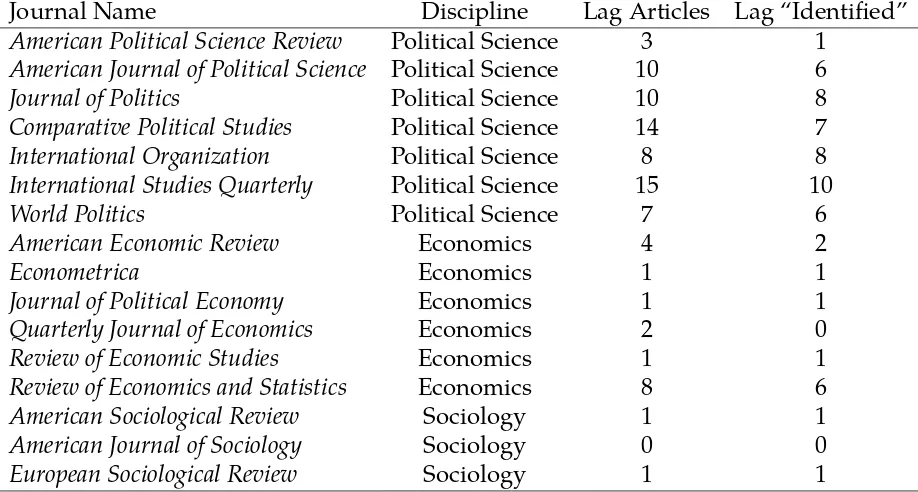
The resulting count of articles in Table 1 suggests that this practice is much more
com-mon in political science relative to economics or sociology. The low number for the
Ameri-can Political Science Reviewin 2014 is also not typical for that journal: we uncovered
twenty-three articles between 2010 and 2014. We also looked closely at the justifications that
Table 1: Journals Reviewed
Journal Name Discipline Lag Articles Lag “Identified”
American Political Science Review Political Science 3 1
American Journal of Political Science Political Science 10 6
Journal of Politics Political Science 10 8
Comparative Political Studies Political Science 14 7
International Organization Political Science 8 8
International Studies Quarterly Political Science 15 10
World Politics Political Science 7 6
American Economic Review Economics 4 2
Econometrica Economics 1 1
Journal of Political Economy Economics 1 1
Quarterly Journal of Economics Economics 2 0
Review of Economic Studies Economics 1 1
Review of Economics and Statistics Economics 8 6
American Sociological Review Sociology 1 1
American Journal of Sociology Sociology 0 0
European Sociological Review Sociology 1 1
Notes: Lag Articles is a raw count of the number of articles published in 2014 that employed a lagged explanatory variable. Lag“Identified” is the number of Lag Articles that either involved endogeneity as a justification for lagging an explanatory variable, or contained no justification at all for lagging an explanatory variable.
frequently invoked theoretical concerns, and rarely justified their lag choices on
endo-geneity grounds.2 However, articles in political science journals frequently invoked
“si-multaneity” or “reverse causality” explicitly as the sole motivation for lagging explanatory
variables.3 Somewhat more concerning, a substantial minority of articles that we identi-fied in this survey contained no justification whatsoever for their lag choice. We did
iden-tify a number of cases where authors employed lagged explanatory variables as part of an
2An example is Kellogg (2014:1710), who justifies a three-month lag between his main predictor of interest
(expected oil price volatility) and his outcome of interest (drilling an oil well) based on interviews with “industry participants” who suggested that this is how long it takes “between the decision to drill and the commencement of drilling.”
3Some examples are as follows: Baccini and Urpelainen (2014:205) write “Most of these variables are
error correction or distributed lag model, but these remain the minority of the articles that
we identified. As Table 1 shows, in 2014, across a range of journals, more than half of the
articles that employed lagged exogenous variables either explicitly invoked endogeneity,
or contained no justification at all.
This review of recent scholarship reveals that the practice of lagging explanatory
vari-ables for identification purposes remains common in the most influential and widely cited
political science journals. We now turn to closer examination of the conceptual problems
that this strategy creates.
2.1
Directed Acyclic Graphs
Following Pearl (2009), we begin with an intuitive discussion of the problem which
relies on directed acyclic graph (DAGs). The DAG in Figure 1 shows the fundamental
identification problem in observational data: the identification of the causal relationship
flowing fromXtoY is compromised by the presence of unobservable factorsUwhich are
correlated with bothX andY.
Figure 1: The Identification Problem
X Y
U
Notes: This is a representation of a causal relationship from X to Y where identification is compromised by unobservablesU.
Figure 2, wherein we add subscripts tto clarify temporal ordering, illustrates the lag
identification strategy that we study in this paper. Lag identification means replacingXt
with its lagged value,Xt−1in a regression ofXonY. The DAG representation in Figure 2
clarifies the logic behind this strategy. It must be the case that there is a causal pathway
fromXt−1 →Xt, or elseXt−1 could not be unrelated toY. However, the fact that there is
particular unobserved confounderUtthreatens causal identification.
But Figure 2 also shows that replacing Xt with Xt−1 merely moves the endogeneity
problem back one time period. It is true thatXt−1is unaffected byUt, but itisaffected by
Ut−1 for the same reason thatUt→ Xt. As a result, if there are any temporal dynamics in
the unobservables, then the causal pathwaysUt−1 → Ut → Yt andUt−1 → Xt−1 → Xt →
Yt prevent causal identification using Xt−1. The critical identification assumption in lag
identification, therefore, is that there are no temporal dynamics among the unobservables.
This assumption is not testable: doing so would require observingU, the unobservable
confounder that motivates laggingXon identification grounds.4
Figure 2: Lagged Independent Variable as a Solution?
Xt−1 Xt Yt
Ut−1 Ut
Notes: This is a representation of the causal relationship from X to Y that is implied when using a lagged value of X to overcome the identification problem in figure 1. The dashed line represents the causal relation among unobservables in timetandt−1that must be zero.
Our discussion thus far has focused on endogeneity in the form of unobserved
hetero-geneity. In many applications, however, lag identification is justified on “reverse causality”
grounds rather than unobserved heterogeneity grounds. The argument that temporal
or-dering prevents current realizations of the dependent variable from affecting past values
of a causal variable of interest appears more reasonable as a defense against simultaneous
or reverse causation. However, this perspective is misplaced. From a conceptual
stand-point, we can reformulate most cases of reverse or simultaneous causation as problems
of unobserved heterogeneity, in which a latent variable representing the “likelihood” or
“propensity” ofY is an unobserved confounder that causes bothY andX.
4There also might be cases whereU
t → Xt butUt−1 6→ Xt−1. This would be a case of “time-varying
Because this idea may not be intuitive, we illustrate this argument using two concrete
examples. Kelley and Simmons (forthcoming) study “the effect of monitoring and
rank-ing on state behavior” (8), argurank-ing that U.S. human rights reports shame countries into
criminalizing human trafficking. They model their dependent variableY (a dummy for
“whether countries criminalize human trafficking in their domestic legislation”) as a
func-tion of several key explanatory variables, including whether a country is named in the U.S.
annual Trafficking in Persons Report. They are explicitly concerned about reverse
causal-ity: “All explanatory and control variables are lagged to help address reverse causality and
selection issues” (8), and ask “Does the United States strategically shame countries that are
likely to criminalize anyway?” (9). This articulation of the inferential threat facing their
analysis is illuminating: the identification problem is not that criminalizing human
traf-ficking causes countries to be named in the Traftraf-ficking in Persons Report, which would
be a case of reverse causality. Rather, it is that strategic dynamics not captured in the
ob-servables determine both criminalization and being included in the report. In this case,
the unobservable confounder U can be understood as whatever unobserved propensity
to criminalize human trafficking is not captured in the explanatory or control variables,
but which also drives U.S. scrutiny of a country’s human trafficking problem.
Substan-tively, this may be something like activism and political pressure by D.C.-linked activists
in trafficking countries. The methodological point is that the inferential threats of “reverse
causality” can be expressed as threats from unobserved heterogeneity:Ut−1 →Shamingt−1
andUt−1 →Ut→Criminalizationt.
Warren (2014) offers another example. This article tests the hypothesis that “states
with high levels of media accessibility will be less likely to experience the onset of civil
war” (123). The independent variable of interest is a media density index.
Identifica-tion is a problem, however: “to guard against spurious results due to reverse causaIdentifica-tion,
all independent variables are lagged by one year” (126). In this case, it is theoretically
But a more general formulation of the inferential problem is that there is a latent,
unob-served probability of civil conflict that both leads to civil war onsets and that hampers
media development even when a civil war onset does not actually occur. In this case,U
is the latent probability of civil war, the past values of which affect past values of media
density as well as the current onset of civil war: P(Conflict)t−1 → MediaDensityt−1 and
P(Conflict)t−1 →P(Conflict)t→Conflictt.
We note that we are not conjuring these endogeneity problems ourselves. Instead, we
are articulating them on behalf of authors who have proposed statistical models that
ex-plicitly recognize that these challenges exist. Our point in highlighting them is to show
that it is easy to reformulate problems of reverse causality as problems of unobserved
het-erogeneity.5 For this reason, our formal analysis in the next section will represent
endo-geneity as unobserved heteroendo-geneity, which we can capture as an omitted variable.
Never-theless, it is useful to highlight that our argument will also travel to contexts with “pure”
reverse or simultaneous causation between X and Y. A classic example of this form of
simultaneous causation is Haavelmo’s (1943) treatment of the joint determination of
con-sumption and investment. This causal process is depicted in figure 3, which shows that if
YtcausesXt,Yt−1also causesXt−1.
Figure 3: Lagged Independent Variable with Pure Reverse Causality
Xt−1 Xt Yt
Yt−1
Notes: This is a representation of pure simultaneous causation with no unob-servables. The dashed line represents the causal relation among dependent variables in timetandt−1that must be zero.
The identification assumption is now that there are dynamics inXbut notY. IfYt−1 →
Xt−1 andYt−1 → Yt, then substitutingXt−1 forXtdoes not avoid the identification
prob-5See Pearl (2009:145-149) for a related argument on the observational equivalence of structural equation
lem. We will analyze a system of this sort in section 4.3.3 below.
3
Analytical Results
The DAGs in the preceding section are useful for clarifying the intuition behind lagged
independent variables, and also for demonstrating why they are unlikely to sidestep
prob-lems of endogeneity. To characterize precisely the inferential probprob-lems that arise from
lagged independent variables in the context of endogeneity, in this section we analyze
for-mally the consequences of lag identification in a bivariate OLS regression setup. Here,
assume that the OLS regression framework is the correct functional form for the
estima-tion of the causal effect of X on Y. If the correct functional form is unknown, then a
non-parametric approach such as those offered by Pearl or Rubin, as well as precise
as-sumptions about counterfactual outcomes, are necessary to define estimators that estimate
causal effects.
Consider the model
Yit =βXit+δUit+ǫit (1)
Xit =ρXit−1+κUit+ηit (2)
Uit =Wit+φWit−1+νit (3)
η
W
∼N
0
0
,
ση2 ση,W
ση,W σW2
(4)
where i and t index units and time, respectively; 0 ≤ ρ < 1; and ǫit ∼ N(0, σ2ǫ), ηit ∼
N(0, ση2). Droppingifor the remainder of this section (it will reappear in the next section),
it is well known that if we estimate
then the resulting estimate ofβ is biased because the unobserved confounderU is
omit-ted.6 The magnitude of the bias is a function of the variances and covariances ofX andU
as well as magnitude of the causal effect of the unobserved confounder:
E[ˆbXt] =β+δ·
Cov(X, U)
V(X) (6)
If eitherδorCov(X, U) = 0—ifU has no effect onY, or ifU is uncorrelated withX—then
endogeneity is not a problem, andE[ˆbXt] =β.
7
The system of equations in (1 – 4) allows for two distinct channels that can produce
endogeneity. The first channel is the straightforward case ofU → X, in which the
unob-servable confounder has a causal relationship with the endogenous variable. The size of
that causal effect ofU onX is the parameterκ. But we also allow for a second source of
endogeneity that capturesany other reason whyXandUmight be correlated. That is the
corre-lation parameterση,W in (4). This term will capture, for example, a still more deeper set of
causal relations where another unobserved confounder causes bothXandU. We include
the term ση,W to emphasize that our derivation captures any such form of endogeneity
betweenXandU.
Now consider a regression that replaces X with Xt−1, but which otherwise remains
subject to the same endogeneity problems as in (1).8 This means estimating the following
equation:
Yt=bXt−1+et (7)
While this is plainly not an unbiased estimate ofβ,9one hope is that lag identification will 6We use Greek letters for population coefficients and Latin letters for sample coefficients.
7Based on the DGPs in Equations 1-3, one can also deriveCov(X, U). The derivation is presented in
Appendix 1.
8For purposes of clarity we do not consider here more complicated models that condition on past values
ofY. We will show in our simulation analysis and in the conclusion that lagging the dependent variable in addition to the endogenous explanatory variable does not avoid endogeneity problems either.
9Indeed, even when equation (2) is such thatX
estimate a function of β and the autocorrelation in X, orρ—a moderated, or
“conserva-tive,” estimate of β. Indeed, by expressions (1 – 4), lag identification implies estimating
the following population parameter:
Yt=β(ρXt−1+κUt+ηt) +δUt+ǫt (8)
=βρXt−1+βκUt+βηt+δUt+ǫt (9)
This immediately makes clear why lag identification fails, for the error termetin (7) now
contains(βκ+δ)Ut+βηt+ǫt. Therefore,ˆbXt−1 from (7) is not a consistent estimate of either
βor the conservativeβρ. To see why, recall thatˆbXt−1 =
Cov(Xt−1,Yt)
V(Xt−1) . We may write
plimn→∞ˆbXt−1 =βρ+
Cov(Xt−1,(βκ+δ)Ut+βηt+ǫt)
V(Xt−1)
(10)
=βρ+ Cov(ρXt−2+κUt−1+ηt−1,(βκ+δ)Ut+βηt+ǫt)
V(Xt−1)
(11)
=
βρ+ ρ(βκ+δ)Cov(Xt−2, Ut) +ρβCov(Xt−2, ηt) +ρCov(Xt−2, ǫt) V(Xt−1)
+κ(βκ+δ)Cov(Ut−1, Ut) +κβCov(Ut−1, ηt) +κCov(Ut−1, ǫt)
V(Xt−1)
+(βκ+δ)Cov(ηt−1, Ut) +βCov(ηt−1, ηt) + Cov(ηt−1, ǫt)
V(Xt−1)
(12)
We know that by design, given expressions (1 – 4), that Cov(Ut−1, Ut) = φσW2 and
Cov(ηt−1, Ut) = φσW,η with all the other covariances set at zero. Thus, equation (12)
re-duces to
plimn→∞ˆbXt−1 =βρ+
φ(βκ+δ)(κσ2W +ση,W) V(Xt−1)
(13)
Contrasting lag identification bias in (13) with the standard result for omitted variable
bias in (6) usefully highlights the troublesome properties of lagged independent variables
from a causal identification perspective. Asση,W,κ, andδgrow larger,ˆbXt−1 grows larger
as well. And critically, in the cases where (7) doesnotyield a biased estimate ofβ, (13) does.
Those are the cases whereδ = 0 butφ 6= 0 (or there exists dynamics in the unobservable
variable Ut). More substantively, lagging Xt and using it as a regressor can open up a
“backward channel” throughUt−1 →Xt−1 andUt−1 →Ut →Yt.
In fact, expression (13) confirms thateither oneof the following conditions should hold
for lag identification to produce a consistent estimate of βρ (which is a “conservative”
estimate of the effect ofX onY, attenuated byρ).
1. No serial autocorrelation inU (φ= 0), i.e., no dynamics among unobservables.
2. There is no endogeneity of any type, which means thatκ =ση,W = 0.
The former condition is precisely the condition identified in Section 2.1 above. In that case,
the second term reduces to zero, andˆbXt−1 =βρ.
4
Monte Carlo Analysis
We have argued so far that when researchers believe that endogeneity threatens their
ability to estimate causal effects, lagging independent variables does not alleviate these
concerns, it simply moves the identification assumption to a different point in the
data-generating process. We have also characterized analytically the magnitude of the bias
in a lagged independent variables framework in a simple OLS regression setup. In this
section, we use Monte Carlo experiments to demonstrate the consequences of using lagged
independent variables in empirical research.
4.1
Setup
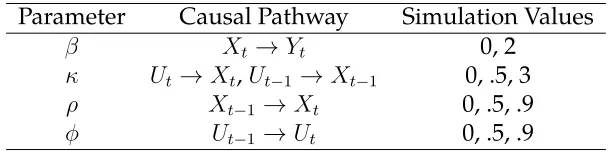
Our task is to estimateβ, the causal effect of X onY. Figure 4 is an extension of our
Figure 4: Monte Carlo Simulations
Xt−1 Xt Yt
Ut−1 Ut
et−1 et
vt
vt−1
ǫt
F E
ρ β
κ κ
φ
Notes: This is a schematic representation of our Monte Carlo simulations, with Greek letters representing the parameters that we vary in our simu-lations. X is the causal variable of interest, represented here as a function of a random variable e and its own past value as well as unit fixed effects
F E. U is an unbserved source of endogeneity, and is itself a function of a random variablevand its own past value. Y is the dependent variable, and is a function of observedX, unobservedU, fixed effects F E, and a random error termǫ. β is the causal parameter to be estimated,κmeasures the size of the endogeneity problem, andρandφcapture dynamics inX andU, re-spectively.
of endogeneity bias is the unobserved confounderU, which is correlated with bothXand
Y. In all simulations, we set the direct effect ofU on Y (which we called δ above) equal
to 1, and explore the consequences of endogeneity bias by varyingκ, the causal pathway
that makesXendogenous toY by forcingCov(X, U)6= 0. The remaining two parameters
are the autocorrelation parametersρandφ, which capture serial correlation inX and U,
respectively. When either of the autocorrelation parameters is zero, then the value of each
variable is statistically independent of its own lag. These are the four parameters that we
vary across simulations; a summary appears in Table 2.
Table 2: Simulation Parameters
Parameter Causal Pathway Simulation Values
β Xt →Yt 0, 2
κ Ut→Xt,Ut−1 →Xt−1 0, .5, 3
ρ Xt−1 →Xt 0, .5, .9
[image:16.612.153.458.640.716.2]For each simulation, we generate a panel withN = 100units andT = 50periods, for
a total of 5,000 unit-period observations. To replicate a standard panel data problem, we
also include time-invariant unit fixed effects F Ei, which we do not observe, and which
affect bothY andX. Altogether, then, we simulate the following system of equations.10
Yit =βXit+ 1·Uit+ 1·F Ei+ǫit (14)
Xit =ρXit−1+κUit+ 1·F Ei+eit (15)
Uit =φUit−1+vit (16)
where
F Ei
ǫit
eit
vit
∼N
0
0
0
0
,
5 0 0 0
0 5 0 0
0 0 1 0
0 0 0 1
(17)
We replicate each combination of parameter values in Table 2 a total of 100 times, and then
test the performance of three estimators in estimatingβ: (i) the “na¨ıve” estimator that
re-gresses Y on X and ignores endogeneity, (ii) the “lag explanatory variables” estimator
that regresses Y onXt−1 in an attempt to avoid endogeneity problems, and (iii) a “true”
estimator that conditions on the unobservable U.11 The “true” estimator is, of course, counterfactual: we presume that the researcher does not observeU, else she would
con-dition on it. The estimates obtained from a regression model that correctly follows the
data generating process, however, will serve as our empirical benchmark against which to
10We set the variance ofF Eandǫat 5 in order to allow for a realistic amount of model uncertainty. Most
estimates from our simulations have an overallR2between 0.05 and 0.1, which is comparable toR2measures
in much applied work. Note also that the covariance matrix in (17) reflects an assumption thatση,W = 0,
so the only form of endogeneity that we model in our simulations is whereU →X. Our results, of course, generalize to other forms of endogeneity reflected in (4) as well.
11Each estimator is a fixed effects regression, which is necessary given our data generating process. We
gauge the performance of the other two estimators.
We emphasize that our causal model has many moving parts, but is still simple in terms
of the dynamics that it allows. Among many other simplifications, we assume that there
are no dynamic causal relationships among unobservables and observables. For example,
lagged omitted variablesUare not direct causes of current values ofY—they only affectY
through the pathwayUt−1 →Ut→Yt. Moreover, there are no complex temporal dynamics
inXorU, just simple one-period autocorrelation, and the fixed effectsF Eare independent
ofU. We view this relatively straightforward setup as a conservative way to show just how
difficult it is to justify lagged independent variables as sources of exogeneity in even the
most favorable cases.
We evaluate the consequences of lag identification according to three criteria: (i) bias,
(ii) root mean squared error (RMSE), and (iii) the likelihood of Type 1 or Type 2 error. The
last of these is perhaps the most important from the perspective of applied researchers, as
it tells us the extent to which researchers will make faulty inferences—rejecting true null
hypotheses thatβ = 0, or failing to reject the null hypothesis when the trueβ >0—when
using lagged independent variables to sidestep problems of endogeneity.
4.2
Results
We begin by comparing bias across the three estimators. For each combination of
pa-rameter values, we save the estimated papa-rameterβˆfrom each of the 100 simulations, and
the plot the distribution of estimates along with the true value ofβ from the data
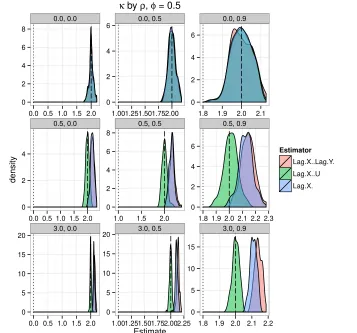
gener-ating process. Figure 5 summarizes our main results for the case where the true causal
effectβ is equal to 2 and the autocorrelation in the unobservablesφ is set equal to 0, and
Figure 6 shows there results whenφ= 0.5.12
The results from these simulations are clear. For any value of φ, and regardless of
12Our results are comparable whenφ = 0.9, but we do not report them here to save space. They are
Figure 5: Bias in Lag Explanatory Variable Regressions,φ= 0
0.0, 0.0 0.0, 0.5 0.0, 0.9
0.5, 0.0 0.5, 0.5 0.5, 0.9
3.0, 0.0 3.0, 0.5 3.0, 0.9 0
2 4
0 2 4 6
0 2 4 6
0 2 4 6
0 2 4 6
0 2 4 6 8
0 5 10 15
0 5 10 15
0 5 10 15
0.0 0.5 1.0 1.5 2.0 0.5 1.0 1.5 2.0 0.8 1.2 1.6 2.0
0 1 2 0.5 1.0 1.5 2.0 2.5 1.0 1.5 2.0
0.0 0.5 1.0 1.5 2.0 0.0 0.5 1.0 1.5 2.0 0.0 0.5 1.0 1.5 2.0
Estimate
density
Estimator
X
X.U
Lag.X. κ by ρ, φ = 0
Notes: This figure plots the empirical density of estimated coefficientsβˆfrom 100 simulations of the data generating process in Figure 4. The dashed line corresponds to the true value ofβ = 2. The dotted line isβ×ρ.
whether the data generating process makesX endogenous toY, lagged explanatory
vari-able estimates are biased towards zero. This result is intuitive:Xt−1is a proxy forXtwhich
measures the latter with error, producing attenuation bias inβeven without endogeneity.
Moreover, and as expected, when there is no endogeneity (i.e.,κ= 0), then regressingYt
onXtsuffices to identifyβ. However, whenκ >0, we find that neither the “na¨ıve” nor the
“lag explanatory variable” estimator identifiesβ. The amount of bias in both is a function
ofρ: the higher the correlation betweenXtandXt−1, the less the bias.
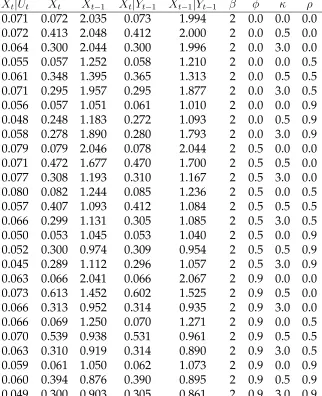
In Table 3 we calculate the root mean squared error (RMSE) of each estimator for each
Figure 6: Bias in Lag Explanatory Variable Regressions,φ=.50
0.0, 0.0 0.0, 0.5 0.0, 0.9
0.5, 0.0 0.5, 0.5 0.5, 0.9
3.0, 0.0 3.0, 0.5 3.0, 0.9 0
2 4
0 2 4
0 2 4 6 8
0 2 4 6
0 2 4 6
0 2 4 6 8
0 5 10 15 20
0 5 10 15
0 5 10 15
0.0 0.5 1.0 1.5 2.0 0.5 1.0 1.5 2.0 0.8 1.2 1.6 2.0
0 1 2 1.0 1.5 2.0 2.5 1.2 1.6 2.0 2.4
0.0 0.5 1.0 1.5 2.0 1.0 1.5 2.0 0.8 1.2 1.6 2.0 2.4
Estimate
density
Estimator
X
X.U
Lag.X. κ by ρ, φ = 0.5
Notes: This figure plots the empirical density of estimated coefficientsβˆfrom 100 simulations of the data generating process in Figure 4. The dashed line corresponds to the true value ofβ = 2. The dotted line isβ×ρ.
onYt−1 in an attempt to account for dynamics.
The results show that the RMSE of the lag explanatory variable estimator is far larger
than that of the na¨ıve estimator, which in turn is much larger than the estimator that
con-ditions onU. The same is true even when conditioning on lagged values ofY. The only
exceptions are purely incidental: when the true value ofβ = 0(not reported in Table 3),
there are a small number of parameter combinations in which the lower variance of the
lag explanatory variable estimator yields a lower RMSE than that of the estimator that
conditions onU. Purely on RMSE grounds, our results indicate that the lag explanatory
Table 3: Root Mean Squared Error
Xt|Ut Xt Xt−1 Xt|Yt−1 Xt−1|Yt−1 β φ κ ρ
0.071 0.072 2.035 0.073 1.994 2 0.0 0.0 0.0 0.072 0.413 2.048 0.412 2.000 2 0.0 0.5 0.0 0.064 0.300 2.044 0.300 1.996 2 0.0 3.0 0.0 0.055 0.057 1.252 0.058 1.210 2 0.0 0.0 0.5 0.061 0.348 1.395 0.365 1.313 2 0.0 0.5 0.5 0.071 0.295 1.957 0.295 1.877 2 0.0 3.0 0.5 0.056 0.057 1.051 0.061 1.010 2 0.0 0.0 0.9 0.048 0.248 1.183 0.272 1.093 2 0.0 0.5 0.9 0.058 0.278 1.890 0.280 1.793 2 0.0 3.0 0.9 0.079 0.079 2.046 0.078 2.044 2 0.5 0.0 0.0 0.071 0.472 1.677 0.470 1.700 2 0.5 0.5 0.0 0.077 0.308 1.193 0.310 1.167 2 0.5 3.0 0.0 0.080 0.082 1.244 0.085 1.236 2 0.5 0.0 0.5 0.057 0.407 1.093 0.412 1.084 2 0.5 0.5 0.5 0.066 0.299 1.131 0.305 1.085 2 0.5 3.0 0.5 0.050 0.053 1.045 0.053 1.040 2 0.5 0.0 0.9 0.052 0.300 0.974 0.309 0.954 2 0.5 0.5 0.9 0.045 0.289 1.112 0.296 1.057 2 0.5 3.0 0.9 0.063 0.066 2.041 0.066 2.067 2 0.9 0.0 0.0 0.073 0.613 1.452 0.602 1.525 2 0.9 0.5 0.0 0.066 0.313 0.952 0.314 0.935 2 0.9 3.0 0.0 0.066 0.069 1.250 0.070 1.271 2 0.9 0.0 0.5 0.070 0.539 0.938 0.531 0.961 2 0.9 0.5 0.5 0.063 0.310 0.919 0.314 0.890 2 0.9 3.0 0.5 0.059 0.061 1.050 0.062 1.073 2 0.9 0.0 0.9 0.060 0.394 0.876 0.390 0.895 2 0.9 0.5 0.9 0.049 0.300 0.903 0.305 0.861 2 0.9 3.0 0.9
endogeneity entirely.
Of course, the finding that an incorrect regression specification generates biased
pa-rameter estimates is not surprising. In fact, for most applied researchers, attenuation bias
does not matter because—all too commonly, in our view—the size of the estimate ofβ is
not of direct interest, but rather itsp-value. That is, scholars are less interested in whether
their estimateβˆ= 2orβˆ= 0.02, but whether the associatedp-value from theirt-test leads
them to reject the null thatβ = 0at some level of significance, which supports the
the lag explanatory variable estimator is one of its strengths relative to the na¨ıve estimator
that ignores endogeneity altogether because attenuation bias leads to more conservative
hypothesis tests, although our discussion in the previous section should dispel that
no-tion. We think that the overwhelming focus placed on statistical significance in applied
work is a major problem, but this is nonetheless an accurate description of current
prac-tice. And so we ask what would happen if an applied researcher were to use a lagged
independent variable in the standard fashion to test the hypothesis thatXcausesY when
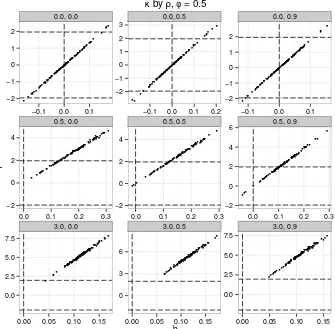
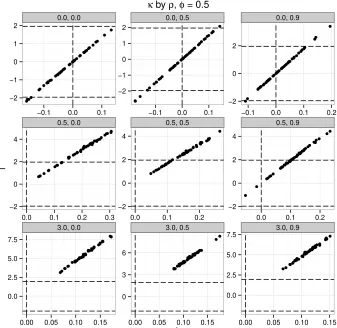
the trueβ = 0. In Figure (7), we plot the estimates ofβagainst theirt-statistics for models
whereφ = 0.5.
These results are troubling, yet consistent with the analytical results previously
de-scribed. When there is no endogeneity problem (κ = 0, as in the top three panels) then
Type 1 error is rare, corresponding to just about 95% of models when the level of
statisti-cal significance isα=.05. But the likelihood of Type 1 error increases dramatically when
κ >0, as in the bottom six panels. The reason for this is apparent in expression (13), which
shows thatˆbXt−1 is a function of the causal effect of the unobserved confounder U, δ, as
well asCov(X, U). Unless both are exactly zero, lag identification will produce non-zero
estimates ofβeven whenβ = 0.
Substantively, this means that lagging independent variables in response to concerns
about endogeneity will lead analysts working within the mainstream approach to
hypoth-esis testing to reject null hypotheses that are true, and to find too many estimates of causal
effects that are spurious. As suggested in the formal analysis, the direction of the error
depends on the correlations between X and U and Y and U. When both are positive,
lag explanatory variable models estimateβ >ˆ 0; when both are negative, lag explanatory
variable models estimate β <ˆ 0; and when one is positive and the other is negative the
sign of theβˆdepends on their relative absolute size.13 When φ = .9 (not reported),
in-13In such cases there is a range of parameter values in which lag explanatory variable models do not
Figure 7: Type I Error in Lag Explanatory Variable Regressions,φ= 0.5 ● ● ● ● ● ● ● ● ● ● ● ● ● ● ●● ●●● ●● ● ●● ● ● ● ● ● ● ● ● ● ● ● ● ●● ● ● ● ● ● ●● ● ● ● ● ●● ● ● ● ● ● ● ● ● ● ● ●● ●● ● ● ● ● ● ● ● ● ● ● ● ● ● ● ● ● ● ● ● ● ● ● ●● ● ● ● ● ● ● ● ● ● ● ● ● ● ● ● ● ● ● ● ● ● ● ● ● ● ● ● ● ● ● ● ● ● ● ● ● ● ● ● ● ● ● ● ● ● ● ● ● ● ● ● ● ● ● ● ● ● ● ● ● ● ● ● ● ● ● ● ● ●● ● ● ● ● ● ● ● ● ● ● ● ● ● ●● ● ● ● ● ● ● ● ● ● ● ● ● ● ● ● ● ● ● ● ● ● ● ● ● ● ● ● ●● ● ● ● ● ● ●● ● ● ● ● ●● ● ● ● ● ● ● ● ● ● ● ● ● ● ●● ● ● ● ● ● ● ● ● ● ● ● ● ●● ● ● ● ● ● ●● ● ● ● ● ●● ● ● ● ● ● ● ● ● ● ● ● ● ● ● ●● ● ● ●● ● ● ● ● ● ● ● ● ● ● ● ● ● ● ● ● ● ● ● ● ● ● ●● ● ● ● ● ● ● ●● ● ● ● ● ● ● ● ● ● ● ● ● ● ● ● ● ●● ● ● ●● ●● ●● ● ● ● ● ● ● ● ● ● ● ● ● ● ● ● ●● ● ● ●● ● ● ● ● ● ● ● ● ● ● ● ● ● ● ●● ● ● ●● ● ● ● ● ●● ● ● ● ● ● ● ● ● ● ● ● ● ● ● ● ● ● ● ● ●● ● ● ● ● ● ● ● ● ● ● ● ● ● ● ● ● ● ● ● ● ● ● ● ●● ●● ●● ● ● ● ● ●● ● ● ● ● ● ● ● ● ● ● ● ●● ● ● ● ● ● ● ● ● ● ● ● ● ● ● ● ● ● ● ● ● ● ● ● ● ● ● ● ● ● ● ● ● ● ● ● ● ● ● ● ● ● ● ● ●● ● ●● ● ● ● ● ● ● ● ● ● ● ● ● ●●● ● ● ● ● ● ● ● ● ● ● ● ● ● ● ● ● ● ● ● ● ● ● ●● ●● ● ● ● ● ● ● ● ● ● ● ● ● ● ● ● ● ● ● ● ● ● ● ● ● ● ● ● ●● ● ● ● ● ● ● ● ● ● ● ● ● ● ● ● ● ● ● ● ● ● ● ● ●● ● ● ● ● ● ● ● ● ● ●● ● ● ● ● ●● ● ●● ● ● ●●● ● ● ● ● ● ● ● ● ● ● ●● ● ● ● ● ● ● ● ● ● ●● ● ● ● ● ● ● ● ● ●● ● ● ● ● ●● ● ● ●● ●● ● ● ● ● ● ● ● ● ● ● ● ● ● ● ● ● ● ●● ● ● ● ● ● ●● ● ●●● ● ● ● ● ● ●● ● ● ●● ● ● ● ● ● ● ● ● ● ● ● ● ● ● ● ● ● ● ● ● ● ● ● ●● ●● ● ●● ● ●● ● ● ● ● ● ● ● ● ● ● ● ● ●●● ● ●● ●● ● ●● ● ● ● ● ● ●●● ● ● ● ● ● ●● ● ● ● ●● ● ● ● ● ● ● ● ●● ● ● ● ● ● ● ● ● ● ● ● ● ●● ● ● ● ●● ● ● ● ● ● ●● ● ● ● ● ● ● ● ●● ● ● ● ●● ● ● ● ● ● ● ● ● ●● ● ● ●● ●● ● ● ● ● ● ● ● ● ● ● ● ● ●● ● ● ● ● ● ● ● ● ● ● ● ● ● ● ● ● ● ● ● ● ●● ● ● ● ● ● ● ● ● ●● ● ● ● ● ● ● ●
0.0, 0.0 0.0, 0.5 0.0, 0.9
0.5, 0.0 0.5, 0.5 0.5, 0.9
3.0, 0.0 3.0, 0.5 3.0, 0.9
−2 −1 0 1 2 −2 −1 0 1 2 3 −2 −1 0 1 2 −2 0 2 4 −2 0 2 4 −2 0 2 4 6 0.0 2.5 5.0 7.5 0 3 6 0.0 2.5 5.0 7.5
−0.1 0.0 0.1 −0.1 0.0 0.1 0.2 −0.1 0.0 0.1
0.0 0.1 0.2 0.3 0.0 0.1 0.2 0.3 0.0 0.1 0.2 0.3
0.00 0.05 0.10 0.15 0.00 0.05 0.10 0.15 0.00 0.05 0.10 0.15
b
T
κ by ρ, φ = 0.5
Notes: This figure compares estimated coefficientsβˆand t-statistics from 100 simulations of the data generating process in Figure 4. The vertical dotted line corresponds to the true value ofβ = 0, and the horizontal dotted lines denote the 95% confidence region from -1.96 to +1.96.
dicating even stronger autocorrelation among the unobservables U, Type 1 error (given
our parameters) is almost certain with any degree of endogeneity and regardless of the
autocorrelation inX.
The summary message from these Monte Carlo simulations is unambiguous. Under
favorable conditions, lagging independent variables generates estimates that are more
bi-ased, and with higher RMSE, than simply ignoring endogeneity altogether. Worst of all,
such estimates are more likely to produce Type 1 error when endogeneity actually does
worry-ing implication of this last result is that lagged independent variables may be a popular
identification strategy under conditions of endogeneity precisely because they generate
statistically significant results.
4.3
Extensions
In this section we entertain several potential objections to our simulation results,
fo-cusing on temporal sequencing of causal effects, dynamic panel data estimators, and pure
cases of simultaneous causality.
4.3.1 Lagged Causal Effects
One criticism of our baseline results is that they do not realistically reflect the kinds of
data generating processes that scholars mean to capture using lag identification to avoid
endogeneity problems. If theory suggests that causal effects operate with a one-period
time lag, for example, then lag identification is not just a way to avoid endogeneity, it is
also the natural way to estimate the correct causal parameterβ. Such an objection might
suggest that the disturbing results in the previous subsection are simply a consequence
of proposing a different data generating process than the one that might justify the lag
identification strategy.
Attuned to such concerns, in Figure 8 we propose a different causal model for Monte
Carlo analysis. Here, as before X is endogenous to Y through U, but the causal effect
of interest β is the one-period lagged effect of X on Y. We therefore assume that the
causal effect operates with a one-period lag, that the empirical specification is designed to
estimate that quantity, and also that the contempaneous casual effect ofXtonYtis exactly
zero. This reflects perhaps the most favorable case for lag identification, one in which
causal effects operate over time and in which there is no direct causal pathway that runs
from the unobserved source ofUtto the causal variableXt−1.
Figure 8: Monte Carlo Simulations: Xt−1 as the Causal Variable
Xt−1 Xt Yt
Ut−1 Ut
et−1 et
vt
vt−1
ǫt
F E
ρ
β
κ κ
φ
Notes: This is a schematic representation of our Monte Carlo simulations whereXt−1is the true causal variable (the causal effect ofXtis, by
assump-tion, 0). It is otherwise identical to Figure 4.
extended version of the lag explanatory variable estimator that also conditions on Yt−1
in an attempt to capture temporal dynamics in the unobservables, and the “true” model
that conditions onUt, once again as an empirical benchmark against which to judge the
others. Our results show that even under the favorable assumption thatXt−1is the causal
variable of interest, lagged independent variables do not alleviate endogeneity bias. As
above, when there is no endogeneity (κ= 0), then the three models are equivalent. When
κ > 0, however, lagging independent variables generates biased estimates of β whose
variance narrows as endogeneity grows larger. The results in Figure 9 also highlight that
when Xt−1 is the true causal variable, lag identification is not even “conservative,” for
estimates arefurther awayfrom zero thanβ.
We also find similar results for Type 1 error, which appear in Figure 10. As before,
these results indicate that with any amount of endogeneity,t-statistics associated with the ˆ
β from a lagged explanatory variable estimate are likely to lead applied researchers to
reject the null thatβ = 0when the null is true. The implication of this analysis is that even
if a strong theory dictates that the causal process linking X to Y operates with exactly
and exclusively a one-period lag, lagged independent variables do not avoid problems of
Figure 9: Bias in Lag Explanatory Variable Regressions,φ >0,Xt−1is the Causal Variable
0.0, 0.0 0.0, 0.5 0.0, 0.9
0.5, 0.0 0.5, 0.5 0.5, 0.9
3.0, 0.0 3.0, 0.5 3.0, 0.9 0
2 4 6 8
0 2 4 6
0 2 4 6
0 2 4
0 2 4 6 8
0 2 4 6
0 5 10 15 20
0 5 10 15 20
0 5 10 15
0.0 0.5 1.0 1.5 2.0 1.001.251.501.752.00 1.8 1.9 2.0 2.1
0.0 0.5 1.0 1.5 2.0 1.0 1.5 2.0 1.8 1.9 2.0 2.1 2.2 2.3
0.0 0.5 1.0 1.5 2.0 1.001.251.501.752.002.25 1.8 1.9 2.0 2.1 2.2
Estimate
density
Estimator
Lag.X..Lag.Y.
Lag.X..U
Lag.X. κ by ρ, φ = 0.5
Notes: This figure plots the empirical density of estimated coefficientsβˆfrom 100 simulations of the data generating process in Figure 8. The dashed line corresponds to the true value ofβ = 2. The dotted line isβ×ρ.
4.3.2 GMM Estimation
Another possible interpretation of our results is that standard panel data techniques
are inappropriate for the dynamic causal processes that we have proposed. Specifically,
when we includeYt−1 as a regressor in an attempt to account for the dynamics inU, we
generate biased estimates of the coefficient onYt−1 that might in turn bias our estimates
ofβ, at least in finite samples. See Nickell (1981) for a fuller treatment.
We explore whether standard dynamic panel data models (Arellano and Bond 1991,
Figure 10: Type I Error in Lag Explanatory Variable Regressions, φ = 0.5, Xt−1 is the Causal Variable ● ● ● ● ● ● ● ● ● ● ● ● ● ● ●● ● ● ● ● ● ● ● ● ● ● ● ● ● ● ● ● ● ● ● ● ● ● ● ● ● ● ● ● ● ● ● ● ● ● ●● ● ● ● ● ● ●● ● ● ● ● ● ● ● ● ● ● ● ● ● ● ● ● ● ● ● ● ● ● ● ● ● ●● ● ● ● ● ● ● ● ●● ● ● ● ● ● ● ● ● ● ● ● ● ● ● ● ● ● ● ● ● ●● ● ● ● ● ● ● ● ● ● ● ● ● ● ● ● ● ● ● ● ● ● ● ● ● ● ● ● ● ● ● ●● ● ● ● ● ● ● ● ● ● ● ● ● ● ● ● ● ● ●●● ● ● ● ● ●● ● ● ● ● ● ●● ● ● ● ● ● ● ● ● ● ●● ● ● ● ● ● ● ● ●●● ● ● ● ● ● ● ● ● ● ● ● ● ● ● ● ● ● ● ● ● ● ● ● ●●● ● ● ● ● ● ● ● ● ● ● ●● ● ●● ● ● ●● ● ● ● ● ● ● ●● ● ● ● ● ●● ● ● ●● ● ● ● ● ● ● ●● ●● ●● ● ● ●● ● ● ● ● ● ● ● ● ● ● ● ● ● ● ●● ● ● ● ● ● ● ● ● ● ● ● ● ● ●● ● ●●● ● ● ● ● ● ● ● ●● ● ● ● ● ● ● ● ● ● ● ● ● ● ● ● ● ● ●●● ● ● ● ● ●● ●●● ● ● ● ●●●● ● ● ● ● ●● ● ● ●● ● ● ●● ● ● ● ● ● ● ●● ● ● ● ● ● ●● ● ●● ● ● ● ● ● ● ● ● ● ● ● ● ● ● ● ●● ● ● ● ● ● ● ●● ● ● ● ● ● ● ● ● ● ● ●● ● ● ● ● ● ●● ● ● ● ● ● ● ● ● ● ● ● ●
0.0, 0.0 0.0, 0.5 0.0, 0.9
0.5, 0.0 0.5, 0.5 0.5, 0.9
3.0, 0.0 3.0, 0.5 3.0, 0.9
−2 −1 0 1 2 −2 −1 0 1 2 −2 0 2 −2 0 2 4 −2 0 2 4 −2 0 2 4 0.0 2.5 5.0 7.5 0 3 6 0.0 2.5 5.0 7.5
−0.1 0.0 0.1 −0.1 0.0 0.1 −0.1 0.0 0.1 0.2
0.0 0.1 0.2 0.3 0.0 0.1 0.2 0.0 0.1 0.2
0.00 0.05 0.10 0.15 0.00 0.05 0.10 0.15 0.00 0.05 0.10 0.15
b
T
κ by ρ, φ = 0.5
Notes: This figure compares estimated coefficientsβˆandt-statistics from 100 simulations of the data generating process in Figure 8. The vertical dotted line corresponds to the true value ofβ = 0, and the horizontal dotted lines denote the 95% confidence region from -1.96 to +1.96.
as instruments forX, Xt−t, and Yt−1, yield better results.14 The results of these analyses
are available upon request, but the summary finding is straightforward: GMM estimation
does a better job of recovering the causal effect of Xt−1 on Y when the data generating
process follows Figure 8 than does a simple lag explanatory variable strategy, but results
remain biased away from zero and Type 1 errors remain very likely. Relative to the “true”
14We estimate these models using thepgmmestimator implemented in theplmlibrary in R. We estimate two
families of models, using the second and third lags ofXandY as instruments in the full panel ofT = 50, and using all available lags ofX and Y as instruments in a short panel of T = 10. We also vary the lag structure, estimating models in which we condition onXt−1only as well as models where we condition on
estimates obtained by conditioning on the confounder U, moreover, GMM estimates are
much less efficient.
4.3.3 True Simultaneous Causality
Our final extension returns to the problem of simultaneous causality. Above, we
ar-gued that most instances of simultaneous or reverse causality can be reformulated in terms
of an unobserved confounderU. Here, we entertain the possibility that true simultaneous
causality has different implications for the estimation of causal effects.
Specifically, we consider the causal model in Figure 11, which is an extension of
Haavel-mo’s (1943) classic treatment of simultaneous equations and the problem of causal
infer-ence (see also Pearl forthcoming). We incorporate into this model both unit-of-observation
fixed effects and a (possible) instrument forX, denotedZ. Endogeneity in Figure 11 is not
Figure 11: Monte Carlo Simulations: Pure Reverse Causality
Xt Yt
ǫ2t ǫ1t
Zt
F E
β
α γ
Notes: This is a schematic representation of our Monte Carlo simulations whereX and Y are truly “simultaneous” equations. Z serves as an instru-ment for X whenever γ > 0. ǫ2t follows an autoregressive process in our simulations: ǫ2t=φǫ2t−1+η.
a function of unobserved confounders, but rather of a simultaneous causal relationship
equations to represent this causal structure:
Yit =βXit+δYF Ei+ǫ1it (18)
Xit =αYit+δXF Ei+γZit+ǫ2it (19)
ǫ2it =φǫ2it−1+ηit (20)
where
F Ei
ǫ1it
ǫ2it
ηit
∼N
0
0
0
0
,
5 0 0 0
0 5 0 0
0 0 1 0
0 0 0 1
(21)
We introduce dynamics inX into the system by allowing for autocorrelation inǫ2, as in
(20). Ifφ= 0, meaning there is no autocorrelation inǫ2, thenXtandXt−1are also
uncorre-lated. We note here that by substituting equations (18) and (20) into (19), we can express
Xsolely in terms of model parameters and errors:
Xit =
αδYF Ei+αǫ1it+δXF Ei+ηit+φǫ2t−1
1−αβ (22)
This expression reveals the magnitude of endogeneity bias when regressingYtonXt.
Because there are no unobserved variables in the data generating process represented
in Figure 11, there is no identification strategy available—even theoretically—that involves
conditioning on an unobservable, as there was in our prior simulations. Identification
requires an instrumental variable Z. Throughout this subsection, we maintain the
as-sumption in Figure 11 thatZ is avalid instrument forX, and vary only therelevance (or
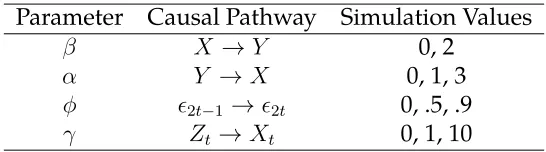
parameters for this final set of simulations are summarized in Table 4:
Table 4: Simulation Parameters: Simultaneous Causality
Parameter Causal Pathway Simulation Values
β X →Y 0, 2
α Y →X 0, 1, 3
φ ǫ2t−1 →ǫ2t 0, .5, .9
γ Zt→Xt 0, 1, 10
Our main results appear in Figure 12. Relative to other figures, these results are slightly
more difficult to interpret. Whenγ = 0, meaning that the instrumental variableZis
unre-lated toX, instrumental variables regression is completely uninformative, as reflected in
the essentially flat density plot. Whenγ > 0, instrumental variables uncover the proper
estimate ofβ, and the largerγis, the better the instrumental variables estimator performs
(recall that the largerγis relative to its standard error, the strongerZ is as an instrument;
see Bound et al. 1995). And regardless of the value ofγ, the lag explanatory variable
esti-mator always returns an estimate ofβthat is biased towards zero whenβ = 2.15 The size of
this lag explanatory variable estimator bias is increasing inα, the degree of endogeneity.
We conclude by studying Type 1 and Type 2 error for the pure simultaneous causality
case. First consider the case whereβ = 0. We discover in Figure 13 that lag explanatory
variable estimators are more likely to generate statistically significant negative estimates
ofβwhen the data generating process is characterized by true simultaneous causation as
in Figure 11 and where there is any degree of endogeneity (α > 0). However, additional
complications arise whereβ = 2. Figure 14 reveals that here, Type 1 error—failing to reject
a null thatβ = 0when the null is actually false—is common when there is any amount of
endogeneity.
The results of this analysis once again demonstrate the pitfalls of using lagged
indepen-dent variables to achieve causal iindepen-dentification. Even under true simultaneous causality,
where there are no unobserved confounders that generate endogeneity, lagged
indepen-15This result also holds regardless of the existence or strength of autocorrelation inǫ
Figure 12: Bias in Lag Explanatory Variable Regressions,φ = 0.5, Pure Reverse Causality
0, 0 0, 1 0, 10
1, 0 1, 1 1, 10
3, 0 3, 1 3, 10
0 5 10 15
0 2 4 6
0 20 40
0 10 20 30
0 5 10 15 20 25
0 10 20 30 40
0 25 50 75 100
0 20 40 60 80
0 20 40 60
−50 0 50 100 1.0 1.4 1.8 2.2 0.8 1.2 1.6 2.0
−60 −40 −20 0 0.0 0.5 1.0 1.5 2.0 0.0 0.5 1.0 1.5 2.0
0.0 2.5 5.0 7.5 10.0 0 1 2 3 4 0.0 0.5 1.0 1.5 2.0
Estimate
density
Estimator
X.inst.Z.
Lag.X. α by γ, φ = 0.5
Notes: This figure plots the empirical density of estimated coefficientsβˆfrom 100 simulations of the data generating process in Figure 11. The dotted line corresponds to the true value ofβ = 2.
dent variables lead to greater rates of both Type 1andType 2 error. Instrumental variables
fare better, but only so long asZ is a relevant instrument for X. When relevant
instru-ments are unavailable, there is no strategy for identifying statistically the causal effect of
XonY.
5
Summary and Conclusions
The genesis of this paper was a conversation among ourselves in which we
explana-Figure 13: Type I Error in Lag Explanatory Variable Regressions,φ = 0.5, Pure Simultane-ous Causality ● ●● ● ● ● ● ● ● ● ● ● ● ● ● ● ● ● ● ● ● ● ● ● ● ● ● ● ● ● ●● ● ● ● ● ● ● ● ●● ● ● ● ● ● ● ● ● ● ● ● ●● ● ● ● ● ● ● ● ● ● ● ● ● ● ● ● ● ● ● ●●● ● ●● ● ● ● ● ● ● ● ● ● ● ● ● ● ● ● ● ● ● ● ● ●● ● ● ● ● ● ● ● ●● ● ● ● ● ●● ●●● ●● ● ● ●● ● ● ● ●● ● ● ● ● ● ● ● ●● ● ● ● ● ● ● ● ● ● ● ● ● ● ●● ●● ●● ● ●● ● ● ● ● ● ● ● ● ● ● ● ● ● ● ● ● ● ● ●● ● ●● ●● ●● ● ● ● ● ● ● ● ● ● ● ● ● ● ● ● ● ●● ● ● ● ●● ● ● ● ● ● ● ● ● ● ● ●●● ● ● ●● ● ● ● ● ● ● ● ● ● ● ● ● ● ● ● ● ● ● ● ● ● ● ●● ● ● ● ● ● ● ● ● ● ● ● ● ● ● ● ● ● ● ● ● ● ● ● ● ● ● ● ● ● ●● ● ● ● ● ● ● ● ●● ● ●● ●● ● ● ● ● ● ● ● ●● ● ● ● ● ●● ●●● ● ● ●● ● ● ●● ● ●● ● ● ● ● ● ●● ● ● ●● ● ● ● ● ● ● ● ● ● ●● ● ● ● ● ● ●●● ● ● ● ● ● ● ● ● ● ●● ● ● ● ● ● ● ● ● ● ● ● ● ● ● ● ● ● ● ● ● ● ● ● ● ● ● ● ● ● ● ● ● ● ● ● ● ● ● ● ● ● ● ● ● ● ● ● ● ● ● ●● ● ● ● ● ● ● ● ● ● ● ● ● ● ● ●● ●● ●● ● ● ● ● ● ● ● ● ● ● ● ● ● ● ● ● ● ● ● ● ● ● ● ● ● ● ● ● ●● ● ●● ● ● ●● ● ● ● ● ● ● ● ● ● ● ● ●● ● ● ● ● ●● ●● ●● ● ● ●● ● ● ● ● ● ● ● ● ● ● ● ● ● ● ● ● ● ● ● ● ● ●● ● ● ● ● ● ● ● ● ● ● ● ● ● ● ● ● ●● ● ● ● ● ● ● ● ● ● ● ● ● ● ● ● ●● ● ● ● ● ● ● ● ● ● ● ● ●● ● ● ● ● ● ● ● ● ● ●● ● ●● ● ● ● ● ● ●●● ● ● ● ● ● ● ● ● ● ● ● ● ●● ● ● ● ● ● ● ●● ● ● ● ● ● ● ● ● ● ● ● ● ● ● ● ● ● ● ● ● ● ● ● ● ● ● ● ● ● ● ● ● ● ● ● ● ●● ● ● ● ● ● ● ● ● ● ● ● ● ● ● ●● ● ● ● ● ● ● ● ● ● ● ● ●● ● ● ●● ● ● ● ● ● ● ● ● ● ● ● ● ● ● ● ● ● ● ● ● ● ● ● ●● ● ● ● ● ● ● ● ● ● ● ● ● ● ● ● ● ● ● ● ● ● ●● ● ● ● ● ● ● ●● ● ● ● ● ● ● ● ● ● ● ● ● ● ●● ● ● ● ● ● ● ● ● ● ● ● ● ● ● ● ● ● ● ●● ● ● ● ● ● ● ● ● ● ● ● ● ● ● ●● ● ● ● ● ● ● ● ● ● ● ●● ● ● ● ● ● ● ● ●● ● ● ● ● ● ● ● ● ●● ● ● ● ● ● ● ● ● ● ● ● ● ● ● ● ●● ● ● ● ● ● ● ● ● ● ● ●● ● ● ● ● ● ● ● ● ● ● ●● ● ● ● ● ● ● ● ● ● ●● ● ● ●● ● ● ●●● ●● ● ● ● ● ● ● ● ● ● ● ●
0, 0 0, 1 0, 10
1, 0 1, 1 1, 10
3, 0 3, 1 3, 10
−2 −1 0 1 2 −2 −1 0 1 2 3 −2 −1 0 1 2 3 −4 −2 0 2 −2 0 2 −4 −2 0 2 −4 −2 0 2 −4 −2 0 2 −4 −2 0 2
−0.1 0.0 0.1 −0.1 0.0 0.1 −0.1 0.0 0.1
−0.04 −0.02 0.00 0.02 −0.04 −0.02 0.00 −0.050 −0.025 0.000 0.025
−0.02 −0.01 0.00 −0.015−0.010−0.005 0.000 −0.015−0.010−0.0050.000 0.005
b
T
α by γ, φ = 0.5
Notes: This figure compares estimated coefficientsβˆand t-statistics from 100 simulations of the data generating process in Figure 11. The vertical dotted line corresponds to the true value ofβ = 0, and the horizontal dotted lines denote the 95% confidence region from -1.96 to +1.96.
tory variables to address endogeneity concerns. Many social scientists trained since the
Credibility Revolution (Angrist and Pischke 2010) have an intuitive sense that this
iden-tification strategy is problematic, yet we suspect that few are able to precisely articulate
the reasons why that is. In this paper, we showed the extent of the problem by showing
how common lag identification is in political science relative to the cognate disciplines of
economics and sociology. We then provided a simple treatment of the nature of the
[image:32.612.137.478.120.454.2]