C a p t u r i n g CFLs with Tree A d j o i n i n g
J a m e s Rogers*
D e p t . o f C o m p u t e r a n d I n f o r m a t i o n S c i e n c e s U n i v e r s i t y o f D e l a w a r e
N e w a r k , D E 19716, U S A j r o g e r s © c i s , u d e l . e d u
G r a m m a r s
A b s t r a c t
We define a decidable class of T A G s t h a t is strongly equivalent to C F G s and is cubic-time parsable. This class serves to lexicalize C F G s in the same m a n n e r as the LC, FGs of Schabes and Waters but with consider- ably less restriction on the form of the g r a m m a r s . T h e class provides a nornlal form for TAGs t h a t generate local sets m rnuch the same way that regular g r a m m a r s provide a normal form for C F G s t h a t generate regular sets.
I n t r o d u c t i o n
We introduce the notion of Regular Form for Tree Ad- joining ( ; r a m m a r s (TA(;s). T h e class of T A G s t h a t are in regular from is equivalent in strong generative capacity 1 to the Context-Free G r a m m a r s , t h a t is, the sets of trees generated by T A G s in this class are the local sets--the sets of derivation trees generated by CFGs. 2 Our investigations were initially motivated by the work of Schabes, Joshi, and Waters in lexicalization of C F G s via TAGs (Schabes and Joshi, 1991; Joshi and Schabes, 1992; Schabes and Waters, 1993a; Schabes and Waters, 1993b; Schabes, 1990). The class we describe not only serves to lexicalize C F G s in a way t h a t is more faith- tiff and more flexible in its encoding than earlier work, but provides a basis for using the more expressive T A G formalism to define Context-Free Languages (CFLs.)
In Schabes et al. (1988) and Schabes (1990) a gen- eral notion of lexicalized grammars is introduced. A g r a m m a r is lexicalized in this sense if each of the ba- sic structures it manipulates is associated with a lexical item, its anchor. T h e set of structures relevant to a particular input string, then, is selected by the lexical
*The work reported here owes a great deal to extensive discussions with K. Vijay-Shanker.
1 We will refer to equivalence of the sets of trees generated by two grammars or classes of grammars as strong equiva- lence. Equivalence of their string languages will be referred to as weak equivalence.
2Technically, the sets of trees generated by TAGs in the class are recognizable sets. The local and recognizable
sets
are equivalent modulo projection. We discuss the distinction in the next section.items t h a t occur in t h a t string. There are a n u m b e r of reasons for exploring lexicalized g r a m m a r s . Chief a m o n g these are linguistic considerations--lexicalized g r a m m a r s reflect the tendency in m a n y current syntac- tic theories to have the details of the syntactic structure be projected from the lexicon. There are also practical advantages. All lexicalized g r a m m a r s are finitely am- biguous and, consequently, recognition for t h e m is de- cidable. Further, lexicalization supports strategies that can, in practice, improve the speed of recognition algo- rithms (Schabes et M., 1988).
One g r a m m a r f o r m a l i s m is said to lezicalize an- other (Joshi and Schabes, 1992) if for every g r a m m a r in the second formalism there is a lexicalized g r a m m a r in the first t h a t generates exactly the same set of struc- tures. While C F G s are attractive for efficiency of recog- nition, Joshi and Schabes (1992) have shown that an arbitrary C F G cannot, in general, be converted into a strongly equivalent lexiealized CFG. Instead, they show how C F G s can be lexicalized by LTAGS (Lexicalized TAGs). While the LTAG t h a t lexicalizes a given C F G must be strongly equivalent to t h a t C F G , both the lan- guages and sets of trees generated by LTAGs as a class are strict supersets of the C F L s and local sets. Thus, while this gives a means of constructing a lexicalized g r a m m a r f r o m an existing C F G , it does not provide a direct m e t h o d for constructing lexicalized g r a m m a r s t h a t are known to be equivalent to (unspecified) CFGs. Furthermore, the best known recognition algorithm for LTAGs runs in O(n 6) time.
any sense to CFGs, must be restricted in some way. The question is what restrictions are necessary.
In this paper we directly address the issue of iden- tifying a class of TAGs that are strongly equivalent to CFGs. In doing so we define such a c l a s s - - T A G s in
regular form--that
is decidable, cubic-time parsable,and lexicalizes CFGs. Further, regular form is essen- tially a closure condition on the elementary trees of the TAG. Rather than restricting the form of the trees that can be employed, or the mechanisms by which they are combined, it requires that whenever a tree with a par- ticular form can be derived then certain other related trees must be derivable as well. The algorithm for de- ciding whether a given g r a m m a r is in regular form can produce a set of elementary trees that will extend a g r a m m a r that does not meet the condition to one that does. 3 Thus the g r a m m a r can be written largely on the basis of the linguistic structures that it is intended to capture. We show that, while the LCFGs that are built by Schabes and Waters's algorithm for lexicalization of CFGs are in regular form, the restrictions they employ are unnecessarily strong.
Regular form provides a partial answer to the more general issue of characterizing the TAGs that generate local sets. It serves as a normal form for these TAGs in the same way that regular g r a m m a r s serve as a normal form for CFGs that generate regular languages. While for every TAG that generates a local set there is a TAG in regular form that generates the same set, and every TAG in regular form generates a local set (modulo pro- jection), there are TAGs that are not in regular form that generate local sets, just as there are CFGs that generate regular languages that are not regular gram- mars.
The next section of this paper briefly introduces no- tation for TAGs and the concept of recognizable sets. Our results on regular form are developed in the subse- quent section. We first define a restricted use of the ad- junction o p e r a t i o n - - d e r i v a t i o n by
regular adjunction--
which we show derives only recognizable sets. We then define the class of TAGs in regular form and show that the set of trees derivable in a TAG of this form is deriv- able by regular adjunction in that TAG and is therefore recognizable. We next show that every local set can be generated by a TAG in regular form and that Schabes and Waters's construction for LCFGs in fact produces TAGs in regular form. Finally, we provide an algorithm for deciding if a given TAG is in regular form. We close with a discussion of the implications of this work with respect to the lexicalization of CFGs and the use of TAGs to define languages that are strictly context-free, and raise the question of whether our results can be strengthened for some classes of TAGs.
3Although the result of this process is not, in general, equivalent to the original grammar.
P r e l i m i n a r i e s
T r e e A d j o i n i n g G r a m m a r s
Formally, a TAG is a five-tuple (E, NT, I, A, S / where: E is a finite set of
terminal symbols,
N T is a finite set of
non-terminal symbols,
I is a finite set of
elementary initial trees,
A is a finite set of
elementary auxiliary trees,
S is a distinguished non-terminal,
the
start symbol.
Every non-frontier node of a tree in I t3 A is labeled with a non-terminal. Frontier nodes may be labeled with either a terminal or a non-terminal. Every tree in A has exactly one frontier node that is designated as its
foot.
This must be labeled with the same non- terminal as the root. The auxiliary and initial trees are distinguished by the presence (or absence, respectively) of a foot node. Every other frontier node that is la- beled with a non-terminal is considered to bemarked
for substitution.
In a lexicalized TAG (LTAG) everytree in I tO A must have some frontier node designated
the
anchor,
which must be labeled with a terminal.Unless otherwise stated, we include both elementary and derived trees when referring to initial trees and auxiliary trees. A TAG derives trees by a sequence of substitutions and adjunctions in the elementary trees.
In
substitution
an instance of aninitial tree
in which theroot is labeled X E NT is substituted for a frontier node (other than the foot) in an instance of either an initial or auxiliary tree that is also labeled X. Both trees may be either an elementary tree or a derived tree.
In
adjunction
an instance of anauxiliary tree
in whichthe root and foot are labeled X is inserted at a node, also labeled X, in an instance of either an initial or auxiliary tree as follows: the subtree at that node is ex- cised, the auxiliary tree is substituted at that node, and the excised subtree is substituted at the foot of the aux- iliary tree. Again, the trees may be either elementary or derived.
The set of objects ultimately derived by a TAG 6' is
T(G),
the set ofcompleted
initial trees derivable in (;.These are the initial trees derivable in G in which tile root is labeled S and every frontier node is labeled with a terminal (thus no nodes are marked for substitution.) We refer to the set of all trees, both initial and auxiliary, with or without nodes marked for substitution, that are derivable in G as
TI(G).
Thelanguage
derived by G isL(G)
the set of strings in E* that are the yields of treesin
T(G).
In this paper, all TAGs are
pure
TAGs, i.e., without adjoining constraints. Most of our results go through for TAGs with adjoining constraints as well, but there is much more to say about these TAGs and the impli- cations of this work in distinguishing the pure T A C s from TAGs in general. This is a part of our ongoing research.in which no node on the spine other than the foot is labeled with the same non-terminal as the root we call a prvper auxiliary tree.
L e m m a 1 For any TAG G there is a TAG G' that includes no improper elementary trees ,such that T ( G ) is a projection ofT((7').
P r o o f (Sketch): T h e g r a m m a r G can be relabeled with symbols in {(x,i} [ x E E U NT, i E {0, 1}} to form G'. Every auxiliary tree is duplicated, with the root and foot labeled (X,O) in one copy and (X, 1} in the other. I m p r o p e r elementary auxiliary trees can be avoided by appropriate choice of labels along the spine. []
The labels in the trees generated by G ' are a refine- ment of the labels of the trees generated by G. Thus (7 partitions the categories assigned by G into sub- categories on the basis of (a fixed a m o u n t of) context. While the use here is technical rather than natural, the al)proach is familiar, as in the use of slashed categories to handle movement.
Recognizable Sets
The local sets are formally very closely related to the recognizable sets, which are s o m e w h a t more con- venient to work with. These are sets of trees that are accepted by finite-state tree automata (G~cseg and Steinby, 1984). If E is a finite alphabet, a Z-valued tree is a finite, rooted, left-to-right ordered tree, the nodes of which are labeled with symbols in E. We will denote such a tree in which the root is labeled o" and in which the subtrees at the children of the root are t l , . . . , tn as c r ( t l , . . . , t , , ) . The set of all E-valued trees is denoted
A (non-deterministic) bottom-up finite state tree au- tomaton over E-valued trees is a tuple ( E , Q , M, F) where:
e is a finite alphabet, Q is a finite set of states,
F is a subset of Q, the set of final states, and M is a partial flmction from I3 x Q* to p ( Q ) (the
powerset of Q) with finite domain, the transi- tion function.
T h e transition function M associates sets of states with alphabet symbols. It induces a function t h a t as- sociates sets of states with trees, M : T~ ~ P ( Q ) , such that:
q e M ( t ) 4 ~
t is a leaf labeled a and q E M ( a , e), or t = a ( t o , . . . , t,~) and there is a sequence
of states qo, • . . , q, such t h a t qi E M ( t i ) , for 0 < i < n, and q E M ( a , qo . . . q,~). An a u t o m a t o n A = ( E , Q , M, F} accepts a tree t E
TE iff, by definition, FIq-'M(t) is not empty. T h e set of trees accepted by an a u t o m a t o n .,4 is denoted T ( A ) .
A set of trees is recognizable iff, by definition, it is T ( A ) for some a u t o m a t o n .A.
L e m m a 2 (Thatcher, 1967) Every local set is recog- nizable. Every recognizable set is the projection of some local set.
T h e projection is necessary because the a u t o m a t o n can distinguish between nodes labeled with the same sym- bol while the CFG cannot. T h e set of trees (with bounded branching) in which exactly one node is la- beled A, for instance, is recognizable but not local. It is, however, the projection of a local set in which the labels of the nodes that d o m i n a t e the node labeled A are distinguished from the labels of those that don't.
As a corollary of this lemma, the path set of a recog- nizable (or local) set, i.e., the set of strings that label paths in the trees in t h a t set, is regular.
T A G s i n R e g u l a r F o r m
R e g u l a r
Adjunction
T h e fact t h a t the p a t h sets of recognizable sets must be regular provides our basic approach to defining a class of T A G s t h a t generate only recognizable sets. We start with a restricted form of adjunction t h a t can generate only regular p a t h sets and then look for a class of TAGs t h a t do not generate any trees t h a t cannot be generated with this restricted form of adjunction.
D e f i n i t i o n 1 R e g u l a r a d j u n c t i o n is ordinary ad- junction restricted to the following cases:
• any auxiliary tree may be adjoined into any initial tree or at any node that is not on the spine of an auxiliary tree,
• any proper auxiliary tree may be adjoined into any auxiliary tree at the root or fool of that tree,
• any auxiliary tree 7t may be adjoined at any node
along the spine of any auxiliary tree
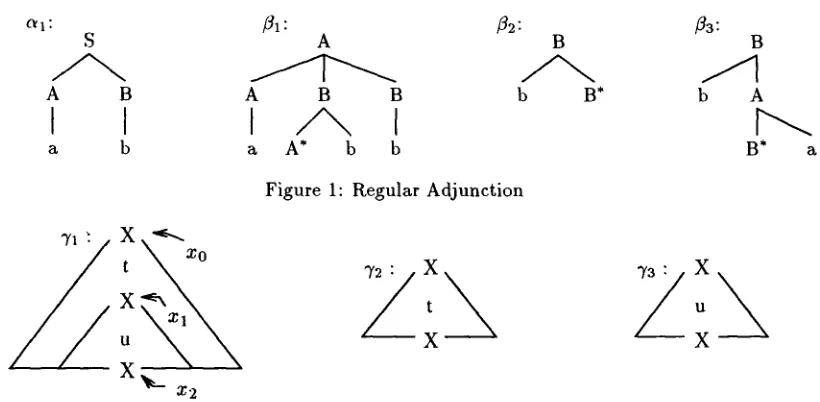
72 provided that no instance of 3'2 can be adjoined at any node along the spine of 71.In figure 1, for example, this rules out adjunction of /31 into the spine of/33, or vice versa, either directly or indirectly (by adjunction of/33, say, into f12 and then adjunction of the resulting auxiliary tree into fit-) Note that, in the case of T A G s with no i m p r o p e r elementary auxiliary trees, the requirement t h a t only proper aux- iliary trees m a y be adjoined at the root or foot is not actually a restriction. This is because the only way to derive an i m p r o p e r auxiliary tree in such a T A G with- out violating the other restrictions on regular adjunc- tion is by adjunction at the root or foot. Any sequence of such adjunctions can always be re-ordered in a way which meets the requirement.
t~l:
S
A B
I
I
a b
X
U
X~__ x2
A
A B B
a A* b b
]32:
B
b B*
Figure 1: Regular Adjunction
/
x
Figure 2: Regular Form
B
b A
[--...
B* a
/
×
P r o p o s i t i o n 1 I f G is a T A G and T ' ( G ) = T'a(G ). Then T ( G ) is a recognizable set.
P r o o f (Sketch): This follows from the fact that in reg- ular adjunction, if one treats adjunction at the root or foot as substitution, there is a fixed bound, dependent only on G, on the depth to which auxiliary trees can be nested. Thus the nesting of the auxiliary trees can be tracked by a fixed depth stack. Such a stack can be encoded in a finite set of states. It's reasonably easy to see, then, how G can be compiled into a b o t t o m - u p finite state tree a u t o m a t o n , t3
Since regular adjunction generates only recognizable sets, and thus (modulo projection) local sets, and since CFGs can be parsed in cubic time, one would hope that TAGs that employ only regular adjunction can be parsed in cubic time as well. In fact, such is the case.
P r o p o s i t i o n 2 I f G is a T A G for which T ( G ) = TR(G) then there is a algorithm that recognizes strings in L(G) in time proportional to the cube of the length of the string. 4
P r o o f ( S k e t c h ) : This, again, follows from the fact that the depth of nesting of auxiliary trees is bounded in regular adjunction. A CKY-style style parsing algorithm for TAGs (the one given in Vijay-Shanker and Weir (1993), for example) can be modified to work with a two-dimensionM array, storing in each slot [i, j] a set of structures that encode a node in an elementary tree that can occur at the root of a subtree spanning the input from position i through j in some tree derivable in G, along with a stack recording the nesting of elementary auxiliary trees around that node in the derivation of that tree. Since the stacks
4This result was suggested by K. Vijay-Shanker.
are bounded the a m o u n t of data stored in each node is independent of the input length and the algorithm executes in time proportional to the cube of the length
of the input, o
R e g u l a r F o r m
We are interested in classes of TAGs for which T ' ( G ) = T~(G). One such class is the TAGs in regular form. D e f i n i t i o n 2 A T A G is in r e g u l a r f o r m if[ whenever a completed auxiliary tree of the form 71 in Figure 2 is derivable, where Xo ~£ xl ~ x2 and no node labeled X occurs properly between xo and x l , then trees of the form 72 and 73 are derivable as well.
Effectively, this is a closure condition oll the elementary trees of the grammar. Note that it immediately implies that every improper elementary auxiliary tree in a reg- ular form TAG is redundant. It is also easy to see, by induction on the number of occurrences of X along the spine, that any auxiliary tree 7 for X that is derivable in G can be decomposed into the concatenation of a sequence of proper auxiliary trees for X each of which is derivable in G. We will refer to the proper auxiliary trees in this sequence as the proper segments of 7. L e m i n a 3 Suppose G is a T A G in regular form. Then T ' ( G ) = T £ ( G )
[image:4.612.118.528.44.245.2]smaller than 7 they are in T ~ ( G ) . It follows t h a t 7 is
in T~(G') as well. []
L e m m a 4 Suppose (; is a T A G with no improper ele- mentary trees and T ' ( G ) = T'R(G ). Then G is in regu- lar form.
P r o o f i Suppose some 7 with the form of 7l in Fig- ure 2 is derivable in G and t h a t for all trees 7' t h a t are smaller than 7 every proper segment of 7' is derivable in G'. By assumption 7 is not elementary since it is im- proper. Thus, by hypothesis, 7 is derivable by regular adjunction of some 7" into some 7' both of which are derivable in (/.
Suppose 7" adjoins into the spine of 7' and t h a t a node labeled X occurs along the spine of 7". Then, by the definition of regular adjunction, 7" must be ad- joined at. either tile root or foot of 7'. Thus both 7' and 7" consist of sequences of consecutive proper seg- ments of 7 with 7" including t and the initial (possibly empty) portion of u and 7' including the remainder of u or vice versa. In either case, by the induction h y p o t h - esis, every proper segment of both 7' and 7", and thus every proper segment of 7 is derivable in G. Then trees of the forrn 72 and 73 are derivable from these proper segments.
Suppose, on the other hand, that 7" does not adjoin along the spine of 7 ~ or that no node labeled X occurs along tile spine of 7"- Note t h a t 7" must occur entirely within a proper segment of 7. Then 7' is a tree with the form of 71 that is smaller than 7. From the induc- tion hypothesis every proper segment of 7 ~ is derivable in (;. It follows then that every proper segment of 7 is derivable in G, either because it is a proper segment of 7' or because it is derivable by a¢0unction of 7" into a proper segment of 7'- Again, trees of the form "r2 and 7a are derivable from these 1)roper segments. []
R e g u l a r F o r m and Local Sets
The class of T A G s in regular form is related to the lo- cal sets in much the same way t h a t the class of regular g r a m m a r s is related to regular languages. Every T A G in regular form generates a recognizable set. This fol- lows from L e m m a 3 and Proposition 1. Thus, modulo projection, every TAG in regular form generates a local set. C, onversely, the next proposition establishes t h a t every local set can be generated by a T A G in regu- lar form. Thus regular form provides a normal form for TAGs that generate local sets. It is not the case, however, t h a t all T A G s t h a t generate local sets are in regular form.
P r o p o s i t i o n 3 For every CFG G there is a T A G G' in regular f o r m such that the set of derivation trees f o r G is exactly T ( G ' ) .
P r o o f : This is nearly immediate, since every CFG is equivalent to a Tree Substitution G r a m m a r (in which
all trees are of depth one) and every Tree Substitution G r a m m a r is, in the definition we use here, a T A G with no elementary auxiliary trees. It follows t h a t this TAG can derive no auxiliary trees at all, and is thus vacu-
ously in regular form. []
This proof is hardly satisfying, depending as it does on the fact that TAGs, as we define them, can employ sub- stitution. T h e next proposition yields, as a corollary, the more substantial result t h a t every C F G is strongly equivalent to a T A G in regular form in which substitu- tion plays no role.
P r o p o s i t i o n 4 The class of T A G s in regular f o r m can lexicalize CFGs.
P r o o f : This follows directly from the equivalent l e m m a in Schabes and Waters (1993a). T h e construction given there builds a left-corner derivation graph (LCG). Vertices in this graph are the terminals and non- terminals of G. Edges correspond to the productions of G in the following way: there is an edge from X to Y labeled X ---* Y a iff X ---* Y a is a production in G. Paths through this graph t h a t end on a termi- nal characterize the left-corner derivations in G. T h e construction proceeds by building a set of elementary initial trees corresponding to the simple (acyelic) paths through the LCG t h a t end on terminals. These capture the non-recursive left-corner derivations in G. The set of auxiliary trees is built in two steps. First, an aux- iliary tree is constructed for every simple cycle in the graph. This gives a set of auxiliary trees t h a t is suffi- cient, with the initial trees, to derive every tree gener- ated by the C F G . This set of auxiliary trees, however, m a y include some which are not lexicalized, t h a t is, in which every frontier node other t h a n the foot is marked for substitution. These can be lexicalized by substitut- ing every corresponding elementary initial tree at one of those frontier nodes. Call the L C F G constructed for G by this m e t h o d G'. For our purposes, the i m p o r t a n t point of the construction is t h a t every simple cycle in the L C G is represented by an elementary auxiliary tree. Since the spines of auxiliary trees derivable in G ' cor- respond to cycles in the LCG, every proper segment of an auxiliary tree derivable in G ' is a simple cycle in the LCG. Thus every such proper segment is derivable in G ' and G ' is in regular form. []
m a t t e r what (complete) derivation strategy is captured ill the graph. In particular, this a d m i t s the possibility of generating an LTAG in which the anchor of each el- ementary tree is some linguistically m o t i v a t e d "head".
C o r o l l a r y 1 For every CFG G there is a TAG G ~ in regular form in which no node is m a r k e d for substitu- tion, such that the set of derivation trees for G is exactly T(G').
This follows from the fact t h a t the step used to lex- icalize the elementary auxiliary trees in Schabes and Waters's construction can be applied to every node (in both initial and auxiliary trees) which is m a r k e d for substitution. Paradoxically, to establish the corollary it is not necessary for every elementary tree to be lex- icalized. In Schabes and W a t e r s ' s l e m m a G is required to be finitely ambiguous and to not generate the e m p t y string. These restrictions are only necessary if G ~ is to be lexicalized. Here we can accept T A G s which include elementary trees in which the only leaf is the foot node or which yield only the e m p t y string. T h u s the corollary applies to all C F G s without restriction.
R e g u l a r F o r m i s D e c i d a b l e
We have established t h a t regular form gives a class of T A G s t h a t is strongly equivalent to C F G s ( m o d u l o pro- jection), and t h a t LTAGs in this class lexicalize CFGs. In this section we provide an effective procedure for de- ciding if a given T A G is in regular form. T h e procedure is based on a graph t h a t is not unlike the L C G of the construction of Schabes and Waters.
If G is a T A G , the Spine Graph of G is a directed multi-graph on a set of vertices, one for each non- terminal in G. If Hi is an elementary auxiliary tree in G and the spine of fli is labeled with the sequence of non-terminals (Xo, X 1 , . . . ,
Xn)
(where X0 = Xn and the remaining Xj are not necessarily distinct), then there is an edge in the graph f r o m each Xj to Xj+I la- beled (Hi, J, ti,j), where ti,j is t h a t portion of Hi t h a t is dominated by Xj but not properly d o m i n a t e d by Xj+I.There are no other edges in the graph except those cor- responding to the elementary auxiliary trees of G in this way.
T h e intent is for the spine graph of G to characterize the set of auxiliary trees derivable in G by adjunction along the spine. Clearly, any vertex t h a t is labeled with a non-terminal for which there is no corresponding aux- iliary tree plays no active role in these derivations and can be replaced, along with the pairs of edges incident on it, by single edges. W i t h o u t loss of generality, then, we assume spine graphs of this reduced form. T h u s ev- ery vertex has at least one edge labeled with a 0 in its second component incident from it.
A well-formed-cycle (wfc) in this graph is a (non- e m p t y ) path traced by the following non-deterministic a u t o m a t o n :
• T h e a u t o m a t o n consists of a single push-down stack. Stack contents are labels of edges in the graph.
• T h e a u t o m a t o n starts on any vertex of the graph with an e m p t y stack.
• At each step, the a u t o m a t o n can move as follows:
- If there is an edge incident from the current vertex labeled (ill, O, ti,o) the a u t o m a t o n can push t h a t label onto the stack and move to the vertex at the far end of t h a t edge.
- If the top of stack contains (fli,j, tis) and there is an edge incident f r o m the current vertex labeled
( f l i , j + 1,ti,j+l) the a u t o m a t o n m a y pop the top of stack, push (Hi,j-t-l,ti,j+l) and move to the vertex at the end of t h a t edge.
- If the top of stack contains
(Hi,j, ti,j)
but there is no edge incident from the current vertex labeled(Hi,J + 1,ti,j+l)
then the a u t o m a t o n m a y pop the top of stack and remain at the s a m e vertex. • T h e a u t o m a t o n m a y halt if its stack is empty. • A p a t h through the graph is traced by the a u t o m a t o nif it starts at the first vertex in the p a t h and halts at the last vertex in the p a t h visiting each of the vertices in the p a t h in order.
Each wfc in a spine graph corresponds to the auxil- iary tree built by concatenating the third components of the labels on the edges in the cycle in order. Then every wfc in the spine graph of G corresponds to an auxiliary tree t h a t is derivable in G by adjunction along the spine only. Conversely, every such auxiliary tree corresponds to some wfc in the spine graph.
A simple cycle in the spine graph, by definition, is any m i n i m a l cycle in the graph t h a t ignores the labels of the edges but not their direction. Simple cycles cor- respond to auxiliary trees in the s a m e way t h a t wfcs do. Say t h a t two cycles in the graph are equivalent iff they correspond to the s a m e auxiliary tree. T h e simple cy- cles in the spine graph for G correspond to the minimal set of elementary auxiliary trees in any presentation of G t h a t is closed under the regular form condition in tile following way.
L e m m a 5 A TAG G is in regular form iff every simple cycle in its spine graph is equivalent to a wfc in that graph.
P r o o f :
(If every simple cycle is equivalent to a wfc then (; is in regular form.)
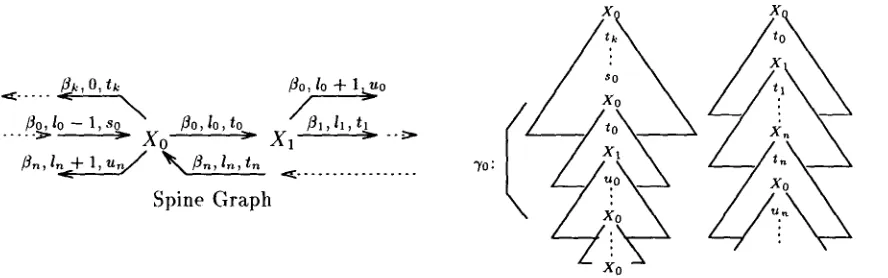
Suppose every simple cycle in the spine graph of (; is equivalent to a wfc and some tree of the form 71 in Figure 2 is derivable in G. Wlog, assume the tree is derivable by adjunction along the spine only. Then there is a wfc in the spine graph of G corresponding to that tree t h a t is of the form ( X o , . . . , X k , . . . , X , , )
where X0 = Xk = Xn, 0 :~ k # n, and Xi # Xo
/3~1o - 1, so ~ /3o, to, t o
... > Xo
Spine G r a p h
/30, lo + 1 !~o
~ , ,
l~, t~
...> X17o:
tk so X o
Figure 3: Regular Form is Decidable
X
spine graph and thus both 72 and 73 are derivable in (;.
(If (; is in regular form then every simple cycle corre- sponds to a wfc.)
Assume, wlog, tile spine graph of G is connected. (If it is not we can treat G as a union of grammars.) Since the spine graph is a union of wfcs it has an Eulerian wfc (in tile usual sense of Eulerian). Further, since every w~rl, ex is the initial vertex of some wfc, every vertex is tile initial vertex of some Eulerian wfc.
Suppose there is some simple cycle
X0 (fl0,10, t0) Xl ( i l l , l l , t l ) ' ' ' ... x ~ (f~,, t,, t~) x 0
where the Xj are the vertices and the tuples are the labels on the edges of the cycle. Then there is a wfc starting at Xo that includes the edge (flo, 10, to), al- though not necessarily initially. In particular the Eule- rian wfc starting at X0 is such a wfc. This corresponds to a derivable auxiliary tree that includes a proper seg- ment beginning with to. Since G is in regular form, that proper segment is a derivable auxiliary tree. Call this 7o (see Figure 3.) The spine of that tree is labeled X 0 , X 1 , . . . , X 0 , where anything (other than X0) can occur in the ellipses.
The same cycle can be rotated to get a simple cycle starting at each of the X j . Thus for each Xj there is a derivable auxiliary tree starting with tj. Call it 73". By a sequence of adjunctions of each 7j at the second node on the spine of 7j-1 an auxiliary tree for X0 is derivable in which the first proper segment is the concatenation of
tO, t l , . . . , t n .
Again, by the fact that G is in regular form, this proper segment is derivable in G. Hence there is a wfc in the spine graph corresponding to this tree. []
P r o p o s i t i o n 5 For any TAG G the question of whetherG is in regular form is decidable. Further, there is an effective procedure that, given any TAG, will ex- tend it to a TAG that is in regular form.
Proof." Given a TAG G we construct its spine graph. Since the TAG is finite, the graph is as well. The TAG is in regular form iff every simple cycle is equivalent to a wfc. This is clearly decidable. Further, the set of elementary trees corresponding to simple cycles that are not equivalent to wfcs is effectively constructible. Adding that set to the original TAG extends it to reg-
ular form. []
Of course the set of trees generated by the extended TAG may well be a proper superset of the set gener- ated by the original TAG.
D i s c u s s i o n
The LCFGs of Schabes and Waters employ a restricted form of adjunction and a highly restricted form of ele- mentary auxiliary tree. The auxiliary trees of LCFGs can only occur in left- or right-recursive form, that is, with the foot as either the left- or right-most node on the frontier of the tree. Thus the structures that can be captured in these trees are restricted by the mechanism itself, and Schabes and Waters (in (1993a)) cite two situations where an existing LTAG g r a m m a r for En- glish (Abeill@ et at., 1990) fails to meet this restriction. But while it is sufficient to assure that the language generated is context-free and cubic-time parsable, this restriction is stronger than necessary.
[image:7.612.79.523.46.185.2]On the other hand, regular form is a property of the grammar as a whole, while the restrictions of LCFG are restrictions on individual trees (and the manner in which they are combined.) Consequently, it is imme- diately obvious if a g r a m m a r meets the requirements of LCFG, while it is less apparent if it is in regular form. In the case of the LTAG g r a m m a r for English, neither of the situations noted by Schabes and Waters violate regular form themselves. As regular form is decidable, it is reasonable to ask whether the gram- mar as a whole is in regular form. A positive result would identify the large fragment of English covered by this g r a m m a r as strongly context-free and cubic-time parsable. A negative result is likely to give insight into those structures covered by the g r a m m a r that require context-sensitivity.
One might approach defining a context-free language within the TAG formalism by developing a g r a m m a r with the intent that all trees derivable in the g r a m m a r be derivable by regular adjunction. This condition can then be verified by the algorithm of previous section. In the case that the g r a m m a r is not in regular form, the al- gorithm proposes a set of additional auxiliary trees that will establish that form. In essence, this is a prediction about the strings that would occur in a context-free language extending the language encoded by the origi- nal grammar. It is then a linguistic issue whether these additional strings are consistent with the intent of the grammar.
If a grammar is not in regular form, it is not necessar- ily the case that it does not generate a recognizable set. The main unresolved issue in this work is whether it is possible to characterize the class of TAGs that gen- erate local sets more completely. It is easy to show, for TAGs that employ adjoining constraints, that this is not possible. This is a consequence of the fact that one can construct, for any CFG, a TAG in which the path language is the image, under a bijeetive homomor- phisrn, of the string language generated by that CFG. Since it is undecidable if an arbitrary C F G generates a regular string language, and since the path language of every recognizable set is regular, it is undecidable if an arbitrary TAG (employing adjoining constraints) generates a recognizable set. This ability to capture CFLs in the string language, however, seems to depend crucially on the nature of the adjoining constraints. It does not appear to extend to pure TAGs, or even TAGs in which the adjoining constraints are implemented as monotonically growing sets of simple features. In the case of TAGs with these limited adjoining constraints, then, the questions of whether there is a class of TAGs which includes all and only those which generate rec- ognizable sets, or if there is an effective procedure for reducing any such TAG which generates a recognizable set to one in regular form, are open.
R e f e r e n c e s
Anne Abeill~, Kathleen M. Bishop, Sharon Cote, and Yves Schabes. 1990. A lexicalized tree adjoining g r a m m a r for English. Technical Report MS-CIS-90- 24, D e p a r t m e n t of Computer and Information Sci- ence, University of Pennsylvania.
Ferenc G~eseg and Magnus Steinby. 1984. Tree Au- tomata. Akad~miai Kiad6, Budapest.
Aravind K. Joshi and Yves Schabes. 1992. Tree- adjoining grammars and lexicalized grammars. In M. Nivat and A. Podelski, editors, Tree Automata and Languages, pages 409-431. Elsevier Science Pub- lishers B.V.
Yves Schabes and Aravind K. Joshi. 1991. Parsing with lexicalized tree adjoining grammar. In Masaru Tomita, editor, Current Issues in Parsing Technol- ogy, chapter 3, pages 25-47. Kluwer Academic Pub- lishers.
Yves Schabes and Richard C. Waters. 1993a. Lexical- ized context-free grammars. In 31st Annual Meet- ing of the Association for Computational Linguistics (ACL'93), pages 121-129, Columbus, OH. Associa- tion for C o m p u t a t i o n a l Linguistics.
Yves Schabes and Richard C. Waters. 1993b. Lexical- ized context-free grammar: A cubic-time parsable, lexicalized normal form for context-free g r a m m a r t h a t preserves tree structure. Technical Report 93- 04, Mitsubishi Electric Research Laboratories Cam- bridge Research Center, Cambridge, MA, June. Yves Sehabes, Anne Abeill~, and Aravind K . . ] o s h i .
1988. Parsing strategies with 'lexicalized' grammars: Application to tree adjoining grammars. In Proceed- ings of the 12th International Conference on Compu- tational Linguistics (COLING'88), Budapest, Hun- gary. Association for Computational Linguistics. Yves Sehabes. 1990. Mathematical and Computational
Aspects of Lexicalized Grammars. Ph.D. thesis, De- p a r t m e n t of Computer and information Science, Uni- versity of Pennsylvania.
J. W. Thatcher. 1967. Characterizing derivation trees of context-free grammars through a generalization of finite a u t o m a t a theory. Journal of Computer and System Sciences, 1:317-322.