Proceedings of the 49th Annual Meeting of the Association for Computational Linguistics, pages 804–813,
A Cross-Lingual ILP Solution to Zero Anaphora Resolution
Ryu Iida
Tokyo Institute of Technology 2-12-1, ˆOokayama, Meguro,
Tokyo 152-8552, Japan [email protected]
Massimo Poesio Universit`a di Trento, Center for Mind / Brain Sciences
University of Essex,
Language and Computation Group [email protected]
Abstract
We present an ILP-based model of zero anaphora detection and resolution that builds on the joint determination of anaphoricity and coreference model proposed by Denis and Baldridge (2007), but revises it and extends it into a three-way ILP problem also incorporat-ing subject detection. We show that this new model outperforms several baselines and com-peting models, as well as a direct translation of the Denis / Baldridge model, for both Italian and Japanese zero anaphora. We incorporate our model in complete anaphoric resolvers for both Italian and Japanese, showing that our approach leads to improved performance also when not used in isolation, provided that sep-arate classifiers are used for zeros and for ex-plicitly realized anaphors.
1 Introduction
In so-called ‘pro-drop’ languages such as Japanese and many romance languages including Italian, phonetic realization is not required for anaphoric references in contexts in which in English non-contrastive pronouns are used: e.g., the subjects of Italian and Japanese translations of buy in (1b) and (1c) are not explicitly realized. We call these non-realized mandatory arguments zero anaphors.
(1) a. [EN] [John]iwent to visit some friends. On the way, [he]i bought some wine.
b. [IT] [Giovanni]iand`o a far visita a degli am-ici. Per via,φicompr`o del vino.
c. [JA] [John]i-wa yujin-o houmon-sita. Tochu-deφiwain-o ka-tta.
The felicitousness of zero anaphoric reference depends on the referred entity being sufficiently salient, hence this type of data–particularly in Japanese and Italian–played a key role in early work in coreference resolution, e.g., in the devel-opment of Centering (Kameyama, 1985; Walker et al., 1994; Di Eugenio, 1998). This research high-lighted both commonalities and differences between the phenomenon in such languages. Zero anaphora resolution has remained a very active area of study for researchers working on Japanese, because of the prevalence of zeros in such languages1 (Seki et al., 2002; Isozaki and Hirao, 2003; Iida et al., 2007a; Taira et al., 2008; Imamura et al., 2009; Sasano et al., 2009; Taira et al., 2010). But now the availabil-ity of corpora annotated to study anaphora, includ-ing zero anaphora, in languages such as Italian (e.g., Rodriguez et al. (2010)), and their use in competi-tions such as SEMEVAL 2010 Task 1 on Multilin-gual Coreference (Recasens et al., 2010), is lead-ing to a renewed interest in zero anaphora resolu-tion, particularly at the light of the mediocre results obtained on zero anaphors by most systems partici-pating in SEMEVAL.
Resolving zero anaphora requires the simulta-neous decision that one of the arguments of a verb is phonetically unrealized (and which argu-ment exactly–in this paper, we will only be con-cerned with subject zeros as these are the only type to occur in Italian) and that a particular en-tity is its antecedent. It is therefore natural to view zero anaphora resolution as a joint inference
1
As shown in Table 1, 64.3% of anaphors in the NAIST Text Corpus of Anaphora are zeros.
task, for which Integer Linear Programming (ILP)–
introduced to NLP by Roth and Yih (2004) and suc-cessfully applied by Denis and Baldridge (2007) to the task of jointly inferring anaphoricity and deter-mining the antecedent–would be appropriate.
In this work we developed, starting from the ILP system proposed by Denis and Baldridge, an ILP approach to zero anaphora detection and resolu-tion that integrates (revised) versions of Denis and Baldridge’s constraints with additional constraints between the values of three distinct classifiers, one of which is a novel one for subject prediction. We demonstrate that treating zero anaphora resolution as a three-way inference problem is successful for both Italian and Japanese. We integrate the zero anaphora resolver with a coreference resolver and demonstrate that the approach leads to improved re-sults for both Italian and Japanese.
The rest of the paper is organized as follows. Section 2 briefly summarizes the approach proposed by Denis and Baldridge (2007). We next present our new ILP formulation in Section 3. In Section 4 we show the experimental results with zero anaphora only. In Section 5 we discuss experiments testing that adding our zero anaphora detector and resolver to a full coreference resolver would result in overall increase in performance. We conclude and discuss future work in Section 7.
2 Using ILP for joint anaphoricity and coreference determination
Integer Linear Programming (ILP) is a method for constraint-based inference aimed at finding the val-ues for a set of variables that maximize a (linear) ob-jective function while satisfying a number of con-straints. Roth and Yih (2004) advocated ILP as a general solution for a number of NLP tasks that re-quire combining multiple classifiers and which the traditional pipeline architecture is not appropriate, such as entity disambiguation and relation extrac-tion.
Denis and Baldridge (2007) defined the following object function for the joint anaphoricity and coref-erence determination problem.
min
i,j∈P
cCi,j·xi,j+c−i,jC·(1−xi,j)
+
j∈M
cA
j ·yj+c−jA·(1−yj) (2)
subject to
xi,j∈ {0,1} ∀i, j ∈P
yj ∈ {0,1} ∀j∈M
M stands for the set of mentions in the document, and P the set of possible coreference links over these mentions. xi,jis an indicator variable that is set to
1 if mentionsiandjare coreferent, and 0 otherwise.
yj is an indicator variable that is set to 1 if mention
j is anaphoric, and 0 otherwise. The costscCi,j =
−log(P(COREF|i, j)) are (logs of) probabilities produced by an antecedent identification classifier with −log, whereas cAj = −log(P(ANAPH|j)), are the probabilities produced by an anaphoricity de-termination classifier with −log. In the Denis & Baldridge model, the search for a solution to an-tecedent identification and anaphoricity determina-tion is guided by the following three constraints. Resolve only anaphors: if a pair of mentionsi, j is coreferent (xi,j = 1), then mention j must be anaphoric (yj = 1).
xi,j≤yj ∀i, j ∈P (3)
Resolve anaphors: if a mention is anaphoric (yj =
1), it must be coreferent with at least one antecedent.
yj≤
i∈Mj
xi,j ∀j∈M (4)
Do not resolve anaphors: if a mention is non-anaphoric (yj = 0), it should have no antecedents.
yj ≥ 1
|Mj|
i∈Mj
xi,j ∀j ∈M (5)
3 An ILP-based account of zero anaphora detection and resolution
(6) [Pahor]i `e nato a Trieste, allora porto princi-pale dell’Impero Austro-Ungarico.
A sette anni [vide]i l’incendio del Narodni dom,
The proposal of Denis and Baldridge (2007) can be easily turned into a proposal for the task of detecting and resolving zero anaphora in this type of data by reinterpreting the indicator variables as follows:
• yj is 1 if markablej(a verbal form) initiates a verbal complex whose subject is unrealized, 0 otherwise;
• xi,j is 1 if the empty mention realizing the
subject argument of markablej and markable
iare mentions of the same entity, 0 otherwise. There are however a number of ways in which this direct adaptation can be modified and extended. We discuss them in turn.
3.1 Best First
In the context of zero anaphora resolution, the ‘Do not resolve non-anaphors’ constraint (5) is too weak, as it allows the redundant choice of more than one candidate antecedent. We developed therefore the following alternative, that blocks selection of more than one antecedent.
Best First (BF):
yj ≥
i∈Mj
xi,j ∀j∈M (7)
3.2 A subject detection model
The greatest difficulty in zero anaphora resolution in comparison to, say, pronoun resolution, is zero anaphora detection. Simply relying for this on the parser is not enough: most dependency parsers are not very accurate at identifying cases in which the verb does not have a subject on syntactic grounds only. Again, it seems reasonable to suppose this is because zero anaphora detection requires a com-bination of syntactic information and information about the current context. Within the ILP frame-work, this hypothesis can be implemented by turn-ing the zero anaphora resolution optimization prob-lem into one with three indicator variables, with the objective function in (8). The third variable, zj, en-codes the information provided by the parser: it is 1 with cost cSj = −log(P(SUBJ|j)) if the parser
thinks that verbjhas an explicit subject with proba-bilityP(SUBJ|j), otherwise it is 0.
min
i,j∈P
cC
i,j·xi,j+c−i,jC·(1−xi,j)
+
j∈M
cjA·yj+cj−A·(1−yj)
+
j∈M
cjS·zj+cj−S·(1−zj) (8)
subject to
xi,j∈ {0,1} ∀i, j ∈P
yj ∈ {0,1} ∀j∈M
zj ∈ {0,1} ∀j∈M
The crucial fact about the relation betweenzjand
yjis that a verb has either a syntactically realized NP or a zero pronoun as a subject, but not both. This is encoded by the following constraint.
Resolve only non-subjects: if a predicatej syntac-tically depends on a subject (zj = 1), then the predi-catejshould have no antecedents of its subject zero pronoun.
yj+zj ≤1 ∀j∈M (9)
4 Experiment 1: zero anaphora resolution
In a first round of experiments, we evaluated the per-formance of the model proposed in Section 3 on zero anaphora only (i.e., not attempting to resolve other types of anaphoric expressions).
4.1 Data sets
We use the two data sets summarized in Table 1. The table shows that NP anaphora occurs more fre-quently than zero-anaphora in Italian, whereas in Japanese the frequency of anaphoric zero-anaphors2 is almost double the frequency of the remaining anaphoric expressions.
Italian For Italian coreference, we used the anno-tated data set presented in Rodriguez et al. (2010) and developed for the Semeval 2010 task ‘Corefer-ence Resolution in Multiple Languages’ (Recasens et al., 2010), where both zero-anaphora and NP
2
#instances (anaphoric/total)
language type #docs #sentences #words zero-anaphors others all
Italian train 97 3,294 98,304 1,093 / 1,160 6,747 / 27,187 7,840 / 28,347
test 46 1,478 41,587 792 / 837 3,058 / 11,880 3,850 / 12,717
[image:4.612.96.516.71.143.2]Japanese train 1,753 24,263 651,986 18,526 / 29,544 10,206 / 161,124 28,732 / 190,668 test 696 9,287 250,901 7,877 / 11,205 4,396 / 61,652 12,273 / 72,857 In the 6th column we use the term ‘anaphoric’ to indicate the number of zero anaphors that have an antecedent in the text, whereas the total figure is the sum of anaphoric and exophoric zero-anaphors - zeros with a vague / generic reference.
Table 1: Italian and Japanese Data Sets
coreference are annotated. This dataset consists of articles from Italian Wikipedia, tokenized, POS-tagged and morphologically analyzed using TextPro, a freely available Italian pipeline (Pianta et al., 2008). We parsed the corpus using the Italian ver-sion of the DESR dependency parser (Attardi et al., 2007).
In Italian, zero pronouns may only occur as omit-ted subjects of verbs. Therefore, in the task of zero-anaphora resolution all verbs appearing in a text are considered candidates for zero pronouns, and all gold mentions or system mentions preced-ing a candidate zero pronoun are considered as can-didate antecedents. (In contrast, in the experiments on coreference resolution discussed in the following section, all mentions are considered as both candi-date anaphors and candicandi-date antecedents. To com-pare the results with gold mentions and with system detected mentions, we carried out an evaluation us-ing the mentions automatically detected by the Ital-ian version of the BART system (I-BART) (Poesio et al., 2010), which is freely downloadable.3
Japanese For Japanese coreference we used the NAIST Text Corpus (Iida et al., 2007b) version 1.4β, which contains the annotated data about NP coreference and zero-anaphoric relations. We also used the Kyoto University Text Corpus4 that pro-vides dependency relations information for the same articles as the NAIST Text Corpus. In addition, we also used a Japanese named entity tagger, CaboCha5 for automatically tagging named entity labels. In the NAIST Text Corpus mention boundaries are not annotated, only the heads. Thus, we considered
3
http://www.bart-coref.org/ 4
http://www-lab25.kuee.kyoto-u.ac.jp/nl-resource/corpus.html
5
http://chasen.org˜taku/software/cabocha/
as pseudo-mentions all bunsetsu chunks (i.e. base phrases in Japanese) whose head part-of-speech was automatically tagged by the Japanese morphologi-cal analyser Chasen6 as either ‘noun’ or ‘unknown word’ according to the NAIST-jdic dictionary.7
For evaluation, articles published from January 1st to January 11th and the editorials from January to August were used for training and articles dated January 14th to 17th and editorials dated October to December are used for testing as done by Taira et al. (2008) and Imamura et al. (2009). Further-more, in the experiments we only considered subject zero pronouns for a fair comparison to Italian zero-anaphora.
4.2 Models
In these first experiments we compared the three ILP-based models discussed in Section 3: the direct reimplementation of the Denis and Baldridge pro-posal (i.e., using the same constrains), a version re-placing Do-Not-Resolve-Not-Anaphors with Best-First, and a version with Subject Detection as well.
As discussed by Iida et al. (2007a) and Imamura et al. (2009), useful features in intra-sentential zero-anaphora are different from ones in inter-sentential zero-anaphora because in the former problem syn-tactic information between a zero pronoun and its candidate antecedent is essential, while the lat-ter needs to capture the significance of saliency based on Centering Theory (Grosz et al., 1995). To directly reflect this difference, we created two antecedent identification models; one for intra-sentential zero-anaphora, induced using the training instances which a zero pronoun and its candidate an-tecedent appear in the same sentences, the other for
6http://chasen-legacy.sourceforge.jp/ 7
inter-sentential cases, induced from the remaining training instances.
To estimate the feature weights of each classifier, we used MEGAM8, an implementation of the Max-imum Entropy model, with default parameter set-tings. The ILP-based models were compared with the following baselines.
PAIRWISE: as in the work by Soon et al. (2001), antecedent identification and anaphoricity determi-nation are simultaneously executed by a single clas-sifier.
DS-CASCADE: the model first filters out non-anaphoric candidate anaphors using an non- anaphoric-ity determination model, then selects an antecedent from a set of candidate antecedents of anaphoric candidate anaphors using an antecedent identifica-tion model.
4.3 Features
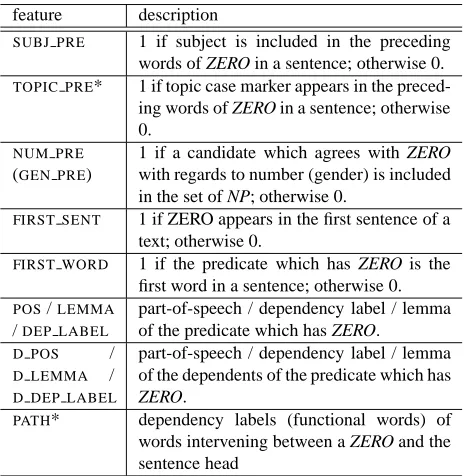
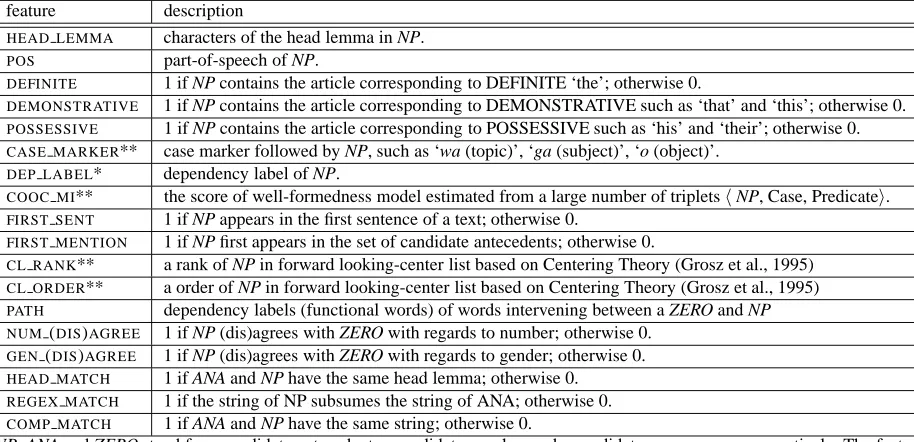
The feature sets for antecedent identification and anaphoricity determination are briefly summarized in Table 2 and Table 3, respectively. The agreement features such as NUM AGREE and GEN AGREE are
automatically derived using TextPro. Such agree-ment features are not available in Japanese because Japanese words do not contain such information.
4.4 Creating subject detection models
To create a subject detection model for Italian, we used the TUT corpus9 (Bosco et al., 2010), which contains manually annotated dependency relations and their labels, consisting of 80,878 tokens in CoNLL format. We induced an maximum entropy classifier by using as items all arcs of dependency relations, each of which is used as a positive instance if its label is subject; otherwise it is used as a nega-tive instance.
To train the Japanese subject detection model we used 1,753 articles contained both in the NAIST Text Corpus and the Kyoto University Text Corpus. By merging these two corpora, we can obtain the an-notated data including which dependency arc is sub-ject10. To create the training instances, any pair of a predicate and its dependent are extracted, each of
8
http://www.cs.utah.edu/˜hal/megam/ 9
http://www.di.unito.it/˜tutreeb/ 10
Note that Iida et al. (2007b) referred to this relation as ‘nominative’.
feature description
SUBJ PRE 1 if subject is included in the preceding words of ZERO in a sentence; otherwise 0.
TOPIC PRE* 1 if topic case marker appears in the preced-ing words of ZERO in a sentence; otherwise 0.
NUM PRE
(GEN PRE)
1 if a candidate which agrees with ZERO with regards to number (gender) is included in the set of NP; otherwise 0.
FIRST SENT 1 if ZERO appears in the first sentence of a text; otherwise 0.
FIRST WORD 1 if the predicate which has ZERO is the first word in a sentence; otherwise 0.
POS/LEMMA
/DEP LABEL
part-of-speech / dependency label / lemma of the predicate which has ZERO.
D POS /
D LEMMA /
D DEP LABEL
part-of-speech / dependency label / lemma of the dependents of the predicate which has
ZERO.
PATH* dependency labels (functional words) of words intervening between a ZERO and the sentence head
[image:5.612.313.545.71.309.2]The features marked with ‘*’ used only in Japanese.
Table 3: Features for anaphoricity determination
which is judged as positive if its relation is subject; as negative otherwise.
As features for Italian, we used lemmas, PoS tag of a predicate and its dependents as well as their morphological information (i.e. gender and num-ber) automatically computed by TextPro (Pianta et al., 2008). For Japanese, the head lemmas of predi-cate and dependent chunks as well as the functional words involved with these two chunks were used as features. One case specially treated is when a de-pendent is placed as an adnominal constituent of a predicate, as in this case relation estimation of de-pendency arcs is difficult. In such case we instead use the features shown in Table 2 for accurate esti-mation.
4.5 Results with zero anaphora only
In zero anaphora resolution, we need to find all pred-icates that have anaphoric unrealized subjects (i.e. zero pronouns which have an antecedent in a text), and then identify an antecedent for each such argu-ment.
feature description
HEAD LEMMA characters of the head lemma in NP.
POS part-of-speech of NP.
DEFINITE 1 if NP contains the article corresponding to DEFINITE ‘the’; otherwise 0.
DEMONSTRATIVE 1 if NP contains the article corresponding to DEMONSTRATIVE such as ‘that’ and ‘this’; otherwise 0.
POSSESSIVE 1 if NP contains the article corresponding to POSSESSIVE such as ‘his’ and ‘their’; otherwise 0.
CASE MARKER** case marker followed by NP, such as ‘wa (topic)’, ‘ga (subject)’, ‘o (object)’.
DEP LABEL* dependency label of NP.
COOC MI** the score of well-formedness model estimated from a large number of tripletsNP, Case, Predicate.
FIRST SENT 1 if NP appears in the first sentence of a text; otherwise 0.
FIRST MENTION 1 if NP first appears in the set of candidate antecedents; otherwise 0.
CL RANK** a rank of NP in forward looking-center list based on Centering Theory (Grosz et al., 1995)
CL ORDER** a order of NP in forward looking-center list based on Centering Theory (Grosz et al., 1995)
PATH dependency labels (functional words) of words intervening between a ZERO and NP
NUM(DIS)AGREE 1 if NP (dis)agrees with ZERO with regards to number; otherwise 0.
GEN(DIS)AGREE 1 if NP (dis)agrees with ZERO with regards to gender; otherwise 0.
HEAD MATCH 1 if ANA and NP have the same head lemma; otherwise 0.
REGEX MATCH 1 if the string of NP subsumes the string of ANA; otherwise 0.
COMP MATCH 1 if ANA and NP have the same string; otherwise 0.
NP, ANA and ZERO stand for a candidate antecedent, a candidate anaphor and a candidate zero pronoun respectively. The features
[image:6.612.75.532.72.293.2]marked with ‘*’ are only used in Italian, while the features marked with ‘**’ are only used in Japanese.
Table 2: Features used for antecedent identification
Italian Japanese
system mentions gold mentions
model R P F R P F R P F
PAIRWISE 0.864 0.172 0.287 0.864 0.172 0.287 0.286 0.308 0.296 DS-CASCADE 0.396 0.684 0.502 0.404 0.697 0.511 0.345 0.194 0.248
ILP 0.905 0.034 0.065 0.929 0.028 0.055 0.379 0.238 0.293
ILP +BF 0.803 0.375 0.511 0.834 0.369 0.511 0.353 0.256 0.297 ILP +SUBJ 0.900 0.034 0.066 0.927 0.028 0.055 0.371 0.315 0.341 ILP +BF+SUBJ 0.777 0.398 0.526 0.815 0.398 0.534 0.345 0.348 0.346
Table 4: Results on zero pronouns
/ precision / F over link detection as a metric (model theoretic metrics do not apply for this task as only subsets of coreference chains are considered). As can be seen from Table 4, the ILP version with Do-Not-Resolve-Non-Anaphors performs no better than the baselines for either languages, but in both lan-guages replacing that constraint with Best-First re-sults in a performance above the baselines; adding Subject Detection results in further improvement for both languages. Notice also that the performance of the models on Italian is quite a bit higher than for Japanese although the dataset is much smaller, pos-sibly meaning that the task is easier in Italian.
5 Experiment 2: coreference resolution for all anaphors
In a second series of experiments we evaluated the performance of our models together with a full coreference system resolving all anaphors, not just zeros.
5.1 Separating vs combining classifiers
resolu-tion (Soon et al., 2001; Ng and Cardie, 2002, etc.) is to use a single classifier to identify antecedents of all anaphoric expressions, relying on the ability of the machine learning algorithm to learn these differ-ences. These models, however, often fail to capture the differences in anaphoric behavior between dif-ferent types of expressions–one of the reasons be-ing that the amount of trainbe-ing instances is often too small to learn such differences.11 Using different models would appear to be key in the case of zero-anaphora resolution, which differs even more from the rest of anaphora resolution, e.g., in being partic-ularly sensitive to local salience, as amply discussed in the literature on Centering discussed earlier.
To test the hypothesis that using what we will call separated models for zero anaphora and every-thing else would work better than combined
mod-els induced from all the learning instances, we
man-ually split the training instances in terms of these two anaphora types and then created two classifiers for antecedent identification: one for zero-anaphora, the other for NP-anaphora, separately induced from the corresponding training instances. Likewise, anaphoricity determination models were separately induced with regards to these two anaphora types.
5.2 Results with all anaphors
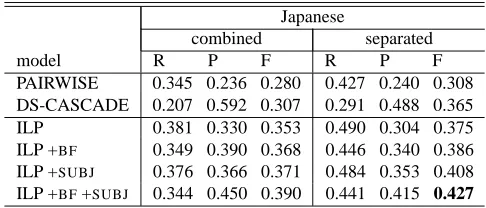
In Table 5 and Table 6 we show the (MUC scorer) results obtained by adding the zero anaphoric reso-lution models proposed in this paper to both a com-bined and a separated classifier. For the separated classifier, we use the ILP+BF model for explicitly realized NPs, and different ILP models for zeros.
The results show that the separated classi-fier works systematically better than a combined classifier. For both Italian and Japanese the ILP+BF+SUBJ model works clearly better than the baselines, whereas simply applying the original De-nis and Baldridge model unchanged to this case we obtain worse results than the baselines. For Italian we could also compare our results with those ob-tained on the same dataset by one of the two sys-tems that participated to the Italian section of SE-MEVAL, I-BART. I-BART’s results are clearly bet-ter than those with both baselines, but also clearly
in-11
E.g., the entire MUC-6 corpus contains a grand total of 3 reflexive pronouns.
Japanese
combined separated
model R P F R P F
PAIRWISE 0.345 0.236 0.280 0.427 0.240 0.308 DS-CASCADE 0.207 0.592 0.307 0.291 0.488 0.365
ILP 0.381 0.330 0.353 0.490 0.304 0.375
[image:7.612.311.554.72.176.2]ILP +BF 0.349 0.390 0.368 0.446 0.340 0.386 ILP +SUBJ 0.376 0.366 0.371 0.484 0.353 0.408 ILP +BF+SUBJ 0.344 0.450 0.390 0.441 0.415 0.427
Table 6: Results for overall coreference: Japanese (MUC score)
ferior to the results obtained with our models. In par-ticular, the effect of introducing the separated model with ILP+BF+SUBJ is more significant when us-ing the system detected mentions; it obtained perfor-mance more than 13 points better than I-BART when the model referred to the system detected mentions.
6 Related work
We are not aware of any previous machine learn-ing model for zero anaphora in Italian, but there has been quite a lot of work on Japanese zero-anaphora (Iida et al., 2007a; Taira et al., 2008; Ima-mura et al., 2009; Taira et al., 2010; Sasano et al., 2009). In work such as Taira et al. (2008) and Ima-mura et al. (2009), zero-anaphora resolution is con-sidered as a sub-task of predicate argument structure analysis, taking the NAIST text corpus as a target data set. Taira et al. (2008) and Taira et al. (2010) ap-plied decision lists and transformation-based learn-ing respectively in order to manually analyze which clues are important for each argument assignment. Imamura et al. (2009) also tackled to the same prob-lem setting by applying a pairwise classifier for each argument. In their approach, a ‘null’ argument is ex-plicitly added into the set of candidate argument to learn the situation where an argument of a predicate is ‘exophoric’. They reported their model achieved better performance than the work by Taira et al. (2008).
Italian
system mentions gold mentions
combined separated combined separated
model R P F R P F R P F R P F
PAIRWISE 0.508 0.208 0.295 0.472 0.241 0.319 0.582 0.261 0.361 0.566 0.314 0.404 DS-CASCADE 0.225 0.553 0.320 0.217 0.574 0.315 0.245 0.609 0.349 0.246 0.686 0.362
I-BART 0.324 0.294 0.308 – – – 0.532 0.441 0.482 – – –
ILP 0.539 0.321 0.403 0.535 0.316 0.397 0.614 0.369 0.461 0.607 0.384 0.470
ILP +BF 0.471 0.404 0.435 0.483 0.409 0.443 0.545 0.517 0.530 0.563 0.519 0.540 ILP +SUBJ 0.537 0.325 0.405 0.534 0.318 0.399 0.611 0.372 0.463 0.606 0.387 0.473 ILP +BF+SUBJ 0.464 0.410 0.435 0.478 0.418 0.446 0.538 0.527 0.533 0.559 0.536 0.547
[image:8.612.80.532.71.197.2]R: Recall, P: Precision, F:f-score,BF: best first constraint,SUBJ: subject detection model.
Table 5: Results for overall coreference: Italian (MUC score)
their model into the ILP formulation proposed here looks like a promising further extension.
Sasano et al. (2009) obtained interesting experi-mental results about the relationship between zero-anaphora resolution and the scale of automatically acquired case frames. In their work, their case frames were acquired from a very large corpus con-sisting of 100 billion words. They also proposed a probabilistic model to Japanese zero-anaphora in which an argument assignment score is esti-mated based on the automatically acquired case frames. They concluded that case frames acquired from larger corpora lead to better f-score on zero-anaphora resolution.
In contrast to these approaches in Japanese, the participants to Semeval 2010 task 1 (especially the Italian coreference task) simply solved the prob-lems using one coreference classifier, not distin-guishing zero-anaphora from the other types of anaphora (Kobdani and Sch¨utze, 2010; Poesio et al., 2010). On the other hand, our approach shows sep-arating problems contributes to improving perfor-mance in Italian zero-anaphora. Although we used gold mentions in our evaluations, mention detection is also essential. As a next step, we also need to take into account ways of incorporating a mention detec-tion model into the ILP formuladetec-tion.
7 Conclusion
In this paper, we developed a new ILP-based model of zero anaphora detection and resolution that ex-tends the coreference resolution model proposed by Denis and Baldridge (2007) by introducing modi-fied constraints and a subject detection model. We
evaluated this model both individually and as part of the overall coreference task for both Italian and Japanese zero anaphora, obtaining clear improve-ments in performance.
One avenue for future research is motivated by the observation that whereas introducing the subject de-tection model and the best-first constraint results in higher precision maintaining the recall compared to the baselines, that precision is still low. One of the major source of the errors is that zero pronouns are frequently used in Italian and Japanese in contexts in which in English as so-called generic they would be used: “I walked into the hotel and (they) said ..”. In such case, the zero pronoun detection model is often incorrect. We are considering adding a generic they detection component.
We also intend to experiment with introducing more sophisticated antecedent identification models in the ILP framework. In this paper, we used a very basic pairwise classifier; however Yang et al. (2008) and Iida et al. (2003) showed that the relative com-parison of two candidate antecedents leads to obtain-ing better accuracy than the pairwise model. How-ever, these approaches do not output absolute prob-abilities, but relative significance between two can-didates, and therefore cannot be directly integrated with the ILP-framework. We plan to examine ways of appropriately estimating an absolute score from a set of relative scores for further refinement.
instan-tiation, omitted arguments of predicates like “We arrived φgoal at 8pm.”. (Unfortunately the dataset
available for SEMEVAL was very small.) Another interesting area of application of these techniques would be VP ellipsis.
Acknowledgments
Ryu Iida’s stay in Trento was supported by the Ex-cellent Young Researcher Overseas Visit Program of the Japan Society for the Promotion of Science (JSPS). Massimo Poesio was supported in part by the Provincia di Trento Grande Progetto LiveMem-ories, which also funded the creation of the Italian corpus used in this study. We also wish to thank Francesca Delogu, Kepa Rodriguez, Olga Uryupina and Yannick Versley for much help with the corpus and BART.
References
G. Attardi, F. Dell’Orletta, M. Simi, A. Chanev, and M. Ciaramita. 2007. Multilingual dependency pars-ing and domain adaptation uspars-ing desr. In Proc. of the
CoNLL Shared Task Session of EMNLP-CoNLL 2007,
Prague.
C. Bosco, S. Montemagni, A. Mazzei, V. Lombardo, F. Dell’Orletta, A. Lenci, L. Lesmo, G. Attardi, M. Simi, A. Lavelli, J. Hall, J. Nilsson, and J. Nivre. 2010. Comparing the influence of different treebank annotations on dependency parsing. In Proceedings of
LREC, pages 1794–1801.
P. Denis and J. Baldridge. 2007. Joint determination of anaphoricity and coreference resolution using integer programming. In Proc. of HLT/NAACL, pages 236– 243.
B. Di Eugenio. 1998. Centering in Italian. In M. A. Walker, A. K. Joshi, and E. F. Prince, editors,
Cen-tering Theory in Discourse, chapter 7, pages 115–138.
Oxford.
B. J. Grosz, A. K. Joshi, and S. Weinstein. 1995. Center-ing: A framework for modeling the local coherence of discourse. Computational Linguistics, 21(2):203–226. R. Iida, K. Inui, H. Takamura, and Y. Matsumoto. 2003. Incorporating contextual cues in trainable models for coreference resolution. In Proceedings of the 10th
EACL Workshop on The Computational Treatment of Anaphora, pages 23–30.
R. Iida, K. Inui, and Y. Matsumoto. 2007a. Zero-anaphora resolution by learning rich syntactic pattern features. ACM Transactions on Asian Language
Infor-mation Processing (TALIP), 6(4).
R. Iida, M. Komachi, K. Inui, and Y. Matsumoto. 2007b. Annotating a Japanese text corpus with predicate-argument and coreference relations. In Proceeding of
the ACL Workshop ‘Linguistic Annotation Workshop’,
pages 132–139.
K. Imamura, K. Saito, and T. Izumi. 2009. Discrimi-native approach to predicate-argument structure anal-ysis with zero-anaphora resolution. In Proceedings of
ACL-IJCNLP, Short Papers, pages 85–88.
H. Isozaki and T. Hirao. 2003. Japanese zero pronoun resolution based on ranking rules and machine learn-ing. In Proceedings of EMNLP, pages 184–191. M. Kameyama. 1985. Zero Anaphora: The case of
Japanese. Ph.D. thesis, Stanford University.
H. Kobdani and H. Sch¨utze. 2010. Sucre: A modular system for coreference resolution. In Proceedings of
the 5th International Workshop on Semantic Evalua-tion, pages 92–95.
T. Kudo and Y. Matsumoto. 2004. A boosting algorithm for classification of semi-structured text. In
Proceed-ings of EMNLP, pages 301–308.
V. Ng and C. Cardie. 2002. Improving machine learning approaches to coreference resolution. In Proceedings
of the 40th ACL, pages 104–111.
E. Pianta, C. Girardi, and R. Zanoli. 2008. The TextPro tool suite. In In Proceedings of LREC, pages 28–30. M. Poesio, O. Uryupina, and Y. Versley. 2010. Creating a
coreference resolution system for Italian. In
Proceed-ings of LREC.
M. Recasens, L. M`arquez, E. Sapena, M. A. Mart´ı, M. Taul´e, V. Hoste, M. Poesio, and Y. Versley. 2010. Semeval-2010 task 1: Coreference resolution in multi-ple languages. In Proceedings of the 5th International
Workshop on Semantic Evaluation, pages 1–8.
K-J. Rodriguez, F. Delogu, Y. Versley, E. Stemle, and M. Poesio. 2010. Anaphoric annotation of wikipedia and blogs in the live memories corpus. In Proc. LREC. D. Roth and W.-T. Yih. 2004. A linear programming formulation for global inference in natural language tasks. In Proc. of CONLL.
R. Sasano, D. Kawahara, and S. Kurohashi. 2009. The effect of corpus size on case frame acquisition for dis-course analysis. In Proceedings of HLT/NAACL, pages 521–529.
K. Seki, A. Fujii, and T. Ishikawa. 2002. A probabilistic method for analyzing Japanese anaphora integrating zero pronoun detection and resolution. In Proceedings
of the 19th COLING, pages 911–917.
H. Taira, S. Fujita, and M. Nagata. 2008. A Japanese predicate argument structure analysis using decision lists. In Proceedings of EMNLP, pages 523–532. H. Taira, S. Fujita, and M. Nagata. 2010. Predicate
ar-gument structure analysis using transformation based learning. In Proceedings of the ACL 2010 Conference
Short Papers, pages 162–167.
M. A. Walker, M. Iida, and S. Cote. 1994. Japanese discourse and the process of centering. Computational
Linguistics, 20(2):193–232.
X. Yang, J. Su, and C. L. Tan. 2008. Twin-candidate model for learning-based anaphora resolution.