INSERT – FIELD ARTILLERY
(English)Issued on Authority of the Chief of the Land Staff
OPI: DAD 6 2000-04-01
B-GL-332-004/FP-001
WARNING
Insert — Field Artillery i LIST OF EFFECTIVE PAGES
Insert latest changed page; dispose of superseded pages in accordance with applicable orders.
NOTE
The portion of the text affected by the latest change is indicated by a black vertical line in the margin of the page. Changes to illustrations are indicated by miniature pointing hands or black vertical lines. Dates of issue for original and changed pages are:
Original….. Ch………..
0 1
2000-01-04 Ch……..
Ch…….. 2 3
Zero in change no. Column indicates an original page. Total number of pages in this publication is 81 consisting of the following:
Page No. Change No. Page No. Change No.
Title 0
i - vi 0
8-1 to 8-73 0
Insert — Field Artillery iii TABLE OF CONTENTS
PART 8 – ARM INSERT ...8-1 TAM 803 – FIELD ARTILLERY ...8-1 SECTION 1 – GENERAL ...8-1 803.01 – Standard Movement Order Form...8-1 803.02 – Royal Canadian Artillery Yardsticks ...8-1 803.03 – Accuracy/tolerances...8-4 803.04 – Degrees of Preparation...8-5 803.05 – Survey States...8-6 803.06 – Zone Time of Flight Tables/Conversion Tables...8-6 SECTION 2 – OCCUPATION ...8-6 803.07 – Observation Post ...8-6 803.08 – Gunline...8-11 SECTION 3 – ENGAGEMENT OF TARGETS ... 8-15 803.09 – Operational Planning...8-15 803.10 – Gunline...8-17 803.11 – Area Neutralization with High Explosive Impact...8-18 803.12 – Area Neutralization with High Explosive Time...8-20 803.13 – Area Neutralization with High Explosive Variable
iv B-GL-332-004/FP-001
Insert — Field Artillery v LIST OF FIGURES
Figure 1: Std Mov Order Form...8-1 Figure 2: Sound Ranging Depl Times...8-2 Figure 3: Impact and VT Ammo Safe Distance...8-3 Figure 4: Response Times to Calls for Fire...8-3 Figure 5: Time to Prepare 20 Rds ...8-3 Figure 6: Production of Firing Data Accuracy/Tolerances...8-4 Figure 7: Linear Measurement Accuracy/Tolerances Orientation ...8-4 Figure 8: Orientation Accuracy/Tolerances...8-4 Figure 9: Fixation Accuracy/Tolerances...8-5 Figure 10: Met Accuracy/Tolerances...8-5 Figure 11: A Sample Extract from an OP Log...8-8 Figure 12: Effect of Angle T on the Length of Zone...8-9 Figure 13: Measuring Angles Using the Hand...8-10 Figure 14: Short Brackets...8-11 Figure 15: Decision to Make/Factors Table...8-16 Figure 16: Observer’s Initial Sequence of Orders...8-17 Figure 17: GPO’s Initial Sequence of Orders ...8-17 Figure 18: Tgt Engagement Report...8-18 Figure 19: Availability Report ...8-18 Figure 20: Example of an Area Neutralization Msn Using ...8-19 Figure 21: Example of an Area Neutralization Msn
Using HE Time ...8-22 Figure 22: Example of an Area Neutralization
Msn Using HE VT ...8-24 Figure 23: Example of Engagement Using Polar Coordinates ...8-26 Figure 24: Example of Engagement of a Linear Tgt...8-27 Figure 25: Example of Engagement of a Mobile Tgt...8-29 Figure 27: Example of a Regimental Msn—Ordinary Observer...8-31 Figure 28: Guide for Determining the Number of Guns for Adj
for Gun Data ...8-32 Figure 29: Example of a Regimental Fire Msn,
Adjustment for Gun Data...8-33 Figure 30: Example of a Fire Msn to Determine Coordinates...8-34 Figure 31: Illuminating Shell Characteristics ...8-34 Figure 32: Example of a Diamond Illum Msn ...8-35 Figure 33: Example of a Co-ordinated Illum Msn...8-38 Figure 34: Example of a Regimental Laser Point Msn...8-40 Figure 35: Example of a Bty Laser Point Msn...8-41 Figure 36: Registration Limits...8-42 Figure 37: Example of a Registration Msn with
HEPD and HE Time ...8-45 Figure 38: Example of Laser Registration Msn ...8-45 Figure 39: Detail and Dimension for a Cloud Produced
vi B-GL-332-004/FP-001
Figure 40: The Beaufort Scale of Winds... 8-47 Figure 41: Rates of Fire Required for Smoke Engagement Under... 8-48 Figure 43: Diagram Showing the Posn of the Points of Origin
Insert — Field Artillery 8-1 PART 8 – ARM INSERT
TAM 803 – FIELD ARTILLERY SECTION 1 – GENERAL
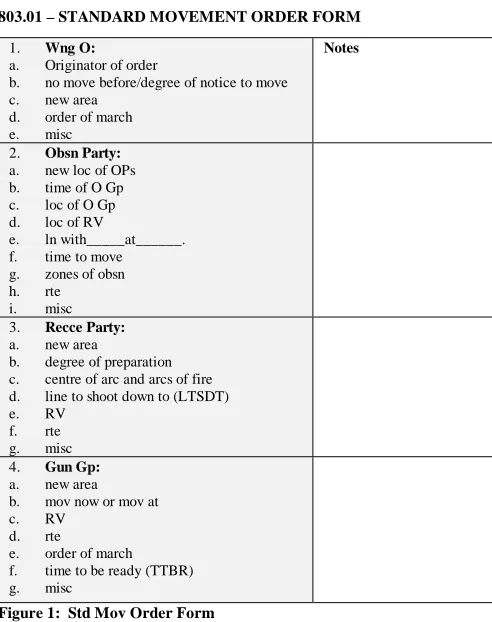
803.01 – STANDARD MOVEMENT ORDER FORM 1. Wng O:
a. Originator of order
b. no move before/degree of notice to move
c. new area
d. order of march
e. misc
Notes
2. Obsn Party:
a. new loc of OPs
b. time of O Gp
c. loc of O Gp
d. loc of RV
e. ln with_____at______.
f. time to move
g. zones of obsn
h. rte
i. misc
3. Recce Party:
a. new area
b. degree of preparation
c. centre of arc and arcs of fire
d. line to shoot down to (LTSDT)
e. RV
f. rte
g. misc
4. Gun Gp:
a. new area
b. mov now or mov at
c. RV
d. rte
e. order of march
f. time to be ready (TTBR)
[image:9.306.37.283.69.380.2]g. misc
Figure 1: Std Mov Order Form
803.02 – ROYAL CANADIAN ARTILLERY YARDSTICKS
1. The times shown are a guide for planning purposes only. Actual
8-2 B-GL-332-004/FP-001 DEPLOYMENT
2. To prep area after arrival of full regt recce party:
a. min: 30 min;
b. normal: 1 ½ hrs;
c. max: 3 hrs.
3. To move a bty off a main rte, into action, and report “READY“:
a. 105 mm How (towed): 15 min;
b. 105 mm LG1 (towed): 15 min; and
c. 155 mm How self-propelled (SP): 15 mins.
4. To dig a gun pit for a 105 mm How (by hand), in average grd, with seven
detachment members working in shifts: 4 to 6 hrs.
5. To load an MLVW truck using six men with:
a. 100 rds of 105 mm ammo: 20 mins; and
b. 48 rds of 155 mm ammo: 30 mins.
LOCATING DEVICES 6. Sound Ranging (SRG).
SRG BASE
NO. OF MIC
DISTANCE APART
TOTAL LENGTH
TIME TO DEPL INCL RECCE/ SVY/LAY LINE
TIME TO DEPL USING RAD LINK EQPT
Short 4 300 to 700 m 900 to
2100 m 1 ½ to 5 hrs 1 to 2 hrs
Long 9 1500 to
2000 m 12 000 to16 000 m 6 to 8 hrs 3 to 4 hrs
Figure 2: Sound Ranging Depl Times
7. Survey. A survey (svy) tp can be expected to fix 12 to 16 survey control points (SCPs) a day.
8. Radar. To close down, come out of action, move 5 kms, and come into action again, incl recce: 30 to 45 mins.
AIR OBSERVATION
9. Endurance. The Tac Sp Flt of the Tac Hel Sqn can maint an ac on continuous watch throughout the hrs of daylight (if no other task). One sortie can remain in the air up to 2 hrs. Weather is the restricting factor.
FIRE PLANNING
Insert — Field Artillery 8-3
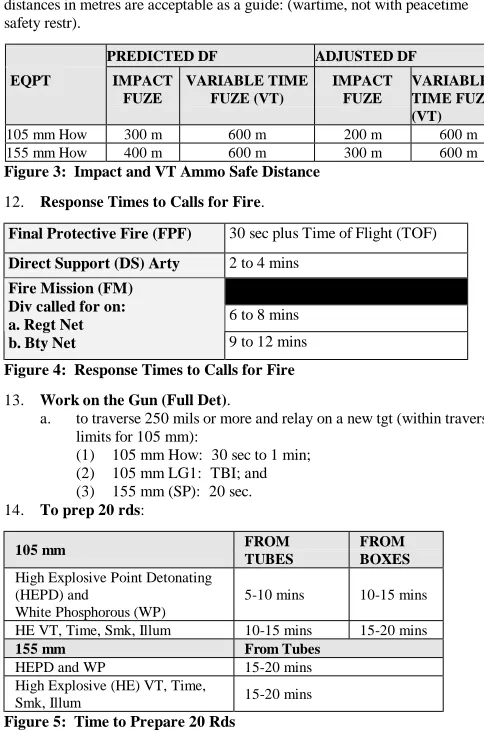
11. Defence. The proximity of defensive fires (DFs) to our dug-in tps must be
assessed by the arty observer bearing in mind prevailing conditions. The fol distances in metres are acceptable as a guide: (wartime, not with peacetime safety restr).
PREDICTED DF ADJUSTED DF
EQPT IMPACT
FUZE
VARIABLE TIME FUZE (VT)
IMPACT FUZE
VARIABLE TIME FUZE (VT)
105 mm How 300 m 600 m 200 m 600 m
155 mm How 400 m 600 m 300 m 600 m
Figure 3: Impact and VT Ammo Safe Distance 12. Response Times to Calls for Fire.
Final Protective Fire (FPF) 30 sec plus Time of Flight (TOF) Direct Support (DS) Arty 2 to 4 mins
6 to 8 mins Fire Mission (FM)
Div called for on: a. Regt Net
[image:11.306.34.276.48.425.2]b. Bty Net 9 to 12 mins Figure 4: Response Times to Calls for Fire 13. Work on the Gun (Full Det).
a. to traverse 250 mils or more and relay on a new tgt (within traverse
limits for 105 mm):
(1) 105 mm How: 30 sec to 1 min;
(2) 105 mm LG1: TBI; and
(3) 155 mm (SP): 20 sec.
14. To prep 20 rds:
105 mm FROM
TUBES
FROM BOXES High Explosive Point Detonating
(HEPD) and
White Phosphorous (WP)
5-10 mins 10-15 mins
HE VT, Time, Smk, Illum 10-15 mins 15-20 mins
155 mm From Tubes
HEPD and WP 15-20 mins
High Explosive (HE) VT, Time,
Smk, Illum 15-20 mins
8-4 B-GL-332-004/FP-001 803.03 – ACCURACY/TOLERANCES 1. Production Firing Data.
SER
INSTRUMENT TO
INSTRUMENT
TOLERANCE
1
Indirect Fire Control Computer System (IFCCS) -IFCCS
NONE
2
Battery Fire Control System (BFCS) – BFCS
1 mil/10 m
3 IFCCS/BFCS -MAPS 10 mils/100 m
4 maps – maps (b/w
Tech) 10 mils/100 m
5 GPO's Check Mapto All 20 mils/200 m
Figure 6: Production of Firing Data Accuracy/Tolerances 2. Linear Measurement.
SER INSTRUMENT ACCURACY/TOLERANCE
1 DI 1000 1/10 000 m
2 tp ranger 1/1000 m
3 laser rge finder
ANV/GS-5A (+) 10 m ALL RANGES
4 stadia rod UP TO 200 m (+) 5 m200 TO 400 m (+) 10 m
5 pacing 1/50 m
Figure 7: Linear Measurement Accuracy/Tolerances Orientation 3. Orientation.
SER INSTRUMENT ACCURACY/TOLERANCE
1 RSCP/SCP (+) 0.6 mils
2 simo (+) 2 mils (within 6000 m)
3 gyro (+) 0.6 mils
4 aiming circle
(compass) (+) 5 mils
5 T-16 theodolite(compass) (+) 5 mils
6 prismatic compass (+) 20 mils
Insert — Field Artillery 8-5 4. Fixation.
SER INSTRUMENT ACCURACY/TOLERANCE
1 map spot 200 m eastings & northings
2 resection 1/50 000 100 m eastings & northings
3 resection 1/25 000 50 m eastings & northings
4 survey control point
(SCP)
(+) 2 m eastings, northings, & altitude
5 regt survey control
point (RSCP)
(+)10 m eastings, northings & 1/2 contour
6
Precision Lightweight Global Positioning System Receiver (PLGR) + 96 Precision Positioning System (PPS)
(+) 10 m eastings & northings
7
PLGR+ 96 Standard Positioning System (SPS)
(+) 100 m eastings & northings Figure 9: Fixation Accuracy/Tolerances
5. Meterology.
SER INSTRUMENT ACCURACY/TOLERANCE
1 computation - computation 1 mil / 1 m
2 IFCCS - IFCCS TBD
3 BFCS - BFCS 1 mil / 10 m
Figure 10: Met Accuracy/Tolerances 803.04 – DEGREES OF PREPARATION
1. Min. The initial degree of readiness always includes:
a. confirmation that the area is suitable;
b. selection of gun, ech and CP areas;
c. check of crest clearance;
d. selection and map spot of pt of origin for bty svy; and
e. rough sketch of bty layout.
2. Normal. Is the degree of preparation for daylight occupation, includes all min preparation plus:
a. selection of posns for:
(1) director(s);
(2) gun platforms;
(3) CP’s; and
(4) wagon line if applicable.
b. markings, gun platforms;
c. completion of bty svy;
d. laying of line;
8-6 B-GL-332-004/FP-001
f. recording of convergence position (CP) and fuze correction (FC)
data; and
g. if time permits, any additional preparations for opening fire that can
be made.
3. Max. Is the max degree for daylight occupation and the normal degree for night occupation. Includes all normal preparation plus:
a. recce of a prelim posn;
b. recording of night reference objects (ROs) and angles to gun markers
from the director;
c. erection of night pickets and night directional signs;
d. additional preparations for orienting the guns as required;
e. laying of any line such as:
(1) from the director(s) to the CP;
(2) from the CP to the altn CP; and
(3) from the CP’s to the local def outposts as required; and
f. laying of marking tape at last light to mark rtes as required.
803.05 – SURVEY STATES
1. Survey States. The state of survey is normally sent to higher HQ, RCPO and the BC along with the report “READY”. They are as fol:
a. State A. All guns within the bty are not on common fixation and
orientation.
b. State B. All guns within the bty are on common orientation and
fixation.
c. State C. All guns within the bty are on common orientation and
fixation and in sympathy with the regt.
d. State D. All guns within the bty are on common orientation and
fixation and in sympathy with the div.
803.06 – ZONE TIME OF FLIGHT TABLES/CONVERSION TABLES
1. Zone TOF Tables: TBI
2. Conversion Table Mils/Degrees: TBI
3. Conversion Table Metres/Miles: TBI
SECTION 2 – OCCUPATION 803.07 – OBSERVATION POST
1. Main Duties of the Forward Observation Officer (FOO):
a. act as fire sp advisor and coord to sp arm comd at Cbt Tm level;
b. est an OP and observe a zone or area as ordered by his BC;
c. engage tgts;
d. report tac info to his BC, Bty CP, and sp arm as required;
e. report hostile mortaring, shelling, bombing, and nuc strikes to his BC
Insert — Field Artillery 8-7
f. report the suitability of potential gun areas to his BC and Bty CP;
and
g. perform all duties as detailed by his BC.
2. Purpose of Arty OPs:
a. engagement of tgts by observed fire;
b. battlefield surv;
c. fire planning; and
d. maint of ln with the tps being supported or in whose area the OP is
situated.
3. Selection of an OP. The OP should be located to provide the best possible view of the zone or area to be observed. It should also provide:
a. comd of the grd being occupied by the supported tps;
b. cover from grd and air obsn, including a covered approach to the OP;
c. high performance op of rad and other elec eqpt used by the party;
d. conformity with the local def pattern of the supported tps;
e. an OP base, i.e., a small area to serve as a maint base and vehicle
park, close to the OP and hidden from en obsn; and
f. it must be emphasized that a static OP is deployed as part of an
overall obsn plan and the responsibility for its depl is the BC, not the supported arm comd.
4. Occupation of an OP. The method of occupying an OP varies considerably with the type of op. Whether the occupation is to be carried out hastily during mobile ops or deliberately during static ops, the following factors must be considered:
a. the tac sit;
b. the availability of a covered approach to the OP;
c. the proximity to which vehs can be brought to the OP;
d. the protection and mobility of APCs during mech ops must be fully
exploited;
e. occupation of a static OP should take place during pds of poor
visibility or at night; and
f. cam and concealment must be of a very high std.
5. Initial Actions Upon Occupation. As soon as he occupies an OP, the observer will:
a. plot the OP and the zone of obsn on the map, send his loc to his BC,
and to the gun posn;
b. check his comms;
c. select on the map one or two prominent pts visible from the OP and
plot them to assist in orientation;
d. set up the tgt map;
e. conduct silent zone ident (confirm with tech);
f. ensure that the OP Tech sets up the laser range finder (LRF) and
orients it;
g. ensure that all other target acquisition (TA) means are set up;
h. begin prelim planning of a tgt list; and
8-8 B-GL-332-004/FP-001
6. Reporting and Recording of Info. An important task of the arty observer is the prompt accurate reporting of tac info. Info of immed value is reported without delay; other info is recorded and reported at intervals as ordered. The following shall be reported as they occur:
a. mov of own tps, so that safety may be ensured when tgts are engaged;
b. a description of each tgt engaged and the result of the engagement
(both sent as parts of calls for fire);
c. hostile shelling, mortaring, air, nuc and toxic atk, by use of the
appropriate report, i.e., SHELREP, MORTREP, BOMBREP, NUCREP, or TOXREP; and
d. any important or unusual en activity or mov.
7. All info obtained is recorded in the OP log. A sample extract from such a
log is shown below:
DATE TIME EVENT ACTION REMARKS
6 Jul 1005 3 APCs moving
west along rd 4467 - entered wood at 443673.
BC info.
1045 D Coy req wood
4567 blinded while 10 pl moves fwd 200 m.
Smk fired 1100 hrs. BC info.
Smk effective.
1135 10 pl now at
451664
BC and CP info.
1205 Shelling 400 m
WEST of OP.
SHELREP sent 1208 hrs. Figure 11: A Sample Extract from an OP Log
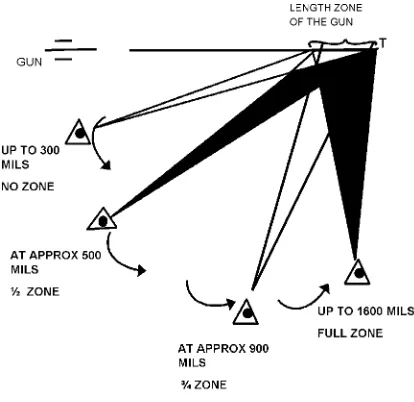
Insert — Field Artillery 8-9 Figure 12: Effect of Angle T on the Length of Zone
9. Example.
155 mm How M109 A1 Rge 9000 m charge 6 White Bag
Angle T = 500 mils 1 PEr = 24m
Therefore 82% zone = 4 X 24 = 96m Apparent length of zone = ½ of 96m = 48m
Therefore any rds within 24m of each side of line OT should initially be considered on line. For convenience this width of 24 m can be converted to mils as read in binos or by any other method of angular measurement:The following formula is used:
W — = M R
8-10 B-GL-332-004/FP-001 24
M = — = 8
3
Hence, all rds observed with binos that fall within 8 mils left and right of the tgt are considered on line.
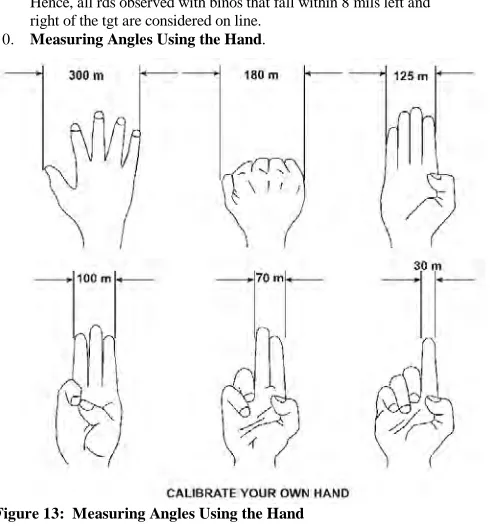
[image:18.306.21.266.58.321.2]10. Measuring Angles Using the Hand.
Figure 13: Measuring Angles Using the Hand
11. Panoramas. A panorama is a drawing of a view seen from an OP. Arty panoramas are useful for two purposes:
a. as an aid to an arty comd for briefing and indicating tgts for observed
fire to his subordinates; and
b. as an aid to obsn during periods of reduced visibility as an alternative
to the tgt map, and to assist in ident of features by moonlight and artificial means.
12. Shooting Tips:
a. Always have your OT factor ready before the first rd lands.
b. If first rd is likely to be lost, adjust original grid by a tgt grid
correction so that the rd will be seen.
c. Rehearse lost drill with your tech.
d. One observer uses binos, and other members of the party use eyes
Insert — Field Artillery 8-11
e. Consider angle T.
f. Always give a tac description for each tgt.
g. Record all tgts likely to be re-engaged.
h. Do not change line OT (dir) after initial rd, if angle T is over
500 mils, unless a min of two adjusting rds are off line OT.
i. Always measure off line distance of initial rd as accurately as
possible.
j. The no. of guns used and the duration of Fire For Effect (FFE) must
be decided before the call for fire is made. When the aim is to neutralize with HE, the principles observed are:
(1) an adequate no. of rds must fall in the tgt area;
(2) to be most effective, FFE is applied in bursts at varying
intervals with the max weight on the tgt during the first three minutes; and
(3) whenever obsn of FFE is possible, it must be done carefully and
every attempt made to render the fire more effective.
k. Observer goes into FFE:
(1) at the split of the short bracket;
(2) when he observes a tgt rd during adjustment; and
(3) during a shoot with mechanical time Fuzes, when the Mean
Pont of Burst (MPB) of three airbursts is adjusted to 20 m.
l. Short Brackets are as fol:
Bty (+/-) 100 m
Regt (+/-) 200 m
Div (+/-) 400 m
Figure 14: Short Brackets 803.08 – GUNLINE 1. Deployment:
a. Action on receipt of move orders (within 10 min):
(1) Nominate the recce O, if not the GPO.
(2) Give orders concerning:
(a) composition of recce party (altn CP, guides, protection
party);
(b) extra eqpt to be taken (aiming posts, etc.);
(c) loc of recce RV; and
(d) loc of gun gp RV or bty release point (rel P).
(3) Do a quick map recce of new area and rte ordered.
(4) Brief recce party.
b. En rte to new area:
(1) Check suitability of rte ordered.
(2) Report obstacles and rtes around them on regt net to DCO,
RCPO and bty.
(3) Report on regt net any suitable gun areas observed and likely
ambush areas to bty CP.
8-12 B-GL-332-004/FP-001
c. Upon arrival in new area:
(1) Conduct security sweep of area.
(2) Verify centre of arc (C of A) and arcs of fire with compass.
(3) Recce all areas allotted and check Crest Clearance and Line to
Shoot Down To (LTSDT).
(4) Posn a sentry to warn of air or grd atk.
(5) Select posns for:
(a) guns;
(b) CP area;
(c) A ech; and
(d) wagon lines, if nec.
(6) Call recce party fwd.
(7) Formulate bty svy plan and method of orienting bty director.
(8) Give dir to Battery Sergeant-major (BSM), PRONTO, Troop
Sergeant-major (TSM) on:
(a) loc of gun line, director, bty CP, A ech and wagon lines;
(b) outline local def plan and trk plan;
(c) laying of line;
(d) confirm gun gp RV, bty rel P (if required); and
(e) method of occupation.
(9) Posn gun markers.
(10) Check bty survey and bty director with compass (within
20 mils/100 m).
(11) Obtain CP and FC data.
(12) Report posn prepared with loc to Ops O, DCO, RCPO, BC and
bty.
(13) Select posns of assy for adv and wdr.
d. Upon arrival of the guns:
(1) Supervise occupation of the bty posn.
(2) Passage of line to the guns.
e. After occupation is completed:
(1) Check each gun with compass.
(2) Conduct check bearing and quick sight test.
(3) Order recce stores loaded for next recce/or update svy if time
permits.
(4) Check that CP set-up is complete (i.e. tgt records, laying of line,
tac map, etc.).
(5) BK briefs GPO, TSM and Nos 1 on:
(a) tac sit;
(b) local def plan;
(c) pri of work;
(d) stand easy areas;
(e) passwords; and
(f) adm pts.
Insert — Field Artillery 8-13 2. Bty Survey:
a. Orientation Only. Compare old grid bg to RO with new grid bg to RO. The difference is the amount of change required to the orientation:
(1) The change for the guns is equal to the old bg minus the new
bg.
(2) The change in RO’s and tgt records is the same amount
required for the guns but in the opposite dir.
(3) The following example shows the computation required:
(a) bg C of A – 0800 mils;
(b) old bg to RO – 3201 mils;
(c) new bg to RO – 3217 mils; and
(d) change in orientation for the guns [(b) minus (c)] is
– 16 mils or left 16 mils.
(4) The GPO would order “BG 0784 RECORD AT 0800” to the
guns.
(5) He would order “AMEND RO’S AND OLD GRID TGT
RECORDS RIGHT 16” to his CP Tech.
b. Fixation Only. Deduce a new grid (GR) for the bty centre and compare to the old one as fol:
(1) The orders for a change in fixation include the new GR and
altitude (alt) of the bty centre.
(2) The GPO would order “CHANGE TO REGT GR AT
____HRS, GR 12345678, ALT 311” to his CP Tech. c. Orientation and Fixation. If a change in both is required the steps
detailed in both sub-paras a and b are required. The GPO would order “CHANGE TO REGT GR AT ____HRS, BG 0784 RECORD AT 0800, AMEND RO’S AND OLD TGT RECORDS RIGHT 16 MILS; GRID 12345678, ALT 311”.
d. Simultaneous Obsn:
(1) All directors are levelled for Astral obsn.
(2) Master station orients the instrument and orders outstations:
“PREPARE TO TRACK THE __(SUN, MOON, ETC.)”.
(3) The outstations lay on the celestial body with 0000 mils on the
horizontal scale and using the lower gear track the celestial body Outstations report “READY”.
(4) Master station, using upper gear, tracks the celestial body and
orders “TRACKING 3-2-1 UP”.
(5) On “UP” all stations cease tracking and master station records
the bearing to the celestial body.
(6) If outstation tracked properly it will answer “ROGER OUT”.
If not the report “BAD TRACK OVER” will be made and the drill repeated.
(7) Master station sends its bearing to the celestial body and the
8-14 B-GL-332-004/FP-001
(8) The outstation, using the upper gear lays on the RO on the
horizontal scale. This reading is added to the bg passed by the master station. The result is the bg to the RO.
(9) The outstations set the bg to the RO on the horizontal scale and
lay on the RO. Using the upper gear swings onto the celestial body and reports “TRACKING, OVER”.
(10) The master station has followed the celestial body during this
interval and orders “TRACKING 3-2-1 UP, OVER”.
(11) The outstations answer “ROGER OUT”(see sub-para (4)).
(12) The outstations report the recorded angle (bg to the celestial
body) to the master station.
(13) If this bg agrees within 2 mils of the bg read by the master
station, the master station will answer “CORRECT, OUT”. If not, it will order “WRONG, REPORT WHEN READY, OVER” and the drill is repeated.
(14) Outstations will check the bearing to the RO with the Prismatic
compass against gross error. 3. Quick Actions:
a. Preparation for Opening Fire:
(1) GPO: Plots tgt and own loc on map. Determines bg of fire. Roughly lines up guns by indicating line of fire. Orients first gun by compass.
(2) Tech WO: Checks GPO’s plots and bg of fire. Determines rge. Prepares engagement data for the initial rd.
(3) Tech (Director): Sets up director. Passes line from first gun to remaining guns.
b. Establishing Parallelism: (1) Modified Individual Method:
(a) GPO directs first gun on by compass;
(b) after first rd fired orders “Aiming Point Director”;
(c) No.1 lays on director and reports reading;
(d) GPO orders No.1 to record at nearest 100 mils to bg of
fire;
(e) line passed by director to other guns after setting angle
passed by adjusting gun on director and laying on adjusting gun; and
(f) other guns ordered to record at same bg as ordered to
adjusting gun.
(2) Aiming Point Method: (Quickest method if a distant aiming point can be located to a flank)
(a) GPO determines bg to aiming pt;
(b) GPO subtracts this bg from the bg to tgt; and
(c) guns ordered to lay on aiming point, indicated by GPO at
this angle.
Insert — Field Artillery 8-15 5. Local Def of the Bty Posn:
a. Although local def is a resp of the BK, consideration begins with the
initial recce and includes a hasty plan adopted on occupation, before a detailed plan can be developed and orders for its implementation given.
b. The gun posn is laid out to meet the requirements for the provision of
indirect fire, protection from CB, and to provide concealment against detection. These considerations normally conflict with the requirements of a def posn. The local def plan must provide: early wng of the threat, the capability of dealing with limited en forces while maintaining indirect fire sp, or the all-out def of the posn when movement to an alternative cannot be effected and a determined atk has been launched against the posn.
c. The fol resources are normally aval:
(1) guns of the bty;
(2) small arms, MG’s and AT wpns within the bty;
(3) gren and def stores;
(4) DF/FPF from regt/div; and
(5) mutual sp from other posns deployed in the same area, once ln
completed.
d. The local def plan may be implemented in three basic stages. These
stages may be stated in orders or found in unit SOP’s. They are: (1) Stage 1: Normal air and grd sentries. LP’s, and limited
clearing patrols within bty area.
(2) Stage 2: All pers not engaged in firing the guns man trenches; atk wpns deployed to primary posns.
(3) Stage 3: All pers and wpns committed; may involve mov of gun(s) to prepared posns for the local def battle.
SECTION 3 – ENGAGEMENT OF TARGETS 803.09 – OPERATIONAL PLANNING
1. Effects of Fire. The desired effect of fire sp on a tgt has to be decided by the manoeuvre comd. There are three types of fire:
a. suppression—limits the ability of en pers to perform their msn;
b. neutralisation—knocks the tgt out of the battle temporarily; and
c. destruction—puts the tgt out of action permanently.
2. Categories of Tgts. Tgts engaged by observed fire may be divided into five categories:
a. fire msns against pers;
b. fire msns against eqpt and fd def;
c. illum msns;
d. indication; and
e. fire msns to obtain gun and survey data.
8-16 B-GL-332-004/FP-001
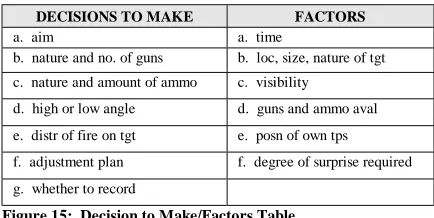
DECISIONS TO MAKE FACTORS
a. aim a. time
b. nature and no. of guns b. loc, size, nature of tgt
c. nature and amount of ammo c. visibility
d. high or low angle d. guns and ammo aval
e. distr of fire on tgt e. posn of own tps
f. adjustment plan f. degree of surprise required
[image:24.306.17.234.25.134.2]g. whether to record
Figure 15: Decision to Make/Factors Table INDICATION OF TGTS TO GUNS
4. Grid Ref. A six-figure GR is used for observed fire. The loc of the tgt should be found either from the tgt map or by plotting in the following sequence:
a. determine dir;
b. plot dir on map;
c. estimate distance OT and mark on map;
d. relate map detail to grd detail in area of tgt; and
e. make common sense check, e.g. is grid ref on reverse slope?
5. Tgt No or Known Pt. Best method when all CPs have recorded, e.g. ZR 1847, or Registration Point 1.
6. Tgt Grid Correction From a Recorded Tgt. New tgts must not be more than 500 mils from the recorded tgt. The following must be included in the call for fire:
a. recorded tgt no;
b. dir to NEW tgt;
c. tgt grid correction; and
d. vertical correction when difference in altitude is significant.
Ex.: “FROM ZP 1967, DIR 1340, RIGHT 100, ADD 400, UP 50.”
7. Polar Coordinates. If the observer’s loc is known by the CP, a tgt may be ordered to the guns by giving a dir (OT) and a distance. Included in the order to the guns must be:
a. dir OT (nearest 10 mils);
b. distance OT (nearest 1 m); and
Insert — Field Artillery 8-17 8. Observer’s Sequence of Initial Orders.
ORDER EXAMPLE
Observer’s Identification 3 THIS IS 31
Wng O FIRE MSN BTY
Loc of Target GRID 385 145, ALT 140
Dir DIR 4960
Description of Target MORS IN RAVINE, RADIUS 50
Type of Engagement ADJUSTING ZR 1335
Trajectory HIGH ANGLE
Ammo VT IN EFFECT, 3 RDS
Distr of Fire CONVERGE
At my Command AT MY COMMAND
Method of Adjustment or Orders for FFE
ADJUST FIRE NOTE: Boldfaced orders must be given in the initial sequence Figure 16: Observer’s Initial Sequence of Orders 803.10 – GUNLINE
1. GPO’s Initial Sequence of Orders.
ORDER EXAMPLE
Wng O FIRE MSN BTY
Type of Engagement ADJUSTING ZT 2015
Trajectory HIGH ANGLE
Ammo HE, TIME, CHARGE 4 (PREP 3 RDS/GUN)
Converge (1) CONVERGE NO. 1 LEFT 6…
Bearing BEARING 0568
Quadrant Laying QUADRANT LAYING
Gun Correction (1) GUN CORRECTION NO.1 PLUS 4, …
Fuze Correction (1) FUZE CORRECTION NO. 1
LENGTHEN 0.2,…
Fuze Setting FUZE NO.1 26.2,…
Load (2) NO. 1 LOAD
At My Comd AT MY COMD
Elevation ELEVATION 422
Method of Adjustment or Order for FFE
NO. 1 ADJUST FIRE
Description of Tgt MACHINE GUNS
NOTES
1. Boldfaced orders must be given in the initial sequence.
2. For manual systems only
3. Load may be ordered at any time providing the nec ammo orders
[image:25.306.35.264.43.258.2]have been issued.
8-18 B-GL-332-004/FP-001 2. Tgt Engagement Report.
ORDER EXAMPLE
Identification 0, 95 THIS IS 1
Sub-unit Engaged ENGAGED BTY
Tgt Loc GR 123 456
Tgt Description PL DUG IN RADIUS 50
Figure 18: Tgt Engagement Report 3. Availability Report.
ORDER EXAMPLE
Identification 0, 95 THIS IS 1
Availability AVAL
Tgt Results PL NEUTRALIZED
Tgt Number (if applicable) ZT 1240
Ammo expended 20
NOTE: In the example “20”refers to total ammo expended during this engagement. When different types of fuzes and propellants are used, they must be identified.
Figure 19: Availability Report
803.11 – AREA NEUTRALIZATION WITH HIGH EXPLOSIVE IMPACT
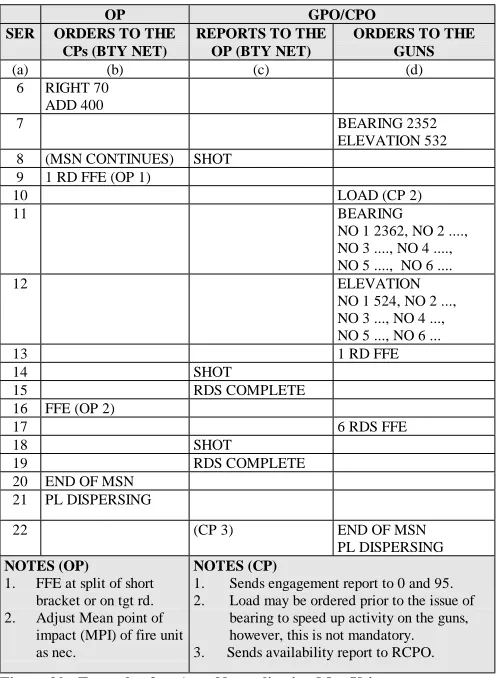
1. Example.
OP GPO/CPO
SER ORDERS TO THE CPs (BTY NET)
REPORTS TO THE OP (BTY NET)
ORDERS TO THE GUNS
(a) (b) (c) (d)
1 1 THIS IS 12
FIRE MSN BTY
(READ BACK ALL FIRE ORDERS)
2 FIRE MSN BTY
3 COORDS 167321
ALTITUDE 350 DIR 2300 PL DIGGING IN RADIUS 80 7 RDS ADJUST FIRE
4 (CP 1) HE, QUICK, GREEN
BAG, CHARGE 5, NUMBER 2 LOAD BEARING 2308 ELEVATION 532 NUMBER 2, ADJUST FIRE
Insert — Field Artillery 8-19
OP GPO/CPO
SER ORDERS TO THE CPs (BTY NET)
REPORTS TO THE OP (BTY NET)
ORDERS TO THE GUNS
(a) (b) (c) (d)
6 RIGHT 70
ADD 400
7 BEARING 2352
ELEVATION 532
8 (MSN CONTINUES) SHOT
9 1 RD FFE (OP 1)
10 LOAD (CP 2)
11 BEARING
NO 1 2362, NO 2 ...., NO 3 ...., NO 4 ...., NO 5 ...., NO 6 ....
12 ELEVATION
NO 1 524, NO 2 ..., NO 3 ..., NO 4 ..., NO 5 ..., NO 6 ...
13 1 RD FFE
14 SHOT
15 RDS COMPLETE
16 FFE (OP 2)
17 6 RDS FFE
18 SHOT
19 RDS COMPLETE
20 END OF MSN
21 PL DISPERSING
22 (CP 3) END OF MSN
PL DISPERSING NOTES (OP)
1. FFE at split of short
bracket or on tgt rd.
2. Adjust Mean point of
impact (MPI) of fire unit as nec.
NOTES (CP)
1. Sends engagement report to 0 and 95.
2. Load may be ordered prior to the issue of
bearing to speed up activity on the guns, however, this is not mandatory.
[image:27.306.36.284.25.364.2]3. Sends availability report to RCPO.
Figure 20: Example of an Area Neutralization Msn Using
2. Procedure for High Angle Msns. High angle fire may be required when firing from defiles, built-up area, rds, gullies, over high terrain features, or when tgts are located directly behind hills, crests, jungles, or ravines. The following procedures are followed for a call for fire:
a. order “HIGH ANGLE” as trajectory in initial call;
b. for airbursts use VT;
c. for LG1, or C3 guns, order “PREPARE FOR HIGH ANGLE AT
8-20 B-GL-332-004/FP-001
d. splash will be reported; and
e. met is not applied.
803.12 – AREA NEUTRALIZATION WITH HIGH EXPLOSIVE TIME 1. Example.
OP CPO
SER ORDERS TO THE CPs (BTY NET)
REPORTS TO THE OP (BTY NET)
ORDERS TO THE GUNS
(a) (b) (c) (d)
1 1 THIS IS 11
FIRE MSN BTY
(READ BACK ALL FIRE ORDERS)
2 FIRE MSN BTY
3
GRID 284 624 ALTITUDE 100 DIR 0620 MGS DUG IN RADIUS 100 TIME IN EFFECT, 5 RDS
AT MY COMD ADJUST FIRE
4 (CP 1)
5
HE, QUICK, CHARGE 6 PREPARE 5 RDS TIME PER GUN BEARING 1420 AT MY COMD ELEVATION 400 NO 4 ADJUST FIRE MGS DUG IN
6 READY 24 (GUNS REPORT
READY TO CP)
7 FIRE FIRE
8 SHOT 4
9
CANCEL AT MY COMD ADD 400
CANCEL AT MY COMD BEARING 1430 ELEVATION 382
10 SHOT
11 TIME DROP 50
Insert — Field Artillery 8-21
OP CPO
SER ORDERS TO THE CPs (BTY NET)
REPORTS TO THE OP (BTY NET)
ORDERS TO THE GUNS
(a) (b) (c) (d)
12
TIME
BEARING NO 3 1423, NO 4 1425, NO 5 1427 FUZE NO 3 16.0, NO 4 16.1, NO 5 16.2 AT MY COMD (CP 3) ELEVATION NO 3 389, NO 4 391, NO 5 393
NO 3, 4 AND 5 ADJUST FIRE (GUNS REPORT READY) FIRE
13 SHOTRDS COMPLETE
14 UP 40 (OP 2,3)
15
FUZE NO 3 15.7, NO 4 15.8, NO 5 15.9 ELEVATION NO 3 389, NO 4 391, NO 5 393
(GUNS REPORT READY) FIRE
16 SHOT
17 FFE (OP 4)
BEARING NO 1 1419, NO 2 1421 ... FUZE NO 1 15.5 ... CANCEL AT MY COMD ELEVATION NO 1 393 ... 5 RDS FFE
18 SHOT
19 RDS COMPLETE
20
RECORD AS ZP 3762
END OF MSN, MGS
8-22 B-GL-332-004/FP-001
OP CPO
SER ORDERS TO THE CPs (BTY NET)
REPORTS TO THE OP (BTY NET)
ORDERS TO THE GUNS
(a) (b) (c) (d)
21
RECORD AS ZP 3762, END OF MSN, MGS NEUTRALIZED
22 ZP 3762RECORDED
23 (CP 4)
NOTES (OP)
1. Order “TIME” at the split of the
short bracket or at a tgt rd with a correction if nec. E.g. “TIME, DROP 50”.
2. Corrections to height of burst
(HOB) (optimum 20 m) ordered in multiples of 10, e.g. “UP 40”
3. If initial rds of time burst on
impact “UP 40”will be ordered.
4. A normal tgt grid correction
should be used at FFE if rds are at correct HOB but MPB is incorrect.
NOTES (CP)
1. Sends engagement report to
RCPO.2.By convention three guns shall be used in adjustment.
2. The CPO shall control the moment
of firing when more than one gun is used in adjustment.
3. Sends availability report to
RCPO.
Figure 21: Example of an Area Neutralization Msn Using HE Time 803.13 – AREA NEUTRALIZATION WITH HIGH EXPLOSIVE VARIABLE TIME FUZE
1. Example.
OP CPO
SER ORDERS TO THE CPs (BTY NET)
REPORTS TO THE OP (BTY NET)
ORDERS TO THE GUNS
(a) (b) (c) (d)
1 1 THIS IS 11
FIRE MSN BTY
(READ BACK ALL ORDERS)
Insert — Field Artillery 8-23
OP CPO
SER ORDERS TO THE CPs (BTY NET)
REPORTS TO THE OP (BTY NET)
ORDERS TO THE GUNS
(a) (b) (c) (d)
3
FROM ZP 1738 DIR 1220 RIGHT 400 DROP 200 MORTARS DUG IN RADIUS 100 VT IN EFFECT (OP 1) 6 RDS
ADJUST FIRE (CP 1)
4
HE, QUICK, GREEN BAG, CHARGE 4 NO 3 LOAD PREPARE 6 RDS VT PER GUN BEARING 6101 ELEVATION 468 NO 3 ADJUST FIRE
MORTAR POSN 5
6 SHOT 3, 24
7 LEFT 200
ADD 400
8 BEARING 6010ELEVATION 453
9 (MSN CONTINUES) SHOT
10 DROP 50 1 RD FFE (OP 2) VT
11
BEARING NO 1 6015, NO 2 ... FUZE: NO 1, 2 AND 3 23.0; NO 4, 5 AND 6, 24.0 ELEVATION NO 1 457, NO 2 ... 1 RD FFE
12 SHOT
8-24 B-GL-332-004/FP-001
OP CPO
SER ORDERS TO THE CPs (BTY NET)
REPORTS TO THE OP (BTY NET)
ORDERS TO THE GUNS
(a) (b) (c) (d)
14 FFE (OP 3)
15 5 RDS FFE
16 SHOT
17 RDS COMPLETE
18
END OF MSN MORTARS STOPPED FIRING
19
(CP 2) END OF MSN
MORTARS STOPPED FIRING NOTES (OP)
1. Normally HE quick used in adjustment
2. HOB approx 7 m above tgt. 3. When using vt, if rds burst on impact
at ffe, observer should order “shorten 1.0” and continue to shorten fuze by one sec increments until airbursts are achieved.
NOTES (CP)
1. Sends engagement report to RCPO.
2. Sends availability report to RCPO.
Figure 22: Example of an Area Neutralization Msn Using HE VT 803.14 – ENGAGEMENT USING POLAR COORDINATES 1. Example.
OP CPO
SER ORDERS TO THE CP
REPORTS TO THE OP
ORDERS TO THE GUNS
(a) (b) (c) (d)
1 FIRE MSN BTY (READ BACK ALL ORDERS)
2 FIRE MSN BTY
3
Insert — Field Artillery 8-25
OP CPO
SER ORDERS TO THE CP
REPORTS TO THE OP
ORDERS TO THE GUNS
(a) (b) (c) (d)
4 (CP 2)
HE QUICK, GREEN BAG, CHARGE 5, BEARING 2901, ELEVATION 335 NUMBER 1, ADJUST FIRE PREPARE 5 RDS VT PER GUN
5 SHOT 1, 26
6
DIR 1520 DISTANCE 4550 FFE
(OP 2,3)
7
VT
BEARING NO 1 2919, NO 2
FUZE SETTING NO 1 26.0, NO 2 LOAD
ELEVATION NO 1 320, NO 2…5RDS FFE
8 SHOT
9 RDS
COMPLETE
10 PL
WITHDRAWING NW INTO DEFILE TGT (CP 3) DIR 0220 DISTANCE 3800 UP 15
SECTION POSN WITH 2 HMGS RADIUS 70, ADJUSTING ZP 4820
ADJUST FIRE
11 (CP 4)
HE QUICK, GREEN BAG, CHARGE 5,
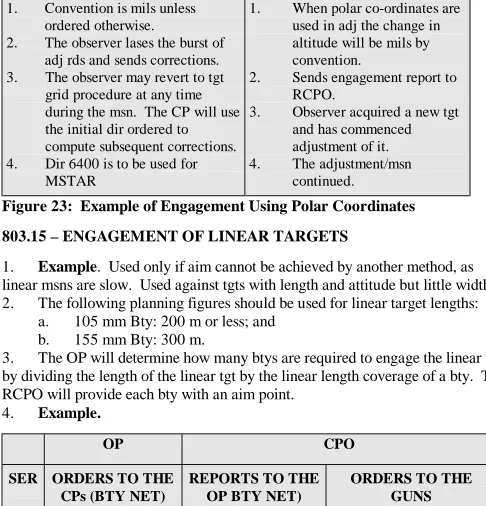
8-26 B-GL-332-004/FP-001 NOTES (OP)
1. Convention is mils unless
ordered otherwise.
2. The observer lases the burst of
adj rds and sends corrections.
3. The observer may revert to tgt
grid procedure at any time during the msn. The CP will use the initial dir ordered to compute subsequent corrections.
4. Dir 6400 is to be used for
MSTAR
NOTES (CP)
1. When polar co-ordinates are
used in adj the change in altitude will be mils by convention.
2. Sends engagement report to
RCPO.
3. Observer acquired a new tgt
and has commenced adjustment of it.
4. The adjustment/msn
[image:34.306.17.260.37.290.2]continued. Figure 23: Example of Engagement Using Polar Coordinates 803.15 – ENGAGEMENT OF LINEAR TARGETS
1. Example. Used only if aim cannot be achieved by another method, as linear msns are slow. Used against tgts with length and attitude but little width.
2. The following planning figures should be used for linear target lengths:
a. 105 mm Bty: 200 m or less; and
b. 155 mm Bty: 300 m.
3. The OP will determine how many btys are required to engage the linear tgt
by dividing the length of the linear tgt by the linear length coverage of a bty. The RCPO will provide each bty with an aim point.
4. Example.
OP CPO
SER ORDERS TO THE CPs (BTY NET)
REPORTS TO THE OP BTY NET)
ORDERS TO THE GUNS
(a) (b) (c) (d)
1 1 THIS IS 11
FIRE MSN BTY
(READ BACK ALL ORDERS)
2 FIRE MSN BTY
3
GRID 124 836 ALT 180 DIR 1380 ATK POSN 200 ATTITUDE 1850 8 RDS LINEAR (OP 3) ADJUST FIRE
(OP 1) (OP 2)
Insert — Field Artillery 8-27
OP CPO
SER ORDERS TO THE CPs (BTY NET)
REPORTS TO THE OP BTY NET)
ORDERS TO THE GUNS
(a) (b) (c) (d)
4 (CP 1)
HE, QUICK, WHITE BAG, CHARGE 5, PREPARE 8 RDS PER GUN BEARING 2193. ELEVATION 362 NO 3 ADJUST FIRE
5 SHOT 3, 24
6 DROP 400
7 BEARING 2183
ELEVATION 358
8 SHOT
9 (MSN CONTINUES)
AT MY COMD FFE (CP 2)
10
BEARING NO 1 2179, NO 2 ....
NO 3 .... AT MY COMD ELEVATION NO 1 354, NO 2 ...
8 RDS FFE
11 READY
12 FIRE
13 FIRE
14 SHOT
15 RDS COMPLETE
16 END OF MSNEN DISPERSING
17 (CP 3) END OF MSN, ENDISPERSING
NOTES (OP)
1. Tgt loc is at centre of tgt.
2. Length to nearest 100 m, attitude
to nearest 50 mils.
3. Order “LINEAR” as distr of fire.
4. Use “AT MY COMD” for best
effect on the tgt
5. Adj centre point of linear.
NOTES (CP)
1. Sends engagement report to RCPO.
2. In this case the observer has
ordered AT MY COMD to control the time of arrival of the rds.
3. Sends availability report to RCPO.
8-28 B-GL-332-004/FP-001 803.16 – ENGAGEMENT OF MOBILE TARGETS 1. Example.
OP CPO
SER ORDERS TO THE CP REPORTS TO THE OBSERVER
ORDERS TO THE GUNS
(a) (b) (c) (d)
1 1 THIS IS 11FIRE MSN BTY (READ BACKALL ORDERS)
2 FIRE MSN BTY
3
DIR 1510 DISTANCE 4600 TP OF TANKS MOVING EAST AT MY COMD
5 RDS FFE (OP 1)
4 (OP 2)
(CP 1)
HE CHARGE 5, QUICK, GREEN BAG, BEARING NO 1 2921, NO 2, 2926, NO 3 ....
5 AT MY COMD
6
ELEVATION NO 1 394, NO 2 397, NO 3 ...
5 RDS FFE
7 READY 24
8 FIRE
9 FIRE
10 SHOT
11 RDS COMPLETE
12
TGT DIR 1720 DISTANCE 3600 UP 20
AT MY COMD 5 RDS FFE
(CP 2) (OP 3)
13
LOAD
BEARING NO 1, 3162, NO 2 3165, NO 3 14
ELEVATION NO 1 362, NO 2 367, NO 3
15 5 RDS FFE
16 READY 20
17 FIRE
18 SHOT
Insert — Field Artillery 8-29
OP CPO
SER ORDERS TO THE CP REPORTS TO THE OBSERVER
ORDERS TO THE GUNS
(a) (b) (c) (d)
20
END OF MSN 2 TANKS DESTROYED REMAINDER WITHDRAWING INTO WOODLINE
21 (CP 3)
END OF MSN, 2 TANKS DESTROYED; REMAINDER WITHDRAWING INTO WOODLINE
NOTES (OP)
1. Speed is important. Normal adj may
not be possible. Use HEPD or VT. Avoid mechanical time super quick (MTSQ) fuze or CONVERGE msns, or other orders likely to cause delay.
2. Tgts likely to move:
a. Carefully predict grid of tgt and
open one rd FFE from as many guns as possible. Be prep to follow with max weight of fire or quick correction ASAP.
b. Adj off the tgt to avoid alerting it,
then give accurate correction to tgt and max fire at an intense rate.
3. Moving Tgts:
a. If tgt is approaching recorded tgt or
pt accurately loc on map, give call for fire with AT MY COMD and order fire TOF minus of tgt arrival at desired pt.
b. If “a.” is not possible, open with 1 rd
FFE in path of tgt and correct boldly with FFE.
4. When dir changes by more than
500 mils order a new dir.
NOTES (CP)
1. Sends engagement report to
RCPO.
2. Since the tgt is still mobile,
the prefix of tgt to a new dir, distance and angle of sight indicate to the CPO that the observer is ordering a new tgt loc.
3. Sends availability report to
RCPO.
Figure 25: Example of Engagement of a Mobile Tgt
8-30 B-GL-332-004/FP-001
a. DISTANCE (m) X 2 + 10 % = SPEED (mph)
TIME (SEC)
b. TIME (SEC) SPEED (mph) – 10 % = DISTANCE (m)
2
Figure 26: Moving Tgt Travel, Graphical Solution 803.17 – REGIMENTAL AND HIGHER MISSIONS
1. General. The procedure for a regimental or higher msn is similar to that for a bty fire msn. The differences for these higher msns lie in:
a. the auth, or lack of it, of the observer to order the engagement and the
weight of fire;
b. the weight of fire; and
c. the procedures for controlling the fire of several independently
deployed fire units.
2. Priority of Fire. An observer who has been granted pri of fire is treated like an auth observer. If the observer is a BC, the FOOs working for him are also treated as auth.
SER OBSERVER'S ORDERS
RCPO ORDERS REMARKS
Insert — Field Artillery 8-31 SER OBSERVER'S
ORDERS
RCPO ORDERS REMARKS
2
GRID 452 362 DIR 1220
COY POSN RADIUS 200
DELAY IN EFFECT 10 RDS
AT MY COMD ADJUST FIRE
(Note 1)
3
11, CC 1 THIS IS 0 REGT 10 RDS ZT 1230
0 sends to observer and batteries
4 REGT 10 RDS
ZT 1230 FOO reads back
5 2 - READY 28
2 - reports “READY” then 0 sends to FOO
6
2 READY 28 CANCEL AT MY COMD 2 ADJUST FIRE 2 FIRE
CANCEL AT MY COMD 2 – ADJUST FIRE 2 - FIRE NOTES
1. RCPO is responsible for putting “AT MY COMD” into effect, if not done so by the observer, and sending message to the observer.
2. Message to observer indicates Guns or Btys to fire, projectile and fuze combination if different than that ordered by the observer, no of rds to be applied at FFE, and tgt number.
Figure 27: Example of a Regimental Msn—Ordinary Observer 3. Authorized Observer. An auth observer directs his orders to the RCPO. He can select the adjusting bty, if desired. If the observer does not designate the adjusting bty, it will be designated by the RCPO. This procedure permits the RCPO to co-ordinate the fire msn, permitting the observer more of an opportunity to observe and advise.
803.18 – ADJUSTMENT FOR FUTURE ENGAGEMENT 1. General. Adjustment for future engagement is undertaken so that subsequent FFE may be more accurately applied than by unobserved predicted fire.
2. Two situations may arise that will determine the procedure to be used:
8-32 B-GL-332-004/FP-001
b. Adjustment to Determine Coordinates. This procedure is carried out to determine, by firing, the coordinates of the tgt for circulation to other fire units.
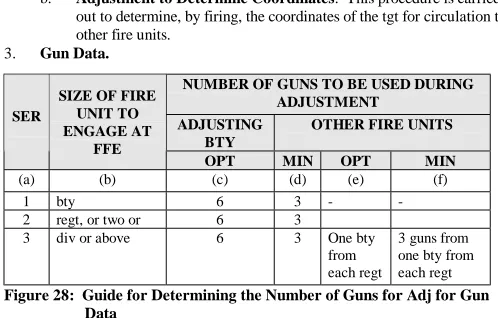
3. Gun Data.
NUMBER OF GUNS TO BE USED DURING ADJUSTMENT
ADJUSTING BTY
OTHER FIRE UNITS SER
SIZE OF FIRE UNIT TO ENGAGE AT
FFE
OPT MIN OPT MIN
(a) (b) (c) (d) (e) (f)
1 bty 6 3 -
-2 regt, or two or 6 3
3 div or above 6 3 One bty
from each regt
[image:40.306.16.265.33.192.2]3 guns from one bty from each regt Figure 28: Guide for Determining the Number of Guns for Adj for Gun
Data
4. Conduct of Adjustment. The adjustment shall be carried out in the normal manner until a suitable short bracket or tgt rd is obtained. The observer shall then order each participating fire unit to fire one rd in adjustment or FFE depending upon the nature of the tgt and the number of guns required from each unit. When adjusting with more than one fire unit, each fire unit, in sequence, shall be adjusted onto the tgt, ordered to record the tgt and then given END OF MSN. If the fire units are being adjusted onto different points in the tgt area, a different tgt number will be assigned to each point.
5. Example. SER OBSERVER'S
ORDERS
RCPO'S REPORTS
NOTES
(a) (b) (c)
1
0, CC1 THIS IS 19 FIRE MSN REGT 2 AND 3, THREE GUNS
(1)
1. The msn is being conducted by an auth observer with a three-bty regt. He requires six guns from the adjusting bty and three guns from each of the other batteries. 2
GRID 452 362, ALTITUDE 320, DIR 1220
3 COY POSN,RAD 200
4 ADJUSTINGZT 5621 (2)
2. The observer gives the tgt number to be used when the tgt is recorded.
Insert — Field Artillery 8-33 SER OBSERVER'S
ORDERS
RCPO'S REPORTS
NOTES
(a) (b) (c)
6 ADD 200 1 SHOT
7
DROP 100, 1 ONE RD FIRE FOR EFFECT
1 SHOT RDS COMPLETE
8
1 RECORD AS TGT, 1 END OF MSN
(3)
3. All rds land in the tgt area.
9 2 ONE RD FIREFOR EFFECT 2 SHOT,31 (3) 3. All rds land in the tgt area.
10
2 RECORD AS TGT, 2 END OF MSN
11 ONE RD FIREFOR EFFECT SHOT,28 (4) 4. C/S 3 is the only fire unitremaining on the msn.
12 ADD 100,REPEAT SHOT,ROUNDSCOMPLETE (5) 5. All rds land in the tgt area.
13
RECORD AS TGT, END OF MSN
Figure 29: Example of a Regimental Fire Msn, Adjustment for Gun Data 6. Coordinates—Conduct of Adjustment. The observer shall use one gun for adjustment until a 100 m bracket or a tgt rd is obtained, and then use the remaining guns to adjust the MPI employing registration procedures. The tgt will be recorded at a correction of ADD/DROP 25.
SER OBSERVER'S ORDERS
GPO's REPORTS
NOTES
(a) (b) (c) (d)
1
1 THIS IS 11 FIRE MSN THREE GUNS GRID 7651 4314 ALTITUDE 200 DIR 4820 ADJUSTING ZT 1364 CONVERGE, ADJUST FIRE
1. 3 guns are used because
MPI can be more readily adj
2. Order “CONVERGE” in
initial sequence of orders
2 SHOT 2, 26 3. One gun adjusts fire
3 RIGHT 50
DROP 400 SHOT
4 ADD 200 SHOT
8-34 B-GL-332-004/FP-001 SER OBSERVER'S
ORDERS
GPO's REPORTS
NOTES
(a) (b) (c) (d)
6
ADD 50, 1 RD FIRE FOR EFFECT
SHOT, RD
COMPLETE 4. All rds plus
7 DROP 50,REPEAT SHOT, RDCOMPLETE 5. All rds minus
8
RECORD AS TGT AT ADD 25, END OF MSN
Figure 30: Example of a Fire Msn to Determine Coordinates 803.19 – ILLUMINATION MISSIONS
1. The illuminating projectile is a carrier type, fitted with a time fuze and
containing an illuminating canister attached to a parachute. The shell is activated at the optimum HOB and under ideal conditions. The effects are as fol:
SER CHARACTERISTIC 105 mm 155 mm 81 mm
(a) (b) (c) (d) (e)
1 HOB 750 m 600 m 250 m
2 BURNING TIME 60 secs 120 secs 35 secs
3 RATE OF DESCENT 10 m/s 5 m/s 2.5 m/s
[image:42.306.17.265.27.144.2]4 ILLUMINATINGDIAMETER 800 m 1000 m 600m
Figure 31: Illuminating Shell Characteristics
2. The Illum Msn. Purely illum msns shall follow the std format. Adjustment is carried out using a single gun firing illuminating ammo. The following methods may be ordered for distr of fire:
a. Lateral Spread. Two guns are fired simultaneously with a lateral spread left and right of the tgt, in relation to the gun line.
b. Rge Spread. Two guns are fired simultaneously at a rge spread plus and minus of the tgt, in relation to the gun line
c. Diamond Illum. Four guns are fired simultaneously (two at a rge spread, and two at a lateral spread).
d. One or Two Gun Illum. One or two guns are directed at a single point of origin. The observer adjusts onto the centre of the area to be illuminated.
Insert — Field Artillery 8-35
OBSERVER'S ORDERS NOTES
1 THIS IS 12
FIRE MSN FOUR GUNS GRID 128346, ALT 500, DIR 4820
SUSPECTED ASSEMBLY AREA.
ILLUM, 12 RDS. DIAMOND ILLUM. ADJ FIRE.
1. The number of rds is only an estimate; it
is based on the burning time and the length of time illum is required.
RIGHT 200. ADD 400. UP 50.
2. Tgt Grid Corrections. Due to the characteristics of illum, corrections of less than 200 m are not worthwhile. 3. HOB. The proper HOB will allow the
illuminating flare to stop burning just before it strikes the grd. When the HOB is too low, the correction is determined from the length of time (in sec) that the flare burned on the grd, multiplied by the rate of descent in metres per second. Up or Down corrections for HOB are ordered to the nearest 50 m. AT MY COMD.
CONTINUOUS FIRE 30 SECONDS.
4. Both rge and lateral rge spread are applied
FIRE
CEASE LOADING. 5. This ensures that the guns are not left
loaded with illuminating ammo if all 12 rds are not needed to be fired. END OF MSN. ILLUM
[image:43.306.34.284.23.377.2]EFFECTIVE. NO VISIBLE TP MOVEMENT.
Figure 32: Example of a Diamond Illum Msn
8-36 B-GL-332-004/FP-001 4. Example.
OP CPO
SER ORDERS TO THE CP
REPORTS TO THE OP (BTY NET)
ORDERS TO THE GUNS
(a) (b) (c) (d)
1 1 THIS IS 11
FIRE MSN BTY
(READ BACK ALL ORDERS)
2 FIRE MSN BTY
3
GRID 245 361 ALT 100 DIR 1210 MGS DUG IN RADIUS 50 ILLUM IN ADJUSTMENT VT IN EFFECT 10 RDS ADJUST FIRE
(OP 1)
4
(CP 1) NO 1 ILLUMINATING,
GREEN BAG, CHARGE 4 PREPARE 8 RDS (CP 2) NO 2, 3, 4, 5 AND 6 HE, QUICK, GREEN BAG, CHARGE 4 PREPARE 10 RDS VT PER GUN
BEARING 1281 (CP 3) NO 2, 3, 4, 5 AND 6 REST FUZE 25.7
ELEVATION 560 NO 1 ADJUST FIRE
5 SHOT 1, 26
6 LEFT 400
UP 50
7 BEARING 1202FUZE 25.2
ELEVATION 555
8 SHOT
(ADJUSTMENT WITH ILLUMINATING SHELLS CONTINUES) 9
DROP 200 COORD ILLUM 60 SECONDS
Insert — Field Artillery 8-37
OP CPO
SER ORDERS TO THE CP
REPORTS TO THE OP (BTY NET)
ORDERS TO THE GUNS
(a) (b) (c) (d)
10
BEARING 1236 FUZE 24.6 CANCEL REST AT MY COMD ELEVATION NO 1 560 COORD ILLUM ELEVATION 275 NO 2 ADJUST FIRE (CP 5 AND 6) (NO 1 AND 2 REPORT READY)
NO 1 FIRE
11 SHOT
12 (60 second interval)(CPO will control fire or
issue interval)
13 SHOT
14 1 RD FFE
15
VT
BEARING NO 2 1248, NO3 ....
FUZE NO 2 24.6, NO 3 ELEVATIONS NO 2 560, NO 3
1 RD FFE
(GUNS REPORT READY)
16 SHOT
17
(60 second interval) (CPO will control fire or issue interval)
18 SHOT
19 RDS COMPLETE
20
8-38 B-GL-332-004/FP-001
OP CPO
SER ORDERS TO THE CP
REPORTS TO THE OP (BTY NET)
ORDERS TO THE GUNS
(a) (b) (c) (d)
21
CANCEL
COORDINATED ILLUM NO 1 VT, GREEN BAG, CHARGE 4
BEARING NO 1 1293, NO 2 ....
FUZE NO 1 23.0, NO 2 ....
CANCEL AT MY COMD ELEVATION NO 1 382, NO 2 ...
9 RDS FFE
22 SHOT
23 RDS COMPLETE
24
END OF MSN MGS STOPPED FIRING
25 (CP 7) END OF MSN
MGS STOPPED FIRING NOTES (OP)
1. If the observer desires the
initial rd of illiminating ammo to be fired at a point different from the grid reference ordered, he shall include a tgt grid correction in his initial sequence e.g. “GR 139 459, DIR 1400, ILLUMINATING A 800”.
2. By convention, the order
“COORD ILLUM” is the executive order to commence HE adjustment.
3. The interval is calculated by
subtracting the HE TOF from the time elapsing between the illuminating gun report or shot and effective illum.
NOTES (CP)
1. Sends engagement report to RCPO.
2. CPO prepares sufficient illuminating
rds required for msn.
3. This negates the requirement to take
post to lay later in the msn.
4. By convention the initial rd in the
adjustment shall be HE unless otherwise ordered and will be fired at the grid ordered in the initial orders unless specifically directed otherwise.
5. By convention, after the order
“COORD ILLUM” has been issued, all further tgt grid corrections apply only to HE unless specifically directed otherwise.
6. Following the order “COORD
ILLUM”, the illuminating gun ignores all orders not prefixed by his number.
[image:46.306.18.265.23.359.2]7. Sends availability report to RCPO.
Insert — Field Artillery 8-39 803.20 – LASER POINT MSN
1. General. A Laser Point (LP) msn is conducted to determine corrections for non-std conditions to be applied to a specific tgt fired by the same observer using polar co-ordinates that meet registration criteria, less projectile and propellant types. It is a similar form of the laser registration procedure except that the target loc is not as accurately known and is used to produce an LP correction. Normally one gun is used in the initial adjustment but three guns must be used to confirm the LP MPI. Three guns can be used throughout depending on the observer's decision based on terrain, visibility and zone.
2. If more than one fire unit is to be used, it may be conducted as fol
:
a. If all batteries are within registration parameters, one bty adjusts onto
the LP, and then circulates the data. The observer can then call for check rds from the other fire units.
b. Each bty is adjusted and recorded individually onto the LP. This
requires more time, but gives a greater guarantee of accuracy.
3. The area of validity of LP data is limited to:
a. bearing of 500 mils left and right of the LP as measured from the
OP's loc;
b. normal registration limits if OP and guns are on the same grid; and
c. a period of validity equal to the current met message.
4. Example of Regimental Laser Pt Msn.
OP CPO
SER ORDERS TO THE CP REPORTS TO THE OBSERVER
(a) (b) (c)
1
FIRE MSN REGT, 3 GUNS DIR 1080 DISTANCE 3870, UP 30
COY DUG IN RADIUS 200 ADJUSTING LP ZT 4600 1 ADJUST FIRE
(OP 1)
(CP 1)
(CP 2)
2 1 SHOT 1, 34 (CP 3)
3 1 DIR 1090, 1 DISTANCE 3800,
1 ONE RD FEE
4 1 SHOT, RD COMPLETE (CP 4)
5 1 RECORD AS LP ZT 4600,2 ADJUST FIRE
6 2 SHOT 1,24
7
2 RECORD AS LP ZT 4600, 3, BTY RIGHT,
8-40 B-GL-332-004/FP-001
OP CPO
SER ORDERS TO THE CP REPORTS TO THEOBSERVER
(a) (b) (c)
8 3 SHOT 1, 31, 3 SHOT 2,
3 SHOT 3 9
3 DIR 1070, 3 DISTANCE 3760, 3, ONE RD FEE
10 3 SHOT, RD COMPLETE
11 3 RECORD AS LP ZT 4600,4 ADJUST FIRE
12 4 SHOT, 1, 26
13 4 RECORD AS LP ZT 4600
14 ADOPT LP FOR IRON LUNG,END OF MSN (OP 2)
NOTES (OP)
1. Min of three guns per Call
Sign should be used to allow adjustment of MPI.
2. At this point laser point
correction will be applied to all targets on IRON LUNG. All targets can be engaged with predicted fire with a high degree of first rd accuracy. If guaranteed fire is required, then check rds should be fired on those targets that require it.
NOTES (CP)
1. When polar co-ordinates are used
in adjustment the change in altitude will be mils by convention.
2. Observers may use one or three
guns in adjustment and will specifically state this in the method ordered.
3. The observer can adjust the LP
with three guns depending on the conditions stated in para 3 of this section.
4. Observer lases MPI of the three rds.
Figure 34: Example of a Regimental Laser Point Msn 5. Example of a Bty Laser Point Msn.
OP CPO
SER ORDERS TO THE CP REPORTS TO THE OBSERVER
(a) (b) (c)
1 FIRE MSN BTY, 3 GUNS
DIR 1080
DISTANCE 3870, UP 30 COY DUG IN
RADIUS 200 ADJUSTING LP ZP 1260 ADJUST FIRE
Insert — Field Artillery 8-41
OP CPO
SER ORDERS TO THE CP REPORTS TO THE OBSERVER
(a) (b) (c)
3 DIR 1090, DISTANCE 3800,
BTY RT 1 RD FFE (OP 2)
4 SHOT, RD COMPLETE (CP1)
5 RECORD AS LP ZP 1260 (OP 3)
6 LP ZP 1260 RECORDED
7 ADOPT LP FOR IRON LUNG,
END OF MSN NOTES (OP)
1. Bty right may be ordered to
allow tech to lase each individual rd.
2. Target and LP are recorded.
NOTES (CP)
1. Bty right fired with std interval
between guns.
Figure 35: Example of a Bty Laser Point Msn 803.21 – REGISTRATION
1. General. The aim of registration is to determine by shooting, the corrections required to map bearing and map rge to compensate for the total effects of non-std conditions, i.e., weather, eqpt, ammo and survey errors. 2. Registration Limits. Under normal climatic and terrain conditions in the temperate zone, a registration is valid for approximately two hrs and may be transferred throughout the regt for use on tgts along the same general line of fire within registration limits.
3. The following limits should be used in the application of corrections from
the registration for the engagement of tgts:
a. Range. 2,000 m plus and minus of the map rge to the registration point.
b. Bearing. 500 mils left and right of the bearing of the adjusting gun to the registration point.
c. Altitude. Between the registration point and the tgt, no limit.
4. Corrections determined from a registration carried out by one fire unit may
be used by other fire units provided that the following conditions are satisfied in relation to the adjusting gun:
a. the guns must be of the same type, i.e., using the same firing tables;
b. the same type of propellant of the same lot and charge must be used;
c. the guns must be on the same grid;
d. the altitude of the guns must be within 200 m; and
8-42 B-GL-332-004/FP-001 Figure 36: Registration Limits
5. Control of Registration. The RCPO shall normally control the implementation of the registration policy within the regt, detailing to the batteries the:
a. loc of the registration point or points;
b. time at which registration will take place;
c. method of registration; and
d. charges, propellant, lot, and the types of ammo to be used.
6. The CPO shall inform the BC of the requirement for registration. The BC
shall then order one of his observers to conduct the registration.
7. When insufficient met or registration data are aval to ensure accurate fire
during a fire plan, an arty comd may decide to carry out a registration. He shall then specify the:
a. observer;
b. loc of the registration point;
c. time of the fire msn;
d. method of registration;
e. charges and types of ammo to be used; and
Insert — Field Artillery 8-43 8. Time Registration. Occasionally, it may be nec to conduct a time registration. The following factors must be considered:
a. the limited amount of time ammo aval; and
b. the fact that the fuze correction of the moment (C of M) is adjusted
automatically based on the results of each time msn engaged. 9. Example.
OP CPO
SER ORDERS TO THE CP (BTY NET)
ORDERS TO THE OP (BTY NET)
ORDERS TO THE GUNS
1 1 THIS IS 11 FIRE MSN 3
GUNS
(READ BACK ALL ORDERS)
2 (CP 1)
FIRE MSN NO 1, 2 AND 3
3
GRID 6392 4786 ALTITUDE 150 DIR 4790 REGISTRATION HE FOLLOWED BY TIME ADJUST FIRE
(OP 1)
4
REGISTRATION HE, QUICK, GREEN BAG, CHARGE 5 PREP 3 RDS TIME/GUN BG 4985 ELEV 461 NO 2 ADJUST FIRE
5 SHOT 2, 24
6 RIGHT 70 ADD 200
7 BG 4981 ELEV501
8 SHOT
MSN CONTINUES
9 ADD 50 1 RD FFE
10
BG NO 1 4995, NO 2 .... NO 3 .... AT MY COMD ELEV NO 1 488, NO 2 ... NO 3 ... 1 RD FFE (GUNS REPORT READY) FIRE
8-44 B-GL-332-004/FP-001
OP CPO
SER ORDERS TO THE CP (BTY NET)
ORDERS TO THE OP (BTY NET)
ORDERS TO THE GUNS
12 DROP 50 REPEAT(OP 2, CP 2)
13
BG NO 1 4989, NO 2 .... ELEV NO 1 484, NO 2 ... 1 RD FFE FIRE
14 SHOT, RDS COMPL
15
RECORD AS REGISTRATION POINT ONE AT A25
(OP 3,4, CP 3)
16
RECORD AS REGISTRATION POINT ONE
17 TIME, REPEAT
18
TIME FUZE NO 1 29, NO 2 ... ELEV NO 1 484, NO 2 ... 1 RD FFE FIRE
19 SHOT, RDS COMPL
20 UP 40, REPEAT (OP 5)
21
FUZE NO 1 29.2, NO 2 ...., NO 3 .... ELEV NO 1 494, NO 2 ..., NO 3 ... 1 RD FFE FIRE
22 SHOT, RDS
COMPLETE 23
RECORD AS TIME REGISTRATION PT 1 END OF MISSION
(OP 6, CP 4,5) NOTES (OP)
1. The grid ref must be as accurate as
possible (8 fig min).
2. Rds all impacted plus of the
registration point.
NOTES (CP)
1. Sends engagement report to RCPO.
2. The FFE all impacted plus of the