Abstract— Roof performance is measured by a number of factors. These includes its life span, effectiveness of its components to retain their strength, chemical and physical properties, appearance and resistance to all forms of failure. All these factors are dependent on the roof materials which are gotten from various sources such as clay, concrete, metal, wood, plastic and recently composite materials (i.e. a mixture of two or more materials). This research focuses on the design of a dual - composite material roof tiles machinery production layout, with the aim of improving on the already existing roof tiles machinery in some countries such as United States of America, Old Soviet Union, South Africa and Uganda. The composite materials that will be processed are plastic with sand and plastic with clay. Five machines are involved in the design of dual - composite material roof tiles machinery which are plastic shredder, dual - chamber dryer, dual-composite mixer, dual - composite extruder and dual - chamber moulding machine. These machines and there components were designed using SolidWorks software.
Index Terms— Composite materials, Design, Machinery, Production per day, Roof tiles.
I. INTRODUCTION
Housing all over the world has remained an interdependent phenomenon that affects every facet of mankind. Its importance is so pronounced that it imparts on the social, physical and mental wellbeing of man irrespective of his socio-economic status, colour or creed. This represents the most basic human needs and has no doubt impact on the health, welfare and productivity of the individual [2]. Buildings are structurally divided into both the sub-structure and structure. The roof as an element of the super-structure serve a great purpose and this is dependent on the type of roof, likewise as the material of the roof. Roofs come in various materials such as clay, concrete, metal and the most recent is the use of composite materials (mixture of different materials such as clay and plastic).
Roofs are susceptible to weather effects and failures. The ultimate and more easily noticeable type of structural failure is roof collapse while thermal failure manifests itself in the form of reduced ability to act as barrier to heat flow from the atmosphere to the building interior [1][4][8]. Other indices of roof failure include leakages, condensation and rusting or corrosion. These failures are material based; thereby necessitating the need to look into various roofing materials especially roof tiles.
Manuscript submitted December 30, 2015.
Oluwafunbi. E. Simolowo is a Reader in the Department of Mechanical Engineering, University of Ibadan Nigeria (phone: +2348059541882; e-mail: [email protected]). Olukunle A. Tolulope is a Post-Graduate Student at the Department of Mechanical Engineering, University of Ibadan Nigeria (phone: +234803698983; e-mail: tolu_olukunle@ yahoo.com).
Nigeria as a case study shows a housing deficit of an estimated 17 million units is well documented. This equates to an investment need of nearly $600 billion when based on an average house price of a modest ₦ 5 million [13]. This deficit is as a result of over dependent on conventional and imported building materials which are rather costly and beyond the affordability of the common man. The building industry in Nigeria is encapsulated with shortage of affordable building and construction materials.
The introduction of composite technology in the production of roof tiles would help meet some of these demands [5]. A look inward reveals that Nigeria has a good number of agro-allied wastes, industrial wastes and mineral deposits such as metals, plastics, paper, wood, sand clay just to mention a few [10]. Improvement in technology has resulted in the development of assorted materials for roofs construction including wood, concrete, metal, rubber, limestone, clay and ceramics [15].
II. SIGNIFICANCE OF STUDY
The areas of research focus on providing the required information in the construction of a dual-composite roof tile production layout. These areas are; (1) to identify and study the operations of existing outfits; (2) recognize the types and numbers of machinery required; and (3) design the layout and operation of the various machines. Although series of machinery are already in existence in various countries of the world, such as United State of America, Old Soviet Union, South Africa, this paper focus on improving on the already existing machinery by introducing an additional composite material. These will serve as a substitute during periods when the regular materials are not available. Likewise, these further improve the functionality of the machine from a single operation system to a dual system.
III. MATERIALS AND METHODS
A. Numbers of Machinery Components
The production layout is carried out by five machines, namely; Plastic shredder, Chamber dryer, Composite mixer, Composite extruder, and Dual-Chamber moulding machine. The criteria for material selection for each machine components are based on the following; (1) the type of force that will be acting on the units; (2) the work they are expected to perform; (3) the environmental condition in which they will function; (4) the useful physical and mechanical properties; (5) availability in the local market. The bulk of the parts of the machinery components are designed with the choice of mild steel as the selected materials. This is because it is easier to join
Process Dualization for the Production of Roof
Tiles
among all other metals, proving its use in unit equipment production by various fabricating industries.
B. Machinery Operation Layout
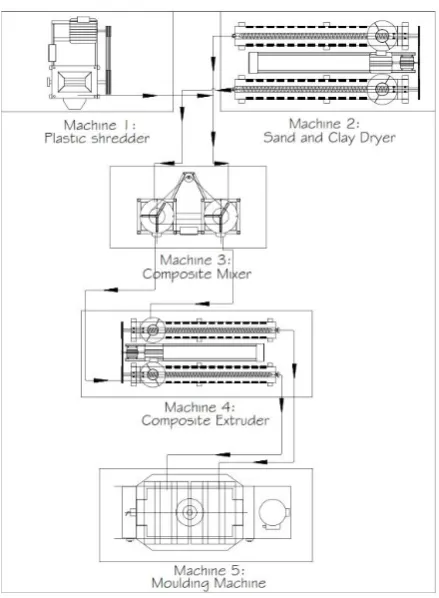
A design is better understood and interpreted when it is represented via a schematic drawing. Below is a schematic design of the machinery layout. Further details about each machine can be found under machinery operations. With reference to the schematic design; a flow diagram of machinery processes is shown. Machine 1 and 2 both run concurrently; Machine 1 is the plastic shredder; its purpose is to reduce the plastic size into smaller bits to serve as the raw material for next machine operation. Machine 2 is a dual-chamber dryer, this device performs drying operation of the sand and clay in the separate chambers under a single machining process. The temperature of the dryers are raised to a high point where moisture can be gotten rid off completely depending on the level of moisture content. Machine 3 performs the dual-composite mixing; it mixes the shredded plastic with sand and shredded plastic with clay in separate drum and in the required proportion. The mixtures are then transferred to machine 4. Machine 4 is a dual-chamber extrusion machine. Each chamber handles the machining of plastic-sand and plastic-clay operations. Each chamber contents are conveyed by a screw shaft through a heated barrel. The heat generated within the barrel melts the composites to form a paste which is later weighed and transferred to machine 5. Machine 5 is the
dual-chamber moulding machine. It handles the
compression of the paste from Machine 4 into roof tiles. The moulded tiles gotten from this machine completes the roof tile production processes.
[image:2.595.313.541.237.407.2]Fig. 1: Machinery Schematic Design
IV. MACHINERY OPERATIONS
A. Description and Operation of Plastic Shredder
[image:2.595.59.279.427.726.2]The shredder is incorporated with rotating cutting blade. From the shredder drawing, the plastic wastes are fed into the machine through the hopper and the rotary blade inside the shredder then cut the plastic into the required small flakes (shredded plastic) and these goes through a screen with small holes. The screen holes determine the flakes sizes. The flakes are then collected in a collection bin. The rotary blade is powered by an electric motor. The rotary blade is connected to the electric motor by a transmission belt with the pulley of both the rotary blade and the electric motor. Through the transmitted power between the blade and electric motor, the cutting process is initiated on the plastics by the blade. The plastic shredder is shown in figure 2.
Fig. 2: Isometric View of the Plastic Shredder
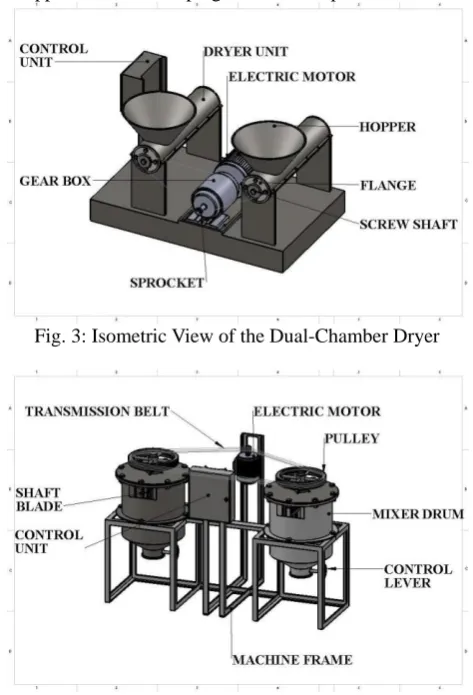
B. Description and Operation of the Dual-Chamber Dryer The machine main components are the hoppers at one end from which the soil materials to be dried are fed by gravity, a tabular barrel, an electric heater and a revolving screw at the opposite end. Since the dryer is the main component where the soil materials are being dried, they are designed to be large enough to hold the maximum possible amount of material, and also designed to prevent the screw from scraping the walls of the barrel that may cause damage to the barrel wall. The dryer drive uses the direct current motor (DC Motor) as the main driving component. The DC motor is a single phase type which can easily be optimized into a 3-phase motor when the need arises. The rotation of the motor is transferred to the gear box which reduced the motor speed before transferring it to the screw with the help of the shaft and gear system to get maximum transmission efficiency even under adverse high-torque condition. The heat generated by the dryer is made possible by passing a certain amount of current through a conductor of certain resistance, as the amount of current through a conductor of certain resistance, as the resistance creates barrier to the flow of electrons, thereby heat is generated. Figure 3 shows the isometric view of the dual-chamber dryer.
C. Description and Operation of the Dual-Composite Mixer
The dried sand and clay are both mixed with the shredded plastic in separate chambers in the required proportion, until a proper mix is achieved. The materials are fed in through the opening on the wall of the drum.
mixtures are evacuated from the drum compartments by opening the control knob at the bottom of the mixer drum. A detail design of the dual-composite mixer is show in figure 4.
D. Description and Operation of the Dual-Composite Extruder
The main machine components are similar to that of the dual-chamber dryer, except for the introduction of the die at the opposite end for shaping the extruded paste.
[image:3.595.311.541.156.318.2]Fig. 3: Isometric View of the Dual-Chamber Dryer
Fig. 4: Isometric View of the Dual-Composite Mixer
The feed section is equipped with a hopper design to prevent premature melting of the composite material. Along the length of the extruder barrel is a covered layer of protective material to prevent heat loss from the inlet. The material feeding is carried through by gravity. Since the extruder barrel is the main component where the composite material is being processed, they are designed to be large enough to hold the maximum possible amount of material, and also designed to prevent the screw from scraping the walls of the barrel that may cause damage to the barrel wall [12].
The extruder die creates a passage through which paste (molten composite) exits the extruder with the help of pressure built up in the barrel during processing.
The extruder drive uses the direct current motor (DC Motor) as the main driving component. The rotation of the motor is transferred to the gear box which reduced the motor speed before transferring it to the screw with the help of the shaft and gear system to get maximum transmission efficiency even under adverse high-torque condition.
The amount of heat generated is given by the equation below, [9]:
Qc= 𝐼2𝑅 = 𝑉𝐼 =𝑉2
𝑅 (1) Where: I is the current in Ampere; R is the resistance in ohms and V is the voltage in volts. This equation is valid for direct current (DC) as well as single phase alternating current (AC) provided the current and voltage are expressed as root mean square (rms) values and the circuit being purely resistive. The design of the dual-composite extruder is shown in figure 5.
Fig. 5: Isometric View of the Dual-Composite Extruder
E. Description and Operation of the Dual-Chamber Moulding Machine
The molten paste is weighed and transferred into the mould. The pressure applied on the paste is controlled by operating the control switch. The switch send signal to the valves on the required operation to be carried out, either to compress or retrieve the hydraulic ram.
The hydraulic pump is powered by an electric motor with the motion transmitted through a transmission belt (V-belt). The design of the dual-chamber moulding machine is shown in figure 6.
Fig. 6: Isometric View of the Dual-Chamber Moulding Machine
V. DESIGN ANALYSES
A. Design of Plastic Shredder
[image:3.595.49.286.162.510.2] [image:3.595.316.540.459.602.2]stress (𝜍) for the system are 400mm2 and 2MPa respectively.
The relationship below is used to determine the diameter of the larger pulley [7];
𝑁1 𝑁2=
𝑑2
𝑑1 2 Where: N1 = Speed of rotation of the electric motor, N2= Speed of rotation of the shredder, d1= Diameter of the electric motor pulley, d2 = Diameter of the shredder pulley The tension acting on the tight side T1 and slack side T2 of the belt were determined by using the relationship below [7];
2.3 𝑙𝑜𝑔 𝑇1 𝑇2
= 𝜇𝜃𝑐𝑜𝑠𝑒𝑐𝛽 (3)
Where; 𝛽 is the groove angle of the pulley, 2𝛽= 40° C and Ө is the angle of lap.
Choosing mild steel as the shaft material; the maximum permissible working stress,𝜍𝑏 and the maximum allowable shear stress, 𝜏 with key way are 84MPa and 42MPa respectively. Where the combined shock and fatigue factor for bending Km is 2.0 and the combined shock and fatigue factor for torsion Kt is 2.0. Applying the equation below, the equivalent twisting moment (Te) and equivalent bending moment (Me) can be used to determine the shaft diameter [7];
𝑇𝑒= (𝐾𝑚+ 𝑀𝑛)2+ (𝐾
𝑡+ 𝑇)2 (4)
𝑇𝑒 =𝜋𝜏𝑑
3
16 (5) 𝑀𝑒=
1
2 𝐾𝑚× 𝑀𝐵+ 𝑇𝑒 (6)
𝑀𝑒 =
𝜋 ∗ 𝜍𝑏∗ 𝑑3
32 (7) B. Design of Dual-Chamber Dryer
The relationship below is used to determine the transmitted speed [14];
𝑉𝑒𝑙𝑜𝑐𝑖𝑡𝑦 𝑟𝑎𝑡𝑖𝑜 𝑉. 𝑅 = 𝑁1 𝑁2
= 𝑇1 𝑇2
(8)
Where: N1 = Speed of rotation of smaller sprocket in rpm (gearbox), N2 = Speed of rotation of larger sprocket in rpm (sand & clay chamber dryer), T1 = Number of teeth on the smaller sprocket (gearbox), T2 = Number of teeth on the larger sprocket (sand & clay chamber dryer).
The motor gear box was introduced to reduce the speed of the electric motor at 2:1. Speed reduction is necessary to reduce the speed of the motor and to increase torque. Thus for the electric motor with gear box gives;
𝑁4 𝑁1
= 2
1 (9) Where; N4 = speed of rotation of the electric motor at
1000rpm
There are two separate drying chambers for each soil material with the same speed and number of teeth. Choosing T1 to be 25 teeth and T2 to be 50 teeth; the speed
of the larger sprockets can be determine using equation (9). Pitch circle diameter of the smaller sprocket or pinion was calculated using the sprocket diameter and teeth number relationship;
𝑑1= 𝑃 𝑐𝑜𝑠𝑒𝑐
180 𝑇1
(10)
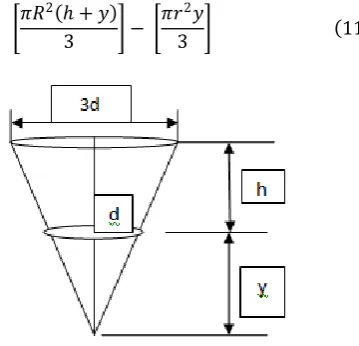
The volume of the soil materials (sand and clay) that the machine can handle in a single operation can be gotten from
the figure below. A frustum shape of a cone was adopted for the hopper from the figure above; the top diameter should be thrice the bottom diameter.
Hence, volume of the hopper 𝑉ℎ can be calculated using the
relationship below;
𝜋𝑅
2 ℎ + 𝑦
3 − 𝜋𝑟2𝑦
[image:4.595.361.541.108.281.2]3 11
Fig 7: Frustum of Cone for the Dryer Hopper
Assuming both materials will be feed by gravity; the weight of the soil material required to fill up each machine hopper can be calculated using these equations [14];
𝑊𝑠 = 𝑉ℎ∗ 𝜌𝑠 ∗ 𝑔 12 𝑊𝑐 = 𝑉ℎ∗ 𝜌𝑐 ∗ 𝑔 13 Where; Ws = weight of the sand material in Newton, Wc = weight of the clay material in Newton, Vh = volume of the machine hopper unit, g = acceleration due to gravity ( 9.81m/s2), ρs = bulk density of sand, ρc = bulk density of clay, Ms = mass of the sand material in Kg, Mc = mass of the clay material in Kg and the Bulk densities of the above materials are: High density polyethylene (HDPE) for the plastic material with bulk density value of 954𝑘𝑔/𝑚3 [6];
Dry sand for the sand material with bulk density value of 1762𝑘𝑔/𝑚3 [11]; Fine clay for the clay material with
bulk density value of 993𝑘𝑔/𝑚3 [11].
According to [7]; choosing carbon steel cold drawn as the shaft material. The maximum permissible working stress σb and the maximum allowable shear stress τ with key ways are 84MPa and 42MPa respectively. Where the combined shock and fatigue factor for bending Km is 1.5 and the combined shock and fatigue factor for torsion Kt is 1.0. Using the equivalent twisting moment (Te) and equivalent bending moment (Me) equations (4) – (7) to determine the shaft diameter.
The processing temperature of the dryer is between 200℃
and 500℃, even though drying occurs between 250℃ and
450℃.
The heating chamber target temperature of 450℃ will be
chosen. Both materials must be raised from the room
temperature of 25℃ to 450℃. The quantity of heat needed
to raise the temperature of these mass from 25℃ to 450℃
can be calculated as [14];
𝑄𝑡1−𝑡2= 𝑀𝐶𝑝∆𝑡1+ 𝑀𝐿 + 𝑀𝐶𝑝∆𝑡2 14
Where; 𝑀 = mass of the material, 𝐶𝑝= Specific heat
capacity of the material, 𝑡1= Initial temperature, 𝑡2= Final
temperature and 𝐿 = The specific latent heat of fusion.
C. Design of Dual-Composite Mixer
expected to run at a rotational speed of 200rpm and with a pulley size of 400mm. The electric motor is located at distance apart (x) of 500mm from the drum pulleys. The shredder is expected to run at a rotational speed of 25rpm. The belt cross-sectional area (A) and belt density are 400mm2 and 1000kg/m3 respectively. The allowable tensile stress (𝜍) is 2MPa.
The relationship in equation (2) can be used to determine the diameter of the larger pulley [7];
Where; N1 = the speed of the motor, N2= the speed of the mixer, d1= diameter of the motor pulley, d2 = diameter of the mixer pulley.
The designed power = rated power * service factor Ks The service factor 𝐾𝑠 is the product of various factors such
as the load factor for variable load with heavy shock loads 𝐾1= 1.5 , the lubrication factor for drop lubrication 𝐾2= 1 and the rating factor for 8 hours per day 𝐾3= 1 Therefore, service factor
𝐾𝑠= 𝐾1∗ 𝐾2∗ 𝐾3 15
Power transmitted by belt can be gotten using the equation below; 𝑃 = 𝑇1− 𝑇2 𝑉 16
The combination of a cylinder and frustum of a cone will be adopted for the mixer drum. Calculating the volume of the drum Vd. Hence; Vd = Volume of the cylinder + Volume of the frustum cone The weight of the composite material required to fill up the mixer chamber can be calculated as [14]; Wc1= Vhρc1g 17
Wc2= Vhρc2g 18
ρc1= ρp + ρs 19
and ρc2= ρp + ρc 20
Where; Wc1 = weight of the first composite material in Newton, Wc2 = weight of the second composite material in Newton, Vd = volume of the mixer drum, g = acceleration due to gravity (9.81m/s2), ρ c1 = bulk density of the first composite material, ρc2 = bulk density of the second composite material, ρp = bulk density of the plastic material, ρs = bulk density of sand, ρc = bulk density of clay. Bulk densities of the above materials as mentioned above. The shaft will be subjected to constant torque and bending moments. Torque (T) transmitted by the shaft is calculated using the equation below; T =P × 60 2πN 21
The maximum bending moment of a simply supported shaft carrying a central load is M =W × L 4 22
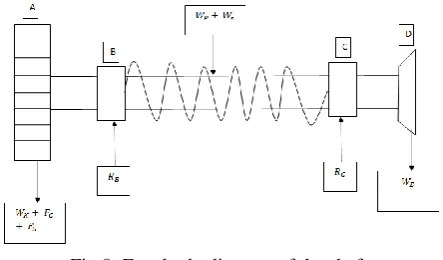
[image:5.595.318.540.322.452.2]The equivalent twisting moment Te and the Equivalent bending moment Me for the first and second mixer shaft is determined by using equations (4) – (7). D. Design of Dual-Composite Extruder Equation (8) is used in the design of the drive system. A motor gear box is used to reduce the speed of the electric motor at 2:1 as expressed in equation (9). The required velocity of the screw conveyor is 15m/s. The diameter of the driven sprocket is 200mm. Other parameters are; Weight of the screw, 𝑊𝑆 taken as 15N, Weight of the die, 𝑊𝐷taken as 200N, Weight of the sprocket, 𝑊𝐾taken as 16N. The total load (or total tension) on the driving side of the chain is the sum of the tangential driving force (𝐹𝑇) = 5060N, centrifugal tension in the chain (𝐹𝐶) = 261N and the tension in the chain due to sagging (𝐹𝑆) = 8.11N. The volume of the composite materials that the machine can handle in a single operation can be gotten from the figure 7. Hence, volume of the hopper 𝑉ℎ can be calculated using the relationship in equation (11). The shaft will be subjected to fluctuating torque and bending moments, and therefore combined shock and fatigue factors are taken into account. The shaft and chain tensions are subjected to both bending moment and shear force as a result of applied loads. Using the free body diagram below; the reactions at point B and D can be determined, likewise the resultant bending moment on the shaft. Using equations (4) – (7), the equivalent twisting (Te) and bending (Me) moments are used to determine the shaft diameter. The processing temperature of the plastic is between 160 °C and 240 °C, even though melting occurs between 105 °C and 130 °C. The heating chamber target temperature of 240 °C will be chosen. Both materials must be raised from the room temperature of 25 °C to 240 °C. The quantity of heat needed to raise the temperature of these mass from 25 °C to 240 °C can be calculated using equation (14). Fig 8: Free body diagram of the shaft E. Design of Dual-Chamber Moulding Machine A required power rating of 3.7KW was chosen which is expected to run at a rotational speed of 1000rpm with the electric motor pulley size of 70mm. The hydraulic pump pulley size is 125mm. The belt cross-sectional area (A) and the allowable tensile stress (𝜍) for the system are 400mm2 and 2MPa respectively. Applying equation (2); the speed of the hydraulic pump, N2 can be determined. The tension acting on the tight side T1 and slack side T2 of the belt were determined from equation (3). Where; 𝛽 is the groove angle of the pulley, 2𝛽= 40° C and Ө is the angle of lap. T1 is 798.65N and T2 is 80.81N. The force required to press fit the paste is calculated by apply the equation below [3]; 𝐹 = 𝐷 ∗ 𝜋 ∗ 𝐿 ∗ 𝐼 ∗ 𝑃 2 23 Where; F = force required in tons, D = diameter of the part to be pressed in inches, L = length of part to be pressed in inches, I = interference in inches (usually 0.002in to 0.006in), P = pressure factor (taken as 75).
A 30psi (203.85KN/m2) capacity hydraulic ram will be used.
VI. RESULT SUMMARY
A VR60 machine of Untha shredding technology was compared with the plastic shredder and a 5090.90Kg production capacity was estimated for a period of 8 hours. Comparing the FTM drying machine from china with the dual-chamber dryer, 59,680Kg mass of soil materials will be expected after an eight hour period.
The Winget 300R electric mixing machine with the dual-composite mixer, when compared showed an 8.448m3 volume of composite material mixture with a working period of 8 hours. A design comparison performed between the dual-composite extruder and the plastic recycling machine [14] showed an estimated molten paste production of 5323.76Kg by the dual-composite extruder within an 8 working hours. The production capacity of the chamber moulding machine can be gotten from the dual-chamber extruder end product. The expected weight of the roof tile is 2Kg with a 2 minute solidification period. Hence, a total number of 40,242 roof tiles are estimated to be produced over an 8 hour period.
These results show the functionality of the dualized roof tile machinery with its application in small-scale production industries.
VII. CONCLUSION
An improved and efficient design of machines specifically for roof tiles production from composite materials was carried out in this research.
The modifications introduced in the design and operation of the machines, if implemented, will be beneficial and advantageous in the following:
1. The processing of waste materials will be enhanced to achieve the production of high quality products on relatively large scale for domestic and industrial uses. 2. The national economy will be boosted since adoption of such machines will help in reducing the importation of similar machines, maximize the use of local materials, thereby save cost.
3. Promotion of technology transfer and adoption for the production of recycling machine from small to medium scale level.
4. It reduces drastically the labour, fatigue and cost involved in the production of roof tiles products under very conducive environmentally friendly conditions.
REFERENCES
[1] Al-Sanea, S.A. (2002) 'Thermal performance of building roof elements', Journal of Building and Environment, 37(7), 665– 675.
[2] Ayedun C.A. and Oluwatobi A.O. Issues and Challenges Militating against the Sustainability of Affordable Housing Provision in Nigeria. Society for Business and Management Dynamics; Vol.1, No.4, Oct 2011, pp.01-08.
[3] Azodo P.A., Hassan A.B., Ezenwa J., and Ogban P.U. Design and Fabrication of Motorized Hydraulically Operated Palm Oil Press. The Pacific Journal of Science and Technology,
Volume 14. Number 1. May 2013.
http://www.akamaiuniversity.us/PJST.htm
[4] Charles, C. R. (2002) Roof Structure Failures, Roberts
Consulting Engineers, Available from
http://www.croberts.com, accessed 6th June, 2015.
[5] Gifford Pinchot (2005). Attractive, Durable Roofing Made From Recycled Plastic And Wood Fibre; Forest Products
Laboratory, Technology Marketing Unit, Madison.
www.fpl.fs.fed.us.
[6] John Vlachopoulos and David Strutt (2002). „Basic Heat Transfer and Some Applications in Polymer Processing‟, Plastics Technician‟s Toolbox, Volume 2, Pages 21-33, SPE 2002. www.polydynamics.com.
[7] Khurmi R.S and Gupta J.K (2015). A Textbook of Machine Design; Eurasia Publishing House (Pvt.) Ltd, New-Dehli. [8] Kumar, K.S. and Stathopoulos, T. (2000) 'Wind loads on
building roofs', Journal of Structural Engineering, 126(8), 251–261.
[9] Nana, Levi Njobet (2012). Degree Thesis: Energy Analysis in the Extrusion of Plastics. ARCADA, Ghana.
[10]Opara Patrick Nnamdi (June 2011). Low Cost Materials for Building and Construction: A Case Study of Rice Husk. Journal of “Sustainable Development and Environmental Protection” Volume 1 Number 1.
[11]Rahul Kumar, „Bulk Density Chart‟. Accessed 2015. pp. 5-13. http://www.academia.edu/6782179/Bulk_Density_Chart. [12]Rauwendaal Chris, (2009). “Polymer extrusion fourth
edition,” ANTEC 2009, p. 1157.
[13]Ronald Ashkin (14th August, 2013). Innovative Building Technologies – The Social Housing Angle; Housing Africa 2013, Abuja, Nigeria.
[14]Ugoamadi C.C., Ihesiulor O.K. (2011). „Optimization Of The Development Of A Plastic Recycling Machine‟, Nigerian Journal of Technology Vol. 30, No. 3, October 2011.
[15]Yahaya Mijinyawa, Sunday Olufemi Adesogan and