Altered Jacobian Newton Iterative Method for
Nonlinear Elliptic Problems
Sanjay K. Khattri
∗Abstract—We present an Altered Jacobian New-ton Iterative Method for solving nonlinear elliptic problems. Effectiveness of the proposed method is demonstrated through numerical experiments. Com-parison of our method with Newton Iterative Method is also presented. Convergence of the Newton Itera-tive Method is highly sensiItera-tive to the initialization or initial guess. Reported numerical work shows the robustness of the Altered Jacobian Newton Iterative Method with respect to initialization.
Keywords: Newton, Jacobian, non-linear, elliptic, Krylov solver
1
Introduction
The past fifty to sixty years have seen a considerable
ad-vancement in methods for solving linear systems. Krylov
subspace method is the result of the huge effort by the
re-searchers during the last century. It is one among the top
ten algorithms of the 20th century. There exists optimal
linear solvers [5]. But, still there is no optimal nonlinear
solver or the one that we know of. Our research is in the
field of optimal solution of nonlinear equations generated
by the discretization of the nonlinear partial differential
equation [1; 2; 3; 4]. Let us consider the following
non-linear elliptic partial differential equation [4]
div(−K gradp) +f(p) =s(x, y) in Ω (1)
p(x, y) =pD on ∂ΩD (2)
g(x, y) = (−K∇p)·nˆ on ∂ΩN (3)
Here, Ω is a polyhedral domain in Rd (d = 2, 3), the
source function s(x, y) is assumed to be in L2(Ω), and
the medium property K is uniformly positive. In the
equations (2) and (3),∂ΩD and∂ΩN represent Dirichlet
and Neumann part of the boundary, respectively. f(p)
represents nonlinear part of the equation. p is the
un-known function. The equations (1), (2) and (3) models a
wide variety of processes with practical applications. For
example, pattern formation in biology, viscous fluid flow
phenomena, chemical reactions, biomolecule
electrostat-ics and crystal growth [6; 7; 8; 9; 10; 11].
There are various methods for discretizing the equations
(1), (2) and (3). To mention a few: Finite Volume, Finite
∗Address: Stord/Haugesund University College & Haugesund, Norway Tel/Fax: 52 70 26 83 Email: [email protected]
p25
p13
p5
[image:1.595.325.517.200.375.2]p1 p2
Figure 1: A 5×5 mesh.
Element and Finite Difference methods [1]. These
meth-ods converts nonlinear partial differential equations into
a system of algebraic equations.
Let discretization of the nonlinear partial differential
equations result in a system of nonlinear algebraic
equa-tionsA(p) = 0. Each cell in the mesh produces a
nonlin-ear algebraic equation [1; 4]. Thus, discretization of the
equations (1), (2) and (3) on a mesh withncells result in
n nonlinear equations, and let these equations are given
as
A(p) =
A1(p)
A2(p)
. . .
An(p)
. (4)
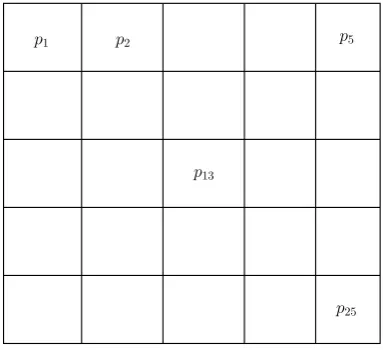
Figure 1 depicts a 5×5 mesh with the unknownp. Since,
the mesh contains 25 cells. Thus, the vector A(p) for
this mesh will consist of 25 nonlinear algebraic equations
[see 4]. In the next section, Altered Jacobian Newton
Iterative Method is presented.
2
Altered
Jacobian
Newton
Iterative
Method
We are interested in finding the vector p for which the
operatorA(p) vanish. Let us first formulate the Newton
operatorA(p) around some initial guessp0is
A(p) =A(p0) +J(p0) ∆p+hot, (5)
where hotstands for higher order terms. That is, terms
involving higher than the first power of ∆p. Here,
dif-ference vector ∆p=p−p0. The JacobianJ is an×n
linear system evaluated at thep0. The JacobianJ in the
equation (5) is given as follows
J = [ ∂Ai ∂pj ] = ∂A1 ∂p1 ∂A1
∂p2 · · ·
∂A1 ∂pn ∂A2 ∂p1 ∂A2 ∂p2
· · · ∂A2
∂pn . . . . . . . .. . . . ∂An ∂p1 ∂An
∂p2 · · ·
∂An ∂pn . (6)
Since, we are interested in the zeroth of the non-linear
vector function A(p). Thus, setting the equation (5)
equals to zero and neglecting higher order terms will
re-sult in the following well known Newton Iteration Method
(NIM)
J(pk) ∆pk+1 =−A(pk),
pk+1 =pk+ ∆pk+1, k= 0, . . . , n.
(7)
Newton Iterative Method may not always converge, and
it’s convergence depends on the initialization p0. If the
initial guess if far from the exact solution, the Newton’s
method may not converge.
Let us modify the Jacobian (6) as follows
Jf def= ∂A1 ∂p1
+A1(p1) ∂A1
∂p2 · · ·
∂A1 ∂pn ∂A2 ∂p1 ∂A2 ∂p2
+A2(p2) · · ·
∂A2 ∂pn . . . . . . . .. . . . ∂An ∂p1 ∂An
∂p2 · · ·
∂An
∂pn
+An(pn)
. (8)
Here,Ai(pj) is theith element of the vectorAevaluated
atpj. Based on the above definition of the Altered
Jaco-bian, we propose the following Alterned Jacobian Newton
Iterative Method (AJNIM)
3
Numerical Experimentation
Without loss of generality let us assume that K is unity,
and the boundary is of Dirichlet type. Let f(p) be
104pexp(p). Thus, the equations (1), (2) and (3) are
written as
−∇2p+ 104pexp(p) =f in Ω, (10)
p(x, y) =pD on ∂ΩD. (11)
For computing the true error and convergence behavior of
the methods, let us further assume that the exact solution
of the equations (10) and (11) is the following bubble
function
p=x(x−1)y(y−1).
Let our domain be a unit square. Thus, Ω = [0,1]×
[0,1]. We are discretizing equations (10) and (11) on a
20×20 mesh by the method of Finite Volumes [1; 2; 4; 12].
Discretization results in a nonlinear algebraic vector (4)
with 400 nonlinear equations.
If the method is convergent, L2 norm of the difference
vector, ∆p, and the residual vector, A(p), converge to
zero [see 12]. We are reporting convergence of both of
these vectors. For better understanding the error
re-ducing property of these methods, we report variation of
∥A(pk)∥L
2/∥A(p0)∥L2 and∥∆(pk)∥L2/∥∆(p0)∥L2 with
iterations (k).
We performed three experiments with different
initializa-tion in the algorithms (7) and (9). In the first test, let the
initial vector be zero for both the algorithms. Figure 2
re-ports the result. Figure 2(a) presents convergence of the
residual vector while the Figure 2(b) presents convergence
of the difference vector. In these figures, NIM stands for
Newton Iterative Method while AJNIM stands for
Al-terted Newton Iterative Method. These figures show that
both the methods converges at the same rate
(quadrat-ically), but still the Altered Jacobian Newton Iterative
Method is better in reducing the error.
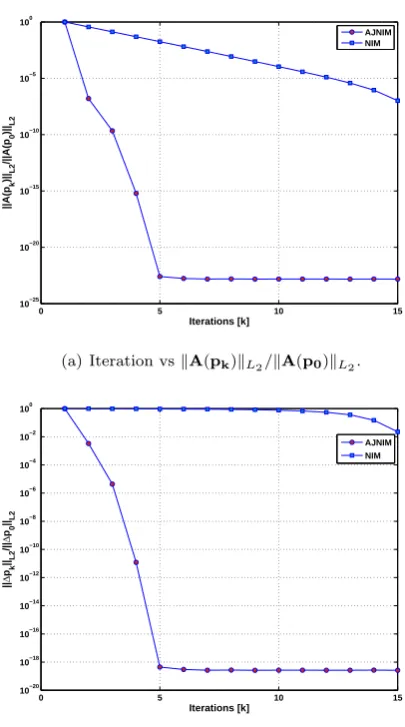
In the second case, let us select initial vector whose
ele-ments 10. Figure 3 presents comparison of the two
meth-ods for an initial vector whose elements are 10. It can be
seen in the Figures 3(a) and 3(b) that the Altered
Jaco-bian Newton Iterative Method converges faster than the
0 1 2 3 4 5 6 7 8 9 10 10−25
10−20 10−15 10−10
10−5 100
Iterations [k]
||A(p
k
)||
L
2
/||A(p
0
)||
L
2
AJNIM
NIM
(a) Iteration vs∥A(pk)∥L2/∥A(p0)∥L2.
0 1 2 3 4 5 6 7 8 9 10
10−18
10−16
10−14
10−12
10−10
10−8
10−6
10−4
10−2
100
Iterations [k]
AJNIM NIM
[image:3.595.322.525.207.571.2](b) Iteration vs∥∆(pk)∥L2/∥∆(p0)∥L2.
Figure 2: Initial guess is the zero vector. Here, NIM
stands for Newton Iterative Method while AJNIM stands
for Altered Jacobian Newton Iterative Method.
0 5 10 15
10−25
10−20 10−15 10−10
10−5
100
Iterations [k]
||A(p
k
)||
L
2
/||A(p
0
)||L
2
AJNIM NIM
(a) Iteration vs∥A(pk)∥L2/∥A(p0)∥L2.
0 5 10 15
10−20 10−18 10−16
10−14
10−12
10−10 10−8 10−6 10−4 10−2
100
Iterations [k]
||
∆
pk ||L
2
/||
∆
p0 ||L
2
AJNIM NIM
(b) Iteration vs∥∆(pk)∥L2/∥∆(p0)∥L2.
Figure 3: Initial vector is of size 400 with each elements
[image:3.595.75.277.401.558.2]0 1 2 3 4 5 6 7 8 9 10 10−70
10−60 10−50 10−40 10−30
10−20
10−10 100
Iterations [k]
||A(p
k
)||
L
2
/||A(p
0
)||L
2
AJNIM NIM
(a) Iteration vs∥A(pk)∥L2/∥A(p0)∥L2.
0 1 2 3 4 5 6 7 8 9 10
10−18 10−16
10−14 10−12
10−10 10−8 10−6
10−4 10−2
100
Iterations [k]
||
∆
pk ||L
2
/||
∆
p0 ||L
2
AJNIM NIM
[image:4.595.66.282.200.372.2](b) Iteration vs∥∆(pk)∥L2/∥∆(p0)∥L2.
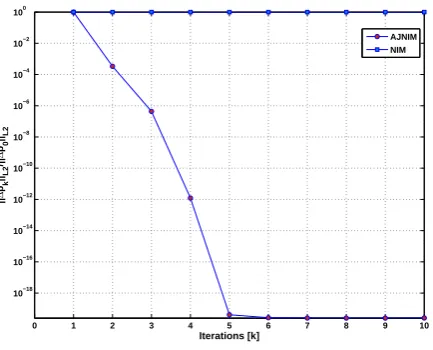
Figure 4: Here, each elements of the initial vector consists
of 100.
the first case (initial guess is zero vector) but its
conver-gence rate decreases as we selected other initial guesses.
On the other hand, for all the initial guesses the Altered
Jacobian Newton Iterative Method converges
quadrati-cally.
Table 1: Error by Altered Jacobian Newton Iterative
Method (ALT NIM) and Newton Iterative Method (NIM)
after 10 iterations. Here, initial guess vector is 100.
Method ∥∆p∥L
2 ∥A(p)∥L2
NIM 19.7828 1.658×1044
AJNIM 5.058×10⁻¹⁷ 1.573×10⁻¹⁵
4
Conclusions
We have developed a nonlinear algorithm named Altered
Jacobian Newton Iterative Method for solving system
nonlinear equations formed from discretization of
non-linear elliptic problems. Presented numerical work shows
that the Altered Jacobian Newton Iterative Method is
robust with respect to the initialization.
References
[1] Khattri, S.K., Aavatsmark, I., “Numerical
conver-gence on adaptive grids for control volume
meth-ods,”The Journal of Numerical Methods for Partial
Differential Equations, V24, pp.465-475, 2008.
[2] Khattri, S.K., “Analyzing Finite Volume for Single
Phase Flow in Porous Media,” Journal of Porous
Media.V10, pp. 109–123, 2007.
[3] Khattri, S.K., Fladmark, G., “Which Meshes Are
Better Conditioned: Adaptive, Uniform, Locally
Re-fined or Locally Adjusted?,”Lecture Notes in
Com-puter Science, V3992, Springer, pp. 102-105, 2006.
[4] Khattri, S.K., “Nonlinear elliptic problems with the
method of finite volumes,” Differential Equations
and Nonlinear Mechanics, V2006, Article ID 31797, 2006.
[image:4.595.67.284.410.585.2][7] Holst, M., Kozack, R., Saied, F., Subramaniam,
S., “Protein electrostatics: Rapid multigrid-based
Newton algorithm for solution of the full nonlinear
Poisson-Boltzmann equation,” J. of Bio. Struct. &
Dyn., V11, pp. 1437–1445, 1994.
[8] Holst, M., Kozack, R., Saied, F., Subramaniam, S.,
“Multigrid-based Newton iterative method for
solv-ing the full Nonlinear Poisson-Boltzmann equation,”
Biophys. J., V66, pp. A130–A150, 1994.
[9] Holst, M.,A robust and efficient numerical method
for nonlinear protein modeling equations, Techni-cal Report CRPC-94-9, Applied Mathematics and
CRPC, California Institute of Technology, 1994.
[10] Holst M., Saied, F., “Multigrid solution of the
Poisson-Boltzmann equation,” J. Comput. Chem.,
V14, pp. 105-113, 1993.
[11] Holst, M., MCLite: An Adaptive Multilevel
Finite Element MATLAB Package for Scalar Nonlinear Elliptic Equations in the Plane,
UCSD Technical report and guide to the
MCLite software package. Available on line at
http://scicomp.ucsd.edu/∼mholst/pubs/publications.html.
[12] Khattri, S.K., “Convergence of an Adaptive Newton
Algorithm,”Int. Journal of Math. Analysis, V1, pp.
279-284, 2007.
[13] Khattri, S.K., “Analysing an adaptive finite
vol-ume for flow in highly heterogeneous porous
medium,”International Journal of Numerical