The Longest (s, t)-paths of C-shaped Supergrid
Graphs
Fatemeh Keshavarz-Kohjerdi
1, Ruo-Wei Hung
2,∗, and Guo-Hao Qiu
2Abstract—A supergrid graph is a finite vertex-induced sub-graph of the infinite sub-graph whose vertex set consists of all points of the plane with integer coordinates and in which two vertices are adjacent if the difference of their x or y coordinates is not larger than 1. The Hamiltonian path (cycle) problem is to determine whether a graph contains a simple path (cycle) in which each vertex of the graph appears exactly once. These two problems are NP-complete for general graphs and they are also NP-complete for general supergrid graphs. Despite the many applications of the problem, they are still open for many classes, including solid supergrid graphs and supergrid graphs with some holes. A graph is called Hamiltonian connected if it contains a Hamiltonian path between any two distinct vertices. In this paper, first we will study the Hamiltonian cycle property of C-shaped supergrid graphs, which are a special case of rectangular supergrid graphs with a rectangular hole. Next, we will show that C-shaped supergrid graphs are Hamiltonian connected except few conditions. Finally, we will compute a longest (s, t)-path between two distinct vertices s, t in linear time. The Hamiltonian and longest (s, t)-paths of C-shaped supergrid graphs can be applied to compute the optimal stitching trace of computer embroidery machines, and construct the minimum printing trace of 3D printers with a C-like component being printed.
Index Terms—Hamiltonicity, Hamiltonian connectivity, longest (s, t)-path, supergrid graphs, C-shaped supergrid graphs, computer embroidery machines, 3D printers.
I. INTRODUCTION
A
Hamiltonian path (cycle) in a graph is a simple path(cycle) in which each vertex of the graph appears exactly once. The Hamiltonian path (cycle) problem involves deciding whether or not a graph contains a Hamiltonian path (cycle). A graph is called Hamiltonian if it contains a Hamiltonian cycle. A graph G is said to be Hamiltonian connected if for each pair of distinct vertices u and v of
G, there is a Hamiltonian path from u to v in G. The Hamiltonian path and cycle problems have numerous ap-plications in different areas, including establishing transport routes, production launching, the on-line optimization of flexible manufacturing systems [1], computing the perceptual boundaries of dot patterns [33], pattern recognition [2], [34], [37], DNA physical mapping [12], fault-tolerant routing for 3D network-on-chip architectures [8], and so on. It is well known that the Hamiltonian path and cycle problems are NP-complete for general graphs [9], [22]. The same holds true
Manuscript received November 26, 2018; revised December 09, 2018. This work was supported in part by the Ministry of Science and Technology of Taiwan under grant no. MOST 105-2221-E-324-010-MY3.
1Fatemeh Keshavarz-Kohjerdi is with the Department of Mathematics &
Computer Science, Shahed University, Tehran, Iran.
2Ruo-Wei Hung and Guo-Hao Qiu are with the Department of Computer
Science and Information Engineering, Chaoyang University of Technology, Wufeng, Taichung 41349, Taiwan.
∗Corresponding author e-mail: [email protected]
for bipartite graphs [30], split graphs [10], circle graphs [7], undirected path graphs [3], grid graphs [21], triangular grid graphs [11], supergrid graphs [13], etc.
The longest path problem, i.e., the problem of finding a simple path with the maximum number of vertices, is one of the most important problems in graph theory. The Hamiltonian path problem is clearly a special case of the longest path problem. Despite the many applications of the problem, it is still open for some classes of graphs, including solid supergrid graphs and supergrid graphs with some holes [14], [15]. There are few classes of graphs in which the longest path problem is polynomial solvable [5], [20], [24], [32], [38]. In this paper, we focus on supergrid graphs. We will give the necessary and sufficient conditions for the Hamiltonian and Hamiltonian connected of C-shaped supergrid graphs. We then present a linear-time algorithm for finding a longest path between any two distinct vertices in aC-shaped supergrid graph.
The two-dimensional integer grid graphG∞ is an infinite graph whose vertex set consists of all points of the Euclidean plane with integer coordinates and in which two vertices are adjacent if the (Euclidean) distance between them is equal to 1. The two-dimensional triangular grid graphT∞
is an infinite graph obtained fromG∞ by adding all edges
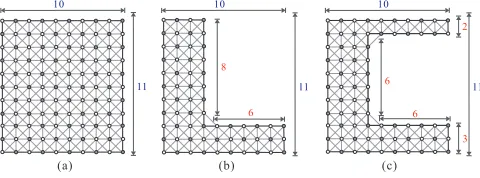
on the lines traced from up-left to down-right. A grid graph is a finite, vertex-induced subgraph of G∞ (see Fig. 1(a)). A triangular grid graph is a finite, vertex-induced subgraph of T∞ (see Fig. 1(b)). Hung et al. [13] have introduced a new class of graphs, namely supergrid graphs. The two-dimensional supergrid graph S∞ is an infinite graph obtained fromT∞ by adding all edges on the lines traced from up-right to down-left. A supergrid graph is a finite, vertex-induced subgraph of S∞ (see Fig. 1(c)). A solid supergrid graph is a supergrid graph without holes. A rectangular supergrid graph is a supergrid graph bounded by a axis-parallel rectangle (see 2(a)). A L-shaped or C -shaped supergrid graph is a supergrid graph obtained from a rectangular supergrid graph by removing a rectangular supergrid graph from it to make a L-like or C-like shape (see 2(b) and 2(c)).
v
(a) (b) (c)
( +1, )vx vy
( ,v vx y-1) (vx-1, )vy
[image:2.595.47.292.51.124.2]( , +1)v vx y
Fig. 1. (a) A grid graph, (b) a triangular grid graph, and (c) a supergrid graph, where circles represent the vertices and solid lines indicate the edges in the graphs.
(a)
10
11 8
6
(b) (c)
10
11
10
11 6
6 2
3
Fig. 2. (a) A rectangular supergrid graph, (b) aL-shaped supergrid graph, and (c) aC-shaped supergrid graph, where circles represent the vertices and solid lines indicate the edges in the graphs.
Hamiltonian line graphs. Later, Chen et al. [6] improved the Hamiltonian path algorithm of [21] on rectangular grid graphs and presented a parallel algorithm for the Hamilto-nian path problem with two given endpoints in rectangular grid graphs. Also there is a polynomial-time algorithm for finding Hamiltonian cycles in solid grid graphs [31]. In [36], Salman introduced alphabet grid graphs and determined classes of alphabet grid graphs which contain Hamiltonian cycles. Keshavarz-Kohjerdi and Bagheri gave necessary and sufficient conditions for the existence of Hamiltonian paths in alphabet grid graphs, and presented linear-time algorithms for finding Hamiltonian paths with two given endpoints in these graphs [23]. They also presented a linear-time algorithm for computing the longest path between two given vertices in rectangular grid graphs [24], gave a parallel algorithm to solve the longest path problem in rectangular grid graphs [25], and solved the Hamiltonian path and longest path problems in some classes of grid graphs [26], [27], [28], [29]. Reay and Zamfirescu [35] proved that all 2-connected, linear-convex triangular grid graphs except one special case contain Hamiltonian cycles. The Hamiltonian cycle (path) on triangular grid graphs has been shown to be NP-complete [11]. They also proved that all connected, locally connected triangular grid graphs (with one exception) contain Hamiltonian cycles.
Recently, we proved that the Hamiltonian cycle and path problems on supergrid graphs are NP-complete [13]. We also showed that every rectangular supergrid graph always contains a Hamiltonian cycle, and proved linear-convex su-pergrid graphs to be Hamiltonian [14]. Very recently, we verified the Hamiltonian connectivity of rectangular, shaped, alphabet, and L-shaped supergrid graphs [15], [16], [17], [18]. We also proposed a linear-time algorithm for the Hamiltonian connected problem on alphabet supergrid graphs [17]. The Hamiltonian connectivity of L-shaped supergrid graphs has been verified in [18], [19]. The L-alphabet and
C-alphabet supergrid graphs in [17] are special cases ofL -shaped and C-shaped supergrid graphs, respectively. Note
thatC-shaped supergrid graphs containL-shaped supergrid graphs as their subgraphs.
In this paper, we consider the Hamiltonian, Hamiltonian connectivity, and longest path ofC-shaped supergrid graphs, which are special case of rectangular supergrid graph with a rectangular hole. This can be considered as the first attempts to solve these problems in supergrid graphs with some holes. The rest of the paper is organized as follows. In Section II, some notations and observations are given. Previous results are also introduced. Section III gives the necessary and sufficient conditions for the Hamiltonicity and Hamiltonian connectivity ofC-shaped supergrid graphs. That is, we show thatC-shaped supergrid graphs are always Hamiltonian and Hamiltonian connected except few conditions. In Section IV, we present a linear-time algorithm to compute a longest path between any two distinct vertices in a C-shaped supergrid graph. Finally, we make concluding remarks in Section V.
II. TERMINOLOGIES ANDBACKGROUNDRESULTS
In this section, we will introduce some terminologies and symbols. Some observations and previously established results for the Hamiltonicity and Hamiltonian connectivity of rectangular and L-shaped supergrid graphs are also pre-sented. For graph-theoretic terminology not defined in this paper, the reader is referred to [4].
The two-dimensional integer grid graphG∞ is an infinite graph whose vertex set consists of all points of the Euclidean plane with integer coordinates and in which two vertices are adjacent if the (Euclidean) distance between them is equal to 1. A grid graph is a finite vertex-induced subgraph of
G∞. For a node v in the plane with integer coordinates, letvx andvy represent thex andy coordinates of node v,
respectively, denoted byv= (vx, vy). Ifvis a vertex in a grid
graph, then its possible adjacent vertices include(vx, vy−1),
(vx−1, vy), (vx+ 1, vy), and (vx, vy+ 1) (see Fig. 1(a)).
The two-dimensional triangular grid graphT∞is an infinite
graph obtained from G∞ by adding all edges on the lines
traced from up-left to down-right. A triangular grid graph is a finite vertex-induced subgraph ofT∞. Ifv is a vertex in a triangular grid graph, then its possible neighboring vertices include(vx, vy−1),(vx−1, vy),(vx+ 1, vy),(vx, vy+ 1),
(vx−1, vy−1), and(vx+ 1, vy+ 1)(see Fig. 1(b)). Thus,
triangular grid graphs contain grid graphs as subgraphs. The triangular grid graphs defined above are isomorphic to the original triangular grid graphs in [11] but these graphs are different when considered as geometric graphs.
The two-dimensional supergrid graph S∞ is the infinite
graph whose vertex set consists of all points of the plane with integer coordinates and in which two vertices are adjacent if the difference of their xory coordinates is not larger than
1. A supergrid graph is a finite vertex-induced subgraph of
S∞. The possible adjacent vertices of a vertexv= (vx, vy)
in a supergrid graph hence include(vx, vy−1),(vx−1, vy),
(vx+ 1, vy),(vx, vy+ 1),(vx−1, vy−1),(vx+ 1, vy+ 1),
(vx + 1, vy − 1), and (vx − 1, vy + 1) (see Fig. 1(c)).
[image:2.595.49.289.179.268.2]n= 8
m= 10
boundary edges
down-right corner vertical edge
horizontal edge
crossed edge
[image:3.595.337.512.52.153.2]flat path (1, 1)
Fig. 3. A rectangular supergrid graphR(m, n), wherem= 10,n= 8, and the bold dashed lines indicate vertical and horizontal separations.
grid graphs are bipartite [21] but triangular grid graphs and supergrid graphs are not bipartite. For a vertexv= (vx, vy)
in a supergrid graph, we color vertex v to be white if
vx+vy ≡0 (mod 2); otherwise, v is colored to be black.
Then there are eight possible neighbors of vertexvincluding four white vertices and four black vertices.
A rectangular supergrid graph, denoted by R(m, n), is a supergrid graph whose vertex set is V(R(m, n)) ={v = (vx, vy)|1 6 vx 6 m and 1 6 vy 6n}. That is, R(m, n)
containsmcolumns andnrows of vertices inS∞. The size of R(m, n)is defined to be mn, and R(m, n)is called n -rectangle. Let v = (vx, vy) be a vertex in R(m, n). The
vertex v is called the upper-left (resp., upper-right, down-left, down-right) corner of R(m, n) if for any vertexw = (wx, wy)∈R(m, n),wx>vxandwy>vy (resp.,wx6vx
andwy>vy,wx>vxandwy6vy,wx6vxandwy6vy).
The edge (u, v) is said to be horizontal (resp., vertical) if
uy=vy(resp.,ux=vx), and is called crossed if it is neither
a horizontal nor a vertical edge. There are four boundaries in a rectangular supergrid graphR(m, n) withm, n>2. The edge in the boundary ofR(m, n)is called boundary edge. A path is called flat ofR(m, n)if it visits all vertices and edges of the same boundary in R(m, n) and its length equals to the number of vertices in the visited boundary. For example, Fig. 3 shows a rectangular supergrid graphR(10,8) which is called 8-rectangle and contains2×(9 + 7) = 32boundary edges. Fig. 3 also indicates the types of edges and corners. In the figures we will assume that (1,1)are coordinates of the upper-left corner in a rectangular supergrid graphR(m, n), except we explicitly change this assumption.
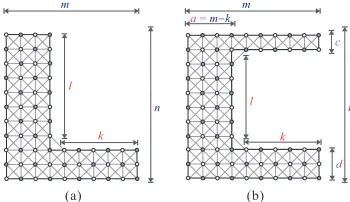
AL-shaped supergrid graph, denoted byL(m, n;k, l), is a supergrid graph obtained from a rectangular supergrid graph
R(m, n) by removing its subgraphR(k, l)from the upper-right corner, wherem, n >1andk, l>1. Then,m−k>1
andn−l>1. AC-shaped supergrid graphC(m, n;k, l;c, d)
is a supergrid graph obtained from a rectangular supergrid graph R(m, n) by removing its subgraph R(k, l) from its node coordinated as (m, c+ 1) while R(m, n) andR(k, l)
have exactly one border side in common, where m > 2,
n >3, k, l >1, c >1,d=n−l−c> 1, and m−k>
1. The structures ofL(m, n;k, l) andC(m, n;k, l;c, d) are explained in Fig. 4(a) and Fig. 4(b), respectively.
LetG= (V, E)be a supergrid graph with vertex setV(G)
and edge setE(G). LetSbe a subset of vertices inG, and let
uandvbe two vertices inG. We writeG[S]for the subgraph ofGinduced byS,G−S for the subgraphG[V −S], i.e., the subgraph induced byV −S. In general, we writeG−v
m
n
l
k
(a) (b)
m
n
l
k c
d a =m k
-Fig. 4. The structure of (a)L-shaped supergrid graphL(m, n;k, l), where k= 6,l= 8,m−k= 4, andn−l= 3and (b)C-shaped supergrid graphC(m, n;k, l;c, d), wherek=l= 6,c= 2,d=n−l−c= 3, anda=m−k= 4.
instead ofG− {v}. We say that uis adjacent to v, and u
and v are incident to edge (u, v), if (u, v) ∈ E(G). The notation u∼v (resp.,u≁v) means that verticesu and v
are adjacent (resp., non-adjacent). A vertexw adjoins edge
(u, v) if w ∼ u and w ∼ v. For two edgese1 = (u1, v1)
and e2 = (u2, v2), if u1 ∼ u2 and v1 ∼ v2, then we say
thate1ande2are parallel, denoted bye1≈e2. For a vertex
v∈V(G), the degree ofv inG, denoted by deg(v), is the number of vertices adjacent tov. A pathP of length|P|inG, denoted byv1→v2→ · · · →v|P|−1→v|P|, is a sequence (v1, v2,· · ·, v|P|−1, v|P|) of vertices such that (vi, vi+1) ∈
E(G) for1 6 i < |P|, and all vertices except v1, v|P| in
it are distinct. The first and last vertices visited by P are denoted bystart(P)andend(P), respectively. We will use
vi∈P to denote “P visits vertexvi” and use(vi, vi+1)∈P
to denote “P visits edge (vi, vi+1)”. A path fromv1 to vk
is denoted by (v1, vk)-path. In addition, we use P to refer
to the set of vertices visited by path P if it is understood without ambiguity. A cycle is a path C with |V(C)| > 4
andstart(C) =end(C). Two paths (or cycles) P1 andP2
of graphGare called vertex-disjoint ifV(P1)∩V(P2) =∅. If
end(P1)∼start(P2), then two vertex-disjoint pathsP1 and
P2 can be concatenated into a path, denoted by P1⇒P2.
LetR(m, n)be a rectangular supergrid graph withm > n>2,C be a cycle ofR(m, n), and letH be a boundary of
R(m, n), whereH is a subgraph ofR(m, n). The restriction of C to H is denoted by C|H. If |C|H| = 1, i.e. C|H is
a flat path on H, then C|H is called flat face on H. If |C|H| >1 andC|H contains at least one boundary edge of H, then C|H is called concave face on H. A Hamiltonian
cycle ofR(m,3) is called canonical if it contains three flat faces on two shorter boundaries and one longer boundary, and it contains one concave face on the other boundary, where the shorter boundary consists of three vertices. And, a Hamiltonian cycle of R(m, n) with n = 2 or n > 4
is said to be canonical if it contains three flat faces on three boundaries, and it contains one concave face on the other boundary. The following lemma states the result in [13] concerning the Hamiltonicity of rectangular supergrid graphs.
Lemma 1. (See [13]) LetR(m, n)be a rectangular super-grid graph withm>n>2. Then, the following statements hold true:
(1)ifn= 3, thenR(m,3)contains a canonical Hamiltonian cycle;
[image:3.595.83.258.53.167.2](a)
s t
(b)
s
[image:4.595.306.545.49.103.2]t
Fig. 5. Rectangular supergrid graphs in which there is no Hamiltonian (s, t)-path for (a)R(m,1), and (b)R(m,2), where solid lines indicate the longest path betweensandt.
Hamiltonian cycles with concave faces being on different boundaries.
Let (G, s, t) denote the supergrid graph G with two
specified distinct verticessandt. Without loss of generality, we will assume that sx 6 tx in the rest of the paper.
We denote a Hamiltonian path between s and t in G by
HP(G, s, t). We say thatHP(G, s, t) does exist if there is a Hamiltonian (s, t)-path in G. From Lemma 1, we know thatHP(R(m, n), s, t) does exist ifm, n>2 and (s, t) is an edge in the constructed Hamiltonian cycle of R(m, n).
Definition 1. Assume thatGis a connected supergrid graph and V1 is a subset of the vertex set V(G). V1 is a vertex
cut if G−V1 is disconnected. A vertexv ∈V(G) is a cut
vertex, ifG− {v} is disconnected. For an example, in Fig. 5(b){s, t}is a vertex cut, and in Fig. 5(a) tis a cut vertex.
In [15], we showed thatHP(R(m, n), s, t)does not exist if the following condition hold:
(F1) s ort is a cut vertex, or{s, t}is a vertex cut (see Fig. 5(a) and Fig. 5(b)).
Let G be any supergrid graphs. The following lemma showing thatHP(G, s, t)does not exist if(G, s, t)satisfies condition (F1) can be verified by the arguments in [26].
Lemma 2. (See [26]) LetGbe a supergrid graph with two vertices s and t. If (G, s, t) satisfies condition (F1), then
HP(G, s, t)does not exist.
The Hamiltonian (s, t)-pathP ofR(m, n)constructed in [15] satisfies thatP contains at least one boundary edge of each boundary, and is called canonical.
Lemma 3. (See [15]) Let R(m, n) be a rectangular su-pergrid graph with m, n > 1, and let s and t be its two distinct vertices. If(R(m, n), s, t)does not satisfy condition
(F1), then there exists a canonical Hamiltonian (s, t)-path ofR(m, n), i.e.,HP(R(m, n), s, t)does exist.
Consider that (R(m, n), s, t) does not satisfy condition (F1). Let w = (1,1), z = (2,1), and f = (3,1) be three vertices of R(m, n) with m > 3 and n > 2. In [19], we have proved that there exists a Hamiltonian (s, t)-path Q
ofR(m, n) such that(z, f)∈Qif the following condition (F2) holds; and (w, z)∈Qotherwise.
(F2) n = 2 and {s, t} ∈ {{w, z}, {(1,1), (2,2)},
{(2,1),(1,2)}}, or n>3and{s, t}={w, z}.
The above result is presented as follows and can be used in proving our result.
(a)
u1
v1 u2 v2
(b) (c)
x
(d)
C1 C2 C1
P1 P1 P2
u1
v1
u1
v1
u1
v1 u2
v2 C1
Fig. 6. A schematic diagram for (a) Statement (1), (b) Statement (2), (c) Statement (3), and (d) Statement (4) of Proposition 1, where bold dashed lines indicate the cycles (paths) and⊗represents the destruction of an edge while constructing a cycle or path.
(a)
s
t
(b)
s
t
(c)
s
t w
l= 1 k> 1
m k
-=1
n l -=2 s
t
[image:4.595.58.282.51.90.2](d)
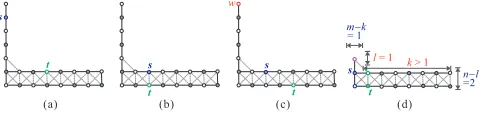
Fig. 7. L-shaped supergrid graph in which there is no Hamiltonian(s, t)-path for (a)sis a cut vertex, (b) {s, t}is a vertex cut, (c) there exists a vertexwsuch thatdeg(w) = 1,w6=s, andw6=t, and (d)m−k= 1, n−l= 2,l= 1,k>2, and{s, t}={(1,2),(2,3)}.
Lemma 4. (See [19]) LetR(m, n)be a rectangular super-grid graph withm>3andn>2,sandtbe its two distinct vertices, and letw= (1,1)andz= (2,1). If(R(m, n), s, t)
does not satisfy condition(F1), then there exists a canonical Hamiltonian(s, t)-pathQofR(m, n)such that(z, f)∈Qif
(R(m, n), s, t)does satisfy condition (F2); and (w, z)∈Q
otherwise.
We then give some observations on the relations among cycle, path, and vertex. These propositions will be used in proving our results and are given in [13], [14], [15].
Proposition 1. (See [13], [14], [15]) LetC1andC2be two
vertex-disjoint cycles of a graphG, letC1andP1be a cycle
and a path, respectively, ofGwithV(C1)∩V(P1) =∅, and
let x be a vertex in G−V(C1) or G−V(P1). Then, the
following statements hold true:
(1)If there exist two edgese1∈C1 ande2∈C2 such that
e1 ≈e2, then C1 andC2 can be combined into a cycle of
G(see Fig. 6(a)).
(2)If there exist two edgese1 ∈C1 ande2∈P1 such that
e1≈e2, thenC1 andP1 can be combined into a path ofG
(see Fig. 6(b)).
(3)If vertex xadjoins one edge (u1, v1) ofC1 (resp.,P1),
then C1 (resp., P1) and x can be combined into a cycle
(resp., path) ofG(see Fig. 6(c)).
(4) If there exists one edge (u1, v1) ∈ C1 such that
u1 ∼ start(P1) and v1 ∼ end(P1), then C1 and P1 can
be combined into a cycleC ofG(see Fig. 6(d)).
In addition to condition (F1) (as depicted in Fig. 7(a) and 7(b)), in [19], we showed that HP(L(m, n;k, l), s, t)
does not exist whenever one of the following conditions is satisfied.
(F3) assume that Gis a supergrid graph, there exists a vertex w∈ Gsuch that deg(w) = 1, w6=s, and
w6=t (see Fig. 7(c)).
(F4) m−k = 1, n−l = 2, l = 1, k ≥ 2, and
[image:4.595.307.548.165.223.2]We then verify the following theorem in [19].
Theorem 1. (See [19]) Let L(m, n;k, l) be a L-shaped supergrid graph with vertices sandt. If(L(m, n;k, l), s, t)
does not satisfy conditions (F1), (F3), and (F4), then
L(m, n;k, l) contains a Hamiltonian (s, t)-path, i.e.,
HP(L(m, n;k, l), s, t)does exist.
The following theorem shows the Hamiltonicity of L -shaped supergrid graphs and has been proved in [18].
Theorem 2. (See [18]) Let L(m, n;k, l) be a L-shaped supergrid graph. Then,L(m, n;k, l)contains a Hamiltonian cycle if it does not satisfy condition(F5).
Where condition (F5) is defined as follows:
(F5) there exists a vertex w in L(m, n;k, l) such that
deg(w) = 1.
In the following, we useLˆ(G, s, t)to denote the length of longest paths betweensandtandUˆ(G, s, t)to indicate the upper bound on the length of longest paths betweensandt, whereG is a rectangular,L-shaped, or C-shaped supergrid graph. By the length of a path we mean the number of vertices of the path. In [15] and [19], we showed that a longest (s, t)-path of a rectangular or L-shaped supergrid graph can be computed in linear time.
Theorem 3. (See [15], [19]) Given a rectangular supergrid
graphR(m, n)withmn>2 or L-shaped supergrid graph
L(m, n;k, l), and two distinct verticessandtinR(m, n)or
L(m, n;k, l), a longest(s, t)-path can be found inO(mn) -linear time.
III. THENECESSARY ANDSUFFICIENTCONDITIONS FOR THEHAMILTONIAN ANDHAMILTONIANCONNECTED OF
C-SHAPEDSUPERGRID GRAPHS
In this section, we will give necessary and sufficient conditions for C-shaped supergrid graphs to have a Hamiltonian cycle and Hamiltonian (s, t)-path. First, we will verify the Hamiltonicity of C-shaped supergrid graphs. If a(= m − k) = 1 or there exists a vertex
w ∈ V(C(m, n;k, l;c, d)) such that deg(w) = 1, then
C(m, n;k, l;c, d)contains no Hamiltonian cycle. Therefore,
C(m, n;k, l;c, d) is not Hamiltonian if condition (F6) is satisfied, where (F6) is defined below.
(F6) a(= m − k) = 1 or there exists a vertex
w∈V(C(m, n;k, l;c, d))such that deg(w) = 1.
By using Lemma 1 and Proposition 1, we can prove the following theorem. Due to the space limitation, we omit its proof.
Theorem 4. C(m, n;k, l;c, d)contains a Hamiltonian cycle if and only if it does not satisfy condition (F6).
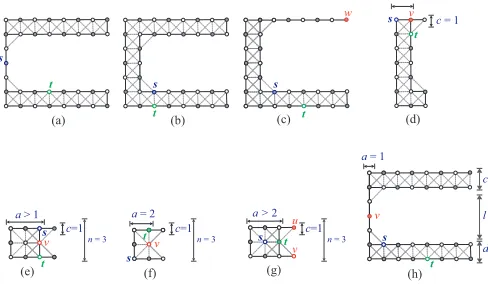
Next, we give necessary and sufficient conditions for the existence of a Hamiltonian (s, t)-path in C(m, n;k, l;c, d). In addition to condition (F1) (as depicted in Fig. 8(a)–8(b)) and (F3) (as depicted in Fig. 8(c)), if(C(m, n;k, l;c, d), s, t)
satisfies one of the following conditions, then it contains no Hamiltonian(s, t)-path.
s
t s
t t
w
s
t s
a=m-k= 2
c= 1
t s
a= 1
c
d l
t s
a> 1
c=1
n= 3 s t
v
u
v t
s v
v
v
c=1
n= 3 c
=1 n= 3
a= 2 a >2
(a) (b) (c) (d)
(e) (f) (g) (h)
Fig. 8. SomeC-shaped supergrid graphs in which there is no Hamiltonian (s, t)-path.
(F7) m= 3,a=m−k= 2, and[(c= 1and{s, t}=
{(1,1),(2,2)} or {(1,2),(2,1)}) or (d = 1 and
{s, t}={(1, n),(2, n−1)}or{(1, n−1),(2, n)})]
(see Fig. 8(d)).
(F8) n= 3,k=c=d= 1, and
1) a>2 andsx =tx=m−1 (see Fig. 8(e));
or
2) a= 2,sx= 1,tx= 2, and|sy−ty|= 2(see
Fig. 8(f)); or
3) a >2,sx< m−1, andt= (m−1,2)(see
Fig. 8(g)).
(F9) a=m−k= 1, and (sy, ty 6c orsy, ty> c+l)
(see Fig. 8(h)).
By using Lemma 1, Lemma 3, Lemma 4, and Theorem 1, we prove the necessary and sufficient conditions for
HP(C(m, n;k, l;c, d), s, t)does exist in the following three lemmas. Due to the space limitation, the proofs are omitted.
Lemma 5. If HP(C(m, n;k, l;c, d), s, t) exists, then
(C(m, n;k, l;c, d), s, t) does not satisfy conditions (F1),
(F3),(F7),(F8), and(F9).
Lemma 6. LetC(m, n;k, l;c, d)be a C-shaped supergrid
graph with a = m−k = 1, and let s and t be its two
distinct vertices such that(C(m, n;k, l;c, d), s, t) does not satisfy conditions(F1), (F3),(F7), (F8), and (F9). Then,
C(m, n;k, l;c, d) contains a Hamiltonian (s, t)-path, i.e.,
HP(C(m, n;k, l;c, d), s, t)does exist.
Lemma 7. LetC(m, n;k, l;c, d)be a C-shaped supergrid graph with a = m−k > 2, and let s and t be its two distinct vertices such that(C(m, n;k, l;c, d), s, t) does not satisfy conditions(F1), (F3),(F7), (F8), and (F9). Then,
C(m, n;k, l;c, d) contains a Hamiltonian (s, t)-path, i.e.,
HP(C(m, n;k, l;c, d), s, t)does exist.
From Lemmas 5–7, it immediately follows that the fol-lowing theorem holds true.
Theorem 5. LetC(m, n;k, l;c, d)be aC-shaped supergrid graph with vertices s and t. C(m, n;k, l;c, d) contains a Hamiltonian (s, t)-path, i.e., HP(C(m, n;k, l;c, d), s, t)
[image:5.595.305.549.57.199.2]IV. THELONGEST(s, t)-PATH INC-SHAPEDSUPERGRID GRAPHS
From Theorem 5, it follows that if(C(m, n;k, l;c, d), s, t)
satisfies one of the conditions (F1), (F3), (F7), (F8), and (F9), then(C(m, n;k, l;c, d), s, t)contains no Hamiltonian(s, t) -path. So in this section, first for these cases we give upper bounds on the lengths of longest paths betweensandt. Then, we show that the derived upper bound is equal to the length of longest paths betweensandt. Notice that the isomorphic cases are omitted. The following lemmas give the bounds. Due to the space limitation, the proofs of the following four lemmas are omitted.
Lemma 8. Let a = 1 and w = (1, c+ 1). Suppose that
(C(m, n;k, l;c, d), s, t)satisfies one of the conditions (F1)
and(F9). Then, the following statements hold true:
(FC1) If sy, ty > c, then the length of any path between s andt cannot exceed Lˆ(G1, s, t), where G1 =L(m, n−
c;k, l).
(FC2)If(sy 6candty > c+l)or(ty6candsy> c+l),
without loss of generality assume thatsy6c, then the length
of any path between s and t cannot exceed Lˆ(G1, s, z) +
ˆ
L(G2, w, t), where G1 =R(m, c),G2 =L(m, n−c;k, l),
andz= (1, c)ifs= (16 , c); otherwise z= (2, c).
Lemma 9. Assume that a > 1, {s, t} is a vertex cut, and
(k >1,sy, ty >n−1, anda+ 16sx=tx6m−1) or
(c+ 16sy =ty 6c+l)]. Then, the following statements
hold true:
(FC3)Ifa= 2andsy=ty, then the length of any path
be-tweens andt cannot exceedmax{Lˆ(G1, s, t),Lˆ(G2, s, t)},
where G1 = L(m, n′;k, l′), G2 = L(sy, m;k′, l′′), n′ = n−sy+ 1,l′=n′−d,k′=l−l′+ 1, andl′′=k.
(FC4) If c = 1, d = 2, and sx = tx,
then the length of any path between s and t
can-not exceed max{Lˆ(G1, s, t),Lˆ(G2, s, t)}, where G1 =
C(m′, n;k′, l;c, d),G2 =R(m−m′+ 1, d),m′ =sx, and k′ =m′−a.
(FC5) Ifc >1,d= 2, andsx=tx, then the length of any
path between s and t cannot exceed Lˆ(G1, s, t) +|G2| =
ˆ
L(G1, s, t) + k× c, where G1 = L(m, n;k, l +c) and
G2=R(k, c).
Lemma 10. Let a > 1 and c = 1. Then, the following statements hold true:
(FC6) If a = 2, sy, ty 6 2, sy 6= ty, and sx 6= tx,
then the length of any path between sandt cannot exceed
ˆ
L(L(m, n;k, l+c), s, t).
(FC7)If(C(m, n;k, l;c, d), s, t)satisfies condition(F8))or
(sx = tx = m−1 and sy, ty 6 2), then the length of
any path between sandt cannot exceedLˆ(G′, s, t), where G′=L(m, n;k, l+c).
Lemma 11. Assume that k, a > 1, c = 1, and
(C(m, n;k, l;c, d), s, t) does not satisfy (FC6). Let w = (a+ 1,1). Then, the following statements hold true:
(FC8) If tx > 1, ty = 1, and [(sx 6 a) or (sx > a
and sy > c +l)], then the length of any path between s and t cannot exceed Lˆ(G1, s, z) + ˆL(G2, w, t), where
G1 = L(m, n;k, l+c), G2 = R(k, c), and z = (a,1) if
s6= (a,1); otherwisez= (a,2).
(FC9)Ifsx, tx>1andsy=ty= 1, then the length of any
path betweensandtcannot exceed tx−sx+ 1.
(FC10) If deg(s) > 1, deg(t) > 1, and (C(m, n;k, l; c, d), s, t) does not satisfy condition (F1), then the length of any path betweensandtcannot exceed Lˆ(G1, s, t) + 1,
whereG1=L(m, n;k, l+c).
It is easy to show that any (C(m, n;k, l;c, d), s, t)
must satisfy one of conditions (C1), (FC1), (FC2), (FC3), (FC4), (FC5), (FC6), (FC7), (FC8), (FC9), and (FC10). If (C(m, n;k, l;c, d), s, t) satisfies (C1), then Uˆ(C(m, n;k, l;c, d), s, t) is mn − kl. Otherwise,
ˆ
U(C(m, n;k, l;c, d), s, t) can be computed using Lemmas 8–11. Where (C1) is defined as follows:
(C1) (C(m, n;k, l;c, d), s, t) does not satisfy any of conditions (F1), (F3), (F7), (F8), and (F9).
We then conclude the upper bounds Uˆ(C(m, n;k, l; c, d), s, t)as follows:
ˆ
U(C(m, n;k, l;c, d), s, t) =
ˆ
L(G1, s, t), if (FC1),
ˆ
L(G1, s, z) + ˆL(G2, w, t), if (FC2) or (FC8),
max{Lˆ(G1, s, t),Lˆ(G2, s, t}, if (FC3) or (FC4),
ˆ
L(G1, s, t) +k×c, if (FC5),
ˆ
L(L(m, n;k, l+c), s, t), if (FC6) or (FC7), tx−sx+ 1, if (FC9),
ˆ
L(G1, s, t) + 1, if (FC10),
mn−kl, if (C1).
Finally, we show how to obtain a longest (s, t)-path for C-shaped supergrid graphs in Lemma 12. Due to the space limitation, its proof is omitted. Notice that if
(C(m, n;k, l;c, d), s, t) satisfies (C1), then by Theorem 5, it contains a Hamiltonian(s, t)-path.
Lemma 12. If(C(m, n;k, l;c, d), s, t)satisfies one of con-ditions (FC1)–(FC10), then Lˆ(C(m, n;k, l;c, d), s, t) =
ˆ
U(C(m, n;k, l;c, d), s, t).
We finally conclude the following theorem.
Theorem 6. Given aC-shaped supergridC(m, n;k, l;c, d)
and two distinct vertices s and t in C(m, n;k, l;c, d), a longest(s, t)-path can be constructed inO(mn)-linear time.
The algorithm is formally presented as Algorithm IV.1.
V. CONCLUDINGREMARKS
Based on the Hamiltonicity and Hamiltonian connectiv-ity of rectangular and L-shaped supergrid graphs, we can prove C-shaped supergrid graphs to be Hamiltonian and Hamiltonian connected except few conditions. On the other hand, we give a linear-time algorithm to find the longest
Algorithm IV.1: The longest(s, t)-path algorithm
Input: AC-shaped supergrid graphC(m, n;k, l;c, d)
withmn>2, and two distinct verticess andt
inC(m, n;k, l;c, d).
Output: The longest(s, t)-path.
1. if a(=m−k) = 1then output
HP(C(m, n;k, l;c, d), s, t)constructed from Lemma 6; // (C(m, n;k, l;c, d), s, t)does not satisfy the forbidden conditions (F1), (F3), (F7), (F8), and (F9);
2. if a(=m−k)>1 then output
HP(C(m, n;k, l;c, d), s, t)constructed from Lemma 7; // (C(m, n;k, l;c, d), s, t)does not satisfy the forbidden conditions (F1), (F3), (F7), and (F8);
3. if (C(m, n;k, l;c, d), s, t)satisfies one of the forbidden
conditions (F1), (F3), (F7), (F8), and (F9), then output the longest(s, t)-path based on Lemma 12;
remains open for solid supergrid graphs in which there exists no hole.
REFERENCES
[1] N. Ascheuer, Hamiltonian Path Problems in the On-line
Optimiza-tion of Flexible Manufacturing Systems, Technique Report TR 96-3,
Konrad-Zuse-Zentrum f¨ur Informationstechnik, Berlin, 1996. [2] J. C. Bermond, Hamiltonian Graphs, in Selected Topics in Graph
Theory, ed. by L. W. Beinke and R. J. Wilson, Academic Press, New
York, 1978.
[3] A. A. Bertossi and M. A. Bonuccelli, “Hamiltonian Circuits in Interval Graph Generalizations,” Inform. Process. Lett., vol. 23, pp. 195–200, 1986.
[4] J. A. Bondy and U. S. R. Murty, Graph Theory with Applications, Macmillan, London, Elsevier, New York, 1976.
[5] R. W. Bulterman, F. W. van der Sommen, G. Zwaan, T. Verhoeff, A. J. M. van Gasteren, and W. H. J. Feijen, “On Computing a Longest Path in a Tree,” Inform. Process. Lett., vol. 81, pp. 93–96, 2002. [6] S. D. Chen, H. Shen, and R. Topor, “An Efficient Algorithm for
Constructing Hamiltonian Paths in Meshes,” Parallel Comput., vol. 28, pp. 1293–1305, 2002.
[7] P. Damaschke, “The Hamiltonian Circuit Problem for Circle Graphs is NP-complete,” Inform. Process. Lett., vol. 32, pp. 1–2, 1989. [8] M. Ebrahimi, M. Daneshtalab, and J. Plosila,“ Fault-tolerant Routing
Algorithm for 3D NoC using Hamiltonian Path Strategy,” in
Proceed-ings of the Conference on Design, Automation and Test in Europe (DATE’13), 2013, pp. 1601–1604.
[9] M. R. Garey and D. S. Johnson, Computers and Intractability: A Guide
to the Theory of NP-completeness, Freeman, San Francisco, CA, 1979.
[10] M. C. Golumbic, Algorithmic Graph Theory and Perfect Graphs, Second edition, Annals of Discrete Mathematics 57, Elsevier, 2004. [11] V. S. Gordon, Y. L. Orlovich, and F. Werner, “Hamiltonian Properties
of Triangular Grid Graphs,” Discrete Math., vol. 308, pp. 6166–6188, 2008.
[12] V. Grebinski and G. Kucherov, “Reconstructing a Hamiltonian Cycle by Querying the Graph: Application to DNA Physical Mapping,”
Discrete Appl. Math., vol. 88, pp. 147–165, 1998.
[13] R. W. Hung, C. C. Yao, and S. J. Chan, “The Hamiltonian Properties of Supergrid Graphs,” Theoret. Comput. Sci., vol. 602, pp. 132–148, 2015.
[14] R. W. Hung, “Hamiltonian Cycles in Linear-convex Supergrid Graphs,”
Discrete Appl. Math., vol. 211, pp. 99–112, 2016.
[15] R. W. Hung, C. F. Li, J. S. Chen, and Q. S. Su, “The Hamiltonian Connectivity of Rectangular Supergrid Graphs,” Discrete Optim., vol. 26, pp. 41–65, 2017.
[16] R. W. Hung, H. D. Chen, and S. C. Zeng, “The Hamiltonicity and Hamiltonian Connectivity of Some Shaped Supergrid Graphs,” IAENG
Intern. J. Comput. Sci., vol. 44, pp. 432–444, 2017.
[17] R. W. Hung, J. L. Li, and C. H. Lin, “The Hamiltonian Connectivity of Some Alphabet Supergrid Graphs,” in The 2017 IEEE 8th International
Conference on Awareness Science and Technology (iCAST’2017),
Taichung, Taiwan, 2017, pp. 27–34.
[18] R. W. Hung, J. L. Li, and C. H. Lin, “The Hamiltonicity and Hamiltonian Connectivity ofL-shaped Supergrid Graphs,” in Lecture
Notes in Engineering and Computer Science: Proceedings of The International MultiConference of Engineers and Computer Scientists (IMECS’2018), Hong Kong, vol. I, 2018, pp. 117–122.
[19] R. W. Hung, F. Keshavarz-Kohjerdi, and J. L. Li, “The Hamiltonicity and Hamiltonian Connectivity ofL-shaped Supergrid Graphs,” sub-mitted for publication.
[20] K. Ioannidou, G. B. Mertzios, and S. D. Nikolopoulos, “The Longest Path Problem has a Polynomial Solution on Interval Graphs,”
Algo-rithmica, vol. 61, pp. 320–341, 2011.
[21] A. Itai, C. H. Papadimitriou, and J. L. Szwarcfiter, “Hamiltonian Paths in Grid Graphs,” SIAM J. Comput., vol. 11, pp. 676–686, 1982. [22] D. S. Johnson, “The NP-complete Column: An Ongoing Guide,” J.
Algorithms, vol. 6, pp. 434–451, 1985.
[23] F. Keshavarz-Kohjerdi and A. Bagheri, “Hamiltonian Paths in Some Classes of Grid Graphs,” J. Appl. Math., vol. 2012, article no. 475087, 2012.
[24] F. Keshavarz-Kohjerdi, A. Bagheri, and A. Asgharian-Sardroud, “A Linear-time Algorithm for the Longest Path Problem in Rectangular Grid Graphs,” Discrete Appl. Math., vol. 160, pp. 210–217, 2012. [25] F. Keshavarz-Kohjerdi and A. Bagheri, “An Efficient Parallel
Algo-rithm for the Longest Path Problem in Meshes,” The J. Supercomput., vol. 65, pp. 723–741, 2013.
[26] F. Keshavarz-Kohjerdi and A. Bagheri, “Hamiltonian Paths in L-shaped Grid Graphs,” Theoret. Comput. Sci., vol. 621, pp. 37–56, 2016. [27] F. Keshavarz-Kohjerdi and A. Bagheri, “A Linear-time Algorithm for Finding Hamiltonian(s, t)-paths in Odd-sized Rectangular Grid Graphs with a Rectangular Hole,” The J. Supercomput., vol. 73, no. 9, pp. 3821–3860, 2017.
[28] F. Keshavarz-Kohjerdi and A. Bagheri, “A Linear-time Algorithm for Finding Hamiltonian(s, t)-paths in Even-sized Rectangular Grid Graphs with a Rectangular Hole,” Theoret. Comput. Sci., vol. 690, pp. 26–58, 2017.
[29] F. Keshavarz-Kohjerdi and A. Bagheri, “Longest (s, t)-path in L-shaped Grid Graphs,” Opti. Methods Softw., to be published. doi.org/10.1080/10556788.2018.1460665.
[30] M. S. Krishnamoorthy, “An NP-hard Problem in Bipartite Graphs,”
SIGACT News, vol. 7, p. 26, 1976.
[31] W. Lenhart and C. Umans, “Hamiltonian Cycles in Solid Grid Graphs”, in Proceedings of the 38th Annual Symposium on Foundations of
Computer Science (FOCS’97), 1997, pp. 496–505.
[32] G. B. Mertzios and D. G. Corneil, “A Simple Polynomial Agorithm for the Longest Path Problem on Cocomparability Graphs,” SIAM J.
Discrete Math., vol. 26, pp. 940–963, 2012.
[33] J. F. O’Callaghan, “Computing the Perceptual Boundaries of Dot Patterns,” Comput. Graphics Image Process., vol. 3, pp. 141–162, 1974.
[34] F. P. Preperata and M. I. Shamos, Computational Geometry: An
Introduction, Springer, New York, 1985.
[35] J. R. Reay and T. Zamfirescu, “Hamiltonian Cycles in T-graphs,”
Discrete Comput. Geom., vol. 24, pp. 497–502, 2000.
[36] A. N. M. Salman, Contributions to Graph Theory, Ph.D. thesis, University of Twente, 2005.
[37] G. T. Toussaint, “Pattern Recognition and Geometrical Complexity,” in Proceedings of the 5th International Conference on Pattern
Recog-nition, Miami Beach, 1980, pp. 1324–1347.
[38] R. Uehara and Y. Uno, “On Computing Longest Paths in Small Graph Classes,” Int. J. Found. Comput. Sci., vol. 18, pp. 911–930, 2007. [39] C. Zamfirescu and T. Zamfirescu, “Hamiltonian Properties of Grid