Page 1 of 62
RESEARCH METHODOLOGY IN
CHILD-ROBOT INTERACTION:
A LITERATURE STUDY
WELMOED LOOGE (S0208841)
MASTER THESIS
HUMAN FACTORS & ENGINEERING PSYCHOLOGY
UNIVERSITEIT TWENTE
2016
FIRST SUPERVISOR: DR. MARTIN SCHMETTOW
SECOND SUPERVISOR: CRISTINA ZAGA
Page 2 of 62
ABSTRACT
Due to its relatively young age, the field of Human-Robot Interactions is still looking for a
commonly agreed upon set of research methods. Literature on research methods suitable for
use in Child-Robot Interaction (CRI) research is even more scarce, despite the fact that children
are not yet as cognitively developed as adults and therefore cannot necessarily be researched
with the same methods that adults can. This thesis aims to bridge this knowledge gap regarding
suitable research methods for CRI. To that end, a systematic literature review was performed
to gain insight in which research methods were used in CRI in the past decade to research
children between ages 0 and 12. The research methods found were then analyzed in terms of
their suitability for use with children of different ages in light of children’s cognitive
development. Self-report methods (interviews and surveys) were found to be suitable only for
children aged 7 and up, whereas other methods such as observations and physiological
measures are suitable for children of all ages. This was found to be because the age of 7 is a
turning point from which children are able to communicate their thought to others – an essential
skill to successfully take part in self-report research. Therefore, even though individual
differences exist between children of the same age, it is recommended to only use self-report
measures with children aged 7 or older.
SAMENVATTING
Vanwege haar relatief jonge leeftijd is het onderzoeksveld van Human-Robot Interaction
(Mens-Robot Interactie, afgekort: HRI) nog steeds op zoek naar een breed geaccepteerde set
onderzoeksmethoden. Literatuur over geschikte onderzoeksmethoden voor gebruik in
onderzoek naar Child-Robot Interaction (Kind-Robot Interactie, afgekort: CRI) is nog
schaarser, ondanks het feit dat kinderen cognitief nog niet zo ver ontwikkeld zijn als
volwassenen, waardoor ze niet perse onderzocht kunnen worden met dezelfde methoden als
volwassenen. Deze thesis heeft als doel deze kenniskloof over geschikte onderzoeksmethoden
voor CRI-onderzoek te dichten. Daarom werd er een systematisch literatuuronderzoek
uitgevoerd om inzicht te krijgen in de onderzoeksmethoden die in het afgelopen decennium
zijn gebruikt binnen CRI om kinderen tussen 0 en 12 jaar te onderzoeken. De gevonden
onderzoeksmethoden werden vervolgens geanalyseerd aan de hand van de cognitieve
ontwikkeling van kinderen om zo hun geschiktheid voor gebruik met kinderen van
verschillende leeftijden te bepalen. Zelfrapportage-methoden (interview en vragenlijsten)
bleken enkel geschikt te zijn voor kinderen van 7 of ouder, terwijl andere methoden, zoals
Page 3 of 62
te zijn omdat 7 het kantelpunt is waarop kinderen in staat zijn hun gedachten te communiceren
aan anderen – een essentiële vaardigheid om succesvol deel te kunnen nemen aan
zelfrapportage-onderzoek. Daarom is het aan te bevelen, ook al bestaan er individuele
verschillen tussen kinderen van dezelfde leeftijd, om zelfrapportage-methoden enkel te
Page 4 of 62
TABLE OF CONTENTS
Abstract ... 2
Samenvatting... 2
1. Introduction ... 6
1.1 Metrics and methodologies for robot interaction research ... 7
1.2 Research with children ... 9
1.3 Children’s cognitive development ... 11
1.4 Classifying research methods ... 13
1.5 Research questions ... 15
2. Methods ... 15
2.1 Search term... 16
2.2 Inclusion criteria ... 16
Age of participants ... 17
2.3 Analysis ... 18
3. Results ... 19
3.1 Focus ... 20
3.2 Surveys ... 21
Interaction-related questions ... 22
Robot-related questions ... 22
Task-related questions ... 23
Child-related questions ... 23
Surveys: discussion ... 23
3.3 Interviews & Focus groups ... 28
Interaction-related interviews ... 30
Task-related interviews ... 30
Child-related interviews ... 30
Interviews: discussion ... 30
3.4 Observation ... 32
Child-related behavior ... 33
Interaction-related behavior ... 35
Robot-related behavior ... 35
Task-related behavior ... 35
Observations: Discussion... 36
3.5 Human measures ... 37
Page 5 of 62
3.7 Ethnography ... 38
Ethnography: Discussion ... 39
3.8 Usability testing ... 39
4. Discussion ... 41
4.1 Answering the main questions in CRI ... 42
4.2 The magical threshold of 7 ... 44
4.3 Status quo of methodological requirements ... 45
4.4 Multiple and mixed methods research... 47
4.5 Limitations ... 49
5. Conclusion ... 51
Page 6 of 62
1. INTRODUCTION
In 1921, Czech writer Karel Čapek’s famous play R.U.R. (Rossum’s Universal Robots) introduced the term ‘robot’ to the world. Loosely translated from Czech, the term means something like ‘forced labor’. Even though this translation corresponds to the stand-alone
industrial production machines that robots have mainly been for decades, the robots portrayed
in Čapek’s play were completely different. These robots were some kind of humanoids that
consisted of synthetic organic matter and that could think for themselves. They were so much
like humans that they could even be mistaken for them. Although this idea of robots that work
with humans and that behave in such a human way may have been revolutionary for Čapek’s
time, it is not that far-fetched now. Due to rapid progress in robotics, increasingly sophisticated
robots are being developed, and robots are now capable to be deployed to work with humans
instead of isolated from them.
Current robots vary in the degree to which they interact with humans, depending on
their function. For instance, personal service robots are being developed with the aim to help
elderly people live at home longer. (e.g. Roy et al. (2000); Scopelliti, Giuliani, & Fornara
(2005); Broadbent, Stafford, & MacDonald, (2009); Broekens, Heerink, & Rosendal (2009)).
Other robots in human lives do not interact with people as much, such as commercially
available robotic vacuum cleaners that are capable of navigating and vacuuming spaces
autonomously (Forlizzi & Disalvo, 2006). Despite the fact that these robots are not designed
with the aim of interacting socially and forming bonds with humans, Sung, Guo, Grinter, and
Christensen (2007) found that people often attributed humanlike characteristics to their robotic
vacuum cleaners and that they expressed attachment towards them. This is in line with the
assertion of Dautenhahn (2007) that humans have a natural tendency to anthropomorphize
everything around them, including technology. This goes especially for children, who,
according to Salter, Werry and Michaud (2008) “are unlikely to only use a robot as a tool and
they will undoubtedly have some sort of interaction that can be considered social.” (p. 94).
Several research projects focus specifically on the use of robots with children. One of
them is the Aliz-e project, which aims to develop artificial intelligence for small humanoid
robots that are intended to interact with children for longer periods of time. In this project,
robots are used to educate hospitalized children with diabetes about their disease and how to
manage it (Blanson Henkemans et al., 2013; Neerincx, 2010). The Aurora Project researches
Page 7 of 62
Conditions (ASC) (AURORA, 2015). People with ASC are impaired when it comes to social
interaction and social communication. Skills for interpreting and predicting human behavior
are typically developed in early childhood, but limited in people with ASC. Because of this,
human behavior occurs as very unpredictable to them. In contrast, robots react very predictably
and their behavior can be repeated tirelessly (Hanson et al., 2012), which creates possibilities
for robots to be used as therapeutic tool for people with ASC. The DREAM project aims to
take robot-assisted therapy to a next level by developing robot-enhanced therapy. This robot is
intended to work more autonomously than current robots by assessing the behavior of the child
and to make inferences about their psychological disposition, based upon which it will be able
to decide therapeutic actions tailored to individual children’s needs (DREAM, 2015).
Because of children’s aforementioned tendency to form social bonds with objects such
as robots, robots need to be able to interact with humans socially. According to Bartneck and
Forlizzi (2004), “a social robot is an autonomous or semi-autonomous robot that interacts and
communicates with humans by following the behavioral norms expected by the people with
whom the robot is intended to interact” (p. 592). They describe autonomous robots as robots “having the technological capabilities to act on behalf of humans without direct input from
humans.” (p. 593), which is necessary because most people interacting with robots – especially
children – are not trained to operate robots. Therefore, Burghart and Haeussling (2005) state
that the interaction between humans and robots should be as intuitive as possible, which
“requires the recognition and consideration of the main social parameters of a co-operative task between human and robot” (p. 23). For that reason, research on interaction between children
and robots is necessary. A challenge, however, is that the research field of Human-Robot
Interaction (HRI) is still young and that commonly agreed upon research methodologies have
not yet been established (Dautenhahn, 2007). This goes even more for interaction between
children and robots, or Child-Robot Interaction (CRI). Therefore, this thesis aims to investigate
what suitable research methods for CRI are.
1.1 METRICS AND METHODOL OGIES FOR ROBOT INTE RACTION RESEARCH
Dautenhahn (2007) describes HRI as “a challenging research field at the intersection of
psychology, cognitive science, social sciences, artificial intelligence, computer science,
robotics, engineering and human-computer interaction.” that aims to “investigate ‘natural’
means by which a human can interact and communicate with a robot” (p. 103). Even though
Page 8 of 62
HRI because in HRI, “robots and humans need to coordinate their activities in time and space
in real-time, often face-to-face” (p. 103), which makes these interactions different from
interactions researched in, for example, Human-Computer Interaction (HCI). Due to
differences such as this, Dautenhahn states that research methods from related fields need to
be adapted to or developed for use in HRI instead of applying them to HRI without change.
Defining common metrics for HRI will, according to Steinfeld et al. (2006), lead to better
comparability between studies and greater sharing of knowledge as a result of it. Similarly,
Dautenhahn stresses the importance of reproducibility of studies, which will improve when a
commonly accepted methodology has been established.
In their attempt to identify common metrics for HRI, Steinfeld et al. (2006) stated that
“the primary difficulty in defining common metrics is the incredibly diverse range of human-robot applications.” (p. 33). To classify these various forms of human-human-robot interactions, Yanco
and Drury (2002) proposed a taxonomy that categorizes HRI in terms of the “team composition
(ratio of people to robots, types of robots), amount of required interaction, decision support
provided for the user, and space-time location”. In 2004, they updated this taxonomy to also
include the social nature of the interaction between human and robot, the type of task, and robot
morphology (anthropomorphic, zoomorphic, or functional). According to Steinfeld and
colleagues, it often happens in the early years of new fields of research that researchers use a
wide variety of often application specific measures. “Common metrics develop as researchers
devote more attention to the core questions of the field” (p. 33). Steinfeld et al. believe that
HRI has reached this point, further stressing the need for commonly accepted methods in the
field.
In a survey study of 29 papers that concern metrics for HRI, Murphy and
Schreckenghost (2013) classified the proposed metrics they found in these papers as either
measures of the human, the robot or the system. Within system metrics, they distinguish
between metrics for “productivity, efficiency, reliability, safety, and coactivity” (p. 197).
Figure 1 shows a taxonomy of all metrics that were found in this study. Murphy and
Schreckenghost conclude from their survey that “often these metrics have no functional, or
generalizable mechanism for measuring that feature” (p. 197). They found that instead of being
directly measured, the human-robot interaction for the system is often inferred from
observations and measurements of the robot or the human, which leads to error and noise in
Page 9 of 62
Figure 1. Taxonomy of HRI metrics. Reprinted with permission from "Survey of Metrics for Human-Robot Interaction" by Murphy, R. R., and Schreckenghost, D., 2013, 8th ACM/IEEE International Conference on Human-Robot Interaction (HRI), p. 197. Copyright 20
From all this, it becomes clear that even though the establishment of a commonly
accepted set of research methods for HRI is necessary, more research on the topic is needed in
order to achieve that. Dautenhahn (2007) warns researchers to avoid methodological battles in
their quest to determine suitable research methods for HRI, as she describes that discussions
are going on within the field about whether large-scale quantitative research or smaller scale
qualitative research such as case studies are best. Dautenhahn argues “that there is no
‘once-and-for-all’ solution applicable across HRI” (p. 103), and that trying to define such solution
would damage the development of the young field of HRI. Instead, she poses that it is in HRI’s
best interest to recognize that there is more than one way to gain insight into the topics of
interest. Despite these efforts to establish a commonly agreed upon research methodology for
HRI, literature on research methodologies for CRI is even more scarce.
Page 10 of 62
In the previous section, the need for commonly agreed upon research methodologies
for HRI was discussed. This section concerns methodologies for child-robot interactions. The
central question here is whether these are needed, and if so: why? The same question was asked
by Punch (2002), who posed that the way children are perceived by adults is deciding in which
methods are used for research. Research with children is often seen as either the same as
research with adults, or as completely different. The former view eliminates the need for
separate or adapted research methods for children, whereas the latter actually necessitates it.
According to Punch, literature that argues research with children to be different from research
with adults often offers one of three explanations for this difference: “the position of childhood
in adult society, adults’ attitudes towards children and the children themselves” (p. 323). Punch suggests that because adults control much of children’s lives, children are used to adults having
power over them and not used to being taken seriously by adults or expressing their own views.
According to Punch, research with children may also differ from research with adults because
of adults’ attitudes towards children and assumptions about their capabilities. For instance,
Punch states that adult researchers often change how they use language in research with
children because they assume children to be less articulate. Because children do differ from
adults in some aspects, such as their more limited vocabulary and experience in the world,
research with children may be different from research with adults as well.
In line with this last assertion, James, Jenks and Prout suggested a third way to see
children, namely as being similar to but having different competencies than adults (cited in
Punch, 2002, p.322). In addition to that, Punch argues that adults should not assume that all
children have the same competencies, such as reading ability or concentration span, and that
appropriate research methods should be used. Even though Punch advocates the use of multiple
research methods to take these individual differences between children into account, she does
not further indicate which research methods are considered appropriate.
A similar view of children to the one proposed by James, Jenks and Prout is the one
described by Einarsdóttir (2007), who reported of a study of playschool children’s (ages 2-6)
experiences with and opinions about the play school they attended. This study “was conducted
under the influence of postmodern views of children and childhood, the sociology of childhood,
and the children’s rights movement” (p. 198). This means “that children, just like adults, hold
their own perspectives, have the right to be heard, and are able to speak for themselves if the
Page 11 of 62
states that children have the right to express their own views on matters that concern them
(“Convention on the Rights of the Child,” 1989). Even though in this quote, Einarsdóttir
consideres the use of the right research methods a necessary condition for children to express
their opinions, she does not provide an answer as to what the right methods are. Instead, she
used multiple research methods in her study (group and individual interviews, analysis of
children’s drawings and photographs taken by children, and a questionnaire, gathering of
artifacts and categorization of pictures). Similar to Punch, Einarsdóttir found that using a
variety of research methods is needed to suit the differences between children, and that
“different methods can shed light on different aspects and can give a new breadth of understanding” (p. 207).
According to Belpaeme et al. (2013), CRI “is different from interaction between adults
and robots in that children have got a different, immature cognitive development” (p. 452),
especially with regards to their tendencies to anthropomorphize technology, including robots.
This makes the way they interact with robots different to the way adults interact with robots.
Furthermore, children are not cognitively as developed as adults. Belpaeme and colleages state,
similar to the points of view presented above, that “children are not just small adults” (p. 453), and that children’s are not yet linguistically as developed as adults, which poses challenges to the design of robots that are to interact with children. However, if children’s more limited
linguistic development poses challenges to robot design, it also poses challenges to the way
they can be researched.
To summarize, even though children are similar to adults in the way that they deserve
to be heard, they cannot be researched in the exact same way that adults are researched because
children are not yet as cognitively and linguistically developed as adults. This calls for research
on suitable research methods for CRI.
1.3 CHILDREN’S COGNITIVE DEVELOPMENT
Because children do differ from adults with regard to their cognitive development, this
thesis ascribes to the views that children may be similar to adults but have different capabilities.
Children, however, form a heterogeneous group with much developmental differences between
individual children. Therefore, in the quest to identify suitable research methods for CRI, it is
important to consider children’s capabilities at different developmental stages. Borgers, De
Leeuw, and Hox (2000) investigated the effects of children’s cognitive development on the
Page 12 of 62
stages of cognitive development. Piaget (1960) recognized four stages of cognitive
development: the sensorimotor stage, the preoperational stage, the concrete operational stage
and the formal operational stage. The sensorimotor stage lasts from birth to around 18 months
of age. During this time, children develop sensorimotor intelligence, which arises from the
child’s sensory and motor experience with the world and the assimilation of these new experiences into the child’s cognitive schemata. The second stage of development, the
preoperational stage, lasts from about 18 months through seven or eight years of age. Piaget
described two distinct developments of thought within this stage: the development of
preconceptual and symbolic thought (until about 4 years of age) and that of intuitive thought
(between 4 and 7-8 years). During the development of preconceptual intelligence, children
learn to use language and to attach notions, or pre-concepts, to this language. In this stage of
development, children are beginning to build cognitive schemata of the world around them,
which Piaget described as remaining “midway between the generality of the concept and the
individuality of the elements composing it, without arriving either at the one or at the other.
(…) It is clear that such a schema, remaining midway between the individual and the general,
is not yet a logical concept and is still partly something of a pattern of action and of
sensori-motor assimilation” (p. 127-128). Summarizing, this means that children are starting to form
the schemata that are at the basis of conceptual and formal thought during this stage. After the
development of preconceptual thought, children develop intuitive thought. During the
development of intuitive thought, children conceptualize more than in previous stages of
development. They move on from “simple half-individual, half-generic figures” (p. 130) to more complex representational structures, forming a rudimentary logic, “but in the form of
representative regulations and not yet of operations”. Concrete operations are, according to
Piaget, developed between ages 7-8 and 11-12. Scott (1997) described that children’s thought
changes dramatically between the preoperational and concrete operational stage. During the
concrete operational stage, “children are not only able to take on the view of others, but they
are also capable of logical thinking and deductive reasoning, even if their thought processes
are still tied to the concrete operations of their immediate world” (p. 334-335). These changes in children’s thinking make that according to Scott (1997) and De Leeuw (2011), children are
able to be answer structured constructed questionnaires or interviews from around age seven,
depending on their individual development. From around age 11, formal thought starts to
develop. This way of thinking is characterized by thinking beyond the present and forming
Page 13 of 62
action in progress” (Piaget, 1960, p. 148) without forming theories. Children in the formal
operational stage are capable of reflective thought and hypothetico-deductive reasoning.
Borgers, de Leeuw and Hox chose to classify children’s development according to
Piaget’s research because it provides “a global classification of developmental stages of children” (p.62). However, they introduce their use of this classification with a few footnotes, because Piaget’s theory has received critique in later research. The boundaries between the
different developmental stages have been argued to be less distinct than Piaget describes.
Instead, there may be overlap between the stages, and one has to take into account that even
within these stages there will be considerable differences in cognitive development between
individual children (Borgers, De Leeuw, & Hox, 2000). In addition to that, later research has
shown that very young children have more reasoning ability than Piaget thought. Machado and
Lourenço (1995) encountered the criticism that Piaget underestimated preoperational
children’s capabilities as one of the most frequent critiques on Piaget’s theory, but they argue
that these criticisms are based on misinterpretations of Piaget. Regardless of whether or not
this is true, Scott (1997) argues that even though younger (preoperational) children may be
more capable of reasoning than Piaget thought, their ability to successfully participate in survey
research is still limited by their abilities to comprehend language and their verbal memory.
Scott furthermore argues that “children’s cognitive capacity clearly does increase with age and
the rudimentary levels of cognitive development remain relevant for understanding the
question and answer process and for highlighting the ways in which children may differ from
adult respondents” (p. 334). Therefore, she, as well as Borgers and colleagues, chooses to use Piaget’s stages of development classify children according to their cognitive development. In
line with these arguments, the research methods found in this thesis will be analyzed in light
of children’s cognitive development as described in Piaget’s theory of cognitive development.
Other developmental psychologists, such as Vygotsky, have argued that social development is
of more influence on children’s cognitive development than Piaget gives credit for, Piaget’s
classification is used here because contrary to the work of Vygotsky, it provides us with the
global classification of children’s development at different ages that is necessary to come to
global recommendations of suitable research methods for CRI.
1.4 CLASSIFYING RESEARCH METHODS
In order to identify which research methods are suitable for use in the field of
Page 14 of 62
measures according to two 2-level dimensions: verbal vs. nonverbal and obtrusive vs.
unobtrusive measurement. According to Dooley, “verbal measures apply to written or spoken
messages, as in questionnaires. Nonverbal measures apply to physical signs including visual
judgments of nonverbal behaviors (e.g. facial expressions) and physiological measures (e.g.
blood pressure)” (p. 97). The obtrusiveness of measures is the extent to which participants are
aware that they are being measured. During questionnaires and physiological measures,
participants are aware of this fact, which may cause them to change their behavior because they
know they are being observed. Dooley refers to this change in behavior as reactivity, which is
a process that can threaten the validity of the research. Unobtrusive measures can be carried
out without the participants knowing, for example by post-hoc analysis of audio or video
recordings for certain behaviors or utterances.
Because research methods differ in the extent to which they are verbal and obtrusive,
research methods rely on different participant abilities. For example, to analyze verbal
utterances, participants need to be capable of expressing themselves verbally, and to conduct a
questionnaire, participants need to be able to understand the questions, form their answers, and
fill in their answer on the questionnaires. Behavior observation, on the other hand, does not
require these capabilities. Therefore, it is important to discuss research methods in light of these
dimensions to determine upon which capabilities these methods rely and whether this makes
them suitable for use in CRI.
However, classifying research methods only on their obtrusiveness is too broad.
Therefore, a more extensive classification based on Lazar, Feng and Hochheiser (2010) is used.
In their book on research methods in Human-Computer Interaction, they dedicate chapters to
the following research methods: surveys, diaries, case studies, interviews and focus groups,
ethnography, usability testing, and measuring the human (eye tracking and physiological
measures). It should be noted that interviews are sometimes considered surveys as well, as
interviews often are conducted based on a questionnaire. Lazar and colleagues distinguish the
two in that they describe surveys as tools that can be self-administered by participants, even
when there is no researcher present, whereas interviews have to take place face-to-face. By this
definition, surveys can be distributed amongst a large amount of (potential) respondents,
whereas interviews are generally carried out with a smaller number of respondents due to the
time-intensive nature of this method. When looking at classifications of research methods for
psychology, however, Lazar and colleagues’ list does not seem to be extensive. In their book
Page 15 of 62
research methods: self-report methods (such as questionnaires and interviews), observations,
and technological measurements (such as EEG and physiological measures). Even though the
research methods that Lazar and colleagues describe almost all fit one of these three categories,
Lazar et al. do not mention observation as a research method. However, because behavior
observation is a commonly used research method in psychology and psychology does play a
role in CRI, we add behavior observation to the list of research methods that Lazar and
colleagues describe.
1.5 RESEARCH QUESTIONS
To summarize, even though there have been some efforts to identify a commonly
agreed upon set of research methods for the field of human-robot interaction, such
methodology has not been established yet. For child-robot interaction, no consensus about
suitable research methods has been reached yet either. Researchers who view children as
similar to adults but having different capabilities advocate the use of appropriate methods in
research with children. However, the question of what appropriate research methods are
remains open. Despite this knowledge gap in suitable research methods for CRI, CRI research
is being conducted and theories are being built based upon this research, which in turn form
the basis for the development of robots that are to interact with children. This once again
stresses the importance of investigating what research methods are suitable for CRI, because
these methods form the foundation for the development of robots that are able to interact with
children and that are able to do that well. Therefore, the goal of this thesis is to identify which
research methods are appropriate for use with children. In line with Dautenhahn's (2007) advice
to avoid to dogmatically determine one and only one best research method, this study does not
aim to determine which research method is superior, but rather to research which ones are
suitable for use in the field of child-robot interaction, given children’s cognitive capacities. To
that end, a literature study will be conducted to identify which research methods are currently
being used in CRI. Then, these research methods will be analyzed in terms of what cognitive
capacities they require from participants, and to determine in light of theories on children’s
cognitive development which are suitable for use in CRI. Finally, this thesis will explore
research fields in which commonly agreed upon methodologies for research with children have
already been established to determine if methods from these fields can also be applied to CRI.
Page 16 of 62
To review which methods are currently used in child-robot interaction research,
systematic literature review was performed. The method for this systematic review is based on
the one used by Riek (2012). Riek perfomed a search with a specific search term and screened
the found papers against her inclusion criteria. Then, she analyzed the included papers using
certain criteria for analysis in order to gain insight in how the Wizard of Oz-method is used in
the field of HRI. In line with this method, this section will describe the search term, inclusion
criteria and criteria for analysis that were used in this literature review to gain insight into which
research methods are used in CRI-research.
2.1 SEARCH TERM
In November 2015, a search was performed on the Web of Science
(http://www.webofknowledge.com) with the following search term:
Child robot interaction AND (research OR experiment OR study OR pilot)
The Web of Science was chosen as search engine for this search because it indexes
nearly all journals and conference proceedings listed in rankings of journals on Human Factors
and Ergonomics1 and Human Computer Interaction2 – fields of research that are most likely
to publish articles on CRI. The search on Web of Science yielded a total of 331 results, which
will be screened and only included in this study if they fulfill the following criteria. From the
publications included in this study, currently used research methods in CRI will be identified
and reflected upon. These methods will then be discussed in light of theories on children’s
social and cognitive development to establish which methods are suitable for children of
different ages.
2.2 INCLUSION CRITERIA
In line with the inclusion criteria described by Riek (2012), only papers published in
peer-reviewed journals or conferences will be included. Furthermore, only papers published in
the last ten years – so between 2005 and 2015 – will be included because older papers may be
1
Http://www.scimagojr.com/journalrank.php?area=0&category=3307&country=all&year=2014&order=sjr&min =0&min_type=cd
2
Page 17 of 62
outdated due to the fast rate of development in the field of robotics. Only papers published in
English will be included.
AGE OF PARTICIPANTS
Because this thesis concerns itself with children’s capabilities to participate in research in relation to their cognitive development, the focus of these inclusion criteria is children’s cognitive age. If participants’ cognitive developmental age is not specifically mentioned, it is
assumed that their developmental age matches their chronological age. In this case,
developmental age is defined as follows: “age of a person estimated from the degree of anatomic, physiologic, mental, and emotional maturation”3.
In this literature study, only papers that focus on children up to the age at which they
leave primary school will be included. In most countries with a school system of primary and
secondary education, the age at which children leave the last grade of primary school is around
12 years. Therefore, only papers focusing on children between ages 0 and 12 will be included
in this study. Papers in which the ages of participants range beyond 12 years of biological age
will be included only if the developmental age of the participants is younger than 12, or if the
papers distinguish different age groups within their sample of participants and present their
results for each age group. In that case, only those age groups that contain children up to 12
years of age will be reviewed in this study. For example, if a paper describes a study with
participants of ages 9-14, this paper will only be included if it distinguishes different age groups
of participants, e.g. 9-11 and 12-14 years. In this case, only the parts of the study concerning
the age group of 9-11 years will be included in this study. Papers with participants both younger
and older than 12 years of age that do not make this distinction and that only report aggregate
findings across all participants will not be included in this study.
In case no developmental or biological age of the participants is reported in the paper,
the paper will be screened for indications of participant’s age, such as the school grade the
participants are in. For instance, papers reporting of pre-school children or 4th graders will be
included, because the ages of these participants are within the age limit of this study. Papers
using descriptions such as ‘students’, ‘undergraduates’, or ‘health care specialists’ will not be
3 developmental age. (n.d.) FARLEX PARTNER MEDICAL DICTIONARY. (2012). Retrieved August 17 2016 from
Page 18 of 62
included because these descriptions imply ages higher than twelve. If the ages of participants
cannot be inferred from a paper, this paper will not be included in this study.
2.3 ANALYSIS
The first stage in the analysis of the papers that resulted from the above described search
action on the Web of Knowledge is skimming the papers to determine whether these papers fit
our inclusion criteria. The papers that do will then be read more thoroughly to extract the
following information for analysis from them: the number of participants in the study;
participants’ ages; and the research methods that were used. To gain insight into the amount of
research that has been done on research methods for CRI, we are furthermore interested in
whether the research reported in papers is method-oriented, theory-oriented, or
design-oriented. Method-oriented papers are papers that focus on the method of doing research within
the field of CRI. This category is of special interest to this thesis. Theory-oriented papers focus
on building and testing theories about child-robot interaction, for instance regarding what robot
behavior is preferred by children or whether interacting with robots can change autistic
children’s stereotypical autistic behaviors. Lastly, design-oriented papers are characterized by
their focus on the design of (parts of) a robot or other system that is to interact with children.
For each paper, the range of participant ages was recorded to analyze for which ages
each found method was used. When the specific ages of participants were mentioned in a paper,
these ages were used for analysis. When a paper specified an age range, for instance when
papers reported that their participants were between 3 and 5 years old, it was assumed that the
method(s) used in that paper was used for children aged 3,4, and 5 – unless stated otherwise in
the paper. Another example is the study by Feil-Seifer and Matarić (2009), in which four
children between the ages of 20 months and 12 years participated. For this paper, the age range
of 1-12 years was recorded, even though not all ages within this range were represented.
However, because Feil-Seifer and Matarić did not specify otherwise, it was assumed that the
same methods that applied to the 20-month-old would also be used with, for instance,
7-year-old or 12-year-7-year-old participants. Eight papers were not included in the analysis of participant
ages because they only reported their participants’ mean age and it’s standard deviation. From
Page 19 of 62
3. RESULTS
From the 331 papers that resulted from the search action on the Web of Knowledge, 121 papers fit the inclusion criteria. Figure 2B shows the reasons for exclusion of papers. Of
the 210 excluded papers, 60 were excluded because participants were older than our age limit
of 12 years, or because the study included older participants but presented the results
aggregated over all participants instead of separately. Sixteen papers were excluded because
they did not indicate participants’ ages and the ages could not be inferred from the papers. 37
papers were excluded because they were not in English (34 were in Korean, two in Turkish and
one in French). 64 papers were excluded because they did not describe research that involved
children – or any human participants at all, for instance, papers in which robot functionality
was tested without human participants. Five papers contained research in which not the
children or their behavior was the subject of interest, but the behavior of adults interacting with
children. Three papers did not contain research with a robot or computer, which meant that no
interaction between children and a robot or computer took place in these experiments (‘no interaction’ in Figure 2), and one was a research proposal of research that had yet to be done
at the time the article was published. These papers were excluded as well. 12 papers were
excluded because they were duplicates of other papers. Several of these were papers that were
found twice in the search action, and several others were different papers that described the
same research. In those cases, the paper published first was included and the duplicates were
not. In one case, two different papers describing the same research were presented at the same
conference. Out of the two, the paper that described this research in the most detail was
included, and the other one was not. Lastly, twelve papers were excluded because the
University of Twente did not have access to them and we received no reaction to a request for Figure 2. (A) Number of papers included and excluded. (B) Reasons for exclusion.
60
16 37
64
12
4 3 1
[image:19.595.68.526.71.285.2]Page 20 of 62
a copy of the paper from the corresponding authors of these papers. As a result, these papers
could not be screened against the inclusion criteria and therefore, they were excluded by
default.
The 121 papers that were included in this study were analyzed for the research methods
they reported using. As described earlier, the methods found can be categorized into the
following categories: surveys, observation, diaries, case studies, interviews and focus groups,
ethnology, usability testing and human measures. Figure 3 shows the frequencies with which
these methods were found in the literature. The results will be presented for each of these
methods, after which a discussion of the method’s suitability for use in CRI will follow.
Figure 3.(A) Research methods found in the CRI literature study and their frequencies. (B) Focus of included papers.
3.1 FOCUS
Considering the young age of CRI as a research field and the aforementioned need for
research on suitable research methods for this field, it is not surprising that this literature study
only found seven papers that focused on developing or validating research methods for CRI
(see Figure 3B). At the same time, this actually is surprising because almost 75% of the papers
in this study focused on building or testing theories within the field of CRI, despite the
knowledge gap in suitable methods for conducting CRI research.
The papers that did focus on the method of doing research in CRI explored different
research methods. Leite, Henriques, Martinho and Paiva (2013) researched measuring
electrodermal activity (EDA) as a possible method of evaluating child-robot interactions and
[image:20.595.72.523.275.466.2]Page 21 of 62
conversation analytic perspective on the interaction of one autistic child with a humanoid robot.
With this, they demonstrated the importance of treating every interaction as potentially relevant
to not miss important information that might not be noticed when looking for a prespecified set
of behaviors. Veenstra and Evers (2011) and Gomes, Sardinha, Segura, Cramer, and Paiva
(2014) researched survey methods for CRI. Veenstra and Evers developed and pilot-tested the
KidSAR (Children’s Social Attitude towards Robots) instrument, and Gomes et al. developed
a questionnaire as part of their effort to establish a methodology to evaluate interactions
between children and robots that can migrate to virtual entities.
In the next sections, the research methods that were found to be used in literature will
be presented and then discussed in terms of their fit with children’s cognitive capacities.
3.2 SURVEYS
Surveys were found to be the second-most used method in the papers that qualified for
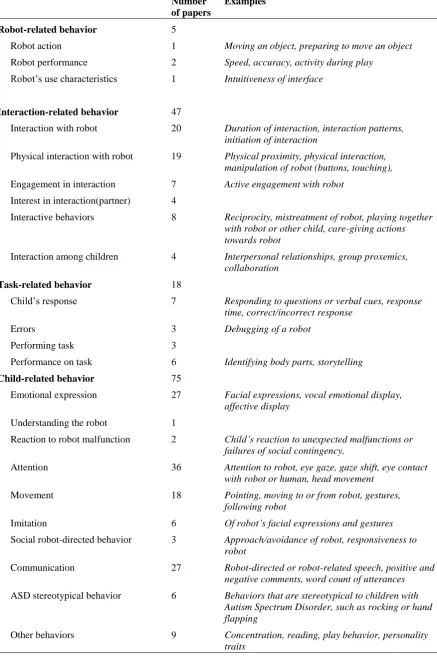
inclusion in this study: 26 papers reporting using questionnaires with children. Four domains
of questions became apparent during analysis of the papers: robot-related questions,
interaction-related questions, task-related questions, and child-related questions. Table 1 shows
an overview of the four domains and examples of themes within these domains that were found
[image:21.595.81.518.477.755.2]to be researched using surveys. The four domains will be discusses in more detail below.
Table 1. Domains of questions researched using surveys and examples of themes within these domains.
Number of papers
Examples
Robot-related questions 11
Perceived robot attributes 5 Robot’s perceived intelligence, trustworthiness, and
social presence
Recognition of robot’s states 3 Recognition of robot’s emotions
Acceptance of robot 2
Perceived robot behavior 2 Robot’s (dis)obedience or performance
Interaction-related questions 18
Desire to interact with robot 1 Desire to communicate and interact physically and
emotionally with robot
Relationship with robot 7 Intimacy, bonding, social attraction towards robot,
robot’s role in relationship
Fun 7 Fun, statisfaction
Difficulty of interaction 1
Engagement 8 Sensory immersion in play with robot, interest in
Page 22 of 62
Task-related questions 3 Perceived task duration, cognitive demand of task
Child-related questions 8 Negative attitude towards robot, experience with
robots, experienced pain
INTERACTION -RELATED QUESTIONS
As can be seen in Table 1, the domain that was researched most often using surveys
was the interaction between children and robots. 18 papers reported using surveys that
contained interaction-related questions. The most often researched topic with this domain was
children’s engagement in the interaction with a robot. Whereas some papers did not specify what questionnaire items they used to survey children’s engagement (Kose-Bagci, Ferrari,
Dautenhahn, Syrdal, & Nehaniv, 2009; Leite, Castellano, Pereira, Martinho, & Paiva, 2014;
Leite et al., 2013), Mubin et al. (2010) reported using the Game Experience Questionnaire
(GEQ) to measure engagement. Other measures for engagement were children’s reported
concentration and motivation on the task (Hashimoto, Kobayashi, & Kato, 2011), sensory
immersion in the activity with the robot (J. Han, Jo, Hyun, & So, 2015) and interest in the task
( Han, Jo, Park, & Kim, 2005; Han, Jo, Jones, & Jo, 2008; Hashimoto et al., 2011).
Children’s relationship with the robot was also frequently researched with surveys.
Children were asked about the robot’s role in the relationship (Oh & Kim, 2010), social
attraction towards the robot (Kose-Bagci et al., 2009; Tung, 2011) and their bonding with the
robot (Ros, Baroni, & Demiris, 2014; Veenstra & Evers, 2011), as well as about the intimacy
children felt with the robot (N. Kim, Han, & Ju, 2014).
Another frequently researched topic was children’s experience of fun during the
interaction with a robot. Gomes, Sardinha, Segura, Cramer, and Paiva (2014) reported using a
Likert-scale to rate children’s fun on. Similarly, three papers used a Likert-scale with smiley
faces (sometimes referred to as a ‘Smileyomter’), intended as visual aids to facilitate children
in filling in the questionnaires (Blanson Henkemans et al., 2013; Leite et al., 2014; Shahid,
Krahmer, & Swerts, 2014).
ROBOT-RELATED QUESTIONS
Children’s perception of robot attributes was the most-researched topic within the
domain of robot-related questions. Specifically, the robot’s perceived intelligence (Kose-Bagci
Page 23 of 62
were researched, in addition to the robot’s perceived trustworthiness and care (Veenstra &
Evers, 2011), empathy (Han, Jo, Hyun, & So, 2015) and appearance (Kose-Bagci et al., 2009).
Other robot-related questions included children’s acceptance of the robot (Hwang &
Wu, 2014; Veenstra & Evers, 2011), the robot’s likeability (Mubin et al., 2010) and children’s
regonition of emotions displayed by the robot (Cohen, Looije, & Neerincx, 2014; Goris,
Saldien, Vanderniepen, & Lefeber, 2009).
TASK-RELATED QUESTIONS
Task-related questions included the task’s cognitive demand (Mubin et al., 2010) and
children’s perception of task duration (Wood, Dautenhahn, Lehmann, et al., 2013; Wood,
Dautenhahn, Rainer, et al., 2013).
CHILD-RELATED QUESTIONS
Eight papers reported asking children child-related questions on surveys. These
questions pertained to children’s experience with the robot (Mubin et al., 2010; Ros et al.,
2014), their negative attitudes towards a robot (Dinet & Vivian (2014), and the amount of pain
they experienced during a vaccination they received while being distracted by a robot (Beran,
Ramirez-Serrano, Kuzyk, Fior, & Nugent, 2011).
SURVEYS: DISCUSSION
One of the benefits of using surveys is that they allow researchers to obtain a large
amount of data relatively easily. Surveys are a form of self-report, and can therefore be
completed by participants without a researcher present. In addition to that, the data collected
with surveys is easy to analyze. According to Lazar, Feng, and Hochheiser (2010), surveys are
especially useful for getting the ‘big picture’. However, they state that “an interview question
might yield an extensive answer to a question that would generate only a few words in a survey
response” (p. 189). Because surveys do not allow researchers the opportunity to ask follow-up
questions based on answers received, the depth of information that can be gathered with
surveys is limited.
Apart from the limited depth of information that can be gathered, surveying children
faces other issues as well, because surveys are not suitable for use with children of all ages. As
mentioned earlier, Scott (1997) and De Leeuw (2011) posed that surveys can be used only with
Page 24 of 62
children do not have sufficient cognitive skills to be effectively and systematically questioned”
and that “below the age of 7, direct questionnaire research of children is not feasible at all” (p.
6). According to Breakwell (as cited in Read and Fine, 2005), “there are four stages in a
question-answer process:
1. Understanding and interpreting the question being asked
2. Retrieving the relevant information from memory
3. Integrating this information into a summarized judgement
4. Reporting this judgement by translating it to the format of the represented response
scale.”
According to Read and Fine, “factors that impact on question answering include
developmental effects; language, reading age, and motor abilities, as well as temperamental
effects including confidence, self-belief and desire to please”. Even though language and
reading abilities of children aged 7 to 12 are still developing, De Leeuw (2011) poses that they
are sufficiently developed in seven-year-olds to be surveyed, provided that questions consist
of short sentences with carefully checked wordings. For instance, children within this age group
are not yet able to understand negations and logical operators such as ‘or’, and in addition to
that, special attention should be payed to avoid ambiguous language in the questions as well as
answer options because children are even less capable of dealing with ambiguous language
than adults (Borgers, De Leeuw, & Hox, 2000; De Leeuw, 2011). And even if these factors are
taken into account, surveying young children is challenging because young children are
susceptible to suggestibility, which entails that they are easily influenced by questions or
researchers conducting the survey. In addition to that, children may succumb to satisficing,
which Read and Fine describe, “occurs when a respondent gives more or less superficial
responses that generally appear reasonable or acceptable, but without having gone through all
the steps in the question-answer process”. Factors that influence the level of satisficing are the
respondent’s motivation, the difficulty of the task and the respondent’s cognitive abilities.
Considering the aforementioned precautions regarding the construction of surveys that need to
be taken in order to succesfully survey children aged 7 and up, the task of answering survey
questions is still quite difficult for this age group in relation to their cognitive capacities. This,
combined with children’s tendency to want to please (Borgers, De Leeuw, & Hox, 2000), explains children’s tendency to answer ‘yes’ regardless of the question (Breakwell, cited in
Page 25 of 62
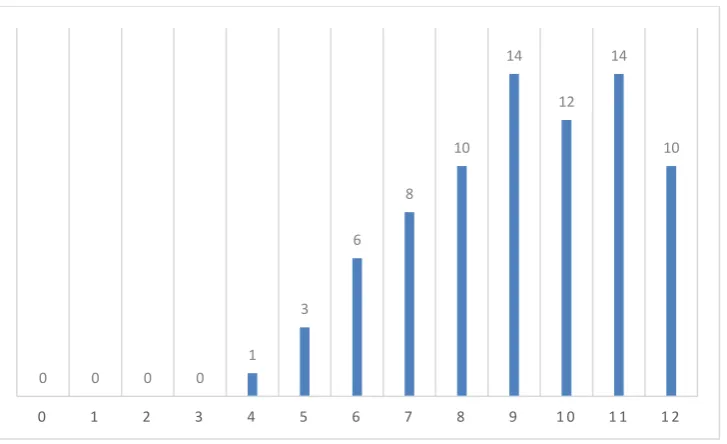
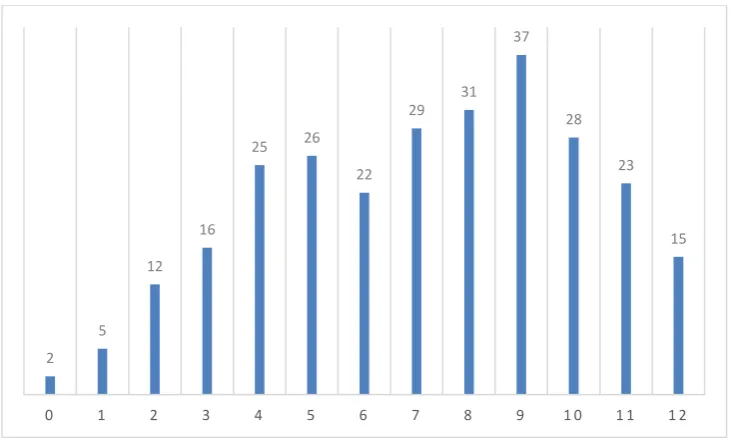
Figure 4. Histogram of participants' ages in studies that reported using surveys.
Despite these difficulties with surveying children older than 7 years of age, as can be
seen in Figure 4, there were ten studies that reported using questionnaires with children younger
than 7. Beran, Ramirez-Serrano, Vanderkooi, and Kuhn (2013) even reported surveying
children as young as four years old. They administered the Faces Pain Scale-Revisited
(FPS-R) to children between ages 4 and 9 to measure their pain while they received a vaccination.
The FPS-R is a visual analogue scale (VAS) with six faces that express increasing levels of
pain. The FPS-R was derived from the Faces Pain Scale (FPS by Bieri, Reeve, Champion,
Addicoat, & Ziegler, 1990) by Hicks, Von Baeyer, Spafford, Van Korlaar, & Goodenough
(2001). Whereas the FPS consists of seven faces expressing pain, the FPS-R consists of six,
allowing for easy scaling of the scores on a 0-5 or 0-10 metric, which are commonly used
metrics for self-reports of pain. Even though according to Scott and De Leeuw, children cannot
be surveyed below the age of 7, Hicks and colleagues found high correlations between
children’s pain ratings on the FPS-R and their ratings on other visual analogue scales even for
children as young as 5 or 6 years, which supports the FPS-R’s validity. However, Beran and
colleagues studied children as young as 4 years old, and evidence that the FPS-R can be used
reliably with children aged 5-6 does not necessarily mean that this holds true for younger
children as well.
The evidence towards the reliability of visual analogue scales with children as young
as age 5 contradicts findings that suggest that surveys can only be reliably used with children
older than 7 years. Therefore, Shields, Palermo, Powers, Grewe, and Smith (2003) researched
cognitive and demographic predictors of children’s ability to use a visual analogue scale. They
0 0 0 0
1 3
6 8
10 14
12 14
10
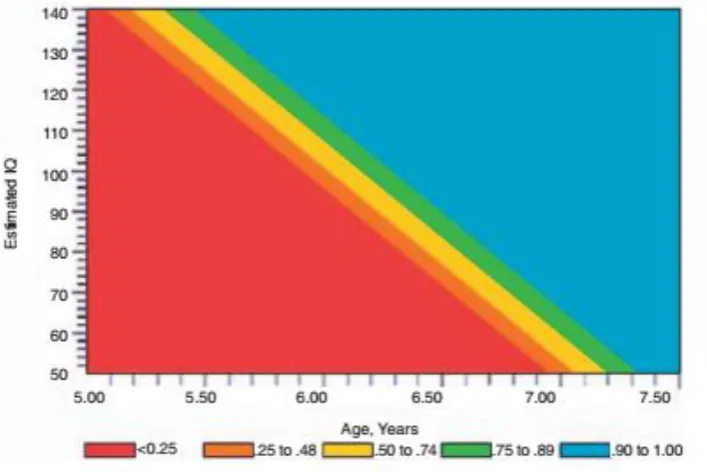
Page 26 of 62
found the best predictor of this ability to be children’s age combined with their estimated IQ.
These predictors were found to predict with 88% accuracy whether children were able to use a
VAS successfully. Shields and colleagues found that “(…) there appears to be a trade-off
between age and estimated IQ. The younger the child, the higher the estimated IQ that is needed
to complete the VAS successfully. Conversely, the older the child, the less stringent is the
estimated IQ requirement for successful completion of the VAS” (p. 287). Figure 5 depicts the
probability of a child’s successful use of a VAS based on age and IQ. However, Shields et al.
noted that measuring children’s IQ is a time-consuming task that may only be worth the effort
in cases where children need to fill out the VAS regularly (for instance in cases of at-home pain
monitoring) instead of only once or twice. On top of that, Shields an colleagues found that only
42% of the children in their study was able to succesfully use the VAS, leading to the
conclusion that VAS is not a suitable research method for kindergarten children, and that
[image:26.595.131.485.367.603.2]alternative rating scales are needed for children younger then 7.
Figure 5. Probability of a child's successful use of a visual analogue scale. Source: “Predictors of a child’s ability to use a visual analogue scale” by Shields, Palermo, Powers, Grewe, & Smith (2003).
Similar results were found for the Smileyometer – a Likert-type scale with different
smiley faces depicting the values on the scale, developed by Read, Macfarlane, and Casey
(2002) to measure children’s fun. Han, Jo, Hyun, and So (2015) used a Smileyometer-like scale
in their study to survey children of 5 and 6 years old. Even though the Smileyometer was
Page 27 of 62
(2006) later found that children aged 7-9 showed little variability in their answers, and although
they did not test this, they suspected that that there would be even less variability in even
younger children’s scores. These findings limit the validity of the Smileyometer for young
children.
To summarize, even though contrasting findings have been reported regarding the age
at which young children are able to successfully complete visual analogue scales, Shields,
Palermo, Powers, Grewe, and Smith (2003) found that children aged 7 and up had a higher
probability to successfully do so than children younger than 7. Due to individual differences in
IQ scores, some children below the age of 7 have been found to be able to use VAS. However,
from this analysis it become apparent that the best course of action in cases where estimating
individual children’s IQs is too time-consuming is to survey only children aged 7 and up.
As described earlier, when surveying children aged 7 and up, special attention has to be
paid to the design of the survey in order to accommodate for children’s still limited language
an thought abilities. In order to check whether the intended respondents are able to understand
the wording of the questions and whether the instructions for the survey are clear, pretesting
surveys before use is necessary (Scott, 1997; De Leeuw, 2011; Lazar, Feng, & Hochheiser,
2010; Collins, 2003). Lazar, Feng and Hochheiser cite Dillman (2000), who proposed a
three-step method for pretesting surveys. The first stage in pretesting a survey is to have it reviewed
by knowledgeable colleagues. Once the survey has passed that stage, potential respondents
should be interviewed to examine what they think of it. Lastly, a “pilot study of both survey
tool and implementation procedures” should be carried out (Lazar, Feng, & Hochheiser, 2010,
p. 118). However, Lazar and colleagues also cite Dillman in noting that this process is rarely
done thouroughly. The findings of this literature study are in accordance with that notion,
because not one study was found reporting a thorough pretest of their survey tool. However,
one study was found to make an effort to this extent. Tung (2011) reported that “the wording
used in the questionnaires was discussed with teachers and the children to prevent any
misunderstanding” (p. 640).
Another noteworthy observation that was made during analysis of the papers reporting
the use of surveys was that hardly any of them report measures validity or reliability of the
survey tool used. This is understandable in cases where previously validated surveys were used,
such as in Beran, Ramirez-Serrano, Vanderkooi, and Kuhn (2013). They used the FPS-R,
Page 28 of 62
pain. However, several studies reported constructing their own surveys or adapting existing
ones, often without reporting measures of the survey’s validity or reliability. For example,
Leite, Castellano, Pereira, Martinho, and Paiva (2014) reported presenting their respondents
with a survey that consisted of parts of other surveys. They used parts of the McGill Friendship
Questionnaire that was developed by Mendelson and Aboud (1999). Mendelson and Aboud
found these questionnaire subscales to have high internal consistency and validity, so using
only these subscales of the entire Friendship Questionnaire can be done reliably. However,
Leite et al. also reported using a questionnaire to measure the robot’s perceived social presence
which they had used in a previous study as well, but neither of these papers reported measures
of validity or reliability of this questionnaire. In addition to this questionnaire, Leite and
colleagues used a questionnaire to measure children’s engagement in interacting with the robot. They report that “the questionnaire items we used for Engagement are based on the questions developed by Sidner et al. to evaluate users’ responses towards a robot capable of using several social capabilities to attract the attention of users” (p. 333). Sidner, Kidd, Lee, and Lesh (2003)
in turn report that they measured engagement by adapting questions by Lombard et al. (2000)
and Lombard and Ditton (1997), whose papers did not report measures of internal consistency,
validity or reliability as the questionnaire they described was still in development at the time
of writing. Furthermore, despite reporting that they adapted questions from Lombard and
colleages, Sidner, Kidd, Lee and Lesh do not report any of these measures for their adaptations
either, and yet Leite and colleagues base their questions regarding engagement on these
adaptations. This raises the question whether this questionnaire is valid and reliable.
3.3 INTERVIEWS & FOCUS G ROUPS
“The ability to ‘go deep’ is perhaps the strongest argument in favor of interviewing,”
according to Lazar, Feng, and Hochheiser (2010). With this, they mean that interviews have
the potential of gathering more in-depth information than surveys because they pose that it is
easier to answer interview questions than questions on a questionnaire. Depending on the
amount of structure in the interview, interviews allow researchers to ask follow-up questions
where they want more information, or to even abandon all structure and let the conversation
flow as it may. At the same time, a drawback to interviewing is that it is more time-intensive
to sit down face-to-face with each participant than it is to hand out questionnaires for
participants to fill in. In addition to that, processing the data gathered from interviews is a far
more time-consuming task than analyzing questionnaires, especially for semi- or unstructured
Page 29 of 62
interview people in focus groups. That way, data from multiple people can be gathered at the
same time, with the added benefit that people can also encourage each other to speak their
minds. On the other hand, however, leading successful focus groups is a true skill, according
to Lazar, Feng and Hochheiser, because a researcher must be able to deal with less favorable
group dynamics as well. For instance, some persons may be so outspoken that they don’t give
others a chance to speak and that need to be reined in in a tactful manner so as not to offend
them, whereas others may tend to keep silent and need to be encouraged to speak.
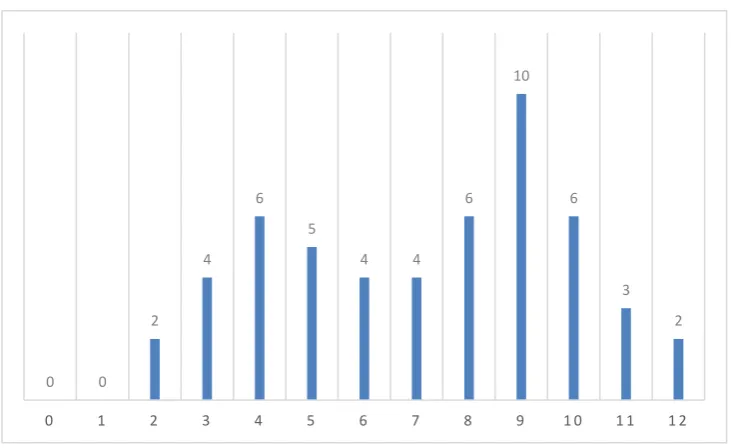
Interviews were found to be used in sixteen papers in this study. One study reported
using a focus group: Mills, Chandra, and Park (2013) used a focus group “to obtain student’s
reflections on the problem solving learning experiences” (p. 320). As with surveys, interviews
were found to contain questions relating to different domains: robot-related, interaction-related,
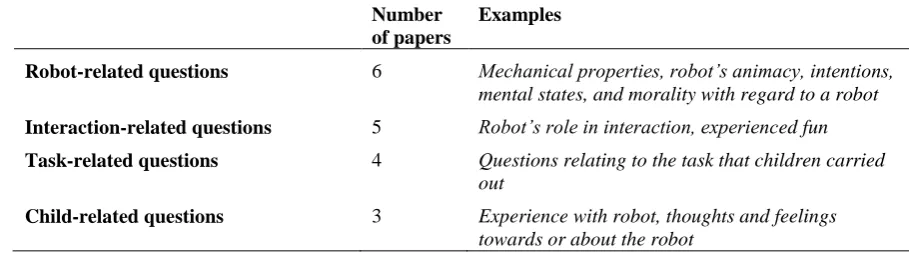
task-related, and child-related questions. Table 2 shows these domains with examples of topics
[image:29.595.65.520.382.510.2]that were researched within them.
Table 2 Domains of questions researched using interviews and examples of themes within these domains.
Number of papers
Examples
Robot-related questions 6 Mechanical properties, robot’s animacy, intentions,
mental states, and morality with regard to a robot
Interaction-related questions 5 Robot’s role in interaction, experienced fun
Task-related questions 4 Questions relating to the task that children carried
out
Child-related questions 3 Experience with robot, thoughts and feelings
towards or about the robot
ROBOT-RELATED INTERVIEWS
Several studies used interviews to understand children’s view of robots and their
properties. Kahn et al. (2006), Melson et al. (2009), Okita, Schwartz, Shibata, and Tokuda
(2005), and Saylor and Levin (2005) interviewed children to discover what animistic and
biological qualities they attributed to the robot. Saylor also asked children about the robot’s
mechanical properties, and Okita and Melson both asked children about the robot’s
psychological properties, asking about the robot’s intentions and mental states, respectively. Melson furthermore researched children’s moral view with regards to robots, and whether they
viewed robots as companions. Beran et al. (2013) asked children about their acceptance of the
Page 30 of 62
INTERACTION -RELATED INTERVIEWS
Only four studies reported asking children questions that can be categorized as
interaction-related. Bethel, Stevenson, and Scassellati (2011) asked children how much fun
they thought interacting with the robot was, and Han, Jo, Park, and Kim (2005) asked children
about the robot’s role in the interaction. Turkle, Taggart, Kidd, and Dasté (2006) report of having conversations with children in a natural setting to talk about the children’s interaction
with robots. This insinuates that the conversation had the form of a non-structured interview.
Yamazaki et al. (2013) held a group interview with children about their interaction with a robot.
TASK-RELATED INTERVIEWS
Bethel, Stevenson, and Scassellati (2011) told children a secret that they were to keep,
and then investigated if they were as inclined to share secrets with a robot as with a human. In
a structured interview with questions with levels of prompting ranging from no prompting at
all to explicitly asking what the secret was, Bethel assessed children’s willingness to share the
secret. Hsiao et al. (2012) read toddlers a short story, about which they then asked the children
questions to test their understanding of the story.
CHILD-RELATED INTERVIEWS
In the category of child-related interviews, Oh and Kim (2010) asked children questions
about their experience with robotics, such as whether children had robotic pets themselves.
Ribi et al. (2008), Sipitakiat & Nusen (2012), and Turkle et al. (2006) all researched children’s
thoughts and feelings about and towards robot, and lastly, Ribi also asked children about their
preference of robot.
INTERVIEWS: DISCUSSION
Similar to surveys, successfully answering interview questions involves understanding
the question, retrieving the information needed to answer the question, summarizing this
information into an answer and reporting the answer to the interviewer. Because of these
similarities with surveying, Scott (1997) and De Leeuw (2011) posed that children younger
than seven years of age do not possess the cognitive capacities to be systematically surveyed
or interviewed. However, research on interviewing young children about adverse past events
(such as hospital stays or medical procedures) has shown that children as young as three years
old are capable of recalling experiences just as accurately as seven-year-olds, albeit less