Voting Power and Voting Blocs
Dennis Leech
and
Robert Leech
No 716
WARWICK ECONOMIC RESEARCH PAPERS
"Voting Power and Voting Blocs"
Dennis Leech (University of Warwick)
and
Robert Leech,
(Birkbeck, University of London)
July 2004
Website: www.warwick.ac.uk/~ecrac
Email: [email protected]
Abstract
It has long been argued that power indices, as objective measures of voting power, can
be used as tools for a precise political theory leading to rigorous analysis. This suggestion was
first made by Simon (1957). One of the first to take up the challenge and to investigate the
possibility was Riker (1959) who sought to use power indices to make statements about
Political Man whose rational behaviour would lead him to maximise power as Economic Man
maximises profit or wealth. Many studies subsequently have used power indices empirically,
but almost all of them have focused on the rather more limited objective of analysing the
relative voting powers of members, or power distribution, within a given decision-making
system, and very few have followed Riker’s lead. One result of this has been that voting power
analysis is often dismissed, by those who might be its users, such as government ministers and
public officials, as being only capable of giving results for static situations, and of being useless
for generating insights into the consequences of institutional changes, requiring an essentially
dynamic mode of analysis.1
An important exception is the work of Coleman (1970, 1971, 1973) whose approach to
the measurement of power is fundamentally dynamic, in which voting is conceived as being
about decisions leading to an action taken by a ‘collectivity’. In Coleman’s framework a voting
body may or may not decide to take an action and the main questions are, first, how likely it is
that the collectivity might take such action, and second, how much control social actors could
exert over it, given the rules of decision making. In his famous 1971 paper, he proposed power
measures within this framework, and subsequently applied them in his 1973 paper.
1
Our paper follows Coleman (1973) and Riker (1959) in exploring the possibility of
using voting power indices for dynamic analysis when the voting body changes by the
formation of voting blocs. Our approach is different from that of Riker however in two major
respects: we avoid the use of the Shapley-Shubik index (SSI), for which there are compelling
grounds2
, and we make no attempt at empirical testing here. We follow the general approach of
Coleman (1973), an important and neglected paper, with the difference that our measure of
power is the Penrose (1946) index, which, in this particular context, differs only in name from
that used by Coleman (‘the power to prevent action’) but its use by name makes for greater
clarity3 .
We begin with a short discussion of Coleman’s approach and his critique of the use of
game theoretic power indices. This is followed by a discussion of voting blocs, a description of
the Penrose index, and then the results of applying this to a hypothetical legislature. Our
conclusion is that this framework is applicable and capable of generating useful results in real
contexts.
Coleman's Contribution to Voting Power Theory
Coleman's 1971 paper argued against the use of cooperative game theory in general and
the SSI in particular. In fact his paper contains a fundamental theoretical critique of that index
based, first, on its use of orderings of members to give different weight to coalitions of different
sizes and, second, its characterisation of voting as a group of rivals bargaining among
2
See Leech (2002). Riker did a lot of other work on voting power measurement but his contribution was limited by his reliance on the Shapley-Shubik index.
3
themselves over a fixed payoff in a game. There does not seem ever to have been a proper reply
to Coleman's arguments but the SSI continues to be taken seriously and used by some scholars.
Coleman's approach was based on the dynamic idea of collective decisions being taken
which would lead to action and not the static idea of decisions being taken about how to divide
up a given fixed quantity such as the spoils of office. This allowed the relaxation of some of the
analytical constraints that came from game theory, such as the requirement that the power
indices of the different players should add up to a constant (an idea often referred to as the
efficiency axiom) and the restriction that the quota has to be at least half the total number of
votes (the restriction to ‘proper games’). This meant that voting power, in Coleman's sense, was
conceived in absolute not relative terms. It shifted the focus of the analysis from the powers of
the members in relation to each other to the relationship between the powers of individual
members and that of the collectivity, which relationship is where much of the real concern lies
in discussing institutions. Coleman made a distinction between the negative power to (in his
terminology) prevent action and the positive power to initiate action, which again is a key
distinction of much practical value in many cases where decisions are taken by supermajorities.
It disappears when the voting rule is a simple majority, and the power to prevent and to initiate
action are identical to each other, and also to the Penrose index and the absolute Banzhaf index.
Mathematically, within this framework, a power index is a probability and it is inappropriate to
normalise it. In this sense there is a fundamental difference between what we refer to as the
Banzhaf index (that is, the normalised Banzhaf index) and the Penrose index. Coleman’s
perspective is useful for considering how power changes as a result of members participating in
coalitions, for which game theory is ill suited.
We do not wish to argue here against the use of cooperative game theory in general as a
strongly against the SSI, which is by no means the only game-theoretic power index, on
grounds of the lack of realism of its assumptions and its failure to produce results that are
acceptable from an empirical perspective. (Coleman, 1971, Leech, 2002)
Voting Power and Voting Blocs
When a social actor, whether an individual or a group, relinquishes independent political
power by joining a group, or a larger group, and agrees to be bound by its decisions, his, or its,
power will either increase or decrease. For example, a country which, as a member of a global
organisation, gives up its independence in certain matters within the organisation, in order to
join a powerful bloc within it, may gain or lose power. The bloc will be more powerful than the
country could be by itself because of its greater size, but the country has only limited power
over decisions taken by the bloc’s members about how it should vote in the global organisation.
The country’s power, as a member of the bloc, is a compound of these two factors. Another
example is a parliament containing one or more party groups whose representatives agree to a
strict whipping discipline combined with majority voting within the group.
This paper is a theoretical investigation that uses power indices to find the trade-offs
involved when blocs are formed in a legislature. We assume a simple model of a legislature and
use the Penrose power index to measure formal voting power when there are blocs of members
who act as one in accordance with a prior agreement such as a party whip.
Power Indices and Voting Blocs within a Global Voting Body: Formal Definitions and Notation
We begin by stating our assumptions and defining our notation. We assume a legislature
with a large number of members; where notation is needed this number is denoted by n.
Decisions are made by simple majority; all members vote, there are no abstentions. Every
formal power of an actor, whether an individual or a bloc, who is a member of this body, as a
probability.
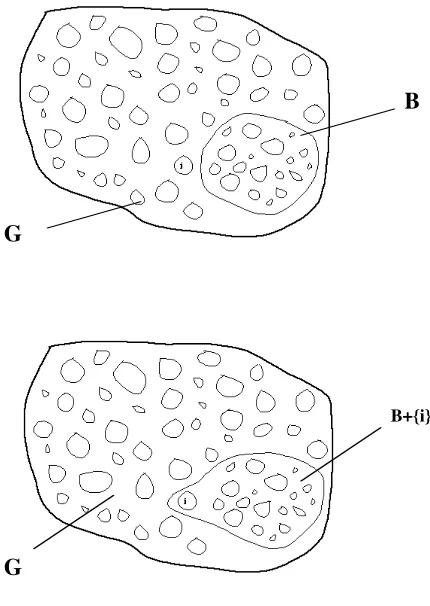
The global legislature, denoted by G, H, etc, is assumed to consist of one or more blocs,
denoted (for example) B, C, W, W1, W2, etc, and individuals, i, j, etc. An individual is treated
formally as a bloc consisting of a single member. It is sometimes convenient to denote the
global body, using set notation, in terms of its membership, as for example, G!=!{B, C, D,…,
[image:7.595.163.378.348.651.2]{i},{j}, …}. The scenario is shown schematically in Figure 1.
Figure 1: Schematic Representation of a Voting Bloc
B
B+{i}
G
G
The power of an actor (whether an individual or bloc) internally within the body in which
it votes is the probability that it swings the vote, a power index. The power of actor a in voting
body V can be written formally as Pa V
Pa V
= Pr[Actor a swings the vote in V] (1)
Expression (1) is the probability that the combined votes of the other members of V are just
short of a majority such that adding the vote(s) of a to them will produce a majority. This
obviously depends on the particular data for the voting body consisting of the sizes of all the
blocs, their number, the number of votes cast by actor a, the decision rule in terms of what sort
of majority is required (in this paper it is always a simple majority) and the model of
probabilistic voting. Thus, the power of an individual i within a bloc B is then written Pi B
while
the power of the bloc within the global body G is denoted by PB G
.
The power indices for all the actors are found using the general definition in equation (1)
applied to the voting model assumed and the data. We can think of the model of probabilistic
voting as either a description of actual behaviour, taking into account relationships between
members and party blocs, or a stylised model in which all actors vote for or against an action
with equal probability and independently. The power indices from the former approach would
measure power empirically, while the latter would be an a priori power index measuring power
deriving from the bloc structure and the voting rules in a purely constitutional sense. The former
requires data on actual voting behaviour; Coleman showed how an estimate of the variance of
the size of the ‘aye’ vote could be used for this purpose. The latter, which is followed here,
requires only a stylised model of probabilistic voting to compute the a priori power indices.4
In this study the power indices are found in two general ways.
(i) If a voting body consists only of individuals, and does not contain any blocs, the power
index for a member is a binomial probability. Thus, the power of an actor who is an individual
4
member within bloc B, which has m members is simply the binomial probability that the
number of other members who vote ‘aye’ is exactly one vote less than the number required for a
decision. That is m/2, or (m-1)/2, depending on whether m is even or odd.
(ii) To find the power of an actor which is a particular bloc within a legislature which also
contains other blocs, that are in general of different sizes, is more difficult computationally, and
requires the use of a computer program that implements an appropriate power indices
algorithm. In this study we use the algorithm known as the method of generating functions to
compute the power indices for bodies that have blocs. (Brams and Affuso, 1976; Leech and
Leech, 2004a).
Each of these calculations gives us the absolute voting power of a certain actor within a
given voting body. Our main interest however is in the power of individuals in relation to
voting blocs, for which we need further notation. It is unnecessary for this purpose now to label
the individual so we can drop the actor subscript from the power index. It is however necessary
to label the bloc structure. Thus we denote the power of an individual acting as a member of
bloc B in global body G as P(B,G), and the power of an individual acting independently in the
same body as P({i},G). In this notation, when we consider variation in the first argument of
P(B,G), B, with G held constant, it is understood that the other blocs do not change. Changes in
the size of the bloc B occur by way of changes in the number of individuals who do not belong
to the other blocs, all of which are assumed constant.
Thus we can write the voting power of an individual member of bloc B:5
P(B,G)!=!Pi B
PB G
. (2)
5
The power of a member of bloc B is the product of his or her power over decisions of the
bloc times the power of the bloc over the decisions of the global legislature. This can be
compared with P({i},G)!=!P{i} G
, the power of an independent member, in order to determine if
there is a net power gain or loss when i joins B6 .
Riker’s Study of the French Assembly
Riker (1959) was an attempt to test the SSI as a measure of absolute voting power by
looking at migrations between party blocs in an actual legislature, the French Assembly, over
two years, 1953 and 1954. He computed the indices for all party blocs before and after every
migration and sought evidence that these could have been motivated by the deputies concerned
seeking to increase their a priori voting power in the Assembly. His findings were negative.
However, the study was deficient in several respects and its findings should not be taken
as serious evidence against power indices, but rather as inconclusive. First, it was
methodologically flawed in its use of the SSI which measures only the relative voting powers of
parties. The measure he used for the voting power of an individual member was the SSI per
head, computed as the index for the bloc divided by the number of bloc members. That is, Riker
assumed the index could be composed in the same way as the Penrose indices in (2), and
multiplied together the SSI of the bloc in the assembly and the internal SSI of the member
within the bloc (which is just 1/m). But this is quite unjustified, as Owen (1995) shows. Owen
discusses the derivation of power indices for a composed game at length, including a proof of
the validity of equation (2). He also describes an approximation method of computation for the
6
properly defined SSI for the composed game and applies it to the US presidential election game.
The indices he obtains in this way are very different from the SSI’s per head derived simply
from the results for the states game with the same data, and illustrate how inaccurate Riker’s
approach is. 7
A second major criticism is that his data set was not good for empirically testing the
adequacy of the power index since very few of the migrations he observed involved members of
the large and powerful party blocs, and the period he took was very short. This suggests a need
for empirical testing of power indices using better data.
Power Index Calculations for a Hypothetical Legislature
We report the calculations for the power indices for a legislature assuming one and then
two blocs. The one-bloc case is described first in order to demonstrate the power of blocs and to
show the trade-off faced by individuals, described above, and also the optimum bloc size. Then
we generalise it and show that the two-bloc situation gives rise to a rich variety of cases
including monopolar and bipolar power structures. We then discuss the incentives that
individual members have to migrate that the differences in voting power create.
Power with One Bloc. We assume there is one bloc, labelled W, whose number of
members is w. Then we can write, for the global legislature, G={W, {i}, {j}, … }, the indirect
power of a bloc member:
7
Owen (1997), chapter XII. The fact that the SSI does not compose in the simple way assumed by Riker is not in itself a sufficient argument against using it to measure power in voting blocs, since, following Owen, an appropriate version of it can be defined, and can also be calculated with the right algorithm, either the approximate method based on multilinear
P(W,G) = Pi W
.PW G
. (3)
The two components of (3) are evaluated separately. The value of Pi W
is found
analytically as a binomial probability. This depends on the parity of w, and we must use
different formulae for odd and even bloc sizes:
†
PiW =
w-1 w-1
2 Ê Ë Á Á ˆ ¯ ˜ ˜ 0.5
w-1, if w is odd; ww-1 2 Ê Ë Á Á ˆ ¯ ˜ ˜ 0.5
w-1 if w is even. (4)
The value of PW G
can also be found analytically in this case, but it is better, as a general
strategy for these calculations, where we wish to allow for a general bloc structure, to evaluate
it numerically.
If w is large enough, then (4) can be replaced by the approximation8,
Pi W
=
†
2
pw =
0.79788
w (5)
Expression (5) is Penrose’s square root rule which states that the power of a member of a
large voting body is approximately inversely proportional to the square root of size of the body.
(Penrose 1946, 1952). In this paper, since our interest is in voting blocs of all sizes, including
very small ones, we will use (4) only. However (5) is useful when the voting blocs contain
many members, for example, where they are constituencies with thousands of electors or
countries with millions.
Power with Two Blocs. When there are two blocs, labelled W1 and W2, with w1and w2
members, the global legislature can be written, G={W1, W2, {i}, {j}, . . . }. The power indices
we are interested in are written:
8
P(W1, G) = Pi W1
.PW1 G
, P(W2, G) = Pi W2
.PW2 G
, P({i}, G)= P{i} G
.
We find Pi W 1
and Pi W
as binomial probabilities, and PW1 G
, PW2 G
and P{i} G
numerically as
before.
Voting Power and Voting Blocks: An Example
Here we report the results for a legislature with 100 members. The assumptions
throughout are that the legislature uses a simple majority of 51 votes and that each bloc uses a
[image:13.595.126.488.328.582.2]simple majority rule internally.
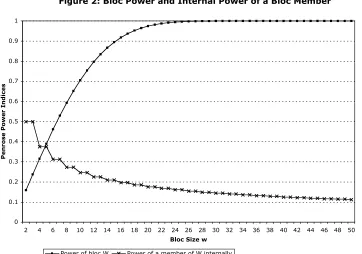
Figure 2: Bloc Power and Internal Power of a Bloc Member
0 0.1 0.2 0.3 0.4 0.5 0.6 0.7 0.8 0.9 1
2 4 6 8 10 12 14 16 18 20 22 24 26 28 30 32 34 36 38 40 42 44 46 48 50
Bloc Size w
Penrose Power Indices
Power of bloc W Power of a member of W internally
We
first consider the one-bloc case. Figure 2 illustrates the tradeoff between the power indices for
the bloc as a whole, PW G
, and of a bloc member within it, Pi W
, as the bloc size, w, increases,
for all values of w from 2 to 50. As the size of the bloc increases its power increases, eventually
approaching 1 when it has an absolute majority, w=51. Its power index gets very close to 1 long
before it has an absolute majority, however, illustrating how very powerful even minority blocs
vote falls continuously, in the limit when w=100, to about 0.08. Figure 3 shows the trade-off
between these two power indices, indicating that there is an optimum bloc size in terms of
[image:14.595.101.490.185.447.2]indirect voting power P(W,G).
Figure 3: Tradeoff between Bloc Power and Bloc Member's Internal Power
0 0.01 0.02 0.03 0.04 0.05 0.06 0.07 0.08 0.09
0.1 0.2 0.3 0.4 0.5 0.6 0.7 0.8 0.9 1
Power of bloc W
Power of bloc member over internal votes
Figure 4 shows this relationship between the indirect power of a bloc member, P(W,G),
defined in equation (3), and bloc size. A bloc with more than 50 members has an absolute
majority, and therefore the essential trade-off disappears: when w>50, PW G
=1, and the power
index for a bloc member, Pi
W , is just a declining function of w, and his or her voting power is
diluted as the bloc membership grows. The saw-tooth appearance of the diagram shows the
sensitivity of the power analysis to the parity of the bloc size, especially in small blocs. This
comes about because,, for example, a member of a bloc with 10 members has the same internal
have the same value of Pi W
.9
However the bloc with 11 members has more power in the
legislature and a greater value of PW G
[image:15.595.100.503.163.427.2].
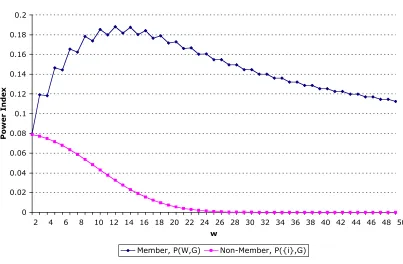
Figure 4: Power of a Bloc Member and a Non-Member
0 0.02 0.04 0.06 0.08 0.1 0.12 0.14 0.16 0.18 0.2
2 4 6 8 10 12 14 16 18 20 22 24 26 28 30 32 34 36 38 40 42 44 46 48 50
w
Power Index
Member, P(W,G) Non-Member, P({i},G)
Figure 4 also shows how the bloc size affects the power of an independent member,
P({i},G). As the bloc grows in size and the number of independent members declines, it
becomes rapidly more powerful. At the same time the power of each independent member falls
rapidly and continuously, becoming virtually zero once the bloc has more than about 20
members, w>20. However the power of a member of the bloc does not grow continuously. It
grows to a point and then declines. The size of voting bloc that makes the influence of one of its
members a maximum is where w=13. Up to this point the bloc is powerful in the legislature but
because the number of members is small, each individual member is influential internally;
9
If w is an even number, then the internal powers of a member of bloc W and of another bloc bigger by one member, say W+(j}, can easily be shown to be equal, that
PiW =
w-1 w 2 Ê Ë Á Á ˆ ¯ ˜ ˜ 0.5
w-1
= PiW+{j} =
w w 2 Ê Ë Á Á ˆ ¯ ˜ ˜ 0.5
w
beyond that point the bloc power increases less rapidly while the addition of new members
dilutes the internal power of individual members. On the other hand, however much this
[image:16.595.125.464.188.436.2]dilution proceeds, the power of a bloc member still far exceeds that of a non-member.
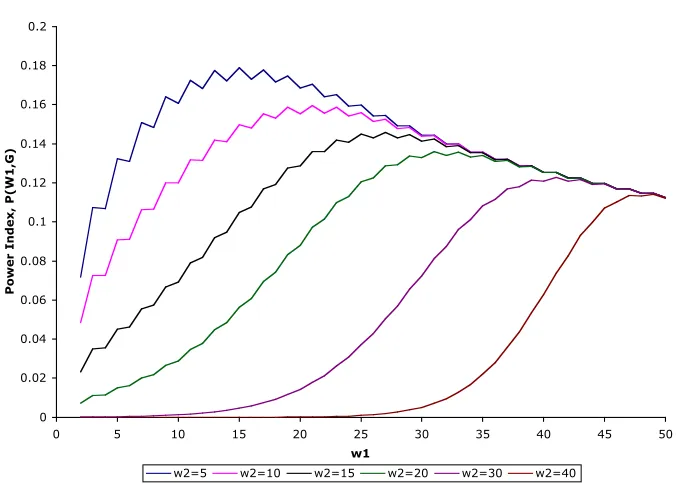
Figure 5: Power of a Bloc Member, Two Blocs
0 0.02 0.04 0.06 0.08 0.1 0.12 0.14 0.16 0.18 0.2
0 5 10 15 20 25 30 35 40 45 50 w1
Power Index, P(W1,G)
w2=5 w2=10 w2=15 w2=20 w2=30 w2=40
Figure 5 extends this analysis to the case where there are two blocs, W1 and W2, and W2
is of a fixed size. The chart shows the power of a member of the bloc W1 as w1 varies, for
different values of w2. The power of a member of bloc W1 is lower the greater the size of W2.
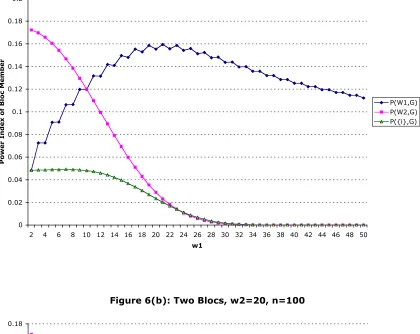
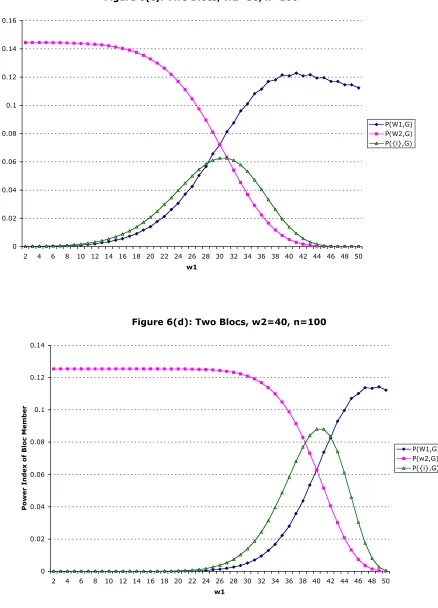
Figure 6 shows the powers of members of W1, W2 and non-members, i, in terms of the
size of the bloc W1 for the four cases: w2 = 10, 20, 30, 40. It is noticeable how in all four
diagrams a major effect is that the two large blocs reduce each other’s power substantially when
they are of comparable size while one of them is very dominant when their sizes differ. In some
cases this is to the advantage of individuals who are not bloc members who become more
powerful than bloc members.
Figure 6(a) is the case where w2=10. When w1 is small P({i}, G) is equal to P{W1,G) and
the bloc is too small to matter. As W1 increases in size and becomes more powerful, W2 loses
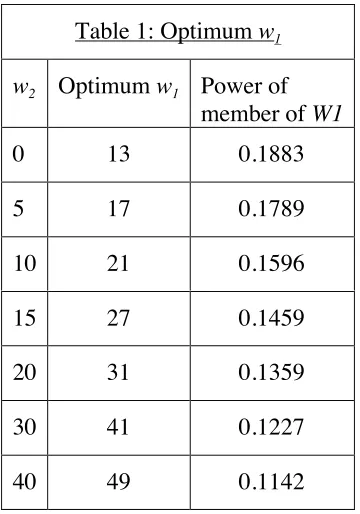
power, as does, also, after a while, the independent member i. The optimum size of W1 is 21
[image:17.595.232.412.70.327.2]when its members’ power is at its maximum.
Table 1: Optimum w1
w2 Optimum w1 Power of
member of W1
0 13 0.1883
5 17 0.1789
10 21 0.1596
15 27 0.1459
20 31 0.1359
30 41 0.1227
Figure 6(a): Two Blocs, w2=10, n=100
0 0.02 0.04 0.06 0.08 0.1 0.12 0.14 0.16 0.18 0.2
2 4 6 8 10 12 14 16 18 20 22 24 26 28 30 32 34 36 38 40 42 44 46 48 50 w1
Power Index of Bloc Member
P(W1,G) P(W2,G) P({i},G)
Figure 6(b): Two Blocs, w2=20, n=100
0 0.02 0.04 0.06 0.08 0.1 0.12 0.14 0.16 0.18
2 4 6 8 10 12 14 16 18 20 22 24 26 28 30 32 34 36 38 40 42 44 46 48 50
w1
Power Index of Bloc Member
[image:18.595.101.521.113.447.2] [image:18.595.100.520.408.693.2]Figure 6(c): Two Blocs, w2=30, n=100
0 0.02 0.04 0.06 0.08 0.1 0.12 0.14 0.16
2 4 6 8 10 12 14 16 18 20 22 24 26 28 30 32 34 36 38 40 42 44 46 48 50
w1
Power Index of Bloc Member
P(W1,G) P(W2,G) P({i},G)
Figure 6(d): Two Blocs, w2=40, n=100
0 0.02 0.04 0.06 0.08 0.1 0.12 0.14
2 4 6 8 10 12 14 16 18 20 22 24 26 28 30 32 34 36 38 40 42 44 46 48 50
w1
Power Index of Bloc Member
[image:19.595.107.545.91.699.2] [image:19.595.128.550.415.688.2]Figure 6(b) shows the case where W2=20. Now it is advantageous to belong to either W2
or W1 until w1=26 when members of bloc W2 have less power than independent members. For
values of w1>26 there is an incentive to join W1 and to leave W2.
Figure 6(c) shows the situation when w2=30. Now W2 is very powerful when w1 is small,
and members of W1 have less power than non-members of any bloc until w1=28. In this range,
there are strong incentives to join W2 and weak incentives for members of W1 to leave and
become independent. Between w1=28 and w1=32 there is an intermediate range where the power
of the independent member is at its peak but, because both blocs are powerful, his or her power
is still below that of a bloc member. Above w1=32 a non-member has greater power than a
member of bloc W2 (even though that bloc controls 30 percent of the votes), such is the power
of W1. In this bipolar situation, the power of W1, even though it is the dominant bloc, is much
less than that of W2 was when W1 was small.
Figure 6(d) shows the case where W2 is just short of an overall majority, w2=40. Now,
when W1 becomes big enough to rival W2, the powers of these 2 blocs are low enough for an
independent member to be more powerful than any member of either bloc. This is a truly
bipolar situation in which two blocs oppose one another and limit one another’s power while at
the same time they are each so large that their members’ power over internal decisions is
dissipated.
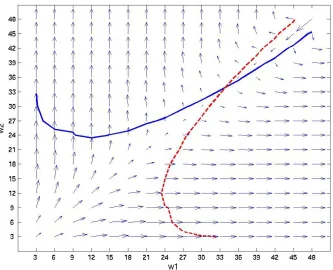
Figure 7 shows the incentives facing individual members to migrate between blocs when
there are two blocs. The diagram shows the range of values of w1 and w2, where neither bloc has
an absolute majority. The incentives to migrate are measured by the differences in power
indices for an individual who is a bloc member and a non-member. The diagram is constructed
from the vector [P(W1,G)!-!P{i},G),!P(W2,G)!-!P({i},G)] for every pair of values of (w1, w2).
the incentive to migrate and the consequent direction of change of the bloc sizes. The lines are
the zero contours where there is no incentive that would lead one of the blocs to change: the
[image:21.595.165.498.240.510.2]power of a non-member of a bloc is equal to that of a bloc member.
Figure 7: Incentives to Migrate between Two Blocs
In Figure 7, along the 45-degree line, when both blocs are equal, there is an incentive for
them both to change unless w1(=w2)=33. Below this value, the incentive is for both blocs to
grow, above it to shrink. The set of points where w1= w2has a knife-edge property, since when
w1 ≠ w2 , the incentive is for the larger bloc to grow and the smaller one to decline. The point
w1=w2=33 has a saddle point property where it is stable in one dimension and unstable in
Conclusion
This paper has considered the use of Penrose power indices to study the power of actors
in a voting body with blocs. We have looked at the simple case of a legislature with 100
members where there are one or two blocs, or party groups, in which the whip is applied on the
basis of simple majority voting among its members.
We have shown that the power of an individual bloc member can be modelled in terms
of two contrasting components: the power of the bloc within the legislature deriving from the
internal discipline that creates the power of combined forces, that increases with bloc size; and
the power of the individual member within the bloc, which declines with bloc size. This
tradeoff leads to useful insights for voting situations with more than one voting body or
multiple layers of decision making.
The model and the general approach described here can be generalised in many ways.
First, the analysis here is entirely a priori in the sense that no account is taken of preferences or
actual voting behaviour. This analysis is especially useful for an understanding of the power
implications of voting rules when considered formally. However, the approach is more general
since the Penrose index can be adapted to allow for actual or empirically observed voting
behaviour if the appropriate data on voting patterns is available. Second, we have considered a
stylised legislature with only two blocs. This can be generalised trivially to take account of
many voting blocs, as for example parties in a real legislature or where weighted voting is used,
such as intergovernmental international organisations.
References
Brams, Stephen and P. J. Affuso (1976), “Power and Size: a New Paradox,” Theory and Decision, 7, 29-56.
---(1971) "Control of Collectivities and the Power of a Collectivity to Act," in B.Lieberman (ed), Social Choice, New York, Gordon and Breach; reprinted in J.S. Coleman, 1986, Individual Interests and Collective Action, Cambridge University Press.
---(1973), "Loss of Power", American Sociological Review, 38,1-17.
Feller (1950), Introduction to Probability theory and Its Applications, volume 1 (3rd Edition), Wiley.
Felsenthal, Dan S. and Moshé Machover, (1998),The Measurement of Voting Power, Cheltenham, Edward Elgar.
Holler, Manfred (1981), (Ed.), Power, Voting and Voting Power, Physica-Verlag, Wurtzburg.
Leech, Dennis (2002), “An Empirical Comparison of the Performance of Classical Power Indices”, Political Studies, 1-15.
Leech, Dennis and Robert Leech (2004a), Algorithms for Computing Voting Power Indices, University of Warwick, website, www.warwick.ac.uk/~ecaae/
---(2004b), “Voting Power in the Bretton Woods Institutions”, mimeo, University of Warwick.
Lucas, William F. (1983), “Measuring Power in Weighted Voting Systems,” in S. Brams, W. Lucas and P. Straffin (eds.), Political and Related Models, Springer.
Owen, Guillermo (1995), Game Theory,(3rd Edition) , Academic Press.
Penrose, L.S. (1946), "The Elementary Statistics of Majority Voting," Journal of the Royal Statistical Society, 109, 53-57.
Riker, William H. (1959), “A Test of the Adequacy of the Power Index”, Behavioral Science, 120-131.
Shapley, Lloyd S. and Martin Shubik (1954), “A Method of Evaluating the Distribution of Power in a Committee System”, American Political Science Review, 48, 787-792.
Simon, Herbert A. (1957), Models of Man, New York: Wiley.