Manuscript version: Author’s Accepted Manuscript
The version presented in WRAP is the author’s accepted manuscript and may differ from the
published version or Version of Record.
Persistent WRAP URL:
http://wrap.warwick.ac.uk/110110
How to cite:
Please refer to published version for the most recent bibliographic citation information.
If a published version is known of, the repository item page linked to above, will contain
details on accessing it.
Copyright and reuse:
The Warwick Research Archive Portal (WRAP) makes this work by researchers of the
University of Warwick available open access under the following conditions.
Copyright © and all moral rights to the version of the paper presented here belong to the
individual author(s) and/or other copyright owners. To the extent reasonable and
practicable the material made available in WRAP has been checked for eligibility before
being made available.
Copies of full items can be used for personal research or study, educational, or not-for-profit
purposes without prior permission or charge. Provided that the authors, title and full
bibliographic details are credited, a hyperlink and/or URL is given for the original metadata
page and the content is not changed in any way.
Publisher’s statement:
Please refer to the repository item page, publisher’s statement section, for further
information.
Working With Activity Theory: Context, Technology, and
Information Behavior
David Allen
AIMTech Research Group, Leeds University Business School, Leeds, West Yorkshire, UK. E-mail: [email protected], [email protected]
Stan Karanasios
University of Leeds, LS2JT, Leeds, West Yorkshire, UK. E-mail: [email protected]
Mira Slavova
International Food Policy Research Institute-Ghana, GSSP, PMB CT 112, Cantonmenents, Accra, Ghana. E-mail: [email protected]
Over the last 7 years, the AIMTech Research Group in the University of Leeds has used cultural-historical activity theory (CHAT) to inform a range of research activities in the fields of information behavior and information sys-tems. In this article, we identify certain openings and theoretical challenges in the field of information behav-ior, which sparked our initial interest in CHAT: context, technology, and the link between practice and policy. We demonstrate the relevance of CHAT in studying infor-mation behavior and addressing the identified openings and argue that by providing a framework and hierarchy of activity-action-operation and semantic tools, CHAT is able to overcome many of the uncertainties concerning information behavior research. In particular, CHAT pro-vides researchers a theoretical lens to account for con-text and activity mediation and, by doing so, can increase the significance of information behavior research to prac-tice. In undertaking this endeavour, we have relied on literature from the fields of information science and oth-ers where CHAT is employed. We provide a detailed description of how CHAT may be applied to information behavior and account for the concepts we see as relevant to its study.
Information Behavior
In 2002, the AIMTech research group in University of Leeds was formed with the broad aims of focusing on the interaction among information behavior, technology, orga-nizational adaptation, and change. Although projects were undertaken in a variety of contexts and environments (from offshore oil rigs to women’s refuges), a common strand,
Received July 21, 2009; revised September 3, 2010; accepted September 3, 2010
© 2011 ASIS&T • Published online in Wiley Online Library (wileyonlinelibrary.com). DOI: 10.1002/asi.21441
which unified research and practice within the group, was the use of cultural-historical activity theory (CHAT) as a the-oretical lens. In this article, we outline our motivation for using activity theory and the potential utility of the theory for understanding information behavior.
Much of the early information-seeking research focused on artefacts and venues of information seeking (such as libraries) and information sources, rather than the needs of an individual. A gradual shift took place in the 1970’s as empha-sis shifted to the individual “as a finder, creator, and user of information” (Case, 2002, p .6) and research branched out into more task-orientated and user-orientated investigations (Dervin & Nilan, 1986). This trend has continued, and both individual and society have come into focus, resulting in more attention to context and social influence, more effort to “get inside the head” of the seeker, more time spent with individ-ual informants, and greater depth of description overall made possible through qualitative analysis (Case, 2006; Vakkari, 2008). Despite this shift in modus operandi, a number of the-oretical questions remain unresolved and openings remain in the field of information-seeking and information behavior.
In this article, we focus our efforts on identifying certain openings and theoretical challenges in the field of infor-mation behavior. In particular, we concentrate on CHAT to demonstrate its relevance to the study of information behav-ior. We argue that by providing a framework and hierarchy of activity-action-operation and semantic toolkit, we are able to overcome many of the uncertainties in information behavior research. In undertaking this endeavour, we have relied on literature from the field of information science, and although we have distinguished between information behavior and information seeking, the literature we refer to in this article intersects both fields. Additionally, to highlight the relevance of CHAT, we have referenced literature spanning the fields of education, human development, human computer interaction (HCI), and others where CHAT is employed.
The structure of this article is as follows. It begins by iden-tifying key areas or gaps in information behavior research that we believe could provide fruitful opportunities for develop-ment. Following this, a brief description of CHAT and its development is presented. We then focus on demonstrating the relevance of CHAT in information behavior research, using examples from the extant literature, and outline how CHAT may address the research areas we identified and pro-vide further theoretical probabilities. In the final section, a synopsis of our main points is presented, focusing specifi-cally on how CHAT can contribute to the study of information behavior. We close with some discussion on the limitations and concluding remarks.
Motivations and Openings
It has been argued that there has been a general “loosening of conceptual frames” in information research and a general weakening of theory (Vakkari, 2008). Difficulties concerning semantic interpretations, definitions and counter definitions, the relative absence of social context in studies, descriptive rather than explanatory output, and weak ties to practice and design are just some of the criticisms (Case, 2002; Vakkari, 2008). Vakkari (2008, Conclusions section, para. 8) notes that this could be seen as being linked to the epistemologi-cal shift towards qualitative methods for description, which
has “intensified the tendency of building loose conceptual frames and of focusing on individual behavior ignoring social context.”
Nonetheless, the field has matured and some authors such as Pettigrew et al. (2001) have reasoned that “a unifying theo-retical body is emerging that, beyond its strong, user-centred core, emphasises the contextual interplay of cognitive, social, cultural, organizational, effective and linguistic factors and asserts that information behavior phenomena are part of the human communicative process” (p. 67). Furthermore, a num-ber of distinct established traditions and emerging tributaries of research have been established, providing clear concep-tual frames for the study of information behavior. These can be categorized as the behavioral, cognitive, social,
physi-cal, perceptive/affective, and multifaceted conceptual frame-works (Pettigrew et al.) with an emerging realist perspective,
although there is considerable intersection among these tra-ditions. A comprehensive review of these traditions is beyond the scope of our exposition and is to be found in Case (2002), Järvelin and Wilson (2003), Pettigrew et al., and others.
Although the extant research has illuminated our under-standing of information behavior phenomena, a number of gaps and theoretical openings have been noted. These range from a weak theorization of information technology, the treat-ment of context (Järvelin & Ingwersen, 2004; Johnson, 2009), power, decision making (Berryman, 2006), and a critical lack of focus on policy and practice, which raises questions about the raison d’être of information behavior research. For some time, information behavior authors have been calling for the-orists to continue to enhance existing frameworks and derive new ones that account for emerging concepts (Pettigrew et al., 2001). Along these lines, researchers have argued that more meaningful research can be attainted only through a shift in theoretical orientation. Against the backdrop of the identified openings and appeals for theoretical shifts and more explana-tory studies, in this article, we describe the relevance and value of CHAT to the study of information behavior. In par-ticular, we provide a clear example of its use as a theoretical frame, which specifically focuses on social context, and we argue it could address some of the challenges in the field.
Openings: Ontological Tilting and Practice Turns
Context. Extending information research to context has
been described as one of the key challenges for the field of human information behavior (Järvelin & Ingwersen, 2004), if not the critical issue in information behavior research (Johnson, 2009). Indeed, Johnson argues that an understand-ing of context could unlock influence on policy and the emancipation of users:
Individuals can only shape contexts, thereby conceptualising their worlds, if they understand active ingredients of context and how they act upon them. In a pragmatic sense, there may be no richer area of study for individuals who desire to shape the world around them. . .so an understanding of our social contexts is key to developing appropriate policy solutions. (2009, p. 802)
The significance of this area to the field was signalled by the creation of the biannual conference Information Seek-ing in Context (where Dervin [1997] presented her seminal paper on context) and in a number of reviews of context (Courtright, 2007; Johnson, 2009). More recently, Savolainen (2009) presented a thoughtful review the concepts of Small Worlds and Information Grounds as contexts for everyday seeking and sharing. This interest is mirrored in related fields of research from HCI (Bradley & Dunlop, 2005) through to IT use (Mark & Poltrock, 2004). Within the field of information behavior, there have been number of attempts to categorize or deconstruct the concept (Savolainen, 2006). Johnson, for example, proposes three senses in which context is used: sit-uational, contingency, and major frameworks for meaning systems or interpretation. Talja, Keso, and Pietilainen (1999) present two polarities of “objectified” and “interpretative” approaches to context while acknowledging that there are also “in-between approaches”; “approaches which are con-structionist, but not explicitly social constructionist” (Talja et al., 1999, p. 759).
Although there seems to be general consensus on the need for research that is sensitive to context, there is a lack of con-sensus on what “context” comprises and how it influences information behavior (and, in turn, is influenced by it). This may be explained by a degree of ontological ambivalence or unconscious assumption of particular theoretical perspectives within traditions (Talja et al., 1999), or that the traditions start from opposing and contradictory ontological positions and so mean different things when they use the label context. This debate parallels work in other fields. Schatzki (2002, p. 60), for example, argues that although context is critically impor-tant to understanding social practices, it has become a “wand for empty gestures,” which is marshalled by theorists; how-ever, the modus operandi or identity is rarely investigated. Indeed, Schatzki’s (2005) analysis of social ontology pro-vides a particularly illuminating perspective. Schatzki (2005) presents “two camps”: that of the individualists and societists. He argues that individualists hold that social phenomena can be both decomposed into and explained by the properties of individual people, while societists analyse and explain by ref-erence to groups. Schatzki then presents his own concept of “sites of organisations” as a possible mid way. He argues that
the key element of site ontologies is that human coexistence inherently transpires as part of a context of a particular sort.
Like societist ontologies, they immerse the relevant fea-tures of individuals in wider, distinctly social settings in the absence of which people with these features would not exist. Like individualist ontologies, however, they deny that the wider context in which these features exists fundamentally diverge in character from these features. (Schatzki, 2005, p. 469)
If his framing is applied to the field of information behav-ior, then we see a lack of research that provides an alternative position to either societist or individualist positions. In com-mon with Schatzki, we advocate a search for a third way within our field and propose a social ontology that emphasizes the dualism of individualism and societism. It has motivated our desire to find theory that overcomes the dualities, which we believe paradigmatic closure enforced (Allen & Ellis, 1997, 1999).
Technology. Courtright (2007) in her review of context in
information behavior research notes that technology has a “special place” within information behavior research. In the past, its place was defined primarily as an unseen actor on the periphery, acknowledged in the micro context of the user interaction with an application or element of a technological system, rather than the interaction between the system within a macro-context and information behavior. Indeed, the role of new technologies provide particular challenges to existing theoretical frames; for example, Savolainen notes that the the-ories based on place and, in particular, Chatman’s concept of Small Worlds are challenged by the new mobile technologies:
Moving around with a mobile phone or wireless Internet makes people less dependent on places characteristic of conventional information grounds. Because connections are to people and not to places, the technology affords the shift to a personalised, wireless world, with each person switching between ties and networks. (Savolainen, 2009, p. 44)
On a metatheoretical level, the enduring question of the materiality of technology and its role in shaping behavior is one that preoccupied us. Although there is a recognition that technology and organization arise at the intersection of material and social (Leonardi & Barley, 2008), this has been manifested in the information behavior and informa-tion retrieval fields as a call for context and seen in increased sharing of theory with reference disciplines (Cronin & Meho, 2008) and importation of social theory.
towards relativism and voluntarism. In her detailed review of science and technology studies (STS) and information studies, Van House (2004), for example, notes:
STS is concerned with technology-in-use. Technology does not exist apart from the meaning that it has for people. It is constituted in use. Its meanings vary across groups and over time. (p. 72)
Talja, Tuominen, and Savolainen (2005) note that con-structivism is used routinely and “without much worry” within information science research, and Savolainen (2007) points to its use within information use studies. Leonardi and Barley (2008) argue that the generation of theoretical accounts that are able to handle the interaction between either material and social or agency and constraint have been prob-lematic because they associate materialism with determinism and relativism with voluntarism. We see the need for a theory that does not tilt and provides analysis of technology devel-opment that acknowledges both materiality and voluntarism. The turn to practice theory within the wider social sciences has been “a reaction against social constructivism and to re-establish the significance of material artefacts in the study of human behavior” (Miettinen, 2006, p. 390). Its introduction into information behavior (Savolainen, 2007) is a significant step within the field; however, its emphasis has not yet been on the reassertion of the significance of technological material artefacts. We feel that there is a pressing need for a theo-retical framework that addresses the significance of material artefacts and provides a nuanced, contextualized understand-ing of their mediatunderstand-ing role in information behavior. Like Miettinen, we sought theoretical openings, first experiment-ing with Dewey’s Pragmatism via Strauss’s Theory of Action (Strauss, 1993) in information strategy formation (Allen, 2000), and then in analyzing the implementation of technol-ogy and information behavior (Allen & Wilson, 2004). We then moved to activity theory, drawing upon the concept of Praxis, where human action is “neither the result of positivis-tic rationality subject to the limited contingency of a specific situation, nor as the irrational outcome of unlimited subjec-tive interpretation, but as an epistemological process” (Han & Jones, 1994, p. 11).
Policy and practice. A final area of interest is on the impact
of the research findings on the world outside our academic community. The influence or impact of our research on pol-icy or practice has been described both as important and as a significant weakness to the development of our field (Dervin, 2003). Webber (2003) points out that it is a “sorry state” if the wider field of information science (which started) from practice is now of little relevance to practitioners, a point rein-forced by Wilson (2008a). Up to this point, the debate about the “policy-practice” gap has remained largely “academic,” with few sanctions or inducements in place to influence the actions of researchers. Recently, however, the issue of rel-evance to practice or policy has been brought into greater focus. In many countries, evaluation of research by those who fund our research and institutional structures has moved from traditional models, based only on journal ranking, citation
analysis, or income generation, to ones where the concept of “impact” now plays a significant place. In the United Kingdom, for example, the new proposed national model for evaluation of research excellence in universities now explic-itly identifies that “in the Research Excellence Framework significant additional recognition will be given where high quality research has contributed to the economy, society, public policy, culture, the environment, international devel-opment or quality of life” (Grant et al. 2009). Equally, given the current financial climate and the expected pressure on both the availability of government research funds and the competition for them, it is not unreasonable to expect that nontraditional research sponsors from the private and pub-lic sector will play a much larger role in supporting research work: organizations that demand that research be relevant to their practice.
Although there are a number of ways in which informa-tion behavior work already does and could make an impact on policy development (Burnett & Jaeger, 2008), to the support of particular communities the one that perhaps provides the greatest opportunity for impact and where we are potentially weakest is that of systems design. Technological systems now mediate many of the behavior that we study and provide and there seems a strong opportunity for engagement in the design of new systems and technologies. Indeed, as the early 1980’s potential for collaboration between systems designers and researchers in the field was noted by Rouse and Rouse (1984). Rouse and Rouse attempted to integrate concepts from human information behavior with systems design. Twenty years later Fidel and Pejtersen (2004) point out that very few studies in the field of information behavior have made an impact on the work of designers of systems, and Keshavarz (2008) asserts that they are rarely incorporated into real information retrieval systems. Approaches have been put forward to bridge the gap by providing new theoretical models, including systems modelling (Johnstone, Bonner, & Tate, 2004), Habermas’s communicative action (Benoît, 2001), and cognitive work analysis (Fidel & Pejtersen). Others have attempted to inte-grate existing models into design such as Makri, Blandord, and Cox’s (2008) use of Ellis’ model. It is perhaps telling that the links between the information science and research com-munity that serves systems developers is also weak. Ellis, Allen, and Wilson (1999) and Sawyer and Huang (2007) note that the research communities of information science and information system also remain fragmented with lit-tle cross-fertilization of ideas or communication. Järvelin and Ingwersen (2004, Goals of Information Seeking Section, para. 5) note:
Supporting information management and information sys-tems design may be the weakest contribution of information seeking so far. . .the research results can not communicate to systems design, because the worlds do not touch.
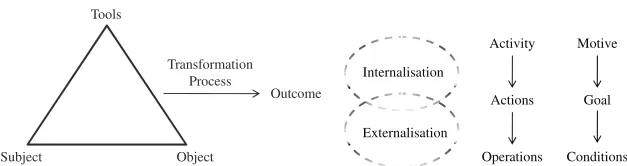
FIG. 1. The basic structure of activity theory.
create an idealized design that ignores existing practices, geometry, ergonomics, and common sense.
The challenge for the field is to be able to provide research findings that are not “lost in translation” (Burton-West et al., 2005) or to find languages, theories, or models that are used in reference disciplines and can help inform both systems design and information behavior. Activity theory is recog-nized as theory that is highly applied (Ponomarenko, 2004) and allows links to practice particularly in the analysis of work, technology, and education (Rogers, 2008) as well as use in HCI (Bertelsen, Bødker, & John, 2003) and system design. As Miettinen (2006) notes that activity theory is an interventionist research approach with relevant concepts that are based on the dialogue between the researchers and the people they are studying.
A Brief Introduction to the Cultural Historical Viewpoint
Activity theory is based on the concepts of the cultural-historical school of Russian psychology. The main ideas of Russian cultural psychology were developed between 1920 and 1930, and they were centred on the unity of conscious-ness and activity. These ideas were an attempt by scholars to explain the interactions between human beings and the material world. Russian cultural psychologists recognized the coevolution of the human subject and the world itself. The human subject is social in nature, shaped by culture, and influenced by language, acting with or through other people in organizations, groups, and communities. The material world itself is social because the majority of the entities people interact with are other people and culturally produced arte-facts. Therefore, Russian cultural psychologists understood the mind-forming interaction between human beings and the world in terms of culture and society. Lev Vygotsky, consid-ered the founder of Russian cultural psychology, introduced many concepts that are widely used today, such as the zone of proximal development, cultural mediation, and natural and higher psychological functions.
Vygotsky emphasized the process of internalization and externalization and reasoned that these two basic pro-cesses operate continuously at every level of human activ-ity. Internalization is related to the reproduction of culture (Engeström & Miettinen, 1999) or the internal reasoning and reconstruction of external objects (Xu, 2007), i.e., a child observes a pencil being used and learns to use it. The thought activity (e.g., reasoning and planning) is an important component of the internalization process (Leont’ev, 1978).
TABLE 1. Description of the basic terms.
Activity: Not necessarily conscious, Governed by motive/ but may become conscious motives (Collective)
“WHY”
Actions: Conscious Governed by goals “WHAT” (Individual or group) Operations: Conscious when learned but can Governed by conditions become unconscious or automatic in routine. (Nonconscious)
“HOW”
Note. Adapted from “Activity Theory,” In J.M. Caroll (Ed.), “HCI
Models, Theories, and Frameworks: Towards An Interdisciplinary Science” (p. 301), 2003, San Francisco, Morgan Kaufmann.
Externalization is the process of the creation of new arte-facts (Engeström & Miettinen, 1999), i.e., a child uses the pencil to draw a picture or to communicate his/her feelings. Internalization, far from being a single, clear-cut process, embodies a wide range of techniques that make mental life and activity more efficacious, i.e., thinking to oneself, read-ing to oneself, doread-ing sums in one’s mind (Toulmin, 1999). Humans not only internalize existing standards and rules of activity but also externalise them, creating new standards and rules (Lektorsky, 1999). Furthermore, internalization and externalization are highly integrated and continually iterating (Leont’ev).
Building on Vygotsky’s work, Leont’ev introduced the concept of activity, a specific form of the societal existence of humans, which comprises the purposeful changing of natural and social reality (Davydov, 1999). Leont’ev distin-guished between collective activity and action, reasoning that humans engage in goal-orientated actions that do not neces-sarily directly contribute to the attainment of the object of activity, mediated by tools. But eventually the actions lead to the satisfaction of a need (the motive) through the attain-ment of the object. Often, these actions make sense only in a social context of a shared work activity. Therefore, activi-ties satisfy a need, and actions constitute the activiactivi-ties. Using this reasoning, Leont’ev (1978) developed a basic structure and common language used with regard to human activity, as represented in Figure 1 and described in Table 1.
[image:6.683.350.592.211.304.2]Tools
Object Subject
Community Division of Labor Rules and Norms
[image:7.683.206.469.77.242.2]Motivation
FIG. 2. The activity system, adapted from Engeström (1987).
Moreover, the three levels of activity are not fixed—activities that exist at one time may become actions or operations at a later time; likewise an action can become an opera-tion through internalizaopera-tion, and an operaopera-tion can become an action through externalization (Bødker, 1991; Leont’ev, 1978; see Figure 1).
Recent generations of activity theory have maintained the foundations of the cultural-historical perspective, emphasiz-ing the social aspects of activity and reflectemphasiz-ing the societal viewpoint with the meanings of social situations and the dia-logues occurring within them. Engeström (1987) expanded the activity system to include other elements such as com-munity, the division of labor, and rules/norms (see Figure 2). By expanding the activity system, Engeström sought to call attention to the larger social context by adding in the commu-nity as a separate component and argued that the relationship between various aspects of the model is mediated in differ-ent ways. The graphical represdiffer-entation of the activity system illustrates that a subject, driven by a motivation to achieve an object, undertakes an activity. This process is mediated by tools and signs in collaboration with the community. Tools are physical artefacts, while signs refer to language, memory, skills and so forth (the word tools is almost exclu-sively used in the literature to refer to both physical artefacts and signs). This process of activity takes place against the backdrop of rules and behavioral norms and a division of labor. Tolman (1999) reasons that the division of labor in human society is the most obvious indicator of the individ-ual human societal nature. Taking the activity as a unit of analysis the researcher constructs the activity system as if looking at it from above. At the same time, the researcher selects a member (or multiple members) of the local activity, through whose eyes and interpretations the activity is con-structed. The reasoning between the overall and subject view brings the researcher into direct dialogical relationship with the activity investigated (Engeström & Miettinen, 1999).
An important element of the activity system is that the activity is constantly developing as a result of contradic-tions, tensions, and instability, and the systemic needs of the community and subject. Examining the tensions and contradictions that exist in the activity system provide a lens
to understanding the development and change taking place within the activity (Engeström, 1987).
The Relevance of the Cultural-Historical Approach: CHAT in Information Behavior
In the foregoing sections, we provided an overview of the research traditions that are predominant in information behavior. As observed, although the use of these traditions in the extant research has contributed to our understanding of information behavior, we identified openings or areas not well accounted for, specifically the weak theorization of informa-tion technology, the treatment of context, and the impact on policy and practice. Here, we demonstrate the relevance of CHAT to the field of information behavior and illustrate how CHAT can account for the identified openings and act as a theoretical lens to information behavior. This has already been explored, to a significant extent, in Wilson’s (2008b) review of the field, where he demonstrated the relevance of activity theory to research on information literacy and con-cluded by suggesting that the time may be opportune for the “expansive transformation” of the field of information sci-ence to embrace what is currently studied from a diversity of disciplinary viewpoints.
Flexible Structure for Information Behavior Analysis
CHAT allows us to analyze information behavior as a collective and individual process (see Figure 3). Taking the activity as the unit of analysis provides a hierarchical struc-ture and framework for examining information behavior that affords researchers insight into the sequential process of information seeking and its underlying tools, within con-text. Further, as underscored in the previous section, using the notions of internalization and externalization we are able to observe the absorption of information the habituation of behavior into practice and the manifestation of these in the form of knowledge and skills.
Collective Activity–Formation of Assignment
Tools
Physical: Stationary, Computers, Communication devices, Library materials, Meeting space Abstract: Experience, Preferences for topics, Competencies on different topics, Writing skills, Research skills, Project management skills
Individual Activity–Seeking Information
Tools
Physical: Textbooks, Library books, Electronic resources, Internet, Lectures notes
Abstract: Research skills, Writing skills, Experience
Object
Completed assignment
Subject
Individual student
Community
Students in group
Division of Labor Object
Completed assignment
Subject
Group of students
Community
University students, Lecturers, Teaching
assistants, Library staff, Tutors, Support
staff
Division of Labor Rules & Norms
Grading policy,
Plagiarism policy, Library hours spent,
Attendance
Rules & Norms
Information seeking
behavior
[image:8.683.115.578.87.346.2]Related Activities
FIG. 3. Collective and individual activity systems.
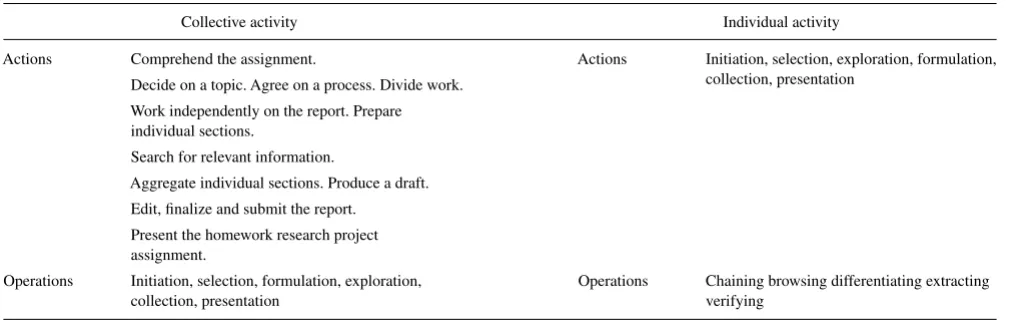
task of completing a group research assignment. The sub-ject of the activity is, therefore, the collective of students, the activity is the formation of the assignment, and the object is the production of the report, which fulfils the assignment requirements, set out by the lecturer. The outcome is the report. Although the activity system provides an overarch-ing snapshot of the activity, we can also distoverarch-inguish between the collective activity and its constituent actions. Actions may become internalized and later become operations. For instance, the skills learned while searching for information and the information discovered may be internalized and may manifest in the form of automatic operations. Although this level of abstraction provides an overview of the activity and its context, it does not necessarily provide an in-depth analy-sis or explanation of the information behavior that has taken place. However, activity theory offers the flexibility in that within our example of the group research project, the actual individual information-seeking action can be conceptualized as a related activity on its own, thereby forming a specific information behavior unit of analysis. Within the individual activity, the subject becomes the individual student (rather than the collective of students), the activity is seeking
infor-mation, and the object of his/her activity is the information to be used within his/her assigned section of the project. Figure 3
and Table 2 demonstrate the distinction between collective and individual activity systems and the related actions and operations.
By allowing for the drilling-down of the collective activ-ity into the activities of group members, CHAT provides researchers with the opportunity to consider a deeper level of analysis of information behavior, in the context of an
overarching activity. Furthermore, CHAT allows for the examination of activity, in which there is a combination of individuals who have merged as a group for a specific activity, such as group the students in the group assign-ment or other forms of work organization that do not fit the standard definition of team (Engeström, Engeström, & Vähäaho, 1999a). Engeström, Engeström, and Tarja (1999a) refer to this as “knotworking,” characterized as the com-ing together (tycom-ing) and divergence (untycom-ing) of otherwise loosely connected actors and activity systems.
Motive, Object, and Information Needs
Activity theory takes motivated activity as the central unit of analysis, helping us to illuminate on the cause of information-seeking and information behavior. Within the behavioral literature on information research, the drivers for information seeking are recognized as “information needs,” which are described as the recognition that an individual’s (or collective) knowledge is inadequate to satisfy a goal (Case, 2002). However, there is little theoretical understanding of how these needs arise.
TABLE 2. Collective and individual activity, actions, and operations.
Collective activity Individual activity
Actions Comprehend the assignment. Actions Initiation, selection, exploration, formulation, Decide on a topic. Agree on a process. Divide work. collection, presentation
Work independently on the report. Prepare individual sections.
Search for relevant information.
Aggregate individual sections. Produce a draft. Edit, finalize and submit the report.
Present the homework research project assignment.
Operations Initiation, selection, formulation, exploration, Operations Chaining browsing differentiating extracting
collection, presentation verifying
Note. Adapted from “Seeking Meaning: A Process Approach to Library and Information Services” (2nd ed.) by C.C. Kuhlthau, 2004, Westport, CT,
Libraries Unlimited.
fully capture the motivation behind the information-seeking activity. Activity theory allows us to link the information need with the context within which the information is being used, or intended to be used. The information-seeking motivation of the students who complete the group assignment needs to be understood within the context of their university education and within the personal cultural-historical background of each of the participating students. These backgrounds carry the “fundamental needs” from which the information need and the ensuing information seeking behavior is derived. Depending on this background, individuals might view the assignment as an opportunity to achieve a high mark, to learn about new topics of interest, or as an opportunity to complete a degree requirement by means of free riding on the efforts of others. By using the concepts of motive and object, and the hierarchical structure of activity, activity theory allows us to understand information behavior within the context of the motives and how they arise.
Context
In the foregoing discussion, it was observed that the notion of context in information research remains broad and fluid. The cultural-historical perspective understands context as a dynamic and changing environmental variable. This is because context is viewed simultaneously as a byproduct and a determinant of history, embedded in action. That is, present context is a result of the social pressures of the past and past actions, giving rise to current practices and meanings, and it creates a cultural environment that impacts on the available courses of action for the future. Within the activity system, context is both internal (involving specific objects and goals) and, at the same time, external to people, involving artefacts, other people, and specific settings (Nardi, 1996c).
We are interested in contributing to the information behav-ior literature by developing an improved understanding of the context of information behavior. We reason that this can be achieved through the basis of the cultural-historical per-spective, which views context as the legacy of past activities and as a determinant of present activities. Nonetheless, an
inherent problem with defining context is that it is emergent, continually renegotiated and defined in the course of action (Dourish, 2004; Kuutti, 1999). CHAT, however, provides the scope to account for context that is relevant to the activity. We have already discussed how this can be achieved from the collective and individual activity perspective, understanding the emergence of the motive and object, and by employing the concepts of internalization and externalization. Addition-ally, examining rules and norms, community and division of labor in an activity provides further basis for account-ing for context. This is done because rules and norms refer to the ever-changing explicit and implicit conventions that govern interactions between the subject and community and are useful for explaining embedded behavior. The commu-nity comprises individuals and groups, which are governed by a continuously refining explicit and implicit division of labor. The division of labor can be observed through the rela-tionship between the community and the outcome. In the case of the group assignment, the context becomes the com-munity (university students, library staff, etc.), the rules and norms (grading policy, library hours, etc.), the tools and signs employed (computers, research skills, preferences, etc.), the division of labor (who did what), and the relationship between these elements and the underlying cultural-historical influ-ences. Against the backdrop of the motive and the object, we can obtain a clearer understanding of context.
Mediation
of communication and representation (Leiman, 1999). In our group assignment example, tools are suggested to be typical items such as computers, books, and so forth, but also abstract artefacts such as language.
It is important to recognize that mediation is an impor-tant element of the activity, in terms of the realization of the object, but more specifically in explaining the cultural-historical influences. This is because artefacts themselves have been created and transformed during the activity and “carry within themselves a particular culture—a historical residue of that development” (Kuutti, 1996, p. 26). Kuutti (1996) reasons that the “tool” is both enabling and limit-ing, because it allows the subject to achieve the object, but it also restricts the interaction, and because it is from the per-spective of that particular tool or instrument (the tool has its historically collected experience).
We can use the concept of mediation to account for the role of tools, both physical and abstract, in determining informa-tion behavior. An important characteristic of CHAT is that it distinguishes and accounts for physical and abstract tools (refer to Figure 3). By focusing on internalization, we can shed light on how tools, information, and practices are appro-priated and routinized. And by examining the physical tools used, we can understand why certain tools are chosen over others.
In most aspects of contemporary society, information tech-nology has become the main mediating channel for seeking and accessing information, but the information research lit-erature has only begun to address the issue of the role of technology in context as a mediating artefact in the search and acquisition of information. Furthermore, there is a paucity of research focusing on the choice among technologies. Employing an activity theory framework and the notion of mediation to the study of information behavior allows us to understand how people in need of information dur-ing the course of their activities choose between different channels and the underlying abstract processes for obtaining information.
Discussion on the Relevance of CHAT
In recent years, activity theory has been developed and shaped by scholars in a wide spectrum of fields, largely shedding its reputation as a Marxist perspective.1Now, activ-ity theory is considered an approach that provides novel conceptual and semantic tools for tackling many of the theo-retical and methodological questions that underpin the social sciences (Engeström, Miettinen, & Punamäki-Gitai, 1999b). Activity theory has been applied in the fields of learn-ing and teachlearn-ing and HCI (Bertelsen & Bødker, 2003; Nardi, 1996b). However, increasingly it has been applied to information systems (Barki, Titah, & Boffo, 2007; Karanasios, Allen, & Vardaxoglou, 2009; Korpela et al., 2000; Vardaxoglou, Slavova, Allen, & Wilson, 2008).
1Discussion on the Marxist origins and influence on activity theory have
been omitted in this paper. See Leont’ev (1993) and Wilson (2008b).
Concerning information behavior, Wilson (2006, Abstract, para. 2) reasons that “the key elements of activity theory, Motivation, Goal, Activity, Tools, Object, Outcome, Rules, Community and Division of labor are all directly applica-ble to the conduct of information behavior research,” arguing that activity theory is a powerful analytical tool and con-ceptual framework for enquiry. Spasser (1999) advocated its strength in accounting for context, its emphasis on practice and its rich heuristic vocabulary and conceptual framework, all of which contribute to the transferability and accumulation of knowledge.
Using activity as a unit of analysis we can explore infor-mation behavior within everyday life. The activity system includes a subjective actor (subject), motive, an objectified goal (object), physical and abstract tools for the accomplish-ment of the goal, and a community centred on the productive activity and mediated by rules, norms, and a division of labor. The use of the formalized activity system can con-tribute towards the development of the idea of a situation in information behavior research.
We demonstrated the relevance of CHAT to information behavior research. We began by establishing the utility of activity theory in understanding collective as well as indi-vidual activity, demonstrating its ability in accounting for information behavior at different levels of abstraction, in con-text. That is, it provides a framework for studying human activity practices at a multilevel, stratified manner (Spasser, 2002).
Activity theory also allows for exploration of the inter-action between activity systems. In the group assignment example, this means that we can explore the interaction of the individual activities as they work towards the shared object. Or, we can explore the interaction of the collective activity in relation to other connected activities such as a parallel assignment.
Key to the relevance of activity theory is the level of abstraction the researcher selects. Engeström (1999) sug-gests that the historical units must be of manageable size. If the unit is the individual activity, then history is reduced to the individual’s personal development (cultural-historical influences), and remains manageable. Likewise, if the unit is the collective activity, then the history goes beyond ontogeny, but remains tenable.
One of the greatest advantages of activity theory in infor-mation behavior is that it takes into account context (Spasser, 1999) and, by doing so, is able to address a major weak-ness in current information behavior research. By examining
rules and norms, tools, community, and division of labor,
its individual components. By doing so, it offers a mid-point between the individualist and societist perspective.
In addition, activity theory provides a hierarchical analysis of information behavior—activity-action-operation—and by doing so allows for the deconstruction of an activity. The dis-tinction between collective, long-term activity, individual or group short-term action, and automatic, routinized operation and movement between the three is a core principle of activity theory (Engeström, 2000). This allows us to not only reduce information behavior in terms of actual observable behav-ior but also offer insight into the cognitive process through the notion of internalization and externalization. In the con-text of information behavior research, internalization can be thought of as the process of learning a practice or habitua-tion (i.e., searching using specific tools) and/or the digeshabitua-tion of certain information. Externalization can be viewed as the manifestation of the learning practice or what we do with the information we have absorbed. Thus, activity theory is not restricted to examining only the behavior in regards to information practices, but rather it takes accounts for the cultural-historical context. This is a particularly powerful concept for information behavior research. However, while we know that internalization and externalization takes place, activity theory cannot inform us more than practice, informa-tion, and so forth are absorbed and later manifest, which we can observe. The actual cognitive processes remain beyond the grasp of activity theory. However, in applying activity the-ory to interactive information retrieval, Xu (2007) proposed a framework that offered an explanation of the mechanisms that govern the interaction between users’ cognitive states and their manifested behavior when using an information retrieval system. Through his analysis, he showed that activ-ity theory is suited to covering the diverse perspectives that were adopted in interactive information-seeking research and uncovering the complicated interactions among activity ele-ments. Such interactions comprise both internalization and externalization processes and reveal the internal mechanisms that drive the dynamic transformation of a user’s informa-tion need and seemingly chaotic query formulainforma-tion behavior. Based on this research, Xu and Liu (2007) reasoned that the activity theory is useful in understanding the recipro-cal effects between users’ cognitive states and manifested behavior.
The notion of the artefact as mediator of human infor-mation behavior activity is central to CHAT. Understanding artefacts and the process of the accumulation of knowledge, can contribute to the cognitive viewpoint. The use of the medi-ation concept, and particularly the use of physical tools, can contribute to the behavioral tradition. The examination of mediation in information behavior may be particularly use-ful for explaining why certain sources and tools are used over others and the notion of mediation has been used in social science studies to facilitate design of information sys-tems and understand the important tools in the process of design. Uden (2007) employed activity theory as a frame-work for describing the components of an activity system for the design of a mobile learning application, arguing that
activity theory, as a social and cultural psychological theory, can be used to design a mobile learning environment and better understand distributed learning. In her study, activity theory was used to facilitate designers’ understanding of the mechanisms through which social relations and material tools affected complex learning, and learners’ interactions with others. Uden, Valderas, and Pastor (2008) reasoned that using the activity as a dynamic unit of analysis prevented simple causal explanation of mobile learning design by account-ing for the institutional settaccount-ing as a collection of multiple, systematically interacting elements, which include social rules, mediating artefacts, and division of labor. Concern-ing the mediation that takes place durConcern-ing innovation activity, Karanasios et al. (2009) used the concept of mediation to understand the pertinent tools during the process of innova-tion, but also to illuminate on the tools that were not used to understand how the innovation process could be enhanced.
Critical for impacting on practice, CHAT provides a con-ceptual framework and common language for engaging the information behavior (Spasser, 1999, 2002) and information systems and HCI research communities, while offering the opportunity to expand understanding of information behav-ior by clarifying language and expanding the boundaries by which we explore information behavior (Widén-Wulff & Davenport, 2007).
As underscored by Pettigrew et al. (2001), few frame-works offer suggestions for improving information sys-tems beyond suggesting that they need to account for the information behavior tendencies of users. Activity theory arms researchers with a set of conceptual tools for analyz-ing and explainanalyz-ing, rather than only exploranalyz-ing information behavior. Using activity theory as an empirical framework, researchers and practitioners can better explain information behavior and employ this knowledge to improve or design efficient information systems. Kaptelinin and Nardi (2006) concluded that the application of activity theory makes a valuable contribution in areas involving complex systems. These include the design of systems with varying virtual and physical contexts such as mobile technologies and the design of technologies for an expanded set of activities such as technologies that are used beyond the work environment (at home and in everyday life). Activity theory is also useful to technology developers because it takes into account human experience in general, going beyond cognition to analyse the totality of action, reflection, and emotion.
weakness in the crew’s performance and identify differences in crews who make errors to the point of an accident compared with those that do not. Importantly, this allowed her to make targeted improvements to train the crew appropriately or build more supportive infrastructure, thus hopefully defeating the chances of an accident in the future.
Therefore, given its ready applicability to technology development, activity theory carries the promise of bridg-ing the gap between our understandbridg-ing of how individuals or groups use the information services at their disposal, allow-ing for information services to be developed that are socially desirable, shaped to the information behavior of particular groups.
Conclusion
Although we have presented discourse concerning the rel-evance and advantages of CHAT to the field of information behavior, we do not contend that it is a remedy nor do we contend that it should be used to displace other frame-works; rather it can be used to treat some of the problems in information behavior research. We see CHAT as a lens that can illuminate three particular challenges that information science research faces: context, theorizing technology, and influencing policy and practice.
Nonetheless, we acknowledge that it comes attached with some limitations and hope that reflection and discussion of the criticisms will increase the self-consciousness of the tra-dition, as underscored by Bakhurst (2009). Linked to its Russian origins, there is underlying philosophical issues concerning the translation of the terms from Russian to English, and Backhurst (2009) claims that this has lead to con-fusion and arguments concerning the semantic interpretations of the terms activity and object. The concept of mediation, central to the concept of activity theory, imposes some lim-itations. This is especially true in information behavior and HCI studies where the study takes place against the back-drop of virtual realities and the boundaries between reality and tool become blurred (Kaptelinin, 1996), an issue that is likely to grow as we see growing convergence of work and social contexts with virtual realities and tools.
The extent to which activity theory can be used without also accepting Marxist theory in its entirety is also an issue of contention. Within our work, we have largely used activity theory as a lens without drawing upon its economic or societal analysis that would be seen as problematic by many within the activity theory research community:
If activity theory is stripped of its historical analysis of con-tradictions of capitalism, the theory becomes either another management toolkit or another psychological approach with-out potential for radical transformations. (Engeström, 2008, p. 258)
As a research group, activity theory has provided AIMTech Research Group with a lens to view the world, a common vocabulary, and a set of tools. Part of our program has been to embrace both those who wish to use it as a management toolkit or approach (dislocating it from its historical analysis
of capitalism) and those who wish to use it as an emancipatory tool.
The research and literature that has informed the approach described in this article is borrowed predominately from the fields of HCI, education, and general activity theory, where the use of CHAT is continuously developing, yet is more mature. At present, there is a lack of clear opera-tionalization in the field of information behavior concern-ing CHAT. Kaptelinin (1996) noted a similar problem in the field of HCI in the 1990s. Although this is perhaps typical among emergent theories, we have attempted to provide some clarity. To address some of the limitations con-cerning CHAT, researchers (von Thaden, 2007) have often employed CHAT in conjunction with other theoretical tools. CHAT is an expansive framework that offers many con-cepts for studying social phenomena. In this article, we focused our efforts on particular aspects of CHAT to demon-strate its relevance in studying information behavior. By providing a conceptual framework and hierarchy of activity-action-operation and a set of semantic tools, we are able to overcome many of the uncertainties in information behavior research. As underscored by Nardi (1996a), activity theory provides a set of concepts for describing activity. However, we also showed that there is a lack of understanding about and limitations to the cultural-historical perspective. To overcome these limitations, we provided a description of how activity theory may be applied to information behavior and accounted for the concepts we see as relevant to its study.
Acknowledgments
We acknowledge the support of the Arts and Humani-ties Research Council Funded Project: An Investigation Into Information Behavior and the Use of Mobile Information Systems for Information Management in Police Forces in England and Wales. Grant No. 119261 provided a research position for Dr. Slavova and allowed us to develop the concepts and ideas represented within this article.
References
Allen, D. (2000). Information strategy formation in UK higher education institutions. Doctoral dissertation, Sheffield University Sheffield. Allen, D., & Ellis, D. (1997). Beyond paradigm closure in information
systems research: Theoretical possibilities for pluralism in Galliers. In R. Galliers, C. Murphy, H. Hansen, R. O’Callghan, S. Carlsson, & C. Loebbecke (Eds.), Proceedings of the Fifth European Conference on Information Systems (pp. 760–776). Cork, Ireland: Cork Publishing Company.
Allen, D.K., & Ellis, D. (1999). The paradigm debate in IS research. In L.K. Brooks & C. Kimble (Eds.), Proceedings of the UK Academy of Infor-mation Systems Annual Conference (pp. 83–97). York, United Kingdom: McGraw-Hill.
Allen, D.K., & Wilson , T.D. (2004). Action, interaction and the role of ambi-guity in the introduction of mobile information systems in a UK police force. In E. Lawrence, B. Pernici, & J. Krogstie (Eds.), Proceedings of the Mobile Information Systems: IFIP TC8 Working Conference on Mobile Information Systems (Vol. I, pp. 15–37). New York: Springer.
Barki, H., Titah, R., & Boffo, C. (2007). Information system use-related activity: An expanded behavioral conceptualization of individual-level information system use. Information Systems Research, 18(2), 173–192.
Benoît, G. (2001). Critical theory as a foundation for pragmatic infor-mation systems design. Inforinfor-mation Research, 6(2). Retrieved from http://informationr.net/ir/6-2/paper98.html
Berryman, J.M. (2006). What defines ‘enough’ information? How policy workers make judgements and decisions during information seeking: Pre-liminary results from an exploratory study. Information Research, 11(4). Retrieved from http://informationr.net/ir/11-4/paper266.html
Bertelsen, O.W., & Bødker, S. (2003). Activity theory. In J.M. Caroll (Ed.), HCI models, theories, and frameworks: Towards an interdisciplinary science (pp. 291–324). San Francisco: Morgan Kaufmann.
Bertelsen, O.W., Bødker, S., & John, M.C. (2003). Activity theory. In HCI Models, Theories, and Frameworks (pp. 291–324). San Francisco: Morgan Kaufmann.
Bødker, S. (1991). Through the interface. A human activity approach to user interface design. Mahwah, NJ: Lawrence Erlbaum Associates, Inc. Burnett, G., & Jaeger, P.T. (2008). Small worlds, lifeworlds, and
informa-tion: the ramifications of the information behavior of social groups in public policy and the public sphere. Information Research-an Interna-tional Electronic Journal, 13(2). Retrieved from http://informationr.net/ir/ 13-2/paper346.html
Burton-West, T., vondracek, R., Erdelez, S., Hendry, D.G., Hirsh, S., & Marchionini, G. (2005, October). Lost in translation? Applying informa-tion behavior research to informainforma-tion systems design (Vol. 42). Paper presented at the Annual Meeting of the American Society for Information Science and Technology, Charlotte, North Carolina.
Case, D.O. (2002). Looking for information: A survey of research on information seeking, needs, and behavior. New York: Academic Press. Case, D.O. (2006). Information behavior. Annual Review of Information
Science and Technology, 40(1), 293–327.
Courtright, C. (2007). Context in information behavior research. Annual Review of Information Science and Technology, 41, 273–306.
Cronin, B. (2008). The sociological turn in information science. Journal of Information Science, 34(4), 465–475.
Cronin, B., & Meho, L.I. (2008). The shifting balance of intellectual trade in information studies. Journal of the American Society for Information Science and Technology, 59(4), 551–564.
Davydov, V.V. (1999). The content and unsolved problems of activity theory. In Y. Engeström, R. Miettinen, & R.-L. Punamäki-Gitai (Eds.), Per-spectives on activity theory. Learning in doing: Social, cognitive and computational perspectives (pp. 39–52). Cambridge, United Kingdom: Cambridge University Press.
Dervin, B. (1997). Given a context by any other name: methodological tools for taming the unruly beast (pp. 13–38). Paper presented at the Proceed-ings of the International Conference on Information Seeking in Context. Tampere, Finland: Taylor Graham Publishing.
Dervin, B. (2003). Human studies and user studies: A call for methodological inter-disciplinarity. Information Research, 9(1), Paper 166.
Dervin, B., & Nilan, M. (1986). Information needs and uses. In M. Williams (Ed.), Annual review of information science and technology (Vol. 21, pp. 3–33). Medford, NJ: Information Today.
Dourish, P. (2004). What we talk about when we talk about context. Personal and Ubiquitous Computing, 8(1), 19–30.
Ellis, D., Allen, D.K., & Wilson, T.D. (1999). Information science and information systems: Conjunct subjects disjunct disciplines. Journal of the American Society for Information Science and Technology, 50(12), 1095–1107.
Engeström, Y. (1987). Learning by expanding: An activity-theoretical approach to developmental research. Helsinki, Finland: Orienta-Konsultit. Engeström, Y. (1999). Activity theory and transformation. In Y. Engeström, R. Miettinen & R.-L. Punamäki-Gitai (Eds.), Perspectives on activity the-ory. Learning in doing: Social, cognitive and computational perspectives (pp. 1–38). Cambridge, United Kingdom: Cambridge University Press. Engeström, Y. (2000). Activity theory and the social construction of
knowledge: A story of four umpires. Organization, 7(2), 301–310.
Engeström, Y. (2008). Enriching activity theory without shortcuts. Interact-ing with Computers, 20(2), 256–259.
Engeström, Y., Engeström, R., & Vähäaho, T. (1999a). When the center does not hold: The importance of knotworking. In S. Chaiklin, M. Hedegaard, U.J. Jensen, & International Society for Activity Theory and Cultural Research Congress (Eds.), Activity theory and social practice: Cultural-historical approaches (p. 381).Aarhus, Denmark:Aarhus University Press. Engeström, Y., & Miettinen, R. (1999). Introduction. In Y. Engeström, R. Miettinen & R.-L. Punamäki-Gitai (Eds.), Perspectives on activity the-ory. Learning in doing: Social, cognitive and computational perspectives (pp. 1–17). Cambridge, United Kingdom: Cambridge University Press. Engeström,Y., Miettinen, R., & Punamäki-Gitai, R.-L. (1999b). Perspectives
on activity theory. Cambridge, United Kingdom: Cambridge University Press.
Fidel, R., & Pejtersen, A.M. (2004). From information behavior research to the design of information systems: The cognitive work Analysis framework. Information Research, 10(1), Paper 210.
Grant, J., Brutscher, P.-B., Kirk, S., Butler, L., & Wooding, S. (2009). Cap-turing Research Impacts: A review of international practice Prepared for the Higher Education Funding Council for England. Cambridge, UK: RAND Corporation. Retrieved from http://www.rand.org/content/dam/ rand/pubs/documented_briefings/2010/RAND_DB578.sum.pdf Han, P., & Jones, M. (1994). The dialectics of information systems: Judge
Institute of Management. Research paper 1994/4, Cambridge University, United Kingdom.
Ingwersen, P., & Järvelin, K. (2005). The turn: Integration of information seeking and retrieval in context. Dordrecht, the Netherlands: Springer. Järvelin, K., & Ingwersen, P. (2004). Information seeking research needs
extension towards tasks and technology Information Research, 10(1), paper 212.
Järvelin, K., & Wilson, T.D. (2003). On conceptual models for information seeking and retrieval research. Information Research, 9(1). Retrieved from http://informationr.net/ir/9-1/paper163.html
Johnson, J.D. (2009). An impressionistic mapping of information behavior with special attention to contexts, rationality and ignorance. Information Processing & Management, 45(5). doi10.1016/j.ipm.2009.04.005 Johnstone, D., Bonner, M., & Tate, M. (2004). Bringing human information
behavior into information systems research: An application of systems modelling. Information Research, 9(4), Paper 191.
Kaptelinin, V. (1996). Computer-aided activity: functional organs in social and developmental contexts. In B.A. Nardi (Ed.), Context and con-sciousness: activity theory and human-computer interaction (pp. 45–68). Cambridge, MA: The MIT Press.
Kaptelinin, V., & Nardi, B. (2006). Acting with technology: Activity theory and interaction design. Cambridge, MA: The MIT Press.
Karanasios, S., Allen, D., & Vardaxoglou, G. (2009). In innovation in UK law enforcement: The emergence of mobile data. Paper pre-sented at the Americas Conference on Information Systems, San Francisco. Retrieved from http://aisel.aisnet.org/cgi/viewcontent.cgi? article=1144&context=amcis2009
Keshavarz, H. (2008). Human information behavior and design, develop-ment and evaluation of information retrieval systems. Program-Electronic Library and Information Systems, 42(4), 391–401.
Korpela, M., Soriyan, H.A., & Olufokunbi, K.C. (2000). Activity analysis as a method for information systems development: General experiments from Nigeria and Finland. Scandinavian Journal of Information Systems, 12, 191–210.
Kuhlthau, C.C. (2004). Seeking meaning: A process approach to library and information services (2nd ed.). Westport, CT: Libraries Unlimited. Kuutti, K. (1996). Activity theory as a potential framework for
human-computer interaction research. In B.A. Nardi (Ed.), Context and con-sciousness: Activity theory and human-computer interaction (pp. 17–44). Cambridge, MA: The MIT Press.
Leiman, M. (1999). The concept of sign in the work of Vygotsky, Winnicott, and Bakhtin: Further integration of object relations theory and activity theory. In Y. Engeström, R. Miettinen, & R.-L. Punamäki-Gitai (Eds.), Perspectives on activity theory. Learning in doing: Social, cognitive and computational perspectives (pp. 419–434). Cambridge, United Kingdom: Cambridge University Press.
Lektorsky, V.A. (1999). Activity theory in a new era. In Y. Engeström, R. Miettinen, & R.-L. Punamäki-Gitai (Eds.), Perspectives on activity theory. Learning in doing: Social, cognitive and computational perspec-tives (pp. 65–69). Cambridge, United Kingdom: Cambridge University Press.
Leonardi, P.M., & Barley, S.R. (2008). Materiality and change: Challenges to building better theory about technology and organizing. Information and Organization, 18(3), 159–176.
Leont’ev, A.N. (1978). Activity, consciousness, and personality. Upper Saddle River, NJ: Prentice-Hall.
Makri, S., Blandord, A., & Cox, L.A. (2008). Investigating the information-seeking behavior of academic lawyers: From Ellis’s model to design. Information Processing & Management, 44(2), 613–634.
Miettinen, R. (2006). Epistemology of transformative material activity: John Dewey’s pragmatism and cultural-historical activity theory. Journal for the Theory of Social Behavior, 36(4), 389–408.
Nardi, B.A. (1996a). Activity theory and human computer interaction. In B.A. Nardi (Ed.), Context and consciousness: Activity theory and human-computer interaction (pp. 1–8). Cambridge, MA: The MIT Press.
Nardi, B.A. (1996b). Context and consciousness: Activity theory and human-computer interaction. Cambridge, MA: MIT Press.
Nardi, B.A. (1996c). Studying context: A comparison of activity the-ory, situated action models, and distributed cognition. In B.A. Nardi (Ed.), Context and consciousness: activity theory and human-computer interaction (pp. 69–102). Cambridge, MA: The MIT Press.
Pettigrew, K.E., Fidel, R., & Bruce, H. (2001). Conceptual Frameworks in Information Behavior. In M.E. Williams (Ed.), Annual Review of Infor-mation Science and Technology (Vol. 43–78). Medford, NJ: InforInfor-mation Today.
Ponomarenko, V.A. (2004). The significance of theoretical concepts in activ-ity theory for applied research in aviation. Theoretical Issues in Ergonomic Science, 5(4), 297–312.
Rogers,Y. (2008). 57 varieties of activity theory. Interacting With Computers, 20(2), 247–250.
Rouse, W.B., & Rouse, S.H. (1984). Human information seeking and design of information systems. Information Processing & Management, 20(1–2), 129–138.
Savolainen, R. (2006). Time as a context of information seeking. Library & Information Science Research, 28(1), 110–127.
Savolainen, R. (2007). Information beviour and information practice: Reviewing the “umbrella concepts” of information-seeking studies. Library Quarterly, 77(2), 109–132.
Savolainen, R. (2009). Small world and information grounds as contexts of information seeking and sharing. Library & Information Science Research, 31(1), 38–45.
Sawyer, S., & Huang, H.Y. (2007). Conceptualizing information, technol-ogy, and people: Comparing information science and information systems literatures. Journal of the American Society for Information Science and Technology, 58(10), 1436–1447.
Schatzki, T.R. (2002). The site of the social: A philosophical account of the constitution of social life and change. University Park, PA: Pennsylvania State University Press.
Schatzki, T.R. (2005). Peripheral vision: The sites of organizations. Organi-zation Studies, 26(3), 465–484.
Spasser, M.A. (1999). Informing information science: The case for activ-ity theory. Journal of the American Society for Information Science and Technology, 50(12), 1136–1138.
Spasser, M.A. (2002). Realist activity theory for digital library evaluation: Conceptual framework and case study. Computer Supported Cooperative Work, 11, 81–110.
Strauss, A.L. (1993). Continual permutations of action. New York: Walter de Gruyter.
Talja, S., Keso, H., & Pietilainen, T. (1999). The production of ‘context’ in information seeking research: A metatheoretical view. Information Processing & Management, 35(6), 751–763.
Talja, S., Tuominen, K., & Savolainen, R. (2005). “Isms” in information science: Constructivism, collectivism and constructionism. Journal of Documentation, 61(1), 79–101.
Tolman, C.W. (1999). Society versus context in individual development: Does theory make a difference? In Y. Engeström, R. Miettinen, & R.-L. Punamäki-Gitai (Eds.), Perspectives on activity theory. Learning in doing: Social, cognitive and computational perspectives (pp. 70–86). Cambridge, United Kingdom: Cambridge University Press.
Toulmin, S. (1999). Knowledge as shared procedures. In Y. Engeström, R. Miettinen, & R.-L. Punamäki-Gitai (Eds.), Perspectives on activity the-ory. Learning in doing: Social, cognitive and computational perspectives (pp. 53–64). Cambridge, United Kingdom: Cambridge University Press. Uden, L. (2007). Activity theory for designing mobile learning. International
Journal of Mobile Learning and Organisation, 1(1), 81–102.
Uden, L., Valderas, P., & Pastor, O. (2008). An activity-theory-based model to analyse Web application requirements. Information Research, 13(2). Retrieved from http://informationr.net/ir/13-2/paper340.html
Vakkari, P. (2008). Trends and approaches in information behavior research. Information Research, 13(4).
Van House, N.A. (2004). Science and technology studies and information studies. Annual Review of Information Science and Technology, 38, 3–86. Vardaxoglou, Slavova, M., Allen, D., & Wilson, T. (2008). Perceptions and adoption of technological innovation in UK public safety organisations: The case of introducing location services in the police. Paper presented at the EGPA Conference, Rotterdam.
von Thaden, T.L. (2007). Building a foundation to study distributed infor-mation behavior. Inforinfor-mation Research, 12(3), Paper 312. Retrieved from http://informationr.net/ir/12-3/paper312.html
Webber, S. (2003). Information science in 2003: A critique. Journal of Information Science, 29(4), 311–330.
Widén-Wulff, G., & Davenport, E. (2007). Activity systems, information sharing and the development of organizational knowledge in two Finnish firms: An exploratory study using activity theory. Information Research, 12(3).
Wilson, T.D. (2000). Human information behavior. Informing Science, 3(2), 49–56.
Wilson, T.D. (2006). A re-examination of information seeking behavior in the context of activity theory. Information Research, 11(4), Paper 260. Retrieved from http://informationr.net/ir/11-4/paper260.html
Wilson, T. (2008a). The information user: past, present and future. Journal of Information Science, 34(4), 457–464.
Wilson, T.D. (2008b). Activity theory and information seeking. Annual Review of Information Science and Technology, 42, 119–161.
Xu, Y. (2007). The dynamics of interactive information retrieval behavior, part I: An activity theory perspective. Journal of the American Society for Information Science and Technology, 58(7), 958–970.
Xu, Y., & Liu, C. (2007). The dynamics of interactive information retrieval, part II: An empirical study from the activity theory perspective. Journal of the American Society for Information Science and Technology, 58(7), 987–988.