How Spatial and Auditory Confinement evokes the
Consumer´s Need for Variety
The influence of environmental and personal factors on product choice
Simon Rump (0171573)
Master Thesis Marketing Communication
University of Twente, 2015
18-05-2015
Supervisors:
Dr. M. Galetzka
Abstract
In multiple contexts, people tend to be influenced in their actions by their direct surroundings. This assumption is applicable to chronic processes, as well as to acute common situations in which we interact with other people or consume goods. In general, people appreciate a certain level of freedom and independence in several areas of life. If this condition of free choice and moving is not provided, considerable emotional and behavioral reactions can be expected among human beings who face a certain level of restriction. The personal constitution in terms of stable characteristics of the person may regulate how this reaction manifests.
The present study deals with the influence of environmental restrictions on consumer reactions
within an experimental setting. Participants were assigned to two different conditions of confinement: confinement in space created by fellow participants and furniture, and confinement
which was generated by disturbance through noise in an experimental setting.
It was examined how people display reactant behavior as a response to the restrictions they faced. In the given conditions, individuals were provided the possibility to choose nutritional products on their own. The assumption was that people would engage in a more exotic, individual, or varied product choice in situations of high confinement and disturbance as a means to regain personal freedom. It was hypothesized that the feeling of “freedom”, or relieving oneself from confinement, is obtained by an altered choice of products.
Introduction
Atmospheric cues in public spaces can be described as elements that are influencing people in a
wide range of situations (Pan, Su & Chiang, 2008). They usually address most of the human senses
and are used in commercial consumption surroundings to retain customers (Ballantine, Jack &
Parsons, 2010).
In line with this, retailers and restaurant owners are increasingly putting emphasis on the right use
of those cues to keep customers satisfied and happy within the respective consumption settings.
Apparent auditory cues like music are not the only atmospheric devices that affect consumer
behavior. In general, people like to control a consumption environment on several levels when they are about to exert goal-directed behavior (Hoffmann et al., 2003). This is the case when they keep
the overview of their surrounding without being overly disturbed or distracted by external stimuli.
Therefore, marketing experts and interior designers steadily have to keep track of the customers´
needs.
In a restaurant surrounding, the need to choose and consume food obviously obtains a certain priority. Several studies, like the one of Wansink (2004) dealt with the influence of environmental
factors on consumption. It was found out that these factors do not only affect food consumption
volume decisions (thus how much we eat), but also food choices themselves (what we eat).
The present research study investigates how people behave and decide in situations in which they
are disturbed and restricted through reduced space, i.e. through spatial confinement evoked by
fellow men and furniture, and through auditory influences.
In a single blind experiment, it is the goal to find out how people react to those more or less
pleasurable conditions mentioned above. Amongst others, the participants´ reaction is traced back to
two characteristical phenomena that have been relevant within multiple researches in the past:
psychological reactance and desire for control. Finally, the subsequent reaction of participants is assumed to be mirrored in the choice of sorts and amounts of products and certain emotional states.
Auditory signals in social settings
Hui et al. (1997) revealed that music being played in a waiting situation positively affected
approach behavior towards the service organization. Also, Lin (2004) pointed out - while refering
to several studies - that music can be a positive auditory cue which stimulates specific consumer
behaviors and emotions. Furthermore, factors of consumer behavior and music were also examined
by Dube & Morin (2001) who found out that the evaluation of a store has been positively
influenced by the background music.
music on customers within public environments (e.g. Eroglu et al., 2005; Mattila&Wirtz, 2001;
Yalch et al., 2000). Findings showed that music can affect the shopping experience significantly, as
well as individual´s satisfaction and the span of stay in a store or a restaurant.
All these findings represent a good inducement to further examine the role of music and soundscape
in the customer satisfaction context as it plays an important role in customer perceptions. If music
evokes positive feelings, such as belongingness and involvement, it would be worth to investigate to
what extent the intervening potential of background music within a public cosumption space (e.g. a
restaurant setting) contributes to the way of how a customer reacts to that environment and the
feelings he or she ascribes to it. Accordingly, Herrington (1999) found out that musical preference
can have a positive influence on the amount of time and money shoppers spend in service
environments. This was the case when the provided background music matched their personal
preferences.
In contrast to, or rather as a complement to that, Guski and Felscher-Suhr (1999) examined the
concept of noise annoyance, thus a negatively working auditory cue. They ruled out a few outcomes that resulted from environmental noise. The most prominent feelings were annoyance and
disturbance the test persons perceived. Those two emotions are exclusively regarded as being
negative and can be evaluated in terms of causing avoidance behavior with regard to the source of
interference (the restaurant setting, in the present case). As a completion to that trail of thought, the
work of Kryter (1985) is worth to be mentioned because he introduced the concept of non-musical
Loudness. This auditory entity, as he pointed out, is perceived as an undesirable, negative stimulation. Further, too much sound that is unexpected and irregular has been declared as the causal initiator of “decreased concentration, increased activity, irritability, and tension” (Lin, 2004).
Two conditions within the present experiment exposed people to sounds that match these
characteristics. Practically, these kinds of auditory cues presented the counterpart of the pleasant
influence of music on the consumer, thus a sort of unpleasant condition. The present experimental
manipulation is additionally based on the finding made by Kim & Shelby (2011) who announced
that manmade sounds like human voices “increase perceived crowding and decrease tolerances for
seeing other people.” (p. 93). The terminology that is used here to describe the degree of
atmospherically intruding sounds goes by the name of auditory confinement.
There are many studies which focus the influence of soundscapes on customers in situations
wherein food consumption takes place (e.g. North, 2012; Stafford, 2012), as it is the case in bars
present study picks up this notion and examines the influence of these attributes on choices and
emotional states.
Spatial Confinement and control through choice
Besides the atmospheric disturbance through auditory confinement, the factor of spatial confinement plays an important role in the present study. It can be described as the relative distance of, for example, shelves towards each other or human crowding within a service or retail
environment. It influences the perceived spaciousness in which an individual is able to move.
By taking this into account, it has to be stated that most people obviously prefer to have control
over a wide range of situations, especially when they feel threatened in either way. In line with this,
Hui & Bateson (1991) mentioned in their work that this factor of perceived control is also applicable in a commercial service setting. In accordance to the present study, they included the
idea of social crowding as a possible influential variable to perceived control, as well as the construct of consumer choice. Generally speaking, the authors stated that perceived crowding had a negative influence on consumer pleasure and perceived control, while the consumer choice was
affected as well.
In the case of Hui & Bateson´s research (1991), the consumer choice included a person´s own
decision to stay in a service situation or not, respectively to make specific choices within that
environment. They stated that this possibility of free choice was increasing the perceived feeling of
control.
It is worth to mention that the variable of consumer choice originated from the conclusions made by
Averill (1973) who operationalized the concept of control in three different ways: behavioral
control, cognitive control, and decisional control. Especially behavioral and decisional control can serve as two important constructs to be kept in mind within the present study because they relate to
goal-directed actions which can be exerted within the present experimental context (e.g. withdrawal or choice of certain products). Accordingly, Bellenger & Korgaonkar (1980) stated that task- or
goal-oriented shoppers share a concern for control, overview and behavioral freedom.
It becomes clear that people prefer dominance over submissiveness. But how might those concepts
of spatialconfinement and consumer choice exactly be connected to each other?
To illustrate this, Levav & Zhu (2009) showed that people tend to seek for variety in brands within
spatially confined places. Space intrusions within a retail setting led to a refusal to “comply” with
environmentally perceived restrictions. Thus, if the participants perceived narrowed space where
they could move less, a higher variety of product brands was chosen within that experiment. As a
personal freedom was perceived to be “in danger”. In this case, the participants chose amongst
others a more varied combination of different candy bars which originated from nine different
brands.
Likewise, Xu et al. (2012) found out that close physical proximity of individuals to each other led to
more unique choices in spending money within an experimental setting. Participants of the study
felt the need to express their individuality by spending their money for less familiar purposes when
being put into a condition of high confinement. Therein, the choice shifted to products that
distinguished themselves from others (e.g. the notion to take a cone-shaped cup that was very
different from other cups that were offered). The idea that variety seeking might be a behavioral
response to confinement is discussed in more detail at a later point of time.
Above that, there seems to be a certain congruence of spatial and auditory confinement. The situations of the present experiment provide - amongst others - conditions of “music dominance”
(or low auditory confinement) wherein human noises are faded out, which contributes to the perception of less social density (Kim & Shelby, 2011). Of course, this is also valid for the reverse
case when human noise dominates and perception of social density is increased.
Customer surrounding and behavior: Variety Seeking
For the most part, commercial operators are interested in how people behave in a consumption
setting when they are exposed to several stimuli. One certain kind of behavior which directly affects
consumption behavior is examined in this context.
More specifically, it is the concept of Variety seeking of customers in a service surrounding which also was a topic to be examined in several studies (e.g. Levav & Zhu, 2009; Jung & Yoon, 2012).
The seeking of variety in a consumption context becomes manifest in the type of products that may
be chosen, or in the number of products that are purchased (Simonson, 1990). The factor of product
choice is used as a measure to determine the degree of variety seeking that is displayed by the
participants of the present study.
This study aims to relate the two concepts of environmental influences and variety seeking to each other by applying an experimental design wherein people are provided different possibilities to
choose products within a virtual restaurant environment. In the experimental surrounding, this free
choice is assumed to serve as an outlet for the need for variety people perceive in different
situations.
contexts, as well as the one of Levav & Zhu (2009) who stated that spatial confinement leads to an
increased need for variety in terms of brand choice, build the foundation of the study which is
presented here. The latter mentioned study regarded variety seeking as a function to regain personal
freedom, which, from the customers´ perspectives, has been perceived while being “threatened” by
space intrusion. This idea is adapted here and implemented in the research model.
The consumer´s feeling of comfort: Dominance, Pleasure, and Arousal
Mehrabian & Russell (1974) introduced the construct of dominance within the context of environmental psychology to describe the degree to which people feel free to act in a setting, which
means that they have control or not. Taking this construct (and the constructs of confinement) into account and remind ourselves of the above mentioned study of Van Rompay, Galetzka, Pruyn, and
Garcia (2008), it becomes clear that the feeling of dominance is an important key to understand the
effect of personal dispositions (desire for control) and faced surroundings (auditory & spatial
confinement) on individual perceptions.
However, within the presented research context, dominance serves as one of the dependent factors as it is assumed to vary with the different degrees of environmental noise and spatial confinement in
the environment, as well as with the stable traits of the participants..
Besides that, and with regard to personal emotional states, the participants´ levels of pleasure and
arousal are assessed. Bitner (1992) conducted an experiment which led to the conclusion that enjoyable physical and atmospheric surroundings can enhance consumers´ pleasure. In addition to this, Vazquez-Carrasco and Foxall (2006) asserted in their paper that every human being has a
preference for a certain level of arousal. If one derives from an optimal level, they stated, one seeks additional variety from the environment in order to regain this desired stimulation level.
Those three acute states of individual perception (pleasure / arousal / dominance) were measured by
means of one single scale.
To be more clear, the lack or presence of people´s feeling of dominance, arousal, and pleasure is
assumed to be influenced by the concept of confinement (auditory/spatial) and moderated by their
desire for control and degree of psychological reactance. High confinement is assumed to increase inner tension and to decrease feelings of dominance and pleasure.
While the temporary emotional conditions of dominance, arousal, and pleasure are regarded as
Personal dispositions and customer behavior: Psychological Reactance and Desire for Control To a great extent, human behavior is quite predictable and likely to be manipulable within certain
contexts. Nevertheless, people are not all the same and therefore, the optimal kind of surrounding is
not always easy to define. It is ascertained that consumer behaviors can be traced back to the
respective personal disposition of those consumers. With regard to that, the human characteristic
which goes by the name of psychological reactance is examined here.
Brehm & Brehm (1981) described it as an individual´s general tendency to regain personal freedom.
It includes an attitude that aims the self-initiated regaining of control by means a reactive mode of
behavior. Theoretically, psychological reactance can also be regarded as a behavior pattern.
For example, if one´s freedom is “threatened” through reduced physical space within which a
person is able to move, this situation may subsequently provoke reactance with the aim to restore
that freedom (Wicklund, 1974) . Yet, psychological reactance is classified as a stable human trait
which refers to the general notion to stick to rules and conventions here.
In the present study, the freedom-threatening issue of spatial confinement is assumed to interplay
with psychological reactance. Clee & Wicklund (1980) confirmed the fact that consumers´
reactance might be triggered in many situations, for example when they experience a forced
exposure to advertisements (Edwards, Li & Lee, 2002) or different kinds of environmental pressure
(Mowen, 1988).
In the study, the threat of the loss of the consumer´s freedom will be generated by auditory (noise)
and spatial (physical) confinement. It is assumed that psychological reactance will be most likely
manifested in terms of increased variety seeking and arousal, as well as in decreased perceptions of
dominance and pleasure in the atmospheric conditions of disturbing noise or reduced space within the experimental environment. Accordingly, reactions are assumed to be contrary in the conditions
wherein music is played and participants have more moving space available. Moreover, the
participant´s degree of psychological reactance is taken as an influential factor that is assumed to be
manifested in consumer´s variety seeking, a behavior that is introduced in the following section. Before this is done, it is essential to present a second human trait that might influence consumer
behavior. This trait that goes by the name of desire for control and is assumed to moderate consumer behavior and emotional states here. It is a disposition that reflects the degree to which people are motivated to control their environment (Burger, 1992).
The study of van Rompay, Galetzka, Pruyn, and Garcia (2008) gives reason to hypothesize that
density in fact negatively affected environmental experience, i.e. perceived control. Additionally,
the impact of these variables depended on consumers´ general need for control. This finding thus led to the inclusion of the factor which is rather relating to a personality trait than to an affective
state: the desire for control. It is assumed that people who generally strive for a higher degree of control will likewise seek solutions to regain that control in situations in which it may get lost.
Connecting the concepts: Confinement, Psychological Reactance& Need for Variety
The paper tries to explore the way how people react to certain environmental cues in a public
setting of consumption. It is focused on how the manipulation of atmospherics leads to the
motivation to react in terms of counteracting spatial restrictions and auditory disturbances. In line
with this, the inherent human traits of desire for control and psychological reactance are also kept in mind and regarded as moderating the effect of confinement on consumer reactions. It is taken a
look at the ways individuals choose to regain satisfaction und and control in a “threatening” context
and how overall satisfaction and in-store residence will be affected by the given circumstances.
Along with the need for variety that is assumed to be triggered by confinement and manifested through a more varied product choice, effects on the consumers´ pleasure, arousal and dominance
levels are measured. Those concepts have been proved and tested in realms of experiments on
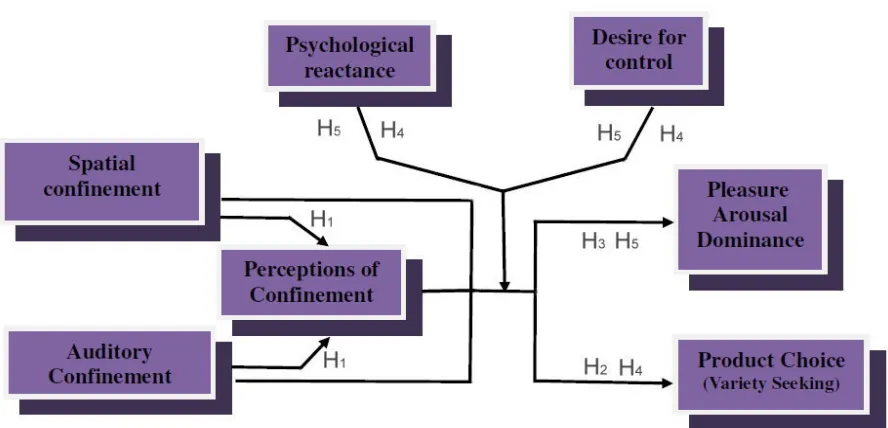
psychology and consumer marketing. Figure 1 provides an overview of the interplay of constructs that appear in the research model.
[image:9.595.60.504.498.712.2]Research model of the laboratory experiment
Research hypotheses
Taking the relevant literature into consideration, it became possible to set up several assumptions
regarding the data that are generated from the study. The following hypotheses are made in order to
guide our study goals:
₁
H : The degree of auditory and spatial confinement will significantly influence the participants´
personal perception of confinement. A condition of high confinement will accordingly be perceived
as more confining. Opposed to that, a condition of lower confinement will be perceived as such as
well.
₂
H : The degree of auditory and spatial confinement will significantly influence the need for
variety/ individuality in products in at least one way. Participants in conditions of high confinement
will show a more varied product choice. Acoordingly, participants in conditions of low
confinement will diplay a lower need for variety.
₃
H : The degree of auditory and spatial confinement will significantly and negatively influence the
perception of pleasure and dominance in the experimental setting, while arousal will be positively
influenced.
₄
H : There will be a moderating effect of psychological reactance and desire for control regarding the impact of confinement on product choice in terms of variety. Conditions of high confinement
will lead to a more varied product choice for participants who appreciate control and tend to be
reactant.
H5: There will be a moderating effect of psychological reactance and desire for control regarding the impact of confinement on emotional states of pleasure, arousal, and dominance. Conditions of
high confinement will lead to a decreased states of pleasure and dominance, as well as to an
Methods
In total, two separate kinds of testing were applied: a pretest and a main experiment. The pretest had
the purpose to rank the later provided products with regard to their exoticness. The according scores
were used in the main experiment to determine the degree of the participants´ variety seeking
behavior.
The Pretest: Product exoticness
Before the start of the the main experiments and tests that contributed to the final results, a pretest
was applied. To provide valid stimulus material, participants had to evaluate several products in
advance. Firstly, the products that finally were presented in the main experiment were rated on a
scale: people had to indicate how exotic/individual, respectively familiar/conventional they would
evaluate them. A high score for the food products indicated high familiarity, while a low score
indicated exoticness.
Thus, the participants should state as how conventional they would consider every single product in
terms of the frequency of direct confrontation with it in their everyday life. The rating was applied
by means of a 7-points Likert Scale.
The purpose of the rating and the subsequent assignment of “exoticness scores” was that the chosen
product could finally serve as an expression of the need for variety. The exoticness score plays an essential role in the main experiment where participants choose several products while remaining in
different conditions of confinement.
As it has already been explained, the concept of need for variety was assumed to be disclosed in two different measures: The number of products that would be chosen by the test persons – and the exoticness of chosen products, which was just now designated by this pretest.
After all, 30 participants were recruited via the Internet to evaluate the 40 given products. Most of
them orginated from the social surrounding of the experimenter. A Link to an online survey was
provided; completing the survey took about five minutes in total. The data were used to calculate a
Median exoticness score for every product.
Table 1. Exoticness scores on the basis of participants´ personal ratings in the pretest. Product Exotic ness Score SD Product Exoti cness Score SD Soft Drinks
Royal Crown 1.2 .58 Schweppes Ginger Ale 5.7 1.16 Canada Dry 1.4 .63 Vittel 5.9 1.14 Mirinda 3.6 1.43 Fanta 6.6 .78 Pellegrino 4.6 1.62 Coca Cola 6.8 .64
Beer Sterling Beer 1.9 1.22 Miller Beer 2.9 1.60 Chang Beer 2.1 1.54 Grolsch Beer 6.0 1.52 Red Stripe 2.3 1.61 Heineken 6.8 .35
Main Course
Dal Bhat 2.6 2.10 Schnitzel 5.0 1.98 Vanille-Garnalen 3.3 .88 Steak 5.5 1.38 Chicken Tikka Masala 4.2 1.84 French Fries 6.0 1.78 Potatoe casserole 5.0 1.76 Pizza 6.7 .70
Snacks African Singgara 1.6 .55 Vietnamese Loempia 5.0 2.09 Baked Samosa with exotic
sauce
2.6 2.00 Potatoe Wedges 5.0 1.85
Aubergine with Yoghurt dressing
3.3 2.16 Frikandel 5.3 2.14
Sticks with cheese and grapes 4.6 1.74
Fruits Pepino Fruit 1.7 1.53 Apple Slices 5.7 1.79 Guavas 2.5 1.66 Strawberries 6.3 1.44 Nashi Peer 2.6 2.07 Banana Slices 6.6 1.35 Sugar Melon 5.1 1.63
The Main Study
The main experiment applied the the arranged model that was illustrated in the introduction within
an experimental context. Thus finally, the research was taken to a crucial laboratory setting after the
successful procedure of the pretest. This laboratory study can be regarded as the main experiment
which generated the essential results.
Participants
In total, 87 respondents participated in the main experiment. 87 participants (62.1 % female, 37.9%
male), with most of them residentiary in the Netherlands. The mean age was 22 years with a
standard deviation of 3. With regard to consumption patterns, it could be detected that 18.4 % were
vegetarians and 96.6 % were drinking alcohol.
Basically, there was no restriction to age, origin or educational background. Nevertheless it can be
stated that most participants had an academic background because a majority of them was recruited
as students of the University of Twente.
It was required that the participants understood Dutch language because the questionnaire was set
[image:13.595.61.541.426.561.2]up in Dutch and English.
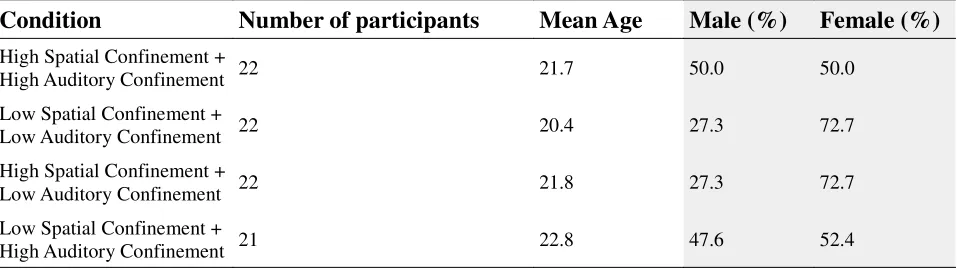
Table 2. Demographic distribution in the different experimental conditions.
Condition Number of participants Mean Age Male (%) Female (%)
High Spatial Confinement +
High Auditory Confinement 22 21.7 50.0 50.0
Low Spatial Confinement +
Low Auditory Confinement 22 20.4 27.3 72.7
High Spatial Confinement +
Low Auditory Confinement 22 21.8 27.3 72.7
Low Spatial Confinement +
High Auditory Confinement 21 22.8 47.6 52.4
Recruitment and Procedure
Regarding the main experiments, participants signed up via Sona Systems, a platform administered
by the University of Twente. Some students were recruited directly in the university or by the
experimenter himself, using his personal social surrounding. Besides some basic demographic
items, two validated self-report questionnaires were provided before the beginning of the field
study. After that, the experimental simulation started and participants had to indicate their product
choices. As soon as the simulation was finished, several items which addressed the personal
Experimental design, manipulation, and setting
A 2x2 between-subjects design which consisted of four conditions was set up. One factor was
defined by the extent of spatial confinement (high/low) within the experimental setting, whilst the other one was divided into the degree of auditory confinement (high/low) the individual is
confronted with. A controlled setting had been set up for the respondents. Within each experimental
session, the experimenter accompanied the participants. The data were collected by means of a
survey in the laboratory experiment. It was located in a prepared room of the hosting University of
Twente. Participants were sitting in front of a big screen where the stimulus material was provided.
The experiment could be declared a single blind experiment because people assumed that the testing
only referred to the presented stimulus material on the screen. In fact, the actual situation of test
persons in the experimental setting was taken into account as well. Spatial and auditory
[image:14.595.57.542.305.627.2]confinement were assumed to influence the participants´ behavior.
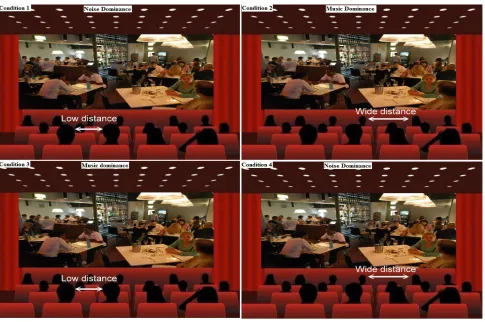
Fig. 2. All four conditions visualized:
All environmental stimuli were adequately prepared to match the desired experimental conditions
that were extensively introduced before. Chairs and tables were rearranged in order to create
different degrees of spatial confinement. The attending persons were sitting in close distance to each other in one condition, and in wider distance to each other in the other condition. The degree of
spatial confinement was manipulated by means of the amount of social crowding (i.e., density of
people within the field of the study), and additionally by physical confinement that was elicited by
additional tables that narrowed the available space. Thus, a combination of physical and human
confinement was used to likewise create different degrees of perceived confinement. Within every condition, six to twelve test persons were repectively attending the experiment, in three rows of
tables, with two (condition of low spatial confinement) to three or four (condition of high spatial
confinement) persons in each row. In the condition of high spatial confinement, the distance of
participants in the same row was less than 50 centimeters. In the condition of low spatial
confinement, a distance of at least one meter was provided. After the presentation of the stimulus
material and complete answering of the survey, people had to evaluate to what extent they perceived
the physical surrounding and human crowding as being confining and restricting. This procedure
served well as a manipulation check.
The condition with low auditory confinement (or also called Music Dominance in Fig. 2) was manipulated by providing a restaurant simulation with addition of relaxing music which drowned
out the usual environmental restaurant noises that might not even be remarked consciously. The
chosen music track was voted by musicians and scientists as the second most relaxing song in a
wide range of music tunes (www.shortlist.com, 2011). In an empirical way, several tunes were
examined with regard to how they calm the body and mind, and how they create a relaxing
atmosphere.
The condition of high auditory confinement (or also called Noise Dominance in Fig. 2 above) was induced by presenting pure environmental restaurant noises that appeared disturbing; within that
condition no background music was played at all. The pure noise of talking people and crashing
cutlery was presented in an irregular manner while also sticking to real sounds of a restaurant that
have been recorded in advance.
Participants were exposed to one of the four conditions mentioned above (high/low auditory
confinement vs. high/low spatial confinement within the lab setting). They were equally weighted
per conditions: finally, three experimental conditions included 22 people and one condition (Low
Image 1. Participants in the high confinement condition with a low distance to each other
Before starting the experiment and while already lingering in the condition of high/low spatial
confinement, people were asked to indicate some demographic data and were provided a scale
which measures the overall desire for control. Besides that, the participants filled in a scale that assessed their general tendency to display psychological reactance.
After ensuring the right manipulation of the stimuli, people were confronted with the virtual setting
without knowing what is being measured. Speakers of appropriate power were provided to shift the
focus on the background sounds respectively the music in the scenario. It was made use of a large
screen to gain as much attention as possible. People were told to imagine that they are engaging in a
“buffet tour” within a restaurant environment that is presented on the screen. It was explained to
them that during the time when the scenario (thus the film segments of the restaurants) is presented,
different types of products will be displayed on the lower part of the screen. When this happened,
the film was stopped for a few seconds and participants could make a choice what kind of products
(food and beverages) they would choose. The range of products they could choose was respectively
restricted, so that they have to make a more thoughtful decision.
The offered products were assigned to different categories which were presented in the following
chronological order: Snacks, Soft Drinks, Beer, Main Courses, Fruits, Dessert. In total, a spectrum of 40 products was provided.
It was prescribed that the participants that they should choose at least one and at most three
products per categroy. People who do not drink alcohol were allowed to skip the choice of Beer. Afterwards, they were asked to fill in the scales which measured their perceptions while browsing
Measures
Perception of Confinement
There was one single item which addressed the question of how the participant would describe
his/her feelings during spending the time in the surrounding. The 7-point scale ran from “confined”
to “free”, whereas the sort of confinement was not defined in more detail. After the reverse scoring
via the statistical software, a high score on the scale indicated a high perceived level of
confinement.
Psychological Reactance
There are several techniques allowing to measure the degree of psychological reactance. One of the
most prominent instruments is the “Hong Psychological Reactance Scale” by Hong & Page (1989) ,
a scale which is rather treating reactance as a trait, than as an acute state. The present study is
aiming the goal of assessing how a general reactant personality moderates product choice.
Therefore, this 14-item (α= .89) self report scale seemed to be adequate and well-fitting here. The items measure to what extent a person conforms to societal conventions or sticks to rules in general
(e.g. `It disappoints me to see others submitting to standards and rules.´).
Desire for Control
Burger & Cooper (1979) designed the Desirability of Control Scale (DC) which is used to measure the according construct Desire for control, which was included within the hypothetical model. It relates to a stable personality trait which is said to be displayed consistently across situations by
people whose control is endangered to be lost. It entails 20 items (α= .87) which which were validated by the authors themselves among college students (Burger & Cooper, p. 389). All the
statements address the personal desire for control among different aspects of life (e.g. `I prefer a job where I have a lot of control over what I do and when I do it.´) Six items (7, 10, 16, 19 & 20) had to be reversed to make the results valid.
Need for Variety
Theoretically, the need for variety can be assessed by means of different validated scales. Yet,
another approach was handled here that was already highlighted in the present paper. Product
choice was regarded as a manifestation of the need for variety and was determined in two-fold
1. Median of chosen number of products
On the one hand, the Need for variety was assessed with the help of the Median score of the number of products that were chosen by each participant. A higher number of products thus indicated a
higher need for variety. The range of chosen products could go from one to three products per
category.
2. Product exoticness
On the other hand, participants were examined on how they choose certain products in the different
experimental conditions. For that purpose, a “Product exoticness scale” has been composed before
the beginning of the main experiment.
In the pretest 30 test persons had to rate several products, like drinks and main courses, on the basis
of how exotic they would evaluate those products. Participants had to indicate to what extent they
would rate the aliments as being commonly prevalent within their current cultural surrounding.
After assessing the ratings, an exoticness score ranging from 0 to 7 (with a high score suggesting high familiarity) was attached to every single product that has been offered during the experiments.
All the chosen products were taken together for every participant and a Median score was
calculated for every individual.This was done by firstly summing up the exoticness scores of all the chosen products. After that, this sum was divided by the number of total chosen products.
Pleasure, Arousal, and Dominance
A well-fitting and well-established scale by Mehrabian and Russell (1974) has been used in the
experiments. The two authors created a scale to measure three entities of emotional states:
Pleasure, Arousal, and Dominance. In short, it is called the PAD Scale, which has been used in several studies of consumer behavior and originates from the PAD emotional state model.
The first part of this dimensional scale assesses Pleasure (α= .91)by means of six items and aims to measure how pleasant an emotion may be in a current situation. It consists of negative emotions like
fear or anger, as well as of positive ones like joy or satisfaction.
The second part of the scale also consists of six items and is stating the level of Arousal (α= .81), meaning the intensity and excitation of the emotion. Anger and rage, for example, are two emotions
of different intensity and people are accordingly more or less excited during these feelings.
PAD-Scale were scored on a 7-point Likert scale. The whole survey can be viewed in the Appendix
section in the final section of the present paper.
Results
Calculations were done with the use of the Statistical Program for Social Sciences (SPSS, version
22.0). At first, Table 3 provides an overview of the descriptive statistics with the inclusion of the
[image:19.595.59.543.256.511.2]independent and dependent variables of the research model.
Table 3. Descriptive statistics regarding the independent and dependent variables with Media and standard deviaton respectively.
Auditory Confinement
Low High
Spatial Confinement Low
M (SD)
High M (SD)
Low M (SD)
High M (SD)
Total M (SD)
Chosen Number of Products 1.83 (.91) 2.11 (.42) 1.44 (.54) 1.89 (.62) 1.87 (.64)
Product Exoticness 4.94 (.86) 4.54 (.88) 4.96 (1.02) 4.38 (.73) 4.61 (.90)
Pleasure 4.20 (1.07) 3.63 (1.34) 4.50 (.90) 3.17 (1.00) 3.76 (1.20)
Arousal 3.55 (1.31) 3.98 (1.07) 4.06 (.83) 4.40 (.99) 4.03 (1.07)
Dominance 3.85 (1.70) 2.76 (1.46) 4.64 (1.15) 2.72 (1.28) 3.29 (1.57)
The Perception of Confinement
The ANOVAanalyses were used with the two types of confinement as fixed factors, and the actual
perception of confinement as dependent variable respectively.
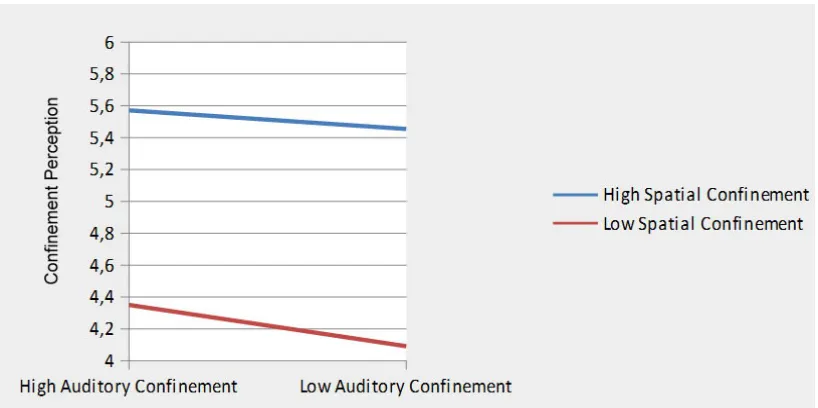
The main effect of spatial confinement on perceived confinement was statistically significant, F (1, 81) = 18.29, p = .01, η² = .18 with participants in the condition with high spatial confinement (M =
3.79, SD = 1.37) perceiving a significantly higher degree of confinement than people in the condition without spatial confinement (M = 2.49, SD = 1.39 ). Partial eta-squared (η²) for this effect was .184.
Fig. 3. The influence of auditory and spatial confinement on participants´ perceptions of confinement.
The main effect of auditory/noise confinement was not statistically significant, F (1, 81) = .38,
p = .53, and low, with partial η² = .005.
Moreover, there was no interaction between auditory and spatial confinement, F (1, 81) = .06,
p = .82, partial η² = .001. An overview of the results of the ANOVA analyses described above is provided below in Table 4.
Table 4.Influence of confinement manipulation on confinement perception. * = p< .05
Effect on the general perception of confinement
Confinement type df df (error) F p η²
Auditory Confinement 1 8 .38 .53 .01
Spatial Confinement 1 8 18.29 .00* .18
Interaction of
Auditory Confinement & Spatial Confinement
1 8 .06 .82 .001
Variety Seeking through Product Choice
The next stage included a MANOVA analysis with the two different conditions of confinement, as
[image:20.595.55.550.476.644.2]while the overall effect of auditory confinement was only marginallysignificant (Pillai-Spur = 0.07;
F= 2.8; d.f. = 2.000; p = .066).
Auditory Confinement
The influence of auditory confinement on product choice / need for variety revealed to be
non-existent respectively insignificant, both for product exoticness and chosen number of products. Follow-up analyses showed that the influence on the latter subconstruct (chosen number of
products) was not that weak with F (1, 79) = 3.21, p = .08 and nearly approaching significance for a higher number of chosen product within the condition of high auditory confinement, a connection to
product exoticness choice was not present (F (1, 79) = 0.01, p = .93 ).
Spatial Confinement
On the other hand, spatial confinement revealed to have a greater impact on product choice,
although significance was not given for both dependent factors. The value for the influence of
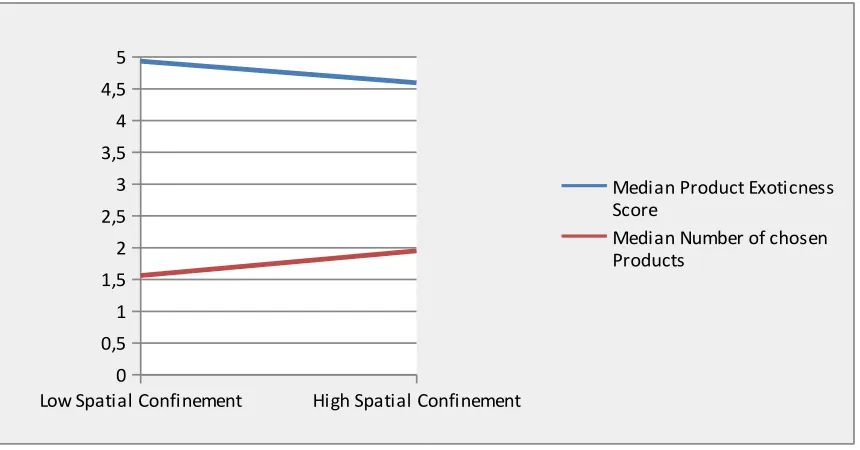
spatial confinement on product exoticness choice missed the range of significance with F (1, 79) = 2.98, p = .09, but the Median of the chosen number of products was indeed affected by this type of confinement (F (1, 79) = 9.23, p = .00 ). People in the conditions of high spatial confinement chose a significantly higher number of products than those who were not spatially confined.
Figure 4 (see below) illustrates the effect of spatial confinement on the two types of product choice.
Fig. 4. The influence of spatial confinement on product choice. For the Median Product Exoticness Score, a low score on the y-axis indicated the choice of more exotic products.
Low Spatial Confinement High Spatial Confinement 0
0,5 1 1,5 2 2,5 3 3,5 4 4,5 5
Median Product Exoticness Score
[image:21.595.58.488.474.699.2]Furthermore, there was no interaction effect between the two types of confinement; neither on
product exoticness choice (F (1, 79) = .01, p = .97 ), nor on chosen number of products (F (1, 79) = .491, p = .49 ).
[image:22.595.54.553.199.379.2]The results of this analytic stage are summarized in Table 5.
Table 5. Influence of confinement manipulation on product choice. * = p< .05
Number of products Product exoticness
df F p df F p
Auditory Confinement 1 3.21 .08 1 .01 .93
Spatial confinement 1 9.23 .00* 1 2.98 .09
Interaction of Auditory Confinement & Spatial
Confinement
1 .49 .49 1 .01 .97
The influence of Confinement on Pleasure, Arousal, and Dominance
A second ANOVA analysis included the two different conditions of confinement, as well as the
scores of the PAD scale with its sub-scales addressing participants´ level of pleasure, arousal and
dominance respectively.
Effects on Pleasure
For one thing, the first dimension of the PAD scale, i.e. pleasure, was statistically significant influenced by the degree of spatial confinement with F (1, 83) = 7.83, p = .01. More specific, a higher spatial confinement indicated a lesser degree of pleasure. For another, the condition of
auditory confinement did not have an effect on the level of pleasure (F (1, 83) = 2.52, p = .12 ).
Effects on Arousal
The second dimension measured the paticipants´ level of arousal in the two conditions of confinement. It turned out that spatial confinement did not have an effect on arousal levels during
Effects on Dominance
At last, the influence of confinement types on perceived dominance in the experimental setting was
assessed. Thereby, the results showed that auditory confinement did not have an effect (F (1, 83) = . 70, p = .41 ). But for the second time, spatial confinement did indeed have a significant (and in this case strong) influence on a dimension of the PAD scale. The lower the degree of spatial
confinement in the experimental condition was, the stronger the feeling of dominance exceled
[image:23.595.46.538.268.447.2](F (1, 83) = 13.87, p = .00 ). None of the ANOVA analyses showed an interaction effect of spatial and auditory confinement on the three sub-scales.
Fig. 5. Significant main effects of confinement on Pleasure, Arousal, and Dominance levels.
Table 6. Influence of confinement types on levels of pleasure, arousal, and dominance. * = p< .05
Pleasure Arousal Dominance
df F p df F p df F p
Auditory
Confinement 1 2.52 .17 1 5.07 .03* 1 .70 .41
Spatial confinement 1 7.83 .01* 1 1.95 .17 1 13.9 .00*
Interaction of Auditory Confinement & Spatial Confinement
[image:23.595.54.545.502.739.2]The moderating effects of Psychological Reactance and Desire for Control
To test the moderating effects of the possibly influential traits, a Median Split (separation of high
and low scorers of the two moderators) and subsequent ANOVA was conducted with the factors of
spatial and auditory confinement, as well as the crucial moderators psychological reactance and
desire for control.
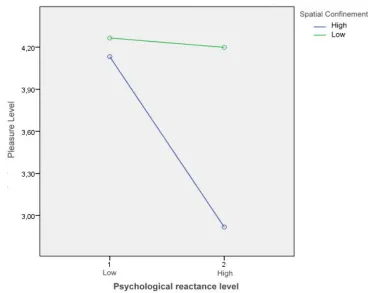
The analysis showed that there was a significant interaction effect of spatial confinement and
reactance on pleasure (F (1, 86) = 7.12, p = .02). As can be seen in Figure 5 below, only for people with higher levels of reactance, spatial confinement had a negative effect on perceived pleasure.
This interaction effect was non-significant for people with higher levels of desire for control. The remaining interaction effects of psychological reactance or desire for control with spatial and
auditory confinement on the emotional states of dominance and arousal, as well as on the choice of products (variety seeking), were non-significant anyway. However, it is worth to mention that there was another marginally significant effect (F (1, 86) = 3.49, p = .07) for the group of highly reactant participants. This experimental group tended to feel less dominant in the condition of high spatial
[image:24.595.122.490.395.688.2]confinement, as opposed to their less reactant counterparts.
Discussion
The present study implemented several strategies to investigate consumer behavior and reactions in
different conditions of confinement.
Atmospheric surroundings were used to manipulate experimental conditions and multiple scales
helped to assess participants´ personal states and behavioral patterns.
Confinement Perceptions
At first, a kind of manipulation check was done to examine the influence of atmospheric conditions
on the perception of the test persons. After all, this had the purpose to make sure that these
conditions were set up in an adequate way.
With regard to the spatial confinement condition, it can be concluded that the manipulation worked
well. Respondents did indeed evaluate the surrounding as more confining in the respective
condition that was prepared in a more constricted way. It is likely that the manipulation succeeded
because of the applied methods that revealed to work well in previous studies. As to say, studies like
these of Levav & Zhu (2009) or Van Rompay, Galetzka, Pruyn, and Garcia (2008) served as
examples to arrange the setting. It can be concluded that the right cues of human and object-related
crowding were chosen to create the desired effects within the main experiment.
On the other hand, the use of disturbing noises did not carry the desired effects of confinement. The
participants were not consciously influenced by the condition of auditory confinement and did not
evaluate it as more confining than the condition where relaxing music was played.
For one thing, it is quite clear that music has the ability to evoke several positive emotions, as well
as to reduce feelings of distress and anxiety (Clark et al.,2006) which may play an important role if
one feels confined or dominated. The question is if people are generally able to evaluate auditory
cues as “confining”. It has to be taken into account that in the common opinion, the term
“confinement” is rather related to a restriction of space. Auditory influences are perhaps more
abstract and not that easy to be observed. Above that, Herrington (1999) found out that musical
preference can indeed have a positive influence on the amount of time and money shoppers spend in
service environments. Of course, this may not necessarily be transferred to a restaurant surrounding.
In either way, in the example of Herrington (1999) positive reactions resulted when the provided
background music matched the participants´ personal preferences. In the present study, no
assessment of people´s musical tastes took place. Finally, the evaluation of music is very individual
and likewise evokes very different emotions and behaviors across customers. These reactions
depend on different background factors as well, e.g. the age of the particular person (Yalch &
Confinement and the Need for Variety
Initially, the need for variety was assumed to be manifested through product choice: either more
exotic product choices, or a higher number of chosen products was hypothesized as a result of
constricting atmospherical conditions.
As the conditions of auditory confinement did not seem to have an effect on confinement perceptions, the test persons´ more latent reactions with regard to product choice did not show a
clear pattern either. The fact that music or background noises were present in the experiments did
not really matter in terms of behavioral responses, namely by the expression of higher variety
needs.
Admittedly, the respondents were influenced by the conditions of spatial confinement. In fact, they did not go for more exotic products in the conditions of high spatial confinement, but the narrowed
surrounding had the effect that people tended to choose a higher number of products. Of course, this result leaves much scope for speculation and interpretation. It was stated that by seeking variance,
an individual tries to free himself/herself from the perceived confinement. This process happens
unconsciously most of the time. There is not a proof of causation available, but the literary
background and the experimental setup both argue for the explanation that the participants´
consumption behavior has to be associated with the manipulated test conditions. Again, the research
by Levav & Zhu (2009) has to be mentioned, as it supports the assumption that restricted space
results in product variety seeking. Parts of the present study can be regarded as complementary and
supportive empirical proof to their findings: a different context finally created a congruent effect.
The connection of Confinement and Pleasure, Arousal, and Dominance
Next to the behavioral responses, the participants´ emotional responses were focused in the present study. To be more clear: three emotional states were assessed in the main experiment.
At first, the degree of pleasure which was perceived by the respondents in the respective conditions was tested. In the condition of spatial confinement, a statistically significant influence was given. People evaluated the stay as more pleasurable when they lingered in the situation without restriction
through space. Accordingly, Sommer (1967) stated in his proxemic theory that the violation of one´s
interpersonal space leads individuals to experience discomfort. The conditions of different degrees
of auditory confinement did not alternate the feeling of pleasure.
evoking feelings of arousal and stress. On the other hand, people felt less aroused when being
exposed to lower levels of auditory confinement. It can be concluded that the relaxing music did
indeed reduce the participants´ inner tension. Of course, this finding is not too innovative, as
countless studies supported the hypothesis that relaxing music can reduce stress and arousal rates
(e.g. Knight & Rickard, 2001; Labbé, Schmidt, Babin & Pharr, 2007). Nevertheless, it is a valuable
finding that the soundscape of a restaurant affects the customer´s arousal level as it reduces the
inner tension. Marketers should use this fact to include it into the basic plan of establishing a food
store or restaurant.
Thirdly, the influence of confinement on the perception of dominance was measured. For the second time, an emotional response was influenced by spatial confinement. The individuals in the high
spatial confinement condition felt significantly less dominant than their counterparts who faced less
confinement. The finding makes sense, regarding the facts that all argue for this perceptual reaction
to confinement in space. The different degrees of auditory confinement had no effects on perceived
dominance. The twofold test of changes in dominance perception can likewise be regarded as
additional manipulation check. Taking this into account, the conclusion may be that manipulations
of space did work confining, while the auditory manipulation did not have that effect.
The moderating effects of Psychological Reactance and Desire for Control
It was an essential assumption during the entire study that human emotional reactions and behavior
in the present context are not only influenced by the surrounding, but also by the personal
constitution of the participants. Therefore, two relevant personality traits were included at the
search for an explanation to consumption behavior: desire for control and psychological reactance.
At first, a moderating effect of these continua on the connection between confinement and variety
seeking was assumed. More precisely, variety seeking was reflected in the number of chosen products, respectively in a more exotic product choice.
It came out that none of these moderator analyses revealed a significant effect on product exoticness
choice or chosen number of products. Both of the personality traits desire for control and
psychological reactance did not play a role in this context of the model.
The trait of desire for control did not moderate any behavior or emotional reaction of the participants at all. An explanation to this could be the present experimental setting. In the beginning
of the paper, it was mentioned that customers often display goal-directed behavior with which
control is gained. The present setting represented a surrounding of a restaurant and cafeteria buffet.
It is assumable that people would follow other interests there than they would do in a shopping
motivations of fun and social interactions. In contrast to that, shopping malls and retailers are rather
motivating goal-directed behaviors (Bagozzi & Dholakia, 1999). Thus, it may be possible that the
trait of desire for control did not counteract the present experimental conditions and thus neither had to evoke respective reactions of the participants.
The level of psychological reactance did not moderate any effects exerted by confinement on product choice. Reasons for this can be of multiple origins. It is striking that there is a lack of
research which included psychological reactance during the last couple years. It is possible that the
concept is outdated and behavior is not affected that extensively anymore by it. The construct was
developed in the 60´s and 70´s of the last century where social conventions were totally different,
compared to present times. It is likely that a rather rebellious attitude had a different weight back
then.
On the other hand, moderating influences on the on the participants´ emotional states were
hypothesized. Participants who scored high on psychological reactance perceived less pleasure in a
condition of high spatial confinement, in contrast to those who appeared to score low on reactance.
₄
The hypotheses H and H5 could be not completely be confirmed, as only psychological reactance
revealed to be influential on one emotional state (pleasure). The effect of space restrictions on perceived dominance was also partly influenced by reactance (there was a tendency of highly
reactant participants to feel less dominant when spatially confined), but this result failed to prove
significance.
The finding that people with high reactance levels felt less pleasurable in confined surroundings
seems to make sense and is congruent with previous explorations. Quick & Stephenson (2007)
made a clear statement, as they declared reactance as a latent variable that comprises of negative
cognitions and state anger. Thus, it is likely that people who tend to be psychologically reactant
rather display negative emotions, especially when their freedom is threatened.
Limitations of the study
The study provides insightful findings, but has to deal with certain boundaries as well. The product
exoticness scores are prone to rater bias. For example, the beer called “Grolsch” is a regional brand
that is especially known in the east of Netherlands where the experiments took place. In another
context, one has to assume that the exoticness rating would look totally different.
Furthermore, the tendency to seek variance may not only be limited to the personality traits that
personal tastes for certain kinds of food are also endangering the empirical stability of this measure.
Above that, the construct of psychological reactance has to be evaluted with certain caution. Woller, Buboltz & Loveland (2007) found out that a younger age group exhibited higher reactance than a
middle age group. Taking into account that a big majority of the respondents contained students, it
is likely that the reactance scores were higher than in a more distributed population. At last, the
issue of food choice and intake may be traced back to another factor: stress. Stress (e.g. evoked by
confinment) may lead to increases, as well as to decreases in food intake (Adam & Epel, 2007).
Relevance in practice and future implications
Our research project contributed to further insights into psychological processes that may be
exhibited within a consumption environment under certain circumstances. The study may be
valuable for restaurant or food store owners to the extent that interior design and auditory stimuli
can be arranged in a right manner, so that consumers will feel well and show “approach behavior”.
Consumers should not perceive consumption-centred environments as being restricting, disturbing
or overly arousing in a negative way. Due to the multiple stimuli to which we are exposed to in
everyday life anyways, persons who are responsible for restaurant design should keep in mind that
less is sometimes more. On the one hand, the study indicates that narrowed space may lead to an
increased number of purchased products. On the other hand – on an emotional level – this kind of
confinement proved to rather evoke aversive feelings. The question is how an environment can be
created which sustainably benefits both the marketer and the customer.
Store owners, scientists and designers can apply the findings to develop an optimal surrounding for
customers. The present study examined the reaction of young people, so the findings may mainly be
valuable for business people who want to address this according target group in their stores.
Follow-up studies should concentrate on customer motives in different consumption settings. Levels
of spatial and auditory confinement possibly operate in different ways across customer contexts.
As it is quite clear that narrowed space rather evokes negative reactions, the effect of the
soundscape is more ambivalent. It is time to include the personal constitution of customers when
setting up a commercial environment. As Novak (2010) found out, people react very differently to
noises and music in restaurant settings. These big differences in sensitivity to the auditory
surrounding should shift the focus on what are the most comfortable volume levels and auditory
contents in those contexts.
In the same vein, it has to be mentioned that certain personality constructs and their measures are
not up to date anymore. The science of consumer behavior has to make use of psychological
target group of higher age would be interesting because the present study exclusively included
young adults.
Finally, it would be interesting to find out if consumers also use different strategies to regain
personal freedom. Next to a more varied product choice, it can surely be thought of other
References
Adam, T. C., & Epel, E. S. (2007). Stress, eating and the reward system. Physiology & behavior,
91(4), 449-458.
Ajzen, I. (1991). The theory of planned behavior. Organizational Behavior and Human Decision Processes, 50 (1991), 179–211.
Areni, C.S. and Kim, D. 1993, "The influence of background music on shopping behavior: classical versus top-forty music in a wine store", in McAlister, L. and Rothschild, M. (Eds), Advances in Consumer Research, Vol. 20, pp. 336-40.
Arnett, J. (1994). Sensation seeking: A new conceptualization and a new scale. Personality and individual differences, 16(2), 289-296.
Averill, James R. (1973), “Personal Control over Aversive Stimuli and Its Relationship to Stress”.
Psychological Bulletin, 80 (4), 286-303.
Ballantine, P. W., Jack, R., & Parsons, A. G. (2010). Atmospheric cues and their effect on the
hedonic retail experience. International Journal of Retail & Distribution Management, 38(8), 641-653.
Bagozzi, R. P., & Dholakia, U. (1999). Goal setting and goal striving in consumer behavior. The Journal of Marketing, 19-32.
Bellenger, D.N.; Korgaonkar, P.K. Profiling the recreational shopper. J Retail 1980;56:77– 92 (Fall).
Bitner, Mary Jo (1992). “Servicescapes: The Impact of Physical Surroundings on Customers and
Employees,” Journal of Marketing, 56 (April), 57–71.
Burger, J.M. and Cooper, H.M. (1979). The desirability of control. Motivation and Emotion. 3, 381-393.
Brehm, S. S., & Brehm, J. W. (1981). Psychological Reactance: A Theory of Freedom and Control. Academic Press.
Clark, M., Isaacks-Downton, G., Wells, N., et al. “Use of preferred music to reduce emotional
distress and symptom activity during radiation therapy.” Journal of Music Therapy 2006; 43: 247-265.
Dube L, Morin S.: “Background music pleasure and store evaluation intensity effects and
psychological mechanisms.” J Bus Res 2001;54:107
Edwards, S. M., Li, H., & Lee, J. H. (2002). Forced exposure and psychological reactance:
Antecedents and consequences of the perceived intrusiveness of pop-up ads. Journal of Advertising,
31(3), 83-95.
Eroglu, S.A., Machleit, K.A. and Chebat, J.C. (2005). The interaction of retail density and music
tempo: effects on shopper responses. Psychology & Marketing, Vol. 22 No. 7, pp. 577-90.
Gosling, S. D., Rentfrow, P. J., & Swann, W. B. (2003). A very brief measure of the Big-Five
personality domains. Journal of Research in personality, 37(6), 504-528.
Guski, R., Felscher-Suhr, U., and Scheumer, R. (1999): The concept of noise
annoyance: How international experts see it. J Sound Vibration 223, 513-527.
Herrington, J. Duncan and Capella, Louis M. (1996), "Effects of Music in
Service Environments: A Field Study," Journal of Services Marketing, 10(2), pp. 36-41.
Hoffman, D. L., Novak, T. P., & Schlosser, A. E. (2003). Locus of control, web use, and consumer
Hong, S. M., & Page, S. (1989). A psychological reactance scale: Development, factor structure and
reliability. Psychological Reports, 64(3c), 1323-1326.
Hui, Michael K., Laurette Dube, and Jean-Charles Chebat (1997), "The Impact of Music on
Consumers' Reactions to Waiting for Services," Journal of Retailing, 73 (1), 87-104.
Hui, M.K.; Bateson, E.G. (1991). Perceived control and the effects of crowding and consumer
choice on the service experience. Journal of consumer research. (September) 1991;18:174– 84.
Jung, H. S., & Yoon, H. H. (2012). Why do satisfied customers switch? Focus on the restaurant
patron variety-seeking orientation and purchase decision involvement. International Journal of Hospitality Management, 31(3), 875-884.
Kahn, Barbara E. (1995), “Consumer Variety-Seeking among Goods and Services: An Integrative
Review,” Journal of Retailingand Consumer Services, 2 (3), 139–148.
Kim, S. O., & Shelby, B. (2011). Effects of Soundscapes on Perceived Crowding and Encounter
Norms. Environmental management, 48(1), 89-97.
Knight, W. E., & Rickard, N. S. (2001). Relaxing music prevents stress-induced increases in
subjective anxiety, systolic blood pressure, and heart rate in healthy males and females. Journal of music therapy, 38(4), 254-272.
Kryter, K.D., 1985. The Effect of Noise on Man, 2nd Edition. Academic Press, Orlando, FL.
Levav, Jonathan and Rui Zhu (2009), “Seeking Freedom Through Variety,” Journal of Consumer Research, 36 (4), 600-10.
Lin, Y. I. (2004). Evaluating a servicescape: The effect of cognition and emotion. International
Journal of Hospitality Management, 23, 163–178.
Mattila, A.S., Wirtz, J., 2001. Congruency of scent and music as a driver of in-store evaluations and