University of Warwick institutional repository: http://go.warwick.ac.uk/wrap
This paper is made available online in accordance with
publisher policies. Please scroll down to view the document
itself. Please refer to the repository record for this item and our
policy information available from the repository home page for
further information.
To see the final version of this paper please visit the publisher’s website.
Access to the published version may require a subscription.
Author(s): R. N. EDMONDSON
Article Title: Past developments and future opportunities in the design
and analysis of crop experiments
Year of publication: 2009
Link to published version:
CENTENARY REVIEW
Past developments and future opportunities in the
design and analysis of crop experiments
R. N . E D M O N D S O N
Warwick HRI,Wellesbourne,Warwick CV35 9EF
(Revised MS received 18 August 2004)
S U M M A R Y
A review of papers on the statistical design and analysis of experiments published in theJournal of Agricultural Science,Cambridge, over the last 100 years is presented. The development of significant ideas in the practical design of field experiments is reviewed. Some possible future developments in the design of spatial field trials and computer-aided design of experiments are discussed.
I N T R O D U C T I O N
The early part of the last century saw the develop-ment of many new and important ideas in statistical methodology including the seminal publication by Gosset (1908) on the distribution theory of small samples from a normal distribution. This theory be-came the basis of the famous Student’st-test and had a profound effect on the development of statistical methodology in agriculture. Gosset was well aware of the importance of his work and in one of his illustrative examples suggested that ‘ cases where the tables will be useful are not uncommon in agricultural work, and they would be more numerous if the advantages of being able to apply statistical reasoning were borne in mind when planning the experiments ’. The Journal of Agricultural Science, Cambridge, founded in 1905, was well placed to help develop these advantages and during the following 100 years, the publication of new statistical methodology in the journal has helped revolutionize the way that agri-cultural experiments are planned and executed.
In this paper, some of the important developments in the statistical design and analysis of experiments associated with the Journal of Agricultural Science,
Cambridge, will be outlined. The main developments have been in the area of field crop experiments and the focus of the paper will be on work in this area. The aim of the review will be to cover the general principles of the design and analysis of experiments and specialized areas such as genotyperenvironment interaction studies, competition designs, diallel cross
designs and other special purpose designs will not be covered. It is not intended to produce a comprehen-sive bibliography of all design and analysis papers published in JAS over the last 100 years and only a selection of relevant papers will be discussed.
S O M E E A R L Y D E V E L O P M E N T S
The first important paper on statistical methodology published in the Journal of Agricultural Science,
Cambridge, was by Wood & Stratton (1910) and was concerned with the interpretation of experimental results using the probable error of a mean based on large sample theory. The authors discussed the numbers of observations required for a given level of precision and discussed the power of an experiment to solve a proposed problem. They investigated field trials using both uniformity data and data from published trials with duplicated plots and concluded that it was useless to compare single plots ‘ whatever their size ’. For small treatment differences, the number of plots must be increased either by ‘ duplication several times in the same experiment, or by repetition of the exper-iment at several stations, or for several seasons ’.
The next major statistical paper was by Mercer & Hall (1911) and was devoted to a study of the exper-imental error of field trials. They collected uniformity data from a large number of small plots of wheat and mangolds and compared the statistical properties of plots of different sizes obtained by amalgamating yields of neighbouring plots in different ways. They showed that the standard deviation of plots of increasing size decreased more slowly than expected on the assumption of independent yields from
Email: [email protected]
neighbouring plots. This showed that ‘ some consider-able correlation exists between the yields of adjacent plots ’. They then showed that by amalgamating yields from plots ‘ scattered systematically ’ across the whole trial, the standard deviation of plots could be reduced more in accordance with the assumption of independent yields. They recommended that in field experiments, each unit of comparison should be replicated up to five times using plots ‘ systematically distributed within the experimental area ’.
There then followed an important period of devel-opment during the 1920s that led to some key ideas in the theory of experimental design. These included the ideas that experimental plots should be arranged at random in replicated blocks to provide unbiased es-timates of error and that treatment factors of interest should be examined in factorial treatment combi-nations rather than individually (Fisher 1926). During this early period, theJournal of Agricultural Science,
Cambridge, published a substantive series of import-ant papers on the topic of Studies in Crop Variation largely inspired by R. A. Fisher’s statistical work at the Rothamsted Experimental Station. Paper IV in the series (Eden & Fisher 1927) exemplified many of the key ideas of blocking, randomization and factorial experimentation.
C O M P L E X D E S I G N S I N T H E 1930s A N D 1940s
Following the initial development of blocked exper-iments, researchers soon found that large replicate blocks of treatments in field experiments were very heterogeneous and that smaller, more complex block designs were needed for precise comparison of treat-ments. Eden & Fisher (1929) discussed a range of block designs and, remarkably, introduced the idea of reducing block size by confounding certain unim-portant factorial contrasts between blocks. Their de-scription of the example design was inadequate but their key idea of reducing block size by confounding unimportant treatment contrasts was undoubtedly correct.
The first major paper in theJournal of Agricultural Science,Cambridge, to deal with the subject of com-plex blocking and confounding was by Yates (1933), in which he discussed the design and analysis of a range of blocked and confounded factorial treatment experiments. His paper covered the principles of main effects confounding in split-plot experiments and also gave a fully valid account of the method of reducing block size by confounding unimportant treatment contrasts between blocks. Yates (1935) then gave an important paper on complex experiments at a discussion meeting of the Royal Statistical Society where much of the modern theory and practice of factorial experiments and confounded block designs was outlined. An unfortunate aspect of that paper
was that Yates ‘ condemned ’ a general class of designs called semi-Latin square designs because of ‘ biased error ’. Although a number of discussants were clearly uncomfortable about this ‘ condemnation ’, researchers were deterred from using these useful and effective designs for many years.
In the following year, Yates (1936a) discussed a class of incomplete Latin square designs obtained by omitting a single row or column from a Latin square and showed that these designs had useful practical properties. Also in that year, Yates (1936b) developed the highly important class of designs now called lattice designs. These designs were originally called pseudo-factor designs and were intended to provide efficient incomplete block designs for unstructured treatment sets by imposing an artificial pseudo-factor structure on the treatments and then confounding pseudo-factor contrasts between blocks in as efficient a way as possible. This collection of papers by Yates, together with a paper by Yates on balanced incom-plete block designs published elsewhere (Yates 1936c), laid the foundations of modern block design theory.
In 1938 Fairfield Smith published an empirical law (Smith 1938) that described the relationship between plot size and plot variability. This law was very in-fluential, for a time, in studies on the choice of plot sizes for experiments.
By the early 1940s, factorial treatment designs were widely used in many areas of research and were of proven value. However, one major practical problem remained. As the number of factors in an experiment increased, the number of factorial combinations nee-ded for a complete factorial treatment design became very large, especially for factors with more than two levels. Consequently, factorial trials with many treat-ment factors involved large numbers of treattreat-ment combinations and were often impracticable. This problem was solved for a large class of factorial designs by Finney in two influential publications on fractionation, one in the Journal of Agricultural Science,Cambridge(Finney 1946) and one elsewhere (Finney 1945). Although much of the theory of fractionation has been developed elsewhere (see, for example, Edmondson 1994), fractionation has found many practical applications in agricultural research and has allowed agricultural experiments with numerous factors to be carried out at a reasonable cost. See for example Chinloyet al. (1953).
Finally, at the end of this period, Pearce & Taylor (1948) discussed the changing of treatments in long-term trials using ideas from the theory of confounded block designs.
M O D E R N D E S I G N W O R K
Following the rapid developments of the 1930s and 1940s, there was a long period during the 1950s when,
possibly due to the appearance of specialized journals such as Biometrics, little of relevance to our review was published in theJournal of Agricultural Science,
Cambridge. However, beginning in the 1960s and especially during the 1970s and later, new areas of work in the design of experiments began to emerge in the journal.
First, Patterson & Ross (1963) undertook an examination of the effects of long narrow cereal plots on the efficiency of block designs. These plots had been introduced to accommodate the new technique of combine harvesting and it was important to know whether they affected the efficiency of variety trials using lattice designs. Patterson & Ross examined the relationship between error variance and block size using data from 454 cereal trials and concluded that the gain in efficiency from using small blocks in cereal trials was as great for the long narrow plots as it had been for the wide short plots used previously.
Next, Patterson (1965) published an influential paper in the Journal of Agricultural Science,
Cambridge, on the construction of fractional factorial treatment designs for rotation experiments. This paper used the idea of adesign keyto identify factorial treat-ment contrasts with individual pseudo-factorial plot contrasts and provided a systematic method for con-structing blocked and fractionated factorial designs. Later, the method was used to develop an algorithm for an early computer program for the design of factorial experiments called DSIGN, which is full described elsewhere in Patterson (1976).
Then, from the late 1970s onwards, perhaps due to the increasing power and availability of computers, there was an upsurge of interest in the development of block designs for various purposes. Pattersonet al. (1978) introduced a new class of cyclically generated lattice designs called alpha designs, which greatly ex-tended the class of lattice block designs then currently available for variety trials. Fielding & Killick (1983) reported favourably on the use of alpha lattice designs in a small sample of potato variety trials and Patterson & Hunter (1983) later published a substantial exam-ination of alpha lattice design efficiency based on an analysis of 240 cereal variety trials in the UK. They concluded that the designs improved cereal trial efficiency under UK conditions by about 42 % rela-tive to randomized block designs. A description of the algorithm used to design alpha designs was given by Patersonet al. (1988).
Finally, Yau (1997) examined the efficiency of alpha lattice designs in 714 international cereal yield trials and concluded that alpha lattice designs gave worthwhile improvements in efficiency relative to randomized block designs, although not such marked improvements as those reported by Patterson & Hunter (1983). As there was no additional cost in implementing the new designs, he recommended the use of alpha lattice designs in international and
regional field trials rather than conventional complete randomized block designs.
Row-and-column designs can be particularly useful for trials with small plots and the efficiency of two-dimensional alpha lattice type designs was investigated for small plot barley trials by Robinsonet al. (1988) using 129 spring barley trials. Gains in efficiency similar to those reported by Patterson & Hunter (1983) were obtained and the two-dimension alpha designs were reported to be equally as useful as the one-dimensional designs. Patterson & Robinson (1989) then published a series of efficient row-and-column designs for variety trials with two replicates.
In a related but separate area of work, Edmondson (1998) developed a class of balanced row-and-column designs obtained by omitting a main row or a main column from a special class of semi-Latin squares called Trojan squares. These designs are natural gen-eralization of the incomplete Latin squares of Yates (1936a) and would probably have been developed much earlier had it not been for the Yates (1935) ‘ condemnation ’ of semi-Latin squares. Ironically, Yates himself, as early as 1937, (Yates 1937, Section 16i and 16j) used Graeco-Latin and hyper-Graeco-Latin squares to construct row-and-column designs that were identical with the class of designs we now know as Trojan squares !
D E V E L O P M E N T S I N S P A T I A L M E T H O D S
The designs and analysis discussed so far have all been based on block designs with the assumption of fixed or random block effects. However, even from the very early days of randomized block designs, research papers in theJournal of Agricultural Science,
Cambridge, have shown a continuing interest in the use of spatial methods for the analysis of field trials. An early study by Sanders (1930) examined a re-gression of annual crop plot yields on the yields of the same plots from previous years while Eden (1931) carried out a similar study for a perennial crop by regressing tea bush yields on the yields of the same bushes from previous years. Sanders found little advantage in the method but Eden reported very substantial improvements in precision. Interestingly, the method of covariance regression on plot position (see Federer & Schlottfeldt 1954) was not discussed by either author and did not occur in the Fourth Edition of Statistical Methods for Research Workers (1932) by R. A. Fisher, although the method did appear in later Editions (Fisher 1973, Section 48) and had, apparently, appeared by at least the 10th Edition published in 1946 (Federer & Schlottfeldt 1954).
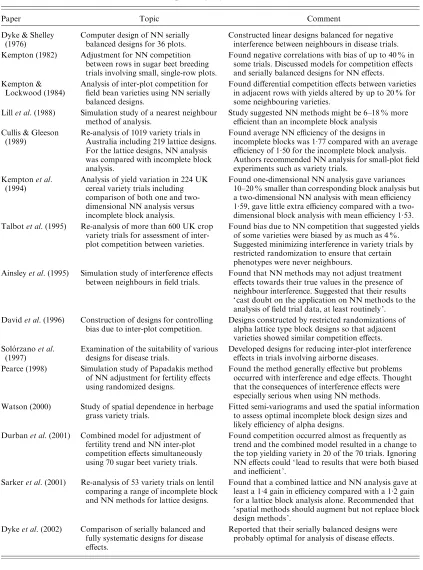
Table 1. Some recent papers on spatial aspects of the design and analysis of experiments using nearest neighbour(NN)methods
Paper Topic Comment
Dyke & Shelley (1976)
Computer design of NN serially balanced designs for 36 plots.
Constructed linear designs balanced for negative interference between neighbours in disease trials. Kempton (1982) Adjustment for NN competition
between rows in sugar beet breeding trials involving small, single-row plots.
Found negative correlations with bias of up to 40 % in some trials. Discussed models for competition effects and serially balanced designs for NN effects. Kempton &
Lockwood (1984)
Analysis of inter-plot competition for field bean varieties using NN serially balanced designs.
Found differential competition effects between varieties in adjacent rows with yields altered by up to 20 % for some neighbouring varieties.
Lillet al. (1988) Simulation study of a nearest neighbour method of analysis.
Study suggested NN methods might be 6–18 % more efficient than an incomplete block analysis Cullis & Gleeson
(1989)
Re-analysis of 1019 variety trials in Australia including 219 lattice designs. For the lattice designs, NN analysis was compared with incomplete block analysis.
Found average NN efficiency of the designs in incomplete blocks was 1.77 compared with an average efficiency of 1.50 for the incomplete block analysis. Authors recommended NN analysis for small-plot field experiments such as variety trials.
Kemptonet al. (1994)
Analysis of yield variation in 224 UK cereal variety trials including comparison of both one and two-dimensional NN analysis versus incomplete block analysis.
Found one-dimensional NN analysis gave variances 10–20 % smaller than corresponding block analysis but a two-dimensional NN analysis with mean efficiency 1.59, gave little extra efficiency compared with a two-dimensional block analysis with mean efficiency 1.53. Talbotet al. (1995) Re-analysis of more than 600 UK crop
variety trials for assessment of inter-plot competition between varieties.
Found bias due to NN competition that suggested yields of some varieties were biased by as much as 4 %. Suggested minimizing interference in variety trials by restricted randomization to ensure that certain phenotypes were never neighbours.
Ainsleyet al. (1995) Simulation study of interference effects between neighbours in field trials.
Found that NN methods may not adjust treatment effects towards their true values in the presence of neighbour interference. Suggested that their results ‘ cast doubt on the application on NN methods to the analysis of field trial data, at least routinely’. Davidet al. (1996) Construction of designs for controlling
bias due to inter-plot competition.
Designs constructed by restricted randomizations of alpha lattice type block designs so that adjacent varieties showed similar competition effects. Solo´rzanoet al.
(1997)
Examination of the suitability of various designs for disease trials.
Developed designs for reducing inter-plot interference effects in trials involving airborne diseases. Pearce (1998) Simulation study of Papadakis method
of NN adjustment for fertility effects using randomized designs.
Found the method generally effective but problems occurred with interference and edge effects. Thought that the consequences of interference effects were especially serious when using NN methods. Watson (2000) Study of spatial dependence in herbage
grass variety trials.
Fitted semi-variograms and used the spatial information to assess optimal incomplete block design sizes and likely efficiency of alpha designs.
Durbanet al. (2001) Combined model for adjustment of fertility trend and NN inter-plot competition effects simultaneously using 70 sugar beet variety trials.
Found competition occurred almost as frequently as trend and the combined model resulted in a change to the top yielding variety in 20 of the 70 trials. Ignoring NN effects could ‘ lead to results that were both biased and inefficient ’.
Sarkeret al. (2001) Re-analysis of 53 variety trials on lentil comparing a range of incomplete block and NN methods for lattice designs.
Found that a combined lattice and NN analysis gave at least a 1.4 gain in efficiency compared with a 1.2 gain for a lattice block analysis alone. Recommended that ‘ spatial methods should augment but not replace block design methods ’.
Dykeet al. (2002) Comparison of serially balanced and fully systematic designs for disease effects.
Reported that their serially balanced designs were probably optimal for analysis of disease effects.
yield residuals of neighbouring plots. He thought this model more appropriate for spatial effects in a field trial than a randomized blocks model and advocated the use of a systematic rather than a randomized layout. Bartlett (1938) made a theoretical study of the method using data from two completely randomized designs and found that the gain in efficiency could be considerable if there was much correlation between plots and reported that the method ‘ should be ap-proximately valid and sometimes useful ’. However, he thought the method would ‘ hardly, as Papadakis suggests, affect the design of experiments of the ran-domized block type ’.
A major drawback of spatial methods has always been the computational labour involved in the analysis of the data but the advent of modern com-puting has effectively removed this obstacle and since about the early 1970s, there has been a considerable upsurge of interest in spatial methods in theJournal of Agricultural Science,Cambridge. Table 1 shows a summary of all relevant papers concerned with spatial analysis of field trials that have been published in JAS from about 1970 onwards. The issues raised by spatial analysis are complex and controversial and cannot be discussed in detail here but a few comments have been inserted into Table 1 to provide a brief indication of the content of each paper. For a full understanding of the issues involved, the reader should refer directly to the relevant papers.
F U T U R E D E V E L O P M E N T S
Objective statistical methods have been at the heart of effective agricultural research for almost a century and despite the development of powerful new research technologies in agriculture and biology, look set to remain at the heart of crop and field exper-imentation for the foreseeable future. The design of field experiments is a well-developed technology but one of the few remaining areas not yet, perhaps, fully developed is the use of computer intensive methods at the design stage of experiments. The following suggestions are for areas of research where modern computing power might be used more intensively.
Agricultural experiments are expensive, compli-cated and difficult to interpret and may run for many years. Under these circumstances, the need for efficient and reliable experimental design is para-mount. Modern computing power now makes it
possible to carry out computer intensive studies at the design stage of an experiment and it seems likely that there will be much more emphasis in the future on the power of a design to provide required solutions under various assumptions about the plot and treatment models. It seems likely, therefore, that formal power studies of designs will become much more important in the future than they have been in the past.
Although past experience has shown that classical block designs work well in practice, considerable evi-dence now exists to show that spatial methods can be used to improve the efficiency of crop experiments. It seems likely, therefore, that there will be more emphasis in the future on choosing designs that are spatially efficient. One approach might be to use an efficient incomplete block design but to restrict the randomization to maximize the expected information from a spatial analysis. Development of efficient design for spatial information seems likely to con-tinue in the future but it would be unwise to depart too far from the principle of the blocked and ran-domized field trial that has worked so well for the last 80 years.
In the past, computer software for design of ex-periments has usually been licensed and has often re-quired highly specialized programming skills and training. This has meant that much of the complex design theory developed in the past has been un-available to non-specialists and has been little used. In the future, web-based software to provide expert virtual advice systems on the construction of exper-imental designs could be used to solve this problem. Such systems would utilize the complex algorithms needed to construct the complex designs needed for efficient experiments but would provide advice through a non-technical interface. Although it is still unclear how best to develop such software, a web-based resource that embodies some of these ideas is currently under development and can be found at : http://biometrics.hri.ac.uk/
Further development of appropriate computer vir-tual advice software could substantially improve the future application of powerful and efficient exper-imental designs in crop research.
The author would like to thank the editorial board of theJournal of Agricultural Science,Cambridge, for the invitation to prepare this review for the Centenary issue of the Journal.
R E F E R E N C E S
AINSLEY, A. E., DYKE, G. V. & JENKYN, J. F. (1995).
Inter-plot interference and nearest neighbour analysis of field experiments.Journal of Agricultural Science, Cambridge 125, 1–9.
BARTLETT, M. S. (1938). The approximate recovery of
in-formation from replicated field experiments with large
blocks. Journal of Agricultural Science, Cambridge 28, 418–427.
CHINLOY, T., INNES, R. F. & FINNEY, D. J. (1953). An
CULLIS, B. R. & GLEESON, A. C. (1989). Efficiency of
neighbour analysis for replicated variety trials in Australia.Journal of Agricultural Science, Cambridge113, 233–239.
DAVID, O., KEMPTON, R. A. & NEVISON, I. M. (1996).
Designs for controlling inter-plot competition in variety trials. Journal of Agricultural Science, Cambridge 127, 285–288.
DURBAN, M., CURRIE, I. D. & KEMPTON, R. A. (2001). Adjusting for fertility and competition in variety trials. Journal of Agricultural Science, Cambridge 136, 129–140.
DYKE, G. V. & SHELLEY, C. F. (1976). Serial designs balanced for effects of neighbours on both sides.Journal of Agricultural Science, Cambridge87, 303–305. DYKE, G. V., TODD, A. D. & JENKYN, J. F. (2002). Some
problems in the design and analysis of field experiments subject to inter-plot interference.Journal of Agricultural Science, Cambridge139, 295–305.
EDEN, T. (1931). Studies in the yield of tea : I. The exper-imental errors of field experiments with tea. Journal of Agricultural Science, Cambridge21, 547–573.
EDEN, T. & FISHER, R. A. (1927). Studies in crop variation
IV. The experimental determination of the value of top dressing with cereals. Journal of Agricultural Science, Cambridge17, 548–562.
EDEN, T. & FISHER, R. A. (1929). Studies in crop variation
VI. Experiments on the response of the potato to potash and nitrogen.Journal of Agricultural Science, Cambridge 19, 201–213.
EDMONDSON, R. N. (1994). Fractional factorial designs for factors with a prime number of quantitative levels.
Journal of the Royal Statistical Society B56, 611–622. EDMONDSON, R. N. (1998). Trojan square and incomplete
Trojan square designs for crop research. Journal of Agricultural Science, Cambridge131, 135–142.
FEDERER, W. T. & SCHLOTTFELDT, C. S. (1954). The use of
covariance to control gradients in experiments.Biometrics 10, 282–290.
FIELDING, W. J. & KILLICK, R. J. (1983). The use of generalized lattice designs in potato variety trials (some preliminary results). Journal of Agricultural Science, Cambridge101, 59–62.
FINNEY, D. J. (1945). The fractional replication of factorial arrangements.Annals of Eugenics12, 291–301.
FINNEY, D. J. (1946). Recent developments in the design of
field experiments III. Fractional replication.Journal of Agricultural Science, Cambridge36, 184–191.
FISHER, R. A. (1926). The arrangement of field experiments.
Journal of the Ministry of Agriculture of Great Britain33, 503–513.
FISHER, R. A. (1973). Statistical Methods for Research Workers. 14th Edition. New York : Hafner Publishing Company.
GOSSET, W. S. (1908). The probable error of a mean. Biometrika6, 1–25.
KEMPTON, R. A. (1982). Adjustment for competition
between varieties in plant breeding trials. Journal of Agricultural Science, Cambridge98, 599–611.
KEMPTON, R. A. & LOCKWOOD, G. (1984). Inter-plot compe-tition in variety trials of field beans. Journal of Agricultural Science, Cambridge103, 293–302.
KEMPTON, R. A., SERAPHIN, J. C. & SWORD, A. M. (1994).
Statistical analysis of two-dimensional variation in variety
yield trials. Journal of Agricultural Science, Cambridge 122, 335–342.
LILL, W. J., GLEESON, A. C. & CULLIS, B. R. (1988). Relative
accuracy of a neighbour method for field trials.Journal of Agricultural Science, Cambridge111, 339–346.
MERCER, W. B. & HALL, A. D. (1911). The experimental error of field trials. Journal of Agricultural Science, Cambridge4, 107–132.
PAPADAKIS, J. (1937).Me´thode statistique pour des expe´ri-ences sur champ. Institut pour l’Ame´lioration des Plantes, Salonique (Gre`ce), Bulletin 23.
PATERSON, L. J., WILD, P. & WILLIAMS, E. R. (1988). An
algorithm to generate designs for variety trials.Journal of Agricultural Science, Cambridge111, 133–136.
PATTERSON, H. D. (1965). The factorial combination of treatments in rotation experiments. Journal of Agricultural Science, Cambridge65, 171–182.
PATTERSON, H. D. (1976). Generation of factorial designs. Journal of the Royal Statistical Society B 38, 175–179.
PATTERSON, H. D. & HUNTER, E. A. (1983). The efficiency of
incomplete block designs in National List and Recommended List cereal variety trials. Journal of Agricultural Science, Cambridge101, 427–433.
PATTERSON, H. D. & ROBINSON, D. L. (1989).
Row-and-column designs with two replicates. Journal of Agricultural Science, Cambridge112, 73–77.
PATTERSON, H. D. & ROSS, G. J. S. (1963). The effect of block
size on the errors of modern cereal experiments.Journal of Agricultural Science, Cambridge60, 275–278.
PATTERSON, H. D., WILLIAMS, E. R. & HUNTER, E. A. (1978). Block designs for variety trials.Journal of Agricultural Science, Cambridge90, 395–400.
PEARCE, S. C. (1998). Field experimentation on rough land :
the method of Papadakis reconsidered. Journal of Agricultural Science, Cambridge131, 1–11.
PEARCE, S. C. & TAYLOR, J. (1948). The changing of
treat-ments in a long-term trial.Journal of Agricultural Science, Cambridge38, 402–410.
ROBINSON, D. L., KERSHAW, C. D. & ELLIS, R. P. (1988). An investigation of two-dimensional yield variability in breeders’ small plot barley trials.Journal of Agricultural Science, Cambridge111, 419–426.
SANDERS, H. G. (1930). A note on the value of uniformity trials for subsequent experiments.Journal of Agricultural Science, Cambridge20, 63–73.
SARKER, A., SINGH, M. & ERSKINE, W. (2001). Efficiency of spatial methods in yield trials of lentil (Lens culinarisssp. culinaris).Journal of Agricultural Science, Cambridge137, 427–438.
SMITH, H. F. (1938). An empirical law describing hetero-geneity in the yield of agricultural crops. Journal of Agricultural Science, Cambridge28, 1–23.
SOLO´RZANO, V., GILMOUR, S. G., PHELPS, K. & KENNEDY, R.
(1997). Assessment of suitable designs for field exper-iments involving airborne diseases.Journal of Agricultural Science, Cambridge129, 249–256.
TALBOT, M., MILNER, A. D., NUTKINS, M. A. E. & LAW, J. R. (1995). Effect of interference between plots on yield per-formance in crop variety trials.Journal of Agricultural Science, Cambridge124, 335–342.
WATSON, S. (2000). Spatial dependence and block designs in spaced plant herbage trials. Journal of Agricultural Science, Cambridge134, 245–258.
WOOD, T. B. & STRATTON, F. J. M. (1910). The
interpret-ation of experimental results. Journal of Agricultural Science, Cambridge3, 417–440.
YATES, F. (1933). The principles of orthogonality and con-founding in replicated experiments. Journal of Agricultural Science, Cambridge23, 108–145.
YATES, F. (1935). Complex experiments. Supplement to the Journal of the Royal Statistical Society 2, 181–247.
YATES, F. (1936a). Incomplete Latin squares. Journal of Agricultural Science, Cambridge26, 301–315.
YATES, F. (1936b). A new method of arranging variety trials
involving a large number of varieties. Journal of Agricultural Science, Cambridge26, 424–455.
YATES, F. (1936c). Incomplete randomized blocks.Annals of Eugenics7, 121–140.
YATES, F. (1937). The design and analysis of factorial experiments. Technical Communication 35, Imperial Bureau of Soil Science, Harpenden, England.
YAU, S. K. (1997). Efficiency of alpha-lattice designs in international variety yield trials of barley and wheat.