University of Warwick institutional repository: http://go.warwick.ac.uk/wrap
A Thesis Submitted for the Degree of PhD at the University of Warwick
http://go.warwick.ac.uk/wrap/35247
This thesis is made available online and is protected by original copyright.
Please scroll down to view the document itself.
Social Personalized E-Learning
Framework
By
Fawaz Ghali
Supervisor: Dr. Alexandra I. Cristea
A thesis submitted in partial fulfilment of the requirements for the
degree of
Doctor of Philosophy in Computer Science
University of Warwick, Department of Computer Science
Table of Contents
Table of Contents ... I List of Figures ... IV List of Tables ...V
Acknowledgments... 2
Declarations and List of Publications... 3
Abstract ... 6
List of Abbreviations and Definitions ... 7
-1. Introduction ... 9
-1.1. Overview ... 9
-1.2. Motivation and Problem Description... 10
-1.3. Research Questions ... 12
-1.4. Research Aim and Objectives... 13
-1.5. Thesis Contributions... 13
-1.6. Thesis Outline... 14
-2. Research Background ... 16
-2.1. Learning Management Systems... 16
-2.2. Web 2.0 and Elearning 2.0 ... 17
-2.3. Adaptive ELearning Research Background ... 19
-2.4. Adaptive ELearning Frameworks ... 22
-2.4.1. The Adaptive Hypermedia Application Model... 22
-2.4.2. The Munich Reference Model ... 23
-2.4.3. WebML... 24
-2.4.4. The XML Adaptive Hypermedia Model... 25
-2.4.5. LAOS... 26
-2.4.6. Summary of Adaptive ELearning Frameworks ... 28
-2.5. Current Adaptive ELearning Systems ... 29
-2.5.1. InterBook ... 30
-2.5.2. KBS Hyperbook... 30
-2.5.3. AHA! ... 31
-2.5.4. My Online Teacher (MOT 1.0)... 32
-2.6. Related Research Projects ... 34
-2.6.1. ProLearn Project ... 34
-2.6.2. Adaptive Learning Space Project... 35
-2.6.3. GRAPPLE Project ... 36
-2.7. Summary ... 37
-3. Interoperability between MOT and Learning Management Systems ... 38
-3.1. Overview ... 38
-3.2. Converting CAF to IMS QTI and IMS CP ... 41
-3.2.1. The Utilization of JAXB ... 41
-3.2.2. Converting CAF to IMS QTI... 42
-3.2.3. Converting CAF to IMS CP... 44
-3.3. Evaluation of the Converters ... 46
-3.3.1. Experimental Setup... 46
-3.3.2. Results... 47
-3.4. Discussion ... 48
-3.5. Related Work... 49
-3.6. Summary ... 50
-4. Augmenting ELearning Standards with Adaptation... 51
-4.1. Overview ... 51
-4.2. Adapting IMS QTI and IMS CP ... 53
-4.2.1. The Conversion and its Underlying Technology ... 53
-4.2.2. Adapting IMS QTI... 53
-4.2.3. Applying Adaptive Strategies for IMS QTI... 54
-4.2.4. Adapting IMS Content Packaging ... 55
-4.2.5. Applying Adaptive Strategies for IMS CP... 55
-4.4. Discussion ... 60
-4.5. Related Work... 61
-4.6. Summary ... 62
-5. Web 2.0, Personalization and Adaptation... 64
-5.1. Overview ... 64
-5.2. My Online Teacher 2.0 Predesign Case Study ... 65
-5.3. Extending Collaboration in MOT 1.0... 66
-5.4. Related Work ... 68
-5.5. Summary ... 69
-6. Social Reference Framework for Personalized Adaptive ELearning ... 70
-6.1. Overview ... 71
-6.2. The Social Personalized Adaptive ELearning scenarios ... 74
-6.2.1. Scenario 1: Help! I’m lost... 74
-6.2.2. Scenario 2: A group project ... 74
-6.2.3. Scenario 3: I’m done. What now?... 75
-6.2.4. Scenario 4: Has this been done before? ... 75
-6.3. The Properties of a Social Personalized Adaptive ELearning system... 75
-6.4. SLAOS Components ... 80
-6.4.1. Social Resource Model ... 80
-6.4.2. Social Domain Model ... 81
-6.4.3. Social Goal and Constraints Model ... 82
-6.4.4. Social User Model ... 83
-6.4.5. Physical Device Model ... 84
-6.4.6. Social Adaptation Model ... 84
-6.4.7. Presentation Model ... 85
-6.5. My Online Teacher 2.0 Prototypes ... 86
-6.5.1. First Prototype ... 86
-6.5.2. Second Prototype ... 87
-6.5.3. Third Prototype ... 87
-6.6. My Online Teacher 2.0 Implementation... 89
-6.7. My Online Teacher 2.0 First Prototype ... 92
-6.8. Case Study of Using MOT 2.0 First Prototype... 96
-6.9. Discussion ... 101
-6.10. Related Research ... 103
-6.11. Summary ... 107
-7. My Online Teacher 2.0 Second Prototype... 108
-7.1. Overview ... 109
-7.2. Overall Collaborative Adaptive Learning Scenario... 110
-7.2.1. The New (elearning 2.0) Learner scenario ... 110
-7.2.2. Conclusions and Required Features Deriving from the Learner Scenario . 111 -7.2.3. Recommended learning contents ... 113
-7.2.4. Recommended (expert) peer learners ... 115
-7.2.5. User’s privileges based on the knowledge ... 116
-7.3. Hypothesis ... 117
-7.4. Case Study of MOT 2.0 Second Prototype... 118
-7.4.1. General Description of the Case Study ... 118
-7.4.2. Scenario Steps... 119
-7.5. Results ... 123
-7.5.1. Comparison of pretest and posttest for all students ... 124
-7.5.2. Students’ Perception Questionnaire ... 126
-7.6. Discussion ... 133
-7.7. Related Research ... 135
-7.8. Summary ... 141
-8. My Online Teacher 2.0 Third Prototype... 142
-8.1. Collaborative Learning Scenario ... 143
-8.2. MOT 2.0 Third Implementation ... 144
-8.3. Hypotheses ... 148
-8.4. Case Study of MOT 2.0 Third Prototype... 149
-8.6. Results ... 153
-8.6.1. Comparison of pretest and posttest ... 153
-8.6.2. Students’ Perception Questionnaire ... 155
-8.7. Discussion ... 159
-8.8. Summary ... 161
-9. Summary, Conclusions and Future Work... 162
-9.1. Overview ... 162
-9.2. Conclusions ... 163
-9.3. Summary of Contributions ... 167
-9.4. Reflection and Critical Analysis ... 167
-9.5. Future Research ... 169
Appendix 1: MOT to IMS CP Evaluation Data ... 171
Appendix 2: MOT to IMS QTI Evaluation Data ... 174
Appendix 3: MOT 2.0 Predesign Evaluation... 177
Appendix 4: MOT 2.0 First Prototype Evaluation ... 178
Appendix 5: MOT 2.0 Second Prototype Evaluation Data ... 187
Appendix 6: MOT 2.0 Third Prototype Evaluation Data ... 188
-List of Figures
Figure 1 The Web 2.0 Meme Map ... 18
Figure 2 The AHAM Model (De Bra et al., 1999)... 23
Figure 3 The LAOS Model (Cristea and de Mooij, 2003c) ... 27
Figure 4 AHA! architecture (Stash and De Bra, 2004) ... 32
Figure 5 the Common Adaptation Format (CAF) ... 33
Figure 6 JAXB facilitate converting CAF to IMS QTI and IMS CP ... 42
Figure 7 the converted CAF to IMS QTI file, after the import into Sakai ... 44
Figure 8 MOT 1.0 lesson in Sakai ... 46
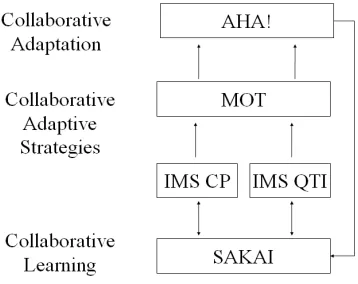
Figure 9 adapting elearning standards ... 52
Figure 10 Applying adaptive parameters on IMS QTI... 55
Figure 11 Defining Adaptation Parameters for IMS CP ... 56
Figure 12 Adaptation in Sakai... 58
Figure 13 UML course presented in AHA! integrated in Sakai ... 59
Figure 14 Smooth Transition from Student to Author in Social Elearning... 77
Figure 15 Social LAOS Framework... 79
Figure 16 Social LAOS Components... 85
Figure 17 MOT 2.0 architecture... 89
Figure 18 MOT 2.0 user activities ... 90
Figure 19 MOT 2.0: User model 2.0... 92
Figure 20 MOT 2.0: Adaptive reading... 93
Figure 21 MOT 2.0: Social and Web 2.0 annotation ... 94
Figure 22 MOT 2.0: Adaptive authoring ... 94
Figure 23 MOT 2.0: Authoring versus delivering... 95
Figure 24 MOT 2.0: Group based authoring ... 95
Figure 25 The Means ‘before’ (MOT 1.0) and ‘after’ (MOT 2.0) by the authors... 98
Figure 26 The Variance ‘before’ (MOT 1.0) and ‘after’ (MOT 2.0) by the authors ... 99
Figure 27 The Means ‘before’ (MOT 1.0) and ‘after’ (MOT 2.0) by the students ... 100
Figure 28 the Variance before (MOT 1.0) and after (MOT 2.0) by the students ... 100
Figure 29 Screenshot of learning environment of Group 1 ... 122
Figure 30 Screenshot of learning environment of Group 2 ... 122
Figure 31 Screenshot of learning environment of Group 3 ... 122
Figure 32 Scenario Steps... 123
Figure 33 The pre and posttests of all students, and their respective groups... 124
Figure 34 The overall answers to the subjective perception questionnaire ... 127
Figure 35 The Durations of Pretest, Posttest and Learning session (in minutes) ... 130
Figure 36 MOT 2.0 Adaptive ELearning 2.0... 140
Figure 37 Scenario Steps... 150
Figure 38 Screenshot of learning environment of Group 1 ... 151
Figure 39 Screenshot of learning environment of Group 2 ... 151
Figure 40 Posttest versus Pretest for Group 1 and Group 2... 153
-List of Tables
Table 1 Comparison between Adaptive ELearning Frameworks ... 29
Table 2 MOT 2.0 Prototypes... 88
Table 3 Paired T for pretest posttest... 124
Table 4 Paired T for pretest G1 posttest G1 ... 125
Table 5 Paired T for pretest G2 posttest G2 ... 125
Table 6 Paired T for pretest G3 posttest G3 ... 125
Table 7 OneSample T: Q1, Q2, Q3, Q4, Q5... 129
Table 8 OneSample T: Q1_G1, Q2_G1, Q3_G1, Q4_G1, Q5_G1, ... Q5_G3 ... 129
Table 9 Paired Ttest for pretest and posttest for two groups ... 154
Table 10 Paired Ttest for pretest and posttest for group 1 ... 154
Table 11 Paired Ttest for pretest and posttest for group 2 ... 155
Table 12 OneSample T: Q1, Q2, Q3, Q4, Q5... 157
-Acknowledgments
“Gratitude helps you to grow and expand; gratitude brings joy and laughter into your life
and into the lives of all those around you.”
Eileen Caddy (1917 – 2006)
First of all, I would like to express my gratitude to my PhD supervisor, Dr. Alexandra I. Cristea, for her invaluable feedback and continuous support throughout my research. Moreover, I acknowledge her financial support towards partially funding my research. This research would probably not exist without her maintenance scholarship.
I also acknowledge my PhD viva examiners, Dr. Jane Sinclair and Prof. Wolfgang Nejdl for their feedback and constructive criticism.
I would like to acknowledge all colleagues in the PROLEARN Network of Excellence, the EU ALS project and the FP7 GRAPPLE project. Furthermore, I would like to thank all the members of the Intelligent and Adaptive Systems Group for their feedback on my research. Particularly, I thank Maurice Hendrix, Jonny Foss, Joshua Scotton, Sarah Niukyun Lim Choi Keung and Jason Nurse.
Finally, I thank, from the bottom of my heart, my parents Pauel and Jamela, my brother Fadi and his family, my sister Rima and her family, my younger sister Lina, and Mira’s family. Also I thank numerous friends for their continuous support and care. Last but not least, to Mira for her passion and support.
Fawaz Ghali, Coventry
Declarations and List of Publications
“One can measure the importance of a scientific work by the number of earlier
publications rendered superfluous by it.”
David Hilbert
This thesis is presented in accordance with the regulations for the degree of Doctor of Philosophy. It has been composed by myself and has not been submitted in any previous application for any degree.
The work in this thesis has been undertaken by me under the supervision of Dr. Alexandra I. Cristea. Parts of this thesis were published previously on various publications.
To date, 14 peer-reviewed publications1have been published from this research:
1. Ghali, F.and Cristea, A. Interoperability between MOT and Learning Management Systems: Converting CAF to IMS QTI and IMS CP, AH 2008: 5th Int. Conf. on Adaptive Hypermedia and Adaptive Web-Based Systems. LNCS 5149. pp. 296–299. DOI 10.1007/978-3-540-70987-9_38, 2008. Hannover, Germany.
2. Ghali, F.and Cristea, A. Evaluation of Interoperability between MOT and regular Learning Management Systems. 3rd European Conference on Technology-Enhanced Learning EC-TEL. ISBN 978-3-540-87604-5, pp. 104-109. DOI 10.1007/978-3-540-87605-2_12. 2008. Maastricht, The Netherlands. 3. Ghali, F.and Cristea, A. Evaluation of Authoring for Adaptation and Delivery
1The full list of all peer-reviewed papers published by the author of this thesis can be retrieved
via Learning Management System. The 11th IASTED International Conference on Computers and Advanced Technology in Education, CATE 2008. ISBN 978-0-88986-767-3. pp. 614-126. 2008. Crete, Greece.
4. Ghali, F.Sharp, M. and Cristea, A. Folksonomies and Ontologies in Authoring of Adaptive Hypermedia. A3H: 6th International Workshop on Authoring of Adaptive and Adaptable Hypermedia Workshop, AH 2008. Hannover, Germany.
5. Ghali, F.Cristea, A. Stewart, C. and Hendrix, M. Collaborative Adaptation Authoring and Social Annotation in MOT, A3H: 6th International Workshop on Authoring of Adaptive and Adaptable Hypermedia Workshop, AH 2008. Hannover, Germany.
6. Gross, T.,Ghali, F.and Cristea, A. Communication and Collaboration Towards Problem Solving: Evaluation of PILS. 3rd European Conference on Technology Enhanced Learning EC-TEL 2008, IGACLE workshop. CEUR-WS.org/Vol-384. 2008 Maastricht, The Netherlands.
7. Ghali, F.Cristea, A. and Stewart, C. (2008). My Online Teacher 2.0. 3rd European Conference on Technology Enhanced Learning EC-TEL 2008, IGACLE workshop. CEUR-WS.org/Vol-384. 2008. Maastricht, The Netherlands.
8. Ghali, F.,Cristea, A. and Hendrix, M. Augmenting E-Learning Standards with Adaptation. The 11th IASTED International Conference on Computers and Advanced Technology in Education, CATE 2008. ISBN 978-0-88986-767-3. pp. 614-122. 2008. Crete, Greece.Nominated for Best Paper Award.
9. Ghali, F.and Cristea, A. Authoring for E-Learning 2.0: a Case Study. The 9th IEEE International Conference on Advanced Learning Technologies, ICALT 2009. ISBN: 978-0-7695-3711-5. pp. 170-174. DOI 10.1109/ICALT.2009.71. 2009, Riga, Latvia.
Education - Building Learning Systems that Care: From Knowledge Representation to Affective Modelling, ISBN 978-1-60750-028-5, pp 333 - 340, DOI: 10.3233/978-1-60750-028-5-333.
11. Ghali, F. and Cristea, A. Social Reference Model for Adaptive Web Learning. International Conference on Web-based Learning, ICWL 2009. ISBN: 978-3-642-03425-1. pp. 162-171. DOI: 10.1007/978-3-642-03426-8_21. 2009, Aachen, Germany.
12. Ghali, F. and Cristea, A. MOT 2.0: Learning 2.0 Tool. In the 4th. European Conference on Technology Enhanced Learning, EC-TEL 2009, 2009. Nice, France.
13. Cristea, A. Ghali, F. and Joy, M. Social, Personalized Lifelong Learning. E-Infrastructures and Technologies for Lifelong Learning, book chapter. IGI Global. ISBN-13: 9781615209835. 2010.
Abstract
This thesis discusses the topic of how to improve adaptive and personalized e-learning in order to provide novel learning experiences. A recent literature review revealed that adaptive and personalized e-learning systems are not widely used. There is a lack of interoperability between adaptive systems and learning management systems, in addition to limited collaborative and social features.
First of all, this thesis investigates the interoperability issue via two case studies. The first case study focuses on how to achieve interoperability between adaptive systems and learning management systems using e-learning standards and the second case study focuses on how to augment e-learning standards with adaptive features. Secondly, this thesis proposes a new social framework for personalized e-learning, in order to provide adaptive and personalized e-learning platforms with new social features. This is not just about creating learning content, but also about developing new ways of learning. For instance, in the presented vision, adaptive learning does not refer to individuals only, but also to groups. Furthermore, the boundaries between authors and learners become less distinct in the Web 2.0 context.
List of Abbreviations and Definitions
AEH Adaptive Educational Hypermedia AH Adaptive Hypermedia
AHA! Adaptive Hypermedia for All!: An Adaptive Hypermedia System
AHAM Adaptive Hypermedia Application Model: A framework for Adaptive Hypermedia
AHS Adaptive Hypermedia Systems ALE Adaptive Learning Environment API Application Programming Interface AM Adaptation Model
CAF Common Adaptation Format DM Domain Model
GAHM Goldsmiths Adaptive Hypermedia Model GM Goal and Constraints Model
IEEE Institute of Electrical and Electronics Engineers IMS CP IMS Content Packaging
IMS QTI IMS Question and Test Interoperability
LAG 1.0 Layers of Adaptation Granularity: A framework for Adaptation LAG 2.0 Layers of Adaptation Granularity: An Adaptation language
LAOS Layered WWW AH Authoring Model and their corresponding Algebraic Operators: A framework for authoring of Adaptive Hypermedia
LMS Learning Management Systems LOM IEEE Learning Object Metadata
MOT 1.0 My Online Teacher: An Adaptive Hypermedia Authoring System
MOT 2.0 My Online Teacher 2.0: An Adaptive Hypermedia Social Authoring and Delivery System.
PM Presentation Model
SCORM Sharable Content Object Reference Model
corresponding Algebraic Operators: A framework for authoring of Adaptive Hypermedia
UM User/learner Model
W3C World Wide Web Consortium
XAHM XML-based Adaptive Hypermedia Model XHTML Extensible Hypertext Mark-up Language XML Extensible Mark-up Language
CHAPTER 1
“Research is to see what everybody else has seen and to think what nobody else has
thought”
Albert Szent-Gyorgyi (1893-1986)
1. Introduction
1.1.
Overview
Over the past decade, the web has constantly evolved in fundamental and innovative ways. The static presentation of information, or the ‘one size fits all’, was the case of the early web, where the content of a page would appear almost in the same way to all users, regardless of their backgrounds, interests, preferences or even their knowledge.
Conversely, personalization has been an important trend for almost 40 years now, if we speak ofuser modelling (Rich, 1979), almost 30 years if we refer tointelligent tutoring systems (Sleeman and Brown, 1982), and almost 20 years since adaptive web systems
arrived (Brusilovsky, 1996b). In these systems, the content (and the navigation) can be adapted according to the user’s interests, preferences or even their knowledge, to what is called the user model.
In the area of e-learning, the e-learning systems (particularly, Learning Management Systems (LMS)) offer flexible learning environments for the learners (individuals and/or groups) by extending time and place coordinates. However, issues regarding adapting and personalizing the learning environments have been raised. Learners have different learning preferences, knowledge levels, interests, and personalizing the learning environment can offer an enhanced learning experience compared to the traditional ‘one size fits all’ case.
This introductory chapter illustrates the general research outline of the work presented in this thesis, which overall belongs to the area ofsocial personalized e-learning. Section 1.2 provides the motivation of this research and the problem description. Section 1.3 describes the research questions of this thesis. Section 1.4 presents the research aim and objectives of this thesis. Section 1.5 describes the research contribution of this thesis. Finally, Section 1.6 provides an outline of this thesis.
1.2.
Motivation and Problem Description
Adaptive Educational Hypermedia Systems (AEHS) offer a personalized learning experience for each learner (Brusilovsky, 1996b). These systems can achieve learning objectives that are difficult to pursue using classical learning methods. Imagine the situation where a teacher needs to repeat the same lesson for each individual learner to fulfil his/her needs. For example, how can this teacher show/hide information for a specific learner? How can the same lesson be presented differently for each learner? This becomes, however, achievable, by using adaptive e-learning systems.
authored (Cristea et al., 2007). This problem becomes even more complex when the author needs to use the authored content in different adaptive e-learning systems. In such a scenario, how can the author determine which adaptive e-learning system to use? How can the author reuse the same content with different adaptive e-learning systems?
One solution to solve the previous limitations is to use the interoperability between e-learning systems (particularly, LMS). The interoperability works as a bridge between different systems, so that the same learning content can be reproduced, to be used in another system.
Another solution to overcome the difficulties of personalized e-learning authoring is to use the strengths of the Web 2.0, which are: 1) user-generated content; 2) harnessing the power of the users by collaborative authoring and social annotations techniques; 3) generating richer authored materials based on communities of practice (Wenger, 1998). Authors who belong to the same community can cooperate in providing more valuable e-learning content within the community, based on their different backgrounds and knowledge.
Another key issue in adaptive and personalized e-learning systems is that collaborative and social activities are not supported. They are however one of the key factors in e-learning environments. Therefore, these systems would not be able to compete with Learning Management Systems. Furthermore, novel e-learning systems have been benefiting from the strength of Web 2.0 (Anderson, 2007), coining the new term e-learning 2.0(Downes, 2005). E-learning 2.0 is a term that refers to the second generation of e-learning, which uses the technologies of the Web 2.0, such ascollaborative authoring
activities would improve adaptive and personalized e-learning, in addition to providing novel learning experiences. In the following section, the main research questions, resulted from the problem described in the current section, are extracted.
1.3.
Research Questions
The abovementioned state reveals a major drawback in the design of adaptive and personalized e-learning systems. Despite the advantages of these systems, they are not yet ready for the current state of the Web 2.0. Therefore, this thesis works on investigating the following questions in order to provide solutions for adaptive and personalized e-learning:
Research Question 1: How can we bridge the gap between Learning Management Systems (LMS) and adaptive e-learning systems?
This question can be further divided into two research sub-questions, which are:
Research Question 1a:How can we provide interoperability between adaptive e-learning systems and Learning Management Systems (LMS)?
Research Question 1b: How can we augment e-learning standards with adaptation in order to provide novel learning experiences?
Research Question 2: How can we harness the Web 2.0 power and its characteristics (i.e., tagging, voting, commenting, and user-generated content) to improve adaptive and
personalized e-learning?
This question can also be further divided into three research sub-questions, which are:
Research Question 2a:Can the current adaptive e-learning frameworks benefit from the strengths of the Web 2.0?
Research Question 2b: Are collaborative authoring and social annotations useful for authors and learners?
Research Question 2c: Can learning content recommendations and the expert peer recommendations of the learners enhance learning?
1.4.
Research Aim and Objectives
The overall aim of this research is to improve adaptive and personalized e-learning in order to provide novel learning experiences. This aim is achievable by overcoming the limitations of these systems. The limitations covered in this thesis consist of: lack of interoperability between adaptive and personalized e-learning and LMS, in addition to limited collaborative and social features in adaptive e-learning systems.
The goal of this research is reachable via the use of e-learning standards in order to connect adaptive and personalized e-learning to LMS on one hand, and to enrich adaptive and personalized e-learning with the Web 2.0 features on the other. Hence the primary objectives of this research are:
1. Analysing the state of the art of the next generation of e-learning systems. 2. Finding the problems which are limiting the use of adaptive and personalized
e-learning systems by studying the interoperability issue between these systems. 3. Comparing current adaptive frameworks and investigating the limitations of
these frameworks.
4. Designing a new framework for social personalized e-learning.
5. Developing and implementing a new prototype based on the proposed framework.
6. Testing and evaluating the implemented prototype in various versions with various features in order to draw useful conclusions.
In the following section, the main contributions of this thesis are summarized.
1.5.
Thesis Contributions
This thesis presents:
were developed and evaluated that facilitate the connections between adaptive systems and Learning Management Systems.
2) A new social personalized framework for e-learning: This new framework is designed to overcome the limitations of the current adaptive and personalized e-learning systems. This is achieved by using the benefits of e-e-learning standards to tackle the interoperability issue, in addition to using the strength of the Web 2.0 to overcome the limited collaborative and social features of the current adaptive and personalized e-learning systems. The new social personalized framework for e-learning is named SLAOS, and the new prototype is named MOT 2.0.
3) Building a new system, MOT 2.0, that corresponds to the social personalized framework for e-learning, SLAOS. Moreover, this system has been built in three iterations, each presented and followed by a case study, towards building the combination of features that illustrates the SLAOS framework.
The various collaborative and social features that have been introduced in this thesis are illustrated via a number of case studies, which include pre-design, prototypes and evaluations. The results of the evaluations are further discussed in detail, and interesting findings about collaboration of both authors and learners, are highlighted.
1.6.
Thesis Outline
Chapter 3 provides a case study of the interoperability between MOT 1.0 and Learning Management Systems. It also describes the conversion from CAF to IMS QTI and IMS CP, in addition to explaining the utilization of JAXB. Chapter 4 presents a case study of augmenting e-learning standards with adaptation. The case study adapts the IMS QTI and IMS CP standards using the authoring tool MOT 1.0, followed by a scenario and discussion on how to use the adapted learning content in the delivery system AHA!.
Chapter 5 provides a pre-design case study of MOT 2.0. It first describes MOT 1.0 with its restricted collaborative features, and then proposes a method for extending the collaboration features in MOT 1.0. Chapter 6 presents a social reference framework for personalized adaptive e-learning, SLAOS. It explains the state of the art of Web 2.0, personalization and adaptation. Also, this chapter presents the first prototype of MOT 2.0.
Chapter 7 presents the second prototype of the MOT 2.0 system. It describes the features of the second prototype, as well as the tested hypotheses, the case study, followed by discussing the results and summarizing the work. Chapter 8 presents the third MOT 2.0 prototype. It describes the features of this third prototype, as well as the tested hypotheses, the case study, followed by a discussion of the results and summarizing the work. Chapter 9 summarizes the research work in this thesis, in addition to discussing its limitations, as well as the future directions. This chapter also describes the degree to which the research aims and objectives of this thesis were reached, in addition to providing answers to the research questions targeted in this thesis.
e-CHAPTER 2
“Keep on the lookout for novel ideas that others have used successfully. Your idea has to
be original only in its adaptation to the problem you're working on.”
Thomas Edison (1847-1931)
2. Research Background
This chapter provides a background to research in the adaptive and personalized e-learning area. It investigates its advantages as well as its current limitations that have caused it to not be as widely used as expected. Moreover, the chapter explores the architectures of adaptive e-learning frameworks, as well as explaining some of the popular adaptive e-learning systems. Moreover, the chapter also describes the concepts of Web 2.0, e-learning 2.0, and Learning Management Systems. The chapter lists (relevant) related EU research projects, draws conclusions on the main limitations in adaptive e-learning systems, and describes how to overcome these limitations.
2.1. Learning Management Systems
Learning Management Systems are e-learning applications that can be used to facilitate the access to learning content, as well as collaborations between teachers and learners (Hauger and Köck, 2007). Learning Management Systems are powerful e-learning systems that support the needs of teachers and learners. Teachers can use LMS to create e-learning courses, online assessments, quizzes, or even to communicate with learners via collaborative tools such as chat, discussion forums or bulletins. Moreover, Learning Management Systems have scheduling tools, such as calendars and timetables.
Sakai: Sakai is a Java-based, service oriented application that is designed to be adaptable, scalable, reliable and interoperable. Forcoursework and assignments, Sakai provides tools to enhance teaching and learning. For collaboration and team working, Sakai has the functionality to support communication between students and teachers, and organize collaborative work.
Moodle: Moodle stands for “Modular Object-Oriented Dynamic Learning Environment”, and it is an open source LMS. Moodle facilitates course management using the following modules: Assignment Module, Chat module, Choice Module, Forum Module, Glossary Module, Lesson Module, Quiz Module, Resource, Survey Module, Wiki Module and Workshop Module.
Blackboard: Blackboard is a commercial Learning Management System that is developed by Blackboard Inc. Blackboard’s features include course management, a customizable portfolio, and a scalable architecture that facilitates integration with student information systems and authentication protocols. Blackboard also includes Communication Announcements, Discussions, Mail, Course content, Calendar, Learning modules, Assignments, Grade Book and Media Library. Learning Management Systems are further discussed in detail in Chapter 3 and Chapter 4.
2.2. Web 2.0 and E-learning 2.0
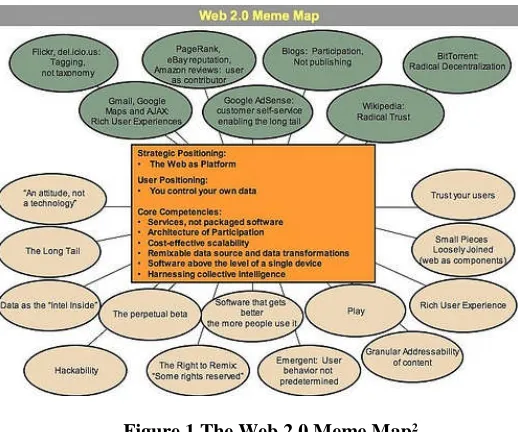
Web 2.0 is still a controversial term which encompasses a large number of concepts and technologies, each of which has to some extent been applied in an educational context. Whilst a detailed discussion of all of these is beyond the scope of this chapter, the reader should view our research into personalization as one aspect of educational Web 2.0 which inevitably overlaps with other pedagogic research. Figure 1 shows the main functionalities and ideas that are related to the Web 2.0. Web 2.0 sites, such as YouTube, Flickr and Del.icio.us, use content tagging, rating and feedback to facilitate interactions between the users. Some of these web sites interact with each other to provide Mashups, which are web applications that use combined data from two or more sources to create new services (see also Chapter 6).
Figure 1 The Web 2.0 Meme Map2
E-learning 2.0 (Downes, 2005) is a term that refers to the second generation of e-learning, which uses the technologies of the Web 2.0, such as collaborative authoring and social annotation (Ghali and Cristea, 2009a) (see Chapter 5 and Chapter 6). In e-learning 2.0, learners and teachers are all involved in the content creation process, and thus the strict delimitations between learners and teachers disappear. Moreover, the learners in learning 2.0 become active as they interact socially with each other. The Web 2.0 and e-learning 2.0 are further discussed in detail in Chapter 5.
2.3. Adaptive E-Learning Research Background
The aim of adaptive e-learning systems is to overcome some specific limitations of traditional e-learning systems. These systems can achieve learning objectives that are difficult to achieve using classical e-learning systems, as follows. In e-learning systems, all learners are offered the same learning content, regardless of their knowledge. The knowledge of different learners can vary and can grow in different ways (Brusilovsky, 1996b). For example, a course can be unclear for a beginner learner and at the same time it can be trivial for an advanced learner.
Brusilovsky (Brusilovsky, 2004) classified the work on this research area into three generations. The first generation belongs to the early 1990s, where a number of research groups worked on the problem related to navigation in hypermedia, and other research groups worked on problems related to the presentation. In this generation, a number of Adaptive Educational Hypermedia Systems (AEHS) were launched in the period between 1990 and 1996. These systems can be categorised in two streams. The first stream focused on extending classical learner modelling and adaptation developed in this field to intelligent tutoring systems with hypermedia components. The second stream focused on educational hypermedia, in an effort to make educational hypermedia systems adapt to individual learners.
The third generation was characterized by the challenge of integrating Adaptive Hypermedia (AH) into the regular educational process. Despite the fact that the systems of the second generation of Adaptive Educational Hypermedia (AEH) research established various methods to integrate Adaptive Hypermedia into e-learning, they failed to influence practical e-learning, mainly because of their lack of ability to answer the needs of practical e-learning (Brusilovsky, 2004). Learning Management Systems are e-learning applications that can be used to facilitate access to learning content, as well as collaborations between teachers and learners (Hauger and Köck, 2007). Furthermore, LMS are powerful e-learning systems that support the needs of teachers and learners. Teachers can use LMS to create e-learning courses, online assessments, quizzes, or even to communicate with learners via collaborative tools such as chat, discussion forums or bulletins. Moreover, LMS have scheduling tools, such as calendars, timetables, etc.
Another key issue preventing adaptive e-learning from becoming popular, is that authoring adaptive lessons is normally a great deal more complex than their non-adaptive counterparts, requiring more time and expertise (Cristea et al., 2007). This problem becomes even more complex when the author needs to use the authored content in different adaptive e-learning systems. One solution to the previous limitations is to enhance the interoperability between e-learning systems (particularly, LMS). Interoperability can work as a bridge between different systems, so that the same learning content can be reproduced to be used in different system.
A further issue in adaptive and personalized e-learning systems is that collaborative and social activities are often not supported; therefore, these systems would not be able to compete with popular Learning Management Systems, in which such activities are considered a key factor. Moreover, the e-learning systems have benefited from the strength of the Web 2.0 (Anderson, 2007), to form the new term, “e-learning 2.0” (Downes, 2005). E-learning 2.0 is a term that refers to the second generation of e-learning, employing the technologies of the Web 2.0, such as collaborative authoring and social annotation (Ghali and Cristea, 2009a) (see Chapter 5 and Chapter 6). In e-learning 2.0, learners and teachers are all involved in the content creation process, and thus the strict delimitations between learners and teachers disappear. Hence, the learners in e-learning 2.0 become active, as they interact socially with each other.
Nevertheless, the most popular Learning Management Systems have not yet employed the advantages offered by adaptation, possibly because the expected profit does not yet justify the high effort of implementing and authoring adaptive courses (Hauger and Köck, 2007). However, the majority of adaptive e-learning systems do not support e-learning standards (Paramythis and Loidl-Reisinger, 2004). According to Brusilovsky (Brusilovsky, 2004) the generation that is coming to replace Learning Management Systems will be based on system interoperability and reusability of content to be supported by a number of emerging standards. Hence, the interoperability and reusability of learning contents can be seen as a solution to bridge the gap between adaptive e-learning and Learning Management Systems.
2.4. Adaptive E-Learning Frameworks
Previous research into personalization for the web belongs to the larger category of Adaptive Hypermedia research – the web being an instance of hypermedia, where nodes are pages and links are hyperlinks, and personalization in this context means user-based adaptation. In this section we examine the most important frameworks for personalization on the web, in order to consider the different aspects of adaptation and personalization on the one hand, and on the other, to select a platform on which to base social extensions.
Many adaptive (educational) hypermedia systems have been launched since the early 1990s; however, until the late 1990s, there was no structural design or standard model for learning Adaptive Hypermedia Systems (AHS). One of the first models designed was the Adaptive Hypermedia Application Model (AHAM) (De Bra et al., 1999), followed by the Web Modelling Language (WebML) (Ceri et al., 2000), the Goldsmiths Adaptive Hypermedia Model (GAHM) (Ohene-Djan, 2000), the Munich reference model (Koch and Wirsing, 2001), the XML Adaptive Hypermedia Model (XAHM) (Cannataro and Pugliese, 2002), the LAOS framework (Cristea and de Mooij, 2003c), and the Generic Adaptation Model (GAM) (de Vrieze et al., 2004), among the most well-known ones.
2.4.1. The Adaptive Hypermedia Application Model
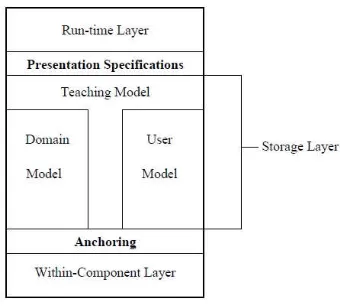
AHAM (De Bra et al., 1999) is based on the Dexter model (Halasz and Schwartz, 1994), a reference model for hypertext systems. AHAM divides adaptive (educational) hypermedia systems into three layers: therun-time layer, thestorage layerand thewithin-component layer, connected by theinterfaces presentation specificationsandanchoring. The focus of AHAM is the storage layer with its three sub-models (see Figure 2):
1. thedomain model, consisting of a set of concepts and concept relationships; 2. the user model, containing concepts with attributes, used to store user
preferences or knowledge-of or interest-in domain model concepts; and
Figure 2 The AHAM Model (De Bra et al., 1999)
The main advantages of AHAM are that it is a relatively simple model, which allows for separation of concerns. The separation into layers helps to define the main components that need to be created by an author. However, AHAM does not make full use of other potential advantages of the separation into layers: for instance, reusability is not supported.
In principle, having separate layers would allow for one domain model to be used in different adaptation or user models. However, this is not possible in AHAM, due to the fact that the adaptation rules apply to concrete domain model concepts, and cannot be re-applied to others. Moreover, reusability would mean that authors could be assigned different roles on each layer, and this would speed up the development process by enabling developers to work in parallel on the different layers – which is not possible in AHAM due to the interdependencies between the layers.
For this reason, after analysing it, AHAM was not chosen as the basis for our new framework for the development. An example system based on AHAM is AHA! (De Bra and Ruiter, 2001) proposed by Eindhoven University of Technology.
2.4.2.
The Munich Reference Model
It is very similar to AHAM, but its main differences are (Koch and Wirsing, 2001) that it: 1. uses an object-oriented software engineering approach, whereas AHAM uses a
database approach;
2. uses the Unified Modelling Language (UML) specification (AHAM uses an adaptation rule language); and
3. includes the AHAM adaptive engine in the adaptation model, as data and functionality are integrated in the object-oriented method.
The main advantage of the Munich Reference Model is that both (1) and (2) ensure a more widespread approach, in the sense that software engineering and UML are well understood outside the personalization and adaptation communities. On the other hand, the Munich Reference model shares both the other advantages and disadvantages of the AHAM model. For example, just like the AHAM model, the Munich model represents prerequisites in the domain model, and bases its domain structure on pages, adding information about how the content will be presented to the final user directly in the domain model. This makes reuse of any of the layers almost impossible, as they are heavily interconnected. Therefore, after analysing it, this model was also dropped.
2.4.3. WebML
WebML (Ceri et al., 2000) is also a visual language like UML, but is specifically designed for describing the content structure of web applications. The specification of a web site in WebML has four orthogonal perspectives.
1. The structural modeldescribes the content in terms of the relevant entities and relationships.
2. Thehypertext modeldescribes how the contents are published on the application hypertext (Ceri et al., 2000).
3. Thepresentation modeldescribes the layout and graphic appearance of pages. 4. Thepersonalization modeldescribes users and their organization in groups in the
The main advantages of WebML as reported in (Wright and Dietrich, 2008) are platform independence, the inclusion of a CASE tool, and messaging capabilities (allowing the WebML model to access query parameters directly). However WebML lacks browser control, lifecycles, UI modelling, standards and meta-models.
However, the main disadvantage is the fact that group interaction is not representable (recommendation of one user to another, for instance). Also, the high-level definition of content and structure is closely related both to a given XML DTD (XML Document Type Definitions)3syntax, which makes it less flexible, and to low-level, presentation-driven
aspects (such as scroll), despite the fact that WebML includes a separate presentation model. An example of a WebML model-based system is WebRatio (Acerbis et al., 2004), which allows modelling and automatic generation of Java web applications. Due to the issues listed above, however, WebML was not chosen for our framework.
2.4.4. The XML Adaptive Hypermedia Model
The XML Adaptive Hypermedia Model (XAHM) (Cannataro and Pugliese, 2002) is an XML-based model for Adaptive Hypermedia (AH) systems with anapplication domain, a
user and an adaptation model. Here however the similarity with previous models ends. XAHM not only describes the different sub-models from a theoretical point of view, but it also dictates the composition of the instances of these models, e.g. the fact that presentation descriptions need to be in XML, fixed by a DTD.
Moreover, XAHM is highly reliant on mathematical models, graph theory and probability computations. The user model contains, in addition to data on the current profile, probability distribution functions that map a user over a number of profiles. Moreover, adaptation is represented as a function defined on a three-dimensional input-output space: theuser’s behaviour, thetechnologyandthe external environment. Finally, the application
domain is composed of a graph-based layered model for describing the logical structure of the hypermedia and XML-based models for describing the metadata for basic information fragments, as well as elementary abstract concepts connected via weighted, dynamically computed links for navigation between elements.
The main advantage of XAHM is that it is the first attempt to create elegant mathematical modelling of the adaptation process; another advantage is that of allowing the adaptation in three dimensions (Cannataro and Pugliese, 2002): the behaviour of the user (i.e., preferences and activity history); the technology dimension (operating system, internet connection, access device, etc.); and the external environment (weather, time-zone, geographical location, etc.), which are not sufficiently treated and separated in previous models.
However, the main disadvantage is that it hides adaptation and personalization, partially in the user model (via probability density computations), partially in the application domain model (where weights are probabilistically computed between navigational elements), and finally, in the adaptation model. This distribution of adaptation is hard to follow, and tools based on it can be difficult to handle by teachers, for instance. An example of a tool based on XAHM is the Java Adaptive Hypermedia Suite (JAHS) (Cannataro and Pugliese, 2002). Due to the above issues, however, XAHM was not chosen for our framework.
2.4.5. LAOS
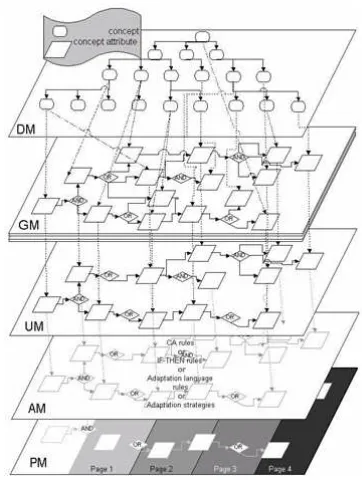
The LAOS framework (Cristea and de Mooij, 2003c) is a general framework for authoring Adaptive Hypermedia (see Figure 3), loosely based on the AHAM model, also presenting however some features of the WebML language, with which it shares the presentation model. It consists of aDomain Model(DM), aGoal and Constraints Model(GM), aUser Model(UM), anAdaptation Model(AM) and aPresentation Model(PM).
teacher, in educational environments, hence pedagogic information, or business logics for commercial sites), something that was missing in previous models (Cristea and de Mooij, 2003c).
Figure 3 The LAOS Model (Cristea and de Mooij, 2003c)
Furthermore, LAOS’s AM is different from that of AHAM. The adaptation model is based on the three layer LAG model (Cristea and Verschoor, 2004) for authoring adaptation, which allows different entry and reuse levels for adaptation specification, depending on whether the author has programming skills or not. Thus, the initial threshold for creating adaptation can be lowered.
Another important difference is given by the notion of ‘concept’ used in the domain model. In LAOS, concepts have different representations defined via attributes, and are restricted to representing a semantic unity (unlike in AHAM). This is further enforced by allowing only self-contained attributes (without direct or indirect dependencies). This setting allows attributes to be flexibly re-ordered, and links are therefore external and can be dynamic. Unlike some of the other models, such as XAHM or WebML, LAOS does not prescribe a unique representation for each layer, but just specifies its contents. Thus, each layer could be represented by databases, XML, state machines, etc.
Moreover, the adaptation model, LAG, only specifies the different entry levels for reuse (whole strategy, high level adaptation language patterns, or low level adaptation ‘assembly’ language patterns such as if-then rules) but does not enforce a specific language. Due to these advantages, LAOS was used as the base framework for the research presented in this thesis.
2.4.6. Summary of Adaptive E-Learning Frameworks
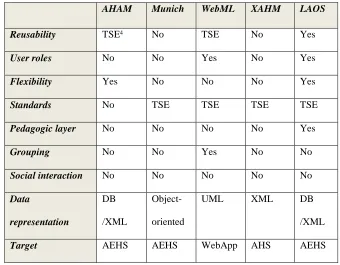
At present, there is no standardised way to do this comparison, as there are no standards for frameworks comparison. Thus, a number of features have been selected:
Reusability: If the authored learning content is reusable, or parts of the authored courses can be reused by the original author, as well as by other authors.
User roles: If the model clearly supports different roles, such as teachers and learners, or different types of authors.
Flexibility: If the model has a specific format of the content, and how flexible the format is, in order to be recombined.
Standards: If the model supports standards, which allow importing and exporting of courses.
Pedagogical layer: The pedagogical layer should contain adaptation rules separated from the learning content, for easy reuse of pedagogical approach.
different groups with different roles.
Social interaction:If the model supports social activities such as tagging, rating and providing feedback.
Data representation: Defining the model data format that is used to represent the data.
[image:36.595.140.480.279.544.2] Target area:Defining the area that the model can be used in. Generally, the area is adaptive e-learning. However, for example, the WebML model is targeted at general web applications.
Table 1 Comparison between Adaptive E-Learning Frameworks
AHAM Munich WebML XAHM LAOS
Reusability TSE4 No TSE No Yes
User roles No No Yes No Yes
Flexibility Yes No No No Yes
Standards No TSE TSE TSE TSE
Pedagogic layer No No No No Yes
Grouping No No Yes No No
Social interaction No No No No No
Data
representation
DB /XML
Object-oriented
UML XML DB /XML
Target AEHS AEHS WebApp AHS AEHS
2.5. Current Adaptive E-Learning Systems
This section gives an overview of some popular adaptive e-learning and authoring systems. The presented systems are InterBook (Brusilovsky et al., 1998), AHA! (De Bra and Calvi, 1998), KBS Hyperbook (Nejdl and Wolpers, 1999) and MOT 1.0 (Cristea and de Mooij, 2003a).
2.5.1. InterBook
InterBook (Brusilovsky et al., 1998) is one of the first adaptive systems for authoring and delivering adaptive electronic textbooks on the Web. It uses two types of knowledge, knowledge about the course being taught, and knowledge about learners. The domain model presents the structure of an adaptive electronic textbook. The domain model provides a structure for representation of the learner’s knowledge. For each domain model concept, an individual learner’s knowledge model stores some value which is an estimation of the student knowledge level of this concept.
All learners’ actions (page access, problem-solving, answering questions) are stored and used to update knowledge levels for the related concepts. Another component of the student model is the model of student's learning goals. In addition, each learner may have a learning goal. A learning goal is a set of concepts to be learned. According to Brusilovsky (Brusilovsky et al., 1998):
“A sequence of assigned learned goals forms an individual order of learning.
Adaptive guidance mechanisms will ensure that the student achieves the first
learning goal in a sequence, then the second one, and so forth.”
InterBook uses coloured bullets and changed font styles (different font size, bold fonts) to achieve adaptive navigation support via link annotation. In addition to links annotation InterBook provides direct help about the recommended next page the learner should access. Moreover, InterBook also uses navigation support.
2.5.2. KBS Hyperbook
the course was integrated with pages from the Sun Java Tutorial into a hyperbook. According to Henze and Nejdl (Henze and Nejdl, 1999):
“the adaptation techniques used for this course are based on a goal-driven
approach. This allows students to choose their own learning goals and to get
suggestions for suitable projects and information units covering the knowledge
required to reach these learning goals.”
The learning content (domain model) of the hyperbook consists ofsemantic information unitsandproject units. Both of these refer to the real content to be displayed on the Web as pages of the hyperbook (Nejdl and Wolpers, 1999):
SemanticInformationUnits: refers to information units about Java Objects. They are indexed by KnowledgeItems, which gives for each knowledge item one main information unit.
ProjectUnits represent project descriptions, and are indexed by those knowledge items which the student needs to know in order to successfully work on these projects.
The learner model in the KBS Hyperbook system is based on a pedagogical component. This pedagogical component consists of the knowledge items and adds a partial sequence between these knowledge items, to describe learning dependencies. The KBS Hyperbook system uses the Bayesian network for modelling the learner's knowledge (Henze and Nejdl, 1998).
2.5.3. AHA!
The AHA! system (De Bra and Calvi, 1998) was developed at the Eindhoven University of Technology. AHA! stands for “Adaptive Hypermedia Architecture”, and provides
adaptive presentation and adaptive navigation support. The architecture of AHA! is presented in Figure 4. The AHA! system uses Java servlets that interact with a combined
condition on the user model can be used to make a decision of including or excluding a fragment. Whereas the adaptive navigation support in AHA! consists of the following parts:
The link anchor tag can have a class (style sheet deterring the colour) attribute based on the user model.
An arbitrary set of icons can be displayed before or after the link anchor, based also on the user model.
The link destination represents the name of a concept from the domain model.
Figure 4 AHA! architecture (Stash and De Bra, 2004)
2.5.4. My Online Teacher (MOT 1.0)
My Online Teacher (MOT 1.0) is an authoring system for Adaptive Hypermedia and adaptive e-learning systems based on the LAOS framework for authoring of Adaptive Hypermedia (Cristea and de Mooij, 2003a), which it maps onto three levels for authoring:
1. Content level: a hierarchy of domain concepts, with a number of domain attributes; this level also allows for other relatedness relations between concepts. 2. Lesson selection level: also called goal map; filtering and ordering contents at
attribute level or above.
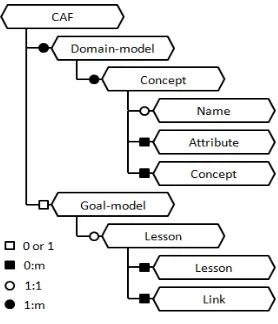
The Common Adaptation Format (CAF) (Cristea et al., 2007) reflects part of the actual course structure as in the MOT 1.0 database. However, it uses XML representation, which is more suitable for web conversions. CAF instantiates a representation (Cristea et al., 2007) for two of the static modules of the AEH description (1) and (2) from above: domain and lesson maps – or goal maps). Figure 5 illustrates the structure of the CAF XML; x:y defines the range of objects, i.e., the number of objects are between x and y; m stands for many; thus, each CAF file can have one or more domain models, but only one (or no) goal model; each concept in a domain model has only one name.
Figure 5 the Common Adaptation Format (CAF)
The Document Type Definition (DTD) of the CAF XML is shown below:
<?xml version="1.0" encoding="UTF-8"?>
<!ELEMENT CAF (domainmodel+, goalmodel?)>
<!ELEMENT domainmodel (concept+)>
<!ELEMENT concept (name, attribute*, concept*)>
<!ELEMENT attribute (name, contents)>
<!ELEMENT name (#PCDATA)>
<!ELEMENT contents (#PCDATA)>
<!ATTLIST link weight CDATA "" label CDATA "">
<!ELEMENT goalmodel (lesson)>
<!ELEMENT lesson (link*, lesson*)>
Thus, a CAF XML file has:
content). An attribute has a name (representing the name of its type), and a content. A concept may have sub-concept(s) that represent associations to other concepts. The creation of the Domain Model, in the context of Adaptive Hypermedia, refers to content organization (Wu, 2002).
2. Goal model: The goal model represents the actual lesson, which may have a set of sub-lesson(s). Each lesson contains a set of link(s). Importantly, each link points to an attribute in the domain model(s), thus reordering the information contained in the initial model(s). Each link has two attributes: weight and label, which are used to determine the adaptation requirements via adaptation strategies (e.g., show links labelled ‘beginner’ to beginner users, and links labelled ‘advanced’ to advanced users).
2.6. Related Research Projects
The research work of this thesis is directly related to three research projects in the area of adaptive and personalized e-learning. This section describes these projects in chronological order.
2.6.1. ProLearn Project
The EU FP6 PROLEARN network of Excellence5 took place between 2005 and 2009. The project aimed at achieving a better focus on questions of European importance and a better integration of research efforts. Therefore, PROLEARN improved collaboration between various actors of academia and industry in the area of technology enhanced learning. The project mission was to support international collaboration and consequently shape a new understanding of an open network within the research community.
The research of this thesis and the work of PROLEARN have in common the aim of improving adaptive and personalized e-learning. Prolearn went beyond that, targeting
learning in general. In addition, the research of this thesis enhances adaptive and personalized e-learning platforms with new social aspects. See also Chapter 6.
This thesis’s contribution to the Prolearn project was to provide a solution for the interoperability issue between different e-learning systems, and the research presented in this thesis gained valuable benefits from the network of excellence, including: online discussions, evaluations, and presenting at worldwide conferences.
2.6.2. Adaptive Learning Space Project
The EU Socrates Minerva project Adaptive Learning Spaces (ALS)6took place between 2006 and 2009. The project aimed at providing technological approaches to overcome the lack of face-to-face contact between tutors and learners and amongst learners themselves. The ALS worked towards the following goals:
1. Increasing the range of guidance and support that adaptive and personalized e-learning systems provide to learners and tutors.
2. Providing novel means to support the social cohesion of groups of learners, as well as the engagement of their members in collaborative / team tasks and processes.
This aim of the project was achieved by developing, field-testing and making openly available a software infrastructure that builds upon and goes beyond the state-of-the-art in the fields of e-learning and Adaptive Hypermedia Systems (AHS), to support the creation of active, personalized learning spaces, that will have a clear focus on learning activities, treating learners as active members of, and contributors to, their learning environments, rather than as passive recipients of their contents.
The research of this thesis contributed directly to the ALS project. The first goal of the ALS Project is covered in Chapter 3 and Chapter4. The Chapter 3 provides a case study on the interoperability between Adaptive Hypermedia authoring tool, MOT 1.0, and the Learning Management System (LMS), Sakai. The Chapter 4 provides a case study on augmenting e-learning standards with adaptation.
The rest of the chapters of this thesis present work on the second goal of the ALS project, by proposing a new social framework for personalized e-learning, in order to provide adaptive and personalized e-learning platforms with new social aspects. This is not just about creating learning content, but also about developing new ways of learning. For instance, adaptive learning does not refer to individuals only, but also to groups. Furthermore, the boundaries between authors and learners become less distinct in the Web 2.0 context. Finally, a new social personalized prototype is introduced, based on the new social framework for personalized e-learning, in order to test this framework. The implementation and evaluation of the new system were carried through a number of case studies.
2.6.3. GRAPPLE Project
The GRAPPLE7project is an EU FP7 STREP. GRAPPLE is an abbreviation of "Generic Responsive Adaptive Personalized Learning Environment". The GRAPPLE project aims at delivering to learners a technology-enhanced learning system that helps them through a lifelong learning experience, automatically adapting to their preferences, knowledge, skills and learning goals.
GRAPPLE includes authoring tools that enable educators to provide adaptive learning content to the learners. Authoring includes creating from scratch or importing other authored learning content, in addition to designing learning activities and defining
pedagogical attributes of adaptation strategies for the learning content and activities. The current thesis feeds into the GRAPPLE project as well, which is a running project, and will go beyond the extent of this thesis.
2.7. Summary
Adaptive and personalized e-learning systems offer a personalized learning experience for each learner. These systems can achieve the learning objectives that are difficult to achieve using the traditional e-learning methods. A number of studies in this chapter highlighted the significance of augmenting e-learning systems (particularly, Learning Management Systems) with adaptation. Despite the advantages of the adaptive e-learning systems, they are not as frequently used as Learning Management Systems. This chapter investigated a number of reasons that cause this problem, which can be summarized as follows:
There is a gap between adaptive e-learning systems and Learning Management Systems (see Chapter 3). This gap becomes larger as both adaptive e-learning systems and Learning Management Systems are becoming more complex, adding new features, with little overlap. This gap can be overcome by providing interoperability and reusability between adaptive e-learning systems and Learning Management Systems.
Another reason is that adding collaborative and social activities is often deficient in adaptive and e-learning systems; therefore, these systems would not be able to easily compete against LMS. This issue can be overcome by improving the current architectures of adaptive e-learning systems, making them benefit from the strengths of the Web 2.0.
CHAPTER 3
“Focused, hard work is the real key to success. Keep your eyes on the goal, and just keep
taking the next step towards completing it.”
John Carmack
3. Interoperability
between
MOT
and
Learning Management Systems
This chapter8provides a case study of the interoperability between My Online Teacher
(MOT 1.0), an Adaptive Hypermedia Authoring tool, and Learning Management Systems (LMS), through the use of e-learning standards. It also describes the conversion from CAF to IMS QTI and IMS CP, in addition to explaining the utilization of JAXB. This is followed by a case study and a conclusion summarizing the research work in this chapter.
3.1. Overview
As mentioned in the previous chapter, there is a gap between research-driven adaptive e-learning systems and Learning Management Systems (LMS) used in practice. This gap becomes larger as both adaptive e-learning systems and LMS are advancing in different,
8This chapter is based on the following peer-reviewed papers:
Ghali, F. and Cristea, A. Interoperability between MOT and Learning Management Systems: Converting CAF to IMS QTI and IMS CP, AH 2008: 5th Int. Conf. on Adaptive Hypermedia and Adaptive Web-Based Systems. LNCS 5149. pp. 296–299. DOI 10.1007/978-3-540-70987-9_38, 2008. Hannover, Germany.
Ghali, F. and Cristea, A. Evaluation of Interoperability between MOT and regular Learning Management Systems. 3rd European Conference on Technology-Enhanced Learning EC-TEL. ISBN 978-3-540-87604-5, pp. 104-109. DOI 10.1007/978-3-540-87605-2_12. 2008. Maastricht, The Netherlands.
complementary directions. This gap can be overcome by enhancing the interoperability and reusability between adaptive e-learning systems and LMS. One way of achieving interoperability is by using e-learning standards, which can be seen as a connection that allows the same learning content to be reproduced or be reused in other systems. This only caters for the static e-learning content representation, and not for the adaptation or presentation specification.
Moreover, when it comes to the authoring of e-learning content for adaptation and personalization, prior research shows that it is a traditionally difficult task, both for the authoring of Intelligent Tutoring Systems (ITS) (Murray, 1999), (Höök et al., 1997), and Adaptive Educational Hypermedia (AEH) especially when performed in the form of ‘one author does it all’ (Brusilovsky, 2001). Adaptive lessons are normally a great deal more complex than their non-adaptive counterparts, requiring more time and expertise to be authored (Cristea et al., 2007). This problem becomes even more complex when the author needs to use the authored content in different adaptive e-learning systems.
While (Cristea et al., 2007) considers adaptive authoring a “serious problem”, it also provides two applicable approaches to solve it: 1) a common language, a lingua franca, used by all authors of Adaptive Educational Hypermedia (AEH); and 2) usage of
Therefore, this chapter presents a solution of converting material created in MOT 1.0, a relatively well-known and versatile Adaptive Hypermedia authoring environment, to Sakai. As well as importing materials from Sakai into MOT 1.0.
The related tools in Sakai are: Melete9(a lesson builder, which allows creating modules)
and Samigo10(an online assessment tool). These tools support IMS Content Packaging11
(IMS CP) and IMS Question and Test Interoperability12(IMS QTI), respectively. Thus, in
order to “export/import” to Sakai from MOT 1.0, we had to “export/import” to these tools – either via internal database representations, or via IMS CP and IMS QTI. We chose the conversion of adaptive materials to IMS CP and IMS QTI for the following reasons:
1)Independency: IMS CP and IMS QTI are e-learning standards; therefore the result of conversions can be easily imported to any platform that supports these standards.
2)Consistency: Standards are usually agreed upon by much larger communities than the adaptive e-learning community. Their changes are rare, and these standards are well documented. Thus, it is important to use them where possible.
Hence, the ultimate purpose of these conversions is to provide adaptive content on LMS by means of applying learning standards, where possible. This work thus aimed to connect adaptive academia prototypes with existing learning standards. We have started this research by examining the export of e-learning content into existing standards. The following chapter deals with the reverse of the import from e-learning standards. When exporting adaptive content to e-learning standards, we linearize this content, because current standards are not ready for adaptation. However, the reuse of the content is also important and the following sections will show the linearization reuse to two standards.
9http://etudes.org/melete.htm
3.2. Converting CAF to IMS QTI and IMS CP
The conversion itself is a two step process: first the CAF format is converted into existing standards, such as IMS QTI and IMS CP, respectively. Next, these are imported into a popular LMS, like Sakai. In the following, we will discuss the technical decisions made in the implementation phase, as well as justify them. Needless to say, these technical matters are transparent to an author, who just interacts with the system via simple interfaces, as is partially depicted in the evaluation that follows.
3.2.1. The Utilization of JAXB
To tackle the various requirements and constraints found in our work we used Java Architecture for XML Binding13(JAXB), due to the fact that CAF, IMS QTI and IMS CP
are defined via XML files. JAXB handles most of the problems raised by traditional mechanisms (e.g., Simple API for XML14or Document Object Model15) of parsing XML
files, as it provides flexible API functions to generate Java classes that match the Document Type Definition16of CAF and the XML Schema17 of IMS QTI and IMS CP.
Thus, with JAXB, no pre-conversion into a common representation format is necessary. The internal conversion steps are as follows (see Figure 6).
First we generate Java classes for the files: CAF.dtd, QTI.xsd and CP.xsd. Secondly we parse (a process called “unmarshalling”) the CAF XML file and generate Java objects. Thirdly we map the results onto IMS QTI and IMS CP classes accordingly. Finally we generate (a process called“marshalling”) IMS QTI and IMS CP. Figure 6 illustrates the use of JAXB in the conversion process. Next we shall describe the conversion of the MOT 1.0 authoring tool output, CAF, to the two e-learning standards, IMS QTI and CP.
13http://java.sun.com/developer/technicalArticles/WebServices/jaxb/ 14http://www.saxproject.org/
15http://www.w3.org/DOM/