University of Warwick institutional repository: http://go.warwick.ac.uk/wrap
This paper is made available online in accordance with
publisher policies. Please scroll down to view the document
itself. Please refer to the repository record for this item and our
policy information available from the repository home page for
further information.
To see the final version of this paper please visit the publisher’s website.
Access to the published version may require a subscription.
Author(s): C. Grabow, S. M. Hill, S. Grosskinsky and M. Timme
Article Title: Do small worlds synchronize fastest?
Year of publication: 2010
Link to published article:
arXiv:1005.3757v1 [cond-mat.dis-nn] 20 May 2010
Do Small Worlds Synchronize Fastest?
Carsten Grabow1, Steven Hill2, Stefan Grosskinsky2and Marc Timme1
1 Network Dynamics Group, Max Planck Institute for Dynamics and Self-Organization, 37073 Göttingen, Germany 2 Centre for Complexity Science, University of Warwick, Coventry CV4 7AL, UK
PACS 89.75.-k– Complex Systems
PACS 05.45.Xt– Synchronization; coupled oscillators
PACS 87.19.lm– Synchronization in the nervous system
Abstract.- Small world networks interpolate between fully regular and fully random topologies
and simultaneously exhibit large local clustering as well as short average path length. Small
world topology has therefore been suggested to support network synchronization. Here we study
the asymptotic speed of synchronization of coupled oscillators in dependence on the degree of
randomness of their interaction topology in generalized Watts-Strogatz ensembles. We find that
networks with fixed in-degree synchronize faster the more random they are, with small worlds
just appearing as an intermediate case. For any generic network ensemble, if synchronization
speed is at all extremal at intermediate randomness, it is slowest in the small world regime. This
phenomenon occurs for various types of oscillators, intrinsic dynamics and coupling schemes.
Synchronization dominates the collective dynamics of
many physical and biological systems [1, 2]. It might be
both advantageous and desired, for instance in secure
com-munication [3], or detrimental and undesired, as during
tremor in patients with Parkinson disease or during
epilep-tic seizures [4, 5]. Therefore, a broad area of research has
emerged [6–8], determining under which conditions on the
interaction strengths and topologies coupled units actually
synchronize and when they do not. In a seminal work
es-sentially founding the science of complex network theory,
Watts and Strogatz [9] suggested that a small world
topol-ogy of a network is particularly supportive of
synchroniza-tion because small worlds exhibit high local clustering and
simultaneously low average path length. Indeed, several
detailed studies support this view by showing that at fixed
coupling strength small world networks tend to already
synchronize at lower connectivity than many other classes
of networks [9, 10]; small worlds also more easily exhibit
self-sustained activity [11].
These results suggest some key properties about the
topological influence on the network synchronizability, i.e.
the capability of a network to synchronize at all, but do
not tell much about the speed of synchronization given
that a network synchronizes in principle.
For any real system, however, it equally matters how
inter-C. Grabow, S. Hill, S. Grosskinsky and M.Timme
actions fail to coordinate the units’ dynamics on time
scales relevant to the system’s function (or dysfunction),
cf. [12–14, 16]. Yet this question is far from being
un-derstood and currently under active investigation [17–21].
In particular it is largely unknown how fast small worlds
synchronize, an astounding fact given the seminal work
on small world networks [9] published more than a decade
ago.
In this Letter we study the speed of synchronization
in generalized Watts-Strogatz ensembles and
systemati-cally compare the small world regime to more regular and
more random topologies. We find that small worlds
syn-chronize faster than regular networks but still orders of
magnitude slower than fully random networks. The
ob-served increase of synchronization speed with randomness
might be attributed [9, 18] to the simultaneous decrease
of the average path length between two units in the
net-work. We therefore compare ensembles of networks where
the degree of randomness varies from completely regular to
completely random such that the average path length stays
constant. Here we find that networks synchronize slowest
in the small world regime. Within the entire model class,
these results hold for any generic ensemble, i.e.
synchro-nization speed may be intermediate or slowest but is never
fastest in the small world regime. This phenomenon occurs
across many distinct systems, including phase oscillators,
higher-dimensional periodic and chaotic systems coupled
diffusively as well as neural circuits with inhibitory delayed
pulse-coupling.
ConsiderN Kuramoto oscillators [22] that interact on
a directed network. The dynamics of phasesθi(t)∈S1=
2πR/Nof oscillatorsiwith timet satisfy
dθi
dt =ω+
X
j
Jijsin(θj−θi) fori∈ {1, ..., N}, (1)
whereω is the natural frequency of the oscillators,Jij =
J/k is the coupling strength between two units and k is
the number of in-links to a unit. To analyze the purely
topological impact on the synchronization times, we study
the network dynamics in its simplest setting: we consider
strongly connected networks with fixed in-degree k and
homogeneous total input coupling strengths such that full
synchrony is achieved from sufficiently close initial
condi-tions for all coupling strengthsJ >0 [21].
As the synchronous periodic orbit analyzed is isolated
in state space, the relaxation time continuously changes
with possible inhomogeneities, so the qualitative results
obtained below are generic and also hold in the presence
of small heterogeneities, cf. [15].
!"!# !"!$ !"!% !"!! !""
"&&& '""& !"""
()*)+),-./+&0/12)31455&6
571.89&(-34&:&
!
&;
!""" #! $! %! &! '!
#!!#!
#!!(
#!!$
#!!
)
*+,)-./0"*1)2
"
"
increasing q
SW regime
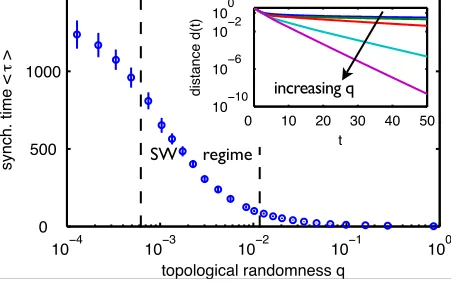
Fig. 1: (color online) Synchronization times (4) monotonically
decrease with randomness in network ensembles with fixed
in-degreek= 20(N = 1000nodes,J= 1, averageshτiover 100
realizations of networks with random initial condition each;
synchronization times ranging from hτi = 1.3 (q → 1) to
hτi = 1316 (q → 0); error bars give standard deviation).
The small world regime [Eq. (2), dashed vertical lines
indi-cate bounds] appears not to be special at all. Inset: Distanced
to the synchronous state (3) decays exponentially with timet
after short transients for entire range of randomnessq∈[0,1];
lines provide single realizations forq∈ {0,0.008,0.04,0.2,1}.
To systematically investigate the sychronization process
in dependence of the topological randomness we first
per-formed extensive numerical simulations of the collective
dynamics. We start with regular ring networks where each
unit receives directed links from itsk/2nearest neighbors
on both sides. Adapting the standard small world model
of Watts and Strogatz [9] to directed networks [23] we
[image:3.595.324.552.277.419.2]rewire it to a randomly selected node (avoiding double
edges and self-loops). The small world regime is
charac-terized by a large clustering coefficient1
hC(q, k)i and a
small average path length2
. hL(q, k)iHereh.idenotes
av-eraging over network realizations at given q and k. To
quantitatively fix the small world regime we take
hL(q, k)i
L(0, k) <0.5 and
hC(q, k)i
C(0, k) >0.85 (2)
throughout this study. The results below are not sensitive
to a change of these values. Starting each simulation from
a random initial phase vector drawn from the uniform
dis-tribution on [0, π)N shows that synchronization becomes
an exponential process after some short transients (Fig. 1,
inset), for all fractionsq∈(0,1]of randomness. Thus the
distance
d(t) = max
i,j dist(θi(t), θj(t)) (3)
from the synchronous state decays as
d(t)∼exp(−t/τ) (4)
in the long time limit, wheredist(θ, θ′)is the circular
dis-tance between the two phasesθ andθ′ onS1.
The asymptotic synchronization time τ systematically
depends on the network topology (Fig. 1): Regular ring
networks (q→0) are typically relatively slow to
synchro-nize.
We find that increasing randomnessqtowards the small
world regime induces shorter and shorter network
syn-chronization times, with small worlds synchronizing a few
times faster than regular rings. Further increasing the
ran-domnessqinduces even much faster synchronization, with
fully random networks (q→1) synchronizing fastest (two
orders of magnitude faster than small worlds in our
ex-amples). Thus in network ensembles with fixed in-degree
small worlds just occur intermediately during a monotonic
1C
(q, k)denotes the actual divided by the possible number of
directed triangles containing a given nodei, averaged over alli. 2
L(q, k)denotes the length of the shortest directed path between
a given pair of nodes(i, j), averaged over all(i, j).
increase of synchronization speed, but are not at all
topo-logically optimal regarding their synchronization time.
This might be expected intuitively, also from studies
about synchronizability [9, 10], and one is tempted to
ascribe faster synchronization to a shorter average path
length that results from increasing randomness.
We therefore first systematically studied the
synchro-nization time for generalized Watts-Strogatz ensembles of
networks, specified by a function k(q), where the average
path lengthhLiis fixed while the degree of randomnessq
varies.3
!"!# !"!$ !"!% !"!! !"" "
&"" !%"" !'""
()*)+),-./+01/23)4256607
682.9:0(-450;0
!
0<
0
0
=>1/4:0?/2/+:@ =>1/4:0?6-4>+:@
SW
regime
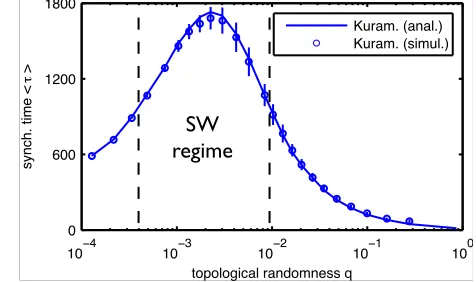
Fig. 2: (color online) Small worlds exhibit slowest
synchro-nization in network ensembles with fixed average path length.
HereN = 1000andhLi= 4; small-world region (2) is located
between dashed vertical lines.
We were surprised to find a non-monotonic behavior of
synchronization time with randomness (Fig. 2). In
partic-ular, networks with intermediate randomness in the small
world regime synchronize slowest. Analytical calculations
support this view. In the dynamics linearizing (1) close to
the synchronous state (where θi(t)≡θj(t) =:θ(t)) phase
perturbationsϕi(t) :=θi(t)−θ(t)evolve according to
dϕi
dt =
X
j
Λijϕj fori∈ {1, ..., N}. (5)
Here the stability matrix coincides with the graph
Lapla-3
We choose an appropriate in-degree k(q) for each given
ran-domnessqfrom numerically determined calibration curves such that
[image:4.595.296.534.293.434.2]C. Grabow, S. Hill, S. Grosskinsky and M.Timme
cian defined as
Λij =Jij(1−δij)−Jδij (6)
and δij is the Kronecker-delta. Close to every invariant
trajectory the eigenvalueλ2of the stability matrixΛthat
is second largest in real part dominates the asymptotic
decay; therefore,λ2 here determines the asymptotic
syn-chronization time via τ = − 1
Reλ2. This feature was
re-cently shown to hold more generally for network systems
where the stability matrix is not necessarily proportional
to the graph Laplacian [2, 17, 24].
Determining the eigenvalues of the stability matrices of
networks with fixed average path lengths yields
synchro-nization time estimates that well agree with those found
from direct numerical simulations, cf. Fig. 2. This
inde-pendently confirms that synchronization is indeed slowest
for small world networks.
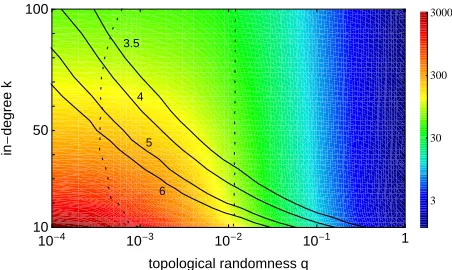
How does synchronization speed vary with randomness
for more general ensembles k(q)? A systematic study of
the synchronization time as a function of both in-degreek
and randomnessq(Fig. 3) reveals an interesting nonlinear
dependence. Firstly, it confirms that for all networks with
fixed in-degree k the synchronization time is monotonic
in the randomnessqand the small world regime at
inter-mediate randomness is not specifically distinguished.
Sec-ondly, the two-dimensional functionhτ(q, k)iimplies that
ensembles of networks with fixed path lengths all exhibit a
non-monotonic behavior of the synchronization time, with
slowest synchronization for intermediate randomness.
Thirdly, considering graph ensembles characterized by
any other smooth function k(q), q ∈ [0,1], shows that
this is a general phenomenon and the specific choice of an
ensemblek(q)is not essential.
In fact, as illustrated in Fig. 3, for any generic network
ensemble k(q) (including ensembles with fixed in-degree
and fixed path length as special choice) the
synchroniza-tion speed hτ(q, k(q))i is either intermediate or slowest,
but never fastest at intermediate randomness, in
particu-lar in the small world regime.
3000
300
30
3
10-4 10-3 10-2 10-1 1
10 50 100
topological randomness q
in
-degree
k
6 5 4 3.5
Fig. 3: (color online) Nonlinear dependence of synchronization
time on in-degree k and topological randomness q indicates
that no generic ensemblek(q)exhibits fastest synchronization
in the small world regime (logarithmic color scale ranging from
hτi = 4606 (dark red) tohτi = 1.1(dark blue)). Solid lines
indicate ensembles of networks with fixed average path length
fromhLi = 3.5(top) to hLi = 6 (bottom). The small world
regime (2) is located between the dashed lines.
Is this phenomenon restricted to the specific class of
Ku-ramoto oscillators? To answer this question, we explored
the synchronization dynamics of various kinds of
oscilla-tors coupled in different ways, and consistently found
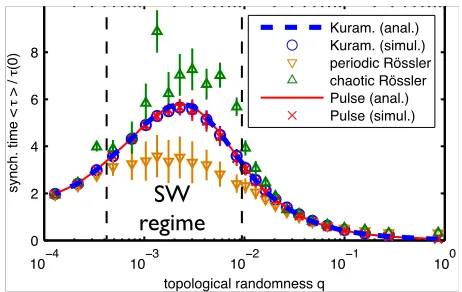
qual-itatively the same results. Specifically, in networks with
fixed average path length, synchrony is consistently fast
for regular rings, fastest for completely random networks,
and slowest in the intermediate small world regime (Fig.
4).
For instance, we tested networks of diffusively coupled
three-dimensional Rössler oscillators [1] satisfying
˙
xi=−yi−zi+PjJij(xj−xi),
˙
yi=xi+ayi,
˙
zi=b+zi(xi−c),
(7)
for i ∈ {1, . . . , N} where Jij = J/k define the
diffu-sive coupling and the parameters a, b and c determine
whether the oscillators are intrinsically periodic or
intrin-sically chaotic. The above phenomenon persists for both
[image:5.595.323.549.115.250.2]Moreover, we investigated the collective dynamics of
pulse-coupled neural oscillators [14,25] with membrane
po-tentialsVi(t)satisfying
dVi
dt =I−γVi+
N
X
j=1;j6=i
X
m∈Z
Jijδ(t−(tj,m+ ∆)). (8)
Here, each potentialVj relaxes towardsI >1 and is reset
to zero whenever it reaches a threshold at unity,
Vj(t−) = 1 ⇒ Vj(t) := 0, tj,m:=t,andm7→m+ 1. (9)
At these times tj,m the neuron sends a pulse that after a
delay ∆ > 0 changes the potential of post-synaptic
neu-rons i in an inhibitory (negative) manner. This neural
system allows analytic computation [18] of an iterative
map
δi(nT) =
N
X
j=1
Aijδj (n−1)T
, n∈N, (10)
for the perturbations δi(nT)of spike times close to the
synchronous orbit of period T = (1/γ) ln(1/(1−γ/I)).
For homogeneous coupling (Jij = −J/k for each
exist-ing connection) the elements of the stability matrixAare
given by Aij =A+ = (γJ)/(k(Ie−γ∆+γJ))if there is a
connection from j to i6=j,Aii = 1−kA+ for the
diago-nal elements and Aij = 0 otherwise, cf. [18]. As for the
Kuramoto system, the prediction of synchronization times
based on the eigenvalues of the matrixAwell agrees with
those obtained from direct numerical simulation (Fig. 4,
crosses and solid line).
These results confirm that, largely insensitive to the
type of oscillators (phase, multi-dimensional, neural),
their intrinsic dynamics (periodic, chaotic) and their
cou-pling schemes (phase-difference, diffusive, pulse-like),
net-works with fixed average path length consistently
synchro-nize slowest in the small world regime at intermediate
ran-domness. Further numerical analysis (not shown)
indi-cates that also the entire nonlinear dependence (Fig. 3)
of the synchronization time onkandqstays qualitatively
the same for all these different systems.
Hence, in general small worlds do not synchronize
fastest. This holds for various oscillator types, intrinsic
!"!# !"!$ !"!% !"!! !"" "
% # & '
()*)+),-./+01/23)4256607
682.9:0(-450;0
!
0<0=0
!
>"?
0
0
@A1/4:0>/2/+:? @A1/4:0>6-4A+:? *51-)3-.0BC66+51 .9/)(-.0BC66+51 DA+650>/2/+:? DA+650>6-4A+:?
SW
regime
Fig. 4: (color online) Synchronization is slowest in the small
world regime for various oscillator types and coupling schemes
(network parameters as in Fig. 2). Normalized average
syn-chronization timeshτi/τ(0)vs.qfor Kuramoto, pulse-coupled
and periodic as well as chaotic Rössler oscillators (network
topologies as in Fig. 2). Neurons with delayed pulse-coupling:
I= 1.01,γ= 1,J=−0.2,τ= 0.1; Diffusively coupled Rössler
oscillators: a= 0.2,c= 5.7, periodic: b= 1.7,J= 2, chaotic:
b= 0.2,J = 6. The synchronization times are determined by
measuring the distancesd= maxi,j{ (xi−xj)2+ (yi−yj)2+
(zi−zj)21/2}(Rössler), andd= maxi|δi|(pulse-coupled) and
fitting (4).
dynamics and coupling schemes: phase oscillators
cou-pled via phase differences, higher-dimensional periodic and
chaotic systems coupled diffusively as well as neural
cir-cuits with inhibitory delayed pulse-coupling. In
particu-lar, small world topologies are not at all special and may
synchronize orders of magnitude slower than completely
random networks. So generically the small world regime
can either exhibit slowest synchronization or just exhibit
no extremal properties regarding synchronization times.
This phenomenon is rather unexpected given previous
results on synchronization and small world topology. For
instance, the original work by Watts and Strogatz, as well
as later studies [7, 9, 10], indicate that small world
topolo-gies support network synchronization, in particular they
synchronize at weaker coupling strength than analogous,
appropriately normalized globally coupled systems.
[image:6.595.303.534.82.228.2]C. Grabow, S. Hill, S. Grosskinsky and M.Timme
features such as betweenness centrality, degree
heterogene-ity or hierarchical organization have been suggested to
control whether or not a network actually synchronizes
[26]. Our results now highlight, that the speed of
syn-chronization may vary several orders of magnitude, even
if only the disorder in the topology changes.
Synchroniza-tion speed thus serves as a key dynamic characteristic of
oscillator networks, because even if a system synchronizes
in principle, it might not in practice as the time scales
involved may be much longer than those relevant to the
system’s function. For practical problems in real-world
networks, such as preventing synchrony in neural circuits
[4], or supporting synchrony in communication systems
[3], it is thus essential to further systematically
investi-gate how additional features, such as heterogeneities [27]
or non-standard degree distributions [20], impact
synchro-nization speed.
∗ ∗ ∗
Supported by the BMBF under grant no. 01GQ0430, by
a grant of the Max Planck Society to MT and by EPSRC
grant no. EP/E501311/1 to SH and SG.
REFERENCES
[1] Pikovsky A., Rosenblum M.andKurths J.,
Synchro-nization, A universal concept in nonlinear sciences
(Cam-bridge Univ. Press, Cam(Cam-bridge, UK) 2001.
[2] Arenas A. et al.,Physics Reports,469(2008) 93. [3] Kanter I., Kinzel W.andKanter E.,Europhys. Lett.,
57(2002) 141.
[4] Maistrenko Yu. et al., Phys. Rev. Lett., 93 (2004) 084102.
[5] Netoff T. et al.,J. Neurosci.,24(2004) 8075. [6] Strogatz S.,Nature,410(2001) 268.
[7] Nishikawa T. et al.,Phys. Rev. Lett.,91(2003) 014101.
[8] Pecora L.andCarroll T.,Phys. Rev. Lett.,80(1998) 2109.
[9] Watts D.andStrogatz S.,Nature,393(1998) 440.
[10] Barahona M.andPecora L. M.,Phys. Rev. Lett.,89
(2002) 054101.
[11] Roxin A., Riecke H.and Solla S.,Phys. Rev. Lett.,
92(2004) 198101.
[12] Zumdieck A. et al.,Phys. Rev. Lett.,93(2004) 244103. [13] Zillmer R. et al.,Phys. Rev. E,76(2007) 046102.
[14] Jahnke S., Memmesheimer R.-M. and Timme M.,
Phys. Rev. Lett.,100(2008) 048102.
[15] Denker M., Timme M., Diesmann M., Wolf F.and
Geisel T.,Phys. Rev. Lett.,92(2004) 074103.
[16] Zillmer R., Brunel N.andHansel D.,Phys. Rev. E.,
79(2009) 031909.
[17] Timme M., Wolf F.and Geisel T., Phys. Rev. Lett.,
92(2004) 074101.
[18] Timme M., Geisel T.andWolf F.,Chaos,16(2006)
015108.
[19] Qi G. X. et al.,Phys. Rev. E,77(2008) 056205. [20] Qi G. X. et al.,Europhys. Lett.,82(2008) 38003.
[21] Timme M.,Europhys. Lett.,76(2006) 367.
[22] Acebron J. et al.,Rev. Mod. Phys.,77(2005) 137. [23] Fagiolo G.,Phys. Rev. E,76(2007) 026107.
[24] Almendral J. A.andDiaz-Guilera A.,New J. Phys.,
9(2007) 1211.
[25] Mirollo R.andStrogatz S.,SIAM J. Appl. Math.,50
(1990) 366.
[26] Motter A., Zhou C. and Kurths J., Phys. Rev. E,
71 (2005) 016116; Goh K. et al., Phys. Rev. Lett., 96
(2006) 018701;Lee S., Kim P.andJeong H.,Phys. Rev.
E,73(2006) 016102; Arenas A., Diaz-Guilera A.and
Perez-Vicente C. J.,Phys. Rev. Lett.,96(2006) 114102.