Master Thesis Kirsten ter Horst 1
MASTER THESIS
PROVIDING DIRECTIONS TO FUTURE JOB SEEKERS
Master Thesis Kirsten ter Horst 2
Author of Master Thesis:
Kirsten ter Horst
[email protected]
1092774
1
stsupervisor
University of Twente
School of Management and Governance
Human Resource management
Dr. Jeroen Meijerink
2
ndsupervisor
University of Twente
School of Management and Governance
Human Resource management
Dr. ir. Jan de Leede
Master Thesis Kirsten ter Horst 3
PREFACE
This study is a Master Thesis for receiving the Master of Science degree in Business Administration
with the specialization Human Resource management at the University of Twente. This final thesis
has been conducted within the period of November 2014 until June 2015. Due to my personal interests
in behavioural sciences and my educational background in psychology and human resource
management, I was interested in a topic that combined these areas. Which brought forth the current
study on job search behavior, wherein I could analyse the behavior of job seekers and their motives for
engaging in specific job search methods, and the effects of differences in human capital i.e., value &
uniqueness on the level of realization of job search objectives.
I would like to thank a few people to whom I own gratitude to, for supporting me and enabling me to
present this study in its current form. First and foremost, I would like to express my appreciation to my
first advisor Dr. Jeroen Meijerink for his support through my Master thesis. Jeroen Meijerink, your
extensive feedbacks and your enthusiasm for research were inspiring and invaluable for me. I would
also like to thank my second advisor Dr. ir. Jan de Leede for providing some very insightful comments
that enabled me to further strengthen this thesis.
Last, but not least, I want to thank my boyfriend, parents and friends, for their support and
understanding throughout my educational career. Through this study, I experienced high and low
points, but overall, this Master Thesis felt like an invaluable experience for my personal, educational
Master Thesis Kirsten ter Horst 4
ABSTRACT
The mobility of the workforce has increased drastically over the last decade especially among the
younger workforce, the average U.S. worker today stays at each of his or her job for about 4.4 years, however the expected tenure of the workforce’s youngest employees in the USA is about half that
(Boswell, Zimmerman, & Swider, 2012). In the Netherlands these numbers are somewhat different, on
average, employees stay nine years of loyalty to their employer. That figure has been stable for several
years, this is however mainly due to older workers who switch little. Young people under 35 years
switch jobs one and a half times as often as the entire workforce and this number is expected to
increase even more in the next few years (CBS, 2015). Job search has become so pervasive and frequent that it is now considered to be an integral part of people’s work life (Kanfer, Wanberg, &
Kantrowitz, 2001;Hoye and Saks, 2009). This led to an increased number of studies on job search
behavior the last few years. However the majority of current studies on job search behavior have
focused on job search behavior that is directed on finding a new job. Given that job search is
conceptualized as a self-regulatory process initiated by goals (Kanfer et al., 2001; Saks, 2005), an
important limitation of most previous studies has been the failure to consider the role of different job
search objectives. Job search does not always result in turnover or employment and there are many
other reasons for job seekers to engage in job search behavior, especially for employed individuals,
such as seeking bargaining leverage to improve one’s present terms of employment (Boswell et al.,
2004).
The first study that took into account multiple job search objectives was the study of Hoye and
Saks (2008). They investigated the relationship between the different job search objectives (i.e. finding
a new job, staying aware of job alternatives, developing a professional network, and obtaining
leverage against an employer) and job search methods (i.e. looking at job ads, visiting job sites,
networking, contacting employment agencies, contacting employers, and submitting applications).
Results showed that different job search objectives indeed elicit specific job search methods to bring
about the objective (Hoye and Saks, 2008). It remained however unclear whether these methods
actually led to the accomplishment of the objectives and maybe even more important, which boundary
conditions influenced the effectiveness of these methods. Therefore this Master Thesis analysed which
job search methods were most effective for obtaining which job search objective, in addition it was
examined whether moderator variables exist that influence the effectiveness of the job search methods.
This was examined by conducting a quantitative online survey design among 149 employed
job seekers of 20 years and up that had obtained a bachelor or master degree of HVE or University.
Results indicated that job seekers that pursue the objective of staying aware of alternatives and wish to
Master Thesis Kirsten ter Horst 5
social media, the method category looking at job ads (including: searching in professional
magazines, searching in newspapers) and contacting acquaintances and family. The more
junior job seekers will benefit most from using the method category online job search
(including: searching on jobsites, searching on social media, and searching on websites of
employers). The second objective developing a professional network was best achieved by
using the method category networking, including (contacting family, friends, and
acquaintances). The method contacting acquaintances of this method category however
explained by far the most of the variance. Followed by the method category contacting
employers (including: contacting employers and visiting employers) followed by the category
contacting employment agencies (including: contacting employment agencies and recruitment
agencies). The final job search objective of obtaining leverage against a current employer was
best achieved by the method category sending application letters (including: sending directed
and open applications letters) closely followed by the category contacting employers
(including: contacting employers and visiting employers). It appeared that the effectiveness of
the method visiting employers was strongly affected by the moderator value and uniqueness of
skills that job seekers possess.
The findings of this study should however be interpreted carefully. Since this study
has focused on one moment in time the findings may not display the actual relationship
between the use of specific job search methods and their effectiveness in achieving the three
job search objectives. Other main limitations are the difficulty of measuring various effects,
multicollinearity among some of the study variables, and possible generalizability problems.
Despite its limitations, I believe that the results of the current study provides useful guidance
to job seekers. Job seekers time is limited these directions will therefore provide job seekers
with efficiency and effectiveness advantages, as they now can get knowledge of what job
search methods they should engage in for realizing what specific job search objectives.
Master Thesis Kirsten ter Horst 6
TABLE OF CONTENT
1. Introduction ... 7
2. Theoretical framework ... 9
2.1. Job search methods ... 9
2.2 Job search objectives ... 10
2.2.1 Staying aware ... 10
2.2.2 Development of professional network ... 10
2.2.3 Obtaining leverage ... 10
2.3 Hypotheses ... 11
3. Method ... 19
3.1. Study design ... 19
3.2. Sample & procedure ... 20
3.3. Measuring the Main Variables ... 22
3.3.1 Measuring job search methods ... 22
3.4 Measuring job search objective realization ... 22
3.5 Measuring moderating variables ... 23
4. Results ... 23
4.1. Descriptive Statistic ... 23
4.2 Results on staying aware of job alternatives ... 30
4.3 Results on developing a professional network ... 37
4.4 Results on obtaining leverage against a current employer ... 38
5. Discussion ... 43
5.1. Implications for theory ... 43
5.2 Implications for Practice ... 46
5.3 Limitations and Implications for Future Research ... 47
6. Conclusion ... 49
7. References ... 51
Master Thesis Kirsten ter Horst 7
1.
Introduction
The mobility of the workforce has increased drastically over the last decade as individuals search for
work following job loss and pursue opportunities to advance their careers (Saks, 2005). The average
U.S. worker today stays at each of his or her job for about 4.4 years, however the expected tenure of the workforce’s youngest employees in the USA is about half that (Boswell, Zimmerman, & Swider,
2012). In the Netherlands these numbers are somewhat different, on average, employees stay nine
years of loyalty to their employer. That figure has been stable for several years, this is however mainly
due to older workers who switch little. Young people under 35 years switch jobs one and a half times
as often as the entire workforce and this number is expected to increase even more in the next few
years (CBS, 2015). So it could be said that job search has become so pervasive and frequent that it is now considered to be an integral part of people’s work life (Kanfer, Wanberg, & Kantrowitz,
2001;Hoye and Saks, 2009). At the same time, there has also been an increase in research on the
prediction of job search behavior (Saks, 2005).
One of the most progressive studies on job search behavior is that of Van Hoye and
Saks (2008). Following Hoye and Saks (2008) job search behavior starts with the
identification and commitment to pursuing an employment goal. This employment objective,
in turn, activates job search methods developed to bring about the objective. They investigated
the relationship between the different job search objectives (i.e. finding a new job, staying
aware of job alternatives, developing a professional network, and obtaining leverage against
an employer) and job search methods (i.e. looking at job ads, visiting job sites, networking,
contacting employment agencies, contacting employers, and submitting applications). Results
showed that employees who are searching for a new job are likely to use all search methods,
whereas those that want to stay aware of alternatives used job ads and job sites more often, job
seekers that pursued the objective of developing a professional network gave preference to the
methods networking and contacting employers, whereas employees that wanted to obtain
leverage against a current employer mostly engaged in contacting other employers (Hoye and
Saks, 2008).
So it is clear that different objectives elicit different methods. However, what we do
not know whether these methods actually led to the accomplishment of the objectives and
maybe even more important, which boundary conditions influence the effectiveness of these
methods. It is expected that there are boundary conditions, as it seems logic that people with
different situations, personalities or backgrounds will be unequally effective in obtaining the
same objective with a specific method. For example a production worker (widely available on
the labour market) that uses the method contacting other potential employers with the goal to
Master Thesis Kirsten ter Horst 8
researcher at a university which knowledge and skills are scare and of great importance for the
company. Research in this direction seems very important from both a practical as theoretical point of
point of view.
From a practical point of view this could provide guidance to job seekers as to what search
methods they should be engaging in for what goal. Job seekers time is limited, therefore it would be
very useful to know what type of method is most effective in a particular situation. This would provide
job seekers with a better focus and make the job search more efficient and effective. On a theoretical
level, this type of research will also try to enhance our understanding of the moderators of the job
search methods and thus whether some boundary conditions enable or hinder the realization of job
search goals. So, we can not only say which method works best for what type of objective, but also
under what conditions. Finally, research in this direction would be able to fill the gap that exists
concerning the operationalization of job search success. Most previous studies have only
operationalized job search success as the number of job offers, search duration, and finding
employment (i.e., Blau, 1993; Kanfer et al., 2001; Saks, 2006). However, as pursuing different
objectives will be related to different outcomes, job search success has to be measured in terms of job seekers’ specific objectives (Kanfer et al., 2001). This leads to the following research question which
will be addressed in this study:
To which extent do the job search methods affect the degree to which job search objectives are met?
And to which extent is the relationship between job search methods and job search objective
realization moderated by selected boundary conditions?
In the next section, the theoretical framework will be presented wherein the two variables job search
Master Thesis Kirsten ter Horst 9
2.
Theoretical framework
2.1. Job search methods
Hoye and Saks (2008) differentiate between six most frequently recurring methods, namely looking at
job ads, visiting jobsites, networking, contacting employment agencies, contacting employers, and
submitting applications. These methods will also be examined in the current study. However, the
method visiting jobsites was slightly altered, it was renamed into online job search, as online job
search today can be performed in more ways than visiting jobsites. With job search method I refer to
the combination of the behavior or action that is performed and the source that is used to find job
offers. The first methods is referred to as looking at job ads. The action here is searching or looking
for job ads, this can be done through all possible offline written media for job ads, in which
newspapers, journals, and advertising papers. The second method of Hoye and Saks (2008) looking at
jobsites, is referred to as online job search. Online job search involves job seekers searching or looking
at online job ads, which can be done through all possible online media for job ads, including job sites,
websites of companies, and social media websites. In this study searching on social media was added
to the method of Hoye and Saks (2008) as companies nowadays increasingly use this as a medium to
post vacancies and information about companies (Lewis, Thomas, & Sanders, 2013). The third method
concerns networking, although networking is a broad term in this study it refers to tapping into
connections job seekers already have, family, friends, and acquaintances to get information on
possible job leads, and other career related opportunities, (i.e., if they or whether they know someone
who has the potential to assist them in their work or career). Networking can be done through various
types of communications such as face to face interaction, phone, or social media. The difference
between the use of social media for the methods networking and online job search is that for
networking interaction has to take place between individuals (i.e., chat or sending a message), whereas
for online job search job seekers solely use social media to search for job offers. Therefore, for online
job search, no interaction is involved.
The fourth method is referred to as contacting agencies, which involves the action of
contacting or getting in touch with employment agencies to obtain job leads. The sources that
can be used in this method are temporary employment agencies and recruitment agencies. The
fifth method is referred to as contacting employers, were the action is contacting/getting in
touch with employers for information on job openings, and the sources are possible
employers. Concerning the last three mentioned methods the action contacting is used, this
Master Thesis Kirsten ter Horst 10
visit etc. The final method is referred to as submitting applications letters, this can be done offline or
online and includes open applications are application specifically directed to a vacancy.
2.2 Job search objectives
In the current study I will examine three job search objectives based on the classification of Hoye and
Saks (2008) the three job search objectives are: staying aware of alternative job opportunities,
developing a network of professional relationships, and obtaining leverage against an employer.
2.2.1 Staying aware
The first objective concerns staying aware of job alternatives. Search does not always result in
turnover (Boudreau et al., 2001), so it seems logical that search objectives may include purposes other
than leaving the job and finding a new one. Employed job seekers also search for job information to
stay aware of job opportunities available in the labour market (Boswell et al., 2002; Hoye and Saks
(2008). In practice, employed individuals motivated by this job search objective are sometimes referred to as ‘‘passive job seekers”, a target group of potential applicants much sought after by
recruiting organizations. They are not actively looking for a new job, but still want to stay aware of
possible job opportunities (Steel, 2002). The goal is achieved when job seekers have the feeling that
they are sufficiently aware of job alternatives and of other developments in the labour market.
2.2.2 Development of professional network
The second objective concerns the development of a professional network. Employed individuals
might engage in job search activities to develop a network of professional relationships with others
that may boost one’s future business and employment prospect (Wanberg et al., 2000). The
importance of developing a network as a career management strategy has increased in recent years as
careers have become more ‘‘boundary less” (Forret & Dougherty, 2001). Individuals guided by the
network objective would not be interested in gathering job information per se, but rather in meeting
and talking to others who might be important for their work or career for example others in their
profession or head-hunters (Hoye and Saks, 2008). This goal is therefore achieved when job seekers
have the feeling they have developed new relationships and/or met interesting companies where they
expects to benefit from in the future.
2.2.3 Obtaining leverage
Employees might also engage in job search to improve their bargaining position in negotiating their
terms of employment with their current employer (Boswell et al., 2002). Job seekers pursuing this
objective will be minimally satisfied with their current working situation, however, they are also not
entirely dissatisfied as they are not searching to leave. These individuals are searching for jobs to
Master Thesis Kirsten ter Horst 11
objective is achieved when job seekers have the feeling that their negotiation position has improved, in
such a way that they are able to negotiate about their terms of contract with success.
2.3 Hypotheses
To be able to answer the research question: To which extent do the job search methods affect the
degree to which job search objectives are met? And to which extent is the relationship between job
search methods and job search objective realization moderated by selected boundary conditions?
The following hypotheses were investigated.
Hypotheses on staying aware of job alternatives objective
The first hypothesis concerns the objective of staying aware of job alternatives. Five of the six
job search method are expected to be effective in achieving this objective, looking at job ads, online
job search, networking, contacting agencies, and contacting employers. The use of the method sending
applications is not expected to be related to the achievement of objective one, awareness of
alternatives. When job seekers are sending application letters it is most likely that they are already
aware of job alternatives. Sending application letters will therefore not lead to awareness, but can be
seen as a follow-up method, that is used to follow-up on the identified job alternatives. Individuals that
have the objective of staying aware are interested in whether other opportunities exist rather than
actually obtaining new employment which is a next step in the process. Through the other five job
search methods job seekers can get to know whether possible job openings exists and therefore
expected to be to a greater or lesser extent effective in achieving awareness.
It is expected that the methods looking at job ads and online search are most effective
for achieving the objective of awareness of job alternatives. This expectation is based on the
study of Randall & Hansen (2010) concerning the ''hidden'' job market. They indicated that 62
percent of all vacancies are to be advertised either online or offline, (i.e., job boards,
newspapers etc.). The other 38 percent of all vacancies are unpublished, job seekers can only
get informed about these vacancies through their network. Their study thus provides some evidence that the ‘’hidden job’’ market is not as big as is often mentioned by some experts and
that most vacancies are published (Smith, 2006). It seems therefore logic the methods looking
at job ads and online job search, are most effective in achieving awareness as the biggest past
of all vacancies are posted through job ads. The methods looking at job ads and online job
search supposed to include all possible mediums through which job ads can be posted either
online or offline, jobseekers that make use of these two methods could in theory get aware of
Master Thesis Kirsten ter Horst 12
The finding of Hoye and Saks (2008) support this expectation, they provided evidence that
having the objective of staying aware predicted the use of the methods looking at job ads and online
job search. Following expectancy theory individuals will decide to behave in a certain way because
they are motivated to select a specific behavior over other behaviors due to what they expect the result
of that selected behavior will be. When people have the choice between different options they will
choose the option with the greatest motivation strength (Wanous, Keon, & Latack, 1983; Ajzen
&Madden, 1986; Van Eerde & Thierry, (1996). This motivation strength is determined by the
expectation "The estimation that an effort will lead to a good performance." Here are the personal
experience of the difficulty of the effort (based on experience), the personal experience of self-efficacy
(based on experience), and their own perceived control of the outcome of great importance (Ajzen
&Madden, 1986). Following this theory chosen behaviours or actions are positively related to the
desired outcome, because experience and with that learning is involved (Armitage & Conner, 2001).
Based on this principle and the findings of Randall & Hansen (2010) the following was hypothesized:
Hypothesis 1: The methods (a) Looking at job ads, and (b) online job search, will be the most effective
for the achievement of objective (1) awareness of job alternatives
However, Hansen (2013) indicated that as a position becomes more senior the percentage of
jobs that are advertised drops, and the percentage of jobs found through ones network increases.
Hansen (2013) defines a senior position as a position with a lot of responsibilities a position that
requires a broad knowledge of principles, practices, and procedures of particular field of specialization
to the completion of difficult assignments and a position in which minimum supervision needed. It
seems that the level of seniority not only changes the effectiveness of the proposed best job search
methods (looking at job ads and online job search) for achieving awareness but also the value of the
method networking. Concerning the proposed best methods, looking at job ads and online job search
the level of seniority affects the use value as follows: A high level of seniority makes the methods less
effective, as Hansen (2013) indicated that a smaller percentage of vacancies can be found through
these method.
Concerning the method networking the level of seniority changes the effectiveness as follows:
It is expected that the method will become more effective as the percentage of vacancies that can be
found through networking increases when the level of seniority increases, since senior jobs are more
likely be communicated through professional networks (Hansen, 2013). The level of seniority is
therefore viewed as a moderating factor. Seniority influences the focal relationship between the
methods looking at job ads, online job search, networking and the objective staying aware of job
Master Thesis Kirsten ter Horst 13 Hypothesis 2: The value of the methods (a) looking at job ads, (b) online job search and (c)
networking for achieving objective (1) awareness of job alternatives is affected by the level of job
seniority
- When job seniority increases the effectiveness of the method networking for achieving
objective (1) awareness of job alternatives increases.
- When job seniority increases the effectiveness of the methods looking at job ads and online job
search for achieving objective (1) awareness of job alternatives decreases.
Hypotheses on developing a professional network objective
The third and fourth hypotheses concern the objective of developing a professional network. Four of
the six job search method are expected to be to some extent effective in achieving this objective,
among which; networking, contacting employers, contacting employment agencies, and submitting
applications. The use of the methods looking at job ads and online job search by itself are not expected
to be related to the achievement of objective two, developing a professional network. Job seekers with
this objective are not necessarily interested in gathering information about jobs or assessing the job
market, however job seekers could also search for job ads online or offline to identify or select
companies that one would like to have in their professional network as a connection. These method by
itself however will not lead to the development of a professional network, these methods can be seen
as a first step in the process, to actually develop new relationships some sort of contact between two
parities is needed. It is therefore expected that looking at job ads and online job search are only
positively related to the achievement of objective two, developing a professional network if they are
used together with one of the other job search methods. The other four job search methods are all
based on some way of interaction, contact with another party, and therefore to a greater of lesser
extent able to develop new connections. It is expected that the methods contacting employers,
contacting employment agencies, and networking are the most effective methods for achieving a
professional network, as these are all based on interaction that is focused on the development of
relationships with individuals/companies that might be helpful for their future career, like meeting and
talking to others in the profession or those with ties to their career (e.g., head-hunters). This in contrast
to the method sending application were the interaction between an individual and a company at first
hand is concerned with a specific vacancy or position one wants to apply for. Although it is possible
that this method will result into the development of a professional connection with an employer, in the
first place the contact between a job seeker and a company is focused on a specific vacancy, this
method can be seen as an indirect method and therefore expected to be less effective. Therefore the
Master Thesis Kirsten ter Horst 14 Hypothesis 3:The methods (a) networking, (b) contacting employers and (c) contacting employment
agencies will be the most effective for the achievement of objective (2) developing a professional
network
However, when are new connections useful? Following structural whole theory which is
concerned with how social capital is created, we have to create a network in which individuals can
broke connections between otherwise disconnected segments, the most useful connections are
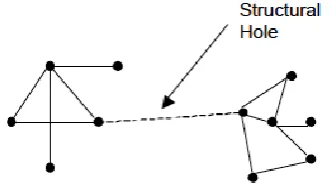
[image:14.595.84.250.290.385.2]connections from different social groups (Ahuja, 2000; Burt, 2009).
Figure 1.Conceptualization of a structural hole.
Connections between different groups are of great important to achieve networks rich in
information benefits. As opinions and behaviors are more homogeneous within than between
groups, so people connected across groups, are more familiar with alternative ways of thinking and
acting. Brokers across the structural holes provides a vision of options otherwise unseen, which is
the mechanism by which brokerage become social capital (Burt, 2009; Kleinberg, Tardos, &
Wexler, 2008). The so called information benefits concerndiversity and independency of information about ideas, threats, and opportunities in time to respond to them, this opposite to
information that flows from individuals in the same group who often have inwardly-focused
conversation, which leads to a fragmented perspective of what is going on in the wider world and
society (Burt, 2009). Granovetter (1983) showed that the advantages of having connections across
different social groups also applied for job seekers. He showed that job leads or career related
information was more likely to come from connections across different social groups than from
individuals in the same group as for example friends.
So individuals pursuing the goal of obtaining a professional network have to develop
networks rich in information benefits. To obtain this it is necessary to build large networks that
maximize the number of non-redundant contacts in order to maximize the number of structural
holes per actor in the network. Non-redundant contacts refers to contacts who give one access to
Master Thesis Kirsten ter Horst 15
The methods contacting employers and contacting employment agencies seem
suitable methods to obtain this, as these methods are focused on direct interaction with
different social groups. For example, a non-redundant contact could be developed between a
job seeker and a consultant of an employment agency. The method networking is however
based on contacting friends, family and acquaintances, the value of this method in
developing new non-redundant connections with a lot of weak ties over structural holes
seems to depend on which part of one’s current network is used to develop these. Friends
and family or seen as strong connections from the same social group, following structural
hole theory connections that are developed through strong connections are not expected to
provide a lot of information benefits as the information shared and further contacts are
likely to be overlapping or similar to that of contacts one already has (Friedkin, 1982). It is
therefore not expected that the connections developed through strong connections, (i.e.,
friends of your friends) will lead to a lot of weak ties over new structural holes
(Granovetter, 1983). So instead of using friends and family job seekers should use their
acquaintances to develop new non-redundant contacts. This will more likely lead to new
structural holes as acquaintances are less similar to you in terms of interests, background
etc. and therefore more likely to be have connections with different social groups then you
or your strong ties. Therefore the following was hypothesized.
Hypothesis 4: The effectiveness of the method networking for achieving objective (2) developing a professional network is affected by the part of one’s current network is used to develop new
professional connections.
- When the use of acquaintances increases in comparison to the use of friends and family to
develop new professional connections the effectiveness of the method networking for
achieving objective (2) developing a professional network increases.
- When the use of friends and/or family increases in comparison to the use of acquaintances
to develop new professional connections the effectiveness of the method networking for
achieving objective (2) developing a professional network decreases
Hypotheses on obtaining leverage objective
The final set of hypotheses concerns the objective of obtaining leverage against an employer. All of
the six job search method are expected to be effective to some extent in achieving this objective.
Individuals pursuing this objective are trying to improve their bargaining position in negotiating their
terms of employment with their current employer (Boswell et al., 2002). Following Hoye and Saks
Master Thesis Kirsten ter Horst 16
actually obtain job offers, compelling their current employer to make a better deal. They based these
statements on dyadic negotiation and equity theory. Concerning dyadic negotiation Pinkely, Neale,
and Bennet (1994) studied the impact of having alternatives to settlement in a dyadic negotiation, they
indicated that the more alternatives and the more specific alternatives where the higher the negotiation
power. So information on alternative job offers may be used as bargaining leverage to improve
employment conditions (e.g., Gault, Redington, & Schlager, 2000; Lazear, 1986). In addition equity
theory (Adams, 1965) which is concerned with defining and measuring the relational satisfaction of
employees suggests that employees try to maintain a balance between their efforts, what they give to a
company against what they receive in terms of salary. The principle of equity serves here as a negation
means. Job seekers should obtain alternative job offers of higher pay or status as a negotiation means,
so that they can show that their effort-reward ratio (equity principle) is better at another employer. This may serve as a signal to the employer of the value of one’s human capital in the external market,
which is likely to lead to more leverage at the employee level, which in turn enhances the output
(salary) (Bretz et al. 1994; Griffeth, & Gaertner, 2001).
All of the six methods are expected to be to some extent effective in obtaining specific
information on alternatives, and therefore effective in achieving objective three, obtaining leverage
against ones current employer. To actually obtain alternative job offers one has to apply to vacancies
which can be done with the method sending applications, so this method is expected to be effective for
both parts, obtaining specific information on job alternatives and obtaining actual job offers. Although
all methods are to some extent expected to be effective, the methods contacting employers and
submitting applications are expected to be the most effective methods for obtaining leverage against
ones employer. Following Boswell (2004) and Hoye and Saks (2008) specific information about job
alternatives was less likely to be provided in job postings or through intermediary persons or agencies.
They stated that vacancies on job sites often don not provide an exact salary, often an indication is
provided or they mention something like market conform employment terms. Mostly specific
employment terms as salary, responsibilities or secondary employment terms are discussed through
direct contact with an employer (i.e., in a job interview). These statements can be supported by the
results of the research from job search engine Adzuna in 2014, which reveals that over 60 percent of
job ads do not include a published salary. Adzuna analysed nearly every job ad in the UK in august
(over 500,000 in total) (Adzuna, 2014). These expectations are supported by the findings of Hoye and
Saks (2008) that having the objective of obtaining leverage against ones current employer predicted
the use of the methods, contacting employers and submitting applications. Following expectancy
theory it may be expected that these methods therefore will also be most positively related to the
Master Thesis Kirsten ter Horst 17 Hypothesis 5: The following methods (a) contacting employers, and (b) submitting applications will
be the most effective for the achievement of objective (3) obtaining leverage against one’s current
employer.
However, as not all employees possess knowledge and skills that are of equal strategic
importance, it seems unlikely that contacting employers and submitting applications would
work for everyone as a method to obtain leverage. It is expected that the more valuable and
unique skills of employees are the greater the value of the methods contacting employers and
sending applications will be for the achievement of objective three, obtaining leverage against one’s current employer.
The Resource-based view model (RBV) is used to explain why the level of skills
(value and unique) of an employee is expected to be a boundary conditions for the expected
value of the methods contacting employers and submitting applications for achieving leverage against one’s employer. The RBV model is concerned with how value is captured at company
level, although obtaining leverage is concerned with capturing value at individual level the
principle of value capturing stays the same.
The RBV argues that a firm can be regarded as a bundle of resources (tangible,
human, or financial), and that valuable, rare, imperfectly imitable and non-substitutable (VRIN) resources are an organization’s main source of sustainable competitive advantage
(Barney, 1991). So the RBV states that performance differences (profitability, market share) in
other words the ability to capture value accrue from firm specific resources that are scare and
superior in use relative to others. Superior resources are more efficient than others in the sense
that they enable a firm to produce at lower opportunity costs and or create more use value for
its customers which in turn results in a higher price paid (exchange value) (Priem & Butlet,
2001).
Obtaining leverage can be viewed as a means of capturing more value (salary) at
individual level. Employees create value for the firm with their human capital, with the labour
they perform, in turn employee capture a part of the value they created in term of salary
(exchange value). When employees pursue the goal of obtaining leverage they are trying to
capture more value for what they create (labor). They feel their value creation (input) is
currently unequal compared to the value that they are capturing (output). It seems logic that
human capital that is viewed as a VRIN resource, which can be translated into valuable and
uniqueness (rare, inimitable, and non-substitutable) skills (Lepak & Snell, 2002), are in the
position to demand a high salary, exchange value. Just as this principle of value capture counts
Master Thesis Kirsten ter Horst 18
price paid (exchange value) for its products (Bowman, & Ambrosini, 2000). So, the more valuable and
unique the skills of an employee are the more value it should capture (salary). As loosing such
valuable and unique resources would have major consequences for a firm´s sustainable competitive
advantage. A company cannot create the same use value for its customers anymore and therefore it
will capture less value at firm level eventually. Therefore the following was hypothesized:
Hypothesis 6: The effectiveness of the methods (a) contacting employers and (b) submitting
applications for achieving objective (3) obtaining leverage against ones current employer is affected
by the degree to which the skills of an employee are viewed as valuable & unique
- When skills become more valuable and unique the effectiveness of the methods contacting
employers and submitting applications for achieving objective (3) obtaining leverage
against one’s current employer increases.
- When skills become less valuable and unique the effectiveness of the methods contacting
employers and submitting applications for achieving objective (3) obtaining leverage
Master Thesis Kirsten ter Horst 19
3.
Method
3.1. Study design
This study makes use of a quantitative research design, quantitative research was chosen as it provides
a basis for more precise measures of the degree of relationship between the various concepts (Bryman
& Bell, 2011). As the main research question is concerned with the extent to which job search
methods affect the degree to which job search objectives are met, and the extent to which the
relationship between job search methods and job search objective realization are moderated by
selected boundary conditions quantitative research design seems most suitable.
There are four main types of quantitative research designs: descriptive, correlational,
quasi-experimental, and experimental. The current study applied a correlational design as the primary
purpose of the study was to examine the relationships between the study variables without the use of
any treatments. There are various ways to conduct a quantitative correlation research design, the
current study applied a survey design, which is a very common design of conducting this type of
research (Johnson, 2001), whereby the subcomponents of the theoretical framework are used to
operationalize the constructs to a level whereby they can be measured (Bryman & Bell, 2011). It is
possible to distribute a survey in various ways, for example face-to-face, telephonic, by letter or online
(Johnson, 2001). It was chosen to conduct the survey online due to the relatively large sample size
required and the geographic dispersion of the job seekers. A large sample size was required as the
study examined a large amount of variables, job search methods, with these variables it was the
question whether they were used or not, it could be that a job seeker used all job search methods
however it seems more likely that job seekers only used a selection. To still be able to uncovering
specific mean differences for the effect of specific job search methods for the realization of the job
search objectives, which are also statistically significant a large sample was needed (Johnson, 2001).
With an online survey is easier to approach a large part of the target group and it is a quicker way of
examination. Other advantages of an online survey are that respondents have the freedom to complete
the survey when they want and at the speed they want. Moreover, it is also quicker to administer and
the researchers have the possibility of sending reminders (Wright, 2005; Bryman & Bell, 2011). The
disadvantage of an online survey is that there is no help for respondents when they have difficulties
with answering a question. In addition online survey bring a greater risk of missing data through
Master Thesis Kirsten ter Horst 20
3.2. Sample & procedure
The data was obtained from a sample of higher educated, employed, individuals from age 20 and
above. Higher educated in this study refers to individuals that are in the possession of a University or
Higher Vocational Education (HVE) bachelor or master degree. It is expected that individuals that
meet these requirements are more likely to be concerned about their career, to engage in job search
activities, and to vary in their pursuit of different job search objectives than individuals with lower
educational backgrounds and individuals which are unemployed (Hoye and Saks, 2008). The study of
Sichermam & Galor (1990) indicated that higher educated in individuals make more steps during their
career, they switch jobs quicker. In addition they study of Vos, Dewettinck and Buyens (2008)
concerning career management and preferred career moves indicated that when higher educated
individuals make a career move this is more often a vertical one than a horizontal, whereas the lower
educated individuals more often make horizontal career moves. Finally the study of Wolf and Moser
(2009) on the effects networking and career success indicated that higher educated individuals engage
more often in career related events like career fairs, master classes, company presentations and that
higher educated individuals are more often a member of a professional network club. This provides
enough reasons to solely include higher educated individuals in the current study. Unemployed
individuals were also left out in the current study as they are known to engage in job search behavior
that for the most part is focused on getting a new job (Kanfer, Wanberg, & Kantrowitz, 2001).
Whereas employed job seekers are known to have more diverse job search objectives (Hoye and Saks,
2008). The final requirement concerning age is a result of the educational requirement, it is very
unlikely that individuals would have obtained a bachelor or master degree before they turn 20,
therefore it makes no sense to include individuals under this age in the sample.
The data from this study is collected from In Person, an employment agency that was willing
to invest time and resources in participating, within this company all employees that met the
requirements were invited to participate in the study. In addition all connection of the search firm that
met the requirements were invited to participate in the study. In Person was not just selected because it
was willing to participate, it was selected because employees of employment agencies are working in a
fast business environment, that is focused on careers of others. They are daily concerned with the
realization of job seekers job search objectives (finding a new job for seekers), in such a business
environment wherein consultants get in touch with a diversity of companies for whom they have to
fulfil vacancies for, it seems likely that these employees will be triggered more to pursue their own job
search objectives because of the exposure effect (Harmon-Jones & Allen, 2001) than employees at
organizations that are not daily exposed to recruitment and other career related topics. In addition the
company was selected because of its useful network of individuals that were expected to pursue job
Master Thesis Kirsten ter Horst 21
talent pool of In Person, job seekers can apply for the talent pool if they are currently looking for a
new job, or in perhaps in the future.
The first group, the connections of the search firm were approached to participate in the
survey through a Linkedin message, inviting them to participate in the current study, given that they
met the requirements stated above. If they agreed, they could complete the survey online on a website
especially created for this study. In total 690 individuals were invited through a Linkedin messages
that was send by three of the head recruiters of In Person, to increase the response rate two reminders
where send on the same manner as the first invitation, the first reminder was send after two weeks and
second after 4 weeks. In total 76 response were obtained, a response rate of 11 &%. The second group,
employees of the search firm received an e-mail, inviting them to participate in the current study,
given that they met the requirements stated above. If they agreed they were directed to the same
website to complete the survey as the first group. To enhance the response rate a reminder email was
send after two weeks and after four weeks. In addition employees were personally encouraged to
participate in the study by the researcher and the commercial director of the company. This led to a
response rate of 70 percent, 87 employees participated. So in total 163 responses were returned. Of
these 14 were removed from further analyses because these responses were incomplete. Therefore, the
final sample consisted of 149 individuals, including 76 individuals of group one 51 % and 73
individuals of group two, 49 %. More women (55%) than men (45%) participated. The most frequent
age category was 30-34.Also striking is that 49 % of the participants had an educational background
in business & management followed by 13.4 % for economy and communicational studies.
Concerning the level of educational background the division is a follows, 59.7 % of the participants
were in the possession of a bachelor at Higher Vocational Education, 23.2 % of a bachelor University
degree and 17.1 % of a Master University degree.
Due to the moderate response rate of the first group, it was assessed whether respondents were
representative of non-respondents by comparing the two groups on information (e.g., demographics,
study level, study direction and age). Independent t-test revealed that was only a significant difference
for study level between the groups, for In Persons M = 3.88, SD = 1.1.7, and for not In Persons M =
4.87, SD = 1.49, t (147) = 4.58 p =.001. It can be concluded that participants that were not an
Master Thesis Kirsten ter Horst 22
3.3. Measuring the Main Variables
This research makes use of quantitative data, wherever possible, existing scales were used to measure
the variables and, a five-point Likert scale ranging from 1 (strongly disagree) to 5 (strongly agree) as
answer options. Two researchers translated the established items from English to Dutch and back
again to ensure the items were correctly represented.
3.3.1 Measuring job search methods
The classification of Hoye and Saks (2008) of six specific job search method categories was used,
with one alteration, the method category visiting job sites was reworded into online job search as
social media was added to this method. The six method categories are looking at job ads, online job
search, networking, contacting employment agencies, contacting employers, and submitting
applications. To measure the use of the method Hoye and Saks (2008) developed two or three items
for each of the six method categories. The first category looking at job ads exist of looking at job ads
is newspapers and of looking at job ads in professional magazines, the second category online job
search exist of three sub methods, searching on jobsites, searching on social media and searching on
websites of employers, the third category networking exist of contacting family, friends and
acquaintances for job leads or career related information, the fourth category contacting employment
agencies exist of contacting employment agencies and contacting recruitment agencies, the fifth
category contacting employers exist of contacting employers and visiting employers, the final category
exist of sending directed and open application letters. Hoye and Saks (2008) used the category scores
in their analyses, however as the current study requires a specific answer to the question which
specific method is most effective for achieving which objective I will use the scores of every method
independently in further analyses. Participants were asked for all the job search methods whether they
used them or not (a dichotomous scale).
3.4 Measuring job search objective realization
Here, participants were asked to evaluate the realization of the job search objectives. Using items
adapted from an existing scale developed by Hoye and Saks (2008). Their scale is called ‘’The job
search objective scale’’, that measured to which extent the objectives; finding a new job/turnover,
staying aware of alternative job opportunities, developing a network of professional relationships, and
obtaining leverage against the current employer explain job seekers engagement in any job search
activity in the past six months. Items were measured on a five-point Likert scale, ranging from 1 = to
no extent to 5 = to a very great extent (i.e. to which extend does the objective of staying aware of job
alternatives explain your engagement in job search activities). In this study I am not interested in why
job seekers engage in job search but in what objectives are achieved with which job search methods,
therefore the items were adapted. Participants were asked to which extent they agreed or disagreed
Master Thesis Kirsten ter Horst 23
five-point Likert scale, ranging from 1 = to no extent to 5 = to a very great extent. Sample items are ‘‘I
am aware of developments in the labor market” (staying aware of job alternatives, a = .85), ‘‘I
developed new professional relationships” (developing a professional network, a = .85), and ‘‘My
bargaining position with my current employer has improved with respect to compensation” (obtaining
leverage against a current employer, a = .89). Two or three items were developed to measure each
specific objective.
3.5 Measuring moderating variables
Value & uniqueness of human capital. Here, participants were asked to indicate how valuable &
unique their skills are for their current employer. This variable was only measured among employed
participants. Using items adapted from an existing scale developed by Lepak and Snell (2002). The
scale exists of two components value which is measured by 10 items and uniqueness (which measures
the rareness, inimitableness and non-substitutability of human capital) which is measured by 8 items.
The original items from Lepak and Snell (2002) were directed to the manager of an employee (i.e.
employee has skills that are instrumental for creating innovations). In this study the items will be
directed to the job seekers them self. Sample items are ‘‘I have skills that are important for my
organization in creating innovations” (value, a = .89), ‘‘I have skills that are not widely available on the labor market” (uniqueness, a = .90). The other expected moderator concerns Seniority. Here
participants were asked to indicate how senior the jobs are one is interested in staying aware of. Using
items from an existing scale developed by Hansen (2013). The scale exist of three items all measuring the level of seniority. Sample item is ‘‘The job alternatives I want to stay aware of generally require
little oversight / supervision” (level of seniority, a = .73).
4.
Results
4.1. Descriptive Statistic
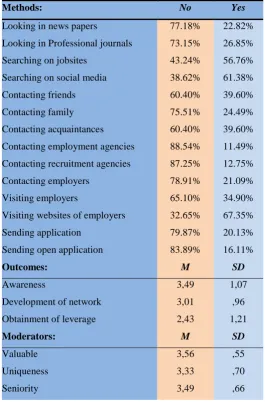
In first table the means and standard deviations for the outcome, and moderating variables are
presented. The methods were measured on a dichotomous scale (yes/no) these were therefore
presented in percentages. The methods visiting websites of employers 67.35% and searching on social
media 61.38% are the most used methods. The other end are the methods contacting employment
agencies 11.49 % and contacting recruitment agencies 12.75%, these methods are the least used
methods. Concerning the outcome scores, the highest average was obtained on the objective awareness
of job alternatives M = 3.49, the lowest average score was obtained on the objective obtaining leverage against one’s current employer M = 2.43, however this outcome score also had the highest
SD = 1.21. For the moderating scores there are no outliners, the variables averages are all about the
Master Thesis Kirsten ter Horst 24
Table 1.Means & standard deviations of all study variables
Methods: No Yes
Looking in news papers 77.18% 22.82% Looking in Professional journals 73.15% 26.85% Searching on jobsites 43.24% 56.76% Searching on social media 38.62% 61.38% Contacting friends 60.40% 39.60% Contacting family 75.51% 24.49% Contacting acquaintances 60.40% 39.60% Contacting employment agencies 88.54% 11.49% Contacting recruitment agencies 87.25% 12.75% Contacting employers 78.91% 21.09% Visiting employers 65.10% 34.90% Visiting websites of employers 32.65% 67.35% Sending application 79.87% 20.13% Sending open application 83.89% 16.11%
Outcomes: M SD
Awareness 3,49 1,07
Development of network 3,01 ,96 Obtainment of leverage 2,43 1,21
Moderators: M SD
Valuable 3,56 ,55
Uniqueness 3,33 ,70
Seniority 3,49 ,66
Note. N = 149.
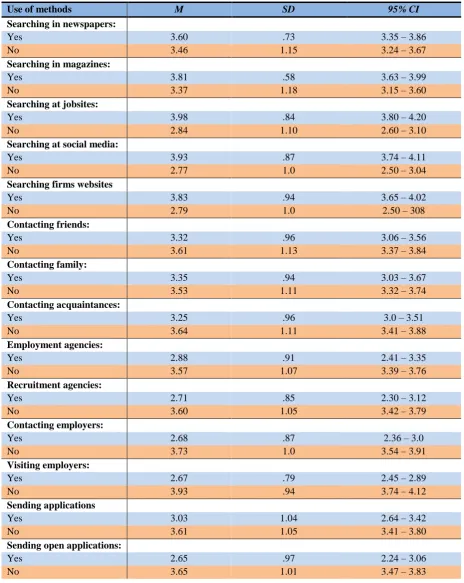
Table two presents the effectiveness scores of the different job search methods for obtaining
awareness of job alternatives. The scores on awareness of job alternatives appeared to be higher for
five of the 14 sub-job search methods when they were used versus when they were not used by
jobseekers. So, these methods had to a greater or lesser extend a positive effect on the score on
awareness of job alternatives. Including: searching in newspapers, searching in professional
magazines, searching on jobsites, searching on social media, and searching on employers´ websites.
The highest average score on awareness of job alternatives for users was found for the method
searching at jobsites M = 3.98 SD = .84. It is striking that some of the not used scores are very high,
for example the method sending application letters, when this method is not used by job seekers they
have a very high score on awareness. This implies that when this method is not used other more
Master Thesis Kirsten ter Horst 25 Table 2. Effectiveness scores on awareness of job alternatives
Use of methods M SD 95% CI
Searching in newspapers:
Yes 3.60 .73 3.35 – 3.86
No 3.46 1.15 3.24 – 3.67
Searching in magazines:
Yes 3.81 .58 3.63 – 3.99
No 3.37 1.18 3.15 – 3.60
Searching at jobsites:
Yes 3.98 .84 3.80 – 4.20
No 2.84 1.10 2.60 – 3.10
Searching at social media:
Yes 3.93 .87 3.74 – 4.11
No 2.77 1.0 2.50 – 3.04
Searching firms websites
Yes 3.83 .94 3.65 – 4.02
No 2.79 1.0 2.50 – 308
Contacting friends:
Yes 3.32 .96 3.06 – 3.56
No 3.61 1.13 3.37 – 3.84
Contacting family:
Yes 3.35 .94 3.03 – 3.67
No 3.53 1.11 3.32 – 3.74
Contacting acquaintances:
Yes 3.25 .96 3.0 – 3.51
No 3.64 1.11 3.41 – 3.88
Employment agencies:
Yes 2.88 .91 2.41 – 3.35
No 3.57 1.07 3.39 – 3.76
Recruitment agencies:
Yes 2.71 .85 2.30 – 3.12
No 3.60 1.05 3.42 – 3.79
Contacting employers:
Yes 2.68 .87 2.36 – 3.0
No 3.73 1.0 3.54 – 3.91
Visiting employers:
Yes 2.67 .79 2.45 – 2.89
No 3.93 .94 3.74 – 4.12
Sending applications
Yes 3.03 1.04 2.64 – 3.42
No 3.61 1.05 3.41 – 3.80
Sending open applications:
Yes 2.65 .97 2.24 – 3.06
No 3.65 1.01 3.47 – 3.83
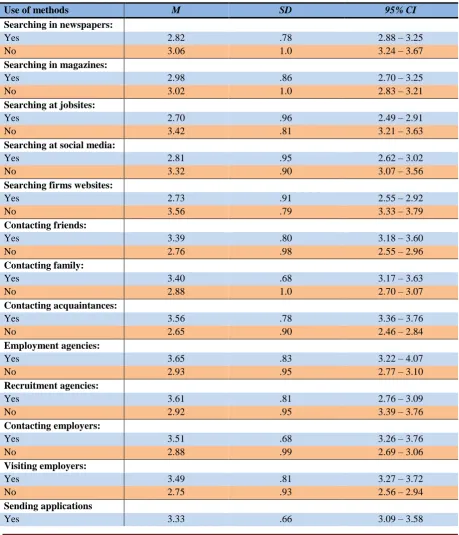
Table three presents the effectiveness scores of the different job search methods for
the development of a professional network. The scores on networking appeared to be higher
Master Thesis Kirsten ter Horst 26
used by jobseekers. So, these methods had to a greater or lesser extend a positive effect on the score
on the development of a professional network. Including: contacting friends, contacting family,
contacting acquaintances, contacting employment agencies, contacting recruitment agencies,
contacting employers, visiting employers, sending applications letters, sending open application
letters. The highest average score on obtaining leverage for users was found for the method contacting
[image:26.595.67.527.216.752.2]employment agencies M = 3.65 SD = .83.
Table 3.Effectiveness scores on developing a professional network
Use of methods M SD 95% CI
Searching in newspapers:
Yes 2.82 .78 2.88 – 3.25
No 3.06 1.0 3.24 – 3.67
Searching in magazines:
Yes 2.98 .86 2.70 – 3.25
No 3.02 1.0 2.83 – 3.21
Searching at jobsites:
Yes 2.70 .96 2.49 – 2.91
No 3.42 .81 3.21 – 3.63
Searching at social media:
Yes 2.81 .95 2.62 – 3.02
No 3.32 .90 3.07 – 3.56
Searching firms websites:
Yes 2.73 .91 2.55 – 2.92
No 3.56 .79 3.33 – 3.79
Contacting friends:
Yes 3.39 .80 3.18 – 3.60
No 2.76 .98 2.55 – 2.96
Contacting family:
Yes 3.40 .68 3.17 – 3.63
No 2.88 1.0 2.70 – 3.07
Contacting acquaintances:
Yes 3.56 .78 3.36 – 3.76
No 2.65 .90 2.46 – 2.84
Employment agencies:
Yes 3.65 .83 3.22 – 4.07
No 2.93 .95 2.77 – 3.10
Recruitment agencies:
Yes 3.61 .81 2.76 – 3.09
No 2.92 .95 3.39 – 3.76
Contacting employers:
Yes 3.51 .68 3.26 – 3.76
No 2.88 .99 2.69 – 3.06
Visiting employers:
Yes 3.49 .81 3.27 – 3.72
No 2.75 .93 2.56 – 2.94
Sending applications
Master Thesis Kirsten ter Horst 27
No 2.93 1.0 2.74 – 3.11
Sending open applications:
Yes 3.11 .71 2.81 – 3.41
[image:27.595.73.527.71.125.2]No 2.99 1.0 2.81 – 3.17
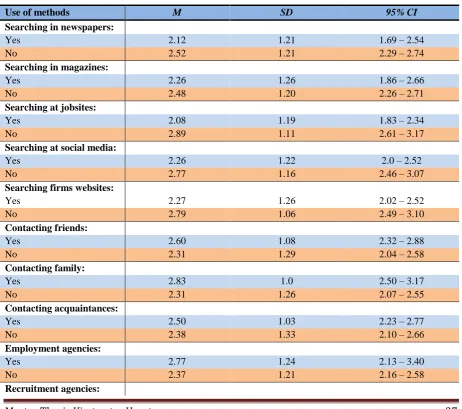
Table four presents the effectiveness scores of the different job search methods for
obtaining more leverage against one’s current employer. The scores on leverage appeared to
be higher for nine of the 14 sub-job search methods when they were used versus when they
were not used by jobseekers. Including: contacting friends, contacting family, contacting
acquaintances, contacting employment agencies, contacting recruitment agencies, contacting
employers, visiting employers, sending applications letters, sending open application letters.
So, these method had to a greater or lesser extend a positive effect on the score on leverage.
The highest average score on obtaining leverage for users was found for the method sending
open applications M = 3.67 SD = .76.
Table 4.Effectiveness scores on obtaining leverage
Use of methods M SD 95% CI
Searching in newspapers:
Yes 2.12 1.21 1.69 – 2.54
No 2.52 1.21 2.29 – 2.74
Searching in magazines:
Yes 2.26 1.26 1.86 – 2.66
No 2.48 1.20 2.26 – 2.71
Searching at jobsites:
Yes 2.08 1.19 1.83 – 2.34
No 2.89 1.11 2.61 – 3.17
Searching at social media:
Yes 2.26 1.22 2.0 – 2.52
No 2.77 1.16 2.46 – 3.07
Searching firms websites:
Yes 2.27 1.26 2.02 – 2.52
No 2.79 1.06 2.49 – 3.10
Contacting friends:
Yes 2.60 1.08 2.32 – 2.88
No 2.31 1.29 2.04 – 2.58
Contacting family:
Yes 2.83 1.0 2.50 – 3.17
No 2.31 1.26 2.07 – 2.55
Contacting acquaintances:
Yes 2.50 1.03 2.23 – 2.77
No 2.38 1.33 2.10 – 2.66
Employment agencies:
Yes 2.77 1.24 2.13 – 3.40
No 2.37 1.21 2.16 – 2.58
[image:27.595.66.529.352.761.2]Master Thesis Kirsten ter Horst 28
Yes 3.03 1.17 2.46 – 3.59
No 2.34 1.20 2.13 – 2.54
Contacting employers:
Yes 3.19 .65 2.95 -3.43
No 2.19 1.23 1.96 – 2.42
Visiting employers:
Yes 3.04 1.07 2.74 – 3.34
No 2.10 1.17 1.86 – 2.33
Sending applications
Yes 3.57 .84 3.25 – 3.88
No 2.14 1.13 1.93 – 2.34
Sending open applications:
Yes 3.67 .76 3.35 – 3.99
Master Thesis Kirsten ter Horst 29 Table 5. Correlations between all job search methods & scores on objective one awareness
Note: *p < .05; ** p < .01
1 2 3 4 5 6 7 8 9 10 11 12 13 14 15 16 17 18 19 20
Methods:
1.Newspapers -
2.Magazines .61** -
3.Jobsites .40** .37** -
4.Socialmedia .35** .40** .72** -
5.Friends .02 .01 -.10 .03 -
6.Family .06 .04 -.08 -.05 -
7.Acquintances -.15 -.12 -.21* -.22** .61** .41** -
8.Employement Agencies
-.04 -.08 -.11 -.19* .06 .20* .23** -
9.Recruitment Agencies
-.06 -.14 -.15 -.20* .10 .16 .27** .77** -
10.Contacting Employers
-.09 -.24* -.20* -.27** .22** .21** .29** .23** .35** -
11.Visiting Employers
-.10 -.22* -.39* -.48** .19* .18* .27** .31** .35** .58 -
12.Visiting companywebsites
.24** .19* .66* .60** -.05 -.11 -.21* -.08 -.05 -.03 -.19* -
13.Sending Application
.01 .04 .03 .020 .18* .07 .07 .20* .36** .17* .26** .10 -
14. Open application -.11 -.14 -.25** -.26** -.09 -.04 -06 .19* .27** .34** .48** .03 .60** -
Outcomes:
15.Awareness .06 .18* .53** .52** -.13 -.07 -.18* -.21* -.28** -.41** -.56** .46** .22**
-.35** -
16.Networking -.11 -.02 -.37** -.25** .32** .23** .47** .24** .24** .27** .37**
-.41**
.17* .05 -.37** -
17.Leverage -.14 -.08 -.33** -.21* .12 .19* .05 .10 .19* .34** .37** -.20* .47** .45** -.41** .50** -
Moderators:
18.Value -.03 .14 -.22* -.18* .03 .08 .05 .02 .10 .25** .18* -.14 .26** .33** -.34** .35** .60** -
19.Unique -.07 .17* -.26* -.25** .06 .05 .10 .07 .13 .33** .34** -.10 .26** .42** -.42** .31** .54** .81** -