TakeLab-QA at SemEval-2017 Task 3: Classification Experiments for
Answer Retrieval in Community QA
Filip Šaina, Toni Kukurin, Lukrecija Pulji´c, Mladen Karan, Jan Šnajder
Text Analysis and Knowledge Engineering Lab
Faculty of Electrical Engineering and Computing, University of Zagreb Unska 3, 10000 Zagreb, Croatia
{name.surname}@fer.hr
Abstract
In this paper we present the TakeLab-QA entry to SemEval 2017 task 3, which is a question-comment re-ranking problem. We present a classification based approach, in-cluding two supervised learning models – Support Vector Machines (SVM) and Con-volutional Neural Networks (CNN). We use features based on different semantic similarity models (e.g., Latent Dirichlet Allocation), as well as features based on several types of pre-trained word embed-dings. Moreover, we also use some hand-crafted task-specific features. For training, our system uses no external labeled data apart from that provided by the organiz-ers. Our primary submission achieves a MAP-score of 81.14 and F1-score of 66.99 – ranking us 10th on the SemEval 2017 task
3, subtask A.
1 Introduction
The ever-growingCommunity Question Answering (CQA) on-line services are gaining popularity at an increasing rate. However, there are some problems inherent to question-answer collections created by on-line communities. A major issue is the sheer volume of CQA collections, which makes finding an answer to a user question infeasible without some kind of an automated retrieval system. Conse-quently, information retrieval on CQA collections has gained increased focus in the research commu-nity, giving rise to several shared tasks on SemEval (Nakov et al.,2017).
From a natural language processing perspective, this is a difficult task due to high variance in the quality of questions and answers in CQA collec-tions (Màrquez et al., 2015). The cause of this is the self-moderated nature of CQA sites, which
implies that there are few restrictions on who is allowed to answer a question.
In this paper we describe our entries for the Se-mEval 2017 Question-Comment Similarity subtask (Nakov et al., 2017). Given a question q and a comment listC, the task is to rank the comments inC according to their relevance with respect to
q. Datasets for this task were extracted from Qatar Living, a web forum where people pose questions about various aspects of their daily life in Qatar.
Following Filice et al. (2016), we framed the task as a binary classification problem. We experi-mented with two classification approaches – Sup-port Vector Machines (SVM) (Cortes and Vapnik,
1995) and Convolutional Neural Networks (CNN) (Kim,2014). Most of the features we use follow the work ofBarrón-Cedeno et al. (2015) andNicosia et al.(2015). Moreover, we use embedding-based (Mihaylov and Nakov,2016) features for both mod-els.
The CNN model with the full feature set has proven to be the most successful, ranking 10th in the competition with a MAP-score of 81.14 and an F1-score of 66.99.
The rest of this paper is structured as follows. Section 2 gives a brief overview of the data set. A detailed description of the our models is given in Section 3. Section 4 outlines our experiments and results. Finally, we present our conclusions in Section 5.
2 Dataset
The dataset we used was provided by the shared-task organizers. Incoming user queries are denoted asoriginal questions. For each original question, we are provided with 10 annotated threads. Each thread consists of arelated question1and a set of
1Related questions are questions that have been asked in the past, and have a set of posted comments.
relevant non-relevant %relevant training 14,418 18,872 43.3
dev 2,198 3,152 41.1
overall 16,616 22,024 43.0
Table 1: Class distribution statistics.
10 comments posted as answers to the related ques-tion. Subtask A, the main focus of this work, is concerned with correctly ranking the 10 comments with respect to a related question (henceforth: ques-tion). Everyquestion-comment paircontains a clas-sification labelGood,Bad, orPotentiallyUseful. In our experiments, labels Bad and PotentiallyUse-fulare both considerednon-relevantand the label Good is considered relevant. Table1 shows the class distribution ofquestion-commentpairs in the shared task dataset. There is a slight bias towards the non-relevant class, but no mechanisms were implemented to address this. The official split al-locates 86% of the data to the train set and 14% to the development set. For further information on the collection we refer to (Nakov et al.,2017).
3 System Description
Considering we have class labels available for each question-comment pair, it is natural to frame this ranking task as a supervised classification problem. The input of the classifier is a vector of features that represents the question-comment pair(q, c). The output is a class – relevant or non-relevant – indicating whethercis relevant with respect to
q. We have experimented with two supervised ap-proaches for classifying the data, SVM and CNN, which were shown to be very successful in question-comment re-ranking tasks in previous work (Nakov et al., 2016). Note that both of these variants of our system fall into thepointwisecategory of the learning-to-rankparadigm (Cao et al.,2007). We next describe all our systems’ components in detail.
3.1 Preprocessing
We have preprocessed all entries by tokenizing them, stemming the tokens, and removing stop-words using the NLTK toolkit.2 These tokens were
used as input to the feature extraction pipeline.
2http://www.nltk.org
3.2 Embedding-Based Features
As observed bySocher et al. (2011), in the case where a large training set is not available, using word embeddings obtained from an unsupervised language model can be an efficient method for im-proving performance. More specifically, in our scenario embeddings alleviate lexical gap that of-ten arises when comparing a question to a relevant comment.
We use two types of embeddings. First, word2vec embeddings trained on Quatar Living questions and comments that was used by last year’s participants (Mihaylov and Nakov, 2016). We used 800-dimensional word vectors.3
Sec-ondly, we use thePARAGRAM4model introduced
by Wieting et al. (2016), which produces 300-dimensional word embeddings specifically tuned to work well when aggregated by a simple operation such as the average.
After some experimentation, we found the fol-lowing embedding features offered the best perfor-mance boosts on the development set:
• Question and Answer Embeddings– using thePARAGRAMembeddings, we compute the vector representation of both the question and comment by averaging their corresponding content-word vectors. This yields two 300-dimensional vectors, which are fed into our models as 600 numerical features;
• Word2vec average cosine similarity – we compute vector representations of the ques-tion and comment in the same manner as for the previous feature, but usingword2vecword vectors. We then introduce into our models a single numerical feature computed as the cosine similarity of the question and comment vector representations.
3.3 SEMILAR Features
Features listed under this group were all obtained from SEMILAR5(Rus et al.,2013). This is a
li-brary that implements a multitude of popular se-mantic similarity measures for text. We use it to calculate the similarity of the question to the can-didate comment, and include each measure as a
3These vectors alone can produce a MAP-score of 78.45 on subtask A, and can be obtained fromhttps://github. com/tbmihailov/semeval2016-task3-cqa
4We use the SL999 variant available at –http://ttic.
uchicago.edu/~wieting/
5http://deeptutor2.memphis.edu/
numerical feature. In our experiments we include similarity measures based on:
• Lexical overlap – two variants, overlap before preprocessing and overlap after preprocess-ing;
• WordNet (Fellbaum,1998);
• Latent Semantic Analysis (Landauer et al.,
1998);
• Latent Dirichlet Allocation (Blei et al.,2003);
• BLEU (Papineni et al.,2002);
• Meteor (Denkowski and Lavie,2011);
• Pointwise Mutual Information (Church and Hanks,1990).
3.4 Other Features
In this group we list hand-crafted features, as well as features that do not fit into the previous two groups:
• Words contained in comment – we have tested each comment for some words that of-ten seem to be useful in distinguishing good from bad comments in the previous editions of the task (Barrón-Cedeno et al.,2015). More specifically, we checked whether the comment contains wordsyes, ok, sorry, no, sure, orcan, and encoded them as binary numerical fea-tures;
• Answer contains question mark– another binary numerical feature that has previously been proven useful is whether the com-ment body contains a question mark ( Barrón-Cedeno et al.,2015);
• Answer length – longer comments tend to be better thought-out and, consequently, more useful with respect to the question at hand. This numerical feature represents the number of words in the comment after preprocessing;
• Tf-Idf cosine similarity– we determine Tf-Idf vectors for each question and comment, respectively. We then compute the cosine sim-ilarity of these vectors and include it as a nu-merical feature for our models.
3.5 SVM
We use the SVM classifier (Cortes and Vapnik,
1995) from ScikitLearn.6 The relevance score of
commentcwith respect to questionqis the confi-dence of the SVM classifier that the class is rele-vant, when presented(q, c)as input.
3.6 CNN
We follow the work of Severyn and Moschitti
(2015). The overall architecture of the network includes two convolutional layers and the corre-sponding information flow:7
• The questionq and commentc at the input are represented as matrices containing the word2vecembeddings of their words. They are the input of two separate convolutional layers that perform feature extraction;
• The max-pooling operation is applied to the resulting feature-maps;
• This results in task-specific representation vec-tors of the question and the comment. These vectors are concatenated and fed into a fully connected hidden layer, along with other fea-tures that we wish to include. Note that the extra features could be especially helpful in cases where many words inq andcthat are not covered by theword2vec model, which may lead to meaningless features extracted by the convolutional layers;
• Finally, a fully connected softmax layer cal-culates the probability distribution over the output label.
The network is trained by mini-batch stochastic gradient descent, minimizing the cross-entropy loss. To combat overfitting we use both early stopping and dropout (Srivastava et al.,2014).
The score of commentcwith respect to question
qis the probability that the network assigns to the relevantclass when presented with(q, c)as input.
4 Evaluation
4.1 Hyperparameters
We optimizeed the hyperparameters of the SVM classifier using cross-validation on the train set. We
6http://scikit-learn.org/
varied theCandγparameters8, and experimented
with both linear and non-linear kernels. We found that the RBF kernel withC set to5andγ set to 0.01was the best performing combination.
For CNN hyperparameters we used as a starting point the values proposed byKim(2014), and then tuned them empirically, to find the setting that op-timizes the performance on the development set. More specifically, we used filter windows of size 3, 4, 5, with 64 feature maps for each window, a dropout rate of 0.7, and mini-batch size of 64.
4.2 Evaluation
Participants were allowed to make three submis-sions and mark them asprimary,contrastive1, or contrastive2. All submissions were evaluated but only theprimarywas considered for the competi-tion system ranking.
For ourcontrastive1run we submitted an SVM classifier trained on features from the embedding-basedandothergroups. We denote this model as SVM-EO.
In our contrastive2 run we submitted a com-pletely different combination: the CNN classifier with theSEMILARfeatures as additional input to the hidden layer. We refer to this variant of the model asCNN-S.
The last combination we considered was the CNN classifier with all the other features provided as additional input to the hidden layer. We refer to this submission asCNN-EOS. This model has access to both the feature representations generated by the convolutional layers, as well as to all other features. Thus, expectedly, it performed best on the development set,9and we decided to submit it as
ourprimaryrun.
4.3 Results
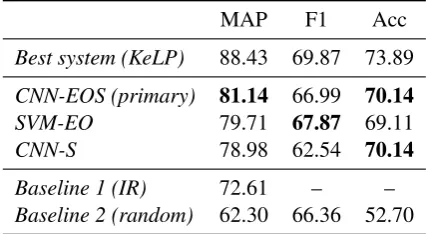
Final evaluation results released by the shared-task organizers are shown in Table2. 10 Our primary
submission was ranked at 10th place, achieving a MAP-score of 81.14.
Our contrastive submissions, both SVM and CNN based, achieve comparable performances. The CNN seems to outperform SVM only when new features are added, suggesting that the features work best when used jointly.
8γonly for the RBF kernel.
9Prediction accuracy – number of correct predictions over all pairs, is used as a overall training and development perfor-mance metric.
10http://alt.qcri.org/semeval2017/task3/data/uploads /semeval2017_task3_results.pdf
MAP F1 Acc
Best system (KeLP) 88.43 69.87 73.89 CNN-EOS (primary) 81.14 66.99 70.14
SVM-EO 79.71 67.87 69.11
CNN-S 78.98 62.54 70.14
[image:4.595.309.524.63.180.2]Baseline 1 (IR) 72.61 – – Baseline 2 (random) 62.30 66.36 52.70
Table 2: Submission results summary.
Furthermore, while the CNN model did prove to be better on the MAP metric, SVM outperforms it on the F1-score. This indicates that maximizing F1-score may not always maximize MAP-score.
5 Conclusion
In this paper we presented a re-ranking system de-veloped to participate in SemEval 2017 Task 3 – Community Question Answering. The system con-sists of two supervised learning approaches – Sup-port Vector Machines (SVM) and Convoluational Neural Networks (CNN), which outperformed the baseline model. While our models were trained only on the official dataset, better results may have been attained with additional training data.
For future work we would like to include addi-tional features, such as tree kernels (Filice et al.,
2016) and sentiment-specific word embeddings pro-posed byTang et al.(2014). We would also like to experiment with different classification models. An intriguing venue would be obtaining more training data from other popular CQA sites, and explore if some cross-domain information transfer that could benefit ranking models is possible. Finally, as in-dicated by our experiments, we would like to con-sider approaches that optimize the ranking model explicitly for the MAP-score.
References
Alberto Barrón-Cedeno, Simone Filice, Giovanni Da San Martino, Shafiq R Joty, Lluís Màrquez, Preslav Nakov, and Alessandro Moschitti. 2015. Thread-level information for comment classification in community question answering. InProceedings of the meeting of the Association for Computational Linguistics. pages 687–693.
Zhe Cao, Tao Qin, Tie-Yan Liu, Ming-Feng Tsai, and Hang Li. 2007. Learning to rank: from pairwise ap-proach to listwise apap-proach. InProceedings of the 24th international conference on Machine learning. ACM, pages 129–136.
Kenneth Ward Church and Patrick Hanks. 1990. Word association norms, mutual information, and lexicog-raphy.Computational linguistics16(1):22–29. Corinna Cortes and Vladimir Vapnik. 1995.
Support-vector networks. Machine learning20(3):273–297. Michael Denkowski and Alon Lavie. 2011. Meteor 1.3:
Automatic metric for reliable optimization and eval-uation of machine translation systems. In Proceed-ings of the Sixth Workshop on Statistical Machine Translation. Association for Computational Linguis-tics, pages 85–91.
Christiane Fellbaum. 1998. WordNet: An Electronic Lexical Database.. Bradford Books.
Simone Filice, Danilo Croce, Alessandro Moschitti, and Roberto Basili. 2016. Kelp at SemEval-2016 task 3: Learning semantic relations between questions and answers. Proceedings of SemEval
16:1116–1123.
Yoon Kim. 2014. Convolutional neural networks for sentence classification. InProceedings of the Con-ference on Empirical Methods in Natural Language Processing.
Thomas K Landauer, Peter W Foltz, and Darrell Laham. 1998. An introduction to latent semantic analysis.
Discourse processes25(2-3):259–284.
Lluís Màrquez, James Glass, Walid Magdy, Alessandro Moschitti, Preslav Nakov, and Bilal Randeree. 2015. SemEval-2015 task 3: Answer selection in commu-nity question answering. InProceedings of the 9th International Workshop on Semantic Evaluation (Se-mEval 2015).
Todor Mihaylov and Preslav Nakov. 2016. Se-manticz at SemEval-2016 task 3: Ranking rele-vant answers in community question answering us-ing semantic similarity based on fine-tuned word embeddings. In Proceedings of the 10th Inter-national Workshop on Semantic Evaluation (Se-mEval 2016). Association for Computational Lin-guistics, San Diego, California, pages 804 – 811.
http://www.aclweb.org/anthology/S16.
Preslav Nakov, Doris Hoogeveen, Lluís Màrquez, Alessandro Moschitti, Hamdy Mubarak, Timothy Baldwin, and Karin Verspoor. 2017. SemEval-2017 task 3: Community question answering. In Proceed-ings of the 11th International Workshop on Semantic Evaluation. Association for Computational Linguis-tics, Vancouver, Canada, SemEval ’17.
Preslav Nakov, Lluís Màrquez, Alessandro Moschitti, Walid Magdy, Hamdy Mubarak, Abed Alhakim Frei-hat, Jim Glass, and Bilal Randeree. 2016. SemEval-2016 task 3: Community question answering. In
Proceedings of the 10th International Workshop on Semantic Evaluation. Association for Computa-tional Linguistics, San Diego, California, SemEval ’16.
Massimo Nicosia, Simone Filice, Alberto Barrón-Cedeno, Iman Saleh, Hamdy Mubarak, Wei Gao, Preslav Nakov, Giovanni Da San Martino, Alessan-dro Moschitti, Kareem Darwish, et al. 2015. Qcri: Answer selection for community question answering-experiments for arabic and english. In
Proceedings of the 9th International Workshop on Semantic Evaluation, SemEval. volume 15, pages 203–209.
Kishore Papineni, Salim Roukos, Todd Ward, and Wei-Jing Zhu. 2002. Bleu: a method for automatic eval-uation of machine translation. In Proceedings of the 40th annual meeting on association for compu-tational linguistics. Association for Computational Linguistics, pages 311–318.
Vasile Rus, Mihai C Lintean, Rajendra Banjade, Nobal B Niraula, and Dan Stefanescu. 2013. Semi-lar: The semantic similarity toolkit. InAssociation for Computational Linguistics (Conference System Demonstrations). pages 163–168.
Aliaksei Severyn and Alessandro Moschitti. 2015. Learning to rank short text pairs with convolutional deep neural networks. In Proceedings of the 38th International ACM SIGIR Conference on Research and Development in Information Retrieval. ACM, pages 373–382.
Richard Socher, Jeffrey Pennington, Eric H. Huang, Andrew Y. Ng, and Christopher D. Manning. 2011. Semi-supervised recursive autoencoders for predicting sentiment distributions. In Proceed-ings of the Conference on Empirical Methods in Natural Language Processing. Associa-tion for ComputaAssocia-tional Linguistics, Strouds-burg, PA, USA, EMNLP ’11, pages 151–161.
http://dl.acm.org/citation.cfm?id=2145432.2145450. Nitish Srivastava, Geoffrey E Hinton, Alex Krizhevsky, Ilya Sutskever, and Ruslan Salakhutdinov. 2014. Dropout: a simple way to prevent neural networks from overfitting. Journal of Machine Learning Re-search15(1):1929–1958.
Duyu Tang, Furu Wei, Nan Yang, Ming Zhou, Ting Liu, and Bing Qin. 2014. Learning sentiment-specific word embedding for twitter sentiment classification. InProceedings of the meeting of the Association for Computational Linguistics. pages 1555–1565. John Wieting, Mohit Bansal, Kevin Gimpel, and Karen