An Online Platform for Community-Based Language Description and
Documentation
Rebecca Everson Independent
Wolf Honor´e Yale University
Scott Grimm University of Rochester
Abstract
We present two pieces of interlocking technol-ogy in development to facilitate community-based, collaborative language description and documentation: (i) a mobile app where speakers submit text, voice recordings and/or videos, and (ii) a community language por-tal that organizes submitted data and provides question/answer boards whereby community members can evaluate/supplement submis-sions.
1 Introduction
While engagement of language communities, and diverse members thereof, is crucial for adequate language documentation and description, this is often a challenging task given the finite resources of field linguists. We present a technological plat-form designed to accelerate and make more in-clusive the process of documenting and describ-ing languages with the goal of enabldescrib-ing language communities to become researchers of their own languages and curators of language-based facets of their culture.
We are currently developing two pieces of inter-locking technology: (i) a mobile app whose func-tionality and simplicity is reminiscent of Whats-App (which is widespread in, for instance, West Africa) through which speakers submit text, voice recordings and/or videos, and (ii) an community language portal that, for each language, organizes and displays submitted data and provides dis-cussion and question/answer boards (in the style of Quora or Stack Exchange) where community members can evaluate, refine, or supplement sub-missions. Together, these permit field linguists, community educators and other stakeholders to serve in the capacity as “language community coordinator”, assigning tasks that are collabora-tively achieved with the community. This technol-ogy shares similarities with recent efforts such as
Aikuma (Bird et al.,2014) or Kamusi (Benjamin and Radetzky,2014); however, the focus is on de-veloping a limited range of functionalities with an emphasis on simplicity to engage the highest num-bers of community memnum-bers. This in turn will ac-celerate the most common tasks facing a language description and/or documentation project and do so at a technological level in which all community members who are capable of using a mobile phone app may participate.
In this paper, we first exemplify the mobile app with the process of developing language resources with developing a lexicon. Section2contains an overview of the application, Section3is a discus-sion of the different user interfaces, and Section4
gives the implementation details. Finally, we ad-dress extensions currently under development in Section5.
2 Language Resource Development
Lexica and other resources are developed through the interaction between coordinators and contrib-utors. The coordinator, who could be a linguist and/or community member, puts out queries for information and accepts submissions through a web console written in TypeScript using the Re-act framework. Contributors use the mobile inter-face, built with React Native, a popular JavaScript framework for mobile development, to add words in both spoken and written form, along with pic-tures. The accepted submissions are used to au-tomatically generate and update interactive online resources, such as a lexicon.
are infeasible could send requests in the form of recorded words soliciting “folk definitions” of those words (Casagrande and Hale,1967; Laugh-ren and Nash, 1983), that is, the speakers them-selves supply the definition of a word, typically producing more words that can be requested by the coordinator. Alternately, semantic domains may serve as the basis of elicitation in the style of Al-bright and Hatton(2008) or in relation to resources such asList et al.(2016). Built into our approach is the ability to record language variation: For lex-icon entries, multiple definitions and forms can be provided by different speakers, which can then be commented and/or voted on, until a definition (or definitions) is generally accepted and variation is properly recorded.
Analogous processes allow speakers to tribute varieties of language-based cultural con-tent: folktales, oral histories, proverbs, songs, videos explaining cultural practices and daily tasks (cooking, sewing, building houses, etc.). Ac-cordingly, this method may be used to develop (i) data repositories and resources for researchers in linguistics and allied fields, especially those touching on studies in language and culture, and (ii) educational materials and other materials that may benefit the community.
3 User Interface
For the purposes of this section, we focus on the task of developing a lexicon on the basis of a pre-determined wordlist, such as the SIL Comparative African Word List (Snider and Roberts, 2004), a common scenario for a fieldworker working on an under-described language for which the speakers also speaks an administrative language such as En-glish or French.
Users of the application fall into three cate-gories: coordinators, contributors, and consumers. A coordinator can be a member of the language community, such as an elder or group of elders, or she might be a field linguist working within the community. Coordinators handle adding new words to translate, assigning words to contribu-tors, and accepting or rejecting submitted trans-lations. Coordinators also have the ability to as-sign contributors and words to subgroups. This is useful if there are specialized vocabularies spe-cific to only a portion of the community, for exam-ple, hunters who use a different vocabulary while hunting. A contributor is a community member
who has been chosen by the coordinators to com-plete the translation work. Finally, a consumer is anyone who has access to the community lan-guage portal that is created from the submissions accepted by the coordinators.
We see the development of the community lan-guage portal and the presentation of speakers shar-ing their language as key for motivatshar-ing contin-ued contributions. We expect that the varieties of language-based cultural content speakers con-tribute as part of the documentation activities, e.g., folk tales or oral histories, will be a key motivator for community members to use and contribute to the platform. We provide functionality for con-sumers to also become contributors. For instance, next to contributed videos, a button allows con-sumers to contribute their own video. Content so contributed will not be directly accepted to the database, but will require approval from the coor-dinator, so as to provide a check on inappropriate content.
The following subsections give sample user sto-ries for each type of user. As will be detailed in Section 4, users will sign in with a Google ac-count, which provides a straightforward solution for user authentication. In the following user sto-ries we use English and Konni [kma] as our exam-ple languages, though the application can work for any pairing.
3.1 Contributor
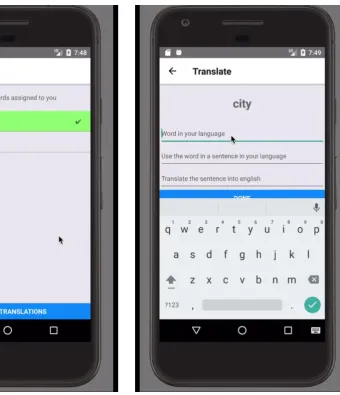
Figure 1: Application home page.
withStartandStopbuttons. PressingStartbegins recording using the phone’s microphone andStop ends the recording and saves the audio as a WAV file. When they have filled in all of the fields, they press theSubmitbutton at the bottom of the screen and are taken back to the home screen. Now the word that they just translated is green and has a check-mark next to it (see Figure 2). They now also see a button at the bottom of the home screen that readsSubmit 1 translation(s). When they are ready to submit their completed translations, they press that button. If their phone is currently con-nected to the Internet, the translated words will be removed from the list and new words will appear. If not, they can continue translating or wait to en-ter an area with WiFi.
Figure 2: Word translation page.
3.2 Coordinator
[image:3.595.172.513.58.454.2]3.3 Consumer
A consumer who visits the Community Language Portal navigates to a part of the website providing a picture gallery of everyday and cultural artifacts. As she looks through the pictures and their cap-tions, she notices that the word for water pitcher has a different form than is used in her village. She clicks on the ‘Contribute’ button, and is able to either leave a comment about the caption or go through the sign-up process to become a contribu-tor. The coordinator reviews her submission, and, if appropriate, adds her to the contributors, later sending out more invitations to contribute.
4 Implementation Details
Users of the application only see information rele-vant to their current task, but all user and language data is stored and managed in a remote database. The application communicates with a CherryPy web server, which acts as the glue between these two components. For example, consider the Konni contributor trying to submit some translations. Be-fore doing anything, the user must first sign in. To avoid having to manage passwords we require users to connect to the application using a Google account. Then the application communicates with Google’s Authentication Server using the OAuth 2.0 protocol to retrieve an authentication token that uniquely identifies the user. When the con-tributor pressesSubmit, the phone will first store the translation information locally and wait until it enters an area with a strong Internet connec-tion. Once connected, it then sends an HTTP re-quest to the web server containing the translations to be submitted (multiple translations are batched together for efficiency), as well as the authentica-tion token. Upon receiving the request, the server uses the token to verify that the user exists and has the proper permissions. It then adds the transla-tions to the database and queries it for a new set of untranslated words. Finally the server responds to the application indicating that the submission was successful and containing the new words.
At the lowest level of the application stack is a MySQL database that is responsible for storing user information and translations. It consists of three tables: wordsfor the words that are to be translated, users for all the application users, and translations for all submitted transla-tions, both reviewed and unreviewed. An entry in words contains the word itself, as well as other
grammatical information, such as part-of-speech. The users table contains users’ names, their Google authentication tokens, their roles (contrib-utor or coordinator), and the maximum number of words that can be assigned to them. Each row in translationsconsists of the word translated to the target language, a sentence containing the word in the source language, the same sentence translated, paths to audio files containing record-ings of the word and sentence, and a flag indicat-ing whether the translation has been accepted.
This is a natural division of the data that al-lows the tables to grow independently of one an-other (e.g. adding a new user only affects the userstable). However, we often want to make queries that depend on information from multi-ple tables, such as searching for words with no accepted translations that are assigned to fewer than three users. To facilitate these searches we also introduce links between the tables. A word can have multiple translations, but each translation corresponds to exactly one word, so words and translations have a 1-many relation. Sim-ilarly, because a user may have many submitted translations, and each translation was submitted by one user,usersandtranslationsalso have a 1-many relation. On the other hand, a word can be assigned to several users, and a user may have multiple assigned words, so words andusers have a many-many relation.
5 Current Developments
With this groundwork laid on the application, we are expanding other aspects of the project. Since one of our primary goals is to engage community members, we are pursuing more ways for them to engage with the software and data. To that end, we are designing a discussion board for raising ques-tions about accepted materials, asking for clarifi-cation on words, debates, polls, and so forth. Any-one from the community will be able to use this software. In short, we aim to leverage successful examples of online community building to further language description and documentation.
from both groups, so they should be able to mark which users belong to which sub-communities in the database. At the moment, we have back-end functionality for this sub-grouping of words and users, but no way for a coordinator to interact with this feature from the application. In the meantime, words are assigned to users automatically.
Having a way for a coordinator to assign words to specific users will also be an important feature. It is very likely that contributors will sometimes be working in areas with a lot of background noise, and not everyone will have a phone that can record high-quality audio. Giving coordinators the abil-ity to reassign words to users who they know can record with better sound quality will ensure high-quality data, which can then be used later in lin-guistic analysis.
References
Eric Albright and John Hatton. 2008. Wesay: A tool for engaging native speakers in dictionary build-ing. Documenting and revitalizing Austronesian languages, (1):189.
Martin Benjamin and Paula Radetzky. 2014. Small lan-guages, big data: Multilingual computational tools and techniques for the lexicography of endangered languages. InProceedings of the 2014 Workshop on the Use of Computational Methods in the Study of Endangered Languages, pages 15–23.
Steven Bird, Florian R Hanke, Oliver Adams, and Hae-joong Lee. 2014. Aikuma: A mobile app for col-laborative language documentation. InProceedings of the 2014 Workshop on the Use of Computational Methods in the Study of Endangered Languages, pages 1–5.
J.B. Casagrande and K.L. Hale. 1967. Semantic Re-lationships in Papago Folk-Definitions. In Studies in Southwestern Ethnolinguistics, pages 165–193. Mouton, The Hague.
M. Laughren and D. Nash. 1983. Warlpiri dictio-nary project: Aims, method, organization and prob-lems of definition. Papers in Australian Linguistics, 15(1):109–133.
Johann-Mattis List, Michael Cysouw, and Robert Forkel. 2016. Concepticon: A resource for the link-ing of concept lists. InProceedings of the Tenth In-ternational Conference on Language Resources and Evaluation, May 23-28, 2016, Portoroˇz, Slovenia, pages 2393–2400.