Open Research Online
The Open University’s repository of research publications
and other research outputs
Exploring the Implementation of Online Non-Formal
Project-Based Language Learning in the Indonesian
Context
Thesis
How to cite:Sampurna, Jessica (2019). Exploring the Implementation of Online Non-Formal Project-Based Language Learning in the Indonesian Context. PhD thesis. The Open University.
For guidance on citations see FAQs.
c
2019 The Author Version: Version of Record
Copyright and Moral Rights for the articles on this site are retained by the individual authors and/or other copyright owners. For more information on Open Research Online’s data policy on reuse of materials please consult the policies page.
Exploring the implementation of online
non-formal project-based language learning
in the Indonesian context
Jessica Sampurna
A thesis submitted to The Open University, UK
for the degree of Doctor of Philosophy
Faculty of Wellbeing, Education, and Language Studies
January 2019
Abstract
Proficiency in English is highly valued in Indonesia. Consequently, the low language attainment amongst learners despite years of compulsory English classes has been a cause for concern. This qualitative study explores the use of multiple Web 2.0 technologies (Facebook, WhatsApp, Google Docs, and LINE) to facilitate non-formal English language teaching and learning in Indonesia. Project-based language learning (PBLL) was chosen as the pedagogy to create meaningful opportunities for target language use and practice beyond the classroom.
Taking on a dual role as a teacher and researcher, I carried out two rounds of data collection (four weeks each) which involved a total of 21 undergraduate students from across Indonesia. Participants were asked to collaboratively create the contents for an English learning website targeting elementary-school children. Adopting the role of a facilitator, I provided extensive support, guidance and encouragement. Rich online data were gathered from all of the Web 2.0 tools employed in the study. In addition, data were collected from a research diary, learners’ reflections, and post-study interviews. All data were subsequently analysed using qualitative content analysis within an interpretivist paradigm.
The findings show that many learners may not be ready for, or readily engage with, the student-centred learning approach championed by PBLL. This is evidenced by generally low levels of learner participation. Learners reported several obstacles to their
engagement during the project: language anxiety; external commitments beyond the project; and technological issues. A minority of participants who persevered, and participated actively, successfully produced their chosen artefact within the study time frame. PBLL afforded four types of language learning opportunities: form-focused instruction, peer review, interaction in the target language, and collaborative dialogue.
Learners’ feedback reveals that they viewed their online non-formal PBLL experiences differently: What some learners considered positive aspects of the project, could be considered negative or challenging by others, and vice versa. Despite this, all learners agreed that the project benefited them albeit in different ways.
The study makes a valuable contribution to the literature on PBLL, offering new insights regarding its integration into online teaching and learning in a non-formal context. The study is unique as it closely scrutinises both the complexities of implementing online PBLL in non-formal education and navigating various digital technologies in the process of language teaching and learning. The demands for English language learning in Indonesia and similar countries, are vast and consequently the implications of this study are relevant for a number of educational contexts. In recognition of this, strategies are suggested to assist the implementation of non-formal online PBLL in the future.
Acknowledgements
I am indebted to my brilliant supervisors, Dr Ursula Stickler, Prof Agnes Kukulska-Hulme, and Prof Regine Hampel, for their invaluable advice, support and constructive feedback during the course of this project and the writing of this thesis.
I am grateful beyond words to colleagues who helped to distribute my online questionnaire and the students who participated in this study. Without them this research would not have been possible.
I am also deeply grateful to the Leverhulme Trust, for without the funding, I would not have been able to realise this dream.
And finally, the biggest debt of gratitude of all is to my husband Allen. For believing in me, for his unconditional support, and for encouraging me when it all gets a bit too much. I am finally finished, no more writing in the weekends!
Table of Contents
Abstract... i Acknowledgements ... iii Table of Contents ... iv List of abbreviations ... ix List of tables ... x List of figures ... xi Chapter 1 Introduction... 11.1 Overview of the chapter ... 1
1.2 Context and the position of English in Indonesia ... 1
1.3 English language teaching and learning in Indonesia ... 3
1.3.1 Challenges ... 5
1.3.1.1 Teacher expertise ... 5
1.3.1.2 Non-communicative national exams... 6
1.3.1.3 Students’ characteristics ... 7
1.3.1.4 Inequality ... 7
1.3.2 Improving English language teaching and learning in Indonesia ... 9
1.3.2.1 Integrating internet and mobile technology ... 9
1.3.2.2 Implementing group work ... 10
1.3.2.3 Integrating English into daily life ... 11
1.4 Research rationale and purpose... 11
1.5 Summary ... 13
Chapter 2 Literature Review... 14
2.1 Introduction ... 14
2.2 Learning theory ... 14
2.2.1 Constructivism ...16
2.2.2 Implications of constructivist learning theory in education ...18
2.2.3 Constructivist approaches to L2 learning and teaching ...19
2.3 Second language learning theories... 20
2.3.1 Interactionist and sociocultural models ...21
2.3.1.1 Form-focused instruction (FFI) ... 22
2.3.1.2 Peer review ... 23
2.3.1.3 Interaction in the target language... 25
2.3.1.4 Collaborative dialogue and language-related episodes (LREs) ... 25
2.3.2 Collaborative tasks and language learning ...26
2.4 ICTs and Web 2.0 tools in education ... 27
2.5 Web 2.0 tools in L2 education ... 29
2.5.1 Facebook... 29
2.5.2 Google Docs ... 39
2.5.3 Messaging apps (WhatsApp and LINE) ... 44
2.5.4 Multiple technologies ... 48
2.6 Project-based learning (PBL) ... 48
2.6.1 Definition of PBL ...48
2.6.2 PBL and other pedagogical approaches ...49
2.6.2.1 Project- vs. problem-based learning ... 49
2.6.2.2 PBL vs task-based learning (TBL) ... 50
2.6.3 Principal features of PBL ...50
2.6.3.1 Authenticity ... 50
2.6.3.3 Student-centred learning ... 52
2.6.3.4 Formative assessment... 52
2.6.3.5 Reflection ... 53
2.6.3.6 Public artefacts ... 53
2.6.3.7 Driving questions... 53
2.6.3.8 Cooperation and/or collaboration ... 54
2.6.4 The implementation of PBL ... 55
2.7 Project-based language learning (PBLL) ... 56
2.7.1 Definition of PBLL ... 56
2.7.2 Previous research on the implementation of PBLL in various contexts ... 56
2.8 Non-formal education... 63
2.8.1 Definition of non-formal education ... 63
2.8.2 Features of non-formal education ... 64
2.8.3 The value of non-formal education ... 66
2.8.4 Technology in non-formal education... 67
2.8.5 L2 teaching and learning in non-formal education... 68
2.9 Summary and limitations of the reviewed literature ... 70
2.10 Research questions ... 72
Chapter 3 Methodology ... 74
3.1 Introduction ... 74
3.2 Purpose of study and research questions ... 74
3.3 Research methodology and design ... 75
3.3.1 The Basic-Applied continuum ... 75
3.3.2 The Exploratory-Confirmatory continuum ... 76
3.3.3 The Qualitative-Quantitative continuum... 77
3.4 Positioning of the research questions in the Qualitative-Quantitative continuum ... 77
3.4.1 Research question 1: what happens when project-based language learning is implemented online in a non-formal education context? ... 77
3.4.2 Research question 2: what language learning opportunities does online non-formal project-based language learning afford learners? ... 78
3.4.3 Research question 3: what are Indonesian learners’ views on their online non-formal project-based language learning experience? ... 80
3.5 Philosophical stance: interpretivism and constructivism ... 81
3.6 Research sample... 82
3.7 Research procedures ... 87
3.8 Overview of project implementation... 90
3.8.1 Introduction of additional Web 2.0 tools ... 91
3.8.2 Change of ice-breaker activity ... 93
3.8.3 Modification to learners’ reflection activity ... 93
3.9 Data collection ... 94 3.9.1 Online data ... 95 3.9.1.1 Facebook ... 96 3.9.1.2 WhatsApp ... 97 3.9.1.3 Google Docs ... 98 3.9.1.4 LINE ... 100 3.9.2 Research diary ... 100 3.9.3 Semi-structured interviews... 101 3.9.4 Learners’ reflection ... 104 3.10 Data analysis ... 105
3.10.1 Qualitative content analysis ... 105
3.10.1.1 Data analysis methods addressing research question 1 ... 106
3.10.1.2 Data analysis methods addressing research question 2 ... 107
3.10.1.3 Data analysis methods addressing research question 3 ... 108
3.10.2.1 Preparation stage ... 110 3.10.2.2 Organising stage ... 110 3.10.2.2.1 Inductive approach ... 110 3.10.2.2.2 Deductive approach ... 114 3.10.2.3 Reporting stage ... 115 3.11 Ethical considerations ... 115 3.11.1 Macroethics ...115
3.11.1.1 Respect for persons ... 115
3.11.1.2 Beneficence ... 116
3.11.1.3 Justice ... 117
3.11.2 Microethics ...117
3.12 Researcher positionality ... 119
3.13 Trustworthiness of the research... 122
3.13.1 Credibility (in preference to internal validity) ...122
3.13.2 Transferability (in preference to external validity or generalisability) ...124
3.13.3 Dependability (in preference to reliability) and confirmability (in preference to objectivity) ...124
3.14 Summary ... 124
Chapter 4 Findings: What happens when project-based language learning is implemented online in a non-formal education context ... 126
4.1 Introduction ... 126
4.2 To what extent do learners and the teacher participate and contribute? ... 127
4.2.1 Per Web 2.0 tool ...128
4.2.1.1 Facebook... 128 4.2.1.2 WhatsApp ... 129 4.2.1.3 Google Docs ... 129 4.2.1.4 LINE ... 132 4.2.2 Per study ...132 4.2.2.1 Study A ... 133 4.2.2.1.1 Group A1 ... 136 4.2.2.1.2 Group A2 ... 138 4.2.2.2 Study B ... 140 4.2.2.2.1 Group B1 ... 142 4.2.2.2.2 Group B2 ... 144 4.2.2.2.3 Group B3 ... 147 4.2.2.2.4 Group B4 ... 148
4.3 How do learners and the teacher interact with each other?... 151
4.3.1 Interaction patterns – deductive analysis ...151
4.3.2 Interaction patterns – inductive analysis ...154
4.3.2.1 Facebook... 154
4.3.2.2 Chat tools ... 156
4.3.2.2.1 WhatsApp ... 157
4.3.2.2.2 LINE ... 157
4.3.2.2.3 Google Docs chat ... 157
4.3.2.3 Google Docs comment ... 157
4.4 How do learners and the teacher use Web 2.0 tools? ... 159
4.5 What obstacles do learners encounter? ... 161
4.5.1 Language anxiety ...161
4.5.2 Other commitments outside the project ...163
4.5.3 Technological issues ...164
4.5.4 Preference to work alone ...165
4.6 How does the teacher support learners? ... 167
4.6.1 Teacher acting as a facilitator ...167
4.6.1.1 Interpersonal support... 167
4.6.1.2.1 Organising and modifying tasks ... 173
4.6.1.2.2 Encouraging collaboration ... 175
4.6.2 Teacher acting as an expert ... 179
4.6.2.1 Advice to first focus on content over language ... 179
4.6.2.2 Feedback on content... 179
4.6.2.3 Feedback on language... 184
4.7 Summary ... 184
Chapter 5 Language learning opportunities afforded by online non-formal project-based language learning ... 186
5.1 Introduction ... 186
5.2 Teacher’s form-focused instruction (FFI)... 187
5.3 Peer review ... 192
5.3.1 Intragroup feedback ... 192
5.3.2 Intergroup feedback ... 193
5.4 Interaction in the target language ... 202
5.5 Collaborative dialogues and language-related episodes (LREs) ... 203
5.5.1 LRE-induced form-focused instruction ... 207
5.6 Summary ... 209
Chapter 6 Learners’ views on their online non-formal PBLL experience ... 210
6.1 Introduction ... 210
6.2 Collaboration ... 211
6.2.1 Participation and contribution ... 211
6.2.2 Communication and interaction ... 214
6.2.3 Peer review ... 216 6.3 Teacher support ... 218 6.3.1 Teacher presence ... 218 6.3.2 Teacher feedback ... 220 6.3.3 Teacher roles ... 221 6.4 Web 2.0 tools ... 222
6.4.1 Use of Web 2.0 tools ... 222
6.4.2 Technology literacy ... 224
6.5 Other project design features ... 225
6.5.1 Task ... 225 6.5.2 L2 use ... 227 6.5.3 Reflections... 229 6.6 Outcomes ... 230 6.6.1 Affect ... 230 6.6.2 L2 benefits ... 232 6.6.3 Non-L2 benefits ... 233 6.7 Summary ... 234 Chapter 7 Discussion ... 237 7.1 Introduction ... 237
7.2 Lack of student-centred learning ... 237
7.3 Prominence of the teacher ... 242
7.3.1 Implications of the lack of student-centred learning and the prominence of the teacher ... 244
7.4 Web 2.0 tools use ... 248
7.4.1 Implications ... 250
7.5 Language learning opportunities ... 251
7.5.1 Interaction in the target language ... 251
7.5.1.1 Implications ... 252
7.5.2.1 Implications ... 255
7.5.3 FFI ...256
7.5.3.1 Implications ... 256
7.5.4 Collaborative dialogue and LREs ...257
7.5.4.1 Implications ... 259
7.6 Summary ... 259
Chapter 8 Conclusion ... 262
8.1 Introduction ... 262
8.2 Major findings of the research ... 262
8.2.1 What happens when PBLL is implemented online in a non-formal education context? ...262
8.2.2 What language learning opportunities does online non-formal PBLL afford learners? ...263
8.2.3 What are Indonesian learners’ views on their online non-formal project-based language learning experience? ...263
8.3 Unique contribution of the research ... 263
8.4 Limitations of the study and recommendations for future research ... 264
8.5 Recommendations for practice ... 266
8.6 Conclusion of the thesis ... 269
References ... 270
Appendices ... 298
Appendix A – Online questionnaire (English version) ... 298
Appendix B – Email invitation to participate in my study (English version) ... 302
Appendix C – WhatsApp invitation to participate in my study ... 304
Appendix D – Project implementation ... 305
Appendix E – Research diary ... 312
Appendix F – Interview questions ... 313
Appendix G – Final group artefacts ... 315
Appendix H – Patterns of interaction ... 324
WhatsApp ...324
LINE ...325
Google Docs chat ...325
List of abbreviations
CLT Communicative Language Teaching EFL English as a Foreign Language ELT English Language Teaching
ELTL English Language Teaching and Learning ESL English as a Second Language
FFI Form-Focused Instruction GD Google Docs
I Interview (only in Chapter Six)
ICT Information and Communication Technology L1 The First Language
L2 The Second Language (used interchangeably with the foreign language) LR Learners’ Reflection
LRE Language-Related Episodes
OECD Organisation for Economic Co-operation and Development PBL Project-Based Learning
PBLL Project-Based Language Learning
SLA Second Language Acquisition (used interchangeably with second language learning)
TBL Task-Based Learning
ZPD Zone of Proximal Development DMC Directed Motivational Current
List of tables
1.1 ELT curricula in Indonesia 3
2.1 Focus on form versus FFI 22
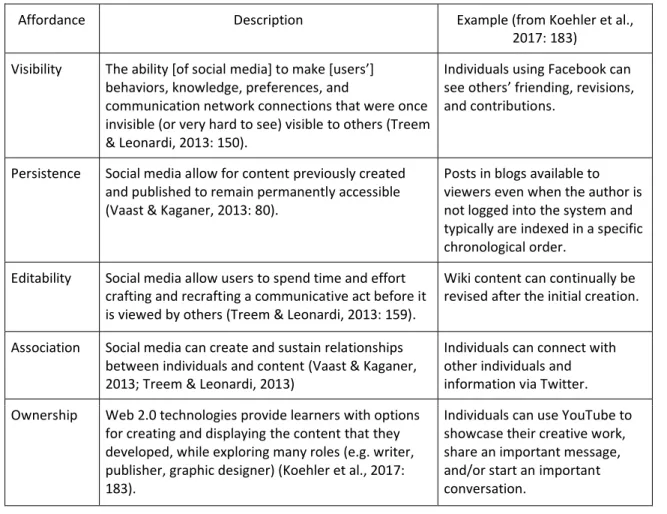
2.2 Overview of Web 2.0 affordances 28
2.3 Formal, non-formal, and informal education 65
3.1 Number of participants in Study A and B 87
3.2 Profile of participants 87
3.3 Project plan 91
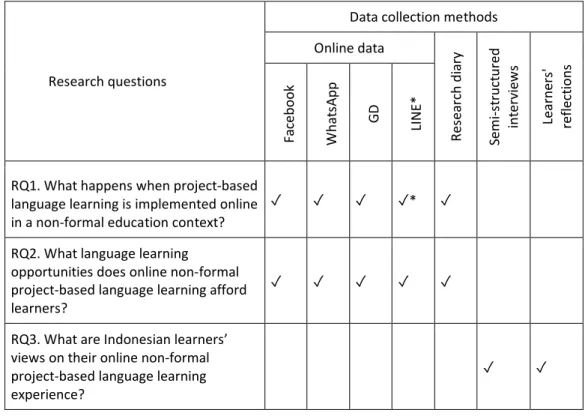
3.4 Data collection methods 95
3.5 Affordances of Web 2.0 tools used in this study 96 3.6 The number of WhatsApp group chats in Study A and B 99
3.7 Learners’ chosen interview language 104
3.8 Summary of data analysis methods for each research question 110
3.9 Organising stage — inductive analysis 113
3.10 Organising stage – deductive analysis 115
4.1 Summary of artefacts produced by each group 133
4.2 Differences in teacher contribution to learners' GD in Study A 135 4.3 Summary of participation and contribution amongst Group A1 members 137 4.4 Summary of participation and contribution amongst Group A2 members 140 4.5 Summary of participation and contribution amongst Group B1 members 145 4.6 Summary of participation and contribution amongst Group B2 members 148 4.7 Summary of participation and contribution amongst Group B3 members 149 4.8 Summary of participation and contribution amongst Group B4 members 151 4.9 Interaction patterns identified using deductive analysis 154 4.10 Use of Web 2.0 tools by the teacher and learners 161 4.11 Summary of what happens when PLL is implemented online in a
non-formal education context
186
5.1 The number of language-focused comments received by each group during intergroup feedback session
200
List of figures
2.1 Theories informing my study and the three elements of my research 14
2.2 Storch's (2002) model of dyadic interaction 43
2.3 Examples of LINE stickers in Indonesian 46
2.4 The implementation of PBL in three steps 56
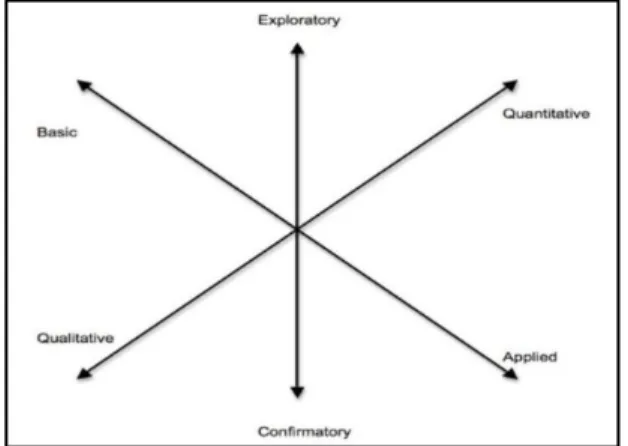
3.1 Perry's (2005) three design continua for classifying research 76
3.2 Process of qualitative content analysis 111
4.1 What happens when PBLL is implemented online in a non-formal education context
127
4.2 Facebook — rates of participation and contribution 129 4.3 WhatsApp — rates of participation and contribution 130 4.4 GD — rates of participation and contribution 131 4.5 LINE — rates of participation and contribution 133 4.6 Interaction patterns on Facebook in Study A and B 157 5.1 Language learning opportunities afforded by online non-formal PBLL 188 6.1 Learners' views on their online non-formal PBLL experience 212
Chapter 1 Introduction
1.1 Overview of the chapter
This chapter introduces readers to the thesis. It begins by presenting the research
context, followed by constraints affecting English language teaching and learning (ELTL) in Indonesia, as well as strategies implemented to alleviate these constraints. Against this backdrop, the development of the research aim is briefly described.
1.2 Context and the position of English in Indonesia
Indonesia is the fourth most populous country in the world, with an estimated population of 265 million (Worldometers, 2018). It consists of over 17,000 islands, stretching along the equator between Southeast Asia and Australia, with more than 700 languages spoken by different ethnic groups.
Historically, Indonesia was occupied by the Dutch for over 350 years and then Japanese for 3 years, before finally winning its independence in 1945. Bahasa Indonesia (the Indonesian language), derived from the Malay language, was first introduced as the official language at the first Indonesian Youth Congress in 1928. The 1945 Constitution cemented the status of Bahasa Indonesia as the official national language. Bahasa Indonesia was and continues to be seen as a unifying tool amongst the ‘potential danger of ethnic divisions and conflicts occurring in such a large and diverse nation’ (Paauw, 2009: 5). To foster the use of Bahasa Indonesia, it is taught as a compulsory subject at all levels of education; as a result most Indonesians speak Bahasa Indonesia and at least one regional language (Lie, 2017). Standard (‘correct’) Bahasa Indonesia is used in formal situations, e.g. in speeches and official documents, but in daily life colloquial Bahasa Indonesia is more commonly used.
English was chosen as the first foreign language to be taught in Indonesian schools over Dutch because the latter was considered the language of colonialists and did not have an international status (Lauder, 2008; Lie, 2007). Indonesian policy makers, however, seem to have a ‘love-hate view of English’ (Lauder, 2008: 14). On the one hand, English has been framed as an essential tool to accelerate development and economic growth. On
the other hand, the spread of English has been associated with the threat of western
‘liberalvalues’ which could erode Indonesian culture, values, and behaviour (ibid.). This anxiety could be the primary reason for the closing of international standards schools, which use English as their medium of communication, and for reducing English
instructional hours in high schools in the latest 2013 curriculum (Lie, 2017).
Despite the inconsistent policy on the use of English, such as banning businesses from using foreign names and requiring them to be changed into Bahasa Indonesia in 2000 and then lifting the ban a few years later, English is generally viewed as a language of prestige and power (Lie, 2017). Moreover, English is a form of cultural capital (Lamb, 2011) and is often a requirement for securing a favourable job (Lie, 2007). The majority of learners are aware of the importance of English and therefore motivated to learn (Jaliyya & Idrus, 2017; Yulia, 2014). These days it is not uncommon to hear English words sprinkled into Bahasa Indonesia. More recently, phrases consisting of a hybrid of English and Bahasa Indonesia, such as kids zaman now (young people nowadays), became widely popular amongst the general public, the press, and even politicians. The politicians’ use of code-mixings in formal forums has attracted criticism from those who are concerned that Bahasa Indonesia will slowly be undermined (Eroby, 2017).
Inconsistent government investment in English language education may be one of the causes for the low English attainment in Indonesia. According to the English Proficiency Index (EPI)1 published by Education First (EF), an international education company,
Indonesia has Low Proficiency and ranks 39, well below its neighbouring countries such as Malaysia at 13 and the Philippines at 15 (EF, 2018). Low Proficiency in this index means most Indonesians are not yet able to use English to participate in meetings in their area of expertise, understand song lyrics, and write professional emails on familiar subjects, all of which are skills that individuals should possess in the Moderate Proficiency level, i.e. the next level up from Low Proficiency (ibid.). Lie (2017) cautions that the quality of the EF EPI is still debatable, but concedes that it is the only available reference that uses a large
1 The EF EPI is based on test data from more test takers who completed the EF Standard English Test (EF
SET), which is an online, adaptive English test of reading and listening skills. The High, Moderate, and Low Proficiency bands correspond to CEFR level B1, with each band corresponding to a single EF course level (EF, 2018: np).
number of test-takers to compare adult English proficiency where English is not a native language.
Indonesia has been successful in implementing its national language policy, but this was possibly achieved at the cost of Indonesians’ mastery of English, which consequently reduced Indonesia’s ability to compete and participate effectively in the global world (Paauw, 2009). The next section will therefore look at the history of ELTL in Indonesia as well as the potential impacts of language policy on students’ motivation and skills.
1.3 English language teaching and learning in Indonesia
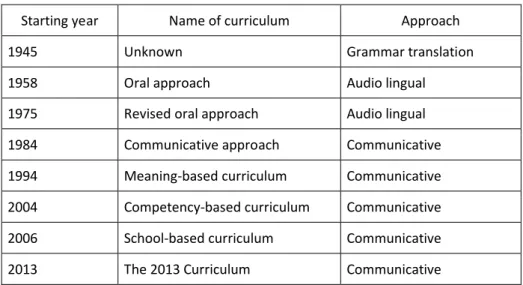
The English teaching curriculum in Indonesia has been changed eight times using three different approaches (Ariatna, 2016; Lie, 2007, 2017; Murniati & Riyandari, 2016; Sahiruddin, 2013) as can be seen in Table 1.1.
Table 1.1 ELT curricula in Indonesia
Starting year Name of curriculum Approach
1945 Unknown Grammar translation
1958 Oral approach Audio lingual
1975 Revised oral approach Audio lingual
1984 Communicative approach Communicative
1994 Meaning-based curriculum Communicative
2004 Competency-based curriculum Communicative
2006 School-based curriculum Communicative
2013 The 2013 Curriculum Communicative
In the early days, the primary goal of English instruction was to develop students’ reading skills so that they can read English textbooks (Renandya, 2004). This, however, was deemed unsuccessful and Indonesian policy makers responded by adopting a
communicative approach designed to improve communicative competence, defined by Canale and Swain (1980: 20) as
a synthesis of knowledge of basic grammatical principles, knowledge of how language is used in social settings to perform communicative functions, and
knowledge of how utterances and communicative functions can be combined according to the principles of discourse.
The 1984 curriculum was proclaimed to be communicative, but the syllabi were actually still structurally oriented with priority given to linguistic instead of communicative
competence (Lie, 2007). The 1994 curriculum also aimed to develop communicative skills whereby students were taught using textbooks containing themes selected and created by the central government (Murniati & Riyandari, 2016; Sahiruddin, 2013). However, the curriculum consisted of a list of topics and grammatical features at a sentence-based level (Madya, 2008) and the focus of teaching was still on a cognitive knowledge of English (Kasihani 2000, cited in Murniarti & Riyandari, 2016). The 2004 curriculum aimed to develop communicative competence and intercultural understanding, but teaching practices remained similar to those in previous periods (Lie, 2007). The 2006 curriculum was similar to the 2004 curriculum and emphasised the development of English
competences through the communicative approach. It marked the Indonesian
government’s attempts to decentralise education by giving schools and teachers
autonomy to develop their own curriculum and teaching materials as long as they meet standards developed by the central government. Nevertheless, the local authority lacked the capacity to assume responsibilities given by the central government, creating role confusion among district staff and individual schools. The 2006 curriculum was very general, so teachers were unsure of what to teach and unable to create lesson plans that were suitable for the characteristics of their local school and students (Yulia, 2014). It has been suggested that too much freedom was given to Indonesian teachers, who were deemed to have very low competence by the Indonesian curriculum makers, and this was believed to be the cause of poor educational outcomes following the implementation of the 2006 curriculum (Yulia, 2014). Thus in the 2013 curriculum the Indonesian
government reduced teachers’ freedom in implementing the curriculum and resumed control by providing more training to ensure consistency (Coleman, 2014). This
curriculum emphasises moral education instead of competencies (Murniati & Riyandari, 2016). The 2013 curriculum also aims to eliminate English from primary schools and reduce English contact hours in high schools, leading to widespread criticism that this decision could reduce Indonesian children’s ability to compete internationally (Christy, 2014). Currently, however, the implementation of the new 2013 curriculum at national
level has been postponed because the Indonesian Ombudsman concluded that the ‘bad
implementation’ of the new curriculum meant that Indonesia was not ready for it (Idhom, 2014: np). Hence the majority of schools, except for approximately 6,000 schools which piloted the 2013 curriculum, are still using the 2006 curriculum (Christy, 2014).
Overall, English curricula in Indonesia, which since 1984 have been aiming to develop communicative competences, have been continuously reviewed and updated.
Nevertheless, learning outcomes are still disappointing (Lie, 2017; Yulia, 2014) due to various issues, which will be discussed next.
1.3.1 Challenges
Prevailing conditions, namely teacher expertise, non-communicative national exams,
students’ characteristics, and inequality, pose challenges for English language learning and teaching in Indonesia.
1.3.1.1 Teacher expertise
Many English language teachers in Indonesia have a poor command of English themselves and are unable to be good models of English language due to their low English proficiency (Marcellino, 2008; Yulia, 2014). The majority of teachers in Yulia’s (2014) study used Bahasa Indonesia, sometimes mixed with the local language, to teach English in class and claimed that they did this to help students understand teaching materials better;
however, survey data from the same study showed that nearly 71% of students actually wanted their teachers to use English inside and outside the classroom.
In addition to their already heavy workload, low salaries mean that some Indonesian teachers have to take on a second job, which leaves little time to enhance their own competencies and the quality of their teaching (Lie, 2007). Few teachers actively attend professional development sessions offered by the district and teachers’ association, either because of their busy schedule or because the training takes place far away from where they live (Yulia, 2014).
Many teachers do not have the confidence or ability to create their own teaching materials, and some are incapable of using the available resources (e.g. WiFi, computer laboratory) to support their teaching (Yulia, 2014). Thus they rely on textbooks, which are generally grammar-based, to determine what and how to teach (Ariatna, 2016; Fadilah, 2018).
Teachers’ inadequate knowledge of communicative pedagogies, combined with their narrow interpretation of the newer curricula, ‘seem to have influenced, if not overtly encouraged, the retention of traditional approaches to pedagogy’ (Sulfasyah, Haig, & Barratt-Pugh, 2015:53). For example, writing classes observed by Sulfasyah et al. (2015) were teacher-centred and followed the typical initiation, response and feedback pattern with little interaction between students. Class activities included copying sentences or a poem from the board, reading from textbooks, making simple sentences based on a text, writing sentences on the board, and writing sentences as a dictation exercise. Writing assessment was based on product, not process, and focused on surface-level skills, e.g. neat handwriting and punctuation, regardless of the type of writing being completed (ibid.).
1.3.1.2 Non-communicative national exams
The policy in which the curriculum is embedded only sets guidelines of standards to achieve but not what and how to teach. All students have to take the same high-stakes national exam regardless of their method of learning. Even though the more recent curricula aim for communicative competence that includes both receptive (reading and listening) and productive (speaking and writing) skills, the main skill tested is reading and the exam is comprised of reading passages leading to vocabulary and grammar questions (Aziez, 2011) presented in a predominantly multiple-choice format (Furaidah, Saukah, & Widiati, 2015). Teachers are under pressure to help students gain good scores in the national exam. If students fail the exam, teachers are often blamed by their principals, who in turn are blamed by the district officials (Yulia, 2014). This situation drives teachers to teach to the test and drill students to do the test in ‘smart and quick ways’ (ibid., 216). Sometimes the drilling activities, typically consisting of practising to answer multiple-choice questions from textbooks, are not only used by final grade teachers who are
preparing their students for the national exam, but also by other teachers in lower grades whose students are not due for the exam in a few years’ time (Furaidah et al., 2015). Drills, however, do not adhere to Communicative Language Teaching (CLT) principles which emphasise authentic communication in the target language (Nunan, 1991).
Listening and speaking skills are often ignored as they are not tested in the national exam (Yulia, 2014).
1.3.1.3 Students’ characteristics
Owing to the prevalence of teacher-centred lessons, Indonesian learners are often passive in class (Mattarima & Haddam, 2011, cited in Nichols, 2014) because they expect knowledge transfer from teachers (Marcellino, 2008). Some students are uncritical and compliant with the teacher’s approach because they consider it impolite to question or interrupt an older person (ibid.). Students are often anxious about making mistakes for fear of being laughed at by their peers (Juhana, 2012; Muamaroh, 2013). Consequently, they choose to be silent and inactive in class (Fadilah, 2018). Many students are neither confident nor accustomed to using English. Pre-service teachers in Muamaroh’s (2013) study used Bahasa Indonesia in English classes, even when they were aware that the class activities specifically targeted their speaking skills. They discussed speaking tasks in Bahasa Indonesia or their local language and when their teacher approached, they switched into English (ibid.). Sometimes students want and can speak English, but they refrain from doing so for fear of being ridiculed by their peers for ‘showing off or trying to be a westerner’ (Lamb, 2011: 11). Such barriers could hamper the implementation of CLT which requires active participation from students. Another implication of this teacher-centred education is that Indonesian students rarely work in pairs or groups (Muamaroh, 2013; Rezeki, 2016). This is unfortunate because pair and group work can facilitate interaction, which is crucial for language learning (Ellis, 2012a).
1.3.1.4 Inequality
Compared to their rural counterparts, schools in big cities usually have better resources, such as a language laboratory and internet connection, which allow students to access a variety of learning activities, for example listening to audiotapes, or reading authentic materials online. Meanwhile, some schools in poor areas do not even have electricity.
Teachers in big cities are also more likely to be better qualified than those in remote schools (Fadilah, 2018; Lie, 2007).
Parents from comfortable socio-economic backgrounds often have good English proficiency themselves, and thus can serve as English conversation partners to their children (Lamb, 2011). Also, these parents can afford to provide their children with a variety of additional learning opportunities, such as private courses, exposure to western TV channels, music, or summer school in an English-speaking country (Fadilah, 2018; Lie, 2007). Some teachers and learners consider private courses, not schools, as a requisite for successful English learning in Indonesia (Lamb, 2011). In some schools, ‘more motivated’ students are selected for elite ‘acceleration’ or ‘excellence’ class, with advantages such as slightly more intensive English classes, better classroom conditions, and more competent teachers, which consequently increase their motivation,
self-confidence, and language achievement (ibid.,16). Lamb’s (2011) longitudinal study in rural Indonesia shows that learners who are supported by their family to exploit language learning opportunities outside school make significant language gains over the six years of schooling. In the long run, inequality in ELT could widen the socio-economic disparity in Indonesia because English ‘is used as a common gate-keeping device in both academia and the jobs market’ (ibid.,18). This made the reduction of compulsory English teaching hours at schools in the 2013 curriculum even more worrying as it is students from poorer families with no access to additional learning resources who will be mostly affected by the change.
In my personal experience English language proficiency has helped open many doors, both in a personal and professional capacity. Because of these positives experiences, I have been acutely aware of, and disappointed by, the persistent inequality in English learning opportunities and attainment in my home country. This sparked my interest in conducting this research. I wanted to contribute something to address this injustice by examining how access to English language education in Indonesia could possibly be widened.
1.3.2 Improving English language teaching and learning in Indonesia
Several ideas have been put forward to alleviate the challenges around ELTL in Indonesia, such as integrating internet and mobile technology into language classrooms,
implementing a group work approach to pedagogy, and integrating English into daily life.
1.3.2.1 Integrating internet and mobile technology
Unequal access to English learning resources and opportunities in Indonesia could
perhaps be alleviated by taking advantage of the rapid expansion of internet technology. It facilitates the flow of English into society, and offers new ways of, and reasons for, learning and using English (Lamb, 2011, 2013).
In 2017, Indonesia had 143.2 million Internet users, amounting to 54.7% of its total population (APJII, 2017). The most popular Internet-supported activity is the use of social media, with Facebook having the greatest number of users (APJII, 2016). In his study of
adolescents’ motivation to learn English in rural Indonesia, Lamb (2013) reported that out of ten participants, six mentioned they had learned English from the internet, either using a mobile phone, or an internet café. More specifically, four students claimed to have used Facebook and other online resources to learn English. Because Lamb’s primary aim was to examine motivation, understandably he did not elaborate on how exactly these students learned English using the internet. Still, his research illustrates the potential of exploiting internet technology to help tackle issues of limited class time and the lack of school teaching resources mentioned earlier.
In recent years, English language educators in Indonesia have attempted to bring their
students’ enthusiasm for technology and social media, especially Facebook, into their teaching. Rodliyah (2016), for example, created a Facebook Group as space for voluntary individual journal writing (on any topics of the students’ choosing) outside the classroom. However, student participation in her study was low. Djiwandono (2015) combined the use of Facebook and face-to-face classroom sessions. In his study, Facebook was used as a repository for online materials, such as videos and glossary created by the students. He identified slow internet connection and students’ inability to understand some of the
Djiwandono (2015) both encountered challenges when incorporating Facebook within their teaching, they encouraged other teachers to consider how advances in technology could be used to enhance teaching and learning.
1.3.2.2 Implementing group work
Some Indonesian researchers have investigated group work as a means of to helping students develop their communicative competence. Muamaroh (2013) conducted two stages of research to explore how to improve Indonesian pre-service teachers’ speaking skills. First, she investigated how students’ confidence in speaking English could be improved and found that pair and small group work gradually increased students’
confidence. Second, in small groups, she implemented cooperative learning techniques, i.e. Learning Together, Team-Games-Tournaments, and Student Teams Achievement, as a means of improving students’ speaking skills. Both the teachers and students struggled at the beginning of Muamaroh’s second stage of research. The teachers had difficulty applying different cooperative learning techniques because they did not have enough time to learn the new techniques. Also, they were not used to managing students in groups. The students also had to cope with learning methods, activities, and expectations that were completely new to them. Nevertheless, after three months, Muamaroh found that both teachers and students believed that cooperative learning could be useful for improving speaking skills. She also found a significant improvement in the duration of
students’ speech (but not in speaking quality). Muamaroh concluded that group work and cooperative learning could be useful for improving speaking skills in Indonesia.
Rezeki (2016) investigated Indonesian undergraduate students’ collaborative writing experiences. As some students had little experience in collaborative writing, they had difficulties in solving affective conflicts, such as domination, resistance, exclusion, and silence when collaborating. Rezeki suggested that the Indonesian collectivist culture might have influenced students’ performance as they employed strategies, such as silence, to maintain group harmony. Despite experiencing the aforementioned
challenges, students reported that collaborative writing provided them opportunities for authentic English use and helped them learn about writing and how to write in English.
Rezeki proposed that collaborative learning be implemented more widely in Indonesia, not only in writing classes, but also in reading and speaking courses.
1.3.2.3 Integrating English into daily life
As a way of addressing the limited time and English resources in the formal education system, Inayati (2015) trained her students to find authentic resources and integrate English into their daily life; for example, by listening to English-language songs, reading articles in English, and writing social media posts in English. Students in this study showed a clear preference for receptive activities (listening and viewing) to productive activities (writing and speaking), typically choosing the former over the latter in their independent study activities. Inayati (2015) was concerned by this large discrepancy as both input and output are important in language learning. She speculated that this could be because receptive activities require less effort than productive ones. On the positive side, almost all students continued their independent study even after the semester ended. Inayati concluded that training students to choose their own English exposure outside the class time was a good option for maximising learning.
The three suggestions for improving ELTL in Indonesia presented in this section are the building blocks of my research, as will be explained next.
1.4 Research rationale and purpose
My study aims to extend and enhance the teaching, and learning, of English in Indonesia by integrating internet technology and group work in students’ daily life. Drawing on
Inayati’s (2015) study, I will foreground the encouragement of students to practise productive skills. This raises the question of which technology, and which group learning pedagogy, to use.
With regards to the choice of technology, initially I chose Facebook because it is the most popular social media platform in Indonesia, and it has been widely used in second and foreign language (L2) education. In choosing a pedagogical approach, I compared various pedagogies which support the use of group learning, such as project-based learning (PBL), problem-based learning, and task-based learning. In PBL, the focus is on the creation of a
final product that can be shared with the intended audience (Railsback, 2002), whilst in problem-based learning, the focus is on problem solving (also commonly seen in PBL, but is not the foundation of the approach) (Dooly, 2010). In the context of L2 education, PBL is commonly referred to as project-based language learning (PBLL). PBLL and task-based learning both stem from the same theoretical understanding that students learn the L2 by using it for purposeful communication (Ellis, 2003), with projects being considered an extension of tasks (Bilsborough, 2013). A project with its wider scope compared to a more tightly defined task should create more opportunity for collaboration and interaction, which is currently lacking in Indonesian L2 pedagogy. Furthermore, the process of
creating a product should push learners to practise their productive skills. Thus, PBLL was chosen as the pedagogy for this study. The way I implemented PBLL means that this study is conducted under the banner of non-formal education, i.e. ‘education which takes place outside the sphere of compulsory schooling, but where there is an educational intent and planning of teaching/learning activities’ (Lafraya, 2011: 8).
Taking into account the different elements that this study is built upon, the original aim of this research was to explore the implementation of non-formal PBLL on Facebook in the Indonesian context. However, unforeseen circumstances led to two major decisions. Firstly, before the commencement of my study, some of my Indonesian colleagues raised doubts about their students’ willingness to participate in non-formal learning. Therefore, prior to my main study, I decided to conduct an online survey to assess the feasibility of conducting my research in Indonesia and to recruit research participants; this will be explained in detail in Section 3.6. Secondly, during the course of my research, unforeseen
students’ needs and preferences resulted in the addition and use of other Web 2.0 tools, namely WhatsApp, Google Docs (GD), and LINE; this will be explained in Section 3.8.1. Therefore, the aim of the research developed to encompass all the technology used in the study. Hence the study’s revised aim was to explore the implementation of online non-formal PBLL in the Indonesian context.
My study seeks to provide insights into what happens when Web 2.0 tools are used to facilitate the implementation of PBLL in a non-formal context. The potential findings would be valuable for other educators who are interested in: using internet technologies; implementing PBLL; engaging learners outside the classroom; or a combination of those.
1.5 Summary
This chapter has provided the background to contextualise the study in its specific setting. English occupies a unique position in Indonesia. It is not widely used in daily life, but it is viewed as a symbol of prestige. English attainment in Indonesia has been low because of challenges that include teachers’ low competence, non-communicative exams, students’
preference for, and familiarity with, a transmission pedagogy that conflicts with the constructivist epistemological assumptions of CLT, as well as unequal access to English language resources and education. Building on separate strategies suggested by other Indonesian educators, i.e. using internet technology, implementing group work, and integrating English into students’ daily life, I have outlined how this study aims to explore the use of Web 2.0 technologies to extend ELTL beyond the classroom in order to give students more opportunities to learn and practise their English language.
The following chapter will present the theoretical frameworks for my research, followed by a review of literature on three important aspects of my study: the use of internet technology in language education; project-based language learning; and non-formal education.
Chapter 2 Literature Review
2.1 Introduction
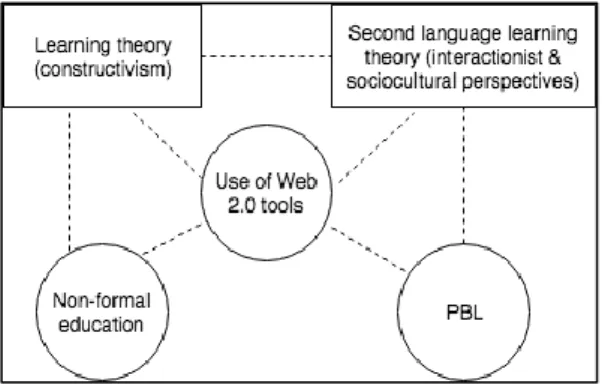
This chapter starts with an overview of the theoretical approaches which I considered from the outset of my research. First, I provide an overview of learning theories, particularly the constructivist views of learning underpinning my study. Then I discuss second language learning theories with a focus on interactionist and sociocultural perspectives, both of which influenced my research design and guided my data analysis procedures. What follows is the three elements of my study: the use of Web 2.0 tools in L2 education; project-based learning (PBL); and non-formal education.
Figure 2.1 Theories informing my study and the three elements of my research
It should be noted that the literature review is divided into five distinct strands, with research on the use of Web 2.0 tools running through non-formal education and PBLL. However, to support a focused in–depth review of the different aspects of my research, Web 2.0 tools use in L2 education is presented as a separate section.
Having considered what the research has offered to date, the chapter considers what is required with regard to future research and explicitly identifies how this thesis attempts to address the gaps in the literature. Finally, the research questions are presented.
2.2 Learning theory
Learning theories illuminate the inherently complex process of learning and provide ‘a
source of verified instructional strategies, tactics, and techniques’ (Ertmer & Newby, 2013: 44). Using learning theories as a conceptual framework, instruction can be
structured around optimising learning (Arghode, Brieger, & McLean, 2017; Eryaman & Genc, 2010). Learning theories are generally divided into three main categories: behaviourism, cognitivism, and constructivism. Although these categories have overlapping features, their differences are often highlighted to help educators select principles and conceptions which suit their particular teaching contexts (Ertmer & Newby, 2013).
Behaviourists view learning as a measurable change in behaviour through conditioning which occurs through interaction with the environment. Cognitivists view learning as an internal and active mental process which stresses information storage, processes, and retrieval (Arghode et al., 2017; Ertmer & Newby, 2013; Eryaman & Genc, 2010). Both behavioural and cognitive theories consider that ‘the world is external to the learner’ and
‘the goal of instruction is to map the structure of the world onto the learner’ (Ertmer & Newby, 2013: 54).
By contrast, constructivists do not believe that knowledge is independent from the learner. Learners actively construct their own understanding of the world based on their past knowledge, experiences, and interactions with their environments. As meaning is
created as opposed to acquired, there is not one, but multiple understandings of the world. Constructivism has become the foundation of teaching methods which involve, for example, student-centred learning, authentic learning experiences, higher order thinking, and collaborative learning (Ertmer & Newby, 2013; Eryaman & Genc, 2010; Mensah, 2015). Where behaviourist and cognitivist learning theories favour unity and truth, constructivism respects experience and relies on creativity. The concept of learning with and from each other advocated by constructivist theory can be facilitated by using
technology in education (Ertmer & Newby, 2013; Weegar & Pacis, 2012). Notwithstanding the value of behaviourist and cognitivist theories of learning, constructivist views of learning fit well with my research aims and were chosen to govern the direction of my study. The next section discusses constructivism in more detail.
2.2.1 Constructivism
Dewey (1938), Piaget (1970), and Vygotsky (1978) are the pioneers who laid the theoretical underpinnings for constructivism working in the early decades of the 20th
century. They all contend that learners construct new knowledge by connecting new information to prior experiences. Although their work focuses largely on children’s
cognitive development, their theories have also been applied to adolescent and adult learning (Blake & Pope, 2008; Hammond, Austin, Orcutt, & Rosso, 2001).
Dewey (1938) emphasises the interdependence between an individual’s needs,
experiences and the curriculum content. He saw experience as key to the learning. For Dewey, experience consists of two conditions: the internal or subjective (individual) and the external or objective (society). Continuous interaction between ‘organized logical subject matter and the psychological needs of the child in a social context fosters
universal growth’ (Dewey, 1938, as cited in Weiss et al., 2005: np). Experience generates another experience and this promotes continuity of knowledge growth (Gross & Rutland, 2017; Romi & Schmida, 2009). Dewey believes that in a democratic society, the main function of education is to improve the reasoning process and schools should prepare students for participation in social and political life. Classrooms should be treated as a microcosm of community where learners are encouraged to work together to solve shared real-life problems (Benson, 2005; Huang, 2002; Lutz & Huitt, 2004).
Similar to Dewey, Piaget also views learning as occurring through engagement with the environment. He explains that the process of coming to know occurred when there are discrepancies between learners’ existing cognitive structures and new experiences. Learners would either translate incoming information into a form that matches their existing structures (a process called assimilation), or adjust their current knowledge structures in response to the new experience (a process called accommodation). The end product of assimilation and accommodation is called equilibration which results in more effective self-regulation when processing information from the environment. Piaget also proposes four universal stages of knowledge development: sensory-motor stage
(infancy); pre-operational stage (toddler and early childhood); concrete operations (elementary and early adolescence); and formal operations (adolescence and adulthood). Assimilation, accommodation, and biological maturation advances an individual to a
higher cognitive stage (Kugelmass, 2007; Lutz & Huitt, 2004; Mensah, 2015). Piaget and Dewey both believe that the teacher’s role is as a guide rather than a director. Teachers shape learners’ real experience from the environment and allow the process of discovery rather than outcome-based teaching (Huang, 2002).
Vygotsky (1978) emphasises the role of language, culture, and social interaction in learning and development. According to Vygotsky, there are two levels of mental functions: elementary functions that individuals are born with and higher mental functions, which include ‘the creation and use of self-generated stimulation such as memory, attention, thinking and language’ (Lutz & Huitt, 2004: 72). The shift from elementary to higher mental functions is culturally mediated by tools such as language and other mediational means (e.g. works of art, various systems for counting, etc.) (Cole & Wertsch, 1996). A central aspect of Vygotsky’s account of development is the zone of proximal development (ZPD), i.e. ‘the distance between the child’s developmental level as determined by independent problem solving and the higher level of potential
development as determined through problem solving under adult guidance or in collaboration with more capable peers’ (Vygotsky, 1978: 85). Learning within the ZPD occurs through scaffolding, i.e. ‘the temporary assistance that teachers provide for their students in order to assist them to complete a task or develop new understanding, so that they will later be able to complete similar tasks alone’ (Hammond & Gibbons, 2001: 3).
Vygotsky’s social constructivism is often distinguished from Piaget’s cognitive constructivism on the basis of ‘the proximal locus of development’ (Cole & Wertsch, 1996: 250). Vygotsky is said to focus on the social processes of human development and mind whereas Piaget purportedly disregards these dimensions and focuses on individual children. The distinction, however, has been criticized as overly simplistic (Cole &
Wertsch, 1996; Stetsenko, 2016). In fact, Vygotsky also recognises the centrality of
individual construction of knowledge, and Piaget many times states the importance of the social world in knowledge development.
A more appropriate contrast between Vygotsky and Piaget concerns the role attributed to cultural mediation, i.e. ‘the mediation of action through artifacts – in the development of
mind’ (Cole & Wertsch, 1996: 250). Artifacts here could be physical (e.g. maps,
computers) or psychological (e.g. language) (Thompson, 2013), with language considered by Vygotsky 1978) as the most significant mediational tool. As cultural mediation is central to mind and mental development, ‘the meanings of action and context are not specifiable independent of each other’; this implies that mind cannot be bounded by the head or even by the body, but instead intertwined with artefacts (Cole & Wertsch, 1996: 253). This phenomenon is not observed in Piaget’s theory (Cole & Wertsch, 1996).
Despite their differences, Vygotsky, Piaget, (and Dewey) all consider the growth of human action as a dynamic system formed and expressed in actions embedded in interactions with the world. Because the world is constantly changing, all knowledge construction is related to sociocultural and relational dimensions of human development (Stetsenko, 2016; Stetsenko & Vianna, 2009; Vianna & Stetsenko, 2006). Although working within different cultural milieus (Mayer, 2009), all three scholars oppose ‘the traditional views of mind as passive container of knowledge and of learning as a process of acquiring fixed knowledge (facts and information) that are thought to exist independently of human
activity’ (Stetsenko, 2016: 154). It is clear that Vygotsky, Piaget, and Dewey advocate
learners’ active participation in knowledge creation. From this perspective, development is rooted in interaction. It follows that the opportunities for collaboration, communication (and possibly even conflict) facilitated by project-based learning are likely to help learners develop new knowledge.
2.2.2 Implications of constructivist learning theory in education
There is no one single set of recommendations on how to incorporate constructivist theories into the classroom. Nevertheless, common threads running through a constructivist approach in teaching and education can be identified. They include:
student-centred learning, in which learners are encouraged to actively design their learning plans, set their objectives, find resources, and evaluate their learning progress (Eryaman & Genc, 2010; Huang, 2002); collaborative learning, which advocate social interaction as a primary source of instruction and allow students to learn from one another (Ertmer & Newby, 2013; Huang, 2002; Lutz & Huitt, 2004); authentic learning by providing learning environments that meet real life problems, issues, or events so that
learners are exposed to a range of cognitive processes (e.g. comprehending, analysing, creating, reflecting) which are meaningful to them (Ertmer & Newby, 2013; Eryaman & Genc, 2010; Huang, 2002); and – from the teacher’s perspective –facilitating learning, which means constructivist teachers need to provide support, directions, and guidelines whilst at the same time encouraging students to question, challenge, and formulate their own ideas and opinions (Huang, 2002; Weegar & Pacis, 2012).
2.2.3 Constructivist approaches to L2 learning and teaching
Constructivist principles, which underscore the importance of learners’ active
construction of knowledge, both individually and within communities of learners, in real life-based activities have been integrated into L2 education through various pedagogical models. For example, Communicative Language Teaching, which promotes authentic interaction, language use, and engagement with authentic materials, is a ‘particular
expression of constructivist theory’ (Kobo, 2013: 24). Other teaching approaches
stemming from the constructivist theory of learning include task-based instruction (Ellis, 2003) and project-based learning (Sidman-Taveau, 2005; Simpson, 2011). In general, the constructivist approaches to L2 education requires the creation of an environment whereby linguistics knowledge is constructed through social interaction in real-life activities (John, 2016; Tarnopolsky, 2012). The emphasis on social interaction for
acquiring L2 knowledge is complementary to the interactionist and sociocultural models of second language learning theory, which will be discussed in Section 2.3.1.
In sum, constructivist principles provide the theoretical foundation supporting various aspects of my research. First, with regards to non-formal education, Dewey’s
commitment to the bond between democracy and education as well as his concept of learning by experience imply ‘unity between education and life experiences’ (Romi & Schmida, 2009: 262). Second, the integration of Web 2.0 tools, which enable social interaction and collaboration, facilitate the type of learner experiences suggested by the constructivist model of learning (Paily, 2013). Lastly, project-based language learning, with features such as student-centred learning, authentic learning, teachers as
facilitators, and collaboration, aligns with constructivist principles (Sidman-Taveau, 2005; Simpson, 2011). Having established constructivism as the theoretical framework for my
research, the next section discusses how second language learning theories, in particular the interactionist and sociocultural theory, informed the design and data analysis
procedures of this study.
2.3 Second language learning theories
The term second language broadly includes ‘any other language other than the first
language’ (Ellis, 1994: 11). This definition does not differentiate between second language learning, whereby the language is widely used in the immediate environment of the learners which enable them to easily participate in natural communication situations and
foreign language learning, whereby the language does not have a dominant role in the community where the learner lives (Ringbom, 1980). Second and foreign language learning are often subsumed under the overarching term second language acquisition (SLA) (Ellis, 1994; Mitchell & Myles, 1998); this thesis employs SLA in this sense.
Earlier SLA research sometimes distinguished learning from acquisition, following the distinction proposed by Krashen (1982, 1985) who claimed that learning is the product of a formal instruction and conscious process, while acquisition happens subconsciously when learners use the target language for natural communication. This thesis uses the two terms interchangeably since my study was not designed to differentiate the two learning processes, which are generally examined by conducting outcome tests, but focuses on exploring possible language learning opportunities in PBLL instead.
L2 development has been investigated using three broad theoretical approaches: linguistic approaches, which focus on ‘the formal properties of language and how these shape the development of an L2’; cognitive approaches, which focus on ‘the learning dimension of second language acquisition’; as well as interactionist and sociocultural approaches, which focus on ‘the social context in which language learning takes place’
(Myles, 2013: np). The interactionist and sociocultural models in second language
learning theory are particularly relevant to my thesis. As they both focus on the role social context plays in the co-construction of linguistic knowledge, they complement the
2.3.1 Interactionist and sociocultural models
According to Myles (2013: np), ‘interactionists view language primarily as a source of input which can be modified in various ways in order to facilitate the learning process’,
while sociocultural theorists ‘view language as a tool for thought, and are highly critical of theories which view communication as primarily about the transmission of
predetermined meanings and messages’. Interactionists see language learning as separate from language use. They analyse the role of input learners are exposed to, the role of output produced by learners, and the interactional patterns learners engage in, to identify how they affect L2 learning (ibid.). Long (1996) sees interaction as the means of making L2 input more comprehensible by involving linguistic simplification and
interactional modifications (e.g. repetition, clarification, and confirmation checks), and thus facilitative of L2 learning. In addition to the importance of interaction, Swain (1985, 1995) asserts that learners’ output can serve to elicit modification of input from
conversational partners to make it more comprehensible; thus output is another important variable in SLA.
Unlike interactionists who view learners as individuals ‘making use of psycholinguistic tools to assist learning’, sociocultural theorists view learners as social beings ‘actively
shaping their learning environment and co-constructing knowledge with their
conversational partners’ (Myles, 2013: np). Knowledge is acquired first through socialising with other people (interpsychological) with language seen as the mediation tool. Shared processes such as problem solving and discussion allow experts to scaffold learners into the next development stages in which knowledge becomes internalised
(intrapsychological) (Myles, 2013). Sociocultural theorists do not view interaction as a source of input; it plays a central role as a shaper of development (Lantolf, 2000).
In sum, in light of the importance of interaction in language learning, both interactionists and sociocultural theorists often conduct detailed analyses of interactional patterns. For the purpose of reviewing the kinds of interactions which may promote language
development in project-based learning, the next section presents four micro-language events relevant to my study: form-focused instruction (FFI); peer review; interaction in the target language; as well as collaborative dialogue and language-related episodes (LREs).
2.3.1.1 Form-focused instruction (FFI)
FFI refers to any pedagogical strategies that aim to draw learners’ attention to form (Ellis, 2001; Spada, 1997) and the notion of form includes grammar, vocabulary, pronunciation and pragmatics (Ellis, 2016; Nassaji, 2016). It constrasts with meaning-oriented
instruction, such as in immersion programs and early CLT approaches that eschewed any attention to form. These largely failed in producing learners who achieved native-like L2 accuracy, whereas form-focused instruction (FFI) is seen as beneficial for L2 learning (Ceallaigh, 2016; Macías, 2011; Myles, 2011; Williams, 2005)
FFI incorporates two very different ways of viewing instructions aimed at linguistic forms: focus on forms (the traditional structural and synthetic approaches to language teaching in which the target language is made explicit) and Long's (1991) focus on form
(instruction that draws learners’ attention to forms that arise spontaneously during
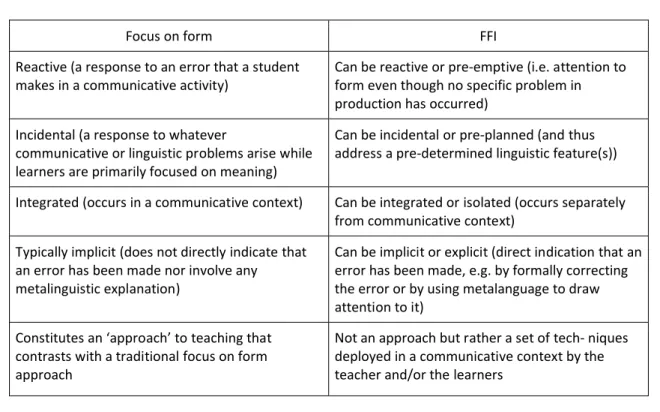
meaning-based communication) (ibid.). Long’s initial conceptualisation of focus on form subsequently expanded to FFI, which is broader in scope and includes focus on forms. Table 2.1 summarises the key differences between Long’s original focus on form and FFI (Ellis, 2015, 2016; Spada, 2011).
Table 2.1 Focus on form versus FFI
Focus on form FFI
Reactive (a response to an error that a student makes in a communicative activity)
Can be reactive or pre-emptive (i.e. attention to form even though no specific problem in production has occurred)
Incidental (a response to whatever
communicative or linguistic problems arise while learners are primarily focused on meaning)
Can be incidental or pre-planned (and thus address a pre-determined linguistic feature(s))
Integrated (occurs in a communicative context) Can be integrated or isolated (occurs separately
from communicative context) Typically implicit (does not directly indicate that
an error has been made nor involve any metalinguistic explanation)
Can be implicit or explicit (direct indication that an error has been made, e.g. by formally correcting the error or by using metalanguage to draw attention to it)
Constitutes an ‘approach’ to teaching that contrasts with a traditional focus on form approach
Not an approach but rather a set of tech- niques deployed in a communicative context by the teacher and/or the learners
FFI is supported by both sociocultural theorists and interactionists. In terms of
sociocultural theory, FFI ‘mediates the intra- and interpsychological processes involved in
learning’ (Ellis, 2012: 273). From interactionists’ perspective, focus on form ‘facilitates
noticing, noticing the gap, and modified output’ (ibid.). Input is the requirement for any L2 learning (Williams, 2005). Linguistic forms cannot be acquired unless learners notice what is present in input (Schmidt & Frota, 1986). However, simultaneous attention to meaning and form is unlikely due to limited information processing capacity, particularly for beginner-level learners (VanPatten, 1996). Another type of noticing, i.e. noticing the gap, can only occur if learners notice that they do not (at least not completely) ‘know’ the target form. Learners use their interlanguage and realise they are making an error. In this situation, focus on form in the form of negative evidence (reactive FFI/ feedback on error/ error correction) is necessary. Negative feedback may lead to modification of output in the direction of target accuracy (Williams, 2005). In other words, reactive FFI (especially the explicit and output-prompting types, i.e. clarification request, repetition, elicitation, and metalinguistic prompts) may make input more salient, and thus help learners to notice the gap and incorporate the new form into their developing
interlanguage (Ellis, 2012b; Williams, 2005). Whereas focus on form has been treated with skepticism (Poole, 2005; VanPatten, 1996), substantial empirical evidence shows that FFI facilitates L2 acquisition (Ellis, 2012b, 2016; Spada, 2011).
2.3.1.2 Peer review
The use of peer review, (also called peer feedback), in L2 classrooms is supported by both sociocultural and interactionist approaches. It is defined as
a collaborative activity involving students reading, critiquing, and providing feedback on each other’s writing, both to secure immediate textual
improvement and to develop, over time, stronger writing competence via mutual scaffolding. (Hu, 2005: 321-322)
Grounded in Vygotsky’s (1978) sociocultural theory of mind, peer review activities provide learners with plentiful opportunities for social interaction which may result in higher level mental processes. The language use within the interaction serves as the