ThinkMiners: Disorder Recognition using Conditional Random Fields
and Distributional Semantics
Ankur Parikh Avinesh PVS Joy Mustafi Lalit Agarwalla Ashish Mungi
IBM India Pvt Ltd, IBM Software Group, Watson
{anparikh,pavinesh,jmustafi,lalit.agarwalla,r1amungi}@in.ibm.com
Abstract
In 2014, SemEval organized multiple chal-lenges on natural language processing and information retrieval. One of the task was analysis of the clinical text. This challenge is further divided into two tasks. The task A of the challenge was to extract disor-der mention spans in the clinical text and the task B was to map each of the disor-der mentions to a unique Unified Medical Language System Concept Unique Iden-tifier. We participated in the task A and developed a clinical disorder recognition system. The proposed system consists of a Conditional Random Fields based ap-proach to recognize disorder entities. The SemEval challenge organizers manually annotated disorder entities in 298 clini-cal notes, of which 199 notes were used for training and 99 for development. On the test data, our system achieved the F-measure of 0.844 for entity recognition in relaxed and 0.689 in strict evaluation.
Keywords: medical language processing, clinical concept extraction, conditional random fields.
1 Introduction
Mining concepts from the electronic medical records such as clinical reports, discharge sum-maries as well as large number of doctor’s notes has become an utmost important task for auto-matic analysis in the medical domain. Identifica-tion and mapping of the concepts like symptoms, disorders, surgical procedures, body sites to a nor-malized standards are usually the first steps
to-This work is licensed under a Creative Commons At-tribution 4.0 International Licence. Page numbers and pro-ceedings footer are added by the organisers. Licence details: http://creativecommons.org/licenses/by/4.0/
wards understanding natural language text in the medical records.
In this paper, we describe a machine learning based disorder recognition system for the Task 7A of 2014 SemEval challenge. In Section 2 we give a background of the existing solutions to tackle the problem. Section 3 covers our approach in detail, followed by evaluation and conclusion in Section 4 and Section 5 respectively.
2 Background
In recent times, many systems have been de-veloped to extract clinical concepts from vari-ous types of clinical notes. The earlier nat-ural language processing (NLP) systems were mainly built heavily using domain knowledge i.e. medical dictionaries. These systems in-clude MetaMap (Aronson and Lang, 2010), Hi-TEX (Zeng et al., 2006), KnowledgeMap (Denny et al., 2003), MedLEE (Friedman et al., 1994), SymText (Koehler, 1994) and Mplus (Christensen et al., 2002). In the past couple of years, re-searchers have been exploring the use of machine learning algorithms in the clinical concept detec-tion. To promote the research in this field many or-ganizations such as ShARe/CLEF, SemEval have organized a few clinical NLP challenges. In CLEF 2013 (Pradhan et al., 2013), the challenge was to recognize medication-related concepts. Both rule-based (Fan et al., 2013; Ramanan et al., 2013; Wang and Akella, 2013) and machine learning based methods as well as hybrid methods (Xia et al., 2013; Osborne et al., 2013; Hervas et al., 2013) were developed. In this shared-task sequen-tial labeling algorithms (i.e., Conditional Random Fields (CRF)) (Gung, 2013; Patrick et al., 2013; Bodnari et al., 2013; Zuccon et al., 2013) and ma-chine learning methods (i.e., Support Vector Ma-chine (SVM)) (Cogley et al., 2013) have been demonstrated to achieve promising performance when provided with a large annotated corpus for
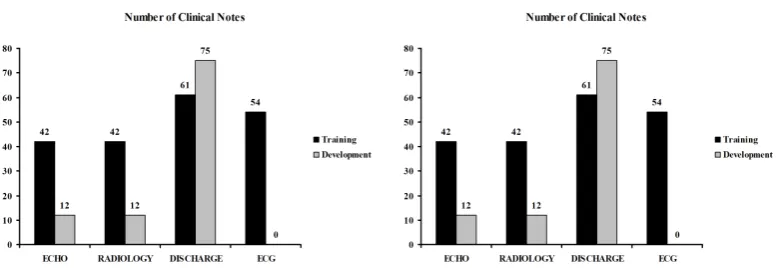
Figure 1: Dataset distribution
training.
3 Approach
Entity recognition has been tried in various do-mains like news articles, Wikipedia, sports arti-cles, financial reports and clinical texts. In clinical text, entities can vary from medical procedures, disorders, body site indicators etc. Clinical text also presents with a peculiar concept of disjoint disorders/entities. This phenomenon is common in clinical domain compared to others and further complicates entity extraction from clinical notes.
3.1 Data
The data consisted of around 298 notes from dif-ferent clinical types including radiology reports, discharge summaries, ECG and ECHO reports. For each note, disorder entities were annotated based on a pre-defined guidelines. The data set was further divided into two, with 199 notes in the training set and 99 notes in the development set. The training set contains 5811 disorders where as the development contained 5340 disorders. Figure 1 shows the distribution of the training and devel-opment set respectively.
3.2 Data Preprocessing
In the pre-processing step we tokenized, lemma-tized and tagged the text with part of speech us-ing the Apache cTAKES1 (Savova et al., 2010).
Further, section and source meta data extraction is done for the text in the documents.
In Named Entity Recognition (NER), when solved using machine learning, the text is typically converted to BIO format (Beginning, Inside and Outside the entity). BIO representation means the
1https://ctakes.apache.org/
words in the text are assigned one of the follow-ing tags B - begin, I - inside and O - outside of the entity i.e. in this case a disorder. So now the task of NER is a sequence labeling problem to assign the labels to the tokens. Especially in the medical domain, the challenge is more complicated due to the presence of disjoint disorders (<10%), which could not be solved using the traditional BIO-notation. BIO approach works well with entities which are consecutive. So, we took an enhanced approach (Tang et al., 2013a) where the consec-utive disorders are assigned traditional BIO tags and for disjoint disorders we create two tag sets a) D{B,I} : for disjoint entity words which are not shared by multiple concepts; and b) H{B,I}: for disjoint entity words which belong to more than one disjoint concept.
The following examples show the annotations of consecutive as well as disjoint disorders.
1: “Theleft atriumis moderatelydilated.”
“The/O left/DB atrium/DI is/O moderately/O dilated/DB ./O”
2: “The left & right atrium are moderately
dilated.”
“The/O left/DB &/O right/DB atrium/HB are/O moderately/O dilated/HB ./O”
3.3 Sequence Labeling
We have used Conditional Random Fields (CRF), a popular approach to solve sequence labeling tasks. CRF++2was used as an implementation of
CRF for our purpose.
Feature set used for the learning algorithm:
• Word level features: words [-2,2], suffix and prefix.
• Syntactic features: parts-of-speech(POS).
• Discourse features: source & section. Sen-tence containing disorder mentions usually have similar syntactic patterns based on sec-tions (ex: ‘Past Medical History’) and source type (ex: discharge summary, radiology re-port). To capture this, source and section meta data have been provided as a feature.
• Distributional semantics: We used a con-textual similarity based approach from the popular concept called NC-value (Frantzi et al., 2000).
We followed the following steps to encap-sulate the distributional semantics into the learning model:
– For all the disorders in the training data we created two sets of contextual words namely context before (CBatrain) and
context after (CAatrain). These words
belong to open class (Noun, Verb, Ad-jective, Adverb) allocated for each sec-tion (Sj).
– Weights are calculated for the contex-tual words.
Weight(btrain) = freqfreq(disorders,b(disorders))
– For each word in the test data we created a similar sets of contextual words(CBa,
CAa) as above.
– Two scores are calculated for each token based on the product of frequency of the contextual word per section Sj
with weight calculated of that word in the training set.
For each section (Sj):
NC−valueB(a) = X
bCBa,Sj
fa(btest)∗weight(btrain)
(1) NC−valueA(a) = X
bCAa,Sj
fa(btest)∗weight(btrain)
(2)
where
ais the candidate term,
CBais the set of context words of “a”
in a window of [-2,0],
CAais the set of context words of “a”
in a window of [0,2],
Sjis a section like “Past Medical
History”, “Lab Reports” etc.
bis a word from CBaor CAa,
fa(btest)is the frequency of b as a term
context word of “a” in the test set,
weight(btrain)is the weight of b as term
context word of a disorder in the training set,
NC-valueB(a)is the distributional
semantic score of contextual words
beforethe candidate term,
NC-valueA(a)is the distributional
semantic score of contextual words
afterthe candidate term.
– Further a similarity class is calculated based on a set of thresholds on the NC-value namely High-Sim, Med-Sim, Low-Sim and assigned to the tokens.
Most of the features were similar to that of the pre-vious approaches (Tang et al., 2013a; Tang et al., 2012; Tang et al., 2013; Jiang et al., 2011) with an addition of an innovative distributional semantics based features (Nc-valueB, NC-valueA), which we
have tried and tested for concept mining in clinical text.
4 Evaluation
The evaluation was done in two categories a) strict evaluation: exact match, which requires the start-ing and endstart-ing of the concept to be the same as the gold standard data b) relaxed evaluation: here the concepts don’t match exactly with the start and end of the concept but may overlap.
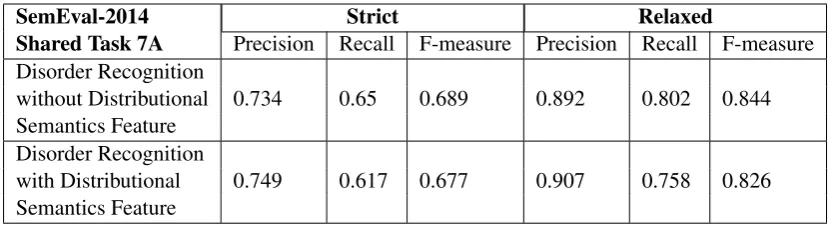
In the strict and relaxed evaluation, the best F-measure among our system was 0.689, 0.844 with-out the distributional semantics where as best Pre-cision was 0.907, 0.749 with the distributional se-mantics as a feature. Table 1. shows the detailed result.
5 Conclusion
SemEval-2014 Strict Relaxed
Shared Task 7A Precision Recall F-measure Precision Recall F-measure Disorder Recognition
0.734 0.65 0.689 0.892 0.802 0.844 without Distributional
Semantics Feature Disorder Recognition
0.749 0.617 0.677 0.907 0.758 0.826 with Distributional
[image:4.595.91.508.61.174.2]Semantics Feature
Table 1: Results of the system on test set
level, syntactic, discourse and distributional se-mantic based features as adapted to the medical domain.
We have observed an increase (+1.5%) in pre-cision but a drastic fall (-4.4%) in recall while using the distributional semantic feature. Ideally this feature has to improve the results because it takes contextual features into consideration. In our opinion inappropriate scaling of the feature values might have caused the drop. Further we would like to investigate the use of large unlabeled data, dependency tree based context and more experi-ments have to be carried out like threshold setting, feature value scaling to show better results. Also due to license issues we could not use UMLS dic-tionary. From our survey we figured out that 2-3% of improvement has been observed when the con-cepts from the dictionary are used.
References
B. Tang, H. Cao, Y. Wu, M. Jiang, and H. Xu. 2013. Recognizing clinical entities in hospital dis-charge summaries using Structural Support Vector Machines with word representation features. BMC Med Inform Decis Mak, vol. 13 Suppl 1, p. S1.
M. Jiang, Y. Chen, M. Liu, S. T. Rosenbloom, S. Mani, J. C. Denny, and H. Xu. 2011. A study of machine-learning-based approaches to extract clinical enti-ties and their assertions from discharge summaries. J Am Med Inform Assoc, vol. 18, no. 5, pp. 601606.
B. Tang, Y. Wu, M. Jiang, Y. Chen, J. C. Denny, and H. Xu. 2013. A hybrid system for temporal informa-tion extracinforma-tion from clinical text. J Am Med Inform Assoc.
B. Tang, H. Cao, Y. Wu, M. Jiang, and H. Xu. 2012.
Clinical entity recognition using structural support vector machines with rich features. in Proceedings of the ACM sixth international workshop on Data and text mining in biomedical informatics, New York, NY, USA, pp. 1320.
C. Friedman, P. O. Alderson, J. H. Austin, J. J. Cimino, and S. B. Johnson. 1994. A general natural-language text processor for clinical radiology. J Am Med Inform Assoc, vol. 1, no. 2, pp. 161174.
S. B. Koehler. 1994. SymText: a natural language un-derstanding system for encoding free text medical data. University of Utah.
L. M. Christensen, P. J. Haug, and M. Fiszman. 2002.
MPLUS: a probabilistic medical language under-standing system. in Proceedings of the ACL-02 workshop on Natural language processing in the biomedical domain - Volume 3, Stroudsburg, PA, USA, pp. 2936.
J. C. Denny, P. R. Irani, F. H. Wehbe, J. D. Smithers, and A. Spickard. 2003. The KnowledgeMap Project: Development of a Concept-Based Medical School Curriculum Database. AMIA Annu Symp Proc, vol. 2003, pp. 195199.
G. K. Savova, J. J. Masanz, P. V. Ogren, J. Zheng, S. Sohn, K. C. Kipper Schuler, and C. G. Chute. 2010. Mayo clinical Text Analysis and Knowledge Extraction System (cTAKES): architecture, compo-nent evaluation and applications. J Am Med Inform Assoc, vol. 17, no. 5, pp. 507513.
Q. T. Zeng, S. Goryachev, S. Weiss, M. Sordo, S. N. Murphy, and R. Lazarus. 2006. Extracting princi-pal diagnosis, co-morbidity and smoking status for asthma research: evaluation of a natural language processing system. BMC Med Inform Decis Mak, vol. 6, p. 30.
A. R. Aronson and F. M. Lang. 2010. An overview of MetaMap: historical perspective and recent ad-vances. J Am Med Inform Assoc, vol. 17, no. 3, pp. 229236.
. Uzuner, I. Solti, and E. Cadag. 2010.Extracting med-ication information from clinical text. J Am Med Inform Assoc, vol. 17, no. 5, pp. 514518.
James Cogley, Nicola Stokes and Joe Carthy. 2013.
Medical Disorder Recognition with Structural Sup-port Vector Machines. Online Working Notes of the CLEF 2013 Evaluation Labs and Workshop, 23 - 26 September, Valencia - Spain.
Robert Leaman, Ritu Khare and Zhiyong Lu. 2013.
NCBI at 2013 ShARe/CLEF eHealth Shared Task: Disorder Normalization in Clinical Notes with Dnorm. Online Working Notes of the CLEF 2013 Evaluation Labs and Workshop, 23 - 26 September, Valencia - Spain.
James Gung. 2013. Using Relations for Identifica-tion and NormalizaIdentifica-tion of Disorders: Team CLEAR in the ShARe/CLEF 2013 eHealth Evaluation Lab. Online Working Notes of the CLEF 2013 Evaluation Labs and Workshop, 23 26 September, Valencia -Spain.
Hongfang Liu, Kavishwar Wagholikar, Siddhartha Jon-nalagadda and Sunghwan Sohn. 2013. Integrated cTAKES for Concept Mention Detection and Nor-malization. Online Working Notes of the CLEF 2013 Evaluation Labs and Workshop, 23 - 26 September, Valencia - Spain.
Jon D. Patrick, Leila Safari and Ying Ou. 2013.
ShARe/CLEF eHealth 2013 Named Entity Recogni-tion and NormalizaRecogni-tion of Disorders Challenge. On-line Working Notes of the CLEF 2013 Evaluation Labs and Workshop, 23 26 September, Valencia -Spain.
Andreea Bodnari, Louise Deleger, Thomas Lavergne, Aurelie Neveol and Pierre Zweigenbaum. 2013.
A Supervised Named-Entity Extraction System for Medical Text. Online Working Notes of the CLEF 2013 Evaluation Labs and Workshop, 23 - 26 September, Valencia - Spain.
Guido Zuccon, Alexander Holloway, Bevan Koop-man and Anthony Nguyen. 2013. Identify Disor-ders in Health Records using Conditional Random Fields and Metamap AEHRC at ShARe/CLEF 2013 eHealth Evaluation Lab Task 1. Online Working Notes of the CLEF 2013 Evaluation Labs and Work-shop, 23 - 26 September, Valencia - Spain.
Jung-wei Fan, Navdeep Sood and Yang Huang. 2013.
Disorder Concept Identification from Clinical Notes An Experience with the ShARe/CLEF 2013 Chal-lenge. Online Working Notes of the CLEF 2013 Evaluation Labs and Workshop, 23 - 26 September, Valencia - Spain.
S. V. Ramanan, Shereen Broido and P. Senthil Nathan. 2013. Performance of a multi-class biomedical tag-ger on clinical records. Online Working Notes of the CLEF 2013 Evaluation Labs and Workshop, 23 - 26 September, Valencia - Spain.
Chunye Wang and Ramakrishna Akella. 2013. Perfor-mance of a multi-class biomedical tagger on clinical records. Online Working Notes of the CLEF 2013
Evaluation Labs and Workshop, 23 - 26 September, Valencia - Spain.
Yunqing Xia, Xiaoshi Zhong, Peng Liu, Cheng Tan, Sen Na, Qinan Hu and Yaohai Huang. 2013. Com-bining MetaMap and cTAKES in Disorder Recog-nition: THCIB at CLEF eHealth Lab 2013 Task 1. Online Working Notes of the CLEF 2013 Evaluation Labs and Workshop, 23 26 September, Valencia -Spain.
John David Osborne, Binod Gyawali and Thamar Solorio. 2013. Evaluation of YTEX and MetaMap for clinical concept recognition. Online Working Notes of the CLEF 2013 Evaluation Labs and Work-shop, 23 - 26 September, Valencia - Spain.
Lucia Hervas, Victor Martinez, Irene Sanchez and Alberto Diaz. 2013. UCM at CLEF eHealth 2013 Shared Task1. Online Working Notes of the CLEF 2013 Evaluation Labs and Workshop, 23 - 26 September, Valencia - Spain.