Proceedings of the Biomedical NLP Workshop associated with RANLP 2017, pages 24–31,
Classification based extraction of numeric values from clinical narratives
Maximilian Zubke Hochschule Hannover
Dept. of Information and Communication Expo Plaza 12, 30539 Hannover
Abstract
The robust extraction of numeric values from clinical narratives is a well known problem in clinical data warehouses. In this paper we describe a dynamic and domain-independent approach to deliver numerical described values from clinical narratives. In contrast to alternative sys-tems, we neither use manual defined rules nor any kind of ontologies or nomencla-tures. Instead we propose a topic-based system, that tackles the information ex-traction as a text classification problem. Hence we use machine learning to iden-tify the crucial context features of a topic-specific numeric value by a given set of example sentences, so that the manual ef-fort reduces to the selection of appropri-ate sample sentences. We describe con-text features of a certain numeric value by term frequency vectors which are gen-erated by multiple document segmenta-tion procedures. Due to this simultane-ous segmentation approaches, there can be more than one context vector for a numeric value. In those cases, we choose the con-text vector with the highest classification confidence and suppress the rest.
To test our approach, we used a dataset from a german hospital containing 12 743 narrative reports about laboratory results of Leukemia patients. We used Support Vector Machines (SVM) for classification and achieved an average accuracy of 96% on a manually labeled subset of 2073 doc-uments, using 10-fold cross validation. This is a significant improvement over an alternative rule based system.
1 Introduction
Driven by the digitalization, also hospitals have begun to process their documentation more and more in a digital manner. The resulting databases establish new opportunities for efficient analysis of patient data. However, many parts of those data are described by a free text, so that concrete in-formation first has to be extracted from text before they become available for further analysis. This paper focuses on the extraction and correct seman-tic interpretation of numeric values from clinical narratives. Indeed, some numeric values like in example E:G-Verhältnis=0,4:1 can extracted by regular expression or template filling due to un-ambiguous formattings or keywords. But there are also numeric values, which are difficult to process on that way. Reasons for the complexity are gen-eral number descriptions, like e.g. percentage val-ues, or a variety of keywords for the associated, semantic information. In front of many different medical areas with different informations and for-mulations, we assume that machine learning can be used to simplify and improve this task.
After an overview of related work in section2, we introduce a method to assign numeric values of a given document to their semantic meanings in section 3. In contrast to rule-based systems, we use a system that is able to learn and identify de-scriptive context features for certain numeric val-ues by example sentences. We consider this task as a supervised machine learning problem and ex-amine the feasibility to replace rule based systems by a more flexible machine learning approach. In section5we compare a rule based system with our approach and substantiate our recommendation to use machine learning procedures for information extraction processes.
2 Related Work
There are various research activities in the field of clinical text mining which can be divided into search in the field of Information Retrieval and re-search in the field of Information Extraction. We position our work in the field of Information Ex-traction. In general, Information Extraction in context of medical text mining often addresses one of the following tasks:
• Named Entity Recognition (Ruch et al.,
2003)
• Negation Detection (Elkin et al.,2005)
• Temporal Information (Hripcsak et al.,2005)
• Extraction of Codes (ICD,OPS) (Baud,2003) We noticed that most of the related studies use reg-ular expressions and some kind of terminology, dictionary or ontology. Especially, a robust map-ping (Sager et al., 1994) between clinical narra-tives and UMLS(Lindberg,1990),SnomedCT or a self-defined coding scheme appear to be the fre-quent goals of research in this field. Using an-notation engines like GATE or UIMA text parts are connected to the corresponding concept of the given knowledge organization system (Liu et al.,
2005).
In addition, some authors define or describe a complete natural language processing tool for clinical narratives, that integrates typical text min-ing operations like tokenization, POS-Taggmin-ing to enhance the process of information extraction. Be-sides MedLEE (Friedman et al., 1995), Apache cTakes (Savova et al., 2010) is such a software solution that combines the concepts, mentioned above.
It should be noticed, that many knowledge or-ganization systems, like e.g. SnomedCT, are not directly available for german. Thus Becker and Böckmann(2016) describe an approach to extract UMLSconcepts from german clinical notes using the german version of UMLS and find the cor-respondingSnomedCT concept by the previously detectedUMLSconcept.
Summarizing, we observe that mapping of doc-uments to knowledge organization systems like UMLS orSnomedCT, supported by classical text mining operations, seems to be the most common approach for information extraction from clinical narratives. One often mentioned argument against
the use of machine learning is the high effort to generate suitable training sets.
3 Method
Instead of executing a traditional Natural Lan-guage Processing (NLP) pipeline and process each word, e.g. by associating it with anUMLSconcept, we are only interested on numeric values specified in text documents. Hence, we introduce a method to determine the meaning of a numeric value by the surrounding words usingmachine learning al-gorithms. This approach represents an alternative to the explicit definition of information extraction rules or ontology based document processing.
As illustrated in figure 1, our information ex-traction method consists of five steps:
1. Extraction of numeric values 2. Document segmentation by . and ;
3. Generation of description candidates for each numeric value
4. Classification of candidates
5. In case of multiple positive classified candi-dates: Suppression of all candidates, except the one with highest score.
Furthermore we use topic-based classifiers. Each topic, like i.e.Blastshave to be described by posi-tive an negaposi-tive example sentences. Based on this sentence sets the topic classifier determines, if a given documents belongs to that topic or not. The mentioned processing steps are explained in detail below. The performance of this approach can be found in section5. Further details about our im-plementation are described in section4.
3.1 Initial Extraction of numeric values
Because we aim to extract numeric values from clinical narratives, we are only interested in doc-uments of the corpusC that contain at least one numerical value. Therefore we useregular expres-sionsto detect and extract numerical intervals or single values from every document. The result of this initial filtering is a subsetCnum ⊆ C. After
this initial processing step each documentdi ∈D
is defined as
di := (t, Ni) (1)
Figure 1: (1) Extraction of numeric values from document d (2) segmentation of sentences and phrases of d (3) for each n (gray area): sentence and phrases that contain n are candidates (4) topic related candidates are matches (5) Choose the match with the highest confidence
3.2 Document Segmentation
In simple clinical information systems, an unstruc-tured text is often represented by a string. How-ever, for advanced information extraction strings do not fit very well. Thus, the transformation of a string in a more complex data structure is the initial processing step of many text mining appli-cations. There are several concepts to represent a document by such a complex data structure. Be-side graph-based approaches (Jiang et al.(2010)), a document can also be described by bag of words or a collection of sentences.
As illustrated in Figure2, we believe, that a nu-meric value is more related to certain segments like sentences or phrases and less to the whole document. Furthermore we assume, that different
Figure 2:
generated text segments could be different expres-sive descriptions of the contained numeric value. Due to this assumptions we describe a textdiboth
as a set of sentences Ds
i and as a set of phrases Dpi. The elements ofDs
i are produced by a
com-monsentence tokenizerwhich splits the document intonsentences based on the dot-sign(.) without destroying point numbers or abbreviations. The elements of Dip are the result of the same proce-dure, which separates a document by semicolon instead of a dot-sign. It should be noted, that in our context the termphrasemeans a document snippet that results from the semicolon based splitting of the document. There are two motivations for this additional segmentation: First, many clinical nar-ratives are more written like a note and less like a formal, well structured document. Therefore, it
can happen, that a document transports several in-formations which are separated by semicolons, but do not contain any dot-signs. In those short docu-ments, a pure dot-sign based segmentation would fail and the whole document would be considered as the related context of a certain numeric value. Second, it is possible, that an author describes a documented quantity by a dedicated sentence, but also by the beginning of the following sentence. This related part of the following sentence is usu-ally separated by a semicolon from the rest of the sentence. An example of such a situation can be seen in figure3.
Figure 3: Underlined: Result from pure dot-sign-based segmentation; Bold: Relevant text snippet which is delivered by semicolon based segmenta-tion.
So finally, we have extended our definition of a document1to:
di:= (Dsi, Dpi, Ni) (2)
for alldi ∈ D. It is possible to extend this
con-cept by a comma based document splitting. But we omitted it due to many for our use case useless segments.
3.3 Candidate Generation
After the generation of overlapping document seg-ments, we are only interested on segseg-ments, which are related to a numeric value nj of di. Due to
[image:3.595.77.508.63.164.2]In our current version, a related text segment of a numerical valuenj of documentdi can only be a
sentence or phrase from the same document that contains this value, so that the candidate set of eachnj ∈Niis defined as:
cand(nj) :={c|((c∈Dsi)∨(c∈Dip))∧(nj ∈c)}
(3) In our implementation we keep track of relations between numerical values, sentences and phrases ofdi, so that we are able to retrieve the correct
can-didates even if the same numerical value appears multiple times indi.
3.4 Topic Learning
Usually, quantities and their numerical values ap-pear in the same sentence or text region. It is how-ever extremely hard to define the exact construc-tion in which the quantity and the value appear. Consider e.g. the following sentence:
(1) Immer wieder Blasten, anteilsmäßig ca. 10% Again and again blasts, rate approx. 10 % The quantity Blastenanteil (Blast rate) is ex-pressed in two words. The second (Anteil) is only present as the root of a derived adjective ( an-teilsmäßig). Patterns like this are hard to capture in rules. However, when the key concept blasts and a numerical value appear in the same region of the text, we can almost be sure, that the number is the value for the blast rate. To recognize such a key concept or topic, our system learns the related words by a set of sample sentences.
Our system does not have any kind of knowl-edge from a connected ontology or terminology base likeUMLS. Also text mining operations like Named Entity Recognition or Negation detection are not part of our processing pipeline.
Instead our system is based on a generic con-cept of topic definition only. In our context a topic associated with a quantity is defined as a pair of sets containing positive and negative example sen-tences for numeric values of that quantity. Ta-ble1illustrates this idea for the amount of blasts, which is mentioned in many documents of our test dataset. Based on this two sets, we train a binary topic-classifier, which determines whether a given text segment belongs to that topic or not.
detectt(c) =
0 if c is not about topic (1, κ) if c is about topic
(4)
Whereκmeans the confidence or score of the clas-sification.
As already explained above,ccan be a sentence or a phrase, that results from the segmentation de-scribed section3.2
We implemented4bySupport Vector Machines
Boser et al.(1992). The features of all candidates are term frequencies of a vocabulary V, so that each candidatecis described by vectorv ∈ Z|V|
at this point. In our experiments, V contains all words from all available clinical narratives.
We assume, thatcis related to topict, ifc con-tains a numeric value and detectt(c) = 1. The
definition ofκdepends on the usedmachine learn-ing algorithm. In our experiments, κ represents the distance to the hyperplane of the SVM based classifier.
3.5 Non Maxima Suppression
The trained classifier tells, whether a document segmentcbelongs to a certain topict. We assume, that the numeric value mentioned in c describes the topic-related quantity, ifcbelongs tot. How-ever, the classifier could find more than one candi-date relevant for the given numeric value. In such cases we select the segment with the highest con-fidence value and assume that the value mentioned in that segment belongs to the topic. Furthermore it is possible to identify a threshold of minimum confidence to accept a candidate as an identifica-tion of a relaidentifica-tion between a numeric valuenj and a topict.
4 System Description
We implemented this method as a software sys-tem, which is based on Python and SQL databases. Our system should supports simple integration into a clinical data warehouse, because many clin-ical narratives originate from such an information system. Furthermore, adjacent data collections could be used as features of clinical narratives or vice versa in the next version of our software.
4.1 Document representation
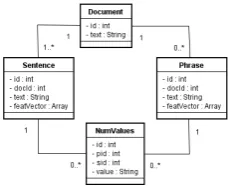
Before the execution of any text mining or ma-chine learningprocedure, our tool first generates a database schema like shown in Figure 4. Our in section3.2described segmentation concept will realized by two tables, that representDs
i andDpi.
Further-Positive sample sentences Negative sample sentences
Weiterhin Monozytoide Blasten (80%)
bei 300 Zellen Ca. 80-85% kleine reife Lymphozyten,einzelne mit Granula Es findet sich eine Verdrängung der
normalen Hämatopoese durch eine monomorphe Blastenpopulation, die ca. 80% beträgt.
Granulopoese stark linksverschoben bis zu den Promyelozyten, die ca. 35% der myeloischen Zellen ausmachen
Blastenanteil 2-4% Ausreifende granulopoese mit leichter vermehrung von eosinophilen und deut-licher vermehrung von plasmazellen mit einem anteil von 5-10%, z. t. vakuolisiert; kein signifikanter blastenanteil
Table 1: Definition of topic "Blasts" for the quantity blast rate by positive and negative example sen-tences; Term-related terms are underlined. The underlining is given only for illustration here and not part of the training data.
Figure 4: Documents are connected indirectly with numerical values by text segments. Each seg-ment type is represented by a corresponding table. Currently supported segment types: Sentences and Phrases as presented in section3.2
more we store all numerical values in a dedicated table, which is filled by the procedure, we de-scribed in section 3.1. Figure 4 also illustrates, that numerical values are directly connected with sentences and phrases, but only indirectly with the documents. We chose this structure to avoid an in-correct behavior for documents, in which exactly the same numerical values appear in multiple sen-tences.
4.2 Topic Definition Format
[image:5.595.105.493.60.228.2]We realized our in section3.4presented topic con-cept by a json based data format. Figure5shows an example of this technical topic description. The example sentences can be defined via an easy to use graphical user interface, that generates the ap-propriate json code internally. So the topics can di-rectly defined by doctors, that do not need knowl-edge about technical data description techniques
Figure 5: Example of our json based topic defini-tion format.
for this task.
A further motivation to define such a data for-mat was the resulting flexibility, that enables the possibility to share well defined topic definitions with other internal or external organizations.
5 Evaluation & Results
We used a collection of 12 743 clinical narratives from a german hospital to evaluate our informa-tion extracinforma-tion system. The narratives consist of 1 to 29 sentences, 5 sentences on average. The collection comes from electronic health records of leukemia patients. One of the main interests of the physicians is the rate of blast cells in all reports related to one patient.
[image:5.595.310.525.299.397.2] [image:5.595.121.239.305.398.2](2) a. Blasten (80%) Blasts (80%)
b. Blastenanteil 2-4% Blast percentage 2-4%
c. Die Granulopoese ist linksverschoben mit einem Blastenanteil von>20% der nicht erythropoetischen Zellen The bone marrow is left-shifted with a blast proportion of>20% of the non erythropoietic cells.
d. Keine Markfremden Zellen, Blastenanteil sicher unter 5%. No marrow foreign cells,
blast percentage for sure below 5% Then we generated a vocabulary V containing 13 400 words, based on the whole collection. A first statistic analysis shows, that the size of
|Cnum|is 9 655 and only 4 162 of that documents contain known keywords about blasts and a per-centage sign.
5.1 Construction of a gold standard
For the gold standard we selected a random sub-set of 2 073 documents, which proportion of doc-uments is fulfilling the three conditions is the same as in the whole collection. About 75% of the doc-uments in this selection do not contain a numer-ical value, or a percentage sign or a keyword re-lated to blasts. We annotated these documents manually. Note that thus we make no difference between documents that have no information on blast rate and documents that do contain informa-tion on blast rate, but do not give a concrete value. Especially this means that we labeled all docu-ments containing the statementKeine Blasten(no blasts) as documents that do not give a value for the quantity blast rate. For the remaining 435 doc-uments, that contain keywords about blasts, a per-centage sign and a numerical value, we extracted the blast percentage manually.
Our classifier is trained only on sentences con-taining numerical values. In our subset there are 6 805 sentences; 604 sentences contain a numeri-cal value, 439 thereof being a blast rate, 165 not related to the amount of blasts.
5.2 Experiment setup
Each text was first split into sentences and phrases as described in section3.2.
Next, we generated a candidate set for each nu-merical value that appears in the given document. As described in section 3.3, the term candidate means a sentence or a phrase that contains the nu-meric value. We processed all documents on that way.
Then we conducted two experiments: In the first experiment we examined the classification of sin-gle sentences. Beside two baselines that are de-scribed in the next section, we used a SVM based topic classifier (see section3.4), which decides for each of the sentences, whether it is relevant for the quantity blast rate. Now we can evaluate how many sentences are classified correctly.
In the second experiment we compared methods for extracting numerical values from whole doc-uments. We evaluated our approach in two con-figurations: SVM (Sentences) represents a variant where all elements of the candidate sets are sen-tences andSVM (Sentences & Phrases)represents the same approach using multiple text segments.
For both experiments, we consider a text as cor-rectly processed when either (1) the correct blast rate is extracted from the text or (2) it is correctly detected that no blast rate is specified.
Our manual labeling has extracted values for each text and each sentence, obtained by splitting texts on full stops. When we make additional seg-ments by splitting on semicolons, we can apply the classifier (trained on whole sentences) to this segments as well. However, we cannot compare the results with the manually labeled ones. On the document level, however, we can compare with the manually labeled documents.
We used ten-fold cross validation for all experi-ments.
5.3 Baselines
We used three baselines. Since most documents are not relevant for the quantity blast rate, we can classify most documents correctly with the major-ity classifier, that assumes that all documents are irrelevant.
As a third baseline we used an extraction method that is purely based on complex regular expressions. Motivated by the remarkable per-formance of the percent-based approach, a group of students developed a regular expressions based approach. Therefore they analyzed the data set and define some keywords manually. Combined with the detection of percentage values, they im-plemented a procedure to extract the searched in-formations by pattern recognition. Note that this approach processes only whole documents, which is why we could not compare this baseline with alternative approaches on sentence level described by table2.
6 Results
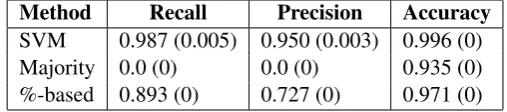
Table2shows the result of the evaluation at sen-tence level We clearly observe, that the classifier treats almost all sentences correctly. With respect to precision and recall it is of course easy to beat the majority baseline, but the SVM also has an higher accuracy.
Given the good results of the %-based approach we can conclude that indeed most numerical val-ues are related to blast rates. However, there are a number of other numerical values. Apparently, the SVM effectively distinguishes the blast rates from other numerical values.
Table 3 shows the results of the complete method on the document level. At the docu-ment level we see again very high scores. We could observe, that the additional semicolon based segmentation indeed excludes a number of mis-takes. (e.g. the third negative example from Ta-ble 2) The lower precision in comparison to the pure sentence-based configuration implies, that the semicolon based approach produces a few seg-ments which are hard to classify by the current version of our topic classifier. ButSVM(Sentences & Phrases)also extracts significant more numeric values than SVM(Sentences). As documented in table 3, the regular expression based integration of keywords improves the performance of the %-based information extraction strategy. Apparently, the rules a very precise and do almost never con-sider a percentage as a blast rate if that is not the case. Thus this method has the highest precision of all tested methods. However, the recall is much lower than that of the classifier based approach.
7 Conclusions and Future Work
In this paper we presented a first version of our in-formation extraction system for medical documen-tations, which identifies the meaning of a numeric value by the surrounding words.
The integral difference to many similar applica-tions is, that we had no explicit described knowl-edge about the content of out dataset. Instead we usedmachine learningto learn important key-words by sample sentences.
With term frequency vectors, we used a very simple kind of feature, which already works very well. In the future we want to examine, which al-ternative features could improve our system.
Our approach yields remarkable results. How-ever, there are situations, that can not processed correctly by our system. We expect, that numeri-cal values are always described by numbers. How-ever, it is possible, that numbers are described by a words instead of number (i.e ’five’ instead 5). We also observed, that especially the number zero is often replaced by a negation (i.e. ’no blasts’ in-stead of ’0% blasts’). Hence we will integrate a preprocessing step that converts textual definitions of numbers in real numbers. It should be noted, that this task is a non-trivial task, because also a quantitative value can correspond with several, very different formulation, which can be consid-ered as an classification problem, very similar to our topic detection problem, described in section
4. Furthermore, words like ’significant’ compli-cate or prevent a mapping to an equivalent numer-ical description of the information.
In general, we believe that machine learning could be much more efficient than rule-based con-cepts. Every rule engine needs someone who de-fines suitable rules, whereas our approach only needs sample sentences which are always avail-able. Furthermore table 3 shows, that the ma-chine learning approach is more adjustable than the more strict rule-based approach.
Acknowledgements
Method Recall Precision Accuracy
[image:8.595.171.425.63.119.2]SVM 0.987 (0.005) 0.950 (0.003) 0.996 (0) Majority 0.0 (0) 0.0 (0) 0.935 (0) %-based 0.893 (0) 0.727 (0) 0.971 (0)
Table 2: Results of the extraction of the percentage of blasts evaluated onsentencelevel. Results are averages of 10-fold cross-validation. Standard deviations are given in parentheses.
Method Recall Precision Accuracy
SVM (Sentences & Phrases) 0.921 (0.049) 0.911 (0.044) 0.965 (0.017) SVM (Sentences) 0.834 (0.069) 0.953 (0.037) 0.957 (0.017) RegExp based 0.517 (0.053) 0.983 (0.021) 0.897 (0.019) %-based 0.461 (0.082) 0.629 (0.081) 0.897 (0.023)
Majority 0.0 (0) 0.0 (0) 0.79 (0.034)
Table 3: Results of the extraction of the percentage of blasts evaluated ondocumentlevel. Results are averages of 10-fold cross-validation. Standard deviations are given in parentheses.
References
R Baud. 2003. A natural language based search engine for icd10 diagnosis encoding. Medicinski arhiv58(1 Suppl 2):79–80.
M Becker and B Böckmann. 2016. Extraction of
umlsR concepts using apache ctakesTMfor german
language. Studies in health technology and
infor-matics223:71–76.
Bernhard E Boser, Isabelle M Guyon, and Vladimir N Vapnik. 1992. A training algorithm for optimal mar-gin classifiers. In Proceedings of the fifth annual workshop on Computational learning theory. ACM, pages 144–152.
Peter L Elkin, Steven H Brown, Brent A Bauer, Casey S Husser, William Carruth, Larry R Bergstrom, and Dietlind L Wahner-Roedler. 2005. A controlled trial of automated classification of negation from clinical
notes. BMC medical informatics and decision
mak-ing5(1):13.
Carol Friedman, Stephen B Johnson, Bruce Forman, and Justin Starren. 1995. Architectural requirements for a multipurpose natural language processor in the
clinical environment. In Proceedings of the
An-nual Symposium on Computer Application in Med-ical Care. American Medical Informatics Associa-tion, page 347.
George Hripcsak, Li Zhou, Simon Parsons, Amar K Das, and Stephen B Johnson. 2005. Modeling electronic discharge summaries as a simple
tem-poral constraint satisfaction problem. Journal
of the American Medical Informatics Association
12(1):55–63.
Chuntao Jiang, Frans Coenen, Robert Sanderson, and Michele Zito. 2010. Text classification using graph
mining-based feature extraction. Knowledge-Based
Systems23(4):302–308.
C Lindberg. 1990. The unified medical language system (umls) of the national library of medicine.
Journal (American Medical Record Association)
61(5):40–42.
Kaihong Liu, Kevin J Mitchell, Wendy W Chapman, and Rebecca S Crowley. 2005. Automating tissue bank annotation from pathology reports–comparison
to a gold standard expert annotation set. In AMIA
Annual Symposium Proceedings. American Medical Informatics Association, volume 2005, page 460. Patrick Ruch, Robert Baud, and Antoine Geissbühler.
2003. Using lexical disambiguation and named-entity recognition to improve spelling correction in the electronic patient record. Artificial intelligence in medicine29(1):169–184.
Naomi Sager, Margaret Lyman, Ngo Thanh Nhan, and Leo J Tick. 1994. Automatic encoding into snomed iii: a preliminary investigation. InProceedings of the Annual Symposium on Computer Application in Medical Care. American Medical Informatics Asso-ciation, page 230.
Guergana K Savova, James J Masanz, Philip V Ogren, Jiaping Zheng, Sunghwan Sohn, Karin C Kipper-Schuler, and Christopher G Chute. 2010. Mayo clin-ical text analysis and knowledge extraction system (ctakes): architecture, component evaluation and
ap-plications. Journal of the American Medical