Evaluating Inter-Annotator Agreement on Historical Spelling
Normalization
Marcel Bollmann Stefanie Dipper
Ruhr-Universität Bochum Department of Linguistics
{bollmann,dipper,petran}@linguistics.rub.de Florian Petran
Abstract
This paper deals with means of evaluat-ing inter-annotator agreement for a nor-malization task. This task differs from common annotation tasks in two important aspects: (i) the class of labels (the nor-malized wordforms) is open, and (ii) an-notations can match to different degrees. We propose a new method to measure inter-annotator agreement for the normal-ization task. It integrates common chance-corrected agreement measures, such as Fleiss’sκ or Krippendorff’sα. The nov-elty of our proposed method lies in the way the annotated word forms are treated. First, they are evaluated character-wise; second, certain characters are mapped to more general categories.
1 Introduction
In recent years, and in particular in the context of digital humanities, historical language data has been gaining increasing significance. The focus is on providing easy access to the information con-tained in the data. To this end, historical texts are digitized and processed by OCR or even tran-scribed manually. Due to the absence of standards, historical data often exhibits large variance, espe-cially with regard to spelling. Hence, further pro-cessing either has to rely on fuzzy-matching strate-gies, or on standardization of the data.
In the Anselm project (Dipper and Schultz-Balluff, 2013), we opted for the second way. We provide normalized wordforms for the full corpus that have been manually annotated according to guidelines specifically created for this task (Kras-selt et al., 2015). These normalizations can be use-ful for search queries, further downstream applica-tions such as POS tagging, or as training data for
automatic normalization methods.
This paper deals with means of quantitative evaluation of these normalization guidelines. We would like to quantify the degree of consistency that can be achieved with annotations according to the guidelines, i.e., the inter-annotator agree-ment (IAA). While a range of measures has been proposed for measuring agreement (e.g., see the survey by Artstein and Poesio (2008)), our task differs from common annotation tasks, such as part-of-speech tagging or semantic role labeling, in two important aspects: (i) the class of labels (the normalized wordforms) is open, and label dis-tribution is sparse; and (ii) annotations are biased to be similar to the surface form of the token they belong to, and can match to different degrees. For example, we would like to score almost identical annotations likenähme – nehme‘take’ (for the his-torical formneme) higher than annotations that are rather dissimilar, likedrückte‘pressed’ –trocknete
‘dried’ (fortrvckente).
We investigate why conventional IAA mea-sures are not suitable to the normalization task, and propose a new method that integrates com-mon chance-corrected agreement measures, such as Fleiss’s κ (Fleiss, 1971) or Krippendorff’s α
(Krippendorff, 1980). The novelty of our pro-posed method lies in the way the annotated word-forms are treated. First, we reframe normalization as a character-based task; and second, we model the inherent properties of normalization by map-ping certain characters to more general categories. We first present the annotation guidelines (Sec. 2) and the dataset that our evaluation is based on (Sec. 3). Sec. 4 discusses the problems that arise from applying common agreement measures to the normalization task. Sec. 5 introduces our new method, followed by an evaluation in Sec. 6, comparing and assessing the results of different ways of measuring agreement.
2 Annotation of Language Changes Languages evolve over time. This probably be-comes most apparent in sound changes, which modify the way words are pronounced. In the long run, such changes are also reflected in the spelling of these words, cf. the pairs of word forms in (1), which are etymologically related, the ances-tor being from Early New High German (ENHG, 1350–1650), the descendant from Modern Ger-man (MG).1
(1) a. friund/ Freund ‘friend’ [N4] b. chind/Kind ‘child’ [M1]
Of course, language evolution concerns all other linguistic levels as well, e.g. (2) shows changes in morpho-syntax (inflection).
(2) vnser vrowen(acc.sg.) / unsereFrau ‘our lady’ [M1]
Finally, words can change semantically or even get lost. In both cases, there is no direct, i.e. etymologically-related, equivalent in the modern language, see (3).
(3) a. geitig(geizig, lit. ‘stingy’) / gierig ‘greedy’ [M1]
b. vnze/ bis ‘until’ [St2]
Since ENHG is already quite close to MG, it was decided to standardize ENHG forms to MG forms in the context of the Anselm project.2 The
question was now whether all the changes de-scribed above should be submitted to the same standardization procedure. For instance, if a word still exists in MG but with a different meaning (as in (3a)), should the word be replaced by the mod-ern equivalent? What should be done with inflec-tional endings that have changed? After all, most inflectional differences would not hinder people from using and understanding the data, in contrast to clear semantic changes.
On the other hand, if we compare the effort it takes to automatically generate the forms, it is, of 1In the following examples, ENHG forms are given first,
MG forms follow after the slash. The labels [N4], [M1] etc. refer to the text the example comes from, see Sec. 3.
2Another option has been traditionally pursued by
re-searchers working on texts from the earlier period of Middle High German (MHG, 1050–1350). They standardized MHG word forms to an artificially-created, “idealized” MHG form, which is supposed to abstract from dialectal variation while keeping the “common” MHG characteristics.
Ex ENHG Norm Mod Type (1a) friund freund
(1b) chind kind
(2) vnser unser unsere INFL
[image:2.595.317.514.63.190.2]vrowen frauen frau INFL (3a) geitig geizig gierig SEM (3b) vnze unz bis EXT
Table 1: Normalization, modernization and mod-ernization type of the examples (1)–(3) in the text.
ENHG Norm Mod Type
da da als SEM
er er
sein sein ihn INFL
zum zum
dritten dritten
mal mal
verlaugnent verleugnet verleugnete INFL
zuhant zehant sogleich EXT
da da
kraet kräht krähte INFL
der der
han hahn
Table 2: Normalization, modernization and mod-ernization type of the sentence ‘As he disowned him for the third time, the rooster crowed immedi-ately’ [Hk1].
course, easier to generate forms that stay close to the original forms. However, for further use and processing of the data, forms are to be preferred in general that are maximally similar to modern data. 2.1 Annotation guidelines
[image:2.595.308.526.237.424.2]Text Tokens Date Dialect Norm-Type Mod-Type
ORIG NORM BOTH INFL SEM EXT
HK1 8,718 16th cent. Central Bavarian 42.5 41.5 83.6 6.3 8.1 2.1 M1 10,274 14th cent. Central Bavarian 41.3 40.8 82.1 8.4 7.4 2.1 N4 8,625 15th cent. Alemannic + Bavarian 31.4 49.9 81.2 9.8 6.6 2.4 ST2 8,873 14th cent. Alemannic 32.9 53.1 86.0 4.4 6.8 2.8
Table 3: The texts of the four annotated fragments, with information about their provenance and frequen-cies (%) of normalization and modernization types.
are marked according to their type: INFL for inflectional modifications, SEM for semantically-determined replacements, and EXT for extinct ENHG word forms.3
Table 1 illustrates the two levels of standardiza-tion for the examples in (1)–(3), Table 2 shows the annotations for a short fragment of one text. If no morphological and/or semantic adjustment is nec-essary, the modernization and type levels are not filled.
3 Data
Our data comes from the Anselm corpus4
(Dip-per and Schultz-Balluff, 2013), a collection of texts from Early New High German (1350–1650). For the IAA evaluation, we selected fragments of 1000–1200 tokens of four manuscripts; see Ta-ble 3 for more information on these texts. All texts are written in dialects that are part of the language area called Upper German. Two of the texts are written in Central Bavarian but come from differ-ent cdiffer-enturies, 14th vs. 16th. The two other texts are from the neighboring region, Alemannic (with one of the texts also showing traits from Bavarian). Table 3 also shows how many ENHG words are identical to MG words and do not need to be modified at all (column ORIG). The amount of “simple” normalizations, which only require sound and spelling adjustments, is shown in col-umn NORM. The table also includes the fre-quencies of the different modernization types (columnsINFL/SEM/EXT).
The four texts behave quite differently with re-3The guidelines define that extinct forms are
stan-dardized at the normalization level to forms that are compliant with reference lexicons, e.g. Lexer:
http://woerterbuchnetz.de/Lexer or Deutsches Wörterbuch by Jacob and Wilhelm Grimm:
http://woerterbuchnetz.de/DWB. In the Anselm corpus, Lexer was used as the reference lexicon.
4https://www.linguistics.rub.de/ comphist/projects/anselm/
gard to normalization and modernization. Judging from columnORIG, the two Alemannic texts, N4 and ST2, seem more archaic than the two Bavar-ian ones, because they have a lower ratio of word forms that already correspond to MG. However, ST2 has a very high ratio of words that can be normalized by adjusting the spelling only (col-umn NORM). In fact, from a grammatical point of view, text ST2 is the most modern one (see col-umn BOTH). The fact that ST2 shows the small-est proportion of INFL-type modernizations also points in this direction.
Of course, these figures do not tell us how dif-ficult it is to normalize the individual texts. Com-mon annotation errors are shown in (4) and (5); the examples first specify the original word form, followed by different normalizations as proposed by the annotators.
(4) Proper nouns
a. iudas:iudas, judas ‘Judas’ b. ysmahelite: ismaeliter, ismaeliten,
ismaheliten ‘Ismaelis’ (5) Imperatives; subjunctive mood
a. sag:sag, sage ‘tell’
b. hoer/hoere:hör, höre ‘listen’ c. neme:nähme, nehme ‘take’
There are also serious disagreements, result-ing in semantically different words even on the normalization layer, as in (6) and (7). Very of-ten, context information helps in disambiguating and, hence, avoiding such cases, so such disagree-ments are considerably less frequent than the cases above.
(6) Function words
a. das: das ‘that’ (pronoun), dass ‘that’ (conjunction)
(7) Content words
a. pin: bin ‘(I) am’, pein ‘torment’ b. dinen:deinen ‘your’, dienen ‘serve’ c. holen:hohlen ‘hollow’, höhle ‘cave’
For the evaluation, passages in Latin and punc-tuation marks were removed from the texts, and all words were lower-cased. Five trained student an-notators annotated these fragments. These annota-tions serve as the basis of the evaluation in Sec. 6. 4 Agreement Measures
The simplest way to measure agreement between annotators is “percentage agreement” (agr%), i.e.,
counting the number of items on which they agree and dividing the result by the total number of items. Percentage agreement has the drawback that it does not account for agreementby chance.
A high chance agreement can occur, for example, when the annotation scheme only has a low num-ber of distinct labels, or when certain labels occur much more often than others.
Therefore, most measures of agreement try to correct for chance. Two of the most widely-used agreement coefficients for nominal data are Scott’s π (Scott, 1955) and Cohen’s κ (Cohen, 1960), which both use the formula:
π, κ= A1o−−AAe
e
Here, Ao stands for observed agreement
be-tween two annotators, while Ae is the agreement
expected by chance. Both coefficients estimateAe
from the distribution of the observed annotations in the evaluation data, the difference being thatκ
uses theindividualdistributions of each annotator, whileπassumes anidenticaldistribution for each. Krippendorff’sα(Krippendorff, 1980) is a sim-ilar, but more versatile coefficient. Likeπ, it as-sumes an identical distribution of labels, but is de-fined by the observed and expecteddisagreement
between annotators:
α = 1−DDo
e
Despite this difference in definition, α and π
are roughly equivalent (Artstein and Poesio, 2008, p. 567). The main advantage ofα lies in the fact that it can use arbitrarydistance functionsto mea-sure distance between labels. This allows for a
more fine-grained treatment of disagreement than the binary “correct” or “wrong” distinction.
In the context of normalization, a possible distance function is normalized Levenshtein dis-tance (NLD),which we define as follows:
NLD(a, b) = max(LD(|aa, b|,|)b|)
Here,LD(a, b)is the Levenshtein distance be-tweenaandb, defined as the number of edits re-quired to changeaintob(Levenshtein, 1966), and |x|is the character length ofx. By using this func-tion with Krippendorff’sα, the disagreement be-tween two annotationsaandbeffectively depends on their string similarity, with disagreements be-ing considered less severe the more similar the two strings are.
It is possible to generalize π and κ to more than two annotators. Fleiss’s κ (Fleiss, 1971) is a generalization ofπ, which we will callπ∗ here
to avoid confusion. Krippendorff’sα already ac-counts for multiple annotators.
4.1 Challenges for the Normalization Task Normalization can be seen as a labelling task with nominal categories, where tokens are the anno-tation units, and normalized wordforms are the labels. This would allow us to use the afore-mentioned coefficients for calculating agreement. However, we believe that a naive application of these measures is not useful, and can even be mis-leading, for this task.
First, the set of all possible labels in the normal-ization task is the set of all morphologically well-formed words in the target language, of which only a small percentage will actually be seen in the annotated data. Estimating the label distribu-tion from this data is therefore problematic, es-pecially if the dataset is small. When calculat-ing chance agreement, plausible alternative nor-malizations that do not occur in the training data will be given a probability of zero, which is not a realistic model.
char-acteristics and the closeness of the historical word-form to the modern target language, and not (or at least not exclusively) on its lexical frequency.
Third, using words as labels does not model the inherent property of normalization that most nor-malized wordforms will be similar, if not identical, to the historical token. When calculating chance agreement, all normalization candidates are con-sidered equally, regardless of their similarity to the historical token. In other words, label probabilities are not conditioned on the items when calculating chance (dis)agreement forπ/κ/α. This is true for all annotation tasks, of course; however, for nor-malization, the large size of the label set exacer-bates this problem.
A consequence of these factors is that a naive calculation of agreement will usually overestimate the annotators’ performance. Particularly the sec-ond and third issue cause the expected chance agreement to be extremely low, while at the same time giving strong weight to almost any item where the annotators agree. The evaluation in Sec. 6 confirms these expectations.
5 Normalization as a Character-Based Annotation Task
Motivated by the problems discussed in Sec. 4.1, we explore the option of reframing the normaliza-tion task in the following way:
1. consider characters as the units for annotation instead of words; and
2. introduce an “identity” label for all normal-izations where the character was not changed.
We will first describe how the mapping of an-notations to characters is performed before dis-cussing how this reframed task relates to the issues raised in Sec. 4.1.
5.1 Mapping Normalizations to Characters Instead of considering words as our annotation units, we choose to view each character in the historical wordform as a unit of annotation. This raises the question of how to map word-level nor-malizations to individual characters, particularly if the historical and modernized wordforms are of different lengths.
Since normalizations derive from their original wordform by making adjustments to its spelling
g e w a i n - g e w a i n -g e w e i n t - - w e i n t e
Figure 1: Character alignments using the Needleman-Wunsch algorithm
Units Full Diff
A B A B
g g ∅ _ ∅
e e ∅ _ ∅
w w w _ _
a e e e e
i i i _ _
n nt nte _t _te
Table 4: Character-based representation of the to-ken gewain being normalized as geweint (A) or
weinte(B), showing either the full normalization (Full) or only the changes (Diff).
where necessary, and leaving other parts un-changed, this should be reflected in the character-based normalization by having identical charac-ters line up if possible. We can achieve this by using the Needleman-Wunsch algorithm for sequence alignment (Needleman and Wunsch, 1970),5 which favors aligning identical matches
over any modifications or “gaps” in the sequences. Figure 1 shows an example of the Needleman-Wunsch algorithm being used to align the his-torical wordform gewain to its potential normal-izations geweint and weinte ‘cried’. While this alignment has the desired property of lining up identical characters, we cannot use it directly be-cause it introduces “gaps” in the historical word-form where characters are inserted—the anno-tation units should be fixed, though, regardless of the value of the normalization. We resolve this issue by merging insertions with the near-est non-insertion character to the left, with the (rare) exception of word-initial insertions, which are merged to the right. Table 4, column “Full” shows how our units and annotations look like af-ter this process.
Finally, we introduce an identity label to rep-resent matching characters. We do this before 5We use the Python implementation from the LingPy
Tokens Word-based Character-based
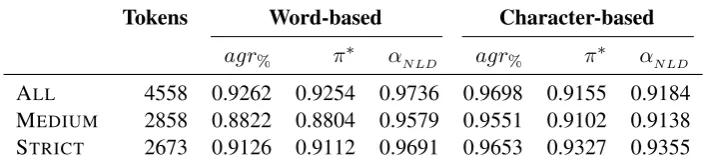
[image:6.595.122.475.64.147.2]agr% π∗ αNLD agr% π∗ αNLD ALL 4558 0.9262 0.9254 0.9736 0.9698 0.9155 0.9184 MEDIUM 2858 0.8822 0.8804 0.9579 0.9551 0.9102 0.9138 STRICT 2673 0.9126 0.9112 0.9691 0.9653 0.9327 0.9355
Table 5: Inter-annotator agreement on normalization across five annotators; ALL= all tokens, MEDIUM= at least one annotator made a change to the original token, STRICT= all annotators made a change to the original token.
the merging step by replacing all identity align-ments in the Needleman-Wunsch alignment with the identity label. The result can be seen in ta-ble 4, column “Diff”. Note how this representa-tion specifically highlights the changes made to the original token.
5.2 Advantages of the Character-Based Representation
Using character-based representations with iden-tity labels does not completely solve the problems described in Sec. 4.1, but alleviates them signifi-cantly.
Instead of words, our label set now contains all possible character n-grams. While this is still a potentially unbounded set, the vast majority of la-bels are single characters only. This means that the effective size of our label set has been greatly re-duced, allowing for a better estimation of the label distribution and reducing the “rare label” problem. Introducing the identity label models the as-sumption that leaving characters unchanged is the “default” action. Under this assumption, the iden-tity label will now be the most common label by far, and all other labels (representing modifica-tions) will be comparatively rare. Since the agree-ment coefficients give more weight to rare labels, this means that agreement on actual modifications is now considered to be much more important than agreement on characters that do not change, which is exactly what we want.
Note that simply using the character-based rep-resentation without identity labels will overes-timate the annotators’ performance even more, since it greatly increases the number of units where the annotators agree. On the other hand, using identity labels directly on a word level does nothing to alleviate the issue of a potentially infi-nite label set.
6 Evaluation
We first compare agreement scores of the naive word-based evaluation with those obtained using the character-based representation of the task. For both scenarios, we calculate average percentage agreement (agr%) and Krippendorff’sαusing the
NLDdistance function defined in Sec. 4. We find that values for π and κ, either naively averaged over all annotator pairs or using the generalization ofπ∗, almost always differ only after the fifth or
sixth decimal place; we therefore restrict ourselves to reportingπ∗.
We evaluate separately on all tokens (ALL), to-kens where at least one annotator made a modifi-cation to the historical token (MEDIUM), and to-kens where all five annotators made a modifica-tion (STRICT).
Table 5 shows the agreement scores for this evaluation. The average word-based agreement over all tokens is 92.62%, and π∗ values for the
word-based task are always similar to the percent-age agreement. Values for αNLD are naturally higher, since it also considers partial agreement within the normalizations. For the character-based task, percentage agreement is always much higher, butπ∗values are now noticeably lower compared
to the percentage values. This is a consequence of the character-based reframing of the task being much more sensitive to agreement on the actual modifications (cf. Sec. 5.2).
Tokens Word-based Character-based
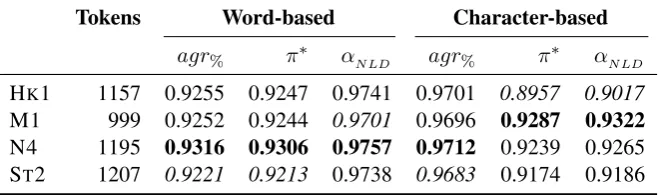
[image:7.595.135.465.64.162.2]agr% π∗ αNLD agr% π∗ αNLD HK1 1157 0.9255 0.9247 0.9741 0.9701 0.8957 0.9017 M1 999 0.9252 0.9244 0.9701 0.9696 0.9287 0.9322 N4 1195 0.9316 0.9306 0.9757 0.9712 0.9239 0.9265 ST2 1207 0.9221 0.9213 0.9738 0.9683 0.9174 0.9186
Table 6: Inter-annotator agreement on normalization, separately for each text; highest score for each measure shown inbold, lowest score shown initalics.
This is supported even further by the fact that the STRICTset has the highestπ∗/αNLD scores in the character-based evaluation.
It is also interesting to compare the agreement by chance (Ae) between the two approaches. For π∗, the naive word-based evaluation has an
ex-pected agreement ofAπ∗
e = 0.0103, which is not
surprising considering that the pool of possible an-notations is the set of all observed wordforms. For the character-based task, the majority of annota-tions are the identity label, which results in a high chance agreement of Aπ∗
e = 0.6312. A better
agreement between the annotators is therefore re-quired to obtain a goodπ∗value.
For these reasons, we believe that the high agreement values of π∗ ≥ 0.91 on the
character-based task provide stronger evidence for a good inter-annotator agreement on our dataset than the naive word-based evaluation does.
6.1 Per-Text Evaluation
Our evaluation dataset consists of passages from four different texts that exhibit different spelling characteristics (cf. Sec. 3). Since it is conceivable that this affects the difficulty of the normalization task, we also choose to evaluate on each text ex-cerpt separately.
The results are shown in Table 6. Generally, there are only minor differences between the texts: for the word-based evaluation, N4 consistently shows the highest agreement, while ST2 usually has the lowest values (except forαNLD, where M1 ranks worse). The same is true for agr% on the character-based task. However, the agreement co-efficients for the character-based task show very different trends: here, M1 gets the highest scores, while the values for HK1 are lowest by a notice-ably margin.
This evaluation shows that our character-based evaluation is also useful for providing a different
Tokens agr% π∗
ALL 4558 0.8857 0.8171 MEDIUM 1230 0.5907 0.4681
STRICT 329 0.8839 0.8081
Table 7: Inter-annotator agreement on type of modernization; ALL = all tokens, MEDIUM = at least one annotator chose a modernization cate-gory (INFL/SEM/EXT), STRICT = all annotators chose a modernization category.
perspective on the annotated data than word-based agreement.
6.2 Type of Modernization
So far, the evaluation has focused on normal-ization alone. However, as described in Sec. 2, the annotation guidelines also include an addi-tional modernization layer, which accounts for changes to the historical wordforms that go be-yond spelling modifications.
Whenever annotators assign a modernization, they also need to select which type of adjustment they have performed. This allows us to evaluate agreement on the “type of modernization” they have chosen; we extend the three modernization types from our guidelines with two types for cases where no modernization has been performed, leav-ing us with these five categories: ORIG = no change from the original token; NORM= normal-ization, but no modernization;INFL= inflectional adjustment; SEM = semantic adjustment in the modernization; EXT = adjustment due to extinct wordform.
Table 7 shows that we achieve a reasonable agreement of π∗ = 0.8171on the assignment of
[image:7.595.321.509.214.280.2]eval-ORIG NORM INFL SEM EXT
ORIG 1452 11 20 36 1
NORM – 2125 68 60 29
INFL – – 233 11 4
SEM – – – 154 15
[image:8.595.310.523.64.156.2]EXT – – – – 71
Table 8: Confusion matrix of annotator judgments between modernization types, averaged across all annotator pairs
uation to tokens where at least one annotator chose one of the actual modernization categories (INFL/SEM/EXT; row MEDIUMin Table 7) results in a very low score of0.4681. A further restriction to tokens whereallannotators chose one of these categories results in a much better score again, however, this was only the case for 329 tokens. These results show that our annotators disagree strongly on when to actually assign a modernized wordform at all; in the few cases where they all agree that a modernization has to be assigned, the agreement on the type of modernization is reason-ably good.
To further illustrate this point, Table 8 shows a confusion matrix on modernization types. For each ofINFL/SEM/EXT, the second most often se-lected category by another annotator was NORM, i.e., a normalization where no additional modern-ization was performed. However, disagreement within these categories of INFL/SEM/EXT occurs only rarely, confirming the interpretation of the values in Table 7. Also, confusion with the ORIG category is also comparatively rare, showing that wordforms which do not need to be changed are much less problematic.
6.3 Character-Based Evaluation of Modernization
Due to the nature of the modernization layer, a character-based evaluation of the wordforms is problematic, since modernized forms usually do not need to bear any resemblance to the histor-ical token. An exception are modernized forms that have been assigned due to inflectional changes (INFL), which we would assume to be similar to the respective historical and normalized forms.
To test this assumption, we evaluate
character-Tokens agr% π∗ αNLD
ORIG 1357 1.0000 – –
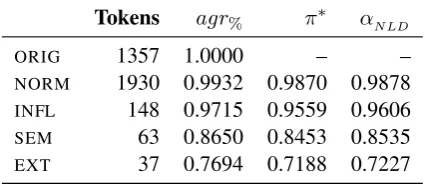
NORM 1930 0.9932 0.9870 0.9878 INFL 148 0.9715 0.9559 0.9606 SEM 63 0.8650 0.8453 0.8535 EXT 37 0.7694 0.7188 0.7227
Table 9: Inter-annotator agreement on moderniza-tion, using character-based evaluamoderniza-tion, separately for tokens where all annotators agree on the type of modernization.
based agreement on the modernization layer for tokens where all annotators agree on a modern-ization type (Table 9). For ORIG andNORM, we assume the modernized wordform to be identical to the normalization. The results confirm our ex-pectations: π∗ on INFLis 0.9559, while it drops
considerably forSEMandEXT; however, the sig-nificance of these results might be limited due to the low sample size for these cases.
Another notable result is the extremely high agreement (π∗= 0.9870) for tokens where all
an-notators agree on type NORM. This tells us that most of the disagreements from the normalization evaluation (cf. Table 5) stem from cases where at least one annotator decided that a modernization was necessary; these tokens therefore appear to be more difficult to agree on not only on the mod-ernization layer, but already on the normalization layer.
While it is plausible that extinct wordforms, as well as words with different meaning or inflection than in modern language, are inherently more dif-ficult to annotate, the intention of the guidelines was to move this difficulty to the modernization layer, while having unambiguous rules for the an-notation of the normalization layer. These results show that while we achieve a good reliability over-all, the guidelines were not able to remove this dif-ficulty completely for these cases.
7 Discussion
perspec-tive, and showed that it behaves differently than a naive word-based measure.
We have found that the scores resulting from our method correspond well to our intuitive judg-ments. As a direction for future research, it would be useful to conduct a systematic evaluation of this notion. For that purpose, human annotators would rate normalizations for agreement, and the level of correspondence would be revealed by how well the metrics can reproduce the rankings of the hu-man annotators. However, the rating of normal-izations is not in itself a trivial task. It would also have to be based on entire texts rather than isolated pairs of normalizations, since expected agreement cannot be calculated for isolated pairs and, hence, a comparison with our scores would not easily be possible. For these reasons, we did not conduct such a study for this paper.
Our proposed method is certainly not the only way to accomodate the specific properties of the normalization task. Instead of viewing the task on a character level, normalizations could also be seen as sets of edit operations on a word. This can easily be derived from the Needleman-Wunsch alignment that we already use (cf. Fig. 1): instead of the normalizationgeweint, we could define the annotation of the tokengewainto be a set of edit operations {4:a → e,6:n → nt}, and use a set-based agreement measure on it—see, e.g., Pas-sonneau (2004) for a set-based measure applied to coreference annotation. However, this approach is also not free of problems: in the annotated set, the position of edit operations is important, but for purposes of calculating chance agreement, posi-tional information should not be included. While we believe this difficulty can probably be resolved, we did not explore this option further.
We are aware of only one approach that re-ports agreement figures on the task of normaliz-ing historical data, Scheible et al. (2011), who deal with data from Early Modern German (1650– 1800) and report word-based percentage agree-ment of 96.9%. As we have argued, word-based evaluation alone cannot adequately assess perfor-mance of the annotators because partial agreement is not considered, and also this measure does not try to correct for chance.
Normalization is also sometimes performed on other types of data, such as dialectal or social me-dia texts. Our method of evaluating IAA can be generalized to these datasets as long as it is
sen-sible to frame them as a character-based annota-tion task, i.e., the annotaannota-tion values should be de-rived from (and typically be similar to) the surface forms of their respective tokens. The same consid-erations apply when transferring this approach to other open-class annotations, e.g. lemmatization. Acknowledgments
We would like to thank Julia Krasselt and all of our student annotators for their help in creating the evaluation dataset. The research reported here was supported by Deutsche Forschungsgemein-schaft (DFG), Grant DI 1558/4.
References
Ron Artstein and Massimo Poesio. 2008. Inter-coder
agreement for computational linguistics.
Computa-tional Linguistics, 34(4):555–596.
Jacob Cohen. 1960. A coefficient of agreement
for nominal scales. Educational and Psychological
Measurement, 20(1):37–46.
Stefanie Dipper and Simone Schultz-Balluff. 2013. The Anselm corpus: Methods and perspectives of
a parallel aligned corpus. In Proceedings of the
NODALIDA Workshop on Computational Historical Linguistics, Oslo, Norway.
Joseph L. Fleiss. 1971. Measuring nominal scale
agreement among many raters. Psychological
Bul-letin, 76(5):378–382.
Julia Krasselt, Marcel Bollmann, Stefanie Dipper, and Florian Petran. 2015. Guidelines for normalizing
historical German texts. Bochumer Linguistische
Arbeitsberichte, 15.
Klaus Krippendorff. 1980. Content Analysis: An
Introduction to Its Methodology. SAGE, Beverly Hills, CA.
Vladimir I. Levenshtein. 1966. Binary codes capa-ble of correcting deletions, insertions, and reversals. Soviet Physics Doklady, 10(8):707–710.
Johann-Mattis List and Robert Forkel. 2016. LingPy. A Python library for historical linguistics.
Ver-sion 2.4. http://lingpy.org. With
collab-orations by Steven Moran, Peter Bouda, Johannes Dellert, Taraka Rama, Frank Nagel, and Simon Greenhill: Max Planck Institute for the Science of Human History.
Rebecca J. Passonneau. 2004. Computing
reliabil-ity for coreference annotation. In Proceedings of
the 4th International Conference on Language Re-sources and Evaluation (LREC), volume 4, pages 1503–1506, Lisbon, Portugal.
Silke Scheible, Richard J. Whitt, Martin Durrell, and Paul Bennett. 2011. A gold standard corpus of
Early Modern German. InProceedings of the
ACL-HLT 2011 Linguistic Annotation Workshop (LAW V), pages 124–128, Portland, Oregon, USA.
![Table 2: Normalization, modernization and mod-ernization type of the sentence ‘As he disownedhim for the third time, the rooster crowed immedi-ately’ [Hk1].](https://thumb-us.123doks.com/thumbv2/123dok_us/1479318.687523/2.595.317.514.63.190/table-normalization-modernization-ernization-sentence-disownedhim-rooster-crowed.webp)