Connective-Based Measuring of the Inter-Annotator Agreement
in the Annotation of Discourse in PDT
Jiří Mírovský, Lucie Mladová, Šárka Zikánová
Charles University in Prague
Institute of Formal and applied Linguistics
{mirovsky,mladova,zikanova}@ufal.mff.cuni.cz
Abstract
We present several ways of measuring the inter-annotator agreement in the on-going annotation of semantic inter-sen-tential discourse relations in the Prague Dependency Treebank (PDT). Two ways have been employed to overcome limitations of measuring the agreement on the exact location of the start/end points of the relations. Both methods – skipping one tree level in the start/end nodes, and the connective-based mea-sure – are focused on a recognition of the existence and of the type of the rela-tions, rather than on fixing the exact po-sitions of the start/end points of the con-necting arrows.
1
Introduction
1.1 Prague Dependency Treebank 2.0
The Prague Dependency Treebank 2.0 (PDT 2.0; Hajič et al., 2006) is a manually annotated corpus of Czech. It belongs to the most complex and elaborate linguistically annotated treebanks in the world. The texts are annotated on three layers of language description: morphological, analytical (which expresses the surface syntactic structure), and tectogrammatical (which ex-presses the deep syntactic structure). On the tec-togrammatical layer, the data consist of almost 50 thousand sentences.
For the upcoming release of PDT, many addi-tional features are planned, coming as results of several projects. Annotation of semantic in-ter-sentential discourse relations is one of the planned additions.
To ensure the highest possible quality of the annotated data, it would be best if several
anno-tators annotated the whole data in parallel. After solving discrepancies in the annotations of the individual annotators, we would get a high--quality annotation. This approach is sometimes employed, but most of the times, the available resources prohibit it (which is also the case of the discourse annotation project). Manual anno-tation of data is a very expensive and time con-suming task. To overcome the restriction of lim-ited resources, each part of the data is annotated by one annotator only, with the exception of a small overlap for studying and measuring the inter-annotator (dis-)agreement.
1.2 Inter-Annotator Agreement in Compu-tational Linguistics
computational linguistics was given in Artstein and Poesio (2008).
For measuring the inter-annotator agreement in the annotation of semantic inter-sentential discourse relations in PDT, we have chosen two measures. The relations do not form natural chains (unlike e.g. textual and grammatical coreference) and a simple F1-measure is well
suited for the agreement on existence of the re-lations. For the agreement on types of the rela-tions, which is a typical classification task, we use Cohen's κ.
Our research has then been focused not on “how to measure” the agreement (which coeffi-cient to use), but rather on “what to measure” (which phenomena), which is the topic of this paper.
2
Annotated Phenomena
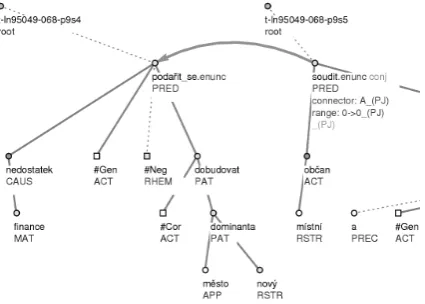
Since the Prague Dependency Treebank 2.0 al-ready contains three layers of linguistic annota-tion, two of which (the analytical layer – surface syntax, and the tectogrammatical layer – under-lying syntax and semantics) are tree representa-tions, we took advantage of these existing analyses and carry out the annotation of dis-course phenomena directly on the trees (the tec-togrammatical layer). It means that we capture the discourse relation between any two (sub)trees in the document by drawing a link (an arrow) between the highest nodes in the (sub)trees, see Figure 1.
Figure 1. A discourse arrow between two nodes represents a discourse relation between two
trees – subtrees of the nodes.
Discourse relations we annotate are in princi-ple semantic relations that apply between two abstract objects (Asher, 1993) (i.e. discourse units or text spans) and help make the text a co-herent whole. These relations are often signaled by the presence of a discourse connective, i.e. expressions as “ale”, ačkoliv”, “tedy”, “ovšem” (in English “but”, “although”, “then”, “however” etc. In the first phase of the project, we only annotate relations (link the (sub)trees) where such a connective is present.
Every relation gets assigned two important attributes: first, the discourse connective that anchors the relation, and, second, the semantic type of the relation. For assigning semantic rela-tions in the discourse, we developed a set of 22 discourse-semantic tags (Mladová et al., 2009). It is inspired partly by the set of semantic labels used for the annotation of the tectogrammatical layer in PDT 2.0, relations within the sentence (the tectogrammatical syntactico-semantic la-bels called functors, Mikulová et al., 2005) – since some of the semantic relations apply also intra-sententially, like causal or contrastive rela-tions; and partly by the set of semantic tags in the Penn Discourse Treebank 2.0 (Prasad et al., 2008), a discourse annotation project for Eng-lish with similar aims.
Hence, there are three important issues for the inter-annotator measurement on the dis-course level of annotation in PDT: the agree-ment on the start and target nodes of the course relation (and so the extent of the course arguments), the agreement on the dis-course connective assigned to the relation, and, last but not least, the agreement on the semantic type of the relation.
3
Measuring the Inter-Annotator
Agreement in the Annotation of
Dis-course in PDT 2.0
3.1 Simple (Strict) Approach
The basic method we use for measuring the in-ter-annotator agreement requires a perfect match in the start and end points of the rela-tions. We calculate recall and precision be-tween the two annotators. Since these measures are not symmetric in respect to the annotators, we use their combination – F1-measure – which
nodes of the discourse relations created by the two annotators. We consider two relations to be in agreement strictly only if they share both the start node and the target node.
A second number we measure is an agree-ment on the relation and the type. For consider-ing two relations to be in agreement, we require that they share their start and target nodes, and also have attached the same type.
Similarly, we measure an agreement on the relation and the connective, and an agreement on the relation, the type and the connective.
Attaching a type to a relation can be under-stood as a classification task. We calculate two numbers – simple ratio agreement and Cohen's κ – on the types attached to those relations where the annotators agreed on the start and the target nodes. Cohen's κ shows the level of agreement on the types above chance.
For completeness, we also calculate simple ratio agreement on the connectives attached to those relations the annotators agreed on.
Table 1 shows results of these measurements on two hundred sentences annotated in parallel by two annotators.1
measure value
F1-measure on relations 0.43
F1-measure on relations + types 0.34
F1-measure on relations + connectives 0.41
F1-measure on rel. + types + connect. 0.32
agreement on types 0.8
agreement on connectives 0.95 Cohen's κ on types 0.74
Table 1. The inter-annotator agreement for a strict match.
3.2 Skipping a Tree Level
Requiring a perfect agreement on the start node and the target node of the discourse relations turns out to be too strict for a fair evaluation of
1 The annotators did not know which part of the data will
be used for the measurement. The agreement was mea-sured on 200 sentences (6 documents). PDT 2.0 contains data from three sources. The proportion of the sentences selected for the measurement reflected the total proportion of these data sources in the whole treebank.
the inter-annotator agreement. It often happens that the annotators recognize the same discourse relation in the data but they disagree either in the start node or the target node of the relation.
In Zikánová et al. (2010), we elaborate on typical cases of this type of disagreement and show that in many times, the difference in the start node or the target node is only one level in the tree. We have also shown that these dis-agreements usually depend on a subtle and not crucial difference in the interpretation of the text.
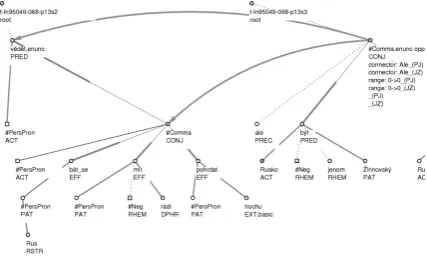
Figure 2 shows an example of a disagreement caused by a one-level difference in the target node of a relation. The two trees (a cut of them) represent these two sentences:
“Vím, že se nás Rusů bojíte, že nás nemáte rádi, že námi trochu pohrdáte. Ale Rusko není jenom Žirinovskij, Rusko není jenom vraždění v Čečensku.”
(In English: “I know that you are afraid of us Russians, that you dislike us, that you despise us a little. But Russia is not only Zhirinovsky, Russia is not only murdering in Chechnya.”)
Figure 2. Disagreement in the target node.
Both annotators recognized the discourse re-lation between the two sentences, both selected the same type (opposition), and both marked the same connective (“Ale”, in English “But”). The disagreement in the target node is caused by the fact that one annotator has connected the second sentence with “knowing that something is going on”, while the other has connected it directly with the expression“something is going on”.
agreement (F1-measure on the relations) of
about 10%. To be exact, by allowing to skip one tree level we mean: if node A is a parent of node B, then we consider arrows A→C and B→C to be in agreement, as well as arrows D→A and D→B. Table 2 shows present results of this type of measurement, performed on the same data as Table 1.
measure value
F1-measure on relations 0.54
F1-measure on relations + types 0.43
F1-measure on relations + connectives 0.49
F1-measure on rel. + types + connect. 0.39
agreement on types 0.8
agreement on connectives 0.92 Cohen's κ on types 0.73
Table 2. The inter-annotator agreement with one-level skipping.
The results seem to be consistent, since the improvement here is similar to the previously published test. The F1-measure on the relations
improved from 0.43 to 0.54. On the other hand (and also consistently with the previous test), simple ratio agreement on types (or connec-tives) and Cohen's κ on types, all measured on those arrows the annotators agreed on, do not change (more or less) after skipping one level is allowed. For these three measures, skipping one level only adds more data to evaluate and does not change conditions of the evaluation.
3.3 Connective-Based Approach
Further studies of discrepancies in parallel an-notations show that skipping one level does not cover all “less severe” cases of disagreement.
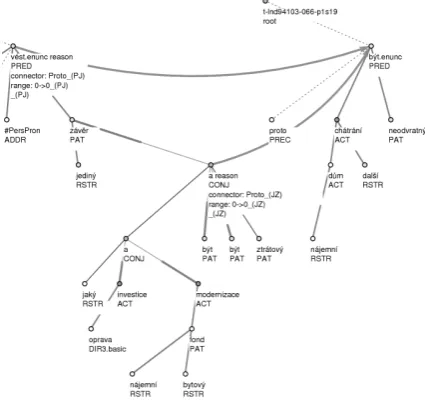
Figure 3 presents an example of a disagree-ment in the start node of a relation with a two-level distance between the nodes. The two trees (a cut of them) represent these two sentences:
“Racionální kalkulace vlastníků nájemních bytů je proto povede k jedinému závěru: jakéko-liv investice do oprav a modernizace nájemního bytového fondu jsou a budou ztrátové. Proto je další chátrání nájemních domů neodvratné.”
(In English: A rational calculation of the owners of the apartments will lead them to the only conclusion: any investment in repairs and renovation of the rental housing resources is and will be loss-making. Therefore, further di-lapidation of the apartment buildings is in-evitable.”)
Figure 3. Two-level disagreement in the start nodes
The difference between the annotators is that one of them started the relation at the phrase “will lead to the only conclusion: any invest-ment ... is and will be ...”, while the other start-ed the relation directly at the phrase “any in-vestment … is and will be ...”.
However, both the annotators admittedly rec-ognized the existence of the discourse relation, they also selected the same type (reason), and marked the same connective (“Proto”, in Eng-lish “Therefore”).
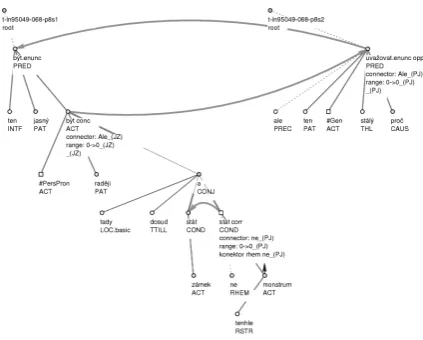
Figure 4 shows an example of a disagreement caused by a different selection of nodes and by the opposite direction of the arrows. The trees represent these sentences: “To je jasné, že bych byl radši, kdyby tady dosud stál zámek a ne tohle monstrum. Ale proč o tom stále uvažovat?”
Figure 4. Disagreement in the nodes and in the direction of the arrows.
This time, both annotators recognized a pres-ence of a discourse relation and marked the same connective (“Ale”, in English “But”). They did not agree on the start/end nodes and on the type of the relation (opposition vs. con-cession).
Figure 5 shows another type of “slight” dis-agreement. This time, the annotators agreed on everything but the range of the relation. They agreed both on the type (reason) and the con-nective (“tak”, in English “Thus”). The three trees (again a cut of them) represent these three sentences:
“Podle šéfa kanceláře představenstva a. s. Škoda Zdeňka Lavičky jsou však v říjnu schop-ny fungovat prakticky všechschop-ny závody bez vážnějšího omezení. To je v rozporu s tvrzením vedení koncernu z minulého týdne, ve kterém škodovácký management tvrdil, že se odstávka dotkne většiny provozů a závodů Škody Plzeň, která má v současnosti 28000 zaměstnanců. Vzniká tak podezření, že se vedení koncernu snažilo vyvinout tlak na vládu a donutit ji k za-placení dluhů.”
(In English: “According to Zdeněk Lavička, the chief of the board of directors of Škoda corp., virtually all factories are able to operate in October without serious limitations. It con-tradicts the statement of the syndicate adminis-tration from the last week, in which the man-agement of Škoda claimed that the downtime would affect most of the plants and factories of Škoda Plzeň, which presently has 28,000 em-ployees. Thus a suspicion arises that the
syndi-cate administration tried to exert pressure on the government and force it to pay the debts.”)
Figure 5. Disagreement in the range of the dis-course relation.
The difference between the annotators is in the range of the start part of the arrows. One of the annotators marked the two first sentences as a start point of the relation, while the other marked the second sentence as the start point only. They agreed on the target point of the rela-tion being the third sentence.
Inspired by these examples, we designed an-other – a connective-based – measure for evalu-ating the inter-annotator agreement of the dis-course relations. It seems that although the an-notators sometimes fail to mark the same start/target nodes, or to select the same type or the same range of the relations, they usually agree on the connective. This idea is also sup-ported by high levels of the simple ratio agree-ment on connectives measured on relations the annotators agreed on from Tables 1 and 2 (0.95 and 0.91). These numbers show that once the annotators agree on a relation, they almost al-ways agree also on the connective.2
The connective-based measure considers the annotators to be in agreement on recognizing a discourse relation if they agree on recognizing the same connective (please note that we only annotate discourse relations with explicitly ex-pressed connectives).
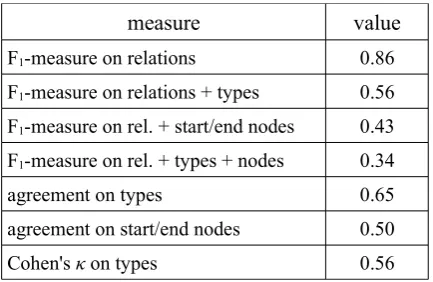
Table 3 shows results of the evaluation of the inter-annotator agreement, performed using the connective-based measure, on the same data as Tables 1 and 2.
2 This is only an interpretation of the numbers, not a
measure value F1-measure on relations 0.86
F1-measure on relations + types 0.56
F1-measure on rel. + start/end nodes 0.43
F1-measure on rel. + types + nodes 0.34
agreement on types 0.65 agreement on start/end nodes 0.50 Cohen's κ on types 0.56
Table 3. The inter-annotator agreement evaluat-ed with the connective-basevaluat-ed measure.
This time (compared with Tables 1 and 2, i.e. the simple strict measure and the one-level skip-ping measure), the agreement (F1-measure) on
relations is much higher – 0.86 (vs. 0.43 and 0.54). On the other hand, simple ratio agreement (and Cohen's κ) measured on relations recog-nized by both annotators are lower than in Ta-bles 1 and 2. Although the annotators might have recognized the same discourse relation, a (possibly small) difference in the interpretation of the text caused sometimes not only a dis-agreement in the positions of the start/end nodes, but also in the type of the relation.
The simple ratio agreement on types from Table 3 (0.65) is probably the closest measure to the way of measuring the inter-annotator agreement on subtypes in the annotation of dis-course relations in the Penn Disdis-course Treebank 2.0, reported in Prasad et al. (2008). Their agreement was 0.8.
4
Conclusion
We have presented several ways of measuring the inter-annotator agreement in the project of annotating the semantic inter-sentential dis-course relations with explicitly expressed con-nectives in the Prague Dependency Treebank. We have shown examples from parallel annota-tions that substantiate the importance of the al-ternative approaches to the evaluation of the agreement.
Skipping a tree level in the start node or the end node of the relations helps to recognize fac-tual agreement in some cases where the strict approach detects disagreement. We have shown that it is still too strict and that there are cases
which we would like to classify as agreement but the measure does not recognize them.
The connective-based measure seems to be the closest one to what we would like to consid-er a critconsid-erion of agreement. It disregards the ac-tual nodes that are connected with a discourse relation, and even disregards the direction of the relation. In this sense, it is the most benevolent of the three measures.
It does not mean that the simple strict mea-sure or skipping a tree level are inferior or obso-lete ways of measuring the agreement. All the measures focus on different aspects of the agreement and they are all important in the process of annotating the corpus, studying the parallel annotations and improving the annota-tion instrucannota-tions. We may agree on the fact that on this level of language description, it is very hard to achieve perfect agreement (Lee at al., 2006), yet we should never cease the effort to further specify and clarify the ways of annota-tion, in order to catch the same linguistic phe-nomena in the same way, and thus provide sys-tematic and coherent linguistic data.
Acknowledgments
We gratefully acknowledge support from the Czech Ministry of Education (grant MSM-0021620838), the Grant Agency of the Czech Republic (grants 405/09/0729 and P406/2010/0875), the Czech Science Founda-tion (grant 201/09/H057), and the Grant Agency of Charles University in Prague (GAUK 103609).
References
Artstein R. and M. Poesio. 2008. Inter-coder agree-ment for computational linguistics. Computational Linguistics 34/4, pp. 555–596.
Asher, N. 1993. Reference to Abstract Objects in Discourse. Kluwer Academic Publishers
Cohen, J. 1960. A coefficient of agreement for nomi-nal scales. Educational and Psychological Mea-surement, 20(1), pp. 37–46.
Krippendorff, K. 1980. Content Analysis: An Intro-duction to Its Methodology. Chapter 12. Sage, Beverly Hills, CA, USA.
Lee, A., Prasad, R., Joshi, A., Dinesh, N., and B. Weber. 2006. Complexity of dependencies in dis-course: Are dependencies in discourse more com-plex than in syntax? J. Hajič and J. Nivre, (eds.). Proceedings of the 5th Workshop on Treebanks and Linguistic Theories (TLT 2006). Prague, Czech Republic, pp. 79–90.
Mikulová, M. et al. 2005: Annotation on the tec-togrammatical layer in the Prague Dependency Treebank. Annotation manual. Avaiable from http://ufal.mff.cuni.cz/pdt2.0/doc/manuals/en/t-layer/pdf/t-man-en.pdf
Mladová L., Zikánová, Š., Bedřichová, Z., and E. Hajičová. 2009. Towards a Discourse Corpus of Czech. Proceedings of the Corpus Linguistics Conference, Liverpool, Great Britain, in press (online proceedings: http://ucrel.lancs.ac.uk/publi-cations/cl2009/).
Passonneau, R. 2004. Computing Reliability for Coreference. Proceedings of LREC, vol. 4, Lis-bon, Portugal, pp. 1503–1506.
Prasad, R., Dinesh N., Lee A., Miltsakaki, E., Robal-do, L., Joshi, A., Webber, B. 2008. The Penn Dis-course Treebank 2.0. Proceedings of the 6th Inter-national Conference on Language Resources and Evaluation (LREC 2008), Morocco.