Linguistic Regularities in Continuous Space Word Representations
Tomas Mikolov∗, Wen-tau Yih, Geoffrey Zweig Microsoft Research
Redmond, WA 98052
Abstract
Continuous space language models have re-cently demonstrated outstanding results across a variety of tasks. In this paper, we ex-amine the vector-space word representations that are implicitly learned by the input-layer weights. We find that these representations are surprisingly good at capturing syntactic and semantic regularities in language, and that each relationship is characterized by a relation-specific vector offset. This allows vector-oriented reasoning based on the offsets between words. For example, the male/female relationship is automatically learned, and with the induced vector representations, “King -Man + Woman” results in a vector very close to “Queen.” We demonstrate that the word vectors capture syntactic regularities by means of syntactic analogy questions (provided with this paper), and are able to correctly answer almost 40% of the questions. We demonstrate that the word vectors capture semantic regu-larities by using the vector offset method to answer SemEval-2012 Task 2 questions. Re-markably, this method outperforms the best previous systems.
1 Introduction
A defining feature of neural network language mod-els is their representation of words as high dimen-sional real valued vectors. In these models (Ben-gio et al., 2003; Schwenk, 2007; Mikolov et al., 2010), words are converted via a learned lookup-table into real valued vectors which are used as the
∗
Currently at Google, Inc.
inputs to a neural network. As pointed out by the original proposers, one of the main advantages of these models is that the distributed representation achieves a level of generalization that is not possi-ble with classicaln-gram language models; whereas an-gram model works in terms of discrete units that have no inherent relationship to one another, a con-tinuous space model works in terms of word vectors where similar words are likely to have similar vec-tors. Thus, when the model parameters are adjusted in response to a particular word or word-sequence, the improvements will carry over to occurrences of similar words and sequences.
By training a neural network language model, one obtains not just the model itself, but also the learned word representations, which may be used for other, potentially unrelated, tasks. This has been used to good effect, for example in (Collobert and Weston, 2008; Turian et al., 2010) where induced word rep-resentations are used with sophisticated classifiers to improve performance in many NLP tasks.
In this work, we find that the learned word repre-sentations in fact capture meaningful syntactic and semantic regularities in a very simple way. Specif-ically, the regularities are observed as constant vec-tor offsets between pairs of words sharing a par-ticular relationship. For example, if we denote the vector for word i as xi, and focus on the
singu-lar/plural relation, we observe thatxapple−xapples≈ xcar−xcars,xf amily−xf amilies≈xcar−xcars, and
so on. Perhaps more surprisingly, we find that this is also the case for a variety of semantic relations, as measured by the SemEval 2012 task of measuring relation similarity.
The remainder of this paper is organized as fol-lows. In Section 2, we discuss related work; Section 3 describes the recurrent neural network language model we used to obtain word vectors; Section 4 dis-cusses the test sets; Section 5 describes our proposed vector offset method; Section 6 summarizes our ex-periments, and we conclude in Section 7.
2 Related Work
Distributed word representations have a long his-tory, with early proposals including (Hinton, 1986; Pollack, 1990; Elman, 1991; Deerwester et al., 1990). More recently, neural network language models have been proposed for the classical lan-guage modeling task of predicting a probability dis-tribution over the “next” word, given some preced-ing words. These models were first studied in the context of feed-forward networks (Bengio et al., 2003; Bengio et al., 2006), and later in the con-text of recurrent neural network models (Mikolov et al., 2010; Mikolov et al., 2011b). This early work demonstrated outstanding performance in terms of word-prediction, but also the need for more compu-tationally efficient models. This has been addressed by subsequent work using hierarchical prediction (Morin and Bengio, 2005; Mnih and Hinton, 2009; Le et al., 2011; Mikolov et al., 2011b; Mikolov et al., 2011a). Also of note, the use of distributed topic representations has been studied in (Hinton and Salakhutdinov, 2006; Hinton and Salakhutdi-nov, 2010), and (Bordes et al., 2012) presents a se-mantically driven method for obtaining word repre-sentations.
3 Recurrent Neural Network Model
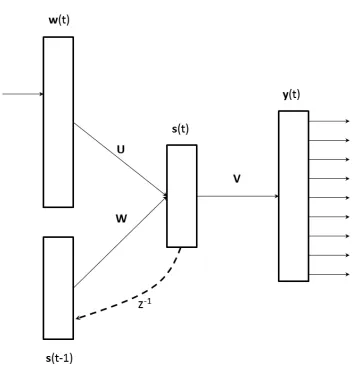
The word representations we study are learned by a recurrent neural network language model (Mikolov et al., 2010), as illustrated in Figure 1. This architec-ture consists of an input layer, a hidden layer with re-current connections, plus the corresponding weight matrices. The input vector w(t) represents input word at timetencoded using 1-of-N coding, and the output layery(t)produces a probability distribution over words. The hidden layers(t)maintains a rep-resentation of the sentence history. The input vector
[image:2.612.334.510.60.246.2]w(t) and the output vectory(t) have dimensional-ity of the vocabulary. The values in the hidden and
Figure 1: Recurrent Neural Network Language Model.
output layers are computed as follows:
s(t) =f(Uw(t) +Ws(t−1)) (1)
y(t) =g(Vs(t)), (2)
where
f(z) = 1
1 +e−z, g(zm) = ezm P
kezk
. (3)
In this framework, the word representations are found in the columns ofU, with each column rep-resenting a word. The RNN is trained with back-propagation to maximize the data log-likelihood un-der the model. The model itself has no knowledge of syntax or morphology or semantics. Remark-ably, training such a purely lexical model to max-imize likelihood will induce word representations with striking syntactic and semantic properties.
4 Measuring Linguistic Regularity
4.1 A Syntactic Test Set
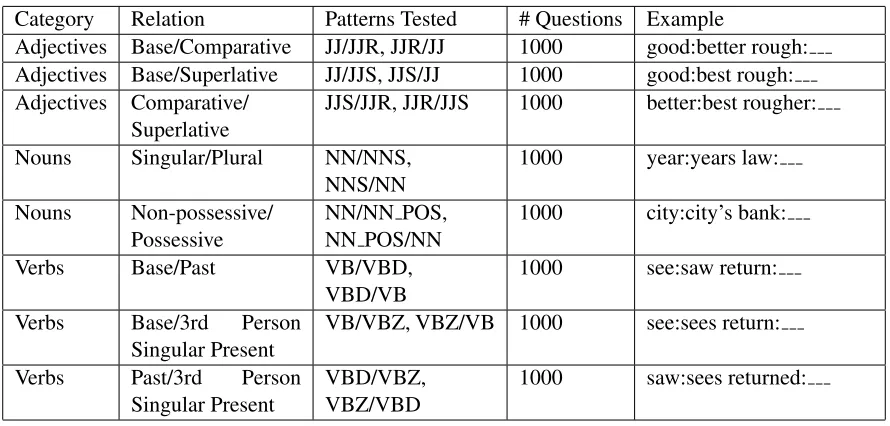
To understand better the syntactic regularities which are inherent in the learned representation, we created a test set of analogy questions of the form “ais tob
Category Relation Patterns Tested # Questions Example
Adjectives Base/Comparative JJ/JJR, JJR/JJ 1000 good:better rough: Adjectives Base/Superlative JJ/JJS, JJS/JJ 1000 good:best rough: Adjectives Comparative/
Superlative
JJS/JJR, JJR/JJS 1000 better:best rougher:
Nouns Singular/Plural NN/NNS,
NNS/NN
1000 year:years law:
Nouns Non-possessive/ Possessive
NN/NN POS, NN POS/NN
1000 city:city’s bank:
Verbs Base/Past VB/VBD,
VBD/VB
1000 see:saw return:
Verbs Base/3rd Person
Singular Present
VB/VBZ, VBZ/VB 1000 see:sees return:
Verbs Past/3rd Person
Singular Present
VBD/VBZ, VBZ/VBD
[image:3.612.84.529.52.265.2]1000 saw:sees returned:
Table 1: Test set patterns. For a given pattern and word-pair, both orderings occur in the test set. For example, if “see:saw return: ” occurs, so will “saw:see returned: ”.
Treebank POS tags (Marcus et al., 1993). We then selected 100 of the most frequent comparative adjec-tives (words labeled JJR); 100 of the most frequent plural nouns (NNS); 100 of the most frequent pos-sessive nouns (NN POS); and 100 of the most fre-quent base form verbs (VB). We then systematically generated analogy questions by randomly matching each of the 100 words with 5 other words from the same category, and creating variants as indicated in Table 1. The total test set size is 8000. The test set is available online. 1
4.2 A Semantic Test Set
In addition to syntactic analogy questions, we used the SemEval-2012 Task 2,Measuring Relation Sim-ilarity(Jurgens et al., 2012), to estimate the extent to which RNNLM word vectors contain semantic information. The dataset contains 79 fine-grained word relations, where 10 are used for training and 69 testing. Each relation is exemplified by 3 or 4 gold word pairs. Given a group of word pairs that supposedly have the same relation, the task is to order the target pairs according to the degreeto which this relation holds. This can be viewed as an-other analogy problem. For example, take the Class-Inclusion:Singular Collectiverelation with the
pro-1
http://research.microsoft.com/en-us/projects/rnn/default.aspx
totypical word pairclothing:shirt. To measure the degree that a target word pairdish:bowlhas the same relation, we form the analogy “clothingis toshirtas
dishis tobowl,” and ask how valid it is.
5 The Vector Offset Method
As we have seen, both the syntactic and semantic tasks have been formulated as analogy questions. We have found that a simple vector offset method based on cosine distance is remarkably effective in solving these questions. In this method, we assume relationships are present as vector offsets, so that in the embedding space, all pairs of words sharing a particular relation are related by the same constant offset. This is illustrated in Figure 2.
In this model, to answer the analogy questiona:b c:d where d is unknown, we find the embedding vectorsxa, xb, xc (all normalized to unit norm), and
compute y = xb −xa +xc. y is the continuous
space representation of the word we expect to be the best answer. Of course, no word might exist at that exact position, so we then search for the word whose embedding vector has the greatest cosine similarity toyand output it:
w∗=argmaxw xwy
kxwkkyk
Figure 2: Left panel shows vector offsets for three word pairs illustrating the gender relation. Right panel shows a different projection, and the singular/plural relation for two words. In high-dimensional space, multiple relations can be embedded for a single word.
provided. We have explored several related meth-ods and found that the proposed method performs well for both syntactic and semantic relations. We note that this measure is qualitatively similar to rela-tional similarity model of (Turney, 2012), which pre-dicts similarity between members of the word pairs
(xb, xd),(xc, xd)and dis-similarity for(xa, xd).
6 Experimental Results
To evaluate the vector offset method, we used vectors generated by the RNN toolkit of Mikolov (2012). Vectors of dimensionality 80, 320, and 640 were generated, along with a composite of several systems, with total dimensionality 1600. The sys-tems were trained with 320M words of Broadcast News data as described in (Mikolov et al., 2011a), and had an 82k vocabulary. Table 2 shows results for both RNNLM and LSA vectors on the syntactic task. LSA was trained on the same data as the RNN. We see that the RNN vectors capture significantly more syntactic regularity than the LSA vectors, and do remarkably well in an absolute sense, answering more than one in three questions correctly.2
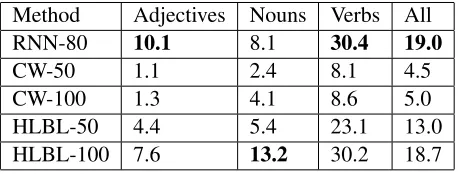
In Table 3 we compare the RNN vectors with those based on the methods of Collobert and We-ston (2008) and Mnih and Hinton (2009), as imple-mented by (Turian et al., 2010) and available online
3Since different words are present in these datasets,
we computed the intersection of the vocabularies of the RNN vectors and the new vectors, and restricted the test set and word vectors to those. This resulted in a 36k word vocabulary, and a test set with 6632
2
Guessing gets a small fraction of a percent. 3http://metaoptimize.com/projects/wordreprs/
Method Adjectives Nouns Verbs All
LSA-80 9.2 11.1 17.4 12.8
LSA-320 11.3 18.1 20.7 16.5
LSA-640 9.6 10.1 13.8 11.3
RNN-80 9.3 5.2 30.4 16.2
RNN-320 18.2 19.0 45.0 28.5
RNN-640 21.0 25.2 54.8 34.7
[image:4.612.313.542.55.168.2]RNN-1600 23.9 29.2 62.2 39.6
Table 2: Results for identifying syntactic regularities for different word representations. Percent correct.
Method Adjectives Nouns Verbs All
RNN-80 10.1 8.1 30.4 19.0
CW-50 1.1 2.4 8.1 4.5
CW-100 1.3 4.1 8.6 5.0
HLBL-50 4.4 5.4 23.1 13.0
HLBL-100 7.6 13.2 30.2 18.7
Table 3: Comparison of RNN vectors with Turian’s Col-lobert and Weston based vectors and the Hierarchical Log-Bilinear model of Mnih and Hinton. Percent correct.
questions. Turian’s Collobert and Weston based vec-tors do poorly on this task, whereas the Hierarchical Log-Bilinear Model vectors of (Mnih and Hinton, 2009) do essentially as well as the RNN vectors. These representations were trained on 37M words of data and this may indicate a greater robustness of the HLBL method.
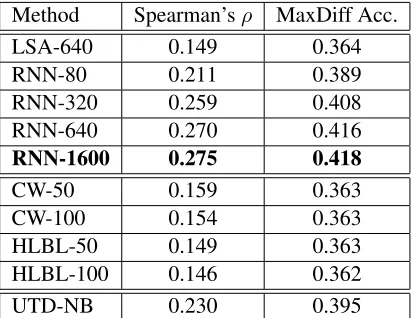
We conducted similar experiments with the se-mantic test set. For each target word pair in a rela-tion category, the model measures its relarela-tional sim-ilarity to each of the prototypical word pairs, and then uses the average as the final score. The results are evaluated using the two standard metrics defined in the task, Spearman’s rank correlation coefficient
[image:4.612.313.542.220.307.2]vec-Method Spearman’sρ MaxDiff Acc.
LSA-640 0.149 0.364
RNN-80 0.211 0.389
RNN-320 0.259 0.408
RNN-640 0.270 0.416
RNN-1600 0.275 0.418
CW-50 0.159 0.363
CW-100 0.154 0.363
HLBL-50 0.149 0.363
HLBL-100 0.146 0.362
[image:5.612.83.291.54.213.2]UTD-NB 0.230 0.395
Table 4: Results in measuring relation similarity
tors are not trained or tuned specifically for this task, the model achieves better results (320, RNN-640 & RNN-1600) than the previously best perform-ing system, UTD-NB (Rink and Harabagiu, 2012).
7 Conclusion
We have presented a generally applicable vector off-set method for identifying linguistic regularities in continuous space word representations. We have shown that the word representations learned by a RNNLM do an especially good job in capturing these regularities. We present a new dataset for mea-suring syntactic performance, and achieve almost 40% correct. We also evaluate semantic general-ization on the SemEval 2012 task, and outperform the previous state-of-the-art. Surprisingly, both re-sults are the byproducts of an unsupervised maxi-mum likelihood training criterion that simply oper-ates on a large amount of text data.
References
Y. Bengio, R. Ducharme, Vincent, P., and C. Jauvin. 2003. A neural probabilistic language model. Jour-nal of Machine Learning Reseach, 3(6).
Y. Bengio, H. Schwenk, J.S. Sen´ecal, F. Morin, and J.L. Gauvain. 2006. Neural probabilistic language models.
Innovations in Machine Learning, pages 137–186. A. Bordes, X. Glorot, J. Weston, and Y. Bengio. 2012.
Joint learning of words and meaning representations for open-text semantic parsing. InProceedings of 15th International Conference on Artificial Intelligence and Statistics.
R. Collobert and J. Weston. 2008. A unified architecture for natural language processing: Deep neural networks with multitask learning. In Proceedings of the 25th international conference on Machine learning, pages 160–167. ACM.
S. Deerwester, S.T. Dumais, G.W. Furnas, T.K. Landauer, and R. Harshman. 1990. Indexing by latent semantic analysis. Journal of the American Society for Informa-tion Science, 41(96).
J.L. Elman. 1991. Distributed representations, simple re-current networks, and grammatical structure. Machine learning, 7(2):195–225.
G.E. Hinton and R.R. Salakhutdinov. 2006. Reducing the dimensionality of data with neural networks. Sci-ence, 313(5786):504–507.
G. Hinton and R. Salakhutdinov. 2010. Discovering bi-nary codes for documents by learning deep generative models.Topics in Cognitive Science, 3(1):74–91. G.E. Hinton. 1986. Learning distributed representations
of concepts. InProceedings of the eighth annual con-ference of the cognitive science society, pages 1–12. Amherst, MA.
David Jurgens, Saif Mohammad, Peter Turney, and Keith Holyoak. 2012. Semeval-2012 task 2: Measuring de-grees of relational similarity. In*SEM 2012: The First Joint Conference on Lexical and Computational Se-mantics (SemEval 2012), pages 356–364. Association for Computational Linguistics.
Hai-Son Le, I. Oparin, A. Allauzen, J.-L. Gauvain, and F. Yvon. 2011. Structured output layer neural network language model. InProceedings of ICASSP 2011. Mitchell P. Marcus, Mary Ann Marcinkiewicz, and
Beat-rice Santorini. 1993. Building a large annotated cor-pus of english: the penn treebank.Computational Lin-guistics, 19(2):313–330.
Tomas Mikolov, Martin Karafiat, Jan Cernocky, and San-jeev Khudanpur. 2010. Recurrent neural network based language model. InProceedings of Interspeech 2010.
Tomas Mikolov, Anoop Deoras, Daniel Povey, Lukas Burget, and Jan Cernocky. 2011a. Strategies for Training Large Scale Neural Network Language Mod-els. InProceedings of ASRU 2011.
Tomas Mikolov, Stefan Kombrink, Lukas Burget, Jan Cernocky, and Sanjeev Khudanpur. 2011b. Ex-tensions of recurrent neural network based language model. InProceedings of ICASSP 2011.
Tomas Mikolov. 2012. RNN toolkit.
A. Mnih and G.E. Hinton. 2009. A scalable hierarchical distributed language model. Advances in neural infor-mation processing systems, 21:1081–1088.
international workshop on artificial intelligence and statistics, pages 246–252.
J.B. Pollack. 1990. Recursive distributed representa-tions. Artificial Intelligence, 46(1):77–105.
Bryan Rink and Sanda Harabagiu. 2012. UTD: Deter-mining relational similarity using lexical patterns. In
*SEM 2012: The First Joint Conference on Lexical and Computational Semantics (SemEval 2012), pages 413–418. Association for Computational Linguistics. Holger Schwenk. 2007. Continuous space language
models. Computer Speech and Language, 21(3):492 – 518.
J. Turian, L. Ratinov, and Y. Bengio. 2010. Word rep-resentations: a simple and general method for semi-supervised learning. InProceedings of Association for Computational Linguistics (ACL 2010).