warwick.ac.uk/lib-publications Manuscript version: Author’s Accepted Manuscript
The version presented in WRAP is the author’s accepted manuscript and may differ from the published version or Version of Record.
Persistent WRAP URL:
http://wrap.warwick.ac.uk/115225 How to cite:
Please refer to published version for the most recent bibliographic citation information. If a published version is known of, the repository item page linked to above, will contain details on accessing it.
Copyright and reuse:
The Warwick Research Archive Portal (WRAP) makes this work by researchers of the University of Warwick available open access under the following conditions.
Copyright © and all moral rights to the version of the paper presented here belong to the individual author(s) and/or other copyright owners. To the extent reasonable and
practicable the material made available in WRAP has been checked for eligibility before being made available.
Copies of full items can be used for personal research or study, educational, or not-for-profit purposes without prior permission or charge. Provided that the authors, title and full
bibliographic details are credited, a hyperlink and/or URL is given for the original metadata page and the content is not changed in any way.
Publisher’s statement:
Please refer to the repository item page, publisher’s statement section, for further information.
Customer Reactions to Downsizing: When is Satisfaction Affected?
Abstract
Organizational downsizing to cut costs frequently creates new, “hidden costs” that neutralize
potential increases in productivity. Customer dissatisfaction is such an overlooked downsizing
outcome. Using longitudinal data from the American Customer Satisfaction Index (ACSI),
Compustat, and a consumer survey this study analyzes satisfaction outcomes of downsizing. It
extends research in this domain to B2C markets and explicitly addresses environmental
influences on the downsizing–satisfaction link. Results indicate that there is a negative effect of
downsizing on customer satisfaction. It is particularly pronounced for companies (1) with little
organizational slack, (2) with high labor productivity, or (3) in industries with high R&D
intensity. Moreover, downsizing has a stronger negative impact on customer satisfaction in
product categories with (4) high risk importance and (5) low probability for consumer errors as
well as (6) low level of brand consciousness. Furthermore, customer satisfaction mediates the
effect of downsizing on financial performance. The results provide an explanation for why so
many downsizing projects fail and what managers can do to prevent adverse effects of
downsizing on customer satisfaction and financial performance.
Keywords: customer satisfaction, organizational downsizing, firm performance, panel
Introduction
In a “Group Strategy Update,” Australian airline Qantas announced on February 26,
2014, plans to cut 5,000 jobs (Qantas 2014). In the same week, the Financial Times reported
plans that IBM was to reduce its U.S. workforce by 13,000 to 15,000 employees (Waters 2014).
Hence, downsizing continues to be one of the most appealing cost-cutting strategies to firms
worldwide. Firms typically expect that the layoffs will improve financial performance. For
instance, Qantas (2014) explicitly states in their media release that the “long-term goal” of the
cost reductions is “the transformation of the Qantas Group for profitable, sustainable growth.”
The importance of downsizing in business practice has motivated many academic studies.
In a comprehensive review, Datta et al. (2010) identify four major research streams. Two of them
look at environmental and organizational antecedents of downsizing. The other two address its
consequences. Of the streams addressing the consequences of downsizing, the first looks at
organizational outcomes. Chadwick, Hunter, and Walston (2004, p. 406) summarize: “The
general consensus among researchers over the last two decades is that organizational
performance is as likely to suffer as it is to improve after downsizing.” The second addresses
outcomes at the employee level. Here, Datta et al. (2010, p. 307) conclude that “[d]ownsizing has
a significant potential to … disrupt relationship networks, and destroy the trust and loyalty that
binds employees and their employers.”
Interestingly, despite Cascio’s (2005, p. 45) advice to “think through the potential
consequences of restructuring on customers,” in their review Datta et al. (2010) identify only two
papers that examine the effect of downsizing on customers (out of a total of 91). Recently, more
research has been conducted in the area. For example, Subramony and Holtom (2012) report that
brand perceptions. However, the focus of research lies on the effect of downsizing on customer
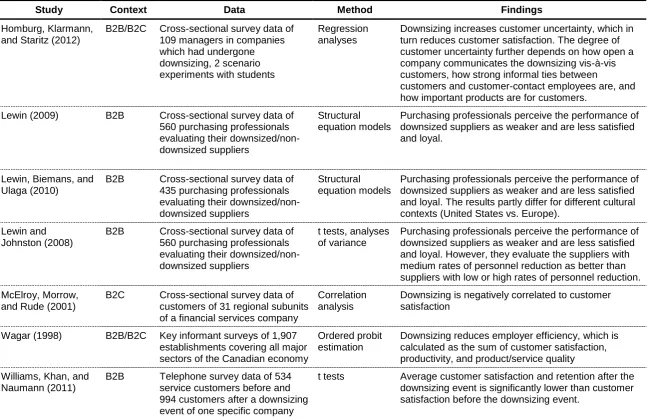
satisfaction. Table 1 provides an overview.
--- Insert Table 1 about here ---
As shown in Table 1, researchers consistently report negative effects of downsizing on
customer satisfaction. That being said, most evidence comes from B2B samples (Lewin 2009;
Lewin and Johnston 2008; Lewin, Biemans, and Ulaga 2010; Williams, Khan, and Naumann
2011) or samples with a prominent B2B share (Homburg, Klarmann, and Staritz 2012; Wagar
1998). One is from the financial services sector (McElroy, Morrow, and Rude 2001).
Hence, previous research in the area is almost exclusively based on environments where
personal interaction between employees and customers is important. Here, the internal disruption
caused by downsizing will be a particular threat to delivering quality. Through processes like
emotional contagion (e.g., Hennig-Thurau et al. 2006), negative job satisfaction outcomes may
translate into negative customer satisfaction (e.g., Homburg and Stock 2004). However,
elsewhere the relationship may be much more complex. While pointing to personal interaction as
differentiator, Anderson, Fornell, and Rust (1997) find that productivity improvements (which
can be achieved through downsizing) are negatively related to customer satisfaction for services,
but positively related for manufactured goods. Homburg, Klarmann, and Staritz (2012) find that
customer uncertainty following downsizing is much larger if customers interact frequently with
their contact employees from the downsizing firm.
We are interested whether the negative effect of downsizing on customer satisfaction
generalizes to other contexts. For our sample we draw on American Customer Satisfaction Index
(ACSI) data, which is collected for many product categories (e.g., food, appliances, apparel,
industries covered by the ACSI, the effect of downsizing on customer satisfaction is far less
intuitive than in B2B environments. In particular, we expect that the degree to which employees
are a crucial resource to the downsizing firm will affect the downsizing–satisfaction link. For
instance, if the firm has enough excess resources (“organizational slack,” Love and Nohria
2005), product quality is less likely to suffer through downsizing and customers might even
benefit from reduced prices. Hence, customer satisfaction might not be negatively affected by
downsizing. To account for effects like this we analyze measures of the downsizing firm’s
resources as moderators of the downsizing–satisfaction link.
Moreover, whether customers respond negatively to downsizing will also depend on what
they learn of the downsizing (Homburg, Klarmann, and Staritz 2012). Only if they devote a
certain amount of time and attention to a product category might they notice quality deficiencies
resulting from downsizing. Likewise, for signaling effects (Love and Kraatz 2009) as well as
reputational effects of downsizing (Flanagan and O’Shaughnessy 2005; Zyglidopoulos 2005) to
affect satisfaction, typically requires that customers follow the business press. To account for
these effects, we analyze customers’ product category involvement and customer purchase
criteria as moderators of the downsizing–satisfaction link.
Finally, we are interested whether customer outcomes to downsizing require firms to
reconsider downsizing as a management instrument. Therefore, we link customer satisfaction
after downsizing to firm performance.
To test our hypotheses, we use data from three sources: (1) As mentioned before, we use
ACSI data to measure customer satisfaction. (2) We measure downsizing, firm performance, and
the firm’s resource situation using the Computstat database. (3) To measure customer product
U.S. consumers. As a result we have a longitudinal dataset with data from 1994 to 2007 (before
the financial crisis) from over 100 companies, covering more than 150 downsizing events.
Our research makes at least four contributions to the discipline. First, we extend research
on customer responses to downsizing from contexts with much employee–customer interaction
to less interactive B2C environments. Second, we identify environmental conditions related to
the downsizing firm’s resources and customer information processing that determine whether
downsizing has a negative impact on customer satisfaction. Thus, we facilitate predictions
regarding potential problems resulting from downsizing. Third, by employing longitudinal data,
our study addresses causality issues. Previous findings on satisfaction outcomes to downsizing
come almost invariably from cross-sectional designs. Fourth, by linking customer responses to
downsizing with financial performance, our study improves the understanding of the ambiguous
results on performance implications of downsizing. If customer outcomes depend on contextual
factors, this helps understanding mixed performance effects in earlier research.
Conceptual framework
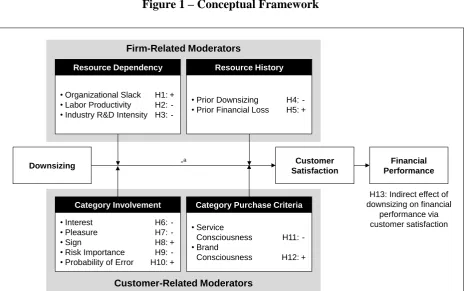
Figure 1 depicts our conceptual framework. It is a causal chain leading from downsizing
via customer satisfaction to financial performance. Twelve contextual factors moderate the link
between downsizing and customer satisfaction.
--- Insert Figure 1 about here ---
We define downsizing as major workforce reductions to cut costs and to improve
productivity and consequently financial performance (Freeman and Cameron 1993). The typical
rationale behind downsizing is to maintain output levels in terms of product and service quality
difficult to maintain quality levels after downsizing, it could affect customer satisfaction, defined
as a “cumulative evaluation of a firm’s market offering” (Fornell et al. 1996, p. 8).
A key conceptual idea behind this paper is that the relationship between downsizing and
customer satisfaction may not always be negative. In environments where customer interaction
with firm employees is not common, we expect that two types of contextual factors influence the
downsizing–satisfaction link: (1) variables relating to the resources of the firm and (2) variables
related to consumer information processing in the buying process. Overall, we expect that
downsizing’s negative effect on customer satisfaction will depend on the degree to which the
downsized employees are crucial in line with the resource-based view of the firm (Kozlenkova,
Samaha, and Palmatier 2014). And in particular, we expect that downsizing’s negative effect on
customer satisfaction will depend on the degree to which customers can perceive the downsizing
and believe it to be important information.
Concerning the downsizing firm’s resources, we consider two sets of variables. The first
consists of measures of a company’s resource dependency. Prior downsizing research has
identified three key factors in this regard: (1) Firms can shield themselves against disruptions of
their resources through organizational slack, defined as “resources in excess of those required to
produce necessary outputs” (Love and Nohria 2005, p. 1087). (2) Negative downsizing outcomes
are more likely if a firm’s labor productivity, defined as the amount of output per unit of labor
(Koch and McGrath 1996), is high. (3) Firms are particularly affected by negative affect in the
workforce if they depend on innovation. This is captured by industry R&D intensity, defined as
average firm expenditures for research and development in an industry (Guthrie and Datta 2008).
The second set of resource-related variables concerns the company’s resource history. A
that history is an important factor driving the outcome of firm decisions (Sydow, Schreyögg, and
Koch 2009)—or, in other words, “history matters” (Vergne and Durand 2010, p. 741).
Building on the concept of path dependence, we argue that the effect of downsizing on
customer satisfaction depends on at least two past events. First, we include prior downsizing,
defined as the occurrence of another major workforce reduction in the same that took place
before the downsizing. Second, we include prior losses, defined as negative earnings before
interest and taxes in the year prior to the downsizing.
Concerning consumer information processing, we also consider two sets of variables. The
first set consists of different aspects of customers’ product category involvement,as “depending
on their level of involvement, individual consumers differ in the extent of their decision process
and their search for information” (Laurent and Kapferer 1985, p. 41). Drawing on Laurent and
Kapferer’s (1985, Kapferer and Laurent 1993) original scale, we distinguish five dimensions of
involvement: (1) a customer’s interest in a product category; (2) hedonic product value, i.e., a
customer’s perception that a product category provides pleasure; (3) sign product value, i.e., a
customer’s perception that a product expresses his or her self; (4) risk importance, i.e., a
customer’s perception that a poor product choice leads to negative consequences; and (5)
probability of error, i.e., a customer’s perception that making a poor product choice is likely.
The second set of consumer-related variables comprises customers’ purchase criteria.
Whether the disruption of firm resources after downsizing affects customer satisfaction should
depend on what drives customer purchase decisions. We propose that two criteria are of
particular relevance in this respect: service consciousness, which denotes to what extent
customers place value on services vs. goods in a product category, and brand consciousness,
Lastly, customer satisfaction is modeled as driver of company’s financial performance. It
is defined as the monetary return a company yields on its invested capital.
Hypotheses
As mentioned before, prior research has established that on average, customer
satisfaction decreases after downsizing (e.g., Homburg, Klarmann, and Staritz 2012; Lewin,
Biemans, and Ulaga 2010). Therefore, our hypotheses focus on how the contextual factors
depicted in Figure 1 moderate the negative effect of downsizing on customer satisfaction.
Moderator effects pertaining to a firm’s resources
Organizational slack Our first hypothesis is based on the idea that downsizing poses a risk to
customer satisfaction through the deterioration of customer-related processes. However, the way
these processes are affected may depend on the excess capacity a company has—that is,
organizational slack (Love and Nohria 2005). We propose that higher levels of organizational
slack lead to less negative (or even positive) effects on processes and thus customer satisfaction
for two reasons. First, slack may act as a buffer (Bourgeois III 1981). A firm with little
organizational slack may not have resources available to cover the process steps of departing
employees, which may lead to a reduction in customer satisfaction. However, a “fat” company
should be able to cut personnel while maintaining process performance. Hence, the more slack a
company has, the less negatively downsizing should affect customer satisfaction.
While slack may offer a buffer, it can also be a cost item. High levels of slack may
indicate inefficient processes resulting, for example, in delays for customers (Bourgeois III
(Marks 2003), which may even increase customer satisfaction through superior quality and/or
lower prices. Thus, we hypothesize:
H1: The negative effect of downsizing on customer satisfaction is more pronounced in companies with little organizational slack.
Labor productivity Our next hypothesis concerns the moderating effect of labor productivity.
High labor productivity is likely to be associated with high workplace involvement (Guthrie
2001). We argue that two characteristics of high-involvement workplaces aggravate the effect of
downsizing on customer satisfaction.
First, employees in high involvement workplaces are likely to perceive their
psychological contract with the firm as strong. That is, employees provide high levels of effort,
loyalty, and commitment while expecting involvement, job security, and fair treatment (e.g., Tsui
et al. 1997). Downsizing can be viewed as a fundamental violation of these obligations. As a
result, employees may no longer be willing to achieve previous levels of performance, which
may in turn reduce customer satisfaction. In contrast, in companies with lower workplace
involvement and thus a weaker psychological contract, downsizing should result in less
disastrous effects on the remaining employees.
Second, in high-involvement workplaces employees are typically more involved in and
responsible for quality assurance. To this end, firms assign employees the mission of
“satisfy[ing] the customer in the best way they can” (Lawler 1992, p. 36). Resulting from this
increase in responsibility, the negative effects of downsizing on employees should more easily
translate to a deterioration of quality and hence, customer satisfaction. In contrast, in companies
result, companies should be able to better buffer their service to customers from internal
disruptions after downsizing. Therefore,
H2: The negative effect of downsizing on customer satisfaction is more pronounced in companies with high labor productivity.
R&D intensity Several arguments suggest that downsizing inhibits innovation by impairing the
different sources of innovation, such as employees, managers, and customers (Tushman and
Nadler 1986). First, concerning employee-triggered innovation, it is worth noting that a major
barrier for innovation is fear: “When people fear for their jobs, their futures, or even for their
self-esteem, it is unlikely that they will feel secure enough to do anything but what they have
done in the past” (Pfeffer and Sutton 2000, p. 109; see also Hurley and Hult 1998; Tellis 2013).
As downsizing triggers fear, uncertainty, and distrust of management among survivors (e.g.,
Brockner et al. 1994, 2004) it reduces creativity (Amabile and Conti 1999), and it is thus likely
to inhibit employee-triggered innovation.
Second, concerning manager-triggered innovation, research has shown that the executors
of downsizing suffer from the same symptoms as victims and survivors (Gandolfi 2008). Hence,
much like employees, managers who play an active role in a downsizing project should forfeit
creativity and innovativeness. Additionally, as in practice downsizing projects are often complex
and embedded in a larger reorganization (Cameron, Freeman, and Mishra 1991), managers
should have less time to initiate, manage, or provide input for innovation projects. As a result,
manager-triggered innovation during phases of downsizing should decline.
Third, concerning customer-triggered innovation, downsizing has been shown to increase
customers are, the less readily they should share their ideas or insights with a company. As a
result, customer-triggered innovation during downsizing phases is likely to decrease.
In sum, there is good reason to believe and even empirical evidence (Dougherty and
Bowman 1995) that downsizing disrupts product innovation. However, if employee-triggered,
manager-triggered, and customer-triggered innovation decline, a company may lose its ability to
meet customers’ future needs, which should lead to decreasing satisfaction. We propose that
firms downsizing in industries with high pressure for innovation (e.g., hardware and/or software
manufacturers such as Apple, Dell, or Microsoft) should be affected by these effects to a larger
extent. Thus, we hypothesize:
H3: The negative effect of downsizing on customer satisfaction is more pronounced in companies operating in industries with high R&D intensity.
Prior downsizing Customers’ evaluations of products and services strongly depend on the
customers’ prior experiences (Oliver 1997). For example, after experiencing a service failure,
customers are more receptive to a repeated service failure, which makes service recovery more
difficult (e.g., Liao 2007; Maxham and Netemeyer 2002).
This mechanism poses a critical risk to companies’ downsizing practices in use: many
companies do not downsize only once, but they complete several rounds of personnel reductions
(e.g., Iverson and Pullman 2000; Moore, Grunberg, and Greenberg 2004). Hence, if during an
earlier round of downsizing product or service quality has deteriorated, customers are likely to be
more receptive for any quality problems during later rounds of downsizing. We thus propose:
Prior losses While some companies reduce their workforce proactively to enhance
organizational performance, others downsize reactively owing to financial distress (Freeman and
Cameron 1993). We expect that customers react differently to these different motivations.
Research shows that customers care about the fairness of corporate activities and are
willing to resist doing business with unfair firms (Kahnemann, Knetsch, and Thaler 1986). In
this regard, downsizing may act as a strong signal regarding a firm’s “character” (Love and
Kraatz 2009). Customers may perceive downsizing as particularly opportunistic if the company
enjoys profits. In contrast, customers may perceive companies that reduce their workforce to
counter losses as less unfair and less socially irresponsible. Indeed, the negative effect of
downsizing on corporate reputation is smaller if downsizing is a reaction to performance
problems of a firm (Love and Kraatz 2009). Therefore:
H5: The negative effect of downsizing on customer satisfaction is less pronounced if a company has had financial losses prior to the downsizing.
Moderator effects pertaining to customer information processing
Product category involvement: interest Product categories which score high on the interest
dimension provide personal meaning to customers (Laurent and Kapferer 1985). Customers
consume these products more consciously and they are thus more likely to notice deteriorations
in product or service quality. As stated by Anderson (1994, p. 28) expectations and negative
disconfirmation are greater when involvement is high, as “customers appear more likely to notice
‘things gone right or wrong’” (Anderson 1994, p. 28). Therefore, we propose:
Product category involvement: pleasure Product categories which score high on the
pleasure dimension of involvement provide hedonic value to customers. Mass layoffs are often
thought of as especially unpleasant firm actions, causing fear and problems for the concerned
employees (Brockner et al. 1994; Greenglass and Burke 2001; Havlovic, Bouthillette, and Van
der Wal 1998). Hedonic consumption, however, is also motivated by a desire to escape the
problems of the everyday world (e.g., Arnold and Reynolds 2012). Therefore, we expect that
downsizing will reduce the hedonic appeal of a firm’s products, which will reduce customer
satisfaction, especially in high pleasure categories. Thus,
H7: The negative effect of downsizing on customer satisfaction is more pronounced in high pleasure product categories.
Product category involvement: sign A high sign value of a product category indicates that
customers’ sense of self is strongly linked to the products (Kapferer and Laurent 1993; Laurent
and Kapferer 1985). Resulting from this nexus, customers should be inclined to maintain positive
attitudes toward these products in order to protect their self-esteem (Bradley 1978; Fournier
1998). Hence, if a company in such a product category downsizes, customer satisfaction should
be less at stake. Empirical evidence supports this. For example, Ferraro, Kirmani, and Matherly
(2013) find that in light of a critical incident, customers’ attitudes toward a brand deteriorate to a
lesser extent if their self-concept is linked to the brand. Similarly, Swaminathan, Page, and
Gürhan-Canli (2007) report that when customers’ self-concept is linked to a brand, these
customers “tend to discount and counterargue … negative information” (p. 256). Finally, Johar,
Birk, and Einwiller (2010) state that customer identification with a brand “is one of the best
forms of insurance against the possibly devastating effects a crisis can have for an organization.”
H8: The negative effect of downsizing on customer satisfaction is less pronounced in high sign product categories.
Product category involvement: risk importance We propose that high risk importance within a
product category amplifies the negative effect of downsizing on customer satisfaction. A
perception of high risk leads customers to make a more extended product-related search
(Dowling and Staelin 1994; Hoyer and MacInnis 2007). In the course of the search, they may be
more likely to learn about a downsizing event, with possible adverse effects on corporate image
(Love and Kraatz 2009) and thus on customer satisfaction. Furthermore, similar to our reasoning
behind H6 and H7, it seems reasonable to assume that customers consume high-risk products
more consciously and are thus more likely to notice quality deteriorations. Hence, we propose:
H9: The negative effect of downsizing on customer satisfaction is more pronounced in high risk importance product categories.
Product category involvement: probability of error. A high probability of error implies that
customers find it difficult to evaluate the quality of a product (Kapferer and Laurent 1993;
Laurent and Kapferer 1985). This evaluation difficulty poses an opportunity to downsizing
companies: if customers cannot easily access the quality of a product, they should be less likely
to notice any quality deteriorations (Anderson 1994). Hence, if after a downsizing event a
company’s performance deteriorates, satisfaction should be less affected. We thus propose:
H10: The negative effect of downsizing on customer satisfaction is less pronounced in high probability of error product categories.
Service consciousness If customers are highly conscious of services in a product category, social
satisfaction. Two arguments suggest that under these circumstances, downsizing has a more
deleterious effect on customer satisfaction.
First, services rely more on their employees to ensure a high-quality delivery to the
customer (Anderson, Fornell, and Rust 1997). Hence, firms that downsize may no longer have
the staff to provide the service effort customers are used to. Indeed, in seeking productivity
improvements, service employees have been shown to reduce the time spent with each customer
(Olivia and Sterman 2001). Also, downsizing has been shown to reduce customer orientation of
service employees (Subramony and Holtom 2012).
Second, if due to a high service consciousness customer satisfaction depends on the
social interaction with frontline employees, customer satisfaction should be affected by the
emotions of these frontline employees (Henning-Thurau et al. 2006). As downsizing typically
negatively affects employee emotions (e.g., Brockner et al. 1986, 1993; DiFonzo and Bordia
1998; Mishra and Spreitzer 1998), customer satisfaction should decrease, too. In contrast, if
customer satisfaction depends less on social interaction with frontline employees, the negative
effect of downsizing on customer satisfaction via employee emotions should be weaker. Thus,
we hypothesize:
H11: The negative effect of downsizing on customer satisfaction is more pronounced if customers have a high service consciousness.
Brand consciousness If a product category is characterized by high brand consciousness,
customers place particular emphasis on the brand when purchasing and using products. One of
the key reasons for using brands is that it facilitates decision making through lower information
costs (e.g., Erdem and Swait 1998). For instance, categorization research (e.g., Cohen and Basu
already stored in memory (e.g., Sujan 1985). To some extent, this can ensure a stability in brand
perceptions over time. For example, Brady et al. (2008) find that the better customers’ brand
associations, the less negatively customer satisfaction is affected by a performance failure.
Similarly, Sloot, Verhoef, and Franses (2005) find that customers are more loyal to such brands
in stock-out situations. Hence, we propose:
H12: The negative effect of downsizing on customer satisfaction is less pronounced if customers have a high brand consciousness.
Indirect effect of downsizing on financial performance via customer satisfaction
If customer satisfaction decreases, so may customer loyalty (Lam et al. 2004), repurchase
intentions (Mittal and Kamakura 2001), and willingness to pay (Anderson 1996). These
behavioral effects might translate into decreased revenues (Fornell 1992), higher costs
(Reichheld and Sasser 1990), and, thus, lower financial performance (Anderson, Fornell, and
Mazvancheryl 2004; Gruca and Rego 2005). Therefore:
H13: Customer satisfaction mediates the link between downsizing and financial performance.
Methodology
Data collection and sample
We assembled a longitudinal dataset to estimate how downsizing affects subsequent
customer satisfaction. By using longitudinal instead of cross-sectional data, our study avoids
reverse-causality issues. The American Customer Satisfaction Index (ACSI) is an ideal data
source for our purposes. It is a customer-based evaluation of the performance of more than 200
about 250 telephone interviews are conducted with current customers of each company on a
quarterly basis. While customers rate specific goods or services in these interviews, the answers
are then mostly aggregated to the company level (Fornell et al. 1996).
As the index scores reach back as far as 1994, they allow for a comprehensive
longitudinal analysis. Also, the index exhibits highly reliable measures of customer satisfaction
due to consistent surveys, interview execution, sampling, and estimation across firms and time
(see Fornell et al. 1996). The population for our study is all companies listed in the ACSI
between 1994 and 2007; 1994 is the first year for which ACSI data is available, and 2007 was
chosen as the cutoff in order to exclude any exceptional effects of the subprime and debt crisis
on firms’ downsizing activities in the following years. As the economic downturn probably
started in 2007 (Pol 2012; Vyas 2011; Wu 2011), we provide robustness checks with 2006 as the
cutoff year.
We excluded companies that (1) were not incorporated in the United States (e.g., BMW),
or (2) provided customer satisfaction data on the brand instead of the firm level (e.g., Chrysler
Corporation, for which the ACSI differentiates between Chrysler and Dodge-Plymouth). We
then matched these companies with financial data and employment information of Standard and
Poor’s Compustat, excluding companies that (3) were not unequivocally listed on Compustat, or
(4) did not provide four consecutive years of complete data. This procedure resulted in a panel of
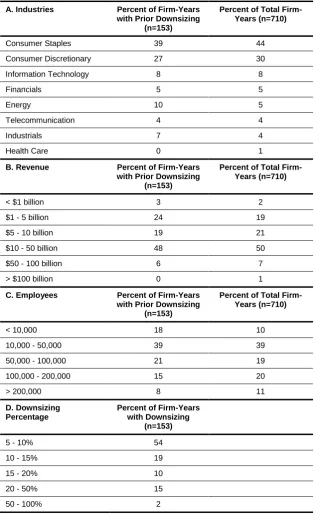
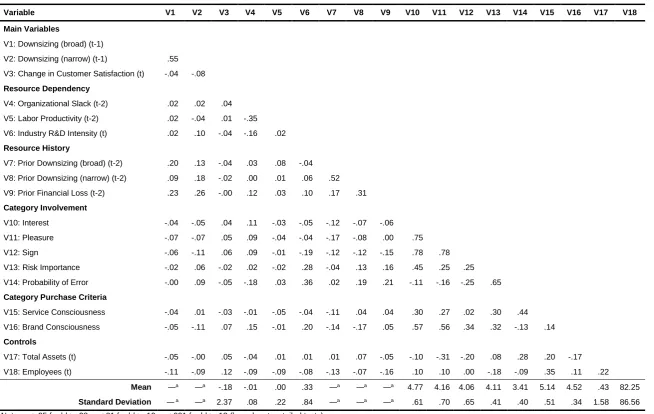
110 companies and 710 firm years. Table 2 shows the sample composition. Differences in the
sample size and composition compared to other studies (e.g., Ittner, Larcker, and Taylor 2009;
Tuli and Bharadwaj 2009) are due to our more selective inclusion criteria and our requirement of
four consecutive years of complete data.
In addition, we collected survey data to measure the customer-related moderators
(product category involvement and purchase criteria). We surveyed 1,522 U.S. residents between
18 and 65 years of age. Respondents were acquired through an online panel provider. The
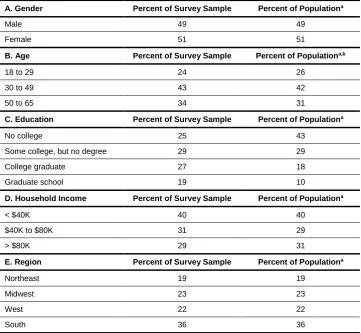
sample is representative for the U.S. population in terms of gender, income, and region (p > .10).
Representativeness in terms of age (p < .05) and education (p < .001) could not be established,
which we attribute to the use of an online survey. Table 3 shows the sample composition.
--- Insert Table 3 about here ---
After agreeing to participate, respondents were randomly assigned to one of the 29
product categories in our sample and asked to evaluate these product categories through an
online survey. For each product category, we obtained at least 50 responses. To match the survey
data to the individual companies in our dataset, we used the Standard Industrial Classification
(SIC) code as the primary key.
Measures
Downsizing We operationalize downsizing as a dummy variable indicating a reduction in the
number of employees of at least 5% as observed in Compustat. This approach is consistent with
many other studies: a dichotomous measure of downsizing is easier to interpret than a continuous
measure (Ahmadjian and Robinson 2001) and is thus frequently used (e.g., Bruton, Keels, and
Shook 1996; Love and Nohria 2005). Also, an extensive literature review shows 5% to be a
predominant cutoff point (e.g., Cascio, Young, and Morris 1997; Guthrie and Datta 2008).
Studies argue that with lower cutoffs, investigators might erroneously interpret unintentional
attrition as downsizing, whereas with higher cutoffs, they might overlook important downsizing
Researchers also use press announcements to identify downsizing (e.g., Love and Nohria
2005; Nixon et al. 2004; Worrell, Davidson, and Sharma 1991). Press announcements might be
the more valid indicator of downsizing, because mere employment changes may be the result of,
for example, spin-offs or outsourcings. Therefore, we searched the ProQuest database records of
the Wall Street Journal and several other wire services for announcements of layoffs for the
firms in our sample. We then constructed a second, narrower downsizing dummy that was set to
1 if employment decreased by at least 5% and a corresponding announcement was available. We
identified 105 downsizing events based on this process. However, as our model requires data
availability for the downsizing year as well as the three years before, we were only able to use 54
downsizing events. We test our hypotheses using both operationalizations of downsizing.
Customer satisfaction We measure customer satisfaction through the change in customer
satisfaction as a firm’s ACSI score in the year after downsizing minus the firm’s ACSI score in
the year of downsizing. This way, we analyze how downsizing changes satisfaction.
Resource dependency We measure organizational slack as the ratio of selling, general, and
administrative (SG&A) expenses to total sales minus the mean industry SG&A level
(sales-weighted) in the year before downsizing. This approach is consistent with other studies (e.g.,
Love and Nohria 2005; Wiseman and Bromiley 1996). Labor productivity is measured as total
sales divided by the number of employees minus the corresponding industry average in the year
before downsizing (Anderson, Fornell, and Rust 1997). For industry R&D intensity, we first
companies within every three-digit SIC code. We then averaged these ratios over the year before,
the year of, and the year after the downsizing event (Guthrie and Datta 2008).
Resource historyPrior downsizing is a dummy indicating if in any of the three years prior to our
focal downsizing event, the company had already downsized at least once. Using a three-year
time horizon is consistent with Love and Nohria (2005). Prior financial loss is a dummy
indicating if in the year before downsizing, a company had negative EBIT.
Product category involvement We measure the five dimensions of product category involvement
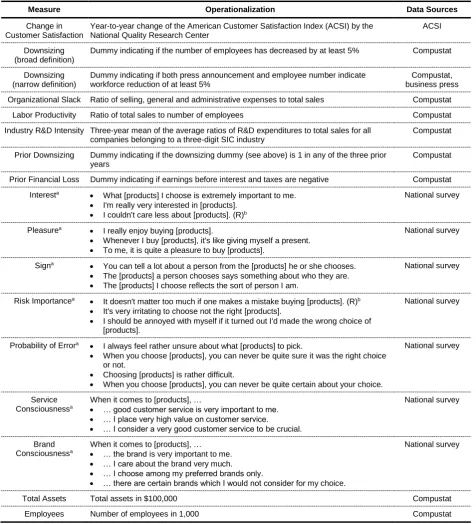
with items based on Kapferer and Laurent (1993). The exact wording is reported in Table 4. We
assessed our measures using a confirmatory factor analysis. Across all product categories,
composite reliabilities (CR) and average variance extracted (AVE) exceed recommended
threshold levels (Bagozzi and Yi 1988) for all involvement dimensions (interest: AVE=.74;
CR=.85; pleasure: AVE=.84; CR=.94, sign: AVE=.89; CR=.96, risk importance: AVE=.76;
CR=.87, probability of error: AVE=.77; CR=.93). We also find good psychometric properties if
we analyze the constructs separately for each product category in our data. The only exception is
the composite reliability of the interest dimension for cookies and crackers (CR=.69), which is
slightly smaller than the recommended threshold of .7.
Product category purchase criteria We measure these criteria using self-developed scales (items
are listed in Table 4). Again, psychometric properties are good (service consciousness:
AVE=.88; CR=.96 and brand consciousness: AVE=.71; CR=.91)for the overall sample as well
Control variables As we explain in more detail in the next section, we rely on a fixed effects
estimator for the model estimation. A key advantage of this method is that omitted variables bias
is strongly reduced (Baltagi 2008). In particular, the model structure already accounts for the
influence of firm-specific variables that stay constant over the observed time period. Therefore,
we control only for firm size in our model by including total assets and employees (Nixon et al.
2004). Table 4 gives an overview of our measures. Table 5 presents descriptive statistics and
correlations.
--- Insert Tables 4 and 5 about here ---
Model specification and estimation
Model specification To test the effect of downsizing on customer satisfaction, we specify a
model which includes all independent and moderating variables. Furthermore, the model
includes interaction terms between downsizing and all moderators:
ChangeinCustomerSatisfactiont,i = β1Downsizingt-1,i
+ β2OrganizationalSlackt-2,i
+ β3LaborProductivityt-2,i
+ β4IndustryR&DIntensityt,i
+ β5PriorDownsizingt-2,i
+ β6PriorFinancialLosst-2,i
+ β7TotalAssetst,i
+ β8Employeest,i
+ β9Downsizingt-1,i OrganizationalSlackt-2,i
+ β10Downsizingt-1,i LaborProductivityt-2,i
+ β11Downsizingt-1,i IndustryR&DIntensityt,i
+ β12Downsizingt-1,i PriorDownsizingt-2,i
+ β13Downsizingt-1,i PriorFinancialLosst-2,i
+ β14Downsizingt-1,i Interesti
+ β15Downsizingt-1,i Pleasurei
+ β16Downsizingt-1,i Signi
+ β17Downsizingt-1,i RiskImportancei
+ β18Downsizingt-1,i ProbabilityofErrori
+ β19Downsizingt-1,i ServiceConsciousnessi
+ αi + εt,i
where β denotes the regression coefficients, t indicates the year, and i the individual
company. αi is an individual (company-specific) error. It accounts for the nested structure of our
dataset, where years are nested in firms. εt,i stands for an idiosyncratic (residual) error that may
vary over both companies and time. For interpretation purposes, we centered all moderators by
subtracting the mean of each variable from its original value (Irwin and McClelland 2001).
The model explains customer satisfaction in a certain year (t) through downsizing in the
period before (t-1) to rule out confounding effects and thus allow for causal conclusions. The
firm-specific moderators that vary over time (i.e., organizational slack, labor productivity, prior
downsizing, and prior financial loss) were measured prior to the downsizing event. We chose to
measure them in the year before the downsizing event because they could be confounded with
the downsizing event itself (e.g., downsizing reduces organizational slack). It is worth noting that
this model requires us to have complete data for five consecutive years, ranging from customer
satisfaction in t via downsizing in t-1 back to prior downsizing in any of the three years before
the focal downsizing event, i.e., back to t-4 (see description of measurement above).
Estimation method It is important to emphasize again that our dataset contains multiple
observations for each firm. Put differently, our dataset is of a hierarchical structure in which
years are nested in companies. This nested structure often leads to violations of the assumptions
of ordinary least squares (OLS), in particular if the individual error αi is not identical across all
firms, if it is correlated with the regressors, or if the idiosyncratic error εt,i is serially correlated or
is heteroskedastic (e.g., Baltagi 2008; Boulding and Staelin 1995). To check whether these
2008; Wooldridge 2002). Indeed, Breusch and Pagan’s (1980) Langrange multiplier test
indicated that there is a company-specific intercept in our data (p < .001), and the
Breusch-Godfrey test (see Baltagi and Li 1995) indicated serial correlation in the error term εt,i (p < .001).
We therefore resorted to two estimation methods that produce consistent results under these
conditions. First, we estimated a fixed effects model with robust standard errors using STATA’s
xtreg procedure (Cameron and Trivedi 2010, p. 335). Second, we deployed a fixed effects
feasible generalized least squares estimator (Wooldridge 2002, p. 247), using the statistical
software package R (procedure pggls, for details see Croissant and Millo 2008). These methods
treat the issue of serial correlation through different mechanisms, but they are similar in the way
they deal with the company-specific intercept through so-called fixed effects. In particular, they
discard any company-specific (i.e., fixed) effect by subtracting the average over time from each
variable. This is a standard econometric method when dealing with data structured like ours. It
has also frequently been used in studies dealing with downsizing (e.g., Love and Kraatz 2009;
Love and Nohria 2005) as well as ACSI data (e.g., Anderson and Mansi 2009; Grewal,
Chandrashekaran, and Citrin 2010).
It is worth mentioning that fixed-effects procedures cannot estimate effects of
time-invariant independent variables (Baltagi 2008; Wooldridge 2002). Therefore, our regression
equation depicted above and our results in the next section do not contain main effects for our
time-invariant moderators (interest, pleasure, sign, risk importance, probability of error, service
Moderated effects of downsizing on customer satisfaction
We first present the results for downsizing being measured as an employment decrease of
at least 5% as observed in Compustat regardless of whether a downsizing announcement was
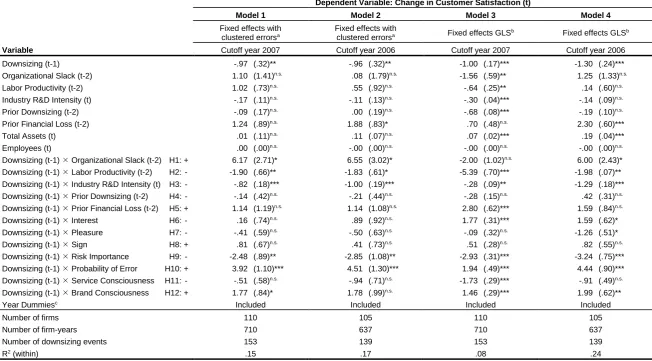
available. Table 6 shows our estimation results.
--- Insert Table 6 about here ---
As described previously, we present models using different cutoff years and estimators.
First, we turn to the results obtained through a fixed effects estimator with clustered errors
(models 1 and 2). Before interpreting the results for our hypotheses, we note that the main effect
of downsizing is significantly negative both for the cutoff 2007 (β1 = -.97, p < .01) and 2006 (β1
= -.96, p < .01). Thus, on average, downsizing has a negative effect on customer satisfaction.
In H1 we predict that organizational slack positively moderates the effect of downsizing
on customer satisfaction. The corresponding interaction term is positive and significant both for
the cutoff 2007 (β9 = 6.17, p < .05) and 2006 (β9 = 6.55, p < .05), providing support for H1
Hypothesis 2 posits that labor productivity negatively moderates the downsizing–
satisfaction link. In support of H2, the interaction between labor productivity and downsizing has
a significant negative effect using both the cutoff 2007 (β10 = -1.90, p < .01) and 2006 (β10 =
-1.83, p < .05).
H3 suggests that industry R&D intensity negatively moderates the downsizing–customer
satisfaction chain. This hypothesis is strongly supported both for the cutoff 2007 (β11 = -.82, p <
.001) and 2006 (β11 = -1.00, p < .001).
In H4 we propose that downsizing has a more deleterious effect on change in customer
satisfaction for firms that undergo repeated downsizing. While, consistent with this proposition,
for the cutoff 2007 and 2006. Hence, H4 is not supported by the data. Similarly, we do not find
support for H5: the sign of the interaction coefficient between downsizing and prior financial
loss is positive as proposed, but insignificant.
Regarding product category involvement, we do not find support for H6 through H8 as
the interaction coefficients are insignificant. Hypotheses 9 and 10 are supported. In line with our
propositions, the interaction coefficient between downsizing and risk importance is significantly
negative (cutoff 2007: β17 = -2.48, p < .01; cutoff 2006: β17 = -2.85, p < .01), whereas the
interaction coefficient between downsizing and probability of error is significantly positive
(cutoff 2007: β18 = 3.92, p < .001; cutoff 2006: β18 = 4.51, p < .001).
Regarding product category purchase criteria, there is no evidence in support H11.
Service consciousness does not have a significant interaction effect with downsizing. Concerning
H12, brand consciousness positively moderates the effect of downsizing on change in customer
satisfaction for the cutoff 2007 (β20 = 1.77, p < .05). When choosing the cutoff 2006, the
interaction effect is insignificant. Hence, support for H122 is limited.
Models 3 and 4 are estimated using the fixed effects GLS method as an alternative
estimator. Here, in line with models 1 and 2, the moderating effects of labor productivity (H2),
industry R&D intensity (H3), risk importance (H9), and probability of error (H10) are supported,
whereas the moderating effects of prior downsizing (H4) and sign (H8) are not. The strong
consistency across all four models raises our confidence in the validity of these findings.
Moreover, in line with model 1, the moderating effect of brand consciousness is supported. The
interaction effect of organizational slack is significant in model 4 but insignificant in model 3.
Hence, seeing that the interaction coefficients of brand consciousness and organizational slack
Lastly, H5, H6, H7, and H11 are partly supported in at least one of models 3 and 4, making our
result in their regard somewhat inconclusive.
To gain further insight into the nature of the interaction effects, we plotted them based on
model 1 in Table 6. Following Guthrie and Datta (2008), we divided our data into two groups
based on whether a firm had downsized in the previous period. In each group, we calculated
means and standard deviations of all variables. We then assigned the moderator a value of one
standard deviation above and below its mean while constraining all other variables to their
means. We then used these values to predict customer satisfaction. Figure 2 shows the plots,
which all reveal that downsizing has a negative effect on the change of customer satisfaction.
This negative effect is however particularly pronounced for disadvantageous configurations of
the moderators, i.e., for low organizational slack, high labor productivity, high industry R&D
intensity, high risk importance, low probability of error, and low brand consciousness. The
negative effect is alleviated or neutralized for advantageous configurations of the moderators.
--- Insert Figure 2 about here ---
Robustness checks for different operationalizations of downsizing
We follow earlier research by considering employee reductions of 5% or more as
downsizing. In this section, we describe two tests to check whether our results are stable when
using other operationalizations. First, we estimated our model a second time with a narrower
downsizing dummy. It was set to 1 only if workforce reductions of at least 5% were
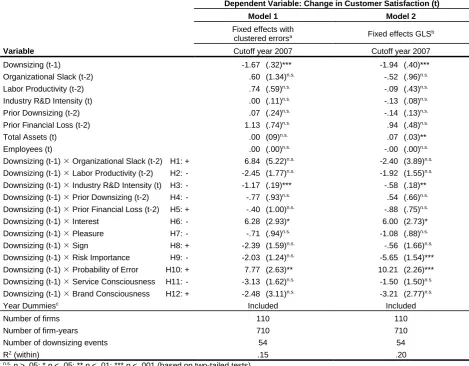
accompanied by a corresponding press announcement. Table 7 shows the results. As changing
the operationalization reduces the number of observed downsizing events to 54, we are mainly
interested whether hypothesized effects have the same sign across operationalizations. This is the
R&D intensity, risk importance, and probability error) are statistically significant. Surprisingly,
contrary to H6, interest has a significant positive interaction effect for both estimation methods.
--- Insert Table 7 about here ---
Second, we tested the stability of the results when using other values than 5% as a
cutoff-point for downsizing events. We find highly consistent results for cutoff cutoff-points of 4% to 7%.
Moreover, for a 3% cutoff point, many effects just barely lose their statistical significance. This
might indicate that at a 3% cutoff point, the effects of downsizing dilute somewhat. Despite that,
overall we are confident that our results are stable for cutoff-points ranging from 3% to 7%. For
more extreme cutoff points (e.g., 1%, 10%, or 15%) the pattern of results is visibly affected.
Indirect effect of downsizing on financial performance via customer satisfaction
To examine our proposition that customer satisfaction mediates the effect of downsizing
on financial performance, we conducted a mediation analysis. Therefore, we specified a model
with change in financial performance as the dependent variable, operationalized as return on
assets (ROA) in t minus ROA in t-1. ROA is calculated as the ratio of earnings before interest,
taxes, depreciation and amortization to total assets. This operationalization is widely used in
downsizing research (e.g., Bruton, Keels, and Shook 1996; Guthrie and Datta 2008; Love and
Nohria 2005). As Cascio, Young, and Morris (1997: 1177) argue: “Any changes in the
performance of a firm that result from employment downsizing should show up in the ROA
measure.” As independent variables, we included our prior independent variables lagged by one
additional period. We further included organizational slack and labor productivity in t as
additional control variables.
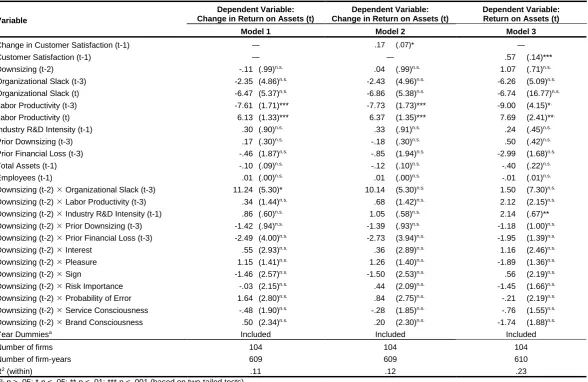
Table 8 shows the results. Model 1 reports the effect of downsizing on change in
financial performance without controlling for change in customer satisfaction. The effect is not
statistically significant. In model 2, we added change in customer satisfaction in t-1 as an
independent variable. Again, we find no effect of downsizing on financial performance,
whereas—consistent with much earlier research (e.g., Anderson, Fornell, and Lehmann 1994;
Anderson, Fornell, and Mazvancheryl 2004)—change in customer satisfaction has a positive
effect (βCSROA = .17, p < .05). As a robustness check, model 3 shows how the absolute level of
customer satisfaction (instead the year-to-year change) affects return on assets. We find a strong
positive effect (βCSROA = .57, p < .001), which substantiates our finding that customer
satisfaction is positively linked to financial performance.
The fact that downsizing reduces customer satisfaction and that customer satisfaction
drives financial performance points to a potential indirect effect of downsizing on financial
performance via customer satisfaction in line with H13. To test H13, we conducted the Sobel test
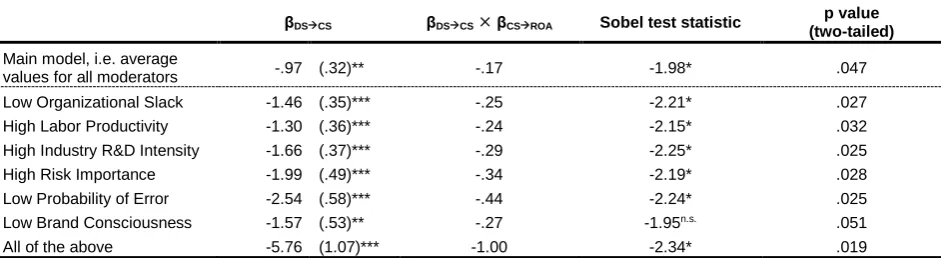
(Sobel 1982), finding a significant effect (βDSCS βCSROA = -.17, p < .05). Hence, in support of
H13 downsizing reduces customer satisfaction, which then reduces financial performance.
Table 9 analyzes this indirect effect for unfavorable conditions of our supported
moderators. Following Spiller et al. (2013), we estimated the simple effect of downsizing on
satisfaction for different levels of the moderators and then repeated the Sobel test. The negative
indirect effect of downsizing on performance via satisfaction becomes stronger for companies
with low slack or high labor productivity and in industries with high R&D intensity as well as in
product categories that customers perceive as risky but have a low probability of error.
Discussion
Research implications
Downsizing has been a popular managerial instrument for almost 30 years. However,
only recently have researchers started to look at customer outcomes of downsizing. Our research
contributes to this new research stream in several ways.
Previous research on customer outcomes of downsizing has focused on B2B markets
(e.g., Lewin 2009; Lewin and Johnston 2008; Lewin, Biemans, and Ulaga 2010). We extend the
field by looking at B2C markets. Here, we also find that downsizing reduces customer
satisfaction. We argue that this finding is less intuitive than it maybe sounds. In B2B markets
there is typically a strong degree of personal interaction between customers and employees of the
downsizing supplier. In contrast, in most B2C markets, consumers have little to no personal
contact with firm employees. As a result, in many product categories consumers seem to be
indifferent to employee working conditions. For instance, despite the highly publicized problems
of workers in one of Apple's supplier firms (e.g., Mishkin 2013), in October 2013 Apple CEO
Tim Cook reported that Apple was winning in terms of customer satisfaction (Bradshaw 2013).
In light of this potential consumer indifference to the way products and services are
produced, the question becomes: When does downsizing affect satisfaction? Our findings
indicate that consumers mostly respond to downsizing if it results in noticeable deteriorations of
product performance. Only in firms with resource configurations that make them especially
vulnerable to losses of human capital (high R&D intensity, high labor productivity, little slack),
does downsizing affect customer outcomes. Moreover, if customers have difficulties in
evaluating product quality, downsizing does not reduce satisfaction. Similarly, downsizing has
B2C markets the effect of downsizing on satisfaction is indeed less clear-cut than one would
maybe expect.
That said, some of our moderator hypotheses were not supported by the data. For
instance, whether services play an important role in a product category does not affect the
downsizing-satisfaction link. This is interesting because Anderson, Fornell, and Rust (1997)
argue that there is a larger trade-off between productivity and customer satisfaction for service
companies than for manufacturers. Their argument is based on the observation that
customization is more important in service firms, which reduces possibilities for increasing
productivity. Given the increasing importance of customizing manufactured goods, differences
between service firms and manufacturers may have become smaller in this regard.
Likewise, we do not find that downsizing is less harmful to customer satisfaction if firm
financial performance was declining before the downsizing or if a firm had downsized before.
This is noteworthy because past performance explains image effects of downsizing. Love and
Kraatz (2009) report that negative effects of downsizing on firm image are less pronounced if the
downsizing is a response to performance problems. The different results points to the importance
of distinguishing between image and satisfaction as outcomes of downsizing.
The way our study is designed also extends earlier research methodologically: (1)
Previous research on customer outcomes of downsizing used cross-sectional data, which triggers
reverse causality issues. It is possible that low customer satisfaction forces firms to cut costs
through downsizing. This would also entail a negative correlation between downsizing and
satisfaction. By linking satisfaction to downsizing the year before, our setup alleviates these
concerns. (2) Previous research has relied on single-source data from a customer’s perspective
perspective (Homburg, Klarmann, and Staritz 2012). Our research integrates the two
perspectives. Hence, with our design common method effects can probably be ruled out as an
explanation for the negative downsizing–satisfaction link.
Finally, our study establishes that customer satisfaction following downsizing mediates
the downsizing–performance relationship. By identifying this mechanism, it also contributes to
research on the “hidden costs” of downsizing, i.e., costs that are often overlooked by managers
starting these activities (Buono 2003). Furthermore, our study offers a new explanation why
researchers have found it hard to find a consistent effect of downsizing on performance (e.g.,
Datta et al. 2010). If customer satisfaction mediates the effects of downsizing, interaction effects
with context factors can create conflicting evidence with regard to the overall relationship. In
fact, we too do not find a significant direct effect of downsizing on financial performance (see
model 1 in Table 8). Coupled with our finding of an indirect effect via customer satisfaction, this
suggests that multiple (opposing) indirect effects explain the relationship between downsizing
and financial performance (e.g., MacKinnon et al. 2000; Rucker et al. 2011; Shrout and Bolger
2002).
It needs to be mentioned that when measuring downsizing, we follow a convention from
management research. We consider any firm year as a downsizing year in which the number of
employees went down by at least 5%. This comes with limitations. First, the 5% threshold is
somewhat arbitrary. We find that results are mostly robust for other thresholds in a range
between 3% and 7%. For very high threshold values (e.g., 15%), results differ. Therefore, future
research could analyze extreme downsizing events further. Second, large reductions of the
number of employees may not always indicate layoffs. Results are qualitatively consistent if only
downsizing is very general. Maybe outcomes of downsizing differ depending on the department
affected. Future research could compare downsizing consequences between departments.
Managerial implications
Our study has important implications for managers. Managers must be aware that
depending on their firm and product category, downsizing has differential effects on customers.
Thus, managers should “think outside the firm” while implementing downsizing. Our results
indicate that this might be worth the effort. Managers should be especially careful with
downsizing if industry R&D intensity and labor productivity are high, while organizational slack
is low. Similarly, they should actively consider alternatives to downsizing if customers perceive
purchases in the category as risky, customers find it easy to assess product quality, and
customers do not consider the brand an important purchase criterion.
Interestingly, our results suggest that currently managers do not pay much attention to
these aspects when engaging in downsizing. A look at our Table 5 reveals that the correlations
between the aforementioned variables and downsizing activity are all smaller than .10. Hence, it
appears as if currently managers mostly ignore the detrimental effects of downsizing on
customers. Our study could contribute to increasing the awareness for these issues.
In addition, our study can guide managers interested in reducing detrimental customer
outcomes of downsizing. First, customers react more negatively to downsizing in product
categories where purchases are perceived as risky. This points to the importance of managing
customer perceived risk during a downsizing. For instance, marketing managers could consider
offering additional guarantees to their customer (e.g., a satisfaction guarantee). They should also
customers. Second, customers react less negatively to downsizing in product categories where
brands play an important role. Hence, during downsizing, marketers should put particular
emphasis on brand communication at the point of sale and elsewhere.
Limitations
This study does have several limitations. First, it relies on balance sheet data to measure
firm-related variables. Hence, downsizing is measured through a proxy, which—as discussed
before—is tied to a number of assumptions about the nature of downsizing. We provide evidence
that results are relatively stable if other operationalizations are used, but these come with their
own disadvantages. Second, the archival nature of the data has also to some extent guided and
restricted our choice of firm-level moderators. Survey data could provide additional insights on
how to manage downsizing, but data on sensitive issues like downsizing is notoriously difficult
to obtain (Homburg, Klarmann, and Staritz 2012) and not available for the time period of
interest. Third, in terms of the firms analyzed, this study is subject to the inclusion requirements
of the ACSI. It served as the starting point of our data collection efforts. Fourth, product category
involvement is measured at one point in time after the focal time-period of the study. Thus, for
our results concerning customer-related interactions to hold, it is required to assume that product
category involvement is to some extent constant over time.
Conclusion
In the B2C markets covered by the American Customer Satisfaction Index, organizational
downsizing is on average associated with decreases in customer satisfaction. In turn these
customer reactions to downsizing is largely influenced by contextual variables. In particular, the
degree to which a firm depends on human resources and the way customers process information
in a product category moderate the downsizing-satisfaction link. Hence, in specific firm–product
configurations, downsizing may prove detrimental with regard to customer satisfaction. For other
References
Ahmadjian, C. L., & Robinson, P. (2001). Safety in Numbers: Downsizing and the
Deinstitutionalization of Permanent Employment in Japan. Administrative Science Quarterly, 46, 622–654.
Amabile, T. M., & Conti, R. (1999). Changes in the Work Environment for Creativity during Downsizing. Academy of Management Journal, 42, 630–640.
Anderson, E. W. (1994). Cross-Category Variation in Customer Satisfaction and Retention. Marketing Letters, 5, 19–30.
Anderson, E. W. (1996). Customer Satisfaction and Price Tolerance. Marketing Letters, 7, 265– 274.
Anderson, E. W., Fornell, C., & Lehmann, D. R. (1994). Customer Satisfaction, Market Share, and Profitability: Findings from Sweden. Journal of Marketing, 68, 53–66.
Anderson, E. W., Fornell, C., & Rust, R. T. (1997). Customer Satisfaction, Productivity, and Profitability: Differences between Goods and Services. Marketing Science, 16, 129–145.
Anderson, E. W., Fornell, C., & Mazvancheryl, S. K. (2004). Customer Satisfaction and Shareholder Value. Journal of Marketing, 68, 172–185.
Anderson, E. W., & Mansi S. A. (2009). Does Customer Satisfaction Matter to Investors? Findings from the Bond Market. Journal of Marketing Research, 46, 703–714.
Arnold, M. J., & Reynolds, K. E. (2012). Approach and Avoidance Motivation: Investigating Hedonic Consumption in a Retail Setting. Journal of Retailing, 88, 399–411.
agozzi, R. P., & Yi, Y. (1988). On the Evaluation of Structural Equation Models. Journal of the
Academy of Marketing Science, 16, 74–97.
Baltagi, B. H. (2008). Econometric Analysis of Panel Data. Chichester: Wiley.
Baltagi, B. H., & Li, Q. (1995). Testing AR(1) Against MA(1) Disturbances in an Error Component Model. Journal of Econometrics, 68, 133–151.
Boulding, W., & Staelin, R. (1995). Identifying Generalizable Effects of Strategic Actions on Firm Performance: The Case of Demand-Side Returns to R&D Spending. Marketing Science, 14, G222–G236.
Bourgeois III, L. J. (1981). On the Measurement of Organizational Slack. Academy of
Management Review, 6, 29–39.
Bradshaw, T. (2013). Apple upbeat over iPhone sales momentum. Financial Times (28-October-2013), Retrieved March 17, 2014 from http://www.ft.com/intl/cms/s/0/a10a6100-400a-11e3-a890-00144feabdc0.html#axzz2wGOdvOnh.
Brady, M. K., Cronin Jr., J. J., Fox, G. L., & Roehmb, M. L. (2008). Strategies to Offset Performance Failures: The Role of Brand Equity. Journal of Retailing, 84, 151–164.
Breusch, T., & Pagan, A. R. (1980). The Lagrange Multiplier Test and Its Applications to Model Specification in Econometrics. Review of Economic Studies, 47, 239–253.
Brockner, J., Grover, S., O'Malley, M. N., Reed, T. F., & Glynn, M. A. (1993). Threat of Future Layoffs, Self-Esteem, and Survivors’ Reactions: Evidence from the Laboratory and the Field.
Strategic Management Journal, 14, 153–166.
Brockner, J., Greenberg, J., Brockner, A., Bortz, J., Davy, J., & Carter, C. (1986). Layoffs, Equity Theory, and Work Performance: Further Evidence of the Impact of Survivor Guilt.
Academy of Management Journal, 29, 373–384.
Brockner, J., Konovsky, M., Cooper-Schneider, R., Folger, R., Martin, C. L., & Bies, R. J. (1994). The Interactive Effects of Procedural Justice and Outcome Negativity on the Victims and Survivors of Job Loss. Academy of Management Journal, 37, 397–409.
Brockner, J., Spreitzer G., Mishra A., Hochwarter W., Pepper L., & Weinberg, J. (2004). Perceived Control as an Antidote to the Negative Effects of Layoffs on Survivors’
Organizational Commitment and Job Performance. Administrative Science Quarterly, 49, 76–100.
Bruton, G. D., Keels, J. K., & Shook, C. L. (1996). Downsizing the Firm: Answering the Strategic Questions. Academy of Management Executive, 10, 38–45.
Buono, A. F. (2003). The Hidden Costs and Benefits of Organizational Resizing Activities. In K. P. de Meuse & M. L. Marks (Eds.), Resizing the Organization: Managing Layoff,
Divestitures, and Closings (pp. 306–346). San Francisco: Jossey-Bass.
Camero, A. C., & Trivedi, P. K. (2010). Microeconometrics Using Stata. College Station: StataCorp.
Cameron, K. S., Freeman, S. J., & Mishra, A. K. (1991). Best Practices in White-Collar Downsizing: Managing Contradictions; Academy of Management Executive, 5, 57–73.
Cascio, W. F. (2002). Strategies for Responsible Restructuring. Academy of Management Executive, 16, 80–91.
Cascio, W. F., Young, C. E., & Morris, J. R. (1997). Financial Consequences of Employment-Change Decisions in Major U.S. Corporations. Academy of Management Journal, 40, 1175– 1189.
Chadwick, C., Hunter, L. W., & Walston S. L. (2004). Effects of Downsizing Practices on the Performance of Hospitals. Strategic Management Journal, 25, 405–427.
Cohen, J. B., & Basu, K. (1987). Alternative Models of Categorization: Toward a Contingent Processing Framework. Journal of Consumer Research, 13, 455–472.
Croissant, Y., & Millo, G. (2008). Panel Data Econometrics in R: The plm Package. Journal of Statistical Software, 27, 1-43.
Datta, D. K., Gutrhie, J. P., Basuil, D., & Pandey, A. (2010). Causes and Effects of Employee Downsizing: A Review and Synthesis. Journal of Management, 36, 281–348.
DiFonzo, N., & Bordia, P. (1998). A Tale of Two Corporations: Managing Uncertainty During Organizational Change. Human Resource Management, 37, 295–303.
Dougherty, D., & Bowman, E. H. (1995). The Effects of Organizational Downsizing on Product Innovation. California Management Review, 37, 28–44.
Dowling, G. R., & Staelin, R. (1994). A Model of Perceived Risk and Intended Risk-Handling Activity. Journal of Consumer Research, 21, 119–134.
Erdem, T., & Swait, J. (1998). Brand Equity as a Signaling Phenomenon. Journal of Consumer
Psychology, 7, 131–157.
Ferraro, R., Kirmani, A., & Matherly, T. (2013). Look at Me! Look at Me! Conspicuous Brand Usage, Self-Brand Connection, and Dilution. Journal of Marketing Research, 50, 477–488.
Flanagan, D. J., & O’Shaughnessy, K. C. (2005). The Effect of Layoffs on Firm Reputation. Journal of Management, 31, 445–463.
Fornell, C. (1992). A National Customer Satisfaction Barometer: The Swedish Experience.
Journal of Marketing, 56, 6–21.
Fornell, C., Johnson, M. D., Anderson, E. W., Cha, J., & Everitt Bryant, B. (1996). The American Customer Satisfaction Index: Nature, Purpose, and Findings. Journal of
Marketing, 60, 7–18.
Fournier, S. (1998). Consumers and Their Brands: Developing Relationship Theory in Consumer Research. Journal of Consumer Research, 24, 343–373.