http://wrap.warwick.ac.uk
Original citation:
Andrew, Rhiann E. and Chaplin, Adrian B.. (2014) Synthesis, structure and dynamics of
NHC-based palladium macrocycles. Dalton Transactions . ISSN 1477-9226
Permanent WRAP url:
http://wrap.warwick.ac.uk/57930
Copyright and reuse:
The Warwick Research Archive Portal (WRAP) makes this work of researchers of the
University of Warwick available open access under the following conditions.
This article is made available under the Creative Commons Attribution 3.0 (CC BY 3.0)
license and may be reused according to the conditions of the license. For more details
see:
http://creativecommons.org/licenses/by/3.0/
A note on versions:
The version presented in WRAP is the published version, or, version of record, and may
be cited as it appears here.
Transactions
PAPER
Cite this: DOI: 10.1039/c3dt52578c
Received 18th September 2013, Accepted 28th October 2013
DOI: 10.1039/c3dt52578c
www.rsc.org/dalton
Synthesis, structure and dynamics of NHC-based
palladium macrocycles
†
Rhiann E. Andrew and Adrian B. Chaplin*
A series of macrocyclic CNC pincer pro-ligands based on bis(imidazolium)lutidine salts with octa-, deca-and dodecamethylene spacers have been prepared deca-and their coordination chemistry investigated. Using a Ag2O based transmetallation strategy, cationic palladium(II) chloride complexes [PdCl{CNC–(CH2)n}]
[BArF4] (n= 8, 10, 12; ArF= 3,5-C6H3(CF3)2) were prepared and fully characterised in solution, by NMR spectroscopy and ESI-MS, and in the solid-state, by X-ray crystallography. The smaller macrocyclic com-plexes (n= 8 and 10) exhibit dynamic behaviour in solution, involving ringflipping of the alkyl spacer across the Pd–Cl bond, which was interrogated by variable temperature NMR spectroscopy. In the solid-state, distorted coordination geometries are observed with the spacer skewed to one side of the Pd–Cl bond. In contrast, a staticC2symmetric structure is observed for the dodecamethylene based macrocycle. For comparison, palladium(II)fluoride analogues [PdF{CNC–(CH2)n}][BArF4] (n= 8, 10, 12) were also pre-pared and their solution and solid-state structures contrasted with those of the chlorides. Notably, these complexes exhibit very low frequency19F chemical shifts (ca.−400 ppm) and the presence of C–H⋯F interactions (2hJFCcoupling observed by13C NMR spectroscopy). The dynamic behaviour of thefluoride complexes is largely consistent with the smaller ancillary ligand; [PdF{CNC–(CH2)8}][BArF4] exceptionally showsC2vtime averaged symmetry in solution at room temperature (CD2Cl2, 500 MHz) as a consequence of dualfluxional processes of the pincer backbone and alkyl spacer.
Introduction
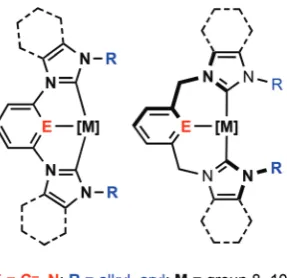
N-heterocyclic carbenes (NHCs) have quickly emerged as a powerful class of carbon-based ligand in organometallic chem-istry and catalysis.1With generally strongerσ-donating charac-teristics and orthogonal steric profiles to widely used phosphine ligands, NHCs are rapidly being established as ligands of choice for many transition metal catalysed reac-tions. Aided by simple and efficient synthetic protocols, intri-cate polydentate ligand topologies can be readily constructed based on NHC donors.2,3 Building on the flourishing chem-istry of phosphine-based pincer complexes,4 analogous NHC-based tridentate architectures have received considerable attention in particular.2,5Archetypical NHC pincer ligands are derived from bis(imidazol-2-ylidene)-benzene, pyridine, xylene or lutidine frameworks (Fig. 1) and the coordination chemistry of these CNC and CCC pincer ligands has been explored for a variety of late transition metals.2,5,6 Notably, palladium CNC based complexes have been thoroughly investigated, following
seminal work by Crabtree and Piers who demonstrated the application of these species in cross coupling reactions.7–14
The substitution geometries of NHC pincers are well suited to the construction of macrocycles. Principally based on luti-dine and xylene backbones, tridentate macrocycles find notable application in supramolecular chemistry; exploiting chemistry of the coordinated metal centre for molecular recog-nition15 and the construction of interlocked catenane and rotaxane systems.16The vast majority of known CNC and CCC Fig. 1 NHC-based pincer architectures.
†Electronic supplementary information (ESI) available. CCDC 961289–961294. For ESI and crystallographic data in CIF or other electronic format see DOI: 10.1039/c3dt52578c
Department of Chemistry, University of Warwick, Gibbet Hill Road, Coventry CV4 7AL, UK. E-mail: [email protected]
Open Access Article. Published on 31 October 2013. Downloaded on 18/11/2013 13:35:52.
This article is licensed under a
Creative Commons Attribution 3.0 Unported Licence.
View Article Online
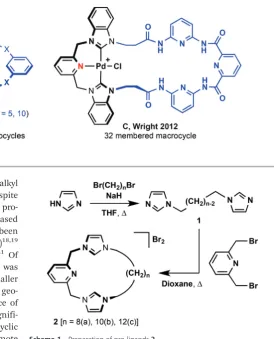
[image:2.595.359.503.421.560.2]based pincer complexes feature ligands bearing simple alkyl (i.e.Me,nBu,tBu, Ad) and aryl (e.g.Mes, Dipp) groups. Despite facile synthetic procedures to macrocyclic imidazolium pro-ligands,17there are very few examples of tridentate NHC-based macrocyclic complexes. Macrocyclic complexes that have been reported are limited to small (e.g.A, 15 membered, Fig. 2)18,19
or very large ring sizes (B and C; 28–38 membered).20,21 Of these systems, tridentate coordination of the macrocycle was observed within B and C, although not in A; the smaller 15 membered ring adopting a bidentate cyclophane geo-metry2,22with no pyridine coordination as a consequence of the short butamethylene spacer. Although showing signifi-cantly lower catalytic activity than related non-macrocyclic variants,7,10,13,14 both xylene and lutidine based B, promote C–C bond coupling reactions.20
Motivated by the possibility for exploiting their unique steric profile in organometallic chemistry and potential ap-plications as building blocks in interlocking architectures, in this communication we present the synthesis of a range of medium sized (19–23 membered) macrocyclic pro-ligands con-sisting of bis(imidazolium)lutidine salts with octa-, deca- and dodecamethylene spacers. The coordination chemistry of the corresponding CNC pincer ligands with palladium is detailed, particularly focusing on the effect of the aliphatic chain and ancillary ligands on the structure and dynamics of the result-ing macrocyclic complexes, as probed by variable temperature NMR spectroscopy and X-ray diffraction.
Results and discussion
The target macrocyclic pro-ligands [CNC–(CH2)n]·2(HBr) (n= 8,
2a; 10, 2b; 12, 2c) were prepared as bromide salts using a straightforward two-step synthesis, involving alkylation of 2,6-bis(bromomethyl)pyridine with bis(imidazole)alkanes1 in dioxane (Scheme 1). All three intermediate bis-imidazoles (n= 8, 10, 12) were readily prepared following minor adaptions to literature procedures employing commercially available alkyl dibromides.23The overall synthetic route readily afforded gram scale quantities of2in high purity following recrystallisation from acetonitrile–diethyl ether (19–32% overall yields). The
salts are notably hygroscopic and best stored and manipulated under a dry inert atmosphere.
The structures of 2 were confirmed by a combination of NMR spectroscopy and ESI-MS, with the latter being particu-larly diagnostic. Strong dication parent ion signals are observed for each compound: 2a, 175.6207 (calc. 175.6206)
m/z; 2b, 189.6361 (calc. 189.6362) m/z; 2c, 203.6521 (calc. 203.6519)m/z. The NMR spectra of2in CD2Cl2exhibit singlet
4H resonances for the methylene bridge atca. 5.8 ppm, with characteristic1H and13C signals of the pre-carbenic centre at ca.10.7 and 138 ppm, respectively. The remaining features of the spectroscopic data fully corroborate the structures of2and are otherwise unremarkable. Satisfactory microanalysis was obtained for all the macrocycles, and the structure of2bwas further confirmed by X-ray crystallography (ESI†).
Typically, coordination of CNC pincers to palladium has been achieved through reaction of the corresponding imidazo-lium pro-ligands with [Pd(OAc)2] in DMSO at elevated
tempera-tures.5With a view of developing a more general procedure for
the coordination of pro-ligands 2 with transition metals, we have adapted Ag2O based transmetallation strategies
pre-viously employed by Youngs, Danopoulos and Cavell for this initial work involving palladium.9–11 This procedure is
out-lined in Scheme 2, and involves reactions of2with Ag2O and
Na[BArF
4] (ArF = 3,5-C6H3(CF3)2) in CH2Cl2, followed by
Scheme 1 Preparation of pro-ligands2. Fig. 2 NHC-based macrocyclic complexes.
Open Access Article. Published on 31 October 2013. Downloaded on 18/11/2013 13:35:52.
This article is licensed under a
[image:3.595.274.549.44.384.2]subsequent addition of [PdCl2(NCPh)2] as a source of
palla-dium(II) halide – all carried out at room temperature. Using
this convenient and mild procedure, macrocyclic palladium complexes [PdCl{CNC–(CH2)n}][BArF4] (n= 8,3a; 10,3b; 12,3c)
were prepared with moderate-to-good isolated yields of 31% (n= 8), 55% (n= 10) and 58% (n= 12), following purification on silica and recrystallisation. [PdCl2(NCMe)2] can also be
used as the palladium(II) halide source, but gave no significant
improvements in yield. Complexes3are air stable both in solu-tion and the solid state; dissolving readily in CH2Cl2, CHCl3,
Et2O and MeCN. No attempts were made to isolate the
corres-ponding intermediate silver complexes, although we note that the incorporation of the [BArF
4]− anion appears to plays an
import role in solubilising these species throughout the procedure.
The palladium complexes 3 were fully characterised by NMR spectroscopy, ESI-MS and elemental analysis. Coordi-nation of the ligand was confirmed through the presence of strong parent ion peaks with the expected isotope distri-butions in mass spectra [3a, 490.0993 (calc. 490.0989)m/z;3b, 518.1308 (calc. 518.1303) m/z; 3c, 546.1616 (calc. 546.1617)
m/z]. 1H and 13C NMR spectra further corroborate the
struc-tures of the compounds, which all exhibit approximateC2
sym-metry in solution at room temperature (CDCl3and CD2Cl2, 400
or 500 MHz). The binding of the ligand through carbene donors is established by the absence of the distinctive high fre-quency imidazolium proton resonances of 2 and significant
13C shifts of the carbene centre from ca. 138 to 163 ppm.
These carbene resonances differ only marginally within the series of complexes, although a positive correlation with increasing frequency and macrocycle size is noted, i.e. 162.4 (3a), 163.3 (3b), 164.5 (3c) ppm. All values are in good agree-ment with that observed for the non-macrocyclic analogue [PdCl{CNC–Me}]+D(164 ppm, Scheme 2).13Complexes3show
interesting dynamic behaviour in solution and these features are discussed below in detail.
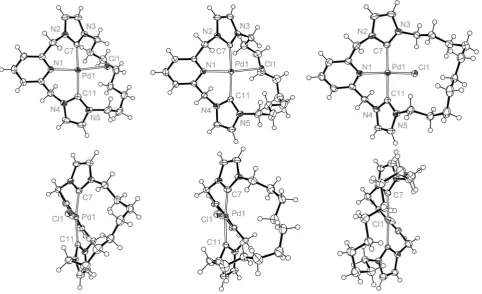
Crystal structures of all three palladium macrocycles were obtained, revealing significant structural differences between the complexes (Fig. 3 and Table 1). Tridentate coordination of the macrocyclic ligand is observed for each complex, with the pincer moiety adopting a characteristic twisted pseudoC2
con-formation, where the pyridine (ca. 40°) and imidazolylidene rings are angled out of the coordination plane as a con-sequence of the methylene bridges.8–10,13Associated Pd1–N1
(ca. 2.1 Å), Pd1–C (ca. 2.0 Å) and Pd1–Cl1 (ca. 2.3 Å) distances closely match those found in other related palladium CNC pincer complexes, as exemplified by comparison to D
(Table 1).13 The principle differences between the structures
are manifested in the conformation of the alkyl spacer, which is skewed to one side of the Pd–Cl bond for the shorter spacers (n = 8 and 10) as a consequence of the steric interactions between the spacer and the chloride ligand. This interaction distinctly leads to distortions of the metal coordination geome-try which are most pronounced for3a, with C7–Pd1–C11 and especially N1–Pd1–Cl1 angles deviating dramatically from 180° [168.82(7) and 163.39(4)°]. With the largest dodecamethylene spacer,3cadopts an overall pseudoC2geometry, with the
co-ordinated chloride ligand fully enclosed within the macrocycle cavity; the C7–Pd1–C11 and N1–Pd1–Cl1 angles are essentially linear [172.8(6) and 176.2(3)°] as observed for non-macrocyclic
D [173.60(7) and 178.19(3)°].13 Related palladium chloride
CNC pincer complexes bearing bulkytBu, Mes and Dipp sub-stituents retain N–Pd–Cl bond angles of effectively 180°.8–10
Distortion from linearity is uncommon within known palla-dium(II) square planar complexes (following inspection of CSD
metrics), although complexes with angles down to 150° are known.24
To investigate the apparent inconsistency between the solu-tion (C2symmetry) and solid-state (C1symmetry) structures of 3aand3b, we turned to variable temperature NMR measure-ments. The fluxional behaviour of CNC based pincer com-plexes [PdX{CNC–Me}]+ D–F (Scheme 2) has previously been
investigated in detail by Crabtree and co-workers.12,14 These
complexes undergo atropisomerisation between left and right-handedC2conformations with a free energy barrier of 60.0 kJ
mol−lfor [D]Cl (CD2Cl2,Tc= 303 K for the methylene bridge
protons).25The rate of this process is highly dependent on the
halide–anion combination. Increased activation barriers are observed for complexes containing the weakly coordinating OTs− anion ([D]OTs, ΔG‡(CDCl3) = 66.0 kJ mol−1) and along
the series: [F]I, [E]Br, [D]Cl [ΔG‡(CDCl3) = 41.9, 52.9 and
59.3 kJ mol−1]. On the basis of these observations and support-ing computational work, a two-step interconversion mechan-ism involving dissociation of the pyridine group and coordination of the counter anion was proposed. Atropisomeri-sation (ΔG‡(CDCl3) = 57–59 kJ mol−1) is also observed in the
macrocyclic complexes [B]Br (Fig. 2, E = N) although only very small changes in barrier height are observed in comparison to Scheme 2 Preparation of3.
Open Access Article. Published on 31 October 2013. Downloaded on 18/11/2013 13:35:52.
This article is licensed under a
the directly relatednBu substituted analogue [PdBr{CNC–n Bu}]-Br (ΔG‡(CDCl3) = 57.4 kJ mol−1) – indicating no significant
macrocyclic effect.20Remarkably, no dynamic behaviour of the pincer coordination geometry is observed for 3 with the methylene bridge protons diastereotopic in CD2Cl2 solution
(500 MHz) up to 308 K (i.e.ΔG‡≫62 kJ mol−1). This is consist-ent with the non-coordinating nature of the [BArF4]− anion26
and the calculated gas-phase barrier ofDof 73.2 kJ mol−1.12 In agreement with the solid-state structure, 3c retains C2
symmetry from 200–298 K in CD2Cl2 solution (500 MHz),
further confirming the good fit of the coordinated chloride
ligand within the cavity of the macrocyclic ligand. For com-plexes 3a and 3b, variable temperature NMR experiments demonstrate ring flipping of the macrocycle across the palla-dium chloride bond. This fluxional process mediates an atro-pisomerisation between skewed C1 symmetric confirmations
observed in the solid-state (Fig. 3) and leads to the time aver-agedC2symmetry in solution at room temperature. For3a, the
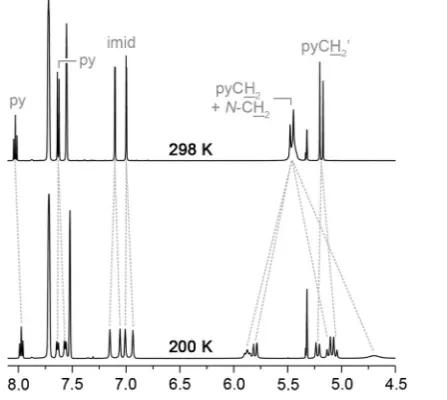
slow exchange limit for this process is reached at 200 K in CD2Cl2(500 MHz), with the1H NMR spectrum showing three
pyridine and four imidazolylidene resonances together with pairs of diastereotopic methylene bridge ( pyCH2) andN-CH2
signals (Fig. 4). Simulation27 of the 1H NMR data over the temperature range 185 to 298 K allowed rate data to be extracted for the exchange process, leading to values ofΔH‡= 43 ± 4 kJ mol−1,ΔS‡=−7 ± 17 J mol−1K−1andΔG‡(298 K) = 45 ± 9 kJ mol−1following an Eyring analysis (see ESI†). In line with the longer alkyl spacer, the fluxional process in 3b is much faster than 3a: the exchange could not be completely frozen out, even upon cooling to 185 K, although the barrier for this process can be approximated at ΔG‡= 37 kJ mol−1 from signal coalescence at low temperature.28
To further investigate the dynamics of the macrocyclic ligands, metathesis of the chloride ligand with the smaller flu-oride ligand was targeted. This was achieved by reactions of3
with excess AgF in acetonitrile to afford the palladium(II)
[image:5.595.58.541.51.345.2]fluor-ide complexes [PdF{CNC–(CH2)n}][BArF4] (n= 8,4a; 10,4b; 12, 4c) with good to moderate isolated yields of 45–88% Table 1 Selected bond lengths (Å) and angles (°) for3andD(ref. 13)a
3a 3b 3c D
Pd1–N1 2.087(2) 2.080(2) 2.077(10) 2.068(1) Pd1–Cl1 2.3051(5) 2.3217(5) 2.287(4) 2.2978(5) Pd1–C7 1.983(2) 2.004(2) 2.056(13) 2.026(2) Pd1–C11 2.073(2) 2.078(2) 2.036(12) 2.029(2) N1–Pd1–Cl1 163.39(4) 166.29(5) 176.2(3) 178.19(3) C7–Pd1–C11 168.82(7) 171.93(8) 172.8(6) 173.60(7) C7–Pd1–Cl1 86.19(5) 87.76(6) 95.9(4) 93.15(5) C11–Pd1–Cl1 98.40(5) 98.22(6) 91.1(4) 93.21(5) lspl(NHC)∠lspl(NHC′) 70.72(8) 76.88(9) 81.0(5) 85.08(7)b lspl(py)∠lspl(coord.) 33.07(6) 39.14(7) 42.5(4) 41.83(5)b alspl(atoms) denotes the least squares plane through the indicated
group of atoms; coord. refers to Pd1, C7, C11 and N1.bRecalculated
using CIF matrix from ref. 13.
Fig. 3 Solid-state structures of3a,3band3cviewed perpendicular (top) and along (bottom) Pd1–N1 bond vectors. Thermal ellipsoids drawn at 50%; minor dis-ordered component (alkyl spacer) in3b, anions and solvent molecules omitted for clarity. Selected structural metrics are listed in Table 1.
Open Access Article. Published on 31 October 2013. Downloaded on 18/11/2013 13:35:52.
This article is licensed under a
[image:5.595.42.293.413.531.2](Scheme 3). Unlike their palladium(II) chloride analogues, the
fluorides are markedly water sensitive and degrade readily on silica. Facile loss of the fluoride ligand is also apparent by ESI-MS and only fragment ion derivatives can be observed. Although many examples of palladium fluoride complexes containing phosphine and nitrogen based donor ligands are known,29 to the best of our knowledge no NHC based
ana-logues have been reported. The formation of4are readily cor-roborated by1H,13C and19F NMR spectroscopy and elemental
analysis. The coordinated carbene centres are observed as broad singlets at ca. 165 ppm by 13C NMR spectroscopy to
slightly higher frequency than observed in3, while 19F NMR
spectra reveal characteristically low frequency Pd(II) fluoride
resonances atca.−400 ppm.19F chemical shifts of this
magni-tude are uncommon,30although notably the palladium PNP
pincerG (Scheme 3) has a 19F NMR shift of −414.3 ppm for
the coordinated fluoride ligand.31
Like its chloride analogue, temperature invariant1H NMR
spectra of 4c demonstrate the adoption of C2 symmetry in
solution. For the smaller 4b, a very low energy fluxional process can be detected only by cooling to 185 K, where the onset of coalescence is noted for one of theN-CH2resonances.
In comparison to3b, the interconversion barrier for4bmust be considerably less as at 185 K the slow exchange limit is
essentially reached for all signals of 3b. Given the large Δν possible for theN-CH2shifts it is difficult to approximate the
barrier, although we estimate a value of ΔG‡ ≤ 34 kJ mol−1 (based onΔν= 600 Hz from3a). The solid-state structure of4b
shows a more symmetric structure than3b (Fig. 5), with the N1–Pd1–F1 angle approaching 180° [175.77(7)cf.166.29(5)° for
3b], although meaningful conclusions from this observation are difficult due to crystal packing effects. Notably the cations in4bpack with relatively close Pd1–Pd1′and Pd1–F1′distances of 4.3357(7) and 3.866(2) Å, respectively. A further interesting feature of note is the presence of weak N-CH–H⋯F inter-actions, which were detected by carbon–fluorine coupling for both 4b and 4c (2hJFC = 6 Hz, 298 K). These 2hJFC values and the corresponding interatomic distances observed in
Fig. 5 Solid-state structures of 4b viewed perpendicular (top) and along (bottom) the Pd1–N1 bond vector. Thermal ellipsoids drawn at 50%, anion omitted for clarity. Selected bond lengths (Å) and angles (°): Pd1–N1, 2.035(2); Pd1–F1, 1.9588(13); Pd1–C7, 2.018(2); Pd1–C11, 1.999(2); N1–Pd1–F, 175.77(7); C7–Pd1–C11, 175.66(10); C7–Pd1–F1, 92.96(8); C11–Pd1–F1, 88.99(7); lspl(NHC) ∠lspl(NHC’), 73.2(1); lspl( py)∠lspl(coord.), 36.52(8).
Scheme 3 Preparation of4.
Fig. 4 Selected1H NMR spectra of3a(CD
2Cl2, 500 MHz).
Open Access Article. Published on 31 October 2013. Downloaded on 18/11/2013 13:35:52.
This article is licensed under a
[image:6.595.62.286.53.253.2] [image:6.595.305.550.237.503.2]solid-state structure of4b[C⋯F = 2.968(3), 3.146(3) Å], are fully consistent with other C–H⋯F interactions reported in the literature.32
In solution, 4a is highly fluxional. At 298 K in CD2Cl2
(500 MHz), C2v symmetry is observed indicating an atrop-isomerisation mechanism involving dynamics of both the pincer and octamethylene spacer. Upon cooling the sample to 225 K onset of decoalescence of the methylene bridge and
N-CH2 protons was observed, while those of the
imidazolyli-dene remained relatively sharp. Further cooling to 185 K led to broadening of the later signals, although the slow exchange limit was not reached ( precluding accurate simulation). These observations support a dual fluxional process involving low energy flipping of the octenyl linker (ΔG‡≤34 kJ mol−1) and higher energy pincer twisting (ΔG‡∼43 kJ mol−1). The latter process is characteristic ofD–F, with the approximate barrier height of 43 kJ mol−1being broadly similar to that calculated for dicationic [Pd{CNC–Me}]2+(ΔG‡= 47.8 kJ mol−1)12and sug-gestive of fluoride ligand dissociation ( promoted by macro-cycle induced steric pressure). Although we could obtain a solid-state structure of4a, somewhat inline with its highly flux-ional solution characteristics, it has two crystallography inde-pendent cations both with extensively disordered macrocycle geometries (see ESI†). However, what is clear from the struc-ture is that the octamethylene group is skewed to one side of the palladium(II) fluoride bond (as with3a and 3b) and the
N–Pd–F angle deviates from linearity (ca. 172°). The shorter macrocycle linker also results in further close C–H⋯F inter-actions, with coupling at 1,8- (2hJFC = 14 Hz) and 4,5- (2hJFC= 6 Hz) positions along the octamethylene group resolved by13C NMR spectroscopy.
Summary
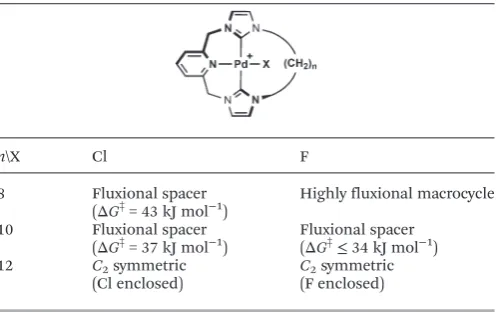
A series of macrocyclic CNC pincer pro-ligands have been pre-pared incorporating simple alkyl spacers, resulting in 19, 21 and 23 membered ring systems (2). The coordination chem-istry of these pro-ligands has been explored, and a series of cat-ionic palladium(II) chloride (3) and fluoride (4) complexes have
been synthesised and fully characterised in solution and the solid-state. The larger macrocyclic complexes, containing dodecamethylene spacers, exhibit static C2 symmetric struc-tures with the coordinated halogen ligands lying within the macrocyclic cavity. As the ring size is reduced, increasing dynamic behaviour is observed in solution, with the spacer undergoing ring flipping across the palladium halogen bond, and is most pronounced with the larger chloride ancillary ligand (Table 2). The atropisomerisation of the smaller macro-cyclic complexes is also manifested in their solid-state struc-tures, with significant distortions from the expected square planar geometries and skewing of the alkyl spacers to one side of the palladium–halogen bonds observed. The dodecamethy-lene based CNC pincer ligands accommodate the coordinated metal–ligand moiety most readily and appear most suitable for subsequent applications in organometallic chemistry and as
building blocks for interlocking architectures: the organo-metallic chemistry of other late transition complexes bearing this ligand is currently being explored.33
Experimental
General considerationsManipulations were performed under an inert atmosphere, using Schlenk (nitrogen) and glove box (argon) techniques unless otherwise stated. Glassware was oven dried and flamed under vacuum prior to use. Anhydrous solvents (<0.005% H2O)
were purchased from ACROS or Aldrich and used as supplied: MeCN, CH2Cl2, CHCl3, THF, 1,4-dioxane, pentane and Et2O.
CD2Cl2 was dried over CaH2, vacuum-distilled and stored
under an atmosphere of argon. CDCl3 (for NMR
characteris-ation of 4) was dried over 3 Å molecular sieves, vacuum-dis-tilled and stored over sieves. Na[BArF4]34 and [Rh(CO)2Cl]235
were synthesised using literature procedures. Bis-imidazoles1
were prepared by adaptions of literature procedures and are fully detailed in the ESI.†23 [PdCl2(NCPh)2], [PdCl2(NCMe)2],
Ag2O, AgF, 2,6-bis(bromomethyl)pyridine, and dibromoalkanes
are commercial products and were used without further purifi-cation. NMR spectra were recorded on Bruker DPX-400, AV-400 and DRX-500 spectrometers at 298 K unless otherwise stated. Chemical shirts are quoted in ppm and coupling constants in Hz. ESI-MS were recorded on a Bruker MaXis mass spectro-meter. Microanalyses were performed at the London Metro-politan University by Stephen Boyer.
Preparation of pro-ligands (2)
General procedure. To refluxing 1,4-dioxane (150 mL),
equi-molar solutions of 2,6-bis(bromomethyl)pyridine and bis-imi-dazole1in THF (ca. 0.075 M, dried over 3 Å molecular sieves) were simultaneously added dropwise over 30 minutes. The resulting reaction mixture was refluxed for 16 hours, cooled to approx. 50 °C and the solvent removedin vacuo. The resulting off-white residue was extracted with MeCN (ca. 200 mL) with vig-orous stirring. The MeCN solution was filtered, concentrated and excess Et2O added to precipitate the product. The product
[image:7.595.305.555.62.218.2]was isolated by filtration and washed with excess Et2O.
Table 2 Summary of the structure and dynamics of3and4
n\X Cl F
8 Fluxional spacer (ΔG‡= 43 kJ mol−1)
Highly fluxional macrocycle
10 Fluxional spacer (ΔG‡= 37 kJ mol−1)
Fluxional spacer (ΔG‡≤34 kJ mol−1) 12 C2symmetric
(Cl enclosed)
C2symmetric
(F enclosed)
Open Access Article. Published on 31 October 2013. Downloaded on 18/11/2013 13:35:52.
This article is licensed under a
2a: following the general procedure using 2,6-bis(bromo-methyl)pyridine (0.79 g, 2.98 mmol) and 1a (0.73 g, 2.98 mmol), the product was obtained as an off-white foam. Yield: 0.47 g (31%).
1H NMR(400 MHz, CD
2Cl2)δ10.55 (app. t,J= 2, 2H), 8.00
(app. t,J= 2, 2H), 7.82 (dd,3JHH= 8.4, 7.0, 1H), 7.72 (app. d,
J= 8, 2H), 7.40 (app. t,J= 2, 2H), 5.82 (s, 4H), 4.42 (t, 3JHH= 6.4, 4H), 1.88 (app. pentet, J = 7, 4H), 1.32–1.41 (m, 4H), 1.18–1.28 (m, 4H).13C{1H} NMR (101 MHz, CD2Cl2) δ 153.6,
139.5, 137.9, 124.6, 124.4, 122.1, 54.2, 50.1, 29.6, 27.5, 24.7.
ESI-MS(CH2Cl2, 180 °C, 3 kV) positive ion: 175.6207m/z, [M]2+
(calc.175.6206).Anal. Calcd for C21H29N5Br2·1.4(H2O) (536.52
[511.30] g mol−1): C, 47.01; H, 5.97; N, 13.05. Found: C, 47.17; H, 5.45; N, 13.01.
2b: following the general procedure using 2,6-bis(bromo-methyl)pyridine (1.00 g, 3.77 mmol) and 1b (1.03 g, 3.77 mmol), the product was obtained as a white crystalline solid. Yield: 0.71 g (35%).
1H NMR(400 MHz, CD
2Cl2)δ10.80 (app. t,J= 2, 2H), 7.94
(app. t,J= 2, 2H), 7.82 (dd,3JHH= 8.1, 7.3, 1H), 7.69 (app. d,
J= 8, 2H), 7.23 (app. t,J= 2, 2H), 5.82 (s, 4H), 4.42 (t, 3JHH= 7.1, 4H), 1.96 (app. pentet, J = 7, 4H), 1.37–1.46 (m, 8H), 1.30–1.35 (m, 4H).13C{1H} NMR (101 MHz, CD2Cl2) δ 153.7,
139.6, 138.5, 124.4, 123.8, 121.9, 54, 50.5, 29.6, 27.9, 27.4, 25.0.ESI-MS(CH2Cl2, 180 °C, 3 kV) positive ion: 189.6361m/z,
[M]2+(calc.189.6362). Anal. Calcd for C23H33N5Br2 (539.35 g
mol−1): C, 51.22; H, 6.17; N, 12.98. Found: C, 51.08; H, 6.08; N, 12.89.
2c: following the general procedure using 2,6-bis(bromo-methyl)pyridine (1.08 g, 4.08 mmol) and 1c (1.23 g, 4.08 mmol), the product was obtained a white crystalline solid. Yield: 0.90 g (39%).
1H NMR(400 MHz, CD
2Cl2)δ10.84 (br, 2H), 8.17 (app. t,J=
2, 2H), 7.69–7.78 (m, 3H), 7.37 (app. t,J= 2, 2H), 5.78 (s, 4H), 4.42 (t,3JHH= 7.0, 4H), 1.93 (app. pentet,J= 7, 2H), 1.22–1.41 (m, 16H). 13C{1H} NMR (101 MHz, CD2Cl2) δ 153.8, 139.4,
138.4, 124.3, 123.9, 122.0, 53.9, 50.2, 30.0, 28.1 (2C), 27.9, 25.3.
ESI-MS(CH2Cl2, 180 °C, 3 kV) positive ion: 203.6521m/z, [M]2+
(calc.203.6519).Anal.Calcd for C25H37N5Br2(567.40 g mol−1):
C, 52.92; H, 6.57; N, 12.34. Found: C, 52.82; H, 6.53; N, 12.17.
Preparation of [PdCl{CNC-(CH2)n}][BArF4] (3)
General procedure. A mixture of2(1 equiv.), Ag2O (1 equiv.)
and Na[BArF4] (1.1 equiv.) in CH2Cl2(3 mL) were stirred in the
absence of light for 16 hours. A solution of [PdCl2(NCPh)2]
(1 equiv.) in CH2Cl2(ca. 3 mL) was added and the suspension
stirred for a further 5 hours. The solution was filtered and the filtrate reduced to dryness in vacuo to afford the crude product. Purification was achieved by passing through a silica pad using CH2Cl2eluent.
3a: following the general procedure using 2a (0.060 g, 0.117 mmol) and subsequent recrystallisation from CHCl3–
pentane, the product was obtained as pale-yellow crystalline solid. Yield: 0.049 g (31%).
1H NMR (400 MHz, CDCl
3) δ 7.71 (t, 3JHH = 7.7, 1H, py),
7.66–7.71 (m, 8H, ArF), 7.49 (br, 4H, ArF), 7.38 (d,3JHH= 7.7,
2H, py), 6.94 (d,3JHH= 1.9, 2H, imid), 6.90 (d,3JHH= 1.9, 2H, imid), 5.39–5.51 (m, 2H, N-CH2), 5.34 (d, 2JHH = 15.3, 2H,
pyCH2), 5.08 (d,2JHH= 15.3, 2H, pyCH2), 3.80 (dt,2JHH= 13.3,
3JHH= 6.6, 2H,N-CH
2), 2.79 (br, 2H, CH2), 1.98–2.14 (m, 2H,
CH2), 1.72–1.86 (m, 2H, CH2), 1.60–1.72 (m, 2H, CH2),
1.41–1.54 (m, 2H, CH2), 1.12–1.25 (m, 2H, CH2).13C{1H} NMR
(101 MHz, CDCl3) δ 162.4 (s, Pd-C), 161.8 (q,1JCB = 50, ArF),
154.7 (s, py), 141.7 (s, py), 134.9 (s, ArF), 129.1 (qq,2JFC= 32,
3JCB= 3, ArF), 125.7 (s, py), 124.6 (q,1JFC= 273, ArF), 123.7 (s,
imid), 120.4 (s, imid), 117.7 ( pentet, 3JFC = 4, ArF), 56.2 (s, pyCH2), 50.0 (s, N-CH2), 31.1 (s, CH2), 26.6 (s, CH2), 26.5 (s,
CH2). ESI-MS (CH3CN, 180 °C, 3 kV) positive ion: 490.0993
m/z, [M]+ (calc. 490.0989). Anal. Calcd for C53H39BClF24N5Pd
(1354.56 g mol−1): C, 46.99; H, 2.90; N, 5.17. Found: C, 46.92; H, 2.87; N, 5.15.
3b: following the general procedure using 2b (0.064 g, 0.110 mmol) and subsequent recrystallization from CHCl3–
pentane, the product was obtained as pale-yellow hexagonal platelets. Yield: 0.094 g (55%).
1H NMR(400 MHz, CDCl
3)δ7.66–7.71 (m, 8H, ArF), 7.64 (t, 3JHH= 7.4, 1H, py), 7.49 (br, 4H, ArF), 7.35 (d,3JHH= 7.4, 2H,
py), 6.97 (d, 3JHH = 1.7, 2H, imid), 6.87 (d, 3JHH = 1.7, 2H, imid), 5.57 (d,3JHH= 15.3, 2H, pyCH2), 4.98 (d,3JHH= 15.3, 2H, pyCH2), 4.59–4.73 (m, 2H,N-CH2), 4.33–4.46 (m, 2H, N-CH2),
2.30–2.43 (m, 2H, CH2), 1.77–1.92 (m, 2H, CH2), 1.57–1.70 (m,
2H, CH2), 1.08–1.48 (m, 10H, CH2).13C{1H} NMR(101 MHz,
CDCl3)δ163.3 (s, Pd-C), 161.8 (q,1JCB= 50, ArF), 155.0 (s, py),
141.6 (s, py), 134.9 (s, ArF), 129.1 (qq,2JFC= 32,3JCB= 3, ArF), 125.3 (s, py), 124.6 (q,1JFC= 273, ArF), 123.2 (s, imid), 120.4 (s, imid), 117.7 ( pentet, 3JFC = 4, ArF), 56.0 (s, pyCH2), 49.9 (s, N-CH2), 30.3 (s, CH2), 27.8 (s, CH2), 27.4 (s, CH2), 25.5 (s, CH2).
ESI-MS(CH3CN, 180 °C, 3 kV) positive ion: 518.1308m/z, [M]+
(calc.518.1303).Anal:Calcd for C55H43BClF24N5Pd (1382.61 g
mol−1): C, 47.78; H, 3.13; N, 5.07. Found: C, 47.85; H, 3.11; N, 5.07.
3c: following the general procedure using 2c (0.100 g, 0.176 mmol) and subsequent recrystallization from Et2O–
hexane, the product was obtained as a white crystalline solid. Yield: 0.151 g (58%).
1H NMR(400 MHz, CDCl
3)δ7.66–7.70 (m, 8H, ArF), 7.58 (t, 3JHH= 7.6, 1H, py), 7.48 (br, 4H, ArF), 7.32 (d,3JHH= 7.6, 2H,
py), 7.02 (d, 3JHH = 1.7, 2H, imid), 6.89 (d, 3JHH = 1.7, 2H, imid), 5.63 (d,2JHH= 15.0, 2H, pyCH2), 4.97 (d,2JHH= 15.0, 2H, pyCH2), 4.72 (td,JHH= 12.4,3JHH= 3.6, 2H,N-CH2), 3.75 (td, JHH = 12.4, 3JHH = 5.7, 2H, N-CH2), 2.09–2.22 (m, 2H, CH2),
1.64–1.77 (m, 2H, CH2), 1.31–1.57 (m, 14H, CH2), 1.08–1.20
(m, 2H, CH2). 13C{1H} NMR (101 MHz, CDCl3) δ 164.5 (s,
Pd-C), 161.8 (q,1JCB= 50, ArF), 154.8 (s, py), 141.5 (s, py), 134.9 (s, ArF), 129.1 (qq,2JFC= 32,3JCB= 3, ArF), 125.4 (s, py), 124.6 (q, 1JFC = 273, ArF), 122.4 (s, imid), 121.0 (s, imid), 117.7 ( pentet,3JFC= 4, ArF), 55.7 (s, pyCH2), 51.6 (s,N-CH2), 31.0 (s,
CH2), 28.3 (s, CH2), 27.1 (s, CH2), 27.0 (s, CH2), 23.2 (s, CH2).
ESI-MS(CH3CN, 180 °C, 3 kV) positive ion: 546.1616m/z, [M]+
(calc.546.1617).Anal.Calcd for C57H47BClF24N5Pd (1410.66 g
mol−1); C, 48.53; H, 3.36; N, 4.96. Found: C, 48.41; H, 3.29; N, 4.98.
Open Access Article. Published on 31 October 2013. Downloaded on 18/11/2013 13:35:52.
This article is licensed under a
Preparation of [PdF{CNC–(CH2)n}][BArF4] (4)
General procedure. To a solution of AgF in MeCN (3 mL)
was added a solution of3in MeCN (2 mL). The resulting sus-pension was stirred in the dark at room temperature for 1–3 hours. The solvent was removedin vacuoand the product extracted with CHCl3through celite (Pasteur pipette, 3 cm).
4a: following the general procedure using AgF (0.023 g, 0.181 mmol) and3a(0.050 g, 0.037 mmol)–stirred for 1 hour, the product was obtained as an off-white solid. Yield: 0.030 g (61%).
1H NMR(400 MHz, CDCl
3) δ 7.67–7.72 (m, 9H, py + ArF),
7.49 (br, 4H, ArF), 7.35 (d, 3JHH= 7.8, 2H, py), 6.95 (d,3JHH= 1.8, 2H, imid), 6.90 (d, 3JHH = 1.8, 2H, imid), 5.23 (s, 4H, pyCH2), 4.31 (app. t, JHH= 7, 4H, N-CH2), 2.04–2.15 (m, 4H,
CH2), 1.42–1.53 (s, 8H, CH2). 19F NMR (377 MHz, CDCl3) δ
−62.38 (s, ArF), −392.08 (s, Pd-F). 13C{1H} NMR (101 MHz, CDCl3)δ164.8 (s, Pd-C), 161.8 (q,1JCB= 50, ArF), 155.4 (s, py),
141.2 (s, py), 134.9 (s, ArF), 129.1 (qq,2JFC= 32,3JCB= 3, ArF), 126.2 (s, py), 124.6 (q,1JFC= 273, ArF), 123.2 (s, imid), 119.7 (s, imid), 117.7 ( pentet, 3JFC = 4, ArF), 55.8 (s, pyCH2), 50.0 (d, 2hJFC= 14,N-CH
2), 30.2 (s, CH2), 26.0 (s, CH2), 25.5 (d,2hJFC=
6, CH2).ESI-MS(CH2Cl2, 180 °C, 3 kV) positive ion: 500.1283 m/z (100%), [M− F]2+[HCOO]− (calc.500.1278); 456.1377 m/z
(35%), [M − F]2+H− (calc. 456.1382). Anal. Calcd for C53H39BClF25N5Pd·0.5(CHCl3) (1397.79 [1338.10] g mol−1): C,
45.97; H, 2.85; N, 5.01. Found: C, 45.77; H, 2.86; N, 4.93.
4b: following the general procedure using AgF (0.019 g, 0.150 mmol) and 3b (0.056 g, 0.041 mmol) – stirred for 3 hours, the product was obtained as a white solid (0.049 g, 88%).
1H NMR(400 MHz, CDCl
3)δ7.67–7.71 (m, 8H, ArF), 7.66 (t, 3JHH= 7.8, 1H, py), 7.49 (br, 4H, ArF), 7.35 (d,3JHH= 7.8, 2H,
py), 6.98 (d, 3JHH = 1.8, 2H, imid), 6.90 (d, 3JHH = 1.8, 2H, imid), 5.60 (d,2JHH= 15.2, 2H, pyCH2), 4.97 (d,2JHH= 15.2, 2H, pyCH2), 4.66 (td,JHH= 12.5,3JHH= 3.9, 2H,N-CH2), 3.71 (td, JHH = 12.5, 3JHH = 5, 2H, N-CH2), 2.00–2.15 (m, 2H, CH2),
1.34–1.81 (m, 12H, CH2), 0.97–1.12 (m, 2H, CH2). 19F NMR
(377 MHz, CDCl3)δ−62.38 (s, ArF),−399.89 (s, Pd-F).13C{1H} NMR (101 MHz, CDCl3) δ165.0 (s, Pd-C), 161.8 (q,1JCB= 50,
ArF), 155.6 (s, py), 141.2 (s, py), 134.9 (s, ArF), 129.1 (qq,2JFC= 32,3JCB= 3, ArF), 126.0 (s, py), 124.6 (q,1JFC= 273, ArF), 122.3 (s, imid), 120.3 (s, imid), 117.7 ( pentet,3JFC= 4, ArF), 55.6 (s, pyCH2), 50.6 (d,2hJFC= 6,N-CH2), 30.4 (s, CH2), 27.0 (s, CH2),
25.6 (s, CH2), 24.5 (s, CH2).ESI-MS(CH2Cl2, 180 °C, 3 kV)
posi-tive ion: 542.1762 m/z (100%), [M − F]2+[CH3COO]− (calc.
542.1747); 528.1604 m/z (10%), [M − F]2+[HCOO]− (calc.
528.1591). Anal. Calcd for C55H43BClF25N5Pd (1366.15 g
mol−1): C, 48.35; H, 3.17; N, 5.13. Found: C, 48.45; H, 3.11; N, 5.17.
4c: following the general procedure using AgF (0.022 g, 0.173 mmol) and3c(0.050 g, 0.035 mmol)–stirred for 1 hour, the product was obtained as an oil that was washed with pentane and dried to give a white foam (0.022 g, 45%).
Table 3 Crystallographic data for2b,3,4aand4b
2b·MeCN 3a 3b·0.5(pentane) 3c·(OEt2) 4a 4b
CCDC 961289 961290 961291 961292 961293 961294 Figure S-31 3 3/SI-32 3 SI-33 + 34 5
Formula C25H36Br2N6 C53H39BClF24N5Pd C57.5H49BClF24N5Pd C61H57BClF24N5OPd C53H39BF25N5Pd C55H43BF25N5Pd
M 580.42 1354.55 1418.67 1484.77 1338.10 1366.15 Crystal system Monoclinic Triclinic Monoclinic Orthorhombic Triclinic Monoclinic Space group P21 P1ˉ P21/c P212121 P1ˉ C2/c
T[K] 150(2) 150(2) 150(2) 150(2) 150(2) 150(2)
a[Å] 8.6112(4) 13.8039(3) 12.92329(18) 9.7194(4) 12.7226(2) 35.3011(14)
b[Å] 36.1437(11) 14.2173(3) 25.0749(3) 15.1274(5) 18.5028(3) 16.1372(3)
c[Å] 8.7973(3) 15.6408(3) 19.5371(2) 43.507(2) 25.0641(5) 27.1414(11) α[°] 90 93.0635(17) 90 90 83.7891(16) 90 β[°] 91.596(4) 102.8239(17) 108.9205(15) 90 78.0669(17) 133.337(7) γ[°] 90 110.5834(19) 90 90 82.1611(16) 90
V[Å3] 2737.01(17) 2772.73(10) 5988.95(13) 6396.7(5) 5699.2(2) 11 245.5(12)
Z(Z′) 4 (2) 2 4 4 4 (2) 8
Density [g cm−3] 1.409 1.622 1.573 1.542 1.559 1.614 μ(mm−1) 2.985 0.506 0.472 0.447 0.448 0.456
θrange [°] 3.2≤θ≤25.0 2.9≤θ≤29.6 3.0≤θ≤27.9 3.1≤θ≤25.0 2.9≤θ≤25.7 2.9≤θ≤27.9 Reflns collected 19 071 78 258 88 555 28 972 50 701 34 662
Rint 0.0327 0.0360 0.0292 0.0820 0.0325 0.0319
Completeness 99.8 99.9% 99.9% 99.7 99.8 99.8
No. of data/restr/param 9360/223/619 15 538/605/850 14 249/964/968 11 264/753/934 21 631/3975/2076 13 379/710/836
R1[I> 2σ(I)] 0.0495 0.0358 0.0392 0.0937 0.0720 0.0412
wR2[all data] 0.1238 0.0862 0.0975 0.2105 0.1988 0.0988
GoF 1.101 1.021 1.058 0.2105 1.022 1.016 Largest diff. pk and
hole [e Å−3] 1.52/−0.47 0.82/−0.56 1.03/−0.57 2.11/−1.24 2.60/−1.27 0.93/−0.75
Flack (x) 0.024(15) 0.47(7)
Open Access Article. Published on 31 October 2013. Downloaded on 18/11/2013 13:35:52.
This article is licensed under a
1H NMR(400 MHz, CDCl
3)δ7.64–7.72 (m, 8H, ArF), 7.56 (t, 3JHH= 7.7, 1H, py), 7.48 (br, 4H, ArF), 7.29 (d,3JHH= 7.7, 2H,
py), 7.01 (d, 3JHH = 1.9, 2H, imid), 6.92 (d, 3JHH = 1.9, 2H, imid), 5.67 (d,2JHH= 15.1, 2H, pyCH2), 4.94 (d,2JHH= 15.1, 2H, pyCH2), 4.75 (dt, JHH= 12.1,3JHH= 5.2, 2H,N-CH2), 3.83 (dt, JHH = 11.8, 3JHH = 5.2, 2H, N-CH2), 1.73–1.97 (m, 4H, CH2),
1.15–1.53 (m, 16H, CH2).19F NMR(377 MHz, CDCl3)δ−62.39
(s, ArF), −399.91 (s, Pd-F).13C{1H} NMR(101 MHz, CDCl3) δ
164.7 (s, Pd-C), 161.9 (q,1JCB= 50, ArF), 155.8 (s, py), 141.3 (s, py), 134.9 (s, ArF), 129.1 (qq,2JFC= 32,3JCB= 3, ArF), 125.8 (s, py), 124.6 (q,1JFC= 273, ArF), 121.7 (s, imid), 120.6 (s, imid), 117.6 ( pentet,3JFC= 4, ArF), 55.6 (s, pyCH2), 50.0 (d,2hJFC= 6, N-CH2), 31.0 (s, CH2), 27.4 (s, CH2), 27.3 (s, CH2), 27.2 (s, CH2),
24.4 (s, CH2). ESI-MS (CH2Cl2, 180 °C, 3 kV) positive ion:
570.2068 m/z (100%), [M − F]2+[CH3COO]− (calc. 570.2060);
556.1902 m/z (5%), [M − F]2+[HCOO]− (calc. 556.1903).Anal.
Calcd for C57H47BClF25N5Pd (1394.21 g mol−1): C, 49.10; H,
3.40; N, 5.02. Found: C, 49.10; H, 3.28; N, 5.13.
Variable temperature NMR experiments
All measurements were performed using a DRX-500 spectro-meter. Samples (0.014 M in CD2Cl2) were prepared in
J. Youngs NMR tubes under inert atmosphere and equilibrated at each temperature inside the spectrometer for 10 minutes prior to data acquisition. Spectra and selected data are com-piled in the ESI.†
Crystallography
Crystallographic data for 2b, 3 and 4 are summarised in Table 3. Full details about the collection, solution and refine-ment are docurefine-mented in the CIF, which have been deposited with the Cambridge Crystallographic Data Centre under CCDC 961289–961294.
Acknowledgements
We thank the University of Warwick (R.E.A.) and the Royal Society (A.B.C.) for financial support.
References
1 (a) S. Díez-González, N. Marion and S. P. Nolan, Chem. Rev., 2009,109, 3612–3676; (b) C. Samojłowicz, M. Bieniek and K. Grela, Chem. Rev., 2009, 109, 3708–3742; (c) F. E. Hahn and M. C. Jahnke, Angew. Chem., Int. Ed., 2008,47, 3122–3172; (d) S. Würtz and F. Glorius,Acc. Chem. Res., 2008,41, 1523–1533.
2 M. Poyatos, J. A. Mata and E. Peris, Chem. Rev., 2009,109, 3677–3707.
3 (a) P. G. Edwards and F. E. Hahn,Dalton Trans., 2011,40, 10278–10288; (b) L. Benhamou, E. Chardon, G. Lavigne, S. Bellemin-Laponnaz and V. Cesar,Chem. Rev., 2011,111, 2705–2733.
4 (a) M. Albrecht and M. M. Lindner,Dalton Trans., 2011,40, 8733–8744; (b) J. Choi, A. H. R. MacArthur, M. Brookhart and A. S. Goldman, Chem. Rev., 2011, 111, 1761–1779; (c) W. H. Bernskoetter, C. K. Schauer, K. I. Goldberg and M. Brookhart,Science, 2009,326, 553–556; (d) M. E. van der Boom and D. Milstein, Chem. Rev., 2003, 103, 1759–1792; (e) M. Albrecht and G. van Koten,Angew. Chem., Int. Ed., 2001,40, 3750–3781.
5 (a) J. A. Mata, M. Poyatos and E. Peris,Coord. Chem. Rev., 2007, 251, 841–859; (b) D. Pugh and A. A. Danopoulos,
Coord. Chem. Rev., 2007, 251, 610–641; (c) E. Peris and R. H. Crabtree, Coord. Chem. Rev., 2004, 248, 2239– 2246.
6 For representative examples see: (a) T. R. Helgert, T. K. Hollis and E. J. Valente, Organometallics, 2012, 31, 3002–3009; (b) X. Zhang, A. M. Wright, N. J. DeYonker, T. K. Hollis, N. I. Hammer, C. E. Webster and E. J. Valente,
Organometallics, 2012,31, 1664–1672; (c) D. Serra, P. Cao, J. Cabrera, R. Padilla, F. Rominger and M. Limbach, Orga-nometallics, 2011, 30, 1885–1895; (d) K. M. Schultz, K. I. Goldberg, D. G. Gusev and D. M. Heinekey, Organome-tallics, 2011, 30, 1429–1437; (e) K. Inamoto, J.-I. Kuroda, E. Kwon, K. Hiroya and T. Doi, J. Organomet. Chem., 2009,
694, 389–396; (f) A. A. Danopoulos, D. Pugh and J. A. Wright, Angew. Chem., Int. Ed., 2008, 47, 9765–9767; (g) J. A. Wright, A. A. Danopoulos, W. B. Motherwell, R. J. Carroll, S. Ellwood and J. Saßmannshausen, Chem. Ber., 2006, 2006, 4857–4865; (h) A. A. Danopoulos, J. A. Wright, W. B. Motherwell and S. Ellwood, Organometal-lics, 2004,23, 4807–4810.
7 (a) C. Gao, H. Zhou, S. Wei, Y. Zhao, J. You and G. Gao,
Chem. Commun., 2013, 49, 1127–1129; (b) F. E. Hahn, M. C. Jahnke and T. Pape,Organometallics, 2007, 26, 150– 154; (c) F. E. Hahn, M. C. Jahnke, V. Gomez-Benitez, D. Morales-Morales and T. Pape,Organometallics, 2005,24, 6458–6463; (d) M. Poyatos, F. Márquez, E. Peris, C. Claver and E. Fernandez, New J. Chem., 2002, 27, 425–431; (e) J. A. Loch, M. Albrecht, E. Peris, J. Mata, J. W. Faller and R. H. Crabtree, Organometallics, 2002, 21, 700–706; (f) E. Peris, J. Mata, J. A. Loch and R. H. Crabtree,Chem. Commun., 2001, 201–202.
8 A. A. D. Tulloch, A. A. Danopoulos, G. J. Tizzard, S. J. Coles, M. B. Hursthouse, R. S. Hay-Motherwell and W. B. Motherwell,Chem. Commun., 2001, 1270–1271. 9 A. A. Danopoulos, A. A. D. Tulloch, S. Winston,
G. Eastham and M. B. Hursthouse, Dalton Trans., 2003, 1009–1015.
10 D. J. Nielsen, K. J. Cavell, B. W. Skelton and A. H. White,
Inorg. Chim. Acta, 2006,359, 1855–1869.
11 R. S. Simons, P. Custer, C. A. Tessier and W. J. Youngs,
Organometallics, 2003,22, 1979–1982.
12 J. R. Miecznikowski, S. Gründemann, M. Albrecht, C. Mégret, E. Clot, J. W. Faller, O. Eisenstein and R. H. Crabtree,Dalton Trans., 2003, 831–838.
13 D. J. Nielsen, K. J. Cavell, B. W. Skelton and A. H. White,
Inorg. Chim. Acta, 2002,327, 116–125.
Open Access Article. Published on 31 October 2013. Downloaded on 18/11/2013 13:35:52.
This article is licensed under a
14 S. Gründemann, M. Albrecht, J. A. Loch, J. W. Faller and R. H. Crabtree, Organometallics, 2001, 20, 5485– 5488.
15 (a) X. Zhang, D. Huang, Y.-S. Chen and R. H. Holm,Inorg. Chem., 2012,51, 11017–11029; (b) J. Kickham, S. Loeb and S. Murphy, Chem.–Eur. J., 1997, 3, 1203–1213; (c) B. R. Cameron, S. J. Loeb and G. P. A. Yap,Inorg. Chem., 1997, 36, 5498–5504; (d) J. Kickham and S. Loeb, Inorg. Chem., 1995, 34, 5656–5665; (e) J. Kickham and S. Loeb,
Inorg. Chem., 1994,33, 4351–4359; (f) J. Kickham, S. Loeb and S. Murphy,J. Am. Chem. Soc., 1993,115, 7031–7032. 16 (a) G. De Bo, J. De Winter, P. Gerbaux and C.-A. Fustin,
Angew. Chem., Int. Ed., 2011, 50, 9093–9096; (b) S. M. Goldup, D. A. Leigh, R. T. McBurney, P. R. McGonigal and A. Plant, Chem. Sci., 2010, 1, 383; (c) S. M. Goldup, D. A. Leigh, P. J. Lusby, R. T. McBurney and A. M. Z. Slawin,Angew. Chem., Int. Ed., 2008,47, 3381– 3384; (d) V. Aucagne, J. Berná, J. D. Crowley, S. M. Goldup, K. D. Hänni, D. A. Leigh, P. J. Lusby, V. E. Ronaldson, A. M. Z. Slawin, A. Viterisi and D. B. Walker,J. Am. Chem. Soc., 2007, 129, 11950–11963; (e) L. Hogg, D. A. Leigh, P. J. Lusby, A. Morelli, S. Parsons and J. K. Y. Wong,Angew. Chem., Int. Ed., 2004,43, 1218–1221.
17 Such species have notably found application in anion sensing: (a) H.-Y. Gong, B. M. Rambo, V. M. Lynch, K. M. Keller and J. L. Sessler,J. Am. Chem. Soc., 2013,135, 6330–6337; (b) H.-T. Niu, Z. Yin, D. Su, D. Niu, Y. Ao, J. He and J.-P. Cheng, Tetrahedron, 2008, 64, 6300–6306; (c) V. K. Khatri, M. Chahar, K. Pavani and P. S. Pandey,
J. Org. Chem., 2007,72, 10224–10226; (d) J. Yoon, S. K. Kim, N. J. Singh and K. S. Kim,Chem. Soc. Rev., 2006,35, 355; (e) M. V. Baker, M. J. Bosnich, D. H. Brown, L. T. Byrne, V. J. Hesler, B. W. Skelton, A. H. White and C. C. Williams,
J. Org. Chem., 2004,69, 7640–7652.
18 C. Radloff, H.-Y. Gong, C. Schulte to Brinke, T. Pape, V. M. Lynch, J. L. Sessler and F. E. Hahn, Chem.–Eur. J., 2010,16, 13077–13081.
19 A range of pyridine based bis-NHC cyclophanes complexes are known, although they adopt dinuclear coordination geometries: (a) M. V. Baker, D. H. Brown, R. A. Haque, P. V. Simpson, B. W. Skelton, A. H. White and C. C. Williams, Organometallics, 2009, 28, 3793–3803; (b) A. Melaiye, Z. Sun, K. Hindi, A. Milsted, D. Ely, D. H. Reneker, C. A. Tessier and W. J. Youngs,J. Am. Chem. Soc., 2005, 127, 2285–2291; (c) P. J. Barnard, M. V. Baker, S. J. Berners-Price, B. W. Skelton and A. H. White,Dalton Trans., 2004, 1038; (d) J. C. Garrison, R. S. Simons, J. M. Talley, C. Wesdemiotis, C. A. Tessier and W. J. Youngs, Organometallics, 2001, 20, 1276–1278; (e) J. C. Garrison, R. S. Simons, W. G. Kofron, C. A. Tessier and W. J. Youngs,Chem. Commun., 2001, 1780–1781. For a unique exception see: M. V. Baker, B. W. Skelton, A. H. White and C. C. Williams,Organometallics, 2002,21, 2674–2678.
20 S. Saito, I. Azumaya, N. Watarai, H. Kawasaki and R. Yamasaki,Heterocycles, 2009,79, 531–548.
21 K. Meyer, A. F. Dalebrook and L. J. Wright,Dalton Trans., 2012,41, 14059–14067.
22 (a) M. V. Baker, S. K. Brayshaw, B. W. Skelton, A. H. White and C. C. Williams,J. Organomet. Chem., 2005,690, 2312– 2322; (b) M. V. Baker, B. W. Skelton, A. H. White and C. C. Williams, J. Chem. Soc., Dalton Trans., 2001, 111– 120.
23 (a) O. Shoji, S. Okada, A. Satake and Y. Kobuke, J. Am. Chem. Soc., 2005, 127, 2201–2210; (b) J. Z. Vlahakis, S. Mitu, G. Roman, E. Patricia Rodriguez, I. E. Crandall and W. A. Szarek,Bioorg. Med. Chem., 2011,19, 6525–6542. 24 For example see: (a) B. Szyszko, L. Latos-Grazyński and
L. Szterenberg,Angew. Chem., Int. Ed., 2011,50, 6587–6591; (b) P.Štěpnička, H. Solařová and I. Císařová,J. Organomet. Chem., 2011, 696, 3727–3740; (c) M. Bröring and C. Kleeberg,Z. Anorg. Allg. Chem., 2007,633, 2210–2216. 25 The conditions under which this coalescence temperature
was measured are unclear: either a 400 or 500 MHz spectro-meter was used.
26 See for example: (a) T. M. Douglas, E. Molinos, S. K. Brayshaw and A. S. Weller,Organometallics, 2007,26, 463–465; (b) I. Krossing and I. Raabe, Angew. Chem., Int. Ed., 2004,43, 2066–2090.
27 gNMR (Adept Scientific, Herts, UK), v 4.1.2.
28 W. Kemp, NMR in Chemistry: A multinuclear introduction, Macmillan, Hampshire, UK, 1986.
29 (a) N. D. Ball, J. W. Kampf and M. S. Sanford,Dalton Trans., 2010, 632–640; (b) V. V. Grushin and W. J. Marshall,J. Am. Chem. Soc., 2009, 131, 918–919; (c) D. A. Watson, M. Su, G. Teverovskiy, Y. Zhang, J. García-Fortanet, T. Kinzel and S. L. Buchwald,Science, 2009,325, 1661–1664; (d) N. D. Ball and M. S. Sanford,J. Am. Chem. Soc., 2009,131, 3796–3797; (e) V. V. Grushin, Chem.–Eur. J., 2002, 8, 1006–1014; (f) M. C. Pilon and V. V. Grushin,Organometallics, 1998,17, 1774–1781; (g) S. L. Fraser, M. Y. Antipin, V. N. Khroustalyov and V. V. Grushin, J. Am. Chem. Soc., 1997,119, 4769–4770.
30 (a) S. R. Caskey, M. H. Stewart, Y. J. Ahn, M. J. A. Johnson, J. L. C. Rowsell and J. W. Kampf,Organometallics, 2007,26, 1912–1923; (b) C. J. Bourgeois, S. A. Garratt, R. P. Hughes, R. B. Larichev, J. M. Smith, A. J. Ward, S. Willemsen, D. Zhang, A. G. DiPasquale, L. N. Zakharov and A. L. Rheingold, Organometallics, 2006, 25, 3474–3480; (c) A. Yahav, I. Goldberg and A. Vigalok,Inorg. Chem., 2005,
44, 1547–1553; (d) J. E. Veltheer, P. Burger and R. G. Bergman,J. Am. Chem. Soc., 1995,117, 12478–12488; (e) S. K. Agbossou, C. Roger, A. Igau and J. A. Gladysz,
Inorg. Chem., 1992, 31, 419–424; (f) S. A. Brewer, J. H. Holloway, E. G. Hope and P. G. Watson,J. Chem. Soc., Chem. Commun., 1992, 1577.
31 R. Huacuja, D. E. Herbert, C. M. Fafard and O. V. Ozerov,
J. Fluorine Chem., 2010,131, 1257–1261.
32 (a) S. C. F. Kui, N. Zhu and M. C. W. Chan,Angew. Chem., Int. Ed., 2003, 42, 1628–1632; (b) D. L. Bryce and R. E. Wasylishen, J. Mol. Struct., 2002, 602, 463–472; (c) G. R. Desiraju, Acc. Chem. Res., 2002, 35, 565–573;
Open Access Article. Published on 31 October 2013. Downloaded on 18/11/2013 13:35:52.
This article is licensed under a
(d) G. W. Gribble, E. R. Olson, J. H. Brown and C. H. Bushweller,J. Org. Chem., 1993,58, 1631–1634. 33 Preliminary catalytic data for3c(Heck reaction) is detailed
in the ESI.†
34 W. E. Buschmann, J. S. Miller, K. Bowman-James and C. N. Miller,Inorg. Synth., 2002,33, 83–91.
35 J. A. McCleverty, G. Wilkinson, L. G. Lipson, M. L. Maddox and H. D. Kaesz,Inorg. Synth., 1990,28, 84–86.
Open Access Article. Published on 31 October 2013. Downloaded on 18/11/2013 13:35:52.
This article is licensed under a