The framing of climate change,
how objective are Dutch newspapers?
Bachelor thesis
Jenny Joëlle Brand s1856863
4 July 2019
Faculty of Management,
society and technology
University of Twente
Supervisor: Ewert Aukes
Second supervisor: Bas Denters
1
Abstract
The research question of this thesis is How do Dutch newspapers write about the governmental top-down initiative of the energy transition, and the social bottom-up
initiatives of the student protests, in the Netherlands, and how do the newspapers relate to
2
Table of content
Abstract ... 1
Table of content ... 2
Table of figures ... 4
Introduction ... 5
Theoretical framework ... 9
Frames in newspapers ... 10
Sources ... 12
Writing style ... 13
Framing in policy processes... 13
Expectations ... 14
Methods ... 15
Data generation ... 15
Data analysis ... 17
Threats and opportunities ... 18
Guarantee of the quality of the study ... 18
Analyses ... 21
The substance of the policy ... 21
Energie transition ... 21
Student protests ... 24
Policy-relevant actors identity... 25
Energy transition ... 25
Student protests ... 28
Policy process ... 31
Frames per newspaper ... 32
Energy transition ... 33
Student protest ... 34
Overview of frames ... 35
The role of sources ... 36
Energy transition ... 36
Student protests ... 37
Overview of sources ... 38
3
Writing style ... 41
Discussion ... 43
Expectations ... 43
Framing the policy process ... 44
Subquestions ... 46
Methodological challenges... 49
Limitations ... 49
Further research ... 49
Conclusion ... 50
References ... 52
Appendices ... 54
Appendix 1 - Selected articles references ... 54
Appendix 2 - Coding manual ... 57
4
Table of figures
Figure 1 Timeline (Dutch) climate policy and students protests……….…………7
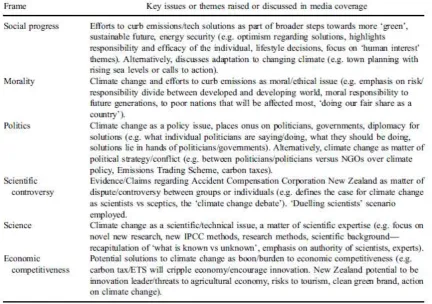
Figure 2 Overview of frames……….11
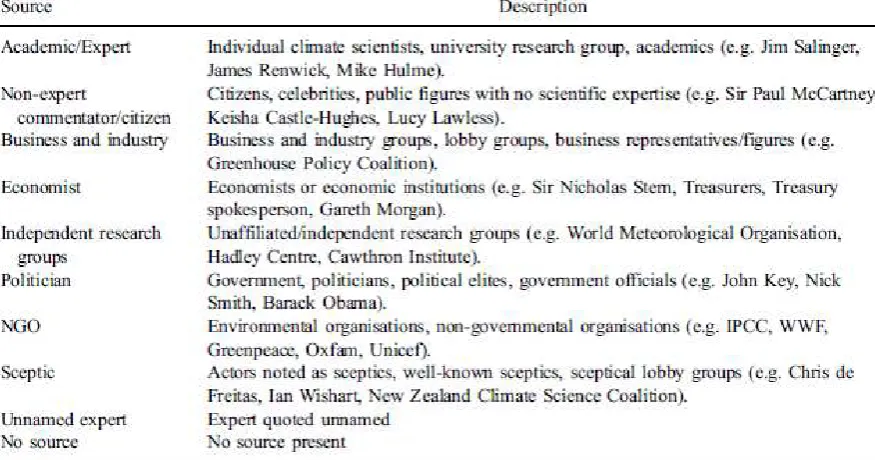
Figure 3 Description of sources………13
Graph 4 Frames in energy transition articles……….33
Graph 5 Frames in student protest articles……….35
Graph 6 Frames per newspaper per topic………..……….36
Graph 7 Energy transition sources per newspaper………36
Graph 8 Student protest sources per newspaper………..38
Graph 9 Source per subject………39
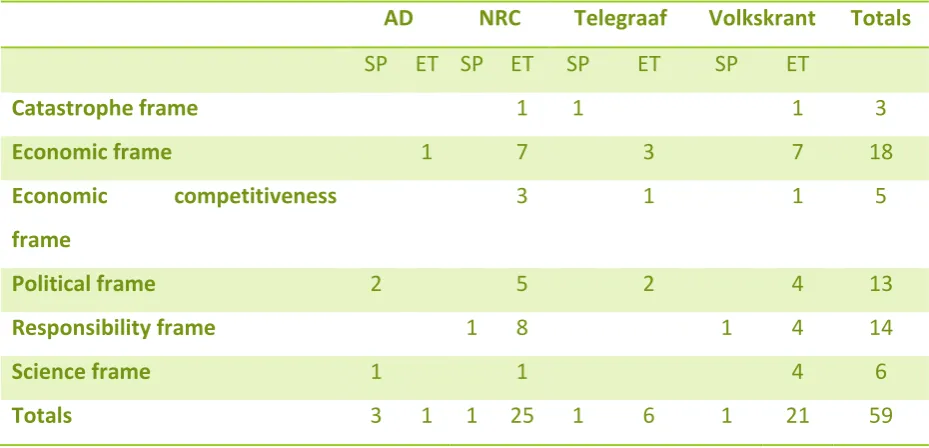
Table 10 frames per subject………..40
Graph 11 Writing style per subject………41
5
Introduction
In recent years, climate change is a hot topic for researchers, politicians, and journalists. Climate change will possibly affect all the people in the world and so also the citizens of the Netherlands, but the way in which Dutch citizens contemplate climate change differs. An important role in the climate change debate is reserved for the media. They are the bridge keeper between the politic, science, and the public. The role of media and journalism is highly important because in the way facts are presented, stories are told, and a stage is given to different opinions, in short, how articles are framed, is influencing all their readers. However, the way in which different news media present this theme differs strongly and this leads to contested knowledge. Readers live, partly conscious but mostly unconscious, in their own filtered bubble. They read often only facts which fit into their own worldview. So, it becomes possible that two people, who live next to each other, have a totally different opinion about the topic of climate change due to the fact that they read different newspapers. In this study, a closer look will be given into the articles of four prominent Dutch newspapers and their way of framing articles with climate change related topics. Framing gives the power to influence people. A story can be told in many different ways through the way in which facts are presented and this leads to contested knowledge. The individual who understands this process can use it in order to strengthen their own power. A politician, for example, who knows which paper frames according to his or her opinion, can conduct interviews with only this newspaper in order to convince more people to vote on his or her party. Another example is a newspaper editor who, through framing and the presentation of only certain articles, makes it more likely for the readers to believe his worldview and opinion on certain topics. The mass public is influenced strongly by the newspapers that are read. In a time, where people live in own media bubbles and only want information which strengthens the own opinion, this study is highly relevant to show how people are influenced by their own information sources without really knowing it. This study will give an insight into the question which newspapers use which frames and how they relate to each other. This will help to understand the opinions of the public on certain topics related to the newspapers that they read and this is practical relevant knowledge.
6
researched the scientific temper of published articles about climate change in India (2015), Ford and King did research about the framing of adaptation to climate change in newspapers in North America (2015), Gkiouzepas and Botetzagias studied climate change coverage in Greek newspapers (2015) and Han et al studied framing climate change in Chinese newspapers (2017). All these studies had as the main topic of climate change and framing in national newspapers but they all used a different point of views and emphasized other aspects of climate change coverage. Chetty et al, for example, researched a wide range of used frames, while Ford and King mainly studied different forms of the adaptation frame. Gkiouzepas and Botetzagias were, at their turn, most interested in the presence of the character of the ‘polarized pluralist’ in the Greek media system, while Han et al focused more on the sources of articles about climate change and searched for relationships between the coverage of newspapers and the financial sponsors which financed the newspaper. In the Netherlands, several framing and newspaper studies were carried out, such as a framing analysis in Dutch Newspapers about asylum seekers (2001) by d’Haenens and de Lange. This study, however, focused on another framing topic than climate change. The study of Dirikx and Gelders did focus on climate change coverage in French and Dutch newspapers during UN conferences (2010), but this research focused only on broadsheet newspapers, which gives a skewed picture of reality.
So there has already a lot of research been done on the topic climate change and framing in newspapers, but this study will add to the existing body of literature because it zooms in on the Netherlands and Dutch newspapers, and this has not been done before, which makes this research scientific relevant. Furthermore, the studies about framing that have already been done in the Netherlands, tend to focus on other topics than climate change. This study will also use a new approach by looking at a governmental top-down initiative, the energy transition of the Dutch government, and a social bottom-up approach, the Dutch student protests, to give a complete picture of the framing between newspapers and the framing within a newspaper. This makes this study special in comparison with existing studies on framing and climate change in other countries.
7
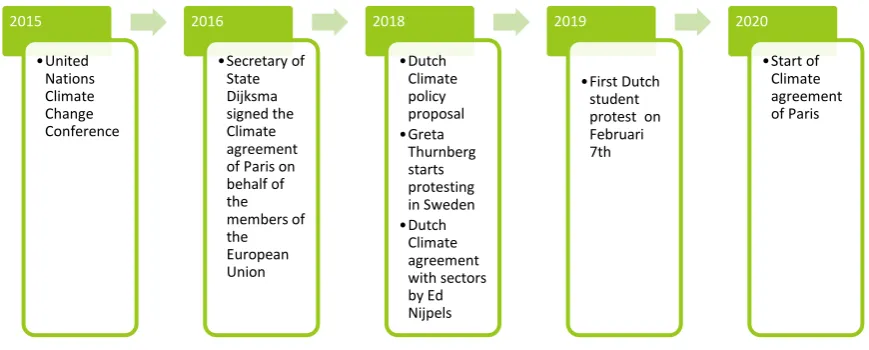
[image:8.595.91.526.479.654.2]the climate conference in Paris. During this conference, the members of the United Nations made agreements about limiting global warming. Agreed is to limit this to 1,5 max 2 degrees Celsius. In 2016, the secretary of state Dijksma signed on behalf of the members of the European Union, the Paris agreement. In June 2018, the draft of the national climate policy proposal in the Netherlands was finished. This agreement had as goal to produce 95% less CO2 in 2050. With this agreement, the Dutch government wanted to give clarity to their citizens, and give guidelines to the business and industries located in the Netherlands. In September that year, the Swedish 16-year old girl Greta Thunberg, refused to go to school any longer. She was worried about global warming and climate change and started her school strike for the climate. At the end of 2018, the climate agreement with the sectors under the chairmanship of Ed Nijpels was published. In February of 2019, Dutch students decided to follow the example of Greta Thunberg's school strike, because they found the climate policy proposals and the climate agreement not progressive enough. They want to convince politicians with the school strikings of the necessity of stricter policies. In 2019, several student demonstrations were organized in the Netherlands. At last, in 2020, the climate agreement of Paris enters into force.
Figure 1 Timeline (Dutch) climate policy and student protests
8
Based on the literature review, which will be discussed later in this paper, a research question could be made, which is as well descriptive as explanatory. The research question of this paper is How do Dutch newspapers write about the governmental top-down initiative of the energy transition, and the social bottom-up initiatives of the student protests, in the
Netherlands, and how do the newspapers relate to each other thereby?
Four sub-questions were created in order to help to answer the research question. With the sub-question, Which frames are used in the selected newspapers describing the energy transition or the student protests? it will become clear which different frames the four newspapers use when they write about the top-down initiative of the energy transition and which frames they use when describing the bottom-up social initiative of the student protests. The second sub-question is In what way differ the frames about the governmental top-down initiative of the energy transition and the social bottom-up initiative of the student
protests? The third sub-question is Which sources are used and what is their role in the different identified frames? This sub-question will look into the question if and how sources are used in different frames. The fourth sub-question is How do the frames relate to each other within and between the newspapers?
9
Theoretical framework
Newspapers and frames are inseparable of each other. In order to write an article, a journalist uses, as well consciously as unconsciously, different frames, in the way an article is written and facts are presented. Gamson and Modigliani say about the presence of frames that these organize the world and make a situation understandable for as well journalists as readers. They call this an ‘interpretive package that gives meaning to an issue’. Interpretive packages are the whole package of elements in an article which bounded together create a frame, such as metaphors, pictures, one-liners, etcetera (1989, p2). These interpretive packages or frames that are used by newspapers shape the public understanding about topics and in this case climate change. Therefore, in this thesis, research will be done regarding different frames that are used in articles about the student protests and the energy transition.
In this theory chapter, first the concept and theory of framing are discussed, second, different frames will be presented in order to give a complete picture of the possible frames that can be present during this research.
Dewulf et al, describe which different approaches of framing exist and what their assumptions are regarding the nature of frames and the subjects of framing. The different approaches of framing that are described in this article are a cognitive approach and an interactional alignment or co-construction approach. Dewulf et al describe this theory as ‘cognitive frames as mental structures that facilitate organizing and interpreting incoming perceptual information by fitting it into already learned schemas or frames about reality’ (Dewulf et al, 2009, p. 4). While studying frames in newspapers, this cognitive approach can be kept in mind, while identifying the frames because the information in newspapers is framed in a way that fit the normally learned schemas about the reality of the readers.
10
are used in order to be able to understand the world and to predict the future, which can be quite useful for policy-relevant actors in order to write policies.
With framing as the work of selecting, naming, and categorizing the authors mean that framing can be used in order to categorize events. By selecting and naming, it becomes easier to categorize a specific situation or word combination.
The last form of framing that is identified, is framing as the work of storytelling. So through framing, all the elements can be bound together in order to make a coherent, understandable story. This frame is often used in politics to make a coherent story about history to underline a point or persuade the audience.
These three distinctive acts of framing are the basis in all the present frames. The frames that are used in the climate articles are used in order to make sense, select, name and categorize, and to tell a coherent story.
Frames in newspapers
When looking at framing in articles about climate change, ideological driven frames are important to recognize. These frames are driven by ideology, influence the public strongly, although they are often not based on facts or give a skewed image of a situation by presenting only one-sided facts. Environmentalists for example, often frame climate change related topics with a Pandora’s Box frame according to Nisbet (2010). This frame is also called an apocalyptic frame by Foust and Murphy (2009). Blue (2015) mentions this frame as the imminent environmental catastrophe frame. This frame, according to blue, consists of the thought that humans risk destroying the earth by passing important thresholds. In this study, these three frames will be combined into the catastrophe frame.
[image:12.595.78.511.107.411.2]
11
Figure 2 Overview of frames
The third and fourth frame will be adopted from Chetty et al (2015, p. 6). This is the economic and the economic competitiveness frame. This economic frame focuses mainly on the negative economic effects that reducing climate change measures can have in the short term. The economic competitiveness frame remarks that these measures will decrease the economic competitiveness of the Netherlands relative to other countries. Dirikx and Van Gelder use the economic frame also in their research, but they call it the (economic) consequences frame. They unite in this frame as well as the possible economic consequences as another kind of consequences (2010, p. 3). However, in this research, there will be a division between the economic frame, the economic competitiveness frame, and the catastrophe frame.
12
The sixth frame is the responsibility frame. This frame is present in the article of Chetty et al as the morality frame. This frame remarks according to Chetty et al the moral and ethical issues related to climate change. The social progress frame of Chetty et al is combined with the responsibility frame in this study because the social progress frame remarks the responsibility of individuals according to sustainable decisions as well as the responsibility frame (Chetty et al, 2015, p. 6). This frame can be recognized in articles were the sources or other actors talk about their own responsibility or about the responsibility of other actors outside themselves.
Sources
[image:14.595.77.515.104.334.2]
13
Figure 3 Description of sources
Writing style
Next, to the five frames that can be identified, the writing style of the articles will also be taken into account. The three possible writing styles are skeptic, neutral and approving. A skeptic article focuses on the controversy in the climate debate and especially on opinions that conflict with the status quo. Blue, for example, states that there is a concern in the existing literature about the influence of these climate denial movements that misinform the public. These movements use according to her a climate skeptic frame (Blue, 2015). Chetty et al identify this too but they name it the scientific controversy frame (2015, p. 6). Dirikx and Van Gelder mention a similar frame which they call the conflict frame. In this frame, there is room for individuals with a different opinion of the status quo. So in the existing literature, the skeptic writing style is mainly used as a frame, but in this research, it will only be labeled as a skeptic writing style. To allocate this label, an article should write skeptic about climate change or global warning, or about the student protests or the energy transition.
Framing in policy processes
14
They comment on the policy process, or suggest how the process should continue. The relevant actor identities describe the actors that are relevant for the policy. In this way, all sides of the policy are lightened. In this research, a closer look will be given into these three entities of the two selected topics.
To sum up, in the theoretical framework, it appeared that framing is unavoidable when writing articles. Framing is the sum of pictures, word choice, metaphors and more, and this is called an interpretive package. There are different ways in which frames are used, such as the basis frames framing as sense-making work, framing as the work of selecting, naming and categorizing, and framing as the work of storytelling. However, there are also some in-depth frames which will be used during this study. These are the catastrophe frame, the political frame, the economic competitiveness frame, the science frame, and the responsibility frame. The writing styles in articles will during this study also be observed and labeled as skeptic, approving or neutral.
Expectations
A few expectations for this study arose while writing the problem background and the theoretical framework and selecting the theoretical concepts. These expectations will be discussed in this subchapter.
First, it is expected that a clear division between the tabloid and the broadsheet newspapers becomes visible. This division is expected to be seen in the use of frames and in the use of sources.
Second, it is expected that the tabloid papers will use more often the economic competitiveness frame than the broadsheet papers in their energy transition articles.
Third, it is expected that the broadsheet papers will make more often use of the science frame than the tabloid papers.
15
Methods
In this chapter, the collected data and documents will be presented. First, the methods that were used will be described. Second, the data generation and operationalization will be described.
In this subchapter, the generation and the operationalization of the Data will be described. First, in the data generation part, it will be described how the required data for this study was collected. Second, the operationalization of this collected data will be discussed.
In this study, there is chosen for meaning-focused research instead of a variable focused inquiry. This is decided because the study has rather topics than measurable variables. According to Haverland and Yanow (2012) ‘interpretive researchers try to structure their research designs in ways that will avoid premature diagnostic closure, maximizing their ability to identify a wide range of interpretations that are relevant to the research setting or situation.’ Haverland and Yanow state that interpretative researchers are less attached to their own theories and concepts. They have a more flexible way of doing research, in which it is possible to start with some theoretical concepts, but while doing the fieldwork it stays possible to adjust these concepts. This means that once the theoretical concepts are made, they are not so-called written in stone, but can be adjusted if necessary.
Therefore, for this study, there is chosen for an interpretive research method. In this way, the theoretical concepts could be flexible and adjusted during the study and instead of looking at variables a closer look could be given into the meaning of the concepts and the results.
Data generation
For the data collection, four Dutch newspapers have been selected. The choice for analyzing only newspapers instead of both newspapers and online news media was made because it is assumed that newspapers publish more in-depth articles in contrast to online media which publish mostly short news stories. During the selection of the newspapers, the number of subscribers and the target audience of the newspaper was the most important selection criteria. Four of the most selling newspapers of the Netherlands were selected, namely NRC,
16 De Telegraaf and Algemeen Dagblad have, in general, a lower educated audience and are known as so-called tabloid newspapers.
During the research, two specific climate initiatives were identified. These two topics are the energy transition and the student protests about climate change. There is chosen for these two topics because they represent a bottom-up and a top-down initiative. The energy transition is a top-down initiative of the government. With the energy transition, the government tries to make the Netherlands more sustainable and less dependent on gas. The student protests about climate change are a bottom-up social initiative of students who try to move the politics to take action, in order to protect nature and prevent climate change. There is chosen for two different kinds of initiatives in order to discover if the newspapers write differently and make use of other frames in articles about a bottom-up social initiative and a top-down politic initiative.
A content analysis of these two initiatives in the four selected newspapers was done. For this analysis, the Saturday newspapers were analyzed over a time period of ten weeks. The Saturday edition of the newspapers was chosen because these contain more in-depth articles about a wider range of subjects. The time period in which articles were selected was January, February and the half of March, because these are the Saturday editions before the Provincial and Water Board elections (20 March 2019) in the Netherlands. In the weeks before these elections, newspapers are more eager to pay attention to in-depth articles about several election subjects, including climate change. Through the content analysis, all articles related to the two initiatives of this research are identified. The articles for the content analysis were selected via Lexis Nexis. Several keywords were used in order to collect the data. Because the articles came from Dutch newspapers the keywords that were used are also in Dutch. For the energy transition, the keywords that were used were
energietransitie, energie overgang, transitie, and klimaatbeleid. The keywords that were used to find the student protest articles were klimaatdemonstratie, klimaat jongeren, and
17
Data analysis
When all the articles were identified, they were coded in Atlas.ti. Initial coding, focused coding, and theoretical coding were used. This was done according to Charmaz approach as described by Bryman (2012, p. 574). During the coding process, the three forms of coding were also continually corresponding with each other. Because qualitative research was done by analyzing the selected articles, a qualitative interpretation of the data was needed. In order to interpret the data correctly, a narrative analysis approach was used as described by Bryman (2012, p. 589-593). The narrative analysis approach fits this research really well because the focus of the analysis lays on the purpose or intended effect of a specific event or situation and how people make sense of this. This fits well with the interpretive research method that is used in this paper. It should be possible to find the frames and the possible purpose of the frames during the data analysis in the selected articles. So, in the data analysis of this research, the most attention will go to the question of what differences could be found between the newspapers and the used frames, for the bottom up and the top down articles. This will be done on the basis of the research question and the sub-questions, which were presented in the part research question.
During the coding process, it was decided to complete the source list with two extra source categories. The categories ‘student’ and ‘other’ were added to the list. The source student contains opinions of youth younger than 21 that is used as a source and the source other is used for every source that was outside the other categories.
Furthermore, the research focused also on the writing style of the articles. Because writers often write an article in a certain way and give room to some critical opinions from an opposite view at the beginning of the end of an article, the articles will be divided into groups while keeping the whole article in mind. So if an article, for example, is in majority skeptical and only for a small part approving or neutral, the article will be labeled as skeptical.
18
Threats and opportunities
A potential threat in this research design is that not all articles can be identified or coded in a correct manner. This can be countered by paying extra attention to the selection and coding of the articles. Therefore, the articles were coded using Charmaz approach as described by Bryman in his book social research methods (Bryman, 2012, p. 574). According to this approach, all articles were coded using initial coding, focused coding, and theoretical coding. Before coding the articles a coding manual, based on Bryman was made. This coding manual can be found in Appendix 2. After all, articles were coded, a coding schedule was made (2012, p. 293-298). The coding schedule can be found in Appendix 3.
Another potential threat that is mentioned by Dirikx and van Gelder, is the fact that only a small number of articles can be analyzed through qualitative content analysis. This makes it hard to generalize data and statements (2010). This threat is also present in this research due to the fact of the small number of articles which can be analyzed per newspaper and topic. This is an unavoidable threat because it is not possible to analyze more articles due to the limited time period. However, this study will still be done because a qualitative content analysis, even if analyzing only a few articles, will give an interesting overview on which further research could be based.
An opportunity for this research is to understand the relationship between the newspapers and their position towards climate-related topics better.
Guarantee of the quality of the study
19
important when doing research with participants. Though this study focused on newspaper articles and did not have interactions with participants, reflexivity is still an important quality criterion. It can also be used to reflect upon the elaboration of the researcher's ideas during the study and to eventually revise the research design when issues arise during the research. Another important part of reflexivity is transparency. This means that the researcher should be transparent and honest about possible events or choices that might have influenced the collecting of data process and so have affected the outcomes of the study.
In order to guarantee the quality of this study, reflexivity and transparency were used. An example of how this was used can be found in the method chapter about the generation of data. There, the collection of data was extensively described. In this section can, for example, be found that it was impossible to collect three articles per topic per newspaper when selecting only the Saturday articles in the set time period. There is, through the use of transparency, clarity given about in what way the data is collected. Through the reflexivity, it became possible to broaden the selection criteria during the study and so almost all the required data could be collected.
Reflexivity and transparency are also important parts of systematicity. By giving openness about the process, the systematicity of a study can be checked and in this way guaranteed. Systematicity is important for research because it shows that the study is done, and those possible conflicting findings were handled, in a disciplined and systematic way. So by giving openness about how the study was conducted and which methods were used, the systematicity of a study becomes clear and this guarantees the quality of the study.
Through reflexivity and systematicity, the study becomes more trustworthy. Schwarts-Sea and Yanow describe trustworthiness with the metaphor of a puzzle that should be solved. The research that is done is the puzzle that needs to be solved. However, a researcher is always biased, that is unavoidable, and therefore the researcher should be aware of the trustworthiness of the research. To guarantee this trustworthiness other ideas and theories opposing their own should be used to check the correctness of the outcomes of the research (Schwarz-Sea & Yanow, 2012).
20
that could be identified but also on the writing style and the presence of sources. Conflicting interpretations can, through using different data collection sources, be found and used during solving the ‘research puzzle’. This means that, if evidence is found that might contradict with the expectations of this research, there should also be room to discuss these findings in the analysis and discussion section of this study. In this way, a balance can be created and a nuanced picture of reality can be given.
21
Analyses
In this chapter, the data and documents that are collected in this research will be analyzed. The data will step by step be presented and analyzed. This begins on the basis of the three entities, namely the substance of the policy, the relevant-actors identity and the policy process. After discussing these three overviewing themes, the sub-questions will be discussed and answered.
The substance of the policy
In this subchapter, a description of the substance of the policies of the two main topics will be given. The main topics of this research are the top-down governmental initiative of the energy transition and the bottom-up social initiative of the student protests. Underneath, a description of the substance of the policy about these two topics can be found.
Energie transition
Three articles about the energy transition, which is part of the Dutch climate policy, were selected per newspaper for this analysis. Unfortunately, only one article about the energy transition could be found for the AD within the selected time period. The substance of the Energy transition or climate policy is described in the following citation of an article of NRC.
For years the climate was primarily a theme for the enthusiast, but last year it
steamed from the fringe to the mainstream. The weeks of the persistent heat wave of July 2018 turned lawns into yellow plains and allowed dogs to burn their paws on the asphalt. At the end of December, the Cabinet presented the draft Climate Agreement, after which concerns arose about the costs for the citizen.
22
transition will cost is often asked, and who will pay for this, is very important for newspapers.
The Volkskrant describes in an article about Ed Nijpels, which belongs to the transition articles, where the policy of the Dutch government originated. It started with politicians who asked for an action plan for the climate. Ed Nijpel became appointed as chairman of the so-called five sector tables meetings. These five sectors consisted of electricity, industry, agriculture and land use, mobility and the built environment. The meetings were attended by civil society organizations and the business community. During the meetings, the action plan, which would protect the climate, was draft and this plan was presented on 21 December 2018. The action plan contained over six hundreds of measures to which all sectors would contribute. After this agreement was made, the Central Planning Office (CPB) of the Netherlands calculated the costs of the plan (Van Lieshout, 2019). From this article, the substance of the policy becomes clear. It appears that many parties, organizations, and points of views were token along while drafting the climate policy for the Dutch government and the Dutch citizens. However, as already appeared in the citation of the NRC, most parties and newspapers focus on the economic measures that will be necessary to reach the goals of the climate policy. So writes the Telegraaf in one of their transition articles that normal Dutch people feel like their opinions and interests were not leading in the policy. Also, many people and political parties are, according to the Telegraaf, afraid about the costs of climate policy (Timmer & Vink, 2019). This article is a good example of how the substance of the policy economizes.
23
economic and the responsibility angle, as can also be seen in the article about the sector tables from the Volkskrant. They write that the environmental NGO’s and the trade unions, who were present at the sector table meetings, refused to sign the agreement at the last moment. They found that the draft agreement divided the costs not fair enough between citizens and the industry. Their point of view is that the biggest polluters have to pay the biggest costs (Van Lieshout, 2019). So in this article, environmental NGO’s and trade unions are mentioned specifically, because they refuse to sign the draft climate policy. This is a strange action, keeping in mind that milieu organizations always try to push politicians for better climate policies and to take as much responsibility as they can. However, despite that the government takes the responsibility, they refuse to sign the policy due to the fact that, in their opinion, the industry does not contribute enough in the concept policy. So this article is also an example of the responsibility angle and the economic angle and how they are related to the substance of the climate policy.
Another important angle of approach of the substance of climate policy is the political angle. This can be seen back in the transition articles in descriptions of quarreling politicians who can not agree on the substance of the policy. In a transition article of NRC, this is described. They write that Thierry Baudet, for example, the leader of Forum for Democracy is skeptic about climate change and global warming. Therefore, he started a climate skeptic movement in Dutch politics. Because of this, the substance of the climate policy became more and more subject of discussion. De Telegraaf is also against the plans, mainly due to the high costs, and campaigns against the draft agreement. This leads to the polarization of the climate debate. They write the following.
The cultural struggle shifts to the climate debate, in which the pompous Tesla rider
takes on the steak-loving normal man.
24
Student protests
25
This fact makes the substance of the student protests interesting, the demands of the students are high and clear, but it is not likely that politics will adopt their views. An important part of their demands is namely a reduction in the CO² emissions and this is entangled with multiple interests, as can be seen in the article about the student protests of the AD. In this article, the researcher Aalberts is quoted, who, summarized, tells that CO² interests are huge in the fossil industry, the air force, and the meat consumption industry. It would cost these parties billions when stricter regulations are made. Aalberts thinks that when the political parties who try already to change the rules not succeed, these student protest will not change anything (Van Dongen, 2019). So, according to the AD, the interests of different parties are too high and this makes it impossible to change the regulations. Concluding, the students of Youth for Climate intend to skip school until there is better climate policy. However, due to the huge interests that are entangled with stricter CO² emissions, it is an extremely sensitive subject for the Dutch government.
Policy-relevant actors identity
Many policy-relevant actors could be found in newspaper articles. In this subchapter, a closer look will be given in these actors and their identity. Firstly, the policy-relevant actors in the articles of the Energy transition will be discussed and secondly the policy-relevant actors in the articles about the student protests.
Energy transition
In the articles about the Energy transition, multiple policy-relevant actors could be identified. The actors can be subdivided into three general groups. Namely, politics, business and industry, and independent persons/research groups. These four groups will one by one be discussed in the following part.
Politics
26
Kruif, 2019). So a policy-relevant actor is the Dutch government. As well the local, as national, as the European governments can give subsidies and make policy about the climate policy and the energy transition. Another political policy-relevant actor is politicians. They have a huge influence on the climate policy of the Dutch government. A good example of this was the Forum for Democracy leader who started a climate skepticism movement in Dutch politics (Bos & Rusman, 2019). Because Baudet is skeptic about climate change and the costs of climate-related measures, he wins a lot of votes. This influences other political parties too, who do not want to lose their voters to Forum for Democracy and become more skeptic about the costs of climate measures. Therefore it becomes difficult to make an agreement. So this article is an example of how politicians can influence public opinion and so influence the climate debate. Therefore, politicians are policy-relevant actors. However, although the parties influence each other, every politician and party has another identity, due to their different opinions. Thierry Baudet, the politician in the article which was described above, is for example known for his climate skeptics, while a party as Groenlinks has a whole different point of view and identity.
Business and industry
27
transition. The companies blame the government for the lack of communication about the energy transition.
Another example of a policy-relevant business actors are the fishermen in the article of the Telegraaf. These are fishermen who fish in the North Sea. In their fishing area more and more windmills are built. This decreases their fishing area. Especially when there is a hard Brexit, their fishing area will decrease even more. Therefore, they are concerned about their future and how everything will work out. The chairman of Visned, Pim Visser, made a report to remark the points of the fishermen and represent them in the political debate (Van Harskamp & De JongAmsterdam, 2019).
The fishermen in the quote above, are limited in their work by windmills, which are part of the energy transition, that are built in the sea. Because of these windmills and their corresponding forbidden areas, their fishing areas become smaller and smaller. Therefore, they are afraid that the energy transition will result in the building of more windmills which will limit their fishing area even more.
Independent persons/research groups
Ed Nijpels is the chairman of the so-called sector tables, which drafted the concept of climate agreement. Nijpels, according to the Volkskrant, is an independent person who functions as chairman of the sector tables. As chairman, he tries to draft up agreements and bring different parties closer together. This resulted in more than six hundred measures in the concept of the climate agreement.
More information about the identity of Ed Nijpels can be subtracted, on the basis of his CV. Nijpels is not only the chairman of the sector tables in the Netherlands, which were founded following the Paris climate agreement in 2015, he has also an impressive CV filled with chairmanships and climate-related subjects. He worked for example as chairman for the Ronald McDonald children’s fund (Van Lieshout, 2017). Nijpels has the difficult job to unite the Dutch parties, the citizens and the industry. The Volkskrant articulates that in the following citate.
It shows that as chairman of the climate agreement, Nijpels must constantly
compromise between parties, not to say: It is not good or it has no virtue. A green
28
(Van Lieshout, 2017) So, Nijpels has to move very carefully between the opinions of all the different parties in order to let his climate agreement succeed. After the concept of the climate agreement was draft up, the CPB (The Centraal Plan Bureau of the Netherlands) calculated all the agreements that were made, in order to be able to present a realistic financial picture of the intended measures. This makes the CPB another important independent research actor in the energy transition process. After the process of calculating and the presentation of the numbers, there was a lot of hassle about the outcomes. Different parties and media called the outcomes wrong or incorrect. The Volkskrant dedicated an article to this subject. In the following citation, they describe the importance of an independent plan bureau.
This article is a textbook example of propaganda disguised as journalism. It also –
unintentionally – illustrates the importance of independent research institutes such as
the three planning offices. They conduct policy research whose outcomes – thanks to
their legally-established independence – cannot or much less be directed by the client
(usually a ministry, with a politician as the person ultimately responsible).
(Hoffs, 2019)
So according to the Volkskrant, an independent research organization is highly important to calculate the true costs of policies. Therefore this is an important actor in the energy transition process.
Student protests
The articles about the student protests contain less policy-relevant actors than the energy transition articles. There are two general stakeholders, namely the students and politicians. Another somewhat smaller stakeholder is The Dutch department of Greenpeace. And at last, a missing stakeholder is the business and industry sector. These stakeholders will be described in the following part.
Students
29
Swedish founder Greta Thunberg and the Dutch student leader Stein Warmenhoven, and second, an overview of protesting students will be given.
Firstly, Greta Thunberg is, as described before in the chapter substance of the policy, the founder of the idea of skipping school for the climate. In an article of the Volkskrant here identity is described. In the summer of 2018, Sweden had the hottest summer ever which made climate change visible. Thunberg saw that politicians did not take adequate measures and therefore she decided that she would wake them up. She started her school strike to move the government to implement the agreements of Paris. She sat every day for the governmental building until the Swedish elections. Then she moved to the Parliament, to sit there every Friday (Kester, 2019). From this article, it appears that Thunberg is serious about the climate and that something has to change. She is persistent with her school strike and so she is an example for other climate activists. Cause Thunberg, became with her message, founder of the student protests all around the world. The Volkskrant described in an article her fast popularity among students. They call her a sort of poster girl for the climate. Newspapers and media all around the world want to interview Thunberg and write articles about her and her message (Van den Outenaar, 2019).
30
because he knows that the politicians who invited them already agree with them (Bouma, 2019).
So it appears that Warmenhoven is more pragmatic and less strict than his example Greta Thunberg. He does not want too strict rules but tries to make people and the government more responsible for their own actions. This is an important characteristic of Warmenhoven because it clarifies the demands that he has for the Dutch Youth for Climate organizations and their student protests.
Another remarkable part of the identity of the students is the fact that they are highly professional. The Volkskrant described in one of their articles on how and why the students became so professional. They describe in the article how the mother of the Dutch student Lilly Platt a ten-year-old girl, collects all the nasty comments that are placed on social media about her daughter. She makes screenshots and collects so proof to show at the police. The girl is among other things compared with Goebbels, who was in World War II the propaganda minister of Adolf Hitler. Other students are also pointed out by the media on their own climate-related shortcomings and are often ridiculed on social media (Bouma, 2019).
Politicians
31
students refuse to let politicians make use of their protests, mainly because they find the policies not ambitious enough.
An important politician as a policy-relevant actor is the Prime Minister of the Netherlands Mark Rutte. The prime minister decided to talk with the leaders of Youth for Climate about their demands and the climate policy of the government. However, he was not able to convince the students to stop their protests (Hiel, 2019).
Another politician that is a relevant actor identity in the student protest article is the minister of Education, Arie Slob, who invited some students to listen to their concerns and demands (Sluis, 2019) but who also remarks that the students should protest when school time is over (Vriesema, 2019).
Environmental NGO
The students are supported by the environmental NGO Greenpeace. Faiza Oulahsen of the Dutch department of Greenpeace says that they are inspired by the student protests in Europe. They help the Dutch students with information about the draft climate agreement (Timmer, 2019). However, the students in the Netherlands are not part of Greenpeace, they are only supported by this NGO.
Business and industry
A large missing stakeholder in the articles is the business and industry sector. It is to be expected that they would be part of articles about the student protests, due to the fact that one of the main demands of the students is a CO² reduction and this sector has high interests in this area, but they are not once mentioned. So the business and industry sector is a stakeholder, but they are not represented in the articles about the student protests. This can be explained by the fact that the student protest articles mainly descriptive are written. The articles document the events that are happening but hardly deepen the question of how the demands of the students should be carried out. This indicates that the newspapers do probably not expect the protests to be so successful that stricter policies will be made and the business and industry become affected in this way.
Policy process
32
some newspapers make suggestions about the policy process. An example of the policy process in an energy transition article is the article about the central planning bureau (CPB) of the Volkskrant, which was described earlier. They wrote the following.
This article is a textbook example of propaganda disguised as journalism. It also –
unintentionally – illustrates the importance of independent research institutes such as
the three planning offices. They conduct policy research whose outcomes – thanks to
their legally-established independence – cannot or much less be directed by the client
(usually a ministry, with a politician as the person ultimately responsible).
(Hoffs, 2019) The Volkskrant takes here a clear position relative to the independence and reliability of the CPB. They state in the article that the CPB is reliable and that parties who deny this often are blinded by their own interests. The Volkskrant even goes as far as calling this ‘propaganda disguised as journalism’ and writes about the policy process that the calculations of the CPB are often right and therefore should be leading the opinions and statements of the politicians, instead of being questioned.
Another example of the policy process can be found in an article about the student protests of the Telegraaf. They have a more subtle way of describing the policy process. They write in the article about the hypocrisy of some of the protesting students. They ask the students to question their own lifestyle and their own ecological footprint. In this way they found out that some of the students take the plane on holidays, take long showers or use their money preferable for necessary things as studying instead of for electric cars (Sluis, 2019). So with these questions and presenting the answers in this way, the Telegraaf seems to suggest that the students should first make their own lives more sustainable and should live in a responsible way before they start protesting. They should, according to the Telegraaf, start with improving their own lives to reduce climate change.
Frames per newspaper
33
Energy transition
In graph 4, the specification of all the frames that could be identified in the articles about the energy transition can be found. The x-as is sorted per newspaper. The y-as indicate how often a specific frame was present in the articles of a specific newspaper. The political frame, for example, could be found five times in the NRC articles, two times in the Telegraaf articles and four times in the Volkskrant.
Graph 4 Frames in Energy Transition articles
The frames, as described in the theoretical framework, could all be found in the selected articles about the energy transition. However, while in some newspaper all the frames could be identified, in other newspapers only a few were found. In the AD, for example, was only the Economic frame found in the transition article. Although it has to be remarked, that there was only one article of the AD selected instead of three. In the NRC, on the other hand, all frames were present in their articles. This also applied for the Volkskrant. All the frames were also present in their articles. In the Telegraaf, however, only the Economic (competitiveness) frame and the political frame could be identified.
The Volkskrant and NRC had more frames than the AD and the Telegraaf. The frames that were present in the AD and the Telegraaf, remarked also mostly the (negative) economic consequences of the climate policy. However, in the energy transition articles could
0 1 2 3 4 5 6 7 8 9
AD NRC Telegraaf Volkskrant
Catstrophe frame
Economic competitiveness frame
Economic frame
Political frame
Responsibility frame
34
frequently the economic frame be found, and the question ‘who will pay for the climate policy of the Dutch government?’ is the most prominent question that is discussed. As can be seen in the graph above, the economic and economic competitiveness frames are even the most used frames in the energy transition articles. In the articles of NRC and the Volkskrant, these frames could mostly be identified. An example of the economic frame can be found in the article of NRC about subsidies for electric cars. This article described this subsidy policy but also pointed out the fact that the subsidies mainly went to citizens of the higher income groups who buy expensive cars and remarked the costs of this policy for the citizens of the Netherlands (Kalse, 2019). This frame was also found in articles of the Telegraaf. In one of their energy transition articles, The Telegraaf writes that the citizens have to pay for the climate policy but that they cannot decide about the content of this policy. They write that the Dutch citizen does not feel represented in the climate agreement (Timmer & Vink, 2019).
So, in articles about the energy transition, in all four newspapers, often the economic or economic competitiveness frame can be identified.
Student protest
35
Graph 5 frames in student protest articles
The graph shows that the AD used the political frame and the science frame. The NRC used the responsibility frame. The Telegraaf used the Catastrophe frame and the Volkskrant used the responsibility frame.
NRC and the Volkskrant used both the responsibility frame, but furthermore, there is no overlap between the frames and the newspapers. An outstanding point is that in none of the newspapers all the frames could be identified in the selected three articles. This was the case with the energy transition articles, but it is not applicable for the student protest articles. A last remarkable point is that in none of the articles the economic or economic competitiveness frame appeared. The graph shows how many times a frame could be identified per newspaper. The responsibility frame is, for example, one time identified in an article of NRC and one time in an article of the Volkskrant.
Overview of frames
In the following graph, the frames that were identified in the energy transition articles can be compared with the frames that were identified in the student protest articles. It appears that in the transition articles more frequently frames and more diverse frames could be identified than in the student protest articles. It is remarkable that the economic and the economic competitiveness frames were frequently present in the energy transition articles but could not be found in the student protest articles.
0 1 2 3 4 5 6 7 8 9
AD NRC Telegraaf Volkskrant
Catstrophe frame
Economic
competitiveness frame
Economic frame
Political frame
Responsibility frame
36
Graph 6 frames per topic
The role of sources
All the sources in the articles were documented. First, the sources of the energy transition will be discussed and second the sources of the student protests.
Energy transition
In graph 7, all the sources that were identified in the energy transition can be found. The sources are structured per category and per paper.
Graph 7 Energy transition sources per newspaper
0 2 4 6 8 10 12 14 16 18 20
Student protest Energy transition
Catastrophe frame Economic competitiveness frame Economic frame Political frame Responsibility frame Science frame 0 5 10 15 20 25 30 35 40
AD NRC Telegraaf Volkskrant
N u m b e r o f o cc u re n ce Newspaper Academic/expert
Business and industry
Independent research group
37
In the one article of AD about the energy transition, the sources that were used were business and industry, and politician sources. This combination of sources indicates often an economic frame. The economic frame could then be found in this particular article about the overcapacity on the electricity network. The AD wrote about the difficulty of solving this problem because it would cost hundreds of millions and could take three to ten years (Van Dongen, 2019). So the energy transition is mainly seen through an economic frame which points out the costs and impossibility of extending the capacity of the Dutch electricity network. The problem in the article is described on the basis of political and business and industry sources. This combination of sources appears often when an economic frame is used. The business and industry sources tell something about the probable (negative) economic consequences and a (local) politician gives a response to the problem.
NRC used several sources in their articles. Namely Academic/expert, business and industry, independent research group, non-expert commentator and politician sources. A large number of sources corresponds with the several frames that were found in their transition articles.
The Telegraaf used mostly business and industry sources, but also an independent research group, an NGO and a politician as the source.
The Volkskrant used no less than seventeen politicians as the source. Furthermore, they used academic/expert sources, NGO’s and business and industry sources.
Student protests
38
Graph 8 Student protest sources per newspaper
In the student protest articles that were selected of the AD five different sources could be identified. These were the academic/expert, the non-expert commentator/citizen, other, politician, and student as the source.
In the NRC, academic/expert were several times used as a source, but the most used source were students. NRC used also politicians, other and non-expert commentators/citizens as the source.
The Telegraaf used mostly the same sources as the other newspapers. Academic/experts, non-expert commentators/citizens, politicians, and students could be found as a source in their articles. However, the Telegraaf is also the only newspaper that used an NGO as a source in one of their articles.
At last, Volkskrant used academic/expert, independent research group, non-expert commentators/citizens and students as a source. What strikes out is the fact that in these articles no business and industry sources were used. Also, it stands out that all articles are based on sources and all the sources are named.
Overview of sources
In graph 9, underneath, an overview of the sources per topic is given. The articles about the student protests contained a total of 63 sources and the articles about the energy transition
0 2 4 6 8 10 12 14
AD NRC Telegraaf Volkskrant
N u m b e r o f o cc u re n ce Newspaper Academic/expert
Business and industry
Independent research group
39
contained a total of 96 sources. The figure shows to which group of sources these sources belong.
Graph 9 source per subject
The type of source that is used, is remarkable, when looking into the sources for the different kind of articles. The transition articles mostly make use of politicians, Independent Research Groups and citizens as the source. Also, Business and industry sources are allowed to speak. However, when you look at the student protest articles it is striking to see that most of the sources are a student and younger than 21 years old. This is of course logically explained by the fact that the students protest mainly consist of youth, but it also remarks that the youth does indeed have an opinion on the climate policy of the Dutch government. However, this is only visible in the articles about the student protests. In none of the analyzed papers were students used as a source in the articles about the energy transition and the climate policy of the Dutch government. Although, in these articles, the opinion of non-expert commentators/citizens is pictured, the opinion of younger people is often not described. This picture can be nuanced a little by the fact that in three of the four papers that were included in this study, non-experts/citizens were not used as a source. Only NRC
0 5 10 15 20 25 30 35 40
Student protest Energy transition
N u m b e r o f o cc u re n ce Topic
Grafiektitel
Academic/expertBusiness and industry
Independent research group
40
used 37 times non-experts/citizens as a source but none of these sources was younger than 21 years.
Frames between and within newspapers
[image:41.595.65.530.261.485.2]The frames that were identified in the articles differ per newspaper and per subject. An overview of the striking points will be given in this subchapter. In table 10, underneath, an overview table can be found showing all the frames that were found in the newspapers per topic.
Table 10 frames per newspaper per subject
AD NRC Telegraaf Volkskrant Totals
SP ET SP ET SP ET SP ET
Catastrophe frame 1 1 1 3
Economic frame 1 7 3 7 18
Economic competitiveness
frame
3 1 1 5
Political frame 2 5 2 4 13
Responsibility frame 1 8 1 4 14
Science frame 1 1 4 6
Totals 3 1 1 25 1 6 1 21 59
*SP = student protest and ET = energy transition
41
Writing style
The articles that were selected for this research often gave away a subtle or hidden value judgment of the described events or measures. These value judgments can be found in the way that events are described, the way that facts are presented or in the word choice of the journalist. In this way, the value judgment of the journalist or newspaper shines through. Therefore, the articles in this research are divided into three categories according to their writing style, namely approving, skeptic and neutral.
In graph 11 the outcomes of these groups can be found. The graph shows the division between the two subjects into the three groups. What strikes out is the fact that nine of the ten articles about the energy transition had a mostly skeptical writing style. The articles about the student protests meanwhile are more equally divided between the three groups. Graph 11 writing style per subject
Table 12, which can be found underneath, deepens the information of figure 11. In this table, for every newspaper, the subject and the writing style is shown. The Volkskrant, for example, has three articles about the student protests written in an approving style and for the energy transition articles, it has one article written in an approving style and two articles written in a skeptic style.
0 1 2 3 4 5 6 7 8 9 10
Student protest Energy transition
Writing style
Approving
Sceptic
[image:42.595.70.433.348.563.2][image:43.595.67.531.93.178.2]
42
Table 12 writing styles per newspaper per subject
AD NRC Telegraaf Volkskrant Totals
SP ET SP ET SP ET SP ET
Approving 2 3 1 6
Neutral 1 2 3
Skeptic 1 1 1 3 3 3 2 14
Total 4 1 3 3 3 3 3 3 23
*SP = student protest and ET = energy transition
43
Discussion
The Discussion consists of X parts, that each will look into and discuss a different topic. The first topic for the Discussion is the expectations which were made before the research and the question to which extent these became true. After discussing these expectations, the framing of the policy process will be discussed. Based on the data analysis and the first part of the discussion, the sub-questions, which were described at the introduction of this paper, will be discussed and answered. Thereafter, the methodological challenges of this research will be discussed, limitations of this study will be described and possibilities for further research are suggested.
Expectations
Some expectations for this research were drawn up at the beginning of this thesis. In this subchapter of the discussion, the expectations and the question of the expectation were right, will be discussed.
The first expectation that was made, was that a clear division would become visible between the broadsheet and the tabloid papers. The division was mainly expected to be seen in the use of frames and in the use of sources. For the articles about the energy transition, this was hard to see due to the fact that there was only one article of the AD included in the selection of the articles so that meant that there were fewer articles of tabloid newspapers than of broadsheet newspapers. However, it still appeared that the broadsheet papers had all the frames present in their selected articles while this was not the case for the tabloid papers. In the articles about the student protests, fewer frames could be identified. However, the tabloid papers used here more often a skeptic approach in their articles about the student protests than the broadsheet papers. When looking at the sources it appeared that the broadsheet papers used more politician sources in energy transition articles that tabloid papers, but more clear differences between sources in broadsheet or tabloid papers were not present. Concluding, there became indeed a division visible between the tabloid and the broadsheet papers in the frames that could be identified and the use of sources in this research.
44
competitiveness frame were one of the most used frames of tabloid papers, the frame was more frequently present in broadsheet papers. This may have to do with the fact that the articles of broadsheet papers where in general longer and therefore there could be more frames be identified. Besides, the economic frame and the economic competitiveness frame were only visible in the energy transition articles and from this topic, there was only one article of the AD selected in this research.
Third, it was expected that the broadsheet papers would make more often use of the science frame than the tabloid papers. This expectation became true. Not only used the broadsheet papers the science frame more often, but this frame was also not present in all analyzed articles of the tabloid papers.
Fourth and last, it was expected that there would be a difference within each newspaper for the two topics regarding frames and sources. This expectation was met. For the different topics could different combinations of frames be identified for all the newspapers. This could mostly be seen in the fact that in the energy transition articles more frames could be identified. Also, in the student protest articles, the economic frame was not used. The used sources differed for each paper and each subject too. This was mainly visible in the use of students as a source.
Framing the policy process
During the analyses, the entities substance of the policy, policy-relevant actors identity and policy process were used to analyze the data. This data gave a picture of the top-down initiative of the Dutch government and the bottom-up social initiative of Dutch students. The picture that could be created by collecting this data could be used as a basis for further analysis.