A Latent Variable Model of Synchronous Syntactic-Semantic Parsing for
Multiple Languages
Andrea Gesmundo Univ Geneva Dept Computer Sci
Andrea.Gesmundo@ unige.ch
James Henderson Univ Geneva Dept Computer Sci
James.Henderson@ unige.ch
Paola Merlo Univ Geneva Dept Linguistics
Paola.Merlo@ unige.ch
Ivan Titov∗ Univ Illinois at U-C Dept Computer Sci
Abstract
Motivated by the large number of languages (seven) and the short development time (two months) of the 2009 CoNLL shared task, we exploited latent variables to avoid the costly process of hand-crafted feature engineering, allowing the latent variables to induce features from the data. We took a pre-existing gener-ative latent variable model of joint syntactic-semantic dependency parsing, developed for English, and applied it to six new languages with minimal adjustments. The parser’s ro-bustness across languages indicates that this parser has a very general feature set. The parser’s high performance indicates that its la-tent variables succeeded in inducing effective features. This system was ranked third overall with a macro averaged F1 score of 82.14%, only 0.5% worse than the best system.
1 Introduction
Recent research in syntax-based statistical machine translation and the recent availability of syntac-tically annotated corpora for multiple languages (Nivre et al., 2007) has provided a new opportunity for evaluating the cross-linguistic validity of statis-tical models of syntactic structure. This opportu-nity has been significantly expanded with the 2009 CoNLL shared task on syntactic and semantic pars-ing of seven languages (Hajiˇc et al., 2009) belongpars-ing to several different language families.
We participate in this task with a generative, history-based model proposed in the CoNLL 2008
0Authors in alphabetical order.
shared task for English (Henderson et al., 2008) and further improved to tackle non-planar dependencies (Titov et al., 2009). This model maximises the joint probability of the syntactic and semantic dependen-cies and thereby enforces that the output structure be globally coherent, but the use of synchronous pars-ing allows it to maintain separate structures for the syntax and semantics. The probabilistic model is based on Incremental Sigmoid Belief Networks (IS-BNs), a recently proposed latent variable model for syntactic structure prediction, which has shown very good performance for both constituency (Titov and Henderson, 2007a) and dependency parsing (Titov and Henderson, 2007b). The use of latent variables enables this architecture to be extended to learning a synchronous parse of syntax and semantics with-out overly restrictive assumptions abwith-out the linking between syntactic and semantic structures.
In this work, we evaluate the ability of this method to generalise across several languages. We take the model as it was developed for English, and apply it directly to all seven languages. The only fine-tuning was to evaluate whether to include one feature type which we had previously found did not help for English, but helped overall. No other fea-ture engineering was done. The use of latent vari-ables to induce features automatically from the data gives our method the adaptability necessary to per-form well across all seven languages, and demon-strates the lack of language specificity in the models of Henderson et al. (2008) and Titov et al. (2009).
The main properties of this model, that differen-tiate it from other approaches, is the use of syn-chronous syntactic and semantic derivations and the
use of online planarisation of crossing semantic de-pendencies. This system was ranked third overall with a macro averaged F1 score of 82.14%, only 0.5% worse than the best system.
2 The Synchronous Model
The use of synchronous parsing allows separate structures for syntax and semantics, while still mod-eling their joint probability. We use the approach to synchronous parsing proposed in Henderson et al. (2008), where we start with two separate derivations specifying each of the two structures, then synchro-nise these derivations at each word. The individual derivations are based on Nivre’s shift-reduce-style parsing algorithm (Nivre et al., 2006), as discussed further below. First we illustrate the high-level struc-ture of the model, discussed in more detail in Hen-derson et al. (2008).
Let Td be a syntactic dependency tree with
derivation Dd1, ..., Dmd
d , and Ts be a semantic
dependency graph with derivation D1
s, ..., Dmss.
To define derivations for the joint structure Td, Ts, we divide the two derivations into the
chunks between shifting each word onto the stack, ctd=Dbtd
d , ..., D et
d
d and cts=Db
t s
s , ..., De
t s
s ,
where Dbtd−1
d =D
bt s−1
s =Shiftt−1 and
Detd+1
d =D
et s+1
s =Shiftt. Then the actions of
the synchronous derivations consist of quadruples Ct= (ctd,Switch, cts,Shiftt), where Switch means switching from syntactic to semantic mode. This gives us the following joint probability model, wherenis the number of words in the input.
P(Td, Ts) =Qnt=1P(Ct|C1, . . . , Ct−1) (1) These synchronous derivationsC1, . . . , Cnonly re-quire a single input queue, since theShiftactions are synchronised, but they require two separate stacks, one for the syntactic derivation and one for the se-mantic derivation.
The probability of each synchronous derivation chunk Ct is the product of four factors, related to the syntactic level, the semantic level and the two synchronising steps. The probability of ct
d is
de-composed into one probability for each derivation actionDi, conditioned on its history using the chain rule, and likewise forct
s. These probabilities are
es-timated using the method described in section 3.
Syn cross Sem cross Sem tree No parse
Cat 0% 0% 61.4% 0%
Chi 0% 28.0% 28.6% 9.5% Cze 22.4% 16.3% 6.1% 1.8% Eng 7.6% 43.9% 21.4% 3.9% Ger 28.1% 1.3% 97.4% 0.0% Jap 0.9% 38.3% 11.2% 14.4%
Spa 0% 0% 57.1% 0%
Table 1: For each language, percentage of training sen-tences with crossing arcs in syntax and semantics, with semantic arcs forming a tree, and which were not parsable using theSwapaction.
One of the main characteristics of our syn-chronous representation, unlike other synsyn-chronous representations of syntax and semantics (Nesson et al., 2008), is that the synchronisation is done on words, rather than on structural components. We take advantage of this freedom and adopt different methods for handling crossing arcs for syntax and for semantics.
While both syntax and semantics are represented as dependency graphs, these graphs differ substan-tially in their properties. Some statistics which in-dicate these differences are shown in table 1. For example, English syntactic dependencies form trees, while semantic dependency structures are only trees 21.4% of the time, since in general each struc-ture does not form a connected graph and some nodes may have more than one parent. The syn-tactic dependency structures for only 7.6% of En-glish sentences contain crossing arcs, while 43.9% of the semantic dependency structures contain cross-ing arcs. Due to variations both in language char-acteristics and annotation decisions across corpora, these differences between syntax and semantics vary across the seven languages, but they are consis-tent enough to motivate the development of new techniques specifically for handling semantic depen-dency structures. In particular, we use a different method for parsing crossing arcs.
For parsing crossing semantic arcs (i.e. non-planar graphs), we use the approach proposed in Titov et al. (2009), which introduces an actionSwap
portions of the parse, so some arcs can be specified using one ordering, then other arcs can be specified using another ordering. Titov et al. (2009) found that only using theSwapaction as a last resort is the best strategy for English (compared to using it preemp-tively to address future crossing arcs) and we use the same strategy here for all languages.
Syntactic graphs do not use a Swap action. We adopt the HEAD method of Nivre and Nils-son (2005) to de-projectivise syntactic dependencies outside of parsing.1
3 Features and New Developments
The synchronous derivations described above are modelled with a type of Bayesian Network called an Incremental Sigmoid Belief Network (ISBN) (Titov and Henderson, 2007a). As in Henderson et al. (2008), the ISBN model distinguishes two types of latent states: syntactic states, when syntactic deci-sions are considered, and semantic states, when se-mantic decision are considered. Latent states are vectors of binary latent variables, which are condi-tioned on variables from previous states via a pattern of connecting edges determined by the previous de-cisions. These latent-to-latent connections are used to engineer soft biases which reflect the relevant do-mains of locality in the structure being built. For these we used the set of connections proposed in Titov et al. (2009), which includes latent-to-latent connections both from syntax states to semantics states and vice versa. The latent variable vectors are also conditioned on a set of observable features of the derivation history. For these features, we start with the feature set from Titov et al. (2009), which extends the semantic features proposed in Hender-son et al. (2008) to allow better handling of the non-planar structures in semantics. Most importantly, all the features previously included for the top of the stack were also included for the word just under the top of the stack. To this set we added one more type of feature, discussed below.
We made some modifications to reflect differ-ences in the task definition between the 2008 and 2009 shared tasks, and experimented with one type of features which had been previously
imple-1The statistics in Table 1 suggest that, for some languages, swapping might be beneficial for syntax as well.
mented. For the former modifications, the system was adapted to allow the use of the PFEAT and FILLPRED fields in the data, which both resulted in improved accuracy for all the languages. The PFEAT data field (automatically predicted morpho-logical features) was introduced in the system in two ways, as an atomic feature bundle that is pre-dicted when predicting the word, and split into its elementary components when conditioning on a pre-vious word, as was done in Titov and Henderson (2007b). Because the testing data included a spec-ification of which words were annotated as predi-cates (the FILLPRED data field), we constrained the parser’s output so as to be consistent with this speci-fication. For rare predicates, if the predicate was not in the parser’s lexicon (extracted from the training set), then a sense was taken from the list of senses reported in the Lexicon and Frame Set resources available for the closed challenge. If this informa-tion was not available, then a default sense was con-structed based on the automatically predicted lemma (PLEMMA) of the predicate.
We also made use of a previously implemented type of feature that allows the prediction of a seman-tic link between two words to be conditioned on the syntactic dependency already predicted between the same two words. While this feature had previously not helped for English, it did result in an overall im-provement across the languages.
Also, in comparison with previous experiments, the search beam used in the decoding phase was in-creased from 50 to 80, producing a small improve-ment in the overall developimprove-ment score.
All development effort took about two person-months, mostly by someone who had no previous experience with the system. Most of this time was spent on the above differences in the task definition between the 2008 and 2009 shared tasks.
4 Results and Discussion
Rank Average Catalan Chinese Czech English German Japanese Spanish macro F1 3 82.14 82.66 76.15 83.21 86.03 79.59 84.91 82.43 syntactic acc 1 @85.77 @87.86 76.11 @80.38 88.79 87.29 92.34 @87.64 semantic F1 3 78.42 77.44 76.05 86.02 83.24 71.78 77.23 77.19
Table 2: The three main scores for our system. Rank is within task.
[image:4.612.76.297.145.195.2]Rank Ave Cze-ood Eng-ood Ger-ood macro F1 3 75.93 @80.70 75.76 71.32 syn Acc 2 78.01 @76.41 80.84 76.77 sem F1 3 73.63 84.99 70.65 65.25 Table 3: Results on out-of-domain for our system. Rank is within task.
The official results on the testing set are shown in tables 2, 3, and 4. The symbol “@” indicates the best result across systems. In table 5, we show our rankings across the different datasets, amongst sys-tems submitted for the same task.
The overall score used to rank systems is the un-weighted average of the syntactic labeled accuracy and the semantic labeled F1 measure, across all lan-guages (“macro F1” in table 2). We were ranked third, out of 14 systems. There was only a 0.5% dif-ference between our score and that of the best sys-tem, while there was a 1.29% difference between our score and the fourth ranked system. Only consid-ering syntactic accuracy, we had the highest aver-age score of all systems, with the highest individual score for Catalan, Czech, and Spanish. Only con-sidering semantic F1, we were again ranked third. Our results for out-of-domain data (table 3) achieved a similar level of success, although here we were ranked second for average syntactic accuracy. Our precision on semantic arcs was generally much bet-ter than our recall (shown in table 4). However, other systems had a similar imbalance, resulting in no change in our third place ranking for semantic precision and for semantic recall. Only when the se-mantic precision is averaged with syntactic accuracy do we squeeze into second place (“macro Prec”).
To get a more detailed picture of the strengths and weaknesses of our system, we computed its rank within each dataset, shown in table 5. Overall, our system is robust across languages, with little fluc-tuation in ranking for the overall score, including for out-of-domain data. The one noticeable excep-tion to this consistency is the syntactic score for
En-data time (min) macro F1 Czech 25% 5007 73.84
50% 3699 77.57 75% 4201 79.10 100% 6870 80.55 English 25% 1300 79.02 50% 1899 81.61 75% 3196 82.41 100% 3191 83.27
Table 6: Training times and development set accuracies using different percentages of the training data, for Czech and English.
glish out-of-domain data. The other ranks for En-glish out-of-domain and EnEn-glish in-domain scores are also on the poor side. These results support our claim that our parser has not undergone much hand-tuning, since it was originally developed for English. It is not currently clear whether this relative differ-ence reflects a English-specific weakness in our sys-tem, or that many of the other systems have been fine-tuned for English.
On the higher end of our dataset rankings, we do relatively well on Catalan, Czech, and Span-ish. Catalan and Spanish are unique amongst these datasets in that they have no crossing arcs in their semantic structure. Czech seems to have semantic structures which are relatively well handled by our derivations with Swap. As indicated above in ta-ble 1, only 2% of sentences are unparsata-ble, despite 16% requiring theSwapaction. However, this argu-ment does not explain why our parser did relatively poorly on German semantic dependencies. Regard-less, these observations would suggest that our sys-tem is still having trouble with crossing dependen-cies, despite the introduction of theSwapoperation, and that our learning method could achieve better performance with an improved treatment of cross-ing semantic dependencies.
Rank Ave Cat Chi Cze Eng Ger Jap Spa Cze-ood Eng-ood Ger-ood semantic Prec 3 81.60 79.08 80.93 87.45 84.92 75.60 83.75 79.44 85.90 72.89 75.19 semantic Rec 3 75.56 75.87 71.73 @84.64 81.63 68.33 71.65 75.05 @84.09 68.55 57.63 macro Prec 2 83.68 83.47 78.52 83.91 86.86 81.44 88.05 83.54 81.16 76.86 @75.98 macro Rec 3 80.66 @81.86 73.92 @82.51 85.21 77.81 81.99 81.35 @80.25 74.70 67.20
Table 4: Semantic precision and recall and macro precision and recall for our system. Rank is within task.
Rank by Ave Cat Chi Cze Eng Ger Jap Spa Ave-ood Cze-ood Eng-ood Ger-ood
macro F1 3 2 3 2 4 4 3 2 3 1 4 3
syntactic Acc 1 1 4 1 3 2 2 1 2 1 7 2
[image:5.612.71.302.233.372.2]semantic F1 3 2 4 2 4 5 4 2 3 2 4 3
Table 5: Our system’s rank within task according to the three main measures, for each dataset.
−1.4 −1.2 −1 −0.8 −0.6 −0.4 −0.2 0
0 10 20 30 40 50
Macro F1 Difference
Words per Second Jap Spa Cat Ger Eng Cze Chi
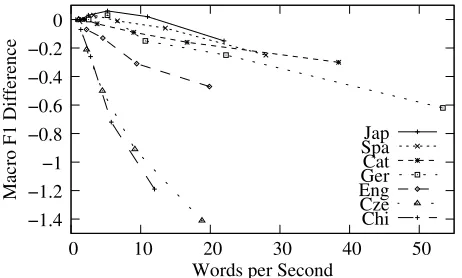
Figure 1: Difference in development set macro F1 as the search beam is decreased from the submitted beam (80) to 40, 20, 10, and 5, plotted against parser speed.
random variations can result in different numbers of training cycles before convergence. Accuracies ap-pear to be roughly log-linear with data size.
Figure 1 shows how the accuracy of the parser de-grades as we speed it up by decreasing the search beam used in decoding, for each language. For some languages, a slightly smaller search beam is actually more accurate,2 but for smaller beams the trade-off of accuracy versus words-per-second is roughly lin-ear. Parsing time per word is also linear in beam width, with a zero intercept.
5 Conclusion
In the joint task of the closed challenge of the CoNLL 2009 shared task (Hajiˇc et al., 2009), we in-vestigated how well a model of syntactic-semantic dependency parsing developed for English would
2This fact suggests that we could have gotten improved re-sults by tailoring the search beam to individual languages.
generalise to the other six languages. This model provides a single generative probability of the joint syntactic and semantic dependency structures, but allows separate representations for these two struc-tures by parsing the two strucstruc-tures synchronously. Finding the statistical correlations both between and within these structures is facilitated through the use of latent variables, which induce features automat-ically from the data, thereby greatly reducing the need for hand-coded feature engineering.
This latent variable model proved very robust across languages, achieving a ranking of between second and fourth on each language, including for out-of-domain data. The extent to which the parser does not rely on hand-crafting is underlined by the fact that its worst ranking is for English, the lan-guage for which it was developed (particularly for out-of-domain data). The parser was ranked third overall out of 14 systems, with a macro averaged F1 score of 82.14%, only 0.5% worse than the best sys-tem.
learn a common hidden representation for this mul-titask learning problem and also was the only one which achieved significant gain from joint parameter estimation. We believe that learning shared hidden representations for related NLP problems is a very promising direction for further research.
Acknowledgements
We thank Gabriele Musillo and Dan Roth for help and advice. This work was partly funded by Swiss NSF grants 100015-122643 and PBGE22-119276, European Community FP7 grant 216594 (CLASSiC, www.classic-project.org), US NSF grant SoD-HCER-0613885 and DARPA (Bootstrap Learning Program).
References
Aljoscha Burchardt, Katrin Erk, Anette Frank, Andrea Kowalski, Sebastian Pad´o, and Manfred Pinkal. 2006. The SALSA corpus: a German corpus resource for lexical semantics. InProceedings of the 5th Interna-tional Conference on Language Resources and Evalu-ation (LREC-2006), Genoa, Italy.
Jan Hajiˇc, Jarmila Panevov´a, Eva Hajiˇcov´a, Petr Sgall, Petr Pajas, Jan ˇStˇep´anek, Jiˇr´ı Havelka, Marie Mikulov´a, and Zdenˇek ˇZabokrtsk´y. 2006. Prague De-pendency Treebank 2.0.
Jan Hajiˇc, Massimiliano Ciaramita, Richard Johans-son, Daisuke Kawahara, Maria Ant`onia Mart´ı, Llu´ıs M`arquez, Adam Meyers, Joakim Nivre, Sebastian Pad´o, Jan ˇStˇep´anek, Pavel Straˇn´ak, Mihai Surdeanu, Nianwen Xue, and Yi Zhang. 2009. The CoNLL-2009 shared task: Syntactic and semantic depen-dencies in multiple languages. In Proceedings of the 13th Conference on Computational Natural Lan-guage Learning (CoNLL-2009), June 4-5, Boulder, Colorado, USA.
James Henderson, Paola Merlo, Gabriele Musillo, and Ivan Titov. 2008. A latent variable model of syn-chronous parsing for syntactic and semantic dependen-cies. InProceedings of CONLL 2008, pages 178–182, Manchester, UK.
Daisuke Kawahara, Sadao Kurohashi, and Kˆoiti Hasida. 2002. Construction of a Japanese relevance-tagged corpus. In Proceedings of the 3rd International Conference on Language Resources and Evaluation (LREC-2002), pages 2008–2013, Las Palmas, Canary Islands.
Rebecca Nesson, Giorgio Satta, and Stuart M. Shieber. 2008. Optimal k-arization of synchronous
tree-adjoining grammar. InProceedings of ACL-08: HLT, pages 604–612, Columbus, Ohio, June.
Joakim Nivre and Jens Nilsson. 2005. Pseudo-projective dependency parsing. InProc. 43rd Meeting of Asso-ciation for Computational Linguistics, pages 99–106, Ann Arbor, MI.
Joakim Nivre, Johan Hall, Jens Nilsson, Gulsen Eryigit, and Svetoslav Marinov. 2006. Pseudo-projective de-pendency parsing with support vector machines. In
Proc. of the Tenth Conference on Computational Nat-ural Language Learning, pages 221–225, New York, USA.
Joakim Nivre, Johan Hall, Sandra K¨ubler, Ryan Mc-Donald, Jens Nilsson, Sebastian Riedel, and Deniz Yuret. 2007. The CoNLL 2007 shared task on depen-dency parsing. InProceedings of the CoNLL Shared Task Session of EMNLP-CoNLL 2007, pages 915–932, Prague, Czech Republic, June.
Martha Palmer and Nianwen Xue. 2009. Adding seman-tic roles to the Chinese Treebank. Natural Language Engineering, 15(1):143–172.
Dan Roth, Kevin Small, and Ivan Titov. 2009. Sequential learning of classifiers for structured prediction prob-lems. InAISTATS, Clearwater, Florida, USA.
Mihai Surdeanu, Richard Johansson, Adam Meyers, Llu´ıs M`arquez, and Joakim Nivre. 2008. The CoNLL-2008 shared task on joint parsing of syntactic and se-mantic dependencies. InProceedings of the 12th Con-ference on Computational Natural Language Learning (CoNLL-2008).
Mariona Taul´e, Maria Ant`onia Mart´ı, and Marta Re-casens. 2008. AnCora: Multilevel Annotated Corpora for Catalan and Spanish. In Proceedings of the 6th International Conference on Language Resources and Evaluation (LREC-2008), Marrakesh, Morroco. Ivan Titov and James Henderson. 2007a. Constituent
parsing with Incremental Sigmoid Belief Networks. In
Proceedings of the 45th Annual Meeting of the Asso-ciation of Computational Linguistics, pages 632–639, Prague, Czech Republic.
Ivan Titov and James Henderson. 2007b. Fast and ro-bust multilingual dependency parsing with a genera-tive latent variable model. InProc. Joint Conf. on Em-pirical Methods in Natural Language Processing and Computational Natural Language Learning (EMNLP-CoNLL 2007), Prague, Czech Republic. (CoNLL Shared Task).