Deep Multi-Task Learning for Aspect Term Extraction
with Memory Interaction
∗Xin Li and Wai Lam
Key Laboratory on High Confidence Software Technologies (Sub-Lab, CUHK), Ministry of Education, and
Department of Systems Engineering and Engineering Management The Chinese University of Hong Kong, Hong Kong
{lixin, wlam}@se.cuhk.edu.hk
Abstract
We propose a novel LSTM-based deep multi-task learning framework for aspect term extraction from user review sen-tences. Two LSTMs equipped with ex-tended memories and neural memory op-erations are designed for jointly handling the extraction tasks of aspects and opin-ions via memory interactopin-ions. Sentimental sentence constraint is also added for more accurate prediction via another LSTM. Experiment results over two benchmark datasets demonstrate the effectiveness of our framework.
1 Introduction
The aspect-based sentiment analysis (ABSA) task is to identify opinions expressed towards specific entities such aslaptopor attributes of entities such asprice(Liu,2012a). This task involves three sub-tasks: Aspect Term Extraction (ATE), Aspect Po-larity Detection and Aspect Category Detection. As a fundamental subtask in ABSA, the goal of the ATE task is to identify opinionated aspect ex-pressions. One of most important characteristics is that opinion words can provide indicative clues for aspect detection since opinion words should co-occur with aspect words. Most publicly avail-able datasets contain the gold standard annotations for opinionated aspects, but the ground truth of the corresponding opinion words is not commonly provided. Some works tackling the ATE task ig-nore the consideration of opinion words and just focus on aspect term modeling and learning (Jin ∗The work described in this paper is substantially sup-ported by a grant from the Research Grant Council of the Hong Kong Special Administrative Region, China (Project Code: 14203414). We thank Lidong Bing and Piji Li for their helpful comments on this draft and the anonymous reviewers for their valuable feedback.
et al.,2009;Jakob and Gurevych, 2010;Toh and Wang,2014;Chernyshevich, 2014;Manek et al., 2017;San Vicente et al., 2015;Liu et al., 2015; Poria et al., 2016; Toh and Su, 2016; Yin et al., 2016). They fail to leverage opinion information which is supposed to be useful clues.
Some works tackling the ATE task con-sider opinion information (Hu and Liu, 2004a,b; Popescu and Etzioni, 2005;Zhuang et al., 2006; Qiu et al.,2011;Liu et al.,2012b,2013a,b,2014) in an unsupervised or partially supervised manner. Qiu et al. (2011) proposed Double Propagation (DP) to collectively extract aspect terms and opin-ion words based on informatopin-ion propagatopin-ion over a dependency graph. One drawback is that it heav-ily relies on the dependency parser, which is prone to generate mistakes when applying on informal online reviews. Liu et al.(2014) modeled relation between aspects and opinions by constructing a bi-partite heterogenous graph. It cannot perform well without a high-quality phrase chunker and POS tagger reducing its flexibility. As unsupervised or partially supervised frameworks cannot take the full advantages of aspect annotations commonly found in the training data, the above methods lead to deficiency in leveraging the data. Recently, Wang et al. (2016) considered relation between opinion words and aspect words in a supervised model named RNCRF. However, RNCRF tends to suffer from parsing errors since the structure of the recursive network hinges on the dependency parse tree. CMLA (Wang et al., 2017a) used a multi-layer neural model where each multi-layer consists of aspect attention and opinion attention. However CMLA merely employs standard GRU without ex-tended memories.
We propose MIN (Memory Interaction Net-work), a novel LSTM-based deep multi-task learn-ing framework for the ATE task. Two LSTMs with extended memory are designed for handling
the extraction tasks of aspects and opinions. The aspect-opinion relationship is established based on neural memory interactions between aspect ex-traction and opinion exex-traction where the global indicator score of opinion terms and local posi-tional relevance between aspects and opinions are considered. To ensure that aspects are from sen-timental sentences, MIN employs a third LSTM for sentimental sentence classification facilitating more accurate aspect term extraction. Experiment results over two benchmark datasets show that our framework achieves superior performance.
2 Model 2.1 Overview
Let an input review sentence withT word tokens and the corresponding distributed representations be w = {w1, ..., wT} and x = {x1, ..., xT} re-spectively. The ATE task is treated as a sequence labeling task with BIO tagging scheme and the set of aspect tags for the wordwtisytA ∈ {B, I, O}, whereB, I, O represent beginning of, inside and outside of the aspect span respectively. Commonly found training data contains gold annotations for aspect terms and opinionated sentences, but the gold standard of opinion words are usually not available.
In our multi-task learning framework, three tasks are involved: (1) aspect term extraction (ATE), (2) opinion word extraction and (3) sen-timental sentence classification. We design a task-specific LSTM, namely, A-LSTM, O-LSTM and S-LSTM, for tackling each of the above tasks re-spectively. The first component of our proposed framework consists of A-LSTM and O-LSTM where we equip LSTMs with extended operational memories and some operations are defined over the memories for task-level memory interactions. The second component is to determine if a review sentence is sentimental. This is achieved by em-ploying a vanilla LSTM, namely, S-LSTM.
2.2 Model Description
The first component of our framework MIN is composed of A-LSTM and O-LSTM. Both LSTMs have extended memories for task-level memory interactions. A-LSTM involves a large aspect memory HA
t ∈ Rnm×dimAh and an opin-ion summary vectormO
t ∈RdimOh whereHtA
con-tainsnmpieces of aspect hidden states of dimen-siondimA
h andmOt is distilled fromHtO. As for
O-LSTM, similarly, an opinion memory HO t ∈
Rnm×dimOh and an aspect-specific summary vector
mA
t ∈RdimAh are included.
We use the aspect term annotations in the training data for training A-LSTM. As there is no ground truth available for opinion words in the training data, sentiment lexicon and high-precision dependency rules are introduced to find potential opinion words. Commonly used opin-ion words can be found in some general sentiment lexicons. To find opinion words, not in sentiment lexicons, in a sentence, we build a small rule setR composed of dependency relations with high con-fidence, e.g., amod, nsubj, and determine if wt directly depends on the gold aspect word through the dependencies in R. If so, wt will be treated as a potential opinion word. Then such opinion words are used as training data for O-LSTM.
In the memory-enhanced A-LSTM and O-LSTM, we manually design three kinds of op-erations: (1) READ to select nm pieces of as-pect (opinion) hidden states from the past mem-ories and buildHA
t (HtO); (2)DIGESTto distill an aspect (opinion)-specific summary mA
t (mOt ) fromHA
t (HtO) where influences of opinion terms and relative positions of inputs are considered; (3) INTERACT to perform interaction between A-LSTM and O-A-LSTM using the task specific sum-maries (i.e.,mA
t andmOt ).
Consider the work flow of A-LSTM for pect term extraction. Since opinion words and as-pect terms should co-occur, the goal of A-LSTM participating in memory interactions is to acquire opinion summaries from O-LSTM (i.e., mO
t ) for better aspect prediction. First of all, MIN will READ nm pieces of opinion memories which are most related to wt from O-LSTM. Syntax structure could be used but syntactic parsers are not effective for processing short informal review sentences. Therefore, MIN selects memory seg-ments temporally related to wt. Precisely, the opinion memory at the time step t is HO
t =
[hO
t−1;...;hOt−nm]wherehOt−i is the(t−i)-th
hid-den state from O-LSTM. Since the linear context contains most of the parent nodes and the child nodes ofwt on the dependency parse tree, treat-ing the correspondtreat-ing memory segments as rele-vant segments towtis reasonable.
Then MIN willDIGESTthe collected opinion memoriesHO
current decision and the same segment in differ-ent memories (i.e., differdiffer-ent HO
t ) also makes a difference, MIN leverages two kind of weights to summarize the collected content. The first weight is the indicator score of being opinion terms de-noted as vI ∈ Rnm, which is used to measure
how much opinion information the word wt−i (i = 1, .., nm) holds. We adopt Euclidean dis-tance between distributed representations ofwt−i and opinion words. It is obvious that computing the distance betweenxt−i and each opinion word is expensive. Thus, we run an off-the-shelf clus-tering algorithm over opinion words in the train-ing set and then use the producednc centroids to estimate the indicator score vI
i ofwt−i being an opinion word:
vI i =
nc X
j=1
1
||xt−i−cj||2 (1)
where xt−i is the distributed representation of
wt−i and cj is the centroid vector representation of j-th cluster. This weighting scheme ensures thatwt−iis assigned a high score as long as xt−i is close to a particular centroid. The aspect de-cision of wt is also affected by relative position between wt−i and wt. Thus, MIN employs the second weight vP to explicitly model their posi-tional relevance and the initial weight for thei-th segmentvP
i is calculated as below:
vPi = nmP−nmi+ 1
k=1k (2)
where nm is the number of hidden state in HtO. This position-aware weight enables that the closer the wordwt−iis to the current input, the more the corresponding memory segment will contribute to the current decision. To better capture the local po-sitional relevance, we make the initialized vP as learnable parameters. Combining the above two weights helps to utilize each active memory seg-ment according to the importance for prediction andmO
t , the summary ofHtOis generated:
mOt = (HtO)>(v||IvI||vP
2 ) (3)
wheredenotes element-wise multiplication and || ∗ ||2is Euclidean norm of vectors. From Equa-tion3,mO
t is dominated by the associated memory segment of wt−i that obtains the high combined weights.
In the last operation INTERACT, A-LSTM communicates with O-LSTM by acquiring mO t from O-LSTM and incorporating the summary into the memory update. The update process is as follows:
iA
t =σ(WiAxt+UiA[HtA[1] :mOt ]) +bAi)
ftA=σ(WfAxt+UfA[HtA[1] :mOt ]) +bAf) ˆ
cA
t =tanh(WcAxt+UcA[HtA[1] :mOt]) +bAc)
oAt =σ(WoAxt+UoA[HtA[1] :mOt ]) +bAo)
cA
t =iAt ˆcAt +cAt−1ftA
hA
t =tanh(cAt)oAt
(4)
where WA
∗ , U∗A and bA∗ are weight parameters of the A-LSTM and σ is the sigmoid activation function. [:] denotes vector concatenation oper-ation. mO
t can be seen as the summary of the opinion indicator in the left context of wt and
HA
t [1] is the most immediate hidden memory of A-LSTM. MIN blends the opinion summary from O-LSTM with the memory from A-LSTM. The co-occurrence relation between aspects and opin-ion words is modeled by such “memory fusopin-ion” strategy. Since opinion words can appear on both sides of wt, memory segments corresponding to the right context (i.e., “future” memory) should be included. Hence, we conduct bi-directional train-ing for A-LSTM.
The work flow of memory interaction and the update process of the internal memories in O-LSTM are kept same with those in A-O-LSTM ex-cept the DIGESToperation. Specifically, we set
mA
t , the task-specific summary of A-LSTM, as
hA t .
The second component of MIN is a generic LSTM called S-LSTM for discriminating senti-mental sentences and non-sentisenti-mental sentences. The design and the process of the memory update in this component are similar to that in Jozefow-icz et al.(2015). In sentences not conveying any sentimental meanings, some words likefood, ser-vicetend to be misclassified as aspect terms since they are commonly used in user reviews. To avoid this kind of error, we add a constraint that an as-pect term should come from sentimental sentence. Specifically, S-LSTM learns the sentimental rep-resentationhS
T of the sentence and then feeds it in aspect prediction as a soft constraint:
P(yA
t |xt) =softmax(WfcA([hAt :hST])) (5) whereWA
On the whole, our proposed MIN framework has three LSTMs and each of them is differen-tiable. Thus, our MIN framework can be ef-ficiently trained with gradient descent. For A-LSTM and O-A-LSTM, we use the token-level cross-entropy error between the predicted distribu-tion P(yT
t |xt) and the gold standard distribution
P(ytT,g|xt)as the loss function (T ∈ {A, O}):
Loss(T) =−N1∗T
N
X
i=1 T
X
t=1
P(Yi,tT,g|Xi,t)
log[P(Yi,tT|Xi,t)] (6)
For S-LSTM, sentence-level cross entropy error are employed to calculate the corresponding loss:
Loss(S) =−N1
N
X
i=1
P(YiS,g|Xi)log[P(YiS|Xi)] (7) Then, losses from different LSTMs are combined to form the training objective of the MIN frame-work:
J(θ) =Loss(A) +Loss(O) +Loss(S) (8)
.
#TRAIN/#TEST Sentences #TRAIN/#TEST Aspects
D1 3045/800 2358/654
D2 2000/676 1743/622
Table 1: Statistics of datasets.
3 Experiment 3.1 Dataset
We conduct experiments on two benchmark datasets from SemEval ABSA challenge (Pontiki et al.,2014,2016) as shown in Table1. D1 (Se-mEval 2014) contains reviews from the laptop do-main and D2 (SemEval 2016) contains reviews from the restaurant domain. In these datasets, as-pect terms have been labeled and sentences con-taining at least one golden truth aspect are re-garded as sentimental sentences. As gold stan-dard annotations for opinion words are not pro-vided, we select words with strong subjectivity from MPQA1 as potential opinion words. Apart
from the common opinion words in the sentiment lexicon, we also treat words, which directly de-pend on gold standard aspect terms through high-precision dependency rules, as opinion words.
1http://mpqa.cs.pitt.edu/
3.2 Experiment Design
To evaluate the proposed MIN framework, we per-form comparison with the following two groups of methods:
(1)CRFbased methods:
• CRF: Conditional Random Fields with basic feature templates2and word embeddings.
• Semi-CRF: First-order semi-Markov condi-tional random fields (Sarawagi et al., 2004) and the feature template in Cuong et al. (2014) is adopted.
• IHS RD (Chernyshevich, 2014), NLANGP (Toh and Su, 2016): Best systems in ATE subtask in SemEval ABSA challenges (Pontiki et al.,2014,2016). • DLIREC (Toh and Wang, 2014),
AUEB (Xenos et al., 2016): Top-ranked CRF-based systems in ATE subtask in SemEval ABSA challenges (Pontiki et al., 2014,2016).
• WDEmb(Yin et al.,2016): Enhanced CRF with word embeddings, linear context em-beddings and dependency path emem-beddings. (2)Neural Networkbased methods
• LSTM: Vanilla bi-directional LSTM with pre-trained word embeddings3.
• RNCRF (Wang et al., 2016): Dependency Tree based Recursive Neural Network with CRF extractor4.
For datasets in the restaurant domain, we train word embeddings of dimension 200 with word2vec (Mikolov et al.,2013) on Yelp reviews5.
For those in laptop domain, we use pre-trained
glove.840B.300d6.
2http://sklearn-crfsuite.readthedocs.io/en/latest/
3As we use our own implementation of LSTM, the re-ported results are different from those in (Liu et al.,2015)
4Specifically, we list the result of RNCRF overD
1 with-out opinion annotations for fair comparison. As no result is provided for RNCRF-no-opinion overD2, we report the cor-responding performance of the full model. See their follow-ing works (Wang et al.,2017a,b). Also, CMLA (Wang et al., 2017a) reports better results than RNCRF but we do not com-pare with it. The reason is that CMLA introduces the gold standard opinion labels in the training data while such labels are not available for our experiments
D1 D2
CRF 74.01% 69.56%
Semi-CRF 68.75% 66.35%
IHS RD 74.55%
-DLIREC 73.78%
-NLANGP - 72.34%
AUEB - 70.44%
WDEmb 75.16%
-LSTM 75.25% 71.26%
[image:5.595.99.261.60.221.2]RNCRF 77.26% 69.74% Our Work 77.58% 73.44%
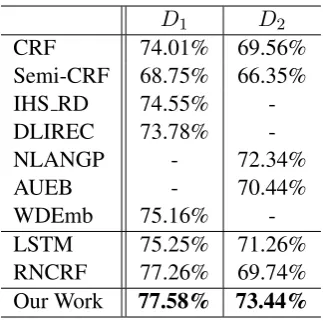
Table 2: Experiment results
The hyper-parameters are selected via ten-fold cross validation. The dimension of hidden repre-sentations are 100, 20, 40 for A-LSTM, O-LSTM and S-LSTM respectively. The dropout rate for O-LSTM and S-LSTM is 0.4. The size of the as-pect (opinion) memorynm is 4. The batch size is set to 32. As for initialization of network parame-ters, we adopt the strategy that the initial weights are sampled from the uniform distribution (Glorot and Bengio,2010). We employ ADAM (Kingma and Ba,2014) as optimizer and the default settings of ADAM are used.
To better reveal the capability of the proposed MIN, we train 5 models with the same group of hyper-parameters and report the averageF1 score over the testing set.
3.3 Results and Analysis
Table 2 depicts experiment results. Compared to the best systems in SemEval challenge, MIN achieves 3.0% and 1.1% absolute gains onD1and
D2 respectively. Besides, our MIN outperforms WDEmb, a strong CRF-based system benefiting from several kinds of useful word embeddings, by 2.1% on D1. With memory interactions and consideration of sentimental sentence, our MIN boosts the performance of vanilla bi-directional LSTM (+2.0% and +1.7% respectively). It vali-dates the effectiveness of the manually designed memory operations and the proposed memory in-teraction mechanism. MIN also outperforms the state-of-the-art RNCRF on each dataset suggest-ing that memory interactions can be an alterna-tive strategy instead of syntactic parsing. To fur-ther study the impact of each element in MIN, we conduct ablation experiments. As shown in Ta-ble3, removing bi-directionality decreases the ex-traction performances (-2.0% and -1.0%). The soft
sentimental constraint proves to be useful since MIN is 1.5% and 1.0% superior than the frame-work without S-LSTM on D1 and D2 respec-tively. O-LSTM brings in the largest performance gains on D2 compared with ablated framework (i.e., MIN without O-LSTM), verifying our pos-tulation that aspect-opinion “interaction” is more effective than only considering aspect terms. We also observe that the contribution of O-LSTM is less significant than that of bi-directionality onD1 (+1.6% vs +2.0%). This is reasonable since using opinion words as adjective modifiers placed after the aspects is common in English.
D1 D2 MIN without bi-directionality 75.59% 71.87% MIN without S-LSTM 76.04% 72.55% MIN without O-LSTM 75.97% 71.80%
MIN 77.58% 73.44%
Table 3: Ablation experiment results.
4 Conclusions
We propose Memory Interaction Network (MIN), a multi-task learning framework, to detect aspect terms from the online user reviews. Compared with previous studies, our MIN has following fea-tures:
• Co-occurrence pattern between aspects and opinions is captured via memory interactions, where the neural memory operations are de-signed to summarize task-level information and perform interactions.
• A novel LSTM unit with extended memories is developed for memory interactions.
References
Maryna Chernyshevich. 2014. Ihs r&d belarus: Cross-domain extraction of product features using crf. In
Proceedings of the 8th International Workshop on Semantic Evaluation (SemEval 2014), pages 309– 313.
Nguyen Viet Cuong, Nan Ye, Wee Sun Lee, and Hai Leong Chieu. 2014. Conditional random field with high-order dependencies for sequence labeling and segmentation. Journal of Machine Learning Re-search, 15(1):981–1009.
Minqing Hu and Bing Liu. 2004a. Mining and summa-rizing customer reviews. InProceedings of KDD, pages 168–177.
Minqing Hu and Bing Liu. 2004b. Mining opinion fea-tures in customer reviews. InProceedings of AAAI, pages 755–760.
Niklas Jakob and Iryna Gurevych. 2010. Extracting opinion targets in a single and cross-domain setting with conditional random fields. InProceedings of EMNLP, pages 1035–1045.
Wei Jin, Hung Hay Ho, and Rohini K Srihari. 2009. A novel lexicalized hmm-based learning framework for web opinion mining. InProceedings of ICML, pages 465–472.
Rafal Jozefowicz, Wojciech Zaremba, and Ilya Sutskever. 2015. An empirical exploration of recur-rent network architectures. InProceedings of ICML, pages 2342–2350.
Diederik Kingma and Jimmy Ba. 2014. Adam: A method for stochastic optimization. InProceedings of ICLR.
Bing Liu. 2012a. Sentiment analysis and opinion min-ing. Synthesis lectures on human language tech-nologies, 5(1):1–167.
Kang Liu, Heng Li Xu, Yang Liu, and Jun Zhao. 2013a. Opinion target extraction using partially-supervised word alignment model. In Proceedings of IJCAI, pages 2134–2140.
Kang Liu, Liheng Xu, and Jun Zhao. 2012b. Opin-ion target extractOpin-ion using word-based translatOpin-ion model. In Proceedings of EMNLP/CoNLL, pages 1346–1356.
Kang Liu, Liheng Xu, and Jun Zhao. 2013b. Syntac-tic patterns versus word alignment: Extracting opin-ion targets from online reviews. InProceedings of ACL, pages 1754–1763. Association for Computa-tional Linguistics.
Kang Liu, Liheng Xu, and Jun Zhao. 2014. Extract-ing opinion targets and opinion words from on-line reviews with graph co-ranking. InProceedings of ACL, pages 314–324. Association for Computa-tional Linguistics.
Pengfei Liu, Shafiq Joty, and Helen Meng. 2015. Fine-grained opinion mining with recurrent neural net-works and word embeddings. In Proceedings of EMNLP, pages 1433–1443.
Asha S Manek, P Deepa Shenoy, M Chandra Mohan, and KR Venugopal. 2017. Aspect term extraction for sentiment analysis in large movie reviews using gini index feature selection method and svm classi-fier. World Wide Web Journal, 20(2):135–154.
Tomas Mikolov, Ilya Sutskever, Kai Chen, Greg S Cor-rado, and Jeff Dean. 2013. Distributed representa-tions of words and phrases and their compositional-ity. InProceedings of NIPS, pages 3111–3119. Maria Pontiki, Dimitris Galanis, Haris Papageorgiou,
Ion Androutsopoulos, Suresh Manandhar, Moham-mad AL-SMoham-madi, Mahmoud Al-Ayyoub, Yanyan Zhao, Bing Qin, Orphee De Clercq, Veronique Hoste, Marianna Apidianaki, Xavier Tannier, Na-talia Loukachevitch, Evgeniy Kotelnikov, N´uria Bel, Salud Mar´ıa Jim´enez-Zafra, and G¨uls¸en Eryi˘git. 2016. Semeval-2016 task 5: Aspect based sentiment analysis. In Proceedings of the 10th International Workshop on Semantic Evaluation (SemEval-2016), pages 19–30.
Maria Pontiki, Dimitris Galanis, John Pavlopoulos, Harris Papageorgiou, Ion Androutsopoulos, and Suresh Manandhar. 2014. Semeval-2014 task 4: As-pect based sentiment analysis. InProceedings of the 8th International Workshop on Semantic Evaluation (SemEval 2014), pages 27–35.
Ana-Maria Popescu and Oren Etzioni. 2005. Extract-ing product features and opinions from reviews. In
Proceedings of EMNLP, pages 339–346.
Soujanya Poria, Erik Cambria, and Alexander Gel-bukh. 2016. Aspect extraction for opinion min-ing with a deep convolutional neural network.
Knowledge-Based Systems, 108:42–49.
Guang Qiu, Bing Liu, Jiajun Bu, and Chun Chen. 2011. Opinion word expansion and target extraction through double propagation. Computational Lin-guistics, 37(1):9–27.
I˜naki San Vicente, Xabier Saralegi, and Rodrigo Agerri. 2015. Elixa: A modular and flexible absa platform. In Proceedings of the 9th International Workshop on Semantic Evaluation (SemEval 2015), pages 748–752.
Sunita Sarawagi, William W Cohen, et al. 2004. Semi-markov conditional random fields for information extraction. In Proceedings of NIPS, pages 1185– 1192.
Zhiqiang Toh and Jian Su. 2016. Nlangp at semeval-2016 task 5: Improving aspect based sentiment anal-ysis using neural network features. In Proceed-ings of the 10th International Workshop on Semantic Evaluation (SemEval-2016), pages 282–288. Zhiqiang Toh and Wenting Wang. 2014. Dlirec:
As-pect term extraction and term polarity classification system. In Proceedings of the 8th International Workshop on Semantic Evaluation (SemEval 2014), pages 235–240.
Wenya Wang, Sinno Jialin Pan, and Daniel Dahlmeier. 2017b. Multi-task coupled attentions for category-specific aspect and opinion terms co-extraction.
Wenya Wang, Sinno Jialin Pan, Daniel Dahlmeier, and Xiaokui Xiao. 2016. Recursive neural conditional random fields for aspect-based sentiment analysis. InProceedings of EMNLP, pages 616–626. Associ-ation for ComputAssoci-ational Linguistics.
Wenya Wang, Sinno Jialin Pan, Daniel Dahlmeier, and Xiaokui Xiao. 2017a. Coupled multi-layer atten-tions for co-extraction of aspect and opinion terms. InProceedings of AAAI, pages 3316–3322.
Dionysios Xenos, Panagiotis Theodorakakos, John Pavlopoulos, Prodromos Malakasiotis, and Ion An-droutsopoulos. 2016. Aueb-absa at semeval-2016 task 5: Ensembles of classifiers and embeddings for aspect based sentiment analysis. InProceedings of the 10th International Workshop on Semantic Eval-uation (SemEval-2016), pages 312–317.
Yichun Yin, Furu Wei, Li Dong, Kaimeng Xu, Ming Zhang, and Ming Zhou. 2016. Unsupervised word and dependency path embeddings for aspect term extraction. In Proceedings of IJCAI, pages 2979– 2985.