Deep Multi-Task Learning with Shared Memory
Pengfei Liu Xipeng Qiu∗ Xuanjing Huang
Shanghai Key Laboratory of Intelligent Information Processing, Fudan University School of Computer Science, Fudan University
825 Zhangheng Road, Shanghai, China {pfliu14,xpqiu,xjhuang}@fudan.edu.cn
Abstract
Neural network based models have achieved impressive results on various specific tasks. However, in previous works, most models are learned separately based on single-task su-pervised objectives, which often suffer from insufficient training data. In this paper, we propose two deep architectures which can be trained jointly on multiple related tasks. More specifically, we augment neural model with an external memory, which is shared by several tasks. Experiments on two groups of text clas-sification tasks show that our proposed archi-tectures can improve the performance of a task with the help of other related tasks.
1 Introduction
Neural network based models have been shown to achieved impressive results on various NLP tasks ri-valing or in some cases surpassing traditional mod-els, such as text classification (Kalchbrenner et al., 2014; Socher et al., 2013; Liu et al., 2015a), seman-tic matching (Hu et al., 2014; Liu et al., 2016a), parser (Chen and Manning, 2014) and machine translation (Bahdanau et al., 2014).
Usually, due to the large number of parameters these neural models need a large-scale corpus. It is hard to train a deep neural model that generalizes well with size-limited data, while building the large scale resources for some NLP tasks is also a chal-lenge. To overcome this problem, these models often involve an unsupervised pre-training phase. The fi-nal model is fine-tuned on specific task with respect
∗ Corresponding author.
to a supervised training criterion. However, most pre-training methods are based on unsupervised ob-jectives (Collobert et al., 2011; Turian et al., 2010; Mikolov et al., 2013), which is effective to improve the final performance, but it does not directly opti-mize the desired task.
Multi-task learning is an approach to learn multi-ple related tasks simultaneously to significantly im-prove performance relative to learning each task in-dependently. Inspired by the success of multi-task learning (Caruana, 1997), several neural network based models (Collobert and Weston, 2008; Liu et al., 2015b) are proposed for NLP tasks, which uti-lized multi-task learning to jointly learn several tasks with the aim of mutual benefit. The characteristic of these multi-task architectures is they share some lower layers to determine common features. After the shared layers, the remaining layers are split into multiple specific tasks.
In this paper, we propose two deep architectures of sharing information among several tasks in multi-task learning framework. All the related multi-tasks are in-tegrated into a single system which is trained jointly. More specifically, inspired by Neural Turing Ma-chine (NTM) (Graves et al., 2014) and memory network (Sukhbaatar et al., 2015), we equip task-specific long short-term memory (LSTM) neural network (Hochreiter and Schmidhuber, 1997) with an external shared memory. The external memory has capability to store long term information and knowledge shared by several related tasks. Different with NTM, we use a deep fusion strategy to integrate the information from the external memory into task-specific LSTM, in which a fusion gate controls the
information flowing flexibly and enables the model to selectively utilize the shared information.
We demonstrate the effectiveness of our architec-tures on two groups of text classification tasks. Ex-perimental results show that jointly learning of mul-tiple related tasks can improve the performance of each task relative to learning them independently.
Our contributions are of three-folds:
• We proposed a generic multi-task framework, in which different tasks can share information by an external memory and communicate by a reading/writing mechanism. Two proposed models are complementary to prior multi-task neural networks.
• Different with Neural Turing Machine and memory network, we introduce a deep fu-sion mechanism between internal and external memories, which helps the LSTM units keep them interacting closely without being con-flated.
• As a by-product, the fusion gate enables us to better understand how the external shared memory helps specific task.
2 Neural Memory Models for Specific Task In this section, we briefly describe LSTM model, and then propose an external memory enhanced LSTM with deep fusion.
2.1 Long Short-term Memory
Long short-term memory network (LSTM) (Hochre-iter and Schmidhuber, 1997) is a type of recurrent neural network (RNN) (Elman, 1990), and specifi-cally addresses the issue of learning long-term de-pendencies. LSTM maintains an internal memory cell that updates and exposes its content only when deemed necessary.
Architecturally speaking, the memory state and output state are explicitly separated by activation gates (Wang and Cho, 2015). However, the limita-tion of LSTM is that it lacks a mechanism to index its memory while writing and reading (Danihelka et al., 2016).
While there are numerous LSTM variants, here we use the LSTM architecture used by (Jozefowicz
et al., 2015), which is similar to the architecture of (Graves, 2013) but without peep-hole connections.
We define the LSTM unitsat each time steptto
be a collection of vectors inRd: an input gatei t, a forget gate ft, an output gateot, a memory cellct and a hidden stateht.dis the number of the LSTM units. The elements of the gating vectors it, ftand otare in[0,1].
The LSTM is precisely specified as follows.
˜ct ot it ft
=
tanh σ σ σ
Wp
xt ht−1
+bp
, (1)
ct=˜ctit+ct−1ft, (2)
ht=ottanh (ct), (3)
wherext∈Rmis the input at the current time step; W ∈ R4h×(d+m)andb
p ∈ R4h are parameters of affine transformation;σdenotes the logistic sigmoid
function anddenotes elementwise multiplication. The update of each LSTM unit can be written pre-cisely as follows:
(ht,ct) =LSTM(ht−1,ct−1,xt, θp). (4)
Here, the function LSTM(·,·,·,·) is a shorthand
for Eq. (1-3), and θp represents all the parameters of LSTM.
2.2 Memory Enhanced LSTM
LSTM has an internal memory to keep useful in-formation for specific task, some of which may be beneficial to other tasks. However, it is non-trivial to share information stored in internal memory.
Recently, there are some works to augment LSTM with an external memory, such as neural Turing machine (Graves et al., 2014) and memory net-work (Sukhbaatar et al., 2015), called memory en-hanced LSTM (ME-LSTM). These models enhance the low-capacity internal memory to have a capabil-ity of modelling long pieces of text (Andrychowicz and Kurach, 2016).
tanh
tanh
t
x
1 t
h
1 t
c
t
r
t
f t
i
ott
g
t
h
t
c
Memory 1
t k
1 t
e
1 t
a
tanh
[image:3.612.92.281.60.187.2]tanh
Figure 1: Graphical illustration of the proposed ME-LSTM unit with deep fusion of internal and external memories.
As shown in Figure 1, ME-LSTM consists the original LSTM and an external memory which is maintained by reading and writing operations. The LSTM not only interacts with the input and output information but accesses the external memory using selective read and write operations.
The external memory and corresponding opera-tions will be discussed in detail below.
External Memory The form of external memory
is defined as a matrix M ∈ RK×M, where K is the number of memory segments, and M is the
size of each segment. Besides,KandM are
gener-ally instance-independent and pre-defined as hyper-parameters.
At each step t, LSTM emits outputht and three key vectorskt,etandatsimultaneously.kt,etand atcan be computed as
kt et at
=
tanh σ tanh
(Wmht+bm) (5)
whereWm andbm are parameters of affine trans-formation.
Reading The read operation is to read information
rt∈RM from memoryMt−1.
rt=αtMt−1, (6)
wherert denotes the reading vector and αt ∈ RK represents a distribution over the set of segments of memoryMt−1, which controls the amount of
infor-mation to be read from and written to the memory.
Each scalarαt,kin attention distributionαtcan be obtained as:
αt,k= softmax(g(Mt−1,k,kt−1)) (7)
whereMt−1,krepresents thek-th row memory vec-tor, andkt−1is a key vector emitted by LSTM.
Here g(x,y) (x ∈ RM,y ∈ RM) is a align function for which we consider two different alter-natives:
g(x,y) =
(
vT tanh(Wa[x;y])
cosine(x, y) (8)
wherev∈RM is a parameter vector.
In our current implementation, the similarity mea-sure is cosine similarity.
Writing The memory can be written by two
oper-ations: erase and add.
Mt=Mt−1(1−αteTt) +αtaTt, (9)
whereet,at ∈ RM represent erase and add vectors respectively.
To facilitate the following statements, we re-write the writing equation as:
Mt=fwrite(Mt−1, αt,ht). (10)
Deep Fusion between External and Internal
Memories After we obtain the information from
external memory, we need a strategy to comprehen-sively utilize information from both external and in-ternal memory.
To better control signals flowing from external memory, inspired by (Wang and Cho, 2015), we pro-pose a deep fusion strategy to keep internal and ex-ternal memories interacting closely without being conflated.
In detail, the stateht of LSTM at steptdepends on both the read vector rt from external memory, and internal memoryct, which is computed by
ht=ottanh(ct+gt(Wfrt)), (11)
where Wf is parameter matrix, and gt is a fusion gate to select information from external memory, which is computed by
x1 x2 x3 xT
h(m)
1 h(2m) h(3m) · · · h(m)
T softmax1 y(m)
M(s)
0 M(1s) M(2s) · · · M(s)
T−1
h(n)
1 h(2n) h(3n) · · · h(n)
T softmax2 y(n)
x1 x2 x3 xT
(a) Global Memory Architecture
x1 x2 x3 xT
h(m)
1 h(2m) h(3m) · · · h(m)
T softmax1 y(m)
M(m)
1 M(2m) M(3m)
M(s)
0 M(1s) M2(s) M(Ts−)1
M(n)
1 M(2n) M(3n)
h(n)
1 h(2n) h(3n) · · · h(n)
T softmax2 y(n)
x1 x2 x3 xT
[image:4.612.76.268.64.286.2](b) Local-Global Hybrid Memory Architecture
Figure 2: Two architectures for modelling text with multi-task learning.
whereWrandWcare parameter matrices.
Finally, the update of external memory enhanced LSTM unit can be written precisely as
(ht,Mt,ct) =ME-LSTM(ht−1,
Mt−1,ct−1,xt, θp, θq), (13)
whereθp represents all the parameters of LSTM in-ternal structure andθq represents all the parameters to maintain the external memory.
Overall, the external memory enables ME-LSTM to have larger capability to store more information, thereby increasing the ability of ME-LSTM. The read and write operations allow ME-LSTM to cap-ture complex sentence patterns.
3 Deep Architectures with Shared Memory for Multi-task Learning
Most existing neural network methods are based on supervised training objectives on a single task (Collobert et al., 2011; Socher et al., 2013; Kalch-brenner et al., 2014). These methods often suffer from the limited amounts of training data. To deal with this problem, these models often involve an unsupervised pre-training phase. This unsupervised pre-training is effective to improve the final perfor-mance, but it does not directly optimize the desired
task.
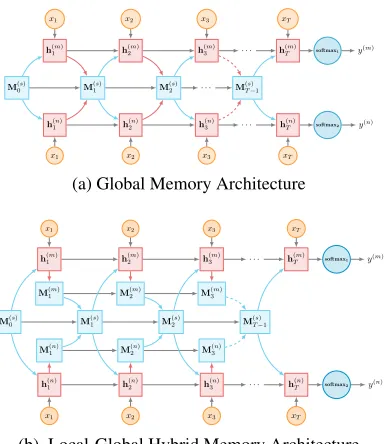
Motivated by the success of multi-task learning (Caruana, 1997), we propose two deep architectures with shared external memory to leverage supervised data from many related tasks. Deep neural model is well suited for multi-task learning since the features learned from a task may be useful for other tasks. Figure 2 gives an illustration of our proposed archi-tectures.
ARC-I: Global Shared Memory In ARC-I, the
input is modelled by a task-specific LSTM and ex-ternal shared memory. More formally, given an input textx, the task-specific outputh(tm)of taskmat step
tis defined as
(h(tm),M(ts),ct(m)) =ME-LSTM(h(t−m1),
M(ts−)1,c(t−m1),xt, θ(pm), θq(s)), (14)
where xt represents word embeddings of word
xt; the superscript s represents the parameters are shared across different tasks; the superscriptm
rep-resents that the parameters or variables are task-specific for taskm.
Here all tasks share single global memory M(s),
meaning that all tasks can read information from it and have the duty to write their shared or task-specific information into the memory.
M(ts)=fwrite(M(t−s)1, α (s)
t ,h
(m)
t ) (15)
After calculating the task-specific representation of texth(Tm)for taskm, we can predict the probability distribution over classes.
ARC-II: Local-Global Hybrid Memory In
ARC-I, all tasks share a global memory, but can also record task-specific information besides shared information. To address this, we allocate each task a local task-specific external memory, which can further write shared information to a global memory for all tasks.
More generally, for taskm, we assign each
task-specific LSTM with a local memoryM(m), followed
by a global memory M(s), which is shared across
different tasks.
The read and write operations of the local and global memory are defined as
Dataset Type Train Size Dev. Size Test Size Class Avg. Length Vocabulary Size
Movie SST-1SST-2 Sen.Sen. 85446920 1101872 22101821 52 1819 18K15K
SUBJ Sen. 9000 - 1000 2 21 21K
IMDB Doc. 25,000 - 25,000 2 294 392K
Product
Books Doc. 1400 200 400 2 181 27K
DVDs Doc. 1400 200 400 2 197 29K
Electronics Doc. 1400 200 400 2 117 14K
[image:5.612.103.513.57.165.2]Kitchen Doc. 1400 200 400 2 98 12K
Table 1: Statistics of two multi-task datasets. Each dataset consists of four related tasks.
Mt(m)=fwrite(Mt(−m1), α(tm),h
(m)
t ), (17)
rt(s)=αt(−s)1M(t−s)1, (18)
M(ts)=fwrite(M(t−s)1, α (s)
t ,r
(m)
t ), (19)
where the superscript s represents the parameters are shared across different tasks; the superscriptm
represents that the parameters or variables are task-specific for taskm.
In ARC-II, the local memories enhance the capac-ity of memorizing, while global memory enables the information flowing from different tasks to interact sufficiently.
4 Training
The task-specific representation h(m), emitted by
the deep muti-task architectures, is ultimately fed into the corresponding task-specific output layers.
ˆ
y(m)= softmax(W(m)h(m)+b(m)), (20)
whereyˆ(m)is prediction probabilities for taskm.
GivenMrelated tasks, our global cost function is the linear combination of cost function for all tasks.
φ=
M
X
m=1
λmL(ˆy(m), y(m)) (21)
where λm is the weights for each task m respec-tively.
Computational Cost Compared with vanilla
LSTM, our proposed two models do not cause much extra computational cost while converge faster. In our experiment, the most complicated ARC-II, costs 2 times as long as vanilla LSTM.
Movie
Reviews ProductReviews Embedding dimension 100 100 Hidden layer size 100 100 External memory size (50,20) (50,20) Initial learning rate 0.01 0.1 Regularization 0 1E−5
Table 2: Hyper-parameters of our models.
5 Experiment
In this section, we investigate the empirical perfor-mances of our proposed architectures on two multi-task datasets. Each dataset contains several related tasks.
5.1 Datasets
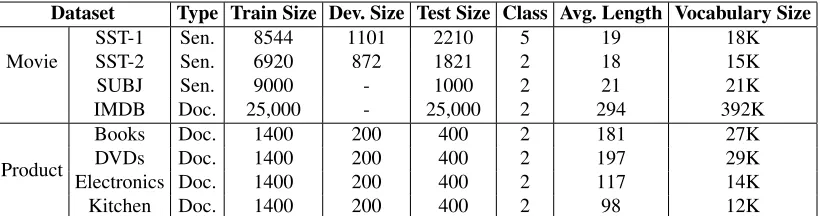
The used multi-task datasets are briefly described as follows. The detailed statistics are listed in Table 1.
Movie Reviews The movie reviews dataset
con-sists of four sub-datasets about movie reviews.
• SST-1The movie reviews with five classes in
the Stanford Sentiment Treebank1 (Socher et al., 2013).
• SST-2The movie reviews with binary classes.
It is also from the Stanford Sentiment Tree-bank.
• SUBJ The movie reviews with labels of sub-jective or obsub-jective (Pang and Lee, 2004). • IMDBThe IMDB dataset2consists of 100,000
Model SST-1 SST-2 SUBJ IMDB Avg∆
Single Task ME-LSTMLSTM 45.946.4 85.885.5 91.691.0 88.588.7 -
-Multi-task
ARC-I 48.6 87.0 93.8 89.8 +(1.8/1.9) ARC-II 49.5 87.8 95.0 91.2 +(2.9/3.0)
MT-CNN 46.7 86.1 92.2 88.4
-MT-DNN 44.5 84.0 90.1 85.6
-NBOW 42.4 80.5 91.3 83.6
-RAE (Socher et al., 2011) 43.2 82.4 - - -MV-RNN (Socher et al., 2012) 44.4 82.9 - - -RNTN (Socher et al., 2013) 45.7 85.4 - - -DCNN (Kalchbrenner et al., 2014) 48.5 86.8 - 89.3 -CNN-multichannel (Kim, 2014) 47.4 88.1 93.2 - -Tree-LSTM (Tai et al., 2015) 50.6 86.9 - -
-Table 3: Accuracies of our models on movie reviews tasks against state-of-the-art neural models. The last column gives the improvements relative to LSTM and ME-LSTM respectively.NBOW: Sums up the word vectors and applies a non-linearity followed by a softmax classification layer.RAE: Recursive Autoencoders with pre-trained word vectors from Wikipedia (Socher et al., 2011). MV-RNN: Matrix-Vector Recursive Neural Network with parse trees (Socher et al., 2012). RNTN: Recursive Neural Tensor Network with tensor-based feature function and parse trees (Socher et al., 2013).DCNN: Dynamic Convolutional Neural Network with dynamic k-max pooling (Kalchbrenner et al., 2014; Denil et al., 2014).CNN-multichannel: Convolutional Neural Network (Kim, 2014). Tree-LSTM: A generalization of LSTMs to tree-structured network topologies (Tai et al., 2015).
Product Reviews This dataset3, constructed by
Blitzer et al. (2007), contains Amazon product re-views from four different domains: Books, DVDs, Electronics and Kitchen appliances. The goal in each domain is to classify a product review as ei-ther positive or negative. The datasets in each do-main are partitioned randomly into training data, de-velopment data and testing data with the proportion of 70%, 20% and 10% respectively.
5.2 Competitor Methods for Multi-task Learning
The multi-task frameworks proposed by previous works are various while not all can be applied to the tasks we focused. Nevertheless, we chose two most related neural models for multi-task learning and im-plement them as strong competitor methods .
• MT-CNN: This model is proposed by Collobert and Weston (2008) with convolutional layer, in which lookup-tables are shared partially while other layers are task-specific.
3https://www.cs.jhu.edu/˜mdredze/ datasets/sentiment/
• MT-DNN: The model is proposed by Liu et al. (2015b) with bag-of-words input and multi-layer perceptrons, in which a hidden multi-layer is shared.
5.3 Hyperparameters and Training
The networks are trained with backpropagation and the gradient-based optimization is performed using the Adagrad update rule (Duchi et al., 2011).
The word embeddings for all of the models are initialized with the 100d GloVe vectors (840B token version, (Pennington et al., 2014)) and fine-tuned during training to improve the performance. The other parameters are initialized by randomly sam-pling from uniform distribution in[−0.1,0.1]. The
mini-batch size is set to 16.
For each task, we take the hyperparameters which achieve the best performance on the development set via an small grid search over combinations of the initial learning rate[0.1,0.01],l2 regularization
[0.0,5E−5,1E−5]. For datasets without
[image:6.612.131.480.55.226.2]5.4 Multi-task Learning of Movie Reviews
We first compare our proposed models with the baseline system for single task classification. Table 3 shows the classification accuracies on the movie reviews dataset. The row of “Single Task” shows the results of LSTM and ME-LSTM for each individ-ual task. With the help of multi-task learning, the performances of these four tasks are improved by 1.8% (ARC-I) and 2.9% (ARC-II) on average rela-tive to LSTM. We can find that the architecture of local-global hybrid external memory has better per-formances. The reason is that the global memory in ARC-I could store some task-specific information besides shared information, which maybe noisy to other tasks. Moreover, both of our proposed mod-els outperform MT-CNN and MT-DNN, which indi-cates the effectiveness of our proposed shared mech-anism. To give an intuitive evaluation of these re-sults, we also list the following state-of-the-art neu-ral models. With the help of utilizing the shared in-formation of several related tasks, our results out-perform most of state-of-the-art models. Although Tree-LSTM outperforms our method on SST-1, it needs an external parser to get the sentence topologi-cal structure. It is worth noticing that our models are generic and compatible with the other LSTM based models. For example, we can easily extend our mod-els to incorporate the Tree-LSTM model.
5.5 Multi-task Learning of Product Reviews
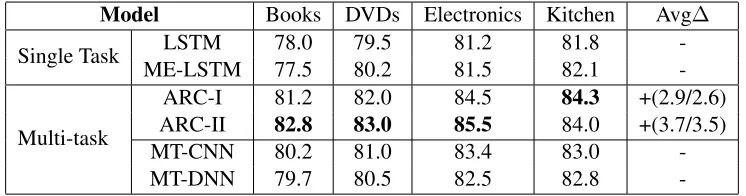
Table 4 shows the classification accuracies on the tasks of product reviews. The row of “Single Task” shows the results of the baseline for each individ-ual task. With the help of global shared memory (ARC-I), the performances of these four tasks are improved by an average of 2.9%(2.6%) compared with LSTM(ME-LSTM). ARC-II achieves best per-formances on three sub-tasks, and its average im-provement is 3.7%(3.5%). Compared with MT-CNN and MT-DNN, our models achieve a better perfor-mance. We think the reason is that our models can not only share lexical information but share compli-cated patterns of sentences by reading/writing op-erations of external memory. Furthermore, these re-sults on product reviews are consistent with that on movie reviews, which shows our architectures are robust.
5.6 Case Study
To get an intuitive understanding of what is happen-ing when we use shared memory to predict the class of text, we design an experiment to compare and an-alyze the difference between our models and vanilla LSTM, thereby demonstrating the effectiveness of our proposed architectures.
We sample two sentences from the SST-2 valida-tion dataset, and the changes of the predicted sen-timent score at different time steps are shown in Figure 3, which are obtained by vanilla LSTM and ARC-I respectively. Additionally, both models are bidirectional for better visualization. To get more insights into how the shared external memory in-fluences the specific task, we plot and observe the evolving activation of fusion gates through time, which controls signals flowing from a shared exter-nal memory to task-specific output, to understand the behaviour of neurons.
For the sentence “It is a cookie-cutter movie, a cut-and-paste job.”, which has a negative sentiment, while the standard LSTM gives a wrong predic-tion due to not understanding the informative words “cookie-cutter” and “cut-and-paste”.
In contrast, our model makes a correct prediction and the reason can be inferred from the activation of fusion gates. As shown in Figure 3-(c), we can see clearly the neurons are activated much when they take input as “cookie-cutter” and “cut-and-paste”, which indicates much information in shared mem-ory has be passed into LSTM, therefore enabling the model to give a correct prediction.
Another case “If you were not nearly moved to tears by a couple of scenes , you ’ve got ice water in your veins”, a subjunctive clause introduced by “if”, has a positive sentiment.
Model Books DVDs Electronics Kitchen Avg∆
Single Task ME-LSTMLSTM 78.077.5 79.580.2 81.281.5 81.882.1 -
-Multi-task
ARC-I 81.2 82.0 84.5 84.3 +(2.9/2.6) ARC-II 82.8 83.0 85.5 84.0 +(3.7/3.5) MT-CNN 80.2 81.0 83.4 83.0 -MT-DNN 79.7 80.5 82.5 82.8
-Table 4: Accuracies of our models on product reviews dataset. The last column gives the improvement relative to LSTM and ME-LSTM respectively.
It is a cookie-cuttermoviecut-and-paste job .
0 0.2
0.4 0.6 0.8
LSTM Ours
(a)
If you were not nearly moved tears by couple scenes you ’ve got ice water your veins
0.2
0.4
0.6
0.8 1
LSTM Ours
(b)
It is a cookie−cutter movie cut−and−paste job . 20
40
60
80
100
(c)
If you were not nearly moved tears by couple scenes you ve got ice water your veins 20
40
60
80
(d)
Figure 3: (a)(b) The change of the predicted sentiment score at different time steps. Y-axis represents the sentiment score, while X-axis represents the input words in chronological order. The red horizontal line gives a border between the positive and negative sentiments. (c)(d) Visualization of the fusion gate’s activation.
6 Related Work
Neural networks based multi-task learning has been proven effective in many NLP problems (Collobert and Weston, 2008; Glorot et al., 2011; Liu et al., 2015b; Liu et al., 2016b). In most of these models, the lower layers are shared across all tasks, while top layers are task-specific.
Collobert and Weston (2008) used a shared rep-resentation for input words and solved different tra-ditional NLP tasks within one framework. However, only one lookup table is shared, and the other lookup tables and layers are task-specific.
Liu et al. (2015b) developed a multi-task DNN for learning representations across multiple tasks. Their multi-task DNN approach combines tasks of query classification and ranking for web search. But the input of the model is bag-of-word representation, which loses the information of word order.
More recently, several multi-task
encoder-decoder networks were also proposed for neural machine translation (Dong et al., 2015; Luong et al., 2015; Firat et al., 2016), which can make use of cross-lingual information.
Unlike these works, in this paper we design two neural architectures with shared memory for multi-task learning, which can store useful information across the tasks. Our architectures are relatively loosely coupled, and therefore more flexible to ex-pand. With the help of shared memory, we can ob-tain better task-specific sentence representation by utilizing the knowledge obtained by other related tasks.
7 Conclusion and Future Work
[image:8.612.120.493.57.155.2] [image:8.612.79.538.205.378.2]memory to store the knowledge shared by several re-lated tasks. Experimental results show that our mod-els can improve the performances of several related tasks by exploring common features.
In addition, we also propose a deep fusion strat-egy to integrate the information from the external memory into task-specific LSTM with a fusion gate. In future work, we would like to investigate the other sharing mechanisms of neural network based multi-task learning.
Acknowledgments
We would like to thank the anonymous reviewers for their valuable comments. This work was partially funded by National Natural Science Foundation of China (No. 61532011 and 61672162), the National High Technology Research and Development Pro-gram of China (No. 2015AA015408).
References
Marcin Andrychowicz and Karol Kurach. 2016. Learn-ing efficient algorithms with hierarchical attentive memory.arXiv preprint arXiv:1602.03218.
D. Bahdanau, K. Cho, and Y. Bengio. 2014. Neural ma-chine translation by jointly learning to align and trans-late. ArXiv e-prints, September.
John Blitzer, Mark Dredze, Fernando Pereira, et al. 2007. Biographies, bollywood, boom-boxes and blenders: Domain adaptation for sentiment classification. In
ACL, volume 7, pages 440–447.
Rich Caruana. 1997. Multitask learning.Machine learn-ing, 28(1):41–75.
Danqi Chen and Christopher D Manning. 2014. A fast and accurate dependency parser using neural net-works. InProceedings of the Conference on Empirical Methods in Natural Language Processing (EMNLP), pages 740–750.
Ronan Collobert and Jason Weston. 2008. A unified ar-chitecture for natural language processing: Deep neu-ral networks with multitask learning. InProceedings of ICML.
Ronan Collobert, Jason Weston, L´eon Bottou, Michael Karlen, Koray Kavukcuoglu, and Pavel Kuksa. 2011. Natural language processing (almost) from scratch.
The Journal of Machine Learning Research, 12:2493– 2537.
Ivo Danihelka, Greg Wayne, Benigno Uria, Nal Kalch-brenner, and Alex Graves. 2016. Associative long short-term memory.CoRR, abs/1602.03032.
Misha Denil, Alban Demiraj, Nal Kalchbrenner, Phil Blunsom, and Nando de Freitas. 2014. Modelling, visualising and summarising documents with a sin-gle convolutional neural network. arXiv preprint arXiv:1406.3830.
Daxiang Dong, Hua Wu, Wei He, Dianhai Yu, and Haifeng Wang. 2015. Multi-task learning for multi-ple language translation. InProceedings of the ACL. John Duchi, Elad Hazan, and Yoram Singer. 2011.
Adaptive subgradient methods for online learning and stochastic optimization. The Journal of Machine Learning Research, 12:2121–2159.
Jeffrey L Elman. 1990. Finding structure in time. Cog-nitive science, 14(2):179–211.
Orhan Firat, Kyunghyun Cho, and Yoshua Bengio. 2016. Multi-way, multilingual neural machine translation with a shared attention mechanism. arXiv preprint arXiv:1601.01073.
Xavier Glorot, Antoine Bordes, and Yoshua Bengio. 2011. Domain adaptation for large-scale sentiment classification: A deep learning approach. In Proceed-ings of the 28th International Conference on Machine Learning (ICML-11), pages 513–520.
Alex Graves, Greg Wayne, and Ivo Danihelka. 2014. Neural turing machines. arXiv preprint arXiv:1410.5401.
Alex Graves. 2013. Generating sequences with recurrent neural networks. arXiv preprint arXiv:1308.0850. Sepp Hochreiter and J¨urgen Schmidhuber. 1997. Long
short-term memory. Neural computation, 9(8):1735– 1780.
Baotian Hu, Zhengdong Lu, Hang Li, and Qingcai Chen. 2014. Convolutional neural network architectures for matching natural language sentences. InAdvances in Neural Information Processing Systems.
Rafal Jozefowicz, Wojciech Zaremba, and Ilya Sutskever. 2015. An empirical exploration of recurrent network architectures. In Proceedings of The 32nd Interna-tional Conference on Machine Learning.
Nal Kalchbrenner, Edward Grefenstette, and Phil Blun-som. 2014. A convolutional neural network for mod-elling sentences. InProceedings of ACL.
Yoon Kim. 2014. Convolutional neural networks for sen-tence classification. arXiv preprint arXiv:1408.5882. PengFei Liu, Xipeng Qiu, Xinchi Chen, Shiyu Wu, and
Xuanjing Huang. 2015a. Multi-timescale long short-term memory neural network for modelling sentences and documents. InProceedings of the Conference on EMNLP.
Xiaodong Liu, Jianfeng Gao, Xiaodong He, Li Deng, Kevin Duh, and Ye-Yi Wang. 2015b. Representa-tion learning using multi-task deep neural networks for semantic classification and information retrieval. In
Pengfei Liu, Xipeng Qiu, Jifan Chen, and Xuanjing Huang. 2016a. Deep fusion LSTMs for text seman-tic matching. InProceedings of Annual Meeting of the Association for Computational Linguistics.
Pengfei Liu, Xipeng Qiu, and Xuanjing Huang. 2016b. Recurrent neural network for text classification with multi-task learning. In Proceedings of International Joint Conference on Artificial Intelligence.
Minh-Thang Luong, Quoc V Le, Ilya Sutskever, Oriol Vinyals, and Lukasz Kaiser. 2015. Multi-task sequence to sequence learning. arXiv preprint arXiv:1511.06114.
Andrew L Maas, Raymond E Daly, Peter T Pham, Dan Huang, Andrew Y Ng, and Christopher Potts. 2011. Learning word vectors for sentiment analysis. In Pro-ceedings of the ACL, pages 142–150.
Tomas Mikolov, Kai Chen, Greg Corrado, and Jeffrey Dean. 2013. Efficient estimation of word representa-tions in vector space. arXiv preprint arXiv:1301.3781. Bo Pang and Lillian Lee. 2004. A sentimental educa-tion: Sentiment analysis using subjectivity summariza-tion based on minimum cuts. InProceedings of ACL. Jeffrey Pennington, Richard Socher, and Christopher D
Manning. 2014. Glove: Global vectors for word representation. Proceedings of the Empiricial Meth-ods in Natural Language Processing (EMNLP 2014), 12:1532–1543.
Richard Socher, Jeffrey Pennington, Eric H Huang, An-drew Y Ng, and Christopher D Manning. 2011. Semi-supervised recursive autoencoders for predicting sen-timent distributions. InProceedings of EMNLP. Richard Socher, Brody Huval, Christopher D Manning,
and Andrew Y Ng. 2012. Semantic compositionality through recursive matrix-vector spaces. In Proceed-ings of EMNLP, pages 1201–1211.
Richard Socher, Alex Perelygin, Jean Y Wu, Jason Chuang, Christopher D Manning, Andrew Y Ng, and Christopher Potts. 2013. Recursive deep models for semantic compositionality over a sentiment treebank. InProceedings of EMNLP.
Sainbayar Sukhbaatar, Jason Weston, Rob Fergus, et al. 2015. End-to-end memory networks. InAdvances in Neural Information Processing Systems, pages 2431– 2439.
Kai Sheng Tai, Richard Socher, and Christopher D Man-ning. 2015. Improved semantic representations from tree-structured long short-term memory net-works. arXiv preprint arXiv:1503.00075.
Joseph Turian, Lev Ratinov, and Yoshua Bengio. 2010. Word representations: a simple and general method for semi-supervised learning. InProceedings of ACL. Tian Wang and Kyunghyun Cho. 2015.