Proceedings of the 2019 Conference on Empirical Methods in Natural Language Processing
4644
Different Absorption from the Same Sharing: Sifted Multi-task Learning
for Fake News Detection
Lianwei Wu, Yuan Rao, Haolin Jin, Ambreen Nazir, Ling Sun Lab of Social Intelligence and Complexity Data Processing
School of Software Engineering, Xi’an Jiaotong University, Xi’an, 710049, China
{stayhungry,jinhaolin,ambreen.nazir,sunling}@stu.xjtu.edu.cn [email protected]
Abstract
Recently, neural networks based on multi-task learning have achieved promising perfor-mance on fake news detection, which focus on learning shared features among tasks as com-plementary features to serve different tasks. However, in most of the existing approaches, the shared features are completely assigned to different tasks without selection, which may lead to some useless and even adverse fea-tures integrated into specific tasks. In this paper, we design a sifted multi-task learning method with a selected sharing layer for fake news detection. The selected sharing layer adopts gate mechanism and attention mecha-nism to filter and select shared feature flows between tasks. Experiments on two public and widely used competition datasets, i.e. Ru-mourEval and PHEME, demonstrate that our proposed method achieves the state-of-the-art performance and boosts the F1-score by more than 0.87%, 1.31%, respectively.
1 Introduction
In recent years, the proliferation of fake news with various content, high-speed spreading, and exten-sive influence has become an increasingly alarming issue. A concrete instance1 was cited by Time Magazine in 2013 when a false announcement of Barack Obama’s injury in a White House explosion “wiped off 130 Billion US Dollars in stock value in a matter of seconds”. Other examples, an analysis of the US Presidential Election in 2016 (Allcott and Gentzkow,2017) revealed that fake news was widely shared during the three months prior to the election with 30 million total Facebook shares of 115 known pro-Trump fake stories and 7.6 million of 41 known pro-Clinton fake stories. Therefore, automatically detecting fake news has attracted
sig-1
http://business.time.com/2013/04/24/how-does-one-fake-tweet-cause-a-stock-market-crash/
6KDUHG
D9DQLOODVKDUHGSULYDWHPRGHO7DVN$ 7DVN%澳
6KDUHG
[image:1.595.336.496.219.298.2]E6LIWHGPXOWLWDVNPRGHO 7DVN$ 7DVN%
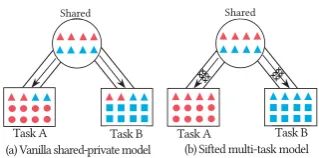
Figure 1: Two schemes for sharing features among tasks. Red circles and blue boxes represent the task-specific features, while the red and blue triangles mean shared features that benefit Task A and Task B, respec-tively.
nificant research attention in both industries and academia.
Most existing methods devise deep neural net-works to capture credibility features for fake news detection. Some methods provide in-depth analy-sis of text features, e.g., linguistic (Conroy et al.,
2015), semantic (Yang et al., 2012), emotional (Wang et al.,2015), stylistic (Potthast et al.,2017), etc. On this basis, some work additionally ex-tracts social context features (a.k.a. meta-data features) as credibility features, including source-based (Castillo et al.,2011), user-centered (Long et al.,2017), post-based (Wang,2017) and network-based (Ruchansky et al.,2017), etc. These methods have attained a certain level of success. Addition-ally, recent researches (Thorne et al.,2017;Dungs et al.,2018) find that doubtful and opposing voices against fake news are always triggered along with its propagation. Fake news tends to provoke con-troversies compared to real news (Mendoza et al.,
2010;Zubiaga et al., 2016b). Therefore, stance analysis of these controversies can serve as valu-able credibility features for fake news detection.
et al.,2018a;Kochkina et al.,2018;Li et al.,2018). These approaches model information sharing and representation reinforcement between the two tasks, which expands valuable features for their respec-tive tasks. However, prominent drawback to these methods and even typical multi-task learning meth-ods, like the shared-private model, is that the shared features in the shared layer are equally sent to their respective tasks without filtering, which causes that some useless and even adverse features are mixed in different tasks, as shown in Figure1(a). By that the network would be confused by these features, interfering effective sharing, and even mislead the predictions.
To address the above problems, we design a sift-ed multi-task learning model with filtering mecha-nism (Figure1(b)) to detect fake news by joining stance detection task. Specifically, we introduce a s-elected sharing layer into each task after the shared layer of the model for filtering shared features. The selected sharing layer composes of two cells: gated sharing cell for discarding useless features and at-tention sharing cell for focusing on features that are conducive to their respective tasks. Besides, to bet-ter capture long-range dependencies and improve the parallelism of the model, we apply transformer encoder module (Vaswani et al.,2017) to our mod-el for encoding input representations of both tasks. Experimental results reveal that the proposed mod-el outperforms the compared methods and gains new benchmarks.
In summary, the contributions of this paper are as follows:
• We explore a selected sharing layer relying on gate mechanism and attention mechanism, which can selectively capture valuable shared features between tasks of fake news detection and stance detection for respective tasks.
• The transformer encoder is introduced in-to our model for encoding inputs of both tasks, which enhances the performance of our method by taking advantages of its long-range dependencies and parallelism.
• Experiments on two public, widely used fake news datasets demonstrate that our method significantly outperforms previous state-of-the-art methods.
2 Related Work
Fake News Detection Exist studies for fake news detection can be roughly summarized into two cat-egories. The first category is to extract or construct comprehensive and complex features with manual ways (Castillo et al.,2011;Ruchansky et al.,2017; Flintham et al.,2018). The second category is to au-tomatically capture deep features based on neural networks. There are two ways in this category. One is to capture linguistic features from text content, such as semantic (Wang,2017;Wu et al.,2018), writing styles (Potthast et al., 2017), and textual entailments (Oshikawa et al.,2018). The other is to focus on gaining effective features from the organic integration of text and user interactions (Qian et al., 2018;Wu et al.,2019). User interactions include users’ behaviours, profiles, and networks between users. In this work, following the second way, we automatically learn representations of text and s-tance information from response and forwarding (users’ behaviour) based on multi-task learning for fake news detection.
Stance Detection The researches (Lukasik et al.,2016;Zubiaga et al.,2016a) demonstrate that the stance detected from fake news can serve as an effective credibility indicator to improve the perfor-mance of fake news detection. The common way of stance detection in rumors is to catch deep se-mantics from text content based on neural network-s(Mohtarami et al.,2018). For instance, Kochkina et al.(Kochkina et al.,2017) project branch-nested LSTM model to encode text of each tweet consid-ering the features and labels of the predicted tweets for stance detection, which reflects the best perfor-mance in RumourEval dataset. In this work, we utilize transformer encoder to acquire semantics from responses and forwarding of fake news for stance detection.
shared-Transformer Encoder
Transformer Encoder Transformer
Encoder
Position Embeddings (PE)
Output Layer
Concatenation Concatenation
ٔ AttentionSelectedSharing Layer
Shared-private Feature Extractor
Input Embeddings
Word Embeddings (WE)
Task 1: Stance Detection Task 2: Fake News Detection
ɐ Gate ɐ
PE WE
ٔ
澳
Attention澳 Gateɐɐ
澳
澳 [image:3.595.164.428.63.234.2]Softmax
澳
Softmax澳
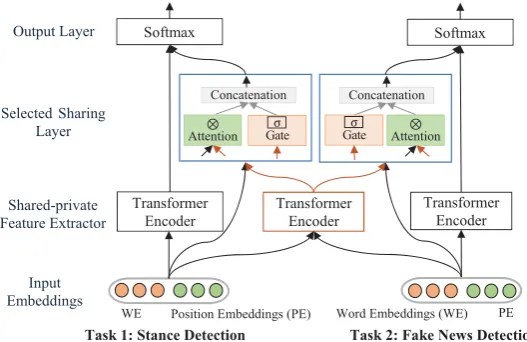
Figure 2: The architecture of the sifted multi-task learning method based on shared-private model. In particular, the two blue boxes represent selected sharing layers of stance detection and fake news detection and the red box denotes shared layer between tasks.
private model to alleviate the shared and private latent feature spaces from interfering with each other. However, these models transmit all shared features in the shared layer to related tasks with-out distillation, which disturb specific tasks due to some useless and even harmful shared features. How to solve this drawback is the main challenge of this work.
3 Method
We propose a novel sifted multi-task learning method on the ground of shared-private model to jointly train the tasks of stance detection and fake news detection, filter original outputs of shared lay-er by a selected sharing laylay-er. Our model consists of a 4-level hierarchical structure, as shown in Fig-ure 2. Next, we will describe each level of our proposed model in detail.
3.1 Input Embeddings
In our notation, a sentence of length l tokens is indicated as X = {x1, x2, ..., xl}. Each token is concatenated by word embeddings and posi-tion embeddings. Word embeddingswi of token
xi are a dw-dimensional vector obtained by pre-trained Word2Vec model (Mikolov et al., 2013), i.e., wi ∈ Rdw. Position embeddings refer to
vectorization representations of position informa-tion of words in a sentence. We employ one-hot encoding to represent position embeddings
pi of token xi, where pi ∈ Rdp, d
p is the posi-tional embedding dimension. Therefore, the em-beddings of a sentence are represented as E =
{[w1;p1],[w2;p2], ...,[wl;pl]},E ∈ Rl×(dp+dw).
In particular, we adopt one-hot encoding to em-bed positions of tokens, rather than sinusoidal posi-tion encoding recommended in BERT model ( De-vlin et al.,2018). The reason is that our experi-ments show that compared with one-hot encoding, sinusoidal position encoding not only increases the complexity of models but also performs poorly on relatively small datasets.
3.2 Shared-private Feature Extractor
Shared-private feature extractor is mainly used for extracting shared features and private features a-mong different tasks. In this paper, we apply the en-coder module of transformer (Vaswani et al.,2017) (henceforth, transformer encoder) to the shared-private extractor of our model. Specially, we em-ploy two transformer encoders to encode the input embeddings of the two tasks as their respective private features. A transformer encoder is used to encode simultaneously the input embeddings of the two tasks as shared features of both tasks. This process is illustrated by the shared-private layer of Figure2. The red box in the middle denotes the extraction of shared features and the left and right boxes represent the extraction of private features of two tasks. Next, we take the extraction of the pri-vate feature of fake news detection as an example to elaborate on the process of transformer encoder.
The kernel of transformer encoder is the scaled dot-product attention, which is a special case of attention mechanism. It can be precisely described as follows:
Attention(Q,K,V) = softmax(QK
T √
whereQ∈Rl×(dp+dw),K∈Rl×(dp+dw), andV∈
Rl×(dp+dw)are query matrix, key matrix, and value
matrix, respectively. In our setting, the queryQ stems from the inputs itself, i.e.,Q=K=V=E.
To explore the high parallelizability of attention, transformer encoder designs a multi-head atten-tion mechanism based on the scaled dot-product attention. More concretely, multi-head attention first linearly projects the queries, keys and values
htimes by using different linear projections. Then
hprojections perform the scaled dot-product atten-tion in parallel. Finally, these results of attenatten-tion are concatenated and once again projected to get the new representation. Formally, the multi-head attention can be formulated as follows:
headi= Attention(QWQi ,KWKi ,VWVi ) (2)
H= MultiHead(Q,K,V)
= Concat(head1, head2, ..., headh)Wo (3)
whereWQi ∈ R(dp+dw)×dk,WK
i ∈ R(dp+dw)×dk, WVi ∈ R(dp+dw)×dk are trainable projection
pa-rameters. dkis(dp +dw)/h, his the number of heads. In Eq.(3),Wo ∈R(dp+dw)×(dp+dw)is also
trainable parameter.
3.3 Selected Sharing Layer
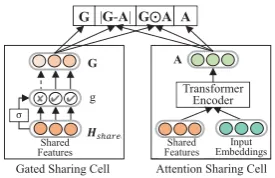
In order to select valuable and appropriate shared features for different tasks, we design a selected sharing layer following the shared layer. The se-lected sharing layer consists of two cells: gated sharing cell for filtering useless features and atten-tion sharing cell for focusing on valuable shared features for specific tasks. The description of this layer is depicted in Figure2and Figure3. In the following, we introduce two cells in details.
Gated Sharing Cell Inspired by forgotten gate
mechanism of LSTM (Hochreiter and
Schmidhu-ber,1997) and GRU (Chung et al.,2014), we de-sign a single gated cell to filter useless shared fea-tures from shared layer. There are two reasons why we adopt single-gate mechanism. One is that trans-former encoder in shared layer can efficiently cap-ture the feacap-tures of long-range dependencies. The features do not need to capture repeatedly by multi-ple commulti-plex gate mechanisms of LSTM and GRU. The other is that single-gate mechanism is more convenient for training (Srivastava et al., 2015). Formally, the gated sharing cell can be expressed as follows:
gf ake =σ(Wf ake·Hshared+bf ake) (4)
G澔|G-A|澳GۨA澳A澔
Input Embeddings澳 Shared
Features澳
Transformer澳 Encoder澳
Shared Features澳
ɐ澳
G
澔
A澔
g
澳
ࡴ௦ௗ
Gated Sharing Cell Attention Sharing Cell
[image:4.595.347.485.61.150.2]ݲ ݶ ݲ
Figure 3: The details of selected sharing layer.
where Hshared ∈ R1×l(dp+dw) denotes the
outputs of shared layer upstream, Wf ake ∈
Rl(dp+dw)×l(dp+dw) andb
f ake ∈ R1×l(dp+dw) are trainable parameters.σis a nonlinear activation -sigmoid, which makes final choices for retaining and discarding features in shared layer.
Then the shared features after filtering via gated sharing cellgf akefor the task of fake news detec-tion are represented as:
Gf ake=gf akeHshared (5)
wheredenotes element-wise multiplication. Similarly, for the auxiliary task - the task of s-tance detection, filtering process in the gated shar-ing cell is the same as the task of fake news detec-tion, so we do not reiterate them here.
Attention Sharing Cell To focus on helpful shared features that are beneficial to specific tasks from upstream shared layer, we devise an attention sharing cell based on attention mechanism. Specif-ically, this cell utilizes input embeddings of the specific task to weight shared features for paying more attention to helpful features. The inputs of this cell include two matrixes: the input embed-dings of the specific task and the shared features of both tasks. The basic attention architecture of this cell, the same as shared-private feature extrac-tor, also adopts transformer encoder (the details in subsection3.2). However, in this architecture, query matrix and key matrix are not projections of the same matrix, i.e., query matrixEf akeis the input embeddings of fake news detection task, and key matrixKshared and value matrixVshared are the projections of shared featuresHshared. Formal-ly, the attention sharing cell can be formalized as follows:
headi= Attention(
Ef akeWQi ,KsharedWKi ,VsharedWVi ) (6)
where the dimensions of Ef ake, Kshared, and Vshared are all Rl×(dp+dw). The dimensions of
remaining parameters in Eqs.(6,7) are the same as in Eqs.(2,3). Moreover, in order to guarantee the diversity of focused shared features, the number of headshshould not be set too large. Experiments show that our method performs the best perfor-mance whenhis equal to 2.
Integration of the Two Cells We first convert the output of the two cells to vectorsGandA, re-spectively, and then integrate the vectors in full by the absolute difference and element-wise product (Mou et al.,2016).
SSL= [G;|G−A|;GA;A] (8)
wheredenotes element-wise multiplication and;
denotes concatenation.
3.4 The Output Layer
As the last layer, softmax functions are applied to achieve the classification of different tasks, which emits the prediction of probability distribution for the specific taski.
ˆ
yi = softmax(WiFi+bi) (9)
Fi = [Hi;SSLi] (10)
whereˆyiis the predictive result,Fiis the concatena-tion of private featuresHiof taskiand the outputs SSLi of selected sharing layer for taski. Wiand biare trainable parameters.
Given the prediction of all tasks, a global loss function forces the model to minimize the cross-entropy of prediction and true distribution for all the tasks:
L=
N
i=1
λiL(ˆyi,yi) (11)
L(ˆyi,yi) =yilogˆyi+ (1−yi)log(1−ˆyi) (12)
whereλiis the weight for the taski, andN is the number of tasks. In this paper,N = 2, and we give more weightλto the task of fake news detection.
4 Experiments
4.1 Datasets and Evaluation Metrics
We use two public datasets for fake news detection and stance detection, i.e., RumourEval (Derczynski et al.,2017) and PHEME (Zubiaga et al.,2016b). We introduce both the datasets in details from three aspects: content, labels, and distribution.
Content. Both datasets contain Twitter conver-sation threads associated with different newsworthy events including the Ferguson unrest, the shooting at Charlie Hebdo, etc. A conversation thread con-sists of a tweet making a true and false claim, and a series of replies.Labels.Both datasets have the same labels on fake news detection and stance de-tection. Fake news is labeled as true, false, and unverified. Because we focus on classifying true and false tweets, we filter the unverified tweets. S-tance of tweets is annotated as support, deny, query,
and comment. Distribution. RumourEval
con-tains 325 Twitter threads discussing rumours and PHEME includes 6,425 Twitter threads. Threads, tweets, and class distribution of the two datasets are shown in Table1.
In consideration of the imbalance label distribu-tions, in addition to accuracy (A) metric, we add Precision (P), Recall (R) and F1-score (F1) as com-plementary evaluation metrics for tasks. We hold out 10% of the instances in each dataset for model tuning, and the rest of the instances are performed 5-fold cross-validation throughout all experiments.
4.2 Settings
Pre-processing - Processing useless and inappro-priate information in text: (1) removing nonalpha-betic characters; (2) removing website links of text content; (3) converting all words to lower case and tokenize texts.
Parameters - hyper-parameters configurations of our model: for each task, we strictly turn all the hyper-parameters on the validation dataset, and we achieve the best performance via a small grid search. The sizes of word embeddings and position embeddings are set to 200 and 100. In transformer encoder, attention heads and blocks are set to 6 and 2 respectively, and the dropout of multi-head attention is set to 0.7. Moreover, the minibatch size is 64; the initial learning rate is set to 0.001, the dropout rate to 0.3, andλto 0.6 for fake news detection.
4.3 Performance Evaluation
4.3.1 Baselines
SVM A Support Vector Machines model in ( Der-czynski et al.,2017) detects misinformation relying on manually extracted features.
CNN A Convolutional Neural Network model
Datasets Threads Tweets True False Unverified Support Deny Query Comment
RumourEval 325 5,568 145 74 106 1,004 415 464 3,685
PHEME 6,425 105,354 1,067 638 697 891 335 353 2,855
Table 1: Statistics of the two datasets.
Dataset Measure SVM CNN TE DeClarE MTL-LSTM TRNN Bayesian-DL Ours
RumourEval
A(%) 71.42 61.90 66.67 66.67 66.67 76.19 80.95 81.48 P(%) 66.67 54.54 60.00 58.33 57.14 70.00 77.78 72.24 R(%) 66.67 66.67 66.67 77.78 88.89 77.78 77.78 86.31 F1(%) 66.67 59.88 63.15 66.67 69.57 73.68 77.78 78.65
PHEME
A(%) 72.18 59.23 65.22 67.87 74.94 78.65 80.33 81.27
P(%) 78.80 56.14 63.05 64.68 68.77 77.11 78.29 73.41
R(%) 75.75 64.64 64.64 71.21 87.87 78.28 79.29 88.10 F1(%) 72.10 60.09 63.83 67.89 77.15 77.69 78.78 80.09
Table 2: Performance comparison of our sifted multi-task learning method against the baselines.
to capture features similar to n-grams.
TE Tensor Embeddings (Guacho et al.,2018) leverages tensor decomposition to derive concise claim embeddings, which are used to create a claim-by-claim graph for label propagation.
DeClarE Evidence-Aware Deep Learning (Popat et al., 2018) encodes claims and articles by Bi-LSTM and focuses on each other based on attention mechanism, and then concatenates claim source and article source information.
MTL-LSTM A multi-task learning model based on LSTM networks (Kochkina et al.,2018) trains jointly the tasks of veracity classification, rumor detection, and stance detection.
TRNN Tree-structured RNN (Ma et al.,2018b) is a bottom-up and a top-down tree-structured mod-el based on recursive neural networks.
Bayesian-DL Bayesian Deep Learning model (Zhang et al.,2019) first adopts Bayesian to repre-sent both the prediction and uncertainty of claim and then encodes replies based on LSTM to update and generate a posterior representations.
4.3.2 Compared with State-of-the-art Methods
We perform experiments on RumourEval and PHEME datasets to evaluate the performance of our method and the baselines. The experimental results are shown in Table2. We gain the following observations:
• On the whole, most well-designed deep learn-ing methods, such as ours, Bayesian-DL, and TRNN, outperform feature engineering-based methods, like SVM. This illustrates that deep learning methods can represent better intrinsic semantics of claims and replies.
• In terms of recall (R), our method and MTL-LSTM, both based on multi-task learning, achieve more competitive performances than other baselines, which presents that sufficient features are shared for each other among mul-tiple tasks. Furthermore, our method reflects a more noticeable performance boost than MTL-LSTM on both datasets, which extrapolates that our method earns more valuable shared features.
• Although our method shows relatively low performance in terms of precision (P) and re-call (R) compared with some specific mod-els, our method achieves the state-of-the-art performance in terms of accuracy (A) and F1-score (F1) on both datasets. Taking into account the tradeoff among different perfor-mance measures, this reveals the effectiveness of our method in the task of fake news detec-tion.
4.4 Discussions
4.4.1 Model Ablation
To evaluate the effectiveness of different compo-nents in our method, we ablate our method into several simplified models and compare their per-formance against related methods. The details of these methods are described as follows:
Single-task Single-task is a model with trans-former encoder as the encoder layer of the model for fake news detection.
RumourEval PHEME
[image:7.595.129.468.62.145.2]A(%) P(%) R(%) F1(%) A(%) P(%) R(%) F1(%) Single-task 62.86 54.21 65.43 59.29 60.94 55.56 64.53 58.57 MT-lstm 65.90 56.61 85.60 68.15 71.61 66.24 85.31 75.29 MT-trans 71.67 58.43 78.78 67.10 75.57 65.73 78.94 71.73 MT-trans-G 74.89 64.32 81.68 71.97 76.24 67.32 83.56 74.57 MT-trans-A 79.22 68.97 84.86 76.10 79.54 70.90 86.71 78.01 MT-trans-G-A 82.10 72.24 86.31 78.65 81.27 73.41 88.10 80.09
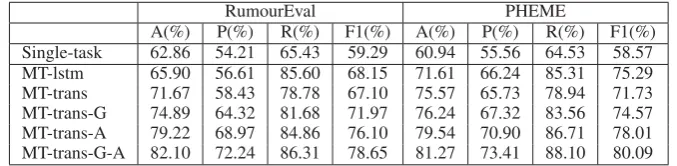
Table 3: Ablation analysis of the sifted multi-task learning method.
SL: what why wrong scary like fact great probably
SSL-FND: what wrong scary fact few false real
SSL-SD: why wrong like hold confirm misleading
PL-FND: what scary few really no notice
[image:7.595.120.480.179.227.2]PL-SD: why like really hold sure doubt
Figure 4: Typical tokens obtained by different layers of the sifted multi-task learning method. In our proposed method, typical tokens are captured by shared layer (SL), selected sharing layer for fake news detection (SSL-FND), selected sharing layer for stance detection (SSL-SD), private layer for fake news detection (PL-(SSL-FND), and private layer for stance detection (PL-SD) respectively. A column of the same color represents the distribution of one token in different layers, while the last two columns denote unique tokens captured by different layers.
MT-trans The only difference between MT-trans and MT-lstm is that encoder of MT-MT-trans is composed of transformer encoder.
MT-trans-G On the basis of trans, MT-trans-G adds gated sharing cell behind the shared layer of MT-trans to filter shared features.
MT-trans-A Unlike MT-trans-G, MT-trans-A replaces gated sharing cell with attention sharing cell for selecting shared features.
MT-trans-G-A Gated sharing cell and attention sharing cell are organically combined as selected sharing layer behind the shared layer of MT-trans, called MT-trans-G-A.
Table 3 provides the experimental results of these methods on RumourEval and PHEME datasets. We have the following observations:
• Effectiveness of multi-task learning. MT-trans boosts about 9% and 15% performance im-provements in accuracy on both datasets com-pared with Single-task, which indicates that the multi-task learning method is effective to detect fake news.
• Effectiveness of transformer encoder. Com-pared with MT-lstm, MT-trans obtains more excellent performance, which explains that transformer encoder has better encoding abili-ty than LSTM for news text on social media.
• Effectiveness of the selected sharing layer. Analysis of the results of the comparison with trans, trans-G, Trans-A, and MT-trans-G-A shows that MT-MT-trans-G-A ensures
optimal performance with the help of the se-lected sharing layer of the model, which con-firms the reasonability of selectively sharing different features for different tasks.
4.4.2 Error Analysis
Although the sifted multi-task learning method ouperforms previous state-of-the-art methods on t-wo datasets (From Table2), we observe that the proposed method achieves more remarkable per-formance boosts on PHEME than on RumourEval. There are two reasons for our analysis according to Table 1 and Table 2. One is that the number of training examples in RumourEval (including 5,568 tweets) is relatively limited as compared with PHEME (including 105,354 tweets), which is not enough to train deep neural networks. Another is that PHEME includes more threads (6,425 threads) than RumourEval (325 threads) so that PHEME can offer more rich credibility features to our proposed method.
4.5 Case Study
(a) Obtained weights of tokens by two models
(b) Neuron behaviours ofAfakeandAstance
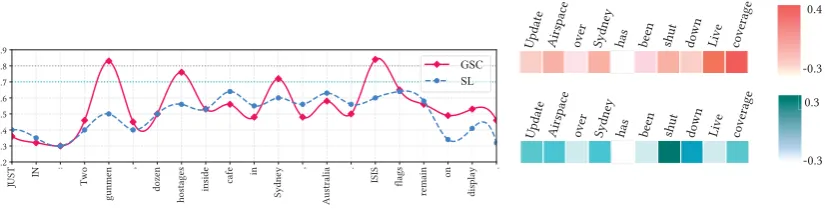
Figure 5: (a) In fake news detection task, the GSC line denotes the weight values gf ake of gated sharing cell, while the SL line represents feature weights ofHsharedin the shared layer. Two horizontal lines give two different
borders to determine the importance of tokens. (b) The red and green heatmaps describe the neuron behaviours of attention sharing cellAf akein fake news detection task andAstancein stance detection task, respectively.
4.5.1 The Visualization of Shared Features Learned from Two Tasks
We visualize shared features learned from the tasks of fake news detection and stance detection. Specif-ically, we first look up these elements with the largest values from the outputs of the shared layer and the selected shared layer respectively. Then, these elements are mapped into the corresponding values in input embeddings so that we can find out specific tokens. The experimental results are shown in Figure4. We draw the following observations:
• Comparing PL-FND and PL-SD, private
fea-tures in private layer from different tasks are different. From PL-FND, PL-SD, and SLT, the combination of the private features and shared features from shared layer increase the diversity of features and help to promote the performance of both fake news detection and stance detection.
• By compared SL, SSL-FND, and SSL-SD,
se-lected sharing layers from different tasks can not only filter tokens from shared layer (for instance, ‘what’, ‘scary’, and ‘fact’ present in SL but not in SSL-SD), but also capture help-ful tokens for its own task (like ‘false’ and ‘real’ in SSL-FND, and ‘confirm’ and
‘mis-leading’ in SSL-SD).
4.5.2 The Visualization of Different Features Learned from Different Cells
To answer the second question, we examine the neuron behaviours of gated sharing cell and atten-tion sharing cell in the selected sharing layer, re-spectively. More concretely, taking the task of fake news detection as an example, we visualize feature
weights ofHsharedin the shared layer and show the weight valuesgf akein gated sharing cell. By that we can find what kinds of features are discarded as interference, as shown in Figure5(a). In addi-tion, for attention sharing cell, we visualize which tokens are concerned in attention sharing cell, as shown in Figure5(b). From Figure5(a) and5(b), we obtain the following observations:
• In Figure 5(a), only the tokens “gunmen, hostages, Sydney, ISIS” give more attention compared with vanilla shared-private model (SP-M). In more details, ‘gunmen’ and ‘ISIS’ obtain the highest weights. These illustrate that gated sharing cell can effectively capture key tokens.
• In Figure 5(b), “live coverage”, as a promi-nent credibility indicator, wins more concerns in the task of fake news detection than oth-er tokens. By contrast, when the sentence of Figure 5(b) is applied to the task of stance detection, the tokens “shut down” obtain the maximum weight, instead of “live coverage”. These may reveal that attention sharing cell focuses on different helpful features from the shared layer for different tasks.
5 Conclusion
[image:8.595.94.507.69.177.2]datasets and further illustrated by visualization ex-periments. There are several important directions remain for future research: (1) the fusion mech-anism of private and shared features; (2) How to represent meta-data of fake news better to integrate into inputs.
Acknowledgments
The research work is supported by “the World-Class Universities(Disciplines) and the Character-istic Development Guidance Funds for the Central Universities”(PY3A022), Shenzhen Science and Technology Project(JCYJ20180306170836595), the National Natural Science Fund of China (No.F020807), Ministry of Education Fund Project “Cloud Number Integration Science and Education Innovation” (No.2017B00030), Basic Scientific Re-search Operating Expenses of Central Universities (No.ZDYF2017006).
References
Hunt Allcott and Matthew Gentzkow. 2017. Social me-dia and fake news in the 2016 election. Journal of economic perspectives, 31(2):211–36.
Carlos Castillo, Marcelo Mendoza, and Barbara Poblete. 2011. Information credibility on twitter. In
Proceedings of the 20th international conference on World wide web, pages 675–684. ACM.
Xilun Chen, Ahmed Hassan Awadallah, Hany Hassan, Wei Wang, and Claire Cardie. 2018. Zero-resource multilingual model transfer: Learning what to share.
arXiv preprint arXiv:1810.03552.
Xilun Chen and Claire Cardie. 2018. Multinomial ad-versarial networks for multi-domain text classifica-tion. InProceedings of the 2018 Conference of the North American Chapter of the Association for Com-putational Linguistics: Human Language Technolo-gies, pages 1226–1240.
Yi-Chin Chen, Zhao-Yang Liu, and Hung-Yu Kao. 2017. Ikm at semeval-2017 task 8: Convolutional neural networks for stance detection and rumor veri-fication. InSemEval-2017, pages 465–469.
Junyoung Chung, Caglar Gulcehre, Kyunghyun Cho, and Yoshua Bengio. 2014. Empirical evaluation of gated recurrent neural networks on sequence mod-eling. In NIPS 2014 Workshop on Deep Learning, December 2014.
Niall J Conroy, Victoria L Rubin, and Yimin Chen. 2015. Automatic deception detection: Methods for finding fake news. Proceedings of the Association for Information Science and Technology, 52(1):1–4.
Leon Derczynski, Kalina Bontcheva, Maria Liakata, Rob Procter, Geraldine Wong Sak Hoi, and Arkaitz Zubiaga. 2017. Semeval-2017 task 8: Rumoureval: Determining rumour veracity and support for ru-mours. InSemEval-2017, pages 69–76.
Jacob Devlin, Ming-Wei Chang, Kenton Lee, and Kristina Toutanova. 2018. Bert: Pre-training of deep bidirectional transformers for language understand-ing.arXiv preprint arXiv:1810.04805.
Sebastian Dungs, Ahmet Aker, Norbert Fuhr, and Kali-na Bontcheva. 2018. Can rumour stance alone pre-dict veracity? In Proceedings of the 27th Inter-national Conference on Computational Linguistics, pages 3360–3370.
Martin Flintham, Christian Karner, Khaled Bachour, Helen Creswick, Neha Gupta, and Stuart Moran. 2018. Falling for fake news: investigating the con-sumption of news via social media. InProceedings of the 2018 CHI Conference on Human Factors in Computing Systems, page 376. ACM.
Gisel Bastidas Guacho, Sara Abdali, Neil Shah, and Evangelos E Papalexakis. 2018. Semi-supervised content-based detection of misinformation via ten-sor embeddings. In2018 IEEE/ACM International Conference on Advances in Social Networks Analy-sis and Mining (ASONAM), pages 322–325. IEEE.
Sepp Hochreiter and J¨urgen Schmidhuber. 1997. Long short-term memory. Neural computation, 9(8):1735–1780.
Elena Kochkina, Maria Liakata, and Isabelle Augen-stein. 2017. Turing at semeval-2017 task 8: Sequen-tial approach to rumour stance classification with branch-lstm. arXiv preprint arXiv:1704.07221.
Elena Kochkina, Maria Liakata, and Arkaitz Zubiaga. 2018. All-in-one: Multi-task learning for rumour verification.arXiv preprint arXiv:1806.03713.
Sizhen Li, Shuai Zhao, Bo Cheng, and Hao Yang. 2018. An end-to-end multi-task learning model for fact checking.EMNLP 2018, page 138.
Boyang Liu, Pang-Ning Tan, and Jiayu Zhou. 2019. Augmented multi-task learning by optimal transport. InProceedings of the 2019 SIAM International Con-ference on Data Mining, pages 19–27. SIAM.
Pengfei Liu, Xipeng Qiu, and Xuanjing Huang. 2017. Adversarial multi-task learning for text classifica-tion. In Proceedings of the 55th Annual Meeting of the Association for Computational Linguistics, pages 1–10.
Michal Lukasik, PK Srijith, Duy Vu, Kalina Bontcheva, Arkaitz Zubiaga, and Trevor Cohn. 2016. Hawkes processes for continuous time sequence classifica-tion: an application to rumour stance classification in twitter. InProceedings of the 54th Annual Meet-ing of the Association for Computational LMeet-inguistics, volume 2, pages 393–398.
Jing Ma, Wei Gao, and Kam-Fai Wong. 2018a. Detect rumor and stance jointly by neural multi-task learn-ing. InCompanion of the The Web Conference 2018 on The Web Conference 2018, pages 585–593. In-ternational World Wide Web Conferences Steering Committee.
Jing Ma, Wei Gao, and Kam-Fai Wong. 2018b. Ru-mor detection on twitter with tree-structured recur-sive neural networks. InACL, pages 1980–1989.
Marcelo Mendoza, Barbara Poblete, and Carlos Castil-lo. 2010. Twitter under crisis: Can we trust what we rt? InProceedings of the first workshop on social media analytics, pages 71–79. ACM.
Tomas Mikolov, Ilya Sutskever, Kai Chen, Greg S Cor-rado, and Jeff Dean. 2013. Distributed representa-tions of words and phrases and their compositional-ity. InAdvances in neural information processing systems, pages 3111–3119.
Mitra Mohtarami, Ramy Baly, James Glass, Preslav Nakov, Llu´ıs M`arquez, and Alessandro Moschitti. 2018. Automatic stance detection using end-to-end memory networks. InProceedings of the 2018 Con-ference of the North American Chapter of the Asso-ciation for Computational Linguistics: Human Lan-guage Technologies, volume 1, pages 767–776.
Lili Mou, Rui Men, Ge Li, Yan Xu, Lu Zhang, Rui Yan, and Zhi Jin. 2016. Natural language inference by tree-based convolution and heuristic matching. In
ACL, page 130.
Ray Oshikawa, Jing Qian, and William Yang Wang. 2018. A survey on natural language process-ing for fake news detection. arXiv preprint arX-iv:1811.00770.
Kashyap Popat, Subhabrata Mukherjee, Andrew Yates, and Gerhard Weikum. 2018. Declare: Debunking fake news and false claims using evidence-aware deep learning. InEMNLP, pages 22–32.
Martin Potthast, Johannes Kiesel, Kevin Reinartz, Janek Bevendorff, and Benno Stein. 2017. A sty-lometric inquiry into hyperpartisan and fake news.
arXiv preprint arXiv:1702.05638.
Feng Qian, Chengyue Gong, Karishma Sharma, and Yan Liu. 2018. Neural user response generator: Fake news detection with collective user intelligence. InIJCAI, pages 3834–3840.
Natali Ruchansky, Sungyong Seo, and Yan Liu. 2017. Csi: A hybrid deep model for fake news detection. In Proceedings of the 2017 ACM on Conference
on Information and Knowledge Management, pages 797–806. ACM.
Rupesh Kumar Srivastava, Klaus Greff, and J¨urgen Schmidhuber. 2015. Highway networks. arXiv preprint arXiv:1505.00387.
James Thorne, Mingjie Chen, Giorgos Myrianthous, Jiashu Pu, Xiaoxuan Wang, and Andreas Vlachos. 2017. Fake news stance detection using stacked en-semble of classifiers. In Proceedings of the 2017 EMNLP Workshop: Natural Language Processing meets Journalism, pages 80–83.
Ashish Vaswani, Noam Shazeer, Niki Parmar, Jakob Uszkoreit, Llion Jones, Aidan N Gomez, Łukasz Kaiser, and Illia Polosukhin. 2017. Attention is al-l you need. InAdvances in neural information pro-cessing systems, pages 5998–6008.
William Yang Wang. 2017. ” liar, liar pants on fire”: A new benchmark dataset for fake news detection.
arXiv preprint arXiv:1705.00648.
Yilin Wang, Suhang Wang, Jiliang Tang, Huan Liu, and Baoxin Li. 2015. Unsupervised sentiment analysis for social media images. InTwenty-Fourth Interna-tional Joint Conference on Artificial Intelligence.
Lianwei Wu, Yuan Rao, Hualei Yu, Yiming Wang, and Nazir Ambreen. 2019. A multi-semantics classifica-tion method based on deep learning for incredible messages on social media. Chinese Journal of Elec-tronics, 28(4):754–763.
Lianwei Wu, Yuan Rao, Hualei Yu, Yiming Wang, and Ambreen Nazir. 2018. False information detection on social media via a hybrid deep model. In Interna-tional Conference on Social Informatics, pages 323– 333. Springer.
Fan Yang, Yang Liu, Xiaohui Yu, and Min Yang. 2012. Automatic detection of rumor on sina weibo. In Pro-ceedings of the ACM SIGKDD Workshop on Mining Data Semantics, page 13. ACM.
Qiang Zhang, Aldo Lipani, Shangsong Liang, and Em-ine Yilmaz. 2019. Reply-aided detection of misin-formation via bayesian deep learning. In Compan-ion Proceedings of The Web Conference.
Arkaitz Zubiaga, Elena Kochkina, Maria Liakata, Rob Procter, and Michal Lukasik. 2016a. Stance classifi-cation in rumours as a sequential task exploiting the tree structure of social media conversations. In Pro-ceedings of COLING 2016, the 26th International Conference on Computational Linguistics: Techni-cal Papers, pages 2438–2448.
Arkaitz Zubiaga, Maria Liakata, Rob Procter, Geral-dine Wong Sak Hoi, and Peter Tolmie. 2016b. Analysing how people orient to and spread rumours in social media by looking at conversational threads.