Abstract—Advancements in computing systems, software,
materials, management techniques, supply chain management, communications, outsourcing and concurrent engineering has changed the dynamics of shop-floor. The use of smart materials, advanced manufacturing processes and psychometric testing of highly skilled labor in a target focused, team environment has enhanced the performance expectations from Man, Machine and Resources. Global competitiveness demands that dissemination and absorption of knowledge by managers and workers need to be achieved through extraordinary effort. A number of working principles and guidelines have been developed and employed in industries for diffusion of knowledge from one level to another. Aircraft industry has also been a source of immense research in various areas of technology. The overall research in area of technology diffusion has added phenomenal knowledge to industry working practices. At this stage, its ia also major consideration in aircraft manufacturing industry. Whereas; the literature on diffusion of technologies in aircraft manufacturing environment is very limited. This paper reviews the techniques developed and adopted in other industries for technology diffusion. The same knowledge has is used to develop framework of technology diffusion in aircraft manufacturing environment. Later, the frame work was applied in a typical aircraft manufacturing industry to evaluate its validity, limitations.
Index Terms— Technology diffusion, knowledge diffusion,
manufacturing, aircraft industry.
1. INTRODUCTION
Technology diffusion is defined as the dissemination of technical knowledge from a person, organization or a country to another through suitable means of communications. It was observed that the speed and path of diffusion of knowledge regarding an innovation is influenced by organizational functions and conflicting objectives [1]. The diffusion of technology is considered as directly proportional to the strength of four factors including technology source, diffusion space, medium and diffusion environment in any industry [2]. An industry with high level of these factors is expected to be able to transfer knowledge easily as compared to others.
Manuscript received February 13, 2008. This work was carried out as a part of MS thesis research project at Department of Engineering Management, Center of Advanced Studies in Engineering Islamabad, Pakistan.
Asif Rashid is a student of MS at Department of Engineering Management, Center of Advanced Studies in Engineering, Islamabad.
Dr. Irfan A Manarvi is a faculty member at Department of Aeronautics and Astronautics, Institute of Space Technology, Islamabad, Pakistan, (Corresponding Author) Email: [email protected],
This process gets more complex when diffusion of knowledge is taking place from an advanced organization to a developing country organization where organizational, informational and social environment may not be sufficient to adapt this process [3]. Organizational size, centralization, formalization and culture are additional internal factors that influence the diffusion process in such situations[4]. In most cases, the organizations and countries requiring advanced technologies approach sources without considering whether they are capable of absorbing it. Absence of this capability makes the whole transfer to be a failure and may lead recipient country to perpetual dependency on suppliers of technology [5]. A larger degree of autonomy among participating partners of technology transfer program and heterogeneity in technological platform might also add to the complexity of a diffusion process in collaboration programs [6].
Technology diffusion has been a vital area of research in industry over a period of time. However, similar literature for aircraft manufacturing industry environment is very limited. Whereas, the problems faced by managers and employees for diffusion of technology are far more complicated. Therefore, present research was focused on developing a framework of technology diffusion for aircraft manufacturing industry based on best practices established through research for other industries.
2. AIRCRAFT MANUFACTURING ENVIRONMENT
A typical environment comprises of activities like conception of a design, its feasibility studies, production planning and control, within industry manufacture and out sourcing, sub-assembly and final assembly, quality control systems, by national and international standards, complex supply chain management, comprehensive management information systems, human resources development programs, operational testing of products and certifications to meet the Military, Civil or Federal Aviation standards. The industry collaboration programs are monitored and controlled by the governmental regulations. It creates further limitations on technology transfer. The knowledge level of engineers, managers and workers may also differ regarding specific technologies. These gaps result into delays in diffusion programs.
A Framework of Technology Diffusion in Aircraft
Manufacturing Industry Environment
3. TANGIBLE AND INTANGIBLE PARAMETERS
The aircraft industry environment also requires tangible and in tangible parameters to be diffused from academia to industry, and from one company to other in collaboration program. These could be split into two major areas:
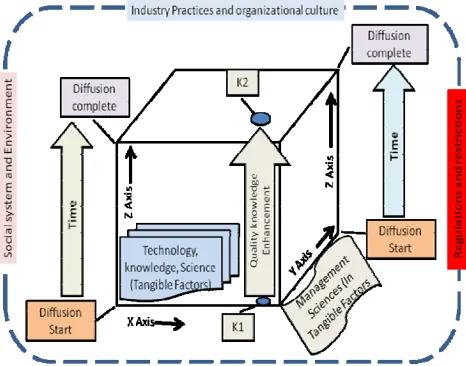
[image:2.612.72.305.427.610.2](a) Specific technology knowledge as tangible. (b) Management and operational systems as intangible Aviation industry best practices, social system, organizational culture and work environment may influence diffusion of above factors among partners. Time is an added dimension influencing the diffusion process. Quality of diffusion of these factors may be determined by the success or failure of a project. Therefore a definite start point of diffusion process and end are mandatory requirements. The frame work indicating the importance of time could be shown as a cube with four dimensional axis. The breadth of tangible parameters is located on X-axis, the depth of management systems is placed at Y – axis and quality of knowledge enhancement at Z – axis. The start and completion of diffusion process for each of tangible and intangible factors could have time dimension along Z-axis. The time for diffusion may be different depending upon the nature of a parameter, its functional requirements, level of complexity and financial or other type of support required from collaborating partners. The knowledge level of these parameters is expected to rise from grassroots such as level K1 to an expert at K2 level on the scales of tangible and in tangible factors as shown as in Fig 1.
Fig 1. Framework of diffusion parameters among collaborating partners
Working of this frame work may be explained by considering an example of a technological process. The parameters required for diffusion are assumed to be transfer of this technology from one organization to another in any third world country. This may require huge investment from recipient aircraft manufacturing factory for purchase of machines, technological processes, training of its personnel to absorb the new processes within limited time.
Secondly recepient might have to invest on infrastructure for installation and commissioning of machines, processes and services for smooth operation. Objectives of user may be to ensure that its personnel start at some basic level of using the machines for production of aircraft parts and arrive at an expert level.
Culture and social factors may not have much influence in diffusion of technology from academia or industry of an advanced country to a technology supplier, but these would become vital factors when the same knowledge is imparted to a technology recipient user. Therefore, the supplier have to set time lines for diffusion of knowledge through dedicated training programs.
4. KNOWLEDGE DIFFUSION
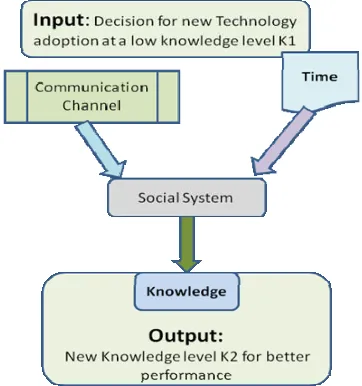
Fig 2. Knowledge diffusion process from supplier to user from skill levels K1 to K2
A knowledge diffusion process may require communication and travel activities of either side personnel to other organization. During this process, social, environmental and different organizational cultures also play a vital role in transfer of knowledge. Travel advisory services of two countries may also issue instructions for restriction of travel to each other that may cause further delays. A mechanism of measurement of communication effectiveness may need to be established from initial stages of a knowledge diffusion process.
5 .MEASUREMENT OF IMPACT OF COMMUNICATION
[image:3.612.94.275.48.241.2]Working of a typical communication channel between two in country aircraft manufacturing organizations or based in other countries start with one organization wishing to communicate a decision and information or data to other at a particular phase of a collaboration project. It has to establish a communication network compatible with the user network for efficient dissemination of the information. It therefore need links with the recipient company policies, regulatory restrictions, secrecy requirements as well as media. A feedback loop to supplier organization completes the communication channel. Clarity of anticipated response by the user may be used as indicator for supplier of having successfully launched the communication channel between the collaborating partners. The speed and efficiency of the communication channel would depend upon the nature and type of communication data and the transmission medium capabilities. A graphic layout of this network may be shown as in Fig 3 below:
Fig 3. Communication framework between supplier and user Once communication framework is established, the two organizations are required to disseminate information to each other for diffusion of specific knowledge.
6. RESOURCE POOLING FOR DIFFUSION
Diffusion of technology also requires infrastructure, financial, technical, logistics, communication and support service resources. Availability of these is to be ascertained through technical evaluation of facilities with recipient of technology by a supplier. Technical facilities scope should also include management systems and practices in vogue at user work environment.
Typical aircraft manufacturing collaborative programs are classified into following few categories of collaboration:-
(a) Establishing of assembly line of an aircraft from semi or completely knocked down kits.
(b) Production of aircraft from piece parts using raw materials and standard parts through supply chain management systems of a supplier organization (c) Production of aircraft through supply chain
management systems while seeking guidance from supplier company in specific technologies.
All these types of collaborative situations will have different set of activities to be performed by supplier and user organizations. Resources utilized for acquisition of these tasks may also differ depending upon the following factors:
(a) User already has an aircraft manufacturing program and may desire to enhance its product line through new collaboration
Whatever is the starting line of user, provisioning of information of its capabilities to the supplier may be a useful option for user. A supplier then may prepare an exhaustive feasibility study of a future collaboration program considering user requirements. It may provide a financial and technical proposal along with technology training of the user employees as part of technology diffusion process.
At times, users may not be able to identify their exact technology requirements and depend on a supplier. They need to train their technology leaders to act as decision makers at later stages of the collaboration program. It will ensure smooth implementation of technology diffusion processes. Infrastructure, supply chain and other resources available with a user organization may also be pooled into research, design, prototype production and serial manufacture of aircraft parts and assemblies. There could be limitations of relevant national and international aviation standards.
7. INTEGRATED FRAMEWORK
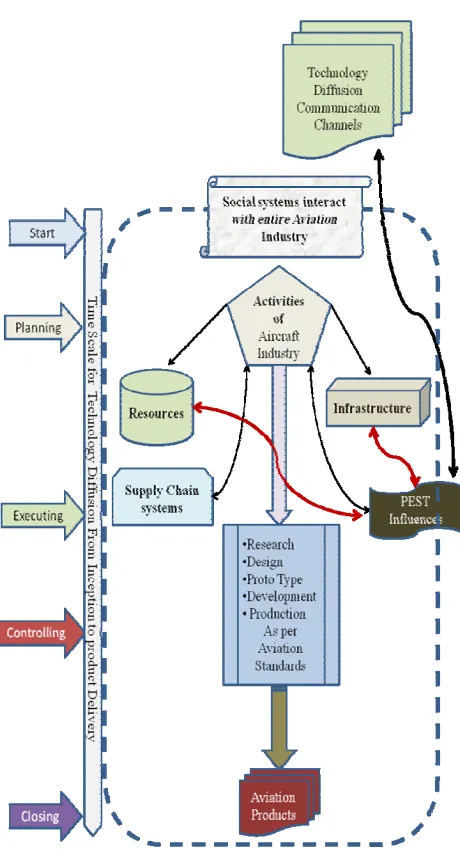
The above stated frame works for different requirements could be merged together to provide a time dependent integrated technology diffusion framework for a typical aircraft manufacturing environment. It may have elements of specific technology, management systems, and communication channels and will be spread over a number of phases as follows:
Start phase
It will commence when two or more collaborative partners agree to a joint aircraft manufacturing program and draft a memorandum of understanding for various collaboration activities is signed. The deliverables of this phase are detailed work plans, lists, documents and computer data covering activities to be performed by partners.
Planning phase
This phase will commence immediately after the start phase. Technology supplier will be expected to submit a feasibility report to user. Its details will include level of technology to be diffused for specific processes and introduction of management systems in users environment.
Execution phase
It will include purchase of machinery, tools, testers and other equipment after setting up the infrastructure according the recommendations of a supplier.
Controlling phase
It will start after establishment of successful quality management system to ensure manufacturing of parts and assemblies according to required dimensional specifications and performance characteristics. Functional testing will also form a part of this phase. It may also include production planning and control activities for rework on defective parts. Acceptance, rejections or deviations in a regular production run are indicators of having launched this phase by a user.
Close phase
[image:4.612.315.545.231.658.2]This is final phase of integrated framework for aircraft manufacturing factory. Its completion indicators are the complete technology diffusion in terms of processes, knowledge transfer, management systems, training of human resource, availability and complete understanding of aircraft technology documents, establishment of supply chain systems as per the product requirements, fully functional quality management, regular production runs taking place according the production plans and achievement of production targets. This integrated framework looks somewhat like Fig 4.
8. IMPLEMENTATION OF INTEGRATED FRAMEWORK
The present frame work was implemented and tested on two programs of a developing country aircraft manufacturing industry environment during its collaboration with a partner country organization. The complete programs were reviewed on the basis of the above stated framework and its individual segments. A large numbers of interviews of management and workers were carried out to collect data for analysis of validity of this framework. The following inferences were made out of the extensive qualitative and quantitative studies carried out throughout the research:
Technology diffusion may be limited to technology transfer
In both collaboration programs between two organizations, the technology diffusion remained limited to technology transfer programs. It included transfer of working practices and management systems knowledge for setting up of infra structure at user premises according to recommendations of supplier, procurement of machinery and tools, acquiring technology documentation, collection of process data and drawings of aircraft parts and assemblies as the tangible gains by user organization.
Supplier driven process
The entire process of technology transfer was mostly supplier driven and very less user input was included in what was required to be transferred and to what level it was to be diffused.
Language as a barrier for knowledge diffusion
The supplier and user technical staff spoke different languages and were unable to communicate clearly in a common language such as English. It resulted to lot of problems at various phases of the projects management in both the supplier and user organizations. The users were mostly at loss in terms of time delays and project completion deadlines always shifting beyond the planned throughout the projects
Gap in knowledge of acquired technologies and processes
There were big gaps in the expertise of supplier and user technical and support staff; which resulted in user’s staff always looking forward to help and guidance from the supplier for specific technological processes.
Purchasing upgraded machinery from other sources
The machinery models required by the users was primarily identified by suppliers organization, however quite a few of those technologies were either upgraded over a period of time. Some of these became out of use on shop floor and were not being supported by the machinery supplier companies.
Mismatch in user and supplier quality management systems
The users were practicing a variety of quality management systems which did not completely match with the suppliers program. The users were observed in deep troubles to alter
their quality management systems and practices in accordance with the supplier requirements. It resulted into suffering of the existing product lines of the user. And also delays in acquiring quality qualification of parts and assemblies by the supplier quality inspectors.
Understanding of technological documentation
The technology documentation though translated partly in English language had working practices applicable to the supplier work environment which was quite different from the users work environment. The same could not be directly applied to the user work environment. The parts to be produced using existing pools of resources could not be manufactured following the processes advised by the supplier. The quality staff of the supplier which was there to certify the qualification of parts according to relevant aviation standards was not ready to qualify the user processes; just because they were different from the supplier work environment. These aspects resulted into substantial rework and rejections of raw materials, frustration and loss of confidence among the user workforce along with significant delays in completion of the programs.
Organizational culture
The user had an organizational culture of working mostly on the western manufacturing systems, whereas the supplier offered program was eastern based with clear difference in working practices for production planning, shop floor activities and support systems activities. The gaps in organizational cultures were not identified at the initial stages of the projects by both sides. The costs of different processes, training and methodologies to be adopted during the collaboration program as agreed earlier appeared to be substantially low when the systems were launched on shop floor level. The supplier was unable to meet the required deliverables at agreed costs and the user was unable to justify the requirements of additional funds to its sponsors. The only way out being considered was to do away with substantial parts of users personnel training and transfer of technologists from supplier to user organization.
Transfer of experienced human resource
The user organization had a regular transfer program of its managers and key human resource from one program to another. The knowledge absorbed during one program was observed to disappear due to the absence of trained human resource for longer duration of the project at the user organization. The consistency of knowledge transfer was not being given sufficient importance at users even for highly advanced processes and technologies. The supplier organization has shown its frustrations and limitations a number of times over such situations but user organization was unable to maintain the level of trained manpower dut to its control by higher level organization with different priorities.
9. FINDINGS
The present research on diffusion of technology in a typical aircraft manufacturing industry revealed the following: (1) Aircraft manufacturing industry environment
comprises of highly complex production technologies and is regulated by strict national and international standards.
(2) Methodologies of technology diffusion evolved by other sectors of industry could be partly or wholly applied to an aircraft manufacturing industry environment after relevant modifications.
(3) The knowledge dissemination process is time based and by itself may act as a constraint in the diffusion process pertaining to advanced technologies. Whereas the advancement in aircraft manufacturing technologies are taking place at much faster rates as compared to other industries.
(4) The social, organizational culture, work environment and communication factors are some of the major elements of any diffusion model observed in other industries, the same are equally applicable in an aircraft manufacturing industry.
An integrated technology diffusion framework developed in this research could be used successfully as a guideline for the supplier as well as user organizations when they wish to start the collaboration program from scratch. It could also be used at later stages for evaluating the success or failures of their collaboration programs through indicators given in this framework.
10. CONCLUSIONS
The present research has provided an integrated technology diffusion framework for an aircraft industry. It is spread over various phases to be executed on a scale that may define the diffusion of knowledge of individual processes from start to closing phases. The joint collaboration projects in this industry undergo similar activities without clear distinctions of the phases identified in this research. This aspect results to incomplete success or at times failures on the part of user to completely absorb the technologies provided by the suppliers. The level of investment into a typical aircraft manufacturing program through collaboration of two or more organizations and sometimes countries demand more focused and exhaustive research on failure of these programs due to insufficient technology diffusion from supplier to users in this industry.
11. REFERENCE
[1] Reddy, N.M.; Aram, J.D.,; Lynn, L.H.; “The institutional environment for technology diffusion: the role of non market institutions”, Engineering Leadership in the 90’s. IEEE Engineering Management Conference, 24 – 26 Oct. 1988, Pages 152-157
[2]Huang Zhen-Li; Lei Ja-Su; “A new thinking and model for technology diffusion”. Technology Management : the New International Language, 1991, 27-31 Oct. 1991 Page(s):529 – 532
[3] Suresh Kumar, S; “ Endogenous social factors and dimensions of technology diffusion in a developing country-an Indian experience”, IEEE International Engineering Management Conference, ‘Managing Projects in a Borderless World’, 17 – 18 Dec. 1993 Pages 130- 132 [4] Dasgupta, S.; “The role of culture in information
technology diffusion in organizations”, Innovation in Technology Management – The Key to Global Leadership, PICMET ’97, 27 – 31 July 1997 Pages 353-356
[5] Jayaraman, V.; Agrawal, R.K.; Seethamraju, R.C.; “International technology Transfer Model”, Innovation in Technology Management – The Key to Global Leadership, PICMET ’97, 27 – 31 July 1997 Pages 954