241
UER: An Open-Source Toolkit for Pre-training Models
Zhe Zhao1,2,♠ Hui Chen2,♣ Jinbin Zhang2,♣ Xin Zhao1,♠ Tao Liu1,♠ Wei Lu1,♠ Xi Chen3,
Haotang Deng2,♣ Qi Ju2,♣,∗ Xiaoyong Du1,♠
1School of Information and DEKE, MOE, Renmin University of China, Beijing, China 2Tencent AI Lab
3School of Electronics Engineering and Computer Science, Peking University, Beijing, China
♠{helloworld, zhaoxinruc, tliu, lu-wei, duyong}@ruc.edu.cn
♣{chenhuichen, westonzhang, haotangdeng, damonju}@tencent.com
{mrcx}@pku.edu.cn
Abstract
Existing works, including ELMO and BERT, have revealed the importance of pre-training for NLP tasks. While there does not exist a single pre-training model that works best in all cases, it is of necessity to develop a frame-work that is able to deploy various pre-training models efficiently. For this purpose, we propose an assemble-on-demand pre-training toolkit, namely Universal Encoder Represen-tations (UER). UER is loosely coupled, and encapsulated with rich modules. By assem-bling modules on demand, users can either re-produce a state-of-the-art pre-training model or develop a pre-training model that remains unexplored. With UER, we have built a model zoo, which contains pre-trained models based on different corpora, encoders, and targets (ob-jectives). With proper pre-trained models, we could achieve new state-of-the-art results on a range of downstream datasets.
1 Introduction
Pre-training has been well recognized as an es-sential step for NLP tasks since it results in re-markable improvements on a range of downstream datasets (Devlin et al., 2018). Instead of train-ing models on a specific task from scratch, pre-training models are firstly trained on general-domain corpora, then followed by fine-tuning on downstream tasks. Thus far, a large number of works have been proposed for finding better pre-training models. Existing pre-training models mainly differ in the following three aspects:
1) Model encoder.
Commonly-used encoders include RNN (Hochreiter and Schmidhuber,1997), CNN (Kim,
2014), AttentionNN (Bahdanau et al.,2014), and their combinations (Zhou et al., 2016). Recently,
∗ ∗
Corresponding author.
Transformer (a structure based on attentionNN) is shown to be a more powerful feature extractor compared with other encoders (Vaswani et al.,
2017).
2) Pre-training target (objective).
Using proper target is one of the keys to the suc-cess of pre-training. While the language model is most commonly used (Radford et al., 2018), many works focus on seeking better targets such as masked language model (cloze test) (Devlin et al.,
2018) and machine translation (McCann et al.,
2017).
3) Fine-tuning strategy.
Using a proper fine-tuning strategy is also im-portant to the performance of pre-training models on downstream tasks. A commonly-used strategy is to regard pre-trained models as feature extrac-tors (Kiros et al.,2015).
Table 1 lists 8 popular pre-training models and their main differences (Kiros et al., 2015;
Lo-geswaran and Lee, 2018; McCann et al., 2017;
Conneau et al.,2017;Peters et al.,2018;Howard
and Ruder, 2018; Radford et al., 2018; Devlin
et al.,2018). In additional to encoder, target, and fine-tuning strategy, corpus is also listed in Table 1 as an important factor for pre-training models.
There are many open-source implementations of pre-training models, such as Google BERT1, ELMO from AllenAI2, GPT and BERT from Hug-gingFace3. However, these works usually focus on the designs of either one or a few pre-training models. Due to the diversity of the downstream tasks and the computational resources constraint, there does not exist a single pre-training model that works best in all cases. BERT is one of the most widely used pre-training models. It exploits
1
https://github.com/google-research/bert 2
Model Corpus Encoder Target
Skip-thoughts Bookcorpus GRU Conditioned LM
Quick-thoughts Bookcorpus+UMBCcorpus GRU Sentence prediction
CoVe English-German Bi-LSTM Machine translation
Infersent Natural language inference LSTM;GRU;CNN;LSTM+Attention Classification
ELMO 1billion benchmark Bi-LSTM Language model
ULMFiT Wikipedia LSTM Language model
[image:2.595.73.527.63.157.2]GPT Bookcorpus; 1billion benchmark Transformer Language model BERT Wikipedia+bookcorpus Transformer Cloze+sentence prediction
Table 1: 8 pre-training models and their differences. For space constraint of the table, fine-tuning strategies of different models are described as follows: Skip-thoughts, quick-thoughts, and infersent regard pre-trained models as feature extractors. The parameters before output layer are frozen. CoVe and ELMO transfer word embedding to downstream tasks, with other parameters in neural networks uninitialized. ULMFit, GPT, and BERT fine-tune entire networks on downstream tasks.
GRU LSTM CNN Max pooling Mean pooling
Machine translation
Transformer self-attention RecNN
NN combinations
Attention RNN CNN
Classification Supervised Language
model Cloze test Auto
encoder predictionSentence Unsupervised
Transformer self-attention Cloze
test Sentence prediction
Wikipedia
Bookcorpus
Corpus Subencoder layer Encoder layer Target layer
General-domain corpus
Supervised task corpus
BERT
+
+
+
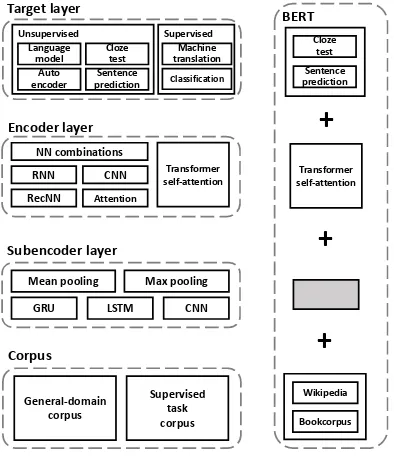
Figure 1: The architecture of UER (pre-training part). We can combine modules in UER to implement BERT model.
two unsupervised targets for pre-training. But in some scenarios, supervised information is critical to the performance of downstream tasks (Conneau et al., 2017; McCann et al., 2017). Besides, in many cases, BERT is excluded due to its efficiency issue. Based on above reasons, it is often the case that one should adopt different pre-training mod-els in different application scenarios.
In this work, we introduce UER, a general framework that is able to facilitate the develop-ments of various pre-training models. UER main-tains model modularity and supports research ex-tensibility. It consists of 4 components: suben-coder, ensuben-coder, target, and downstream task fine-tuning. The architecture of UER (pre-training part) is shown in Figure 1. Ample modules are im-plemented in each component. Users could
assem-ble different modules to implement existing mod-els such as BERT (right part in Figure 1), or de-velop a new pre-training model by implementing customized modules. Clear and robust interfaces allow users to assemble (or add) modules with as few restrictions as possible.
With the help of UER, we build a Chinese pre-trained model zoo based on different corpora, en-coders, and targets. Different datasets have their own characteristics. Selecting proper models from the model zoo can largely boost the performance of downstream datasets. In this work, we use Google BERT as baseline model. We provide some use cases that are based on UER, and the re-sults show that our models can either achieve new state-of-the-art performance, or achieve competi-tive results with an efficient running speed.
UER is built on PyTorch and supports dis-tributed training mode. Clear instructions and documentations are provided to help users read and use UER codes. The UER toolkit and the model zoo are publicly available at https:// github.com/dbiir/UER-py.
2 Related Work
2.1 Pre-training for deep neural networks
Using word embedding to initialize neural net-work’s first layer is one of the most commonly used strategies for NLP tasks (Mikolov et al.,
2013; Kim, 2014). Inspired by the success of word embedding, some recent works try to ini-tialize entire networks (not just first layer) with pre-trained parameters (Howard and Ruder,2018;
Radford et al., 2018). They train a deep neural
network upon large corpus, and fine-tune the pre-trained model on specific downstream tasks. One of the most influential works among them is BERT
(Devlin et al., 2018). BERT extracts text
[image:2.595.78.275.239.468.2]masked language model task and sentence predic-tion task as training targets (objectives). The draw-back of BERT is that it requires expensive compu-tational resources. Thankfully, Google makes its pre-trained models publicly available. So we can directly fine-tune on Google’s models to achieve competitive results on many NLP tasks.
2.2 NLP toolkits
Many NLP models have tens of hyper-parameters and various tricks, and some of which exert large impacts on final performance. Sometimes it is un-likely to report all details and their effects in re-search paper. This may lead to a huge gap be-tween research papers and code implementations. To solve the above problem, some works are pro-posed to implement a class of models in a frame-work. This type of work includes OpenNMT (Klein et al., 2017), fairseq (Ott et al.,2019) for neural machine translation; glyph (Zhang and Le-Cun,2017) for classification; NCRF++ (Yang and
Zhang,2018) for sequence labeling; Hyperwords
(Levy et al.,2015), ngram2vec (Zhao et al.,2017) for word embedding, to name a few.
Recently, we witness many influential pre-training works such as GPT, ULMFiT, and BERT. We think it could be useful to develop a frame-work to facilitate reproducing and refining those models. UER provides the flexibility of building pre-training models of different properties.
3 Architecture
In this section, we firstly introduce the core com-ponents in UER and the modules that we have implemented in each component. Figure 1 il-lustrates UER’s framework and detailed modules (pre-training part). Modularity design of UER largely facilitates the use of pre-training models. At the end of this section, we will give some case studies to illustrate how to use UER effectively.
3.1 Subencoder
This layer learns word vectors from subword fea-tures. For English, we use character as subword features. For Chinese4, we use radical and pinyin as subword features. As a result, the model can be aware of internal structures of words. Sub-word information has been explored in many NLP
4We don’t do word segmentation on Chinese corpus. We regard each Chinese character as a word. Internal structures such as radical and pinyin are regarded as Chinese subword features.
tasks such as text classification (Zhang and Le-Cun, 2017) and word embedding (Joulin et al.,
2016). In the pre-training literature, ELMO ex-ploits subencoder layer. In UER, we implement RNN and CNN as subencoders, and use mean pooling or max pooling upon hidden states to ob-tain fixed-length word vectors.
3.2 Encoder
This layer learns features from word vectors. UER implements a series of basic encoders, includ-ing LSTM, GRU, CNN, GatedCNN, and Atten-tionNN. Users can use these basic encoders di-rectly, or use their combinations. The output of an encoder can be fed into another encoder, forming networks of arbitrary layers. UER provides ample examples of combining basic encoders (e.g. CNN + LSTM). Users can also build their custom com-binations with basic encoders in UER.
Currently, Transformer (a structure based on multi-headed self-attention) becomes a popular text feature extractor and is proven to be effec-tive for many NLP tasks. We implement Trans-former module and integrate it into UER. With Transformer module, we can implement models such as GPT and BERT easily.
3.3 Target (objective)
Using suitable target is the key to the success of pre-training. Many papers in this field propose their targets and show their advantages over other ones. UER consists of a range of targets. Users can choose one of them, or use multiple targets and give them different weights. In this section we introduce targets implemented in UER.
• Language model (LM).Language model is one of the most commonly used targets. It trains model to make it useful to predict cur-rent word given previous words.
• Masked LM (MLM, also known as cloze test).The model is trained to be useful to pre-dict masked word given surrounding words. MLM utilizes both left and right contexts to predict words. LM only considers the left context.
• Autoencoder (AE).The model is trained to be useful to reconstruct input sequence as close as possible.
show that introducing sentence-level task into tar-gets can benefit pre-training models (Logeswaran and Lee,2018;Devlin et al.,2018).
• Next sentence prediction (NSP).The model is trained to predict if the two sentences are continuous. Sentence prediction target is much more efficient than word-level targets. It doesn’t involve sequentially decoding of words and softmax layer over entire vocab-ulary.
Above targets are unsupervised tasks (also known as self-supervised tasks). However, super-vised tasks can provide additional knowledge that raw corpus can not provide.
• Neural machine translation (NMT).CoVe
(McCann et al.,2017) proposes to use NMT
to pre-train model. The implementation of NMT target is similar with autoencoder. Both of them involve encoding source sentences and sequentially decoding words of target sentences.
• Classification (CLS). Infersent (Conneau et al.,2017) proposes to use natural language inference task (three-way classification) to pre-train model.
Most pre-training models use above targets in-dividually. It is worth trying to use multiple targets at the same time. Some targets are complementary to each other, e.g. word-level target and sentence-level target (Devlin et al.,2018), unsupervised tar-get and supervised tartar-get. In experiments section, we demonstrate that proper selection of target is important. UER provides the flexibility to users in trying different targets and their combinations.
3.4 Fine-tuning
UER exploits similar fine-tuning strategy with ULMFiT, GPT, and BERT. Models on down-stream tasks share structures and parameters with pre-training models except that they have differ-ent target layers. The differ-entire models are fine-tuned on downstream tasks. This strategy performs ro-bustly in practice. We also find that feature ex-tractor strategy produces inferior results on mod-els such as GPT and BERT.
Most training works involve 2 stages, pre-training and fine-tuning. But UER supports 3 stages: 1) pre-training on general-domain corpus;
2) pre-training on downstream dataset; 3) fine-tuning on downstream dataset. Stage 2 enables models to get familiar with the distributions of downstream datasets (Howard and Ruder, 2018;
Radford et al., 2018). It is also called
semi-supervised fine-tuning strategy in the work ofDai
and Le(2015) since stage 2 is unsupervised and
stage 3 is supervised.
3.5 Case Studies
In this section, we show how UER facilitates the use of pre-training models. First of all, we demon-strate that UER can build most pre-training mod-els easily. As shown in the following code, only a few lines are required to construct models with the interfaces in UER.
1 # I m p l e m e n t a t i o n o f BERT .
2 e m b e d d i n g = B e r t E m b e d d i n g ( a r g s , v o c a b s i z e )
3 e n c o d e r = B e r t E n c o d e r ( a r g s )
4 t a r g e t = B e r t T a r g e t ( a r g s , v o c a b s i z e )
5
6 # I m p l e m e n t a t i o n o f GPT .
7 e m b e d d i n g = B e r t E m b e d d i n g ( a r g s , v o c a b s i z e )
8 e n c o d e r = G p t E n c o d e r ( a r g s )
9 t a r g e t = LmTarget ( a r g s , v o c a b s i z e )
10
11 # I m p l e m e n t a t i o n o f Quick−t h o u g h t s .
12 e m b e d d i n g = Embedding ( a r g s , v o c a b s i z e )
13 e n c o d e r = G r u E n c o d e r ( a r g s )
14 t a r g e t = N s p T a r g e t ( a r g s , None )
15
16 # I m p l e m e n t a t i o n o f I n f e r S e n t .
17 e m b e d d i n g = Embedding ( a r g s , v o c a b s i z e )
18 e n c o d e r = L s t m E n c o d e r ( a r g s )
19 t a r g e t = C l s T a r g e t ( a r g s , None )
In practice, users can assemble different suben-coder, ensuben-coder, and target modules without any code work. Users can specify modules through op-tions–subencoder, –encoder, and–target. More details are available in quickstart and instructions of UER’s github project. UER provides ample modules. Users can try different module combina-tions according to their downstream datasets. Be-sides trying modules implemented by UER, users can also develop their customized modules and in-tegrate them into UER seamlessly.
4 Experiments
ap-Implementation SST-2 MRPC STS-B QQP MNLI QNLI RTE WNLI
[image:5.595.113.488.61.95.2]HuggingFace 93.0 83.8 89.4 90.7 84.0/84.4 89.0 61.0 53.5 UER 92.4 83.0 89.3 91.0 84.0/84.0 91.5 66.8 56.3
Table 2: The performance of HuggingFace’s implementation and UER’s implementation on GLUE benchmark.
Implementation XNLI LCQMC MSRA-NER ChnSentiCorp nlpcc-dbqa
ERNIE 77.2 87.0 92.6 94.3 94.6
[image:5.595.318.512.346.388.2]UER 77.5 86.6 93.6 94.3 94.6
Table 3: The performance of ERNIE’s implementation and UER’s implementation on ERNIE benchmark.
ply pre-trained models in our model zoo to dif-ferent downstream datasets. Significant improve-ments are witnessed when proper encoders and targets are selected. For space constraint, we put some contents in UER’s github project, including dataset and corpus details, system speed, and part of qualitative/quantitative evaluation results.
4.1 Reproducibility
This section uses English/Chinese benchmarks to test BERT implementation of UER. For English, we use sentence and sentence pair classification datasets in GLUE benchmark (dev set) (Wang et al.,2019). For Chinese, we use five datasets of different types: sentiment analysis, sequence la-beling, question pair matching, natural language inference, and document-based QA (provided by ERNIE5). Table 2 and 3 compare UER’s perfor-mance to other publicly available systems. We can observe that UER could match the performance of HuggingFace’s and ERNIE’s implementations. Results of HuggingFace and ERNIE are reported on their github projects. Results of UER can be reproduced by scripts in UER’s github project.
4.2 Influence of targets and encoders
In this section, we give some examples of select-ing pre-trained models given downstream datasets. Three Chinese sentiment analysis datasets are used for evaluation. They are Douban book re-view, Online shopping rere-view, and Chnsenticorp datasets.
First of all, we use UER to pre-train on large-scale Amazon review corpus with different targets. The parameters are initialized by BERT-base Chi-nese model. The target of original BERT consists of MLM and NSP. However, NSP is not suitable for sentence-level reviews (we have to split re-views into multiple parts). Therefore we remove NSP target. In addition, Amazon reviews are
at-5https://github.com/PaddlePaddle/ERNIE
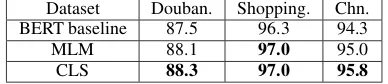
tached with users’ ratings. To this end, we can exploit CLS target for pre-training (similar with InferSent). We fine-tune these pre-trained models (with different targets) on downstream datasets. The results are shown in Table 4. BERT base-line (BERT-base Chinese) is pre-trained upon Chi-nese Wikipedia. We can observe that pre-training on Amazon review corpus can improve the results significantly. Using CLS target achieves the best results in most cases.
Dataset Douban. Shopping. Chn. BERT baseline 87.5 96.3 94.3
MLM 88.1 97.0 95.0
CLS 88.3 97.0 95.8
Table 4: Performance of pre-training models with dif-ferent targets.
BERT requires heavy computational resources. To achieve better efficiency, we use UER to substi-tute 12-layers Transformer encoder with a 2-layers LSTM encoder (embedding size and hidden size are 512 and 1024). We still use the above senti-ment analysis datasets for evaluation. The model is firstly trained on mixed large corpus with LM target, and then trained on large-scale Amazon re-view corpus with LM and CLS targets. Table 5 lists the results of different encoders. Compared with BERT baseline, LSTM encoder can achieve comparable or even better results when proper cor-pora and targets are selected.
Dataset Douban. Shopping. Chn. BERT baseline 87.5 96.3 94.3
LSTM 80.3 94.0 88.3
LSTM+pre-training 86.5 96.9 94.5
Table 5: Performance of pre-training models with dif-ferent encoders.
[image:5.595.309.519.622.667.2]in UER’s github project.
5 Conclusion
This paper describes UER, an open-source toolkit for pre-training on general-domain corpora and fine-tuning on downstream tasks. We demonstrate that UER can largely facilitate implementations of different pre-training models. With the help of UER, we pre-train models based on different corpora, encoders, targets and make these mod-els publicly available. By using proper pre-trained models, we can achieve significant improvements over BERT, or achieve competitive results with an efficient training speed.
Acknowledgments
This work is supported by National Natural Science Foundation of China Grant No.U1711262 and No.61472428, 2018 Tencent Rhino-Bird Elite Training Program.
References
Dzmitry Bahdanau, Kyunghyun Cho, and Yoshua Ben-gio. 2014. Neural machine translation by jointly learning to align and translate. arXiv preprint arXiv:1409.0473.
Alexis Conneau, Douwe Kiela, Holger Schwenk, Loic Barrault, and Antoine Bordes. 2017. Supervised learning of universal sentence representations from natural language inference data. EMNLP.
Andrew M Dai and Quoc V Le. 2015. Semi-supervised sequence learning. InNIPS.
Jacob Devlin, Ming-Wei Chang, Kenton Lee, and Kristina Toutanova. 2018. Bert: Pre-training of deep bidirectional transformers for language understand-ing. arXiv preprint arXiv:1810.04805.
Sepp Hochreiter and J¨urgen Schmidhuber. 1997. Long short-term memory.Neural computation, 9(8).
Jeremy Howard and Sebastian Ruder. 2018. Universal language model fine-tuning for text classification. arXiv preprint arXiv:1801.06146.
Armand Joulin, Edouard Grave, Piotr Bojanowski, and Tomas Mikolov. 2016. Bag of tricks for efficient text classification. arXiv preprint arXiv:1607.01759.
Yoon Kim. 2014. Convolutional neural networks for sentence classification. EMNLP.
Ryan Kiros, Yukun Zhu, Ruslan R Salakhutdinov, Richard Zemel, Raquel Urtasun, Antonio Torralba, and Sanja Fidler. 2015. Skip-thought vectors. In NIPS.
Guillaume Klein, Yoon Kim, Yuntian Deng, Jean Senellart, and Alexander M Rush. 2017. Opennmt: Open-source toolkit for neural machine translation. ACL.
Omer Levy, Yoav Goldberg, and Ido Dagan. 2015. Im-proving distributional similarity with lessons learned from word embeddings. TACL., 3.
Lajanugen Logeswaran and Honglak Lee. 2018. An efficient framework for learning sentence represen-tations.arXiv preprint arXiv:1803.02893.
Bryan McCann, James Bradbury, Caiming Xiong, and Richard Socher. 2017. Learned in translation: Con-textualized word vectors. InNIPS.
Tomas Mikolov, Ilya Sutskever, Kai Chen, Greg S Cor-rado, and Jeff Dean. 2013. Distributed representa-tions of words and phrases and their compositional-ity. InNIPS.
Myle Ott, Sergey Edunov, Alexei Baevski, Angela Fan, Sam Gross, Nathan Ng, David Grangier, and Michael Auli. 2019. fairseq: A fast, extensible toolkit for sequence modeling.NAACL.
Matthew E Peters, Mark Neumann, Mohit Iyyer, Matt Gardner, Christopher Clark, Kenton Lee, and Luke Zettlemoyer. 2018. Deep contextualized word rep-resentations. arXiv preprint arXiv:1802.05365.
Alec Radford, Karthik Narasimhan, Tim Salimans, and Ilya Sutskever. 2018. Improving language under-standing by generative pre-training.
Ashish Vaswani, Noam Shazeer, Niki Parmar, Jakob Uszkoreit, Llion Jones, Aidan N Gomez, Łukasz Kaiser, and Illia Polosukhin. 2017. Attention is all you need. InNIPS.
Alex Wang, Amanpreet Singh, Julian Michael, Felix Hill, Omer Levy, and Samuel R. Bowman. 2019. GLUE: A multi-task benchmark and analysis plat-form for natural language understanding. InICLR.
Jie Yang and Yue Zhang. 2018. Ncrf++: An open-source neural sequence labeling toolkit. arXiv preprint arXiv:1806.05626.
Xiang Zhang and Yann LeCun. 2017. Which encoding is the best for text classification in chinese, english, japanese and korean?
Zhe Zhao, Tao Liu, Shen Li, Bofang Li, and Xiaoyong Du. 2017. Ngram2vec: Learning improved word representations from ngram co-occurrence statistics. EMNLP.