24
When and Why is Document-level Context Useful
in Neural Machine Translation?
Yunsu Kim Duc Thanh Tran Hermann Ney
Human Language Technology and Pattern Recognition Group RWTH Aachen University, Aachen, Germany
{surname}@cs.rwth-aachen.de
Abstract
Document-level context has received lots of attention for compensating neural machine translation (NMT) of isolated sentences. However, recent advances in document-level NMT focus on sophisticated integration of the context, explaining its improvement with only a few selected examples or targeted test sets. We extensively quantify the causes of improvements by a document-level model in general test sets, clarifying the limit of the usefulness of document-level context in NMT. We show that most of the improvements are not interpretable as utilizing the context. We also show that a minimal encoding is sufficient for the context modeling and very long context is not helpful for NMT.
1 Introduction
Neural machine translation (NMT) (Bahdanau et al., 2015; Vaswani et al., 2017) has been ori-ginally developed to work sentence by sentence. Recently, it has been claimed that sentence-level NMT generates document-level errors, e.g. wrong coreference of pronouns/articles or inconsistent translations throughout a document (Guillou et al.,
2018;L¨aubli et al.,2018).
A lot of research addresses these problems by feeding surrounding context sentences as additio-nal inputs to an NMT model. Modeling of the con-text is usually done with fully-fledged NMT enco-ders with extensions to consider complex relati-ons between sentences (Bawden et al.,2018;Voita et al.,2018;Zhang et al., 2018;Miculicich et al.,
2018;Maruf et al.,2019). Despite the high over-head in modeling, translation metric scores (e.g. BLEU) are often only marginally improved, lea-ving the evaluation to artificial tests targeted for pronoun resolution (Jean et al.,2017;Tiedemann and Scherrer, 2017; Bawden et al., 2018; Voita
et al., 2018,2019). Even if the metric score gets significantly better, the improvement is limited to specific datasets or explained with only a few ex-amples (Tu et al.,2018;Maruf and Haffari,2018;
Kuang and Xiong, 2018; Cao and Xiong, 2018;
Zhang et al.,2018;Maruf et al.,2019).
This paper systematically investigates when and why document-level context improves NMT, as-king the following research questions:
• In general, how often is the context utilized in an interpretable way, e.g. coreference?
• Is there any other (non-linguistic) cause of improvements by document-level models?
• Which part of a context sentence is actually meaningful for the improvement?
• Is a long-range context, e.g. in ten consecuti-ve sentences, still useful?
• How much modeling power is necessary for the improvements?
To answer these questions, we conduct an ex-tensive qualitative analysis on non-targeted test sets. According to the analysis, we use only the important parts of the surrounding sentences to fa-cilitate the integration of long-range contexts. We also compare different architectures for the con-text modeling and check sufficient model comple-xity for a significant improvement.
Our results show that the improvement in BLEU is mostly from a non-linguistic factor: regularizati-on by reserving parameters for cregularizati-ontext inputs. We also verify that very long context is indeed not hel-pful for NMT, and a full encoder stack is not ne-cessary for the improved performance.
2 Document-level NMT
input. We illustrate with an example of including one previous source sentence as the document-level context, which can be easily generalized also to other context inputs such as target hypotheses (Agrawal et al., 2018; Bawden et al.,2018; Voi-ta et al.,2019) or decoder states (Tu et al.,2018;
Maruf and Haffari,2018;Miculicich et al.,2018). For the notations, we denote a source sentence byf and its encoded representations byH. A sub-script distinguishes the previous (pre) and current (cur) sentences. ei indicates a target token to be
predicted at positioni, and ei1−1 are already pre-dicted tokens in previous positions.Zdenotes en-coded representations of a partial target sequence.
2.1 Single-Encoder Approach
The simplest method to include context in NMT is to just modify the input, i.e. concatenate surroun-ding sentences to the current one and put the ex-tended sentence in a normal sentence-to-sentence model (Tiedemann and Scherrer, 2017;Agrawal et al.,2018). A special token is inserted between context and current sentences to mark sentence boundaries (e.g. BREAK ).
Figure 1 depicts this approach. Here, a single encoder processes the context and current sen-tences together as one long input. This requires no change in the model architecture but worsens a fundamental problem of NMT: translating long inputs (Koehn and Knowles,2017). Apart from the data scarcity of a higher-dimensional input space, it is difficult to optimize the attention component to the long spans (Sukhbaatar et al.,2019).
Encoderpre+cur Decoder
×N
Attention
fpre BREAK fcur ei−1
1
Hpre+cur
Z p ei|ei−1
1 ,fcur,fpre
[image:2.595.316.512.538.722.2]
Figure 1: Single-encoder approach.
2.2 Multi-Encoder Approach
Alternatively, multi-encoder approaches encode each additional sentence separately. The model learns representations solely of the context sen-tences which are then integrated into the baseli-ne model architecture. This tackles the integration of additional sentences on the architecture level, in contrast to the single-encoder approach. In the following, we describe two methods of integrating the encoded context sentences. The descriptions below do not depend on specific types of context encoding; one can use recurrent or self-attentive encoders with a variable number of layers, or just word embeddings without any hidden layers on top of them (Section3.1).
2.2.1 Integration Outside the Decoder
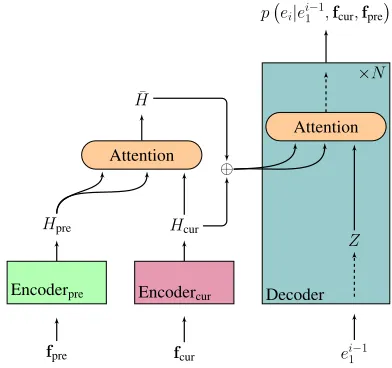
The first method combines encoder representation of all input sentences before being fed to the de-coder (Maruf and Haffari,2018;Voita et al.,2018;
Miculicich et al.,2018;Zhang et al.,2018;Maruf et al.,2019). It attends from the representations of the current sentence (Hcur) to those of the previous sentence (Hpre), yieldingH¯. Afterwards, a linear interpolation with gating is applied:
gH¯ + (1−g)Hcur (1)
whereg = σ Wg
¯ H;Hcur
+bg
is gating acti-vation andWg, bg are learnable parameters. This
type of integration is depicted in Figure 2. By using such a gating mechanism, the model is ca-pable of learning how much additional context in-formation shall be included.
Encodercur
Encoderpre
Attention
⊕
Decoder
×N
Attention
fcur
fpre ei1−1
Hcur Hpre
¯ H
Z p ei|ei−1
1 ,fcur,fpre
[image:2.595.93.270.545.725.2]
2.2.2 Integration Inside the Decoder
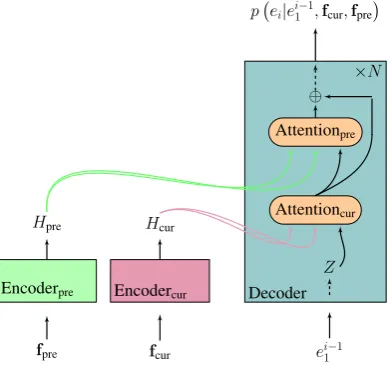
Another method integrates the context inside the decoder; the partial target history ei1−1 is availa-ble during the integration. Here, using the (enco-ded) target history as a query, the decoder attends directly to the context representations. It also has the original attention to the current sentence. De-pending on the order of these two attention com-ponents, this type of integration has two variants.
Sequential Attentions The first variant is
stacking the two attention components, with the output of one component being the query of ano-ther (Tu et al.,2018;Zhang et al.,2018).
Figure3 shows the case when the current sen-tence is attended by the decoder first, which is then used to attend to the context sentence. This refi-nes the regular attention to the current source sen-tence with additional context information. The or-der of the attention components may be switched. To block signals of potentially unimportant con-text information, a gating mechanism can be em-ployed between the regular and context attention outputs like Section2.2.1.
Encodercur
Encoderpre Decoder
×N
Attentioncur
Attentionpre
⊕
fcur
fpre ei1−1
Hcur Hpre
Z p ei|ei1−1,fcur,fpre
Figure 3: Multi-encoder approach integrating context inside the decoder with sequential attentions.
Parallel Attentions Figure 4 shows the case
when performing the two attention operations in parallel and combining them with a gating after-wards (Jean et al., 2017; Cao and Xiong, 2018;
Kuang and Xiong,2018;Bawden et al.,2018; Sto-janovski and Fraser, 2018). This method relates document-level context to the target history inde-pendently of the current source sentence, and lets the decoding computation faster.
Encodercur
Encoderpre Decoder
×N
Attentioncur
Attentionpre
⊕
fcur
fpre ei1−1
Hcur Hpre
Z p ei|ei1−1,fcur,fpre
[image:3.595.310.525.65.247.2]
Figure 4: Multi-encoder approach integrating context inside the decoder with parallel attentions.
For each category above, we have described a common architecture shared by previous works in that category. There are slight variations but they do not diverge much from our descriptions.
2.3 Filtering of Words in the Context
Document-level NMT inherently has heavy com-putations due to longer inputs and additional pro-cessing of context. However, intuitively, not all of the words in the context are actually useful in translating the current sentence. For instance, in most literature, the improvements from using document-level context are explained with corefe-rence, which can be resolved with just nouns, ar-ticles, and the conjugated words affected by them. Under the assumption that we do not need the whole context sentence in document-level NMT, we suggest to retain only the context words that are likely to be useful. This makes the training ea-sier with a smaller input space and less memory requirement. Concretely, we filter out words in the context sentences according to pre-defined word lists or predicted linguistic tags:
• Remove stopwords using a pre-defined list1
• Removen∈Nmost frequent words
• Retain only named entities
• Retain only the words with specific parts-of-speech (POS) tags
The first method has the same motivation as
Kuang et al.(2018) to ignore function words. The second method aims to keep infrequent words that
[image:3.595.85.280.407.590.2]Original source in recent years, I correctly foresaw that, in the absence of stronger fiscal stimulus (which was not forthcoming in either Europe or the United States), recovery from the Great Recession of 2008 would be slow.
Remove stopwords recent years, I correctly foresaw absence stronger fiscal stimulus (forth-coming Europe United States), recovery Great Recession 2008 slow.
Remove most frequent words
recent correctly foresaw absence stronger fiscal stimulus forthcoming either States recovery Great Recession 2008 slow
Retain named entities recent years Europe the United States the Great Recession 2008
[image:4.595.307.527.504.584.2]Retain specific POS years I foresaw the absence stimulus was forthcoming either Europe or the United States recovery the Great Recession 2008 would be
Table 1: Examples for filtering of words in the context (News Commentary v14 English→German).
are domain-specific or containing gender informa-tion. We empirically found that n = 150 works reasonably well. For the last two methods, we use the FLAIR2(Akbik et al.,2018) toolkit. We exclu-de the tags that are irrelevant to syntax/semantics of the current sentence. The detailed lists of retai-ned tags can be found in the appendix.
The filtering is performed on word level in the preprocessing. When a sentence is completely pru-ned, we use a special token to denote an empty sentence (e.g. EMPTY ). Table1 gives examples of the filtering. We can observe that the original sentence is shortened greatly by removing redun-dant tokens, but the topic information and the im-portant subjects still remain.
3 Experiments
We evaluate the document-level approaches in IWSLT 2017 English→Italian3 and WMT 2018 English→German4 translation tasks. We used TED talk or News Commentary v14 dataset as the training data respectively, preprocessed with the-Moses tokenizer5 and byte pair encoding ( Senn-rich et al., 2016) trained with 32k merge opera-tions jointly for source and target languages. In all our experiments, one previous source sentence was given as the document-level context. A speci-al token was inserted at each document boundary, which was also fed as context input when trans-lating sentences around the boundaries. Detailed corpus statistics are given in Table2.
All experiments were carried out with
2https://github.com/zalandoresearch/flair 3
https://sites.google.com/site/iwsltevaluation2017
4
https://www.statmt.org/wmt18/translation-task.html
5http://www.statmt.org/moses
SOCKEYE (Hieber et al., 2018). We used Adam optimizer (Kingma and Ba,2015) with the default parameters. The learning rate was reduced by 30% when the perplexity on a validation set was not improving for four checkpoints. When it did not improve for ten checkpoints, we stopped the training. Batch size was 3k tokens, where the bucketing was done for a tuple of current/context sentence lengths. All other settings follow a 6-layer base Transformer model (Vaswani et al.,
2017).
In all our experiments, a sentence-level model was pre-trained and used to initialize document-level models, which was crucial for the performan-ce. We also shared the source word embeddings over the original and context encoders.
en-it en-de
Running Words 4.3M 8.1M
Sentences 227k 329k
Documents 2,045 8,891
Document Length (avg. #sent) 111 37
Table 2: Training data statistics.
3.1 Model Comparison
Model Architecture Firstly, we compare the
performance of existing single-encoder and multi-encoder approaches (Table 3). For each category of document-level methods (Section 2), we test one representative architecture (Figures 2, 3, 4) which encompasses all existing work in that cate-gory except slight variations. The tested methods are equal or closest to:
Context Encoder en-it en-de
Approach Architecture #layers BLEU[%] TER[%] BLEU[%] TER[%]
Baseline · · 31.4 56.1 28.9 61.8
Single-Encoder Transformer 6 31.5 57.2 28.9 61.4
Multi-Encoder (Out.) Transformer 6 31.3 56.1 29.1 61.4
Multi-Encoder (Seq.) Transformer 6 32.6 55.2 29.9 60.7
Multi-Encoder (Para.) Transformer
6 32.7 54.7 30.1 60.3
2 32.6 55.2 30.2 60.5
1 32.2 55.8 30.0 60.4
Word Embedding · 32.5 54.8 30.3 59.9
Table 3: Comparison of document-level model architectures and complexity.
• Integration outside the decoder: Voita et al.
(2018) without sharing the encoder hidden layers over current/context sentences
• Integration inside the decoder
– Sequential attention: Decoder integrati-on ofZhang et al.(2018) with the order of attentions (current/context) switched – Parallel attention: Gating version of
Ba-wden et al.(2018)
The training of the single-encoder method was quite unstable. It took about twice as long as other document-level models, yet yielding no improve-ments, which is consistent withKuang and Xiong
(2018). Longer inputs make the encoder-decoder attention widely scattered and harder to optimi-ze. We might need larger training data, massi-ve pre-training, and much larger batches to train the single-encoder approach effectively ( Junczys-Dowmunt, 2019); however, these conditions are often not realistic.
For the multi-encoder models, if the context is integrated outside the decoder (“Out.”), it barely improves upon the baseline. By letting the deco-der directly access context sentences with a sepa-rate attention component, they all outperform the single-encoder method, improving the sentence-level baseline up to +1.4% BLEUand -1.9% TER. Particularly, when attending to current and context sentences in parallel (“Para.”), it provides more flexible and selective information flow from mul-tiple source sentences to the decoder, thus produ-cing better results than the sequential attentions (“Seq.”).
Model Complexity In the linguistic sense,
sur-rounding sentences are useful in translating the current sentence mostly by providing case distinc-tions of nouns or topic information (Section 4). The sequential relation of tokens in the surroun-ding sentences is important for neither of them. Therefore we investigate how many levels of se-quential encoding is actually needed for the impro-vement by the context. From a 6-layer Transfor-mer encoder, we gradually reduce the model com-plexity of the context encoder: 2-layer, 1-layer, and only using word embeddings without any se-quential encoding. We remove positional encoding (Vaswani et al.,2017) when we encode only with word embeddings.
The results are shown in the lower part of Ta-ble 3. Context encoding without any sequenti-al modeling (the last row) shows indeed compa-rable performance to using a full 6-layer enco-der. This simplified encoding eases the memory-intensive document-level training by having 22% fewer model parameters, which allows us to adopt a larger batch size without accumulating gradients. For the remainder of this paper, we stick to using the multi-encoder approach with parallel attention components in the decoder and restricting the con-text encoding to only word embeddings.
3.2 Filtering Words in the Context
en-it en-de
Context sentence BLEU[%] TER[%] BLEU[%] TER[%] #tokens
None 31.4 56.1 28.9 61.8
-Full sentence 32.5 54.8 30.3 59.9 100%
Remove stopwords 32.2 55.2 30.3 59.9 63%
Remove most frequent words 32.1 55.6 30.2 60.2 51%
Retain only named entities 32.3 55.4 30.3 60.3 13%
[image:6.595.107.493.65.193.2]Retain specific POS 32.5 55.2 30.4 60.0 59%
Table 4: Comparison of context word filtering methods.
0 5 10 15 20
Context Length 29.5
30.0 30.5 31.0 31.5 32.0 32.5 33.0
BLEU[%]
Full sentence Retain named entities Retain specific POS
(a) IWSLTen-it
0 5 10 15 20
Context Length 28.0
28.5 29.0 29.5 30.0 30.5 31.0
BLEU[%]
Full sentence Retain named entities Retain specific POS
(b) WMTen-de
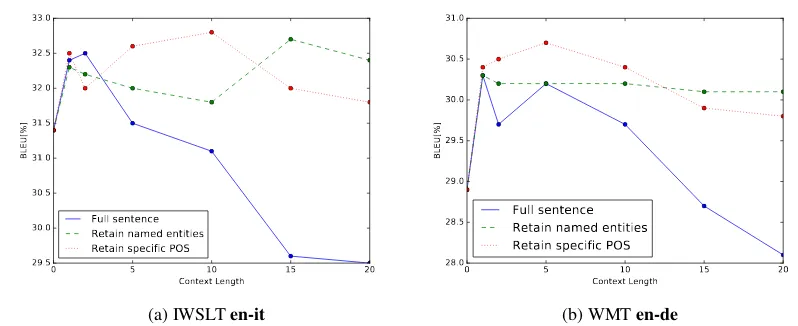
Figure 5: Translation performance as a function of document-level context length (in the number of sentences).
context; the results show that they are all reasona-ble in practice. In particular, using only named en-tities as context input, we achieve the same level of improvement with only 13% of tokens in the full context sentences. By filtering words in the con-text sentences, we can use more examples in each batch for a robust training.
3.3 Context Length
Filtered context inputs (Section 3.2) with a mi-nimal encoding (Section 3.1) make it also feasi-ble to include much longer context without much difficulty. Most of previous works on document-level NMT have not examined context inputs lon-ger than three sentences.
Figure5shows the translation performance with an increasing number of context sentences. If we concatenate full context sentences (plain curves), the performance deteriorates severely. We found that it is hard to fit such long sequences in memory as the training becomes very erratic.
The training is much more stable with filte-red context; the dashed/dotted curves do not drop significantly even when using 20 context
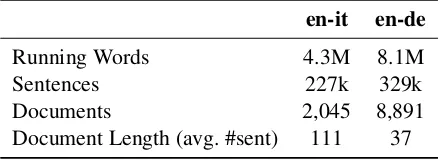
sen-tences. In the English→Italian task, the perfor-mance slightly improves up to 15 context sen-tences. In the English→German task, there is no improvement by extending the context length over 5 sentences. This discrepancy can be explained with document lengths in each dataset (Table 2). The TED talk corpus for English→Italian has much longer documents, thus it is probable to be-nefit from larger context windows. However, in ge-neral we observe only marginal improvements by enlarging the context length to more than one sen-tence, as seen also inBawden et al.(2018), Micu-licich et al.(2018), orZhang et al.(2018).
4 Analysis
[image:6.595.92.491.234.397.2]models; automatic metrics are inherently not sui-table for distinguishing document-level behavior. Our analysis is not constrained to certain discour-se phenomena which are favored in evaluating document-level models. We quantify various cau-ses of the improvements 1) regardless of its lingui-stic interpretability and 2) in a realilingui-stic scenario where not all the test examples require document-level context. Here are the steps we take:
1. Translate a test set with a sentence-level ba-seline and a document-level model.
2. Compute per-sentence TERscores of outputs from both models.
3. Select those cases where the document-level model improves the per-sentence TER over the sentence-level baseline.
4. Examine each case of 3 by looking at:
• Source, context, and translation outputs
• Attention distribution over the context tokens for each target token: averaged over all decoder layers/heads
• Gating activation (Equation1)
5. Classify each case into “coreference”, “topic-aware lexical choice”, or “not interpretable”.
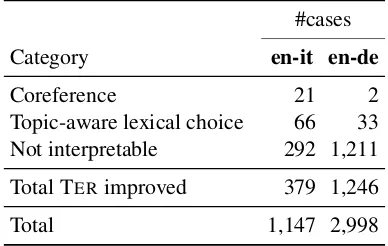
Statistics of each category on the test sets are re-ported in Table5. The manual inspection of trans-lation outputs is done by a native-level speaker of Italian or German, respectively.
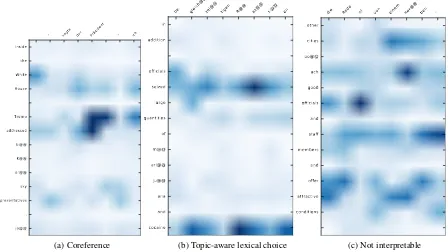
Only a couple of cases belong to coreference, which is ironically the most advocated improve-ment in the literature on docuimprove-ment-level NMT. One of them is shown in Table 6a. In the document-level NMT, the English word “said” is translated to a correct conjugation of “sagen” (= say) for the third person noun “der Pr¨asident” (= the President). This can be explained by the high attention energy on “Trump” (Figure 7a) in the context sentence.
Another interpretable cause is topic-aware lexi-cal choice (Table 6b). The document-level model actively attends to “seized” and “cocaine” in the context sentence (Figure 7b), and does not miss the source word “raids” in the translation (“Raz-zien”). When it corrects the translation of polyse-mous words, it is related to word sense disambi-guation (Gonzales et al.,2017;Marvin and Koehn,
2018;Pu et al.,2018). This category includes also a coherence of text style in the translation outputs, depending on the context topic.
#cases
Category en-it en-de
Coreference 21 2
Topic-aware lexical choice 66 33
Not interpretable 292 1,211
Total TERimproved 379 1,246
Total 1,147 2,998
Table 5: Causes of improvements by document-level context.
We found that only 7.5% of the TER-improved cases can be interpreted as utilizing document-level context. The other cases are mostly general improvements in adequacy or fluency which are not related to the given context. Table 6c shows such an example. It improves the translation by a long-range reordering and rephrasing some nouns, whose clues do not exist in the previous source sentence. Its attention distribution over the context words is totally random and blurry (Figure7c).
A possible reason for the non-interpretable im-provements is regularization of the model, since the training data of our experiments are relative-ly small. Figure6shows that, for most of the im-proved cases, the model has non-negligible gating activation towards document-level context, even if the output seems not to benefit from the context. It means that, when combining the encoded repre-sentations of context/current sentences, the model can reserve some of its capacity to the information from context inputs. This might effectively mitiga-te overfitting to the given training data.
0.20 0.25 0.30 0.35 0.40 0.45 0.50 Avg. Gate Activation
0 100 200 300 400 500 600 700
[image:7.595.319.513.63.186.2]Number of Sentences
Figure 6: Gating activation for all TER-improved cases
of the English→German task, averaged over all layers
[image:7.595.309.517.553.716.2]Previous src inside the White House, Trump addressed Sikorsky representatives, joking with the media about his own fleet of company products.
Current src “I know Sikorsky very well,” the President said, “I have three of them.”
Reference
”ich kenne Sikorsky sehr gut“, sagte der Pr¨asident,”ich habe drei davon.“ Sent-level hyp
”ich kenne Sikorsky sehr gut“,soder Pr¨asident,”habe drei davon.“ Doc-level hyp
”ich kenne Sikorsky sehr gut,“ sagteder Pr¨asident,”ich habe drei davon“. (a) Coreference
Previous src in addition, officials seized large quantities of marijuana and cocaine, firearms and
several hundred thousand euros.
Current src at simultaneous raids in Italy, two people were detained.
Reference bei zeitgleichen Razzien in Italien wurden zwei Personen festgenommen.
Sent-level hyp gleichzeitig wurden in Italien zwei Personen verhaftet.
Doc-level hyp bei gleichzeitigenRazzienin Italien wurden zwei Menschen inhaftiert.
(b) Topic-aware lexical choice
Previous src other cities poach good officials and staff members and offer attractive conditions.
Current src the talk is of a downright “contest between public employers”.
Reference die Rede ist von einem regelrechten
”Wettbewerb der ¨offentlichen Arbeitgeber“.
Sent-level hyp das Gerede ber einen
”Wettkampf zwischen ¨offentlichen Arbeitgebern“ ist von einem Gerechtigkeitstreit.
Doc-level hyp die Rede ist von einem herben
”Wettbewerb zwischen ¨offentlichen Arbeitgebern“. (c) Not interpretable
Table 6: Example translation outputs for each analysis category (WMT English→German newstest2018).
, " sagte der Präsident , " ich
inside
the
White
House
,
Trump
addressed
Si@@
k@@
or@@
sky
representatives ,
jo@@
(a) Coreference
bei gleich@@zei@@ tigen R@@ az@@ zi@@ en in
addition
,
officials
seized
large
quantities
of
m@@
ari@@
ju@@
ana
and
cocaine
(b) Topic-aware lexical choice
die Rede ist von einem her@@ ben " other
cities
po@@
ach
good
officials
and
staff
members
and
offer
attractive
conditions
.
[image:8.595.78.526.477.729.2](c) Not interpretable
BLEU[%]
Condition System en-it en-de
Dropout 0.1 Sentence-level 31.4 28.9 Document-level 32.5 30.3
Dropout 0.3 Sentence-level 33.7 32.3 Document-level 33.5 32.0
Large training data Sentence-level - 40.2
[image:9.595.74.288.70.198.2]Document-level - 39.9
Table 7: Sentence-level vs. document-level translation performance in different data/training conditions.
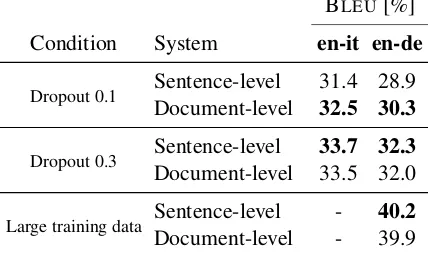
We argue that the linguistic improvements with document-level NMT have been sometimes over-sold, and the document-level components should be tested on top of a well-regularized NMT sys-tem. In our experiments, we obtain a much stron-ger sentence-level baseline by applying a sim-ple regularization (dropout), which the document-level model cannot outperform (Table7).
On a larger scale, we also built a sentence-level model with all parallel training data available for the WMT 2019 task and fine-tuned only with document-level data (Europarl, News Commenta-ry, newstest2008-2014/2016). The document-level training does not give any improvement in BLEU (last two rows of Table 7). There may exist document-level improvements which are not high-lighted by the automatic metrics, but the amount of such improvements must be very small without a clear gain in BLEUor TER.
5 Conclusion
In this work, we critically investigate the advanta-ges of document-level NMT with a thorough qua-litative analysis and expose the limit of its im-provements in terms of context length and model complexity. Regarding the questions asked in Sec-tion1, our answers are:
• In general, document-level context is utilized rarely in an interpretable way.
• We conjecture that a dominant cause of the improvements by document-level NMT is ac-tually the regularization of the model.
• Not all of the words in the context are used in the model; we leave out redundant tokens without loss of performance.
• A long-range context gives only marginal ad-ditional improvements.
• Word embeddings are sufficient to model document-level context.
For a fair evaluation of document-level NMT methods, we argue that one should make a sentence-level NMT baseline as strong as possi-ble first, i.e. by using more data or applying pro-per regularization. This will get rid of by-product improvements from additional information flows and help to focus only on document-level errors in translation. In this condition, we show that document-level NMT can barely improve trans-lation metric scores against such strong baseli-nes. Targeted test sets (Bawden et al.,2018; Voi-ta et al., 2019) might be helpful here to empha-size the document-level improvements. However, one should bear in mind that a big improvement in such test sets may not carry over to practical sce-narios with general test sets, where the number of document-level errors in translation is inherently small.
Given these conclusions, a future research di-rection would be building a lightweight post-editing model to correct only document-level er-rors, not complicating the sentence-level model too much for a very limited amount of document-level improvements. To strengthen our arguments, we also plan to conduct the same qualitative analy-sis on other types of context inputs (e.g. translation history) and different domains.
Our implementation of document-level NMT methods is publicly available on the web.6
Acknowledgments
This work has received funding from the Euro-pean Research Council (ERC) (under the Euro-pean Union’s Horizon 2020 research and innovati-on programme, grant agreement No 694537, pro-ject “SEQCLAS”). The work reflects only the au-thors’ views and none of the funding agencies is responsible for any use that may be made of the information it contains.
The authors thank Tina Raissi for analyzing English→Italian translations.
6https://github.com/ducthanhtran/
References
Ruchit Rajeshkumar Agrawal, Marco Turchi, and Mat-teo Negri. 2018. Contextual handling in neural ma-chine translation: Look behind, ahead and on both
sides. In21st Annual Conference of the European
Association for Machine Translation, pages 11–20.
Alan Akbik, Duncan Blythe, and Roland Vollgraf. 2018. Contextual string embeddings for sequence
labeling. In Proceedings of the 27th International
Conference on Computational Linguistics, COLING 2018, Santa Fe, New Mexico, USA, August 20-26,
2018, pages 1638–1649.
Dzmitry Bahdanau, Kyunghyun Cho, and Yoshua
Ben-gio. 2015. Neural machine translation by jointly
learning to align and translate. In 3rd
Internatio-nal Conference on Learning Representations, ICLR 2015, San Diego, CA, USA, May 7-9, 2015, Confe-rence Track Proceedings.
Rachel Bawden, Rico Sennrich, Alexandra Birch, and
Barry Haddow. 2018. Evaluating discourse
phe-nomena in neural machine translation. In
Procee-dings of the 2018 Conference of the North American Chapter of the Association for Computational Lin-guistics: Human Language Technologies, Volume 1 (Long Papers), pages 1304–1313.
Qian Cao and Deyi Xiong. 2018. Encoding gated
translation memory into neural machine translation. In Proceedings of the 2018 Conference on Empiri-cal Methods in Natural Language Processing, pages 3042–3047.
Annette Rios Gonzales, Laura Mascarell, and Rico Sennrich. 2017. Improving word sense disambigua-tion in neural machine transladisambigua-tion with sense
embed-dings. InProceedings of the Second Conference on
Machine Translation, pages 11–19.
Liane Guillou, Christian Hardmeier, Ekaterina
Lapshinova-Koltunski, and Sharid Lo´aiciga. 2018. A pronoun test suite evaluation of the english–
german mt systems at wmt 2018. In Proceedings
of the Third Conference on Machine Translation: Shared Task Papers, pages 570–577.
Felix Hieber, Tobias Domhan, Michael Denkowski, David Vilar, Artem Sokolov, Ann Clifton, and Matt Post. 2018. The sockeye neural machine translation
toolkit at AMTA 2018. In Proceedings of the 13th
Conference of the Association for Machine Transla-tion in the Americas, AMTA 2018, Boston, MA, USA, March 17-21, 2018 - Volume 1: Research Papers, pa-ges 200–207.
Sebastien Jean, Stanislas Lauly, Orhan Firat, and Kyunghyun Cho. 2017. Does neural machine
trans-lation benefit from larger context? arXiv preprint
arXiv:1704.05135.
Marcin Junczys-Dowmunt. 2019. Microsoft translator at wmt 2019: Towards large-scale document-level
neural machine translation. In Proceedings of the
Fourth Conference on Machine Translation (WMT), Volume 2: Shared Task Papers, pages 424–432, Flo-rence, Italy.
Diederik P. Kingma and Jimmy Ba. 2015. Adam: A
method for stochastic optimization. In 3rd
Inter-national Conference on Learning Representations, ICLR 2015, San Diego, CA, USA, May 7-9, 2015, Conference Track Proceedings.
Philipp Koehn and Rebecca Knowles. 2017. Six
chal-lenges for neural machine translation. In
Procee-dings of the First Workshop on Neural Machine Translation, pages 28–39.
Shaohui Kuang and Deyi Xiong. 2018. Fusing
re-cency into neural machine translation with an
inter-sentence gate model. In Proceedings of the 27th
International Conference on Computational Lingui-stics, pages 607–617.
Shaohui Kuang, Deyi Xiong, Weihua Luo, and Guo-dong Zhou. 2018. Modeling coherence for neural machine translation with dynamic and topic caches. InProceedings of the 27th International Conference on Computational Linguistics, pages 596–606.
Samuel L¨aubli, Rico Sennrich, and Martin Volk. 2018. Has machine translation achieved human parity? a
case for document-level evaluation. InProceedings
of the 2018 Conference on Empirical Methods in Natural Language Processing, pages 4791–4796.
Sameen Maruf and Gholamreza Haffari. 2018. Docu-ment context neural machine translation with
me-mory networks. InProceedings of the 56th Annual
Meeting of the Association for Computational Lin-guistics (Volume 1: Long Papers), pages 1275–1284.
Sameen Maruf, Andr´e FT Martins, and Gholamreza Haffari. 2019. Selective attention for context-aware
neural machine translation. In Proceedings of the
2019 Conference of the North American Chapter of the Association for Computational Linguistics: Hu-man Language Technologies, Volume 1 (Long and Short Papers), pages 3092–3102.
Rebecca Marvin and Philipp Koehn. 2018. Exploring word sense disambiguation abilities of neural ma-chine translation systems (non-archival extended
ab-stract). InProceedings of the 13th Conference of the
Association for Machine Translation in the Ameri-cas (Volume 1: Research Papers), pages 125–131.
Lesly Miculicich, Dhananjay Ram, Nikolaos Pappas, and James Henderson. 2018. Document-level neural machine translation with hierarchical attention
net-works. InProceedings of the 2018 Conference on
Empirical Methods in Natural Language
Proces-sing, pages 2947–2954.
Xiao Pu, Nikolaos Pappas, James Henderson, and An-drei Popescu-Belis. 2018. Integrating weakly super-vised word sense disambiguation into neural
machi-ne translation. Transactions of the Association for
Rico Sennrich, Barry Haddow, and Alexandra Birch. 2016. Neural machine translation of rare words with
subword units. InProceedings of the 54th Annual
Meeting of the Association for Computational Lin-guistics (Volume 1: Long Papers), volume 1, pages 1715–1725.
Dario Stojanovski and Alexander Fraser. 2018. Core-ference and coherence in neural machine translation:
A study using oracle experiments. InProceedings of
the Third Conference on Machine Translation: Rese-arch Papers, pages 49–60.
Sainbayar Sukhbaatar, Edouard Grave, Piotr Bojanow-ski, and Armand Joulin. 2019. Adaptive attention
span in transformers. InProceedings of the 57th
An-nual Meeting of the Association for Computational Linguistics, Florence, Italy.
J¨org Tiedemann and Yves Scherrer. 2017. Neural
ma-chine translation with extended context. In
Procee-dings of the Third Workshop on Discourse in Machi-ne Translation, pages 82–92.
Zhaopeng Tu, Yang Liu, Shuming Shi, and Tong Zhang. 2018. Learning to remember translation
his-tory with a continuous cache. Transactions of the
Association for Computational Linguistics, 6:407– 420.
Ashish Vaswani, Noam Shazeer, Niki Parmar, Jakob Uszkoreit, Llion Jones, Aidan N. Gomez, Lukasz Kaiser, and Illia Polosukhin. 2017. Attention is all
you need. InAdvances in Neural Information
Pro-cessing Systems 30: Annual Conference on Neural Information Processing Systems 2017, 4-9 Decem-ber 2017, Long Beach, CA, USA, pages 5998–6008.
Elena Voita, Rico Sennrich, and Ivan Titov. 2019. When a good translation is wrong in context: Context-aware machine translation improves on dei-xis, ellipsis, and lexical cohesion. InProceedings of the 57th Annual Meeting of the Association for Com-putational Linguistics (ACL 2019), pages 1198– 1212, Florence, Italy.
Elena Voita, Pavel Serdyukov, Rico Sennrich, and Ivan Titov. 2018. Context-aware neural machine
trans-lation learns anaphora resolution. InProceedings of
the 56th Annual Meeting of the Association for Com-putational Linguistics (Volume 1: Long Papers), pa-ges 1264–1274.
Jiacheng Zhang, Huanbo Luan, Maosong Sun, Feifei Zhai, Jingfang Xu, Min Zhang, and Yang Liu. 2018. Improving the transformer translation model with
document-level context. InProceedings of the 2018