Joint Decoding of Tree Transduction Models for Sentence Compression
Jin-ge Yao Xiaojun Wan Jianguo Xiao
Institute of Computer Science and Technology, Peking University, Beijing 100871, China Key Laboratory of Computational Linguistic (Peking University), MOE, China
{yaojinge, wanxiaojun, xiaojianguo}@pku.edu.cn
Abstract
In this paper, we provide a new method for decoding tree transduction based sentence compression models augmented with lan-guage model scores, by jointly decoding two components. In our proposed so-lution, rich local discriminative features can be easily integrated without increasing computational complexity. Utilizing an unobvious fact that the resulted two com-ponents can be independently decoded, we conduct efficient joint decoding based on dual decomposition. Experimental results show that our method outperforms tradi-tional beam search decoding and achieves the state-of-the-art performance.
1 Introduction
Sentence compression is the task of generating a grammatical and shorter summary for a long sen-tence while preserving its most important informa-tion. One specific instantiation is deletion-based compression, namely generating a compression by dropping words. Various approaches have been proposed to challenge the task of deletion-based compression. Earlier pioneering works (Knight and Marcu, 2000) considered several insightful approaches, including noisy-channel based gen-erative models and discriminative decision tree models. Structured discriminative compression models (McDonald, 2006) are capable of inte-grating rich features and have been proved effec-tive for this task. Another powerful paradigm for sentence compression should be mentioned here is constraints-based compression,including inte-ger linear programming solutions (Clarke and La-pata, 2008) and first-order Markov logic networks (Huang et al., 2012; Yoshikawa et al., 2012).
A notable class of methods that explicitly deal with syntactic structures are tree transduction
models (Cohn and Lapata, 2007; Cohn and Lap-ata, 2009). In such models a synchronous gram-mar is extracted from a corpus of parallel syn-tax trees with leaves aligned. Compressions are generated from the grammar with learned weights. Previous works have noticed that local coherence is usually needed by introducing ngram language model scores, which will make accurate decoding intractable. Traditional approaches conduct beam search to find approximate solutions (Cohn and Lapata, 2009).
In this paper we propose a joint decoding strat-egy to challenge this decoding task. We ad-dress the problem as jointly decoding a simple tree transduction model that only considers rule weights and an ngram compression model. Al-though either part can be independently solved by dynamic programming, the naive way to integrate two groups of partial scores into a huge dynamic programming chart table is computationally im-practical. We provide an effective dual decompo-sition solution that utilizes the efficient decoding of both parts. By integrating rich structured fea-tures that cannot be efficiently involved in normal formulation, results get significantly improved.
2 Motivation
Under the tree transduction models, the sentence compression task is formulated as learning a map-ping from an input source syntax tree to a target tree with reduced number of leaves. This map-ping is known as a synchronous grammar. The synchronous grammar discussed through out this paper will be synchronous tree substitution gram-mar (STSG), as in previous studies.
In such formulations, sentence compression is finding the best derivation from a syntax tree that produces a simpler target tree, under the current definition of grammar and learned parameters. Each derivation is attached with a score. For the sake of efficient decoding, the score often
poses with rules involved in the derivation. A typ-ical score definition for a derivation y of source tree x is in such form (Cohn and Lapata, 2008; Cohn and Lapata, 2009):
S(x,y)=X
r∈y wTφ
r(x)+logP(ngram(y)) (1) The first term is a weighted sum of featuresφr(x) defined on each ruler. It is plausible to introduce local scores from ngram models. The second term in the above score definition is added with such purpose.
Cohn and Lapata (2009) explained that ex-act decoding of Equation 1 is intrex-actable. They proposed a beam search decoding strategy cou-pled with cube-pruning heuristic (Chiang, 2007), which can further improve decoding efficiency at the cost of largely losing exactness in log probabil-ity calculations. For efficiency reasons, rich local ngram features have not been introduced as well.
3 Components of Joint Decoding
The score in Equation 1 consists of two parts: sum of weighted rule features and local ngram scores retrieved from a language model. There is an im-plicit fact that either part can be used alone with slight modifications to generate a coarse candidate compression. Therefore, we can build a joint de-coding system that consists of these two indepen-dently decodable components.
In this section we will refer to these two in-dependent models as the pure tree transduction model and the pure ngram compression model, described in Section 3.1 and Section 3.2 respec-tively. There is a direct generalization of the ngram model by introducing rich local features, which results in the structured discriminative mod-els (Section 3.3).
3.1 Pure Tree Transduction model
By merely considering scores from tree transduc-tion rules, i.e. the first part of Equatransduc-tion 1, we can have our scores factorized with rules. Then finding the best derivation from a STSG grammar can be easily solved by a dynamic programming process described by Cohn and Lapata (2007).
This simplified pure tree transduction model can still produce decent compressions if the rule weights are properly learned during training.
3.2 Pure Ngram based Compression
The pure ngram based model will try to find the most locally smooth compression, reflected by having the maximum log probability score of ngrams.
To avoid the trivial solution of deleting all words, we find the target compression with speci-fied length by dynamic programming.
Furthermore, we can integrate features other than log probabilities. This is equivalent to using a structured discriminative model with rich features on ngrams of candidate compressions.
3.3 Structured Discriminative Model
The structured discriminative model proposed by McDonald (2006) defines rich features on bigrams of possible compressions. The score is defined as weighted linear combination of those features:
f(x,z) =
|z|
X
j=2
w·f(x, L(zj−1), L(zj)) (2) where the functionL(zk)maps a tokenzkin com-pression z back to the index of the original sen-tencex. Decoding can still be efficiently done by dynamic programming.
With rich local structural information, the struc-tured discriminative model can play a complemen-tary role to the tree transduction model that focus more on global syntactic structures.
4 Joint Decoding
From now on the remaining issue is jointly de-coding the components. Either part factorizes over local structures: rules for the tree transduc-tion model and ngrams for the language model or structured discriminative model. We may build a large dynamic programming table to utilize this kind of locality. Unfortunately this is computa-tionally impractical. It is mathematically equiva-lent to perform exact dynamic programming de-coding of Equation 1, which would consume asymptotically O(SRL2(n−1)V)1 time for
build-ing the chart (Cohn and Lapata, 2009). Cohn and Lapata (2009) proposed a beam search approxima-tion along with cube-pruning heuristics to reduce the time complexity down toO(SRBV)2.
1S, R, L andV denote respectively for the number of
source tree nodes, the number of rules, size of target lexicon and number of variables involved in each rule.
In this work we utilize the efficiency of indepen-dent decoding from the two components respec-tively and then combine their solutions according to certain standards. This naturally results in a dual decomposition (Rush et al., 2010) solution.
Dual decomposition has been applied in sev-eral natural language processing tasks, including dependency parsing (Koo et al., 2010), machine translation (Chang and Collins, 2011; Rush and Collins, 2011) and information extraction (Re-ichart and Barzilay, 2012). However, the strength of this inference strategy has seldom been noticed in researches on language generation tasks.
We briefly describe the formulation here.
4.1 Description
We denote the pure tree transduction part and the pure ngram part as g(y) and f(z) respectively. Then joint decoding is equivalent to solving:
max
y∈Y,z∈Z g(y) +f(z) (3)
s.t. zkt=ykt, ∀k∈ {1, ..., n}, ∀t∈ {0,1}, whereydenotes a derivation which yields a final compression{y1, ...,ym}. This derivation comes from a pure tree transduction model.zdenotes the compression composed of {z1, ...,zm} from an
ngram compression model. Without loss of gener-ality, we considerykandzkas indicators that take value 1 if the k’s token of original sentence has been preserved in the compression and 0 if it has been deleted. In the constraints of problem 3,ykt orzktdenote indicator variables that take value 1 ifykorzk=tand 0 otherwise.
LetL(u,y,z) be the Lagrangian of (3). Then the dual objective naturally factorizes into two parts that can be evaluated independently:
L(u) = max
y∈Y,z∈ZL(u,y,z)
= max
y∈Y,z∈Zg(y) +f(z) +
X
k,t
ukt(zkt−ykt)
= max
y∈Y(g(y)−
X
k,t
uktykt) +
max
z∈Z(f(z) +
X
k,t
uktzkt)
With this factorization, Algorithm 1 tries to solve the dual problemminuL(u)by alternatively decoding each component.
This framework is feasible and plausible in that the two subproblems (line 3 and line 4 in Algo-rithm 1) can be easily solved with slight
modifica-Algorithm 1Dual Decomposition Joint Decoding
1: Initialization:u(0)k = 0, ∀k∈ {1, ..., n} 2: fori= 1toMAX IT ERdo
3: y(i)←argmax
y∈Y(g(y)−Pk,tu(ikt−1)ykt) 4: z(i)←argmax
z∈Z(f(z) +Pk,tu(ikt−1)zkt) 5: ify(i)
kt =z(i)kt ∀k∀tthen 6: return (y(i),z(i)) 7: else
8: u(i)
kt ←u(ikt−1)−δi(z(i)kt −y(i)kt) 9: end if
10: end for
tions on the values of the original dynamic pro-gramming chart. Joint decoding of a pure tree transduction model and a structured discriminative model is almost the same.
The asymptotic time complexity of Algorithm 1 is O(k(SRV +L2(n−1))), where k denotes the
number of iterations. This is a significant re-duction of O(SRL2(n−1)V) by directly solving the original problem and is also comparable to O(SRBV)of conducting beam search decoding.
We apply a similar heuristic with Rush and Collins (2012) to set the step sizeδi = t+11 , where t < iis the number of past iterations that increase the dual value. This setting decreases the step size only when the dual value moves towards the wrong direction. We limit the maximum iteration number to 50 and return the best primal solution y(i)among all previous iterations for cases that do
not converge in reasonable time.
5 Experiments
5.1 Baselines
The pure tree transduction model and the discrim-inative model naturally become part of our base-lines for comparison 3. Besides comparing our
methods against the tree-transduction model with ngram scores by beam search decoding, we also compare them against the available previous work from Galanis and Androutsopoulos (2010). This state-of-the-art work adopts a two-stage method to rerank results generated by a discriminative maxi-mum entropy model.
5.2 Data Preparation
We evaluated our methods on two standard cor-pora4, refer to as Written and Spoken respectively. 3The pure ngram language model should not be
consid-ered here as it requires additional length constraints and in general does not produce competitive results at all merely by itself.
We split the datasets according to Table 1. Table 1: Dataset partition (number of sentences)
Corpus Training Development Testing
Written 1,014 324 294
Spoken 931 83 254
All tree transduction models require parallel parse trees with aligned leaves. We parsed all sen-tences with the Stanford Parser5and aligned
sen-tence pairs with minimum edit distance heuristic
6. Syntactic features of the discriminative model
were also taken from these parse trees.
For systems involving ngram scores, we trained a trigram language model on the Reuters Corpus (Volume 1) 7 with modified Kneser-Ney
smooth-ing, using the widely used tool SRILM8.
5.3 Model Training
The training process of a tree transduction model followed similarly to Cohn and Lapata (2007) us-ing structured SVMs (Tsochantaridis et al., 2005). The structured discriminative models were trained according to McDonald (2006).
5.4 Evaluation Metrics
We assessed the compression results by the F1-score of grammatical relations (provided by a dependency parser) of generated compressions against the gold-standard compression (Clarke and Lapata, 2006). All systems were controlled to pro-duce similar compression ratios (CR) for fair com-parison. We also reported manual evaluation on a sampled subset of 30 sentences from each dataset. Three unpaid volunteers with self-reported fluency in English were asked to rate every candidate. Rat-ings are in the form of 1-5 scores for each com-pression.
6 Results
We report test set performance of the struc-tured discriminative model, the pure tree transduc-tion (T3), Galanis and Androutsopoulos (2010)’s method (G&A2010), tree transduction with lan-guage model scores by beam search and the pro-posed joint decoding solutions.
5http://nlp.stanford.edu/software/lex-parser.shtml 6Ties were broken by always aligning a token in
compres-sion to its last appearance in the original sentence. This may better preserve the alignments of full constituents.
7http://trec.nist.gov/data/reuters/reuters.html 8http://www-speech.sri.com/projects/srilm/
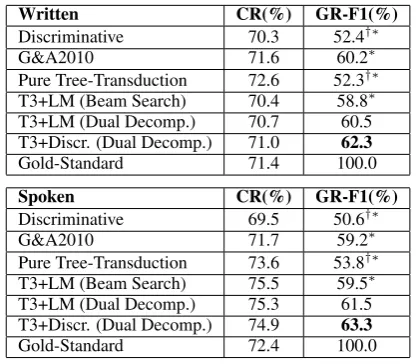
Table 2 shows the compression ratios and F-measure of grammatical relations in average for each dataset. Table 3 presents averaged human rat-ing results for each dataset. We carried out pair-wise t-test to examine the statistical significance of the differences9. In both datasets joint
decod-ing with dual decomposition solution outperforms other systems, especially when structured models involved. We can also find certain improvements of joint modeling with dual decomposition on the original beam search decoding of Equation 1, un-der very close compression ratios.
Joint decoding of pure tree transduction and dis-criminative model gives better performance than the joint model of tree transduction and language model. From Table 3 we can see that integrat-ing discriminative model will mostly improve the preservation of important information rather than grammaticality. This is reasonable under the fact that the language model is trained on large scale data and will often preserve local grammatical co-herence, while the discriminative model is trained on small but more compression specific corpora. Table 2: Results of automatic evaluation. (†: sig. diff. from T3+LM(DD); *: sig. diff. from T3+Discr.(DD) forp <0.01)
Written CR(%) GR-F1(%)
Discriminative 70.3 52.4†∗
G&A2010 71.6 60.2∗
Pure Tree-Transduction 72.6 52.3†∗ T3+LM (Beam Search) 70.4 58.8∗ T3+LM (Dual Decomp.) 70.7 60.5 T3+Discr. (Dual Decomp.) 71.0 62.3
Gold-Standard 71.4 100.0
Spoken CR(%) GR-F1(%)
Discriminative 69.5 50.6†∗
G&A2010 71.7 59.2∗
Pure Tree-Transduction 73.6 53.8†∗ T3+LM (Beam Search) 75.5 59.5∗ T3+LM (Dual Decomp.) 75.3 61.5 T3+Discr. (Dual Decomp.) 74.9 63.3
[image:4.595.311.520.431.613.2]Gold-Standard 72.4 100.0
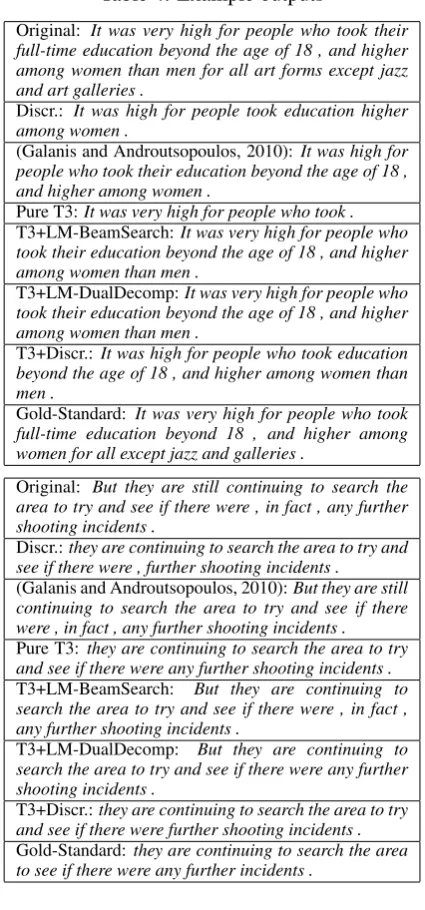
Table 4 shows some examples of compressed sentences produced by all the systems in compar-ison. The two groups of outputs are compressions of one sentence from the Written corpora and the Spoken corpora respectively. Ungrammatical compressions can be found very often by several baselines for different reasons, such as the outputs from pure tree transduction and the discriminative model in the first group. The reason behind the
9For all multiple comparisons in this paper, significance
Table 3: Results of human rating. (†: sig. diff. from T3+LM(DD); *: sig. diff. from T3+Discr.(DD), forp <0.01)
Written GR. Imp. CR(%)
Discriminative 3.92†∗ 3.46†∗ 70.6 G&A2010 4.11†∗ 3.50†∗ 72.4 Pure Tree-Transduction 3.85†∗ 3.42†∗ 70.1 T3+LM (Beam Search) 4.22†∗ 3.69∗ 73.0 T3+LM (Dual Decomp.) 4.63 3.98 73.2 T3+Discr. (Dual Decomp.) 4.62 4.25 73.5 Gold-Standard 4.89 4.76 72.9
Spoken GR. Imp. CR(%)
Discriminative 3.95†∗ 3.62†∗ 71.2 G&A2010 4.09†∗ 3.96∗ 72.5 Pure Tree-Transduction 3.92†∗ 3.55†∗ 71.4 T3+LM (Beam Search) 4.20∗ 3.78∗ 75.0 T3+LM (Dual Decomp.) 4.35 4.18 74.5 T3+Discr. (Dual Decomp.) 4.47 4.26 74.7 Gold-Standard 4.83 4.80 73.1
under generation of pure tree transduction is that it mainly deals with global syntactic integrity merely in terms of the application of synchronous rules. Introducing language model scores will smooth the candidate compressions and avoid many ag-gressive decisions of tree transduction. Discrim-inative models are good at local decisions with poor consideration of grammaticality. We can see that the joint models have collected their predic-tive power together. Unfortunately we can still observe some redundancy from our outputs in the examples. The size of training corpus is not large enough to provide enough lexicalized information. On the other hand, the time consumption of the joint model with dual decomposition decoding in our experiments matched the aforementioned asymptotic analysis. The training process based on new decoding method consumes similar time as beam search with cube-pruning heuristic.
7 Conclusion and Future Work
In this paper we propose a joint decoding scheme for tree transduction based sentence compression. Experimental results suggest that the proposed framework works well. The overall performance gets further improved under our framework by in-troducing the structured discriminative model.
As several recent efforts have focused on ex-tracting large-scale parallel corpus for sentence compression (Filippova and Altun, 2013), we would like to study how larger corpora can af-fect tree transduction and our joint decoding
so-Table 4: Example outputs
Original: It was very high for people who took their full-time education beyond the age of 18 , and higher among women than men for all art forms except jazz and art galleries .
Discr.: It was high for people took education higher among women .
(Galanis and Androutsopoulos, 2010):It was high for people who took their education beyond the age of 18 , and higher among women .
Pure T3:It was very high for people who took . T3+LM-BeamSearch:It was very high for people who took their education beyond the age of 18 , and higher among women than men .
T3+LM-DualDecomp:It was very high for people who took their education beyond the age of 18 , and higher among women than men .
T3+Discr.:It was high for people who took education beyond the age of 18 , and higher among women than men .
Gold-Standard: It was very high for people who took full-time education beyond 18 , and higher among women for all except jazz and galleries .
Original: But they are still continuing to search the area to try and see if there were , in fact , any further shooting incidents .
Discr.:they are continuing to search the area to try and see if there were , further shooting incidents .
(Galanis and Androutsopoulos, 2010):But they are still continuing to search the area to try and see if there were , in fact , any further shooting incidents . Pure T3: they are continuing to search the area to try and see if there were any further shooting incidents . T3+LM-BeamSearch: But they are continuing to search the area to try and see if there were , in fact , any further shooting incidents .
T3+LM-DualDecomp: But they are continuing to search the area to try and see if there were any further shooting incidents .
T3+Discr.:they are continuing to search the area to try and see if there were further shooting incidents . Gold-Standard:they are continuing to search the area to see if there were any further incidents .
lution. Meanwhile, We would like to explore on how other text-rewriting problems can be formu-lated as a joint model and be applicable to similar strategies described in this work.
Acknowledgements
This work was supported by National Hi-Tech Re-search and Development Program (863 Program) of China (2014AA015102, 2012AA011101) and National Natural Science Foundation of China (61170166, 61331011). We also thank the anony-mous reviewers for very helpful comments.
[image:5.595.309.522.83.539.2] [image:5.595.69.293.128.310.2]References
Yin-Wen Chang and Michael Collins. 2011. Exact de-coding of phrase-based translation models through lagrangian relaxation. In Proceedings of the 2011 Conference on Empirical Methods in Natural Lan-guage Processing, pages 26–37, Edinburgh, Scot-land, UK., July. Association for Computational Lin-guistics.
David Chiang. 2007. Hierarchical phrase-based trans-lation.computational linguistics, 33(2):201–228.
James Clarke and Mirella Lapata. 2006. Models for sentence compression: A comparison across do-mains, training requirements and evaluation mea-sures. InProceedings of the 21st International Con-ference on Computational Linguistics and the 44th annual meeting of the Association for Computa-tional Linguistics, pages 377–384. Association for Computational Linguistics.
James Clarke and Mirella Lapata. 2008. Global in-ference for sentence compression: An integer linear programming approach.Journal of Artificial Intelli-gence Research, 31:273–381.
Trevor Cohn and Mirella Lapata. 2007. Large mar-gin synchronous generation and its application to sentence compression. InProceedings of the 2007 Joint Conference on Empirical Methods in Natu-ral Language Processing and Computational Nat-ural Language Learning (EMNLP-CoNLL), pages 73–82, Prague, Czech Republic, June. Association for Computational Linguistics.
Trevor Cohn and Mirella Lapata. 2008. Sentence compression beyond word deletion. InProceedings of the 22nd International Conference on Computa-tional Linguistics-Volume 1, pages 137–144. Asso-ciation for Computational Linguistics.
Trevor Cohn and Mirella Lapata. 2009. Sentence com-pression as tree transduction. Journal of Artificial Intelligence Research, 34:637–674.
Katja Filippova and Yasemin Altun. 2013. Overcom-ing the lack of parallel data in sentence compres-sion. In Proceedings of the 2013 Conference on Empirical Methods in Natural Language Process-ing, pages 1481–1491, Seattle, Washington, USA, October. Association for Computational Linguistics.
Dimitrios Galanis and Ion Androutsopoulos. 2010. An extractive supervised two-stage method for sentence compression. In Human Language Technologies: The 2010 Annual Conference of the North American Chapter of the Association for Computational Lin-guistics, pages 885–893, Los Angeles, California, June. Association for Computational Linguistics.
Minlie Huang, Xing Shi, Feng Jin, and Xiaoyan Zhu. 2012. Using first-order logic to compress sentences. InAAAI.
Kevin Knight and Daniel Marcu. 2000. Statistics-based summarization-step one: Sentence compres-sion. InAAAI/IAAI, pages 703–710.
Terry Koo, Alexander M. Rush, Michael Collins, Tommi Jaakkola, and David Sontag. 2010. Dual decomposition for parsing with non-projective head automata. InProceedings of the 2010 Conference on Empirical Methods in Natural Language Process-ing, pages 1288–1298, Cambridge, MA, October. Association for Computational Linguistics.
Ryan T McDonald. 2006. Discriminative sentence compression with soft syntactic evidence. InEACL. Roi Reichart and Regina Barzilay. 2012. Multi-event extraction guided by global constraints. In Proceed-ings of the 2012 Conference of the North American Chapter of the Association for Computational Lin-guistics: Human Language Technologies, pages 70– 79, Montr´eal, Canada, June. Association for Com-putational Linguistics.
Alexander M. Rush and Michael Collins. 2011. Exact decoding of syntactic translation models through la-grangian relaxation. InProceedings of the 49th An-nual Meeting of the Association for Computational Linguistics: Human Language Technologies, pages 72–82, Portland, Oregon, USA, June. Association for Computational Linguistics.
Alexander M Rush and Michael Collins. 2012. A tuto-rial on dual decomposition and lagrangian relaxation for inference in natural language processing. Jour-nal of Artificial Intelligence Research, 45:305–362. Alexander M Rush, David Sontag, Michael Collins,
and Tommi Jaakkola. 2010. On dual decomposition and linear programming relaxations for natural lan-guage processing. InProceedings of the 2010 Con-ference on Empirical Methods in Natural Language Processing, pages 1–11, Cambridge, MA, October. Association for Computational Linguistics.
Ioannis Tsochantaridis, Thorsten Joachims, Thomas Hofmann, and Yasemin Altun. 2005. Large mar-gin methods for structured and interdependent out-put variables. InJournal of Machine Learning Re-search, pages 1453–1484.