Matching Reviews to Objects using a Language Model
Nilesh Dalvi Ravi Kumar Bo Pang Andrew Tomkins Yahoo! Research
701 First Ave Sunnyvale, CA 94089
{ndalvi,ravikumar,bopang,atomkins}@yahoo-inc.com
Abstract
We develop a general method to match un-structured text reviews to a un-structured list of objects. For this, we propose a lan-guage model for generating reviews that incorporates a description of objects and a generic review language model. This mix-ture model gives us a principled method to find, given a review, the object most likely to be the topic of the review. Extensive experiments and analysis on reviews from Yelp show that our language model-based method vastly outperforms traditional tf-idf-based methods.
1 Introduction
Consider a user searching for reviews of “Casablanca Moroccan Restaurant.” The search engine would like to obtain as many reviews of this restaurant as possible, both to offer a high-quality result set for even obscure restaurants, and to enable advanced applications such as aggrega-tion/summarization/categorization of reviews and recommendation of alternate restaurants. To solve this problem, it faces two high-level challenges: first, identify the restaurant review pages on the Web; and second, given a review, identify the restaurant that is being reviewed. There has been previous work addressing the first challenge (Sec-tion 2). We focus in this paper on the second.
The Web is replete with restaurant reviews available on top restaurant verticals such as Yelp and CitySearch, as well as newspaper articles, newsgroup discussions, blog posts, small local re-view aggregators and so forth. Ideally, the search engine would like to obtain reviews from all pos-sible sources. While identifying the subject mat-ter of a given review on the large sites may be amenable to structured extraction through wrapper induction or related techniques, it is typically not
cost-effective to apply such techniques to smaller “tail” sites, and purely unstructured sources re-quire alternate approaches altogether. In this pa-per, we explore the setting of matching reviews to objects using only their textual content. Note that matching reviews to objects is a pervasive prob-lem beyond the restaurant domain. Shopping ver-ticals like to aggregate camera reviews, entertain-ment verticals wish to collect movie reviews, and so on. We use restaurant reviews as a running ex-ample, but the techniques are general.
More specifically, the problem we consider in this paper is the following. Given a list of struc-tured objects (restaurants/cameras/movies) and a text review, identify the object from the list that is the topic of the review. Our focus on tex-tual content allows us to expand the universe of sources from which we can extract reviews to in-clude sources that are purely textual, such as fo-rum posts, blog posts, newsgroup postings, and the like. In fact, even among collections of “struc-tured” sources like review aggregators, there are no highly accurate unsupervised techniques to match a known review page to an object. Struc-tured (e.g., HTML) cues provide valuable lever-age in attacking this problem, but the types of tex-tual cues we focus on are also a key part of the puzzle; in such a context, our techniques can still contribute to the overall matching problem.
It is important to contrast our problem against two settings of related flavor — entity matching, whose goal is to find the correspondence between two structured objects and information retrieval (IR), whose goal is to match unstructured short text (query) against unstructured text (document). Our problem is considerably harder than entity matching for the following reasons. In matching two structured objects there is often a natural cor-respondence between their attributes, whereas no such correspondence exists between an object and
its review. For instance, while trying to match a review to a restaurant object, it is unclear if a spe-cific portion of the review refers to the name of the restaurant, or to its location, or is a statement not concerning specifics of the restaurant. Moreover, even if we wish to use entity matching, we must first recognize the entities from a review. There are two methods to do this, namely, wrapper duction and information extraction. Wrapper in-duction methods have serious limitations: they are applicable only to highly-structured websites and involve human labeling effort that is expensive and error-prone and entails constant maintenance to keep wrappers up-to-date. Information extraction methods (Cardie, 1997; Sarawagi, 2008), on the other hand, often have limited accuracy.
Our problem is also not amenable to classical IR methods such as tf-idf. For example, suppose we want to find the relevant restaurant for a given review. The standard tf-idf will treat the review as the query, the set of restaurant as documents and compute the tf-idf scores. Now consider a restau-rant called “Food.”1 Since the term “food” is rare
as a restaurant name, it will get a very high idf score and hence will likely be the top match for all reviews containing the word “food.” In fact, unlike in traditional IR, a “query” (i.e., review) is long and a “document” (i.e., restaurant) is short — this demands adapting established IR concepts such as inverse document frequency and document length normalization to our setting. If we take the op-posite view by considering reviews as documents and restaurants as queries, we still deviate from the IR setting, since now we need to rank and find the best “query” for a given “document.” In Section 3.4, we illustrate the shortcomings of both these approaches.
In fact, the nature of the object database we con-sider provides several unique opportunities over traditional IR. First the “document”, i.e., the ob-ject to be matched, has more semantics, since each document is associated with one or more se-mantic attribute, such as the name/location of the restaurant. Second, the “query”, i.e., the text we are matching is known to be a review of the ob-ject, and hence is rendered in a language that is “review-like” — this can be modeled by a genera-tive process that produces reviews from objects. Third, the set of objects we are interested in is
11569 Lexington Ave., New York, NY 10029. (212) 348-0200.
given a priori, and we only seek to match reviews with one of these objects; this makes our problem more tractable than open-ended entity recognition.
Our contributions. We propose a general method to match reviews to objects. To this end, we postulate a language model for generating re-views. The intuition behind our model is simple and natural: when a review is written about an ob-ject, each word in the review is drawn either from a description of the object or from a generic review language that is independent of the object. This mixture model leads to a method to find, given a review, the object most likely to be the topic of the review.
Our method is light-weight and scalable and can be viewed as obviating the need for highly-expensive information extraction. Since the method is text-based and does not rely on any HTML structural clues, it is especially applicable to reviews present in blogs and the so-called tail web sites — web sites for which it is not feasible to maintain wrappers to automatically extract the object of a review.
We then report results on over 11K restaurant reviews from Yelp. The experiments and our ex-tensive analysis show that our language model-based method significantly outperforms traditional tf-idf based methods, which fail to take full ad-vantage of the properties that are specific to our setting.
2 Related work
lexicon-lookup methods have limited success on general non-product review texts (Stoyanov and Cardie, 2008). In general, this line of work is more rooted in the information extraction literature, where text spans covering the object (or features of the ob-ject) were extracted as the first step; in contrast, we do not have an explicit extraction phase. Since the (very extensive) list of candidate objects are given as input, our task is to rank all matching ob-jects, and in this sense is closer in nature to infor-mation retrieval tasks. There has been some work on detecting reviews in large-scale collections (Ng et al., 2006; Barbosa et al., 2009); this is a logical step that precedes the review matching step, the topic of our paper.
Language modeling is becoming a powerful paradigm in the realm of information retrieval ap-plications (Ponte and Croft, 1998; Hiemstra, 1998; Song and Croft, 1999; Lafferty and Zhai, 2003; Zhai, 2008). The basic theme behind language modeling is to first postulate a model for each doc-ument and for a given query select the docdoc-ument that is most likely to have generated the query; smoothing is an important means to manage data sparsity in language models (Zhai and Lafferty, 2004). As noted earlier, language models devel-oped for IR are unsuitable for our setting. Further-more, there are opportunities, such as the presence of structure in our data, which we use in this work (Section 3.2). In fact, in a subsequent paper, we show how a language model specific to each at-tribute can further improve the accuracy of review matching (Dalvi et al., 2009).
Entity matching is a well-studied topic in databases. There are several approaches to entity matching: non-relational approaches, which con-sider pairwise attribute similarities between enti-ties (Newcombe et al., 1959; Fellegi and Sunter, 1969), relational approaches, which exploit the re-lationships that exist between entities (Ananthakr-ishna et al., 2002; Kalashnikov et al., 2005), and collective approaches, which exploit the relation-ship between various matching decisions, (Bhat-tacharya and Getoor, 2007; McCallum and Well-ner, 2004). The EROCS system (Chakaravarthy et al., 2006), which uses information extraction and entity matching, is closest in spirit to our problem; they, however, employ tf-idf to match, which we show to be significantly sub-optimal in our set-ting.
3 Model and method
In this section we present the problem formula-tion, the basic generative model for reviews, a method based on this model to associate an object with a review, and the techniques to estimate the parameters of this model.
Problem formulation. LetE denote a set of ob-jects. Each object e ∈ E has a set of attributes and lettext(e)denote the union of the textual con-tent of all its attributes. Suppose we have a col-lection of reviews R, where each review is writ-ten (mainly) about one of the objects in the listing
E. The problem now is to correctly associate each
r∈ Rwith exactly one ofe∈ E.
We model each review as a bag of words. Therefore, notation such as “w ∈ r” for a word
wand a reviewrmakes sense. For a reviewrand an objecte, letre=r∩text(e).
As a running example, we use E to denote the set of all restaurants andRto denote the set of all restaurant reviews.
3.1 A generative model for reviews
We first state the intuition behind our generative model: when a reviewris written about an object
e, some words inr(e.g., the name and the address of the restaurant) are drawn fromtext(e)to refer to the object under discussion, while some other words are drawn from ageneric review language independent ofe.
Formally, let α ∈ (0,1) be a parameter. Let Pe(·) denote a distribution whose support is
text(e); this corresponds to the distribution of words specific to the objecte, taken from the de-scription text(e). We use Pe(w) to denote the probability the wordwis chosen according to this distribution. Let P(·) be an object-independent distribution whose support is the review language, i.e., all the words that can be used to write a re-view; we useP(w) to denote the probability the word w is chosen according to this distribution. Now, for a given object e, a review r is gener-ated as follows. Each word in r is generated in-dependently: with probabilityα, a wordwis cho-sen with probability Pe(w) and with probability
Given a review r and an objecte, by our inde-pendence assumption,
Pr[r |e] =Z(r) Y
w∈rPr[w|e]
= Z(r) Y
w∈r((1−α)P(w) +αPe(w)),(1)
where Z(r) is a normalizing term that only de-pends on the length of r and the counts of the words in it. Recallingre = r∩text(e), we note that Pe(w) assigns zero probability to w 6∈ re. From (1), we get
Pr[r |e] =Z(r) Y
w∈r\re
(1−α)P(w)·
Y
w∈re
((1−α)P(w) +αPe(w))
= Z(r) Y
w∈r
(1−α)P(w)·
Y
w∈re
1 +1−ααPPe(w)(w)
. (2)
Note that Eq. (2) appears similar to the formula obtained in the language model approach for IR (Hiemstra and Kraaij, 1998); the interpretation of terms, however, is very different. For instance,
P(w) in our case is computed over the “query” corpus whereas the analogous term (collection fre-quency) in (Hiemstra and Kraaij, 1998) is com-puted over the “document” corpus. As the “Food” restaurant example in Section 1 suggests, using the “document” frequency is undesirable. The use of “query” corpus frequency arises naturally from our generative story and also guides us to a differ-ent way to estimateP(w); see Section 3.3.
3.2 Matching a review to an object
Given the above review language model (RLM),
we now state how to match a given review to an object. According to our model, the most likely objecte∗to have generated a reviewris given by
e∗= arg max
e Pr[e|r] = arg maxe
Pr[e]
Pr[r]·Pr[r|e].
In the absence of any information, we assume a uniform distribution for Pr[e]. (Additional information about objects, such as their rat-ing/popularity, can be used to model Pr[e] more accurately.) From this, we get
e∗ = arg maxe Pr[r |e],
or equivalently,
e∗ = arg maxe log Pr[r |e].
SinceZ(r)Qw∈r((1−α)P(w))is independent of
e, using (2), we have
e∗= arg maxe X
w∈re
log
1 +1−ααPPe(w)(w)
.
(3)
3.3 Estimating the parameters
We now describe how to estimate the parameters of the model, namely,P(·),Pe(·), andα.
Recall thatP(·)is the distribution of generic re-view language. Ideally, for each rere-view r, if we know the componentr(e)that came from the
dis-tributionPe(·) and the componentr(g) that came from P(·), then we can collect the r(g)
compo-nents of all the reviews inR, denoted asR(g), and
estimateP(·)by the fraction of occurrences ofw
inR(g). More specifically, letc(w,R(g)) denote
the number of timeswoccurs inR(g). With
add-one smoothing, we estimate
P(w) = P c(w,R(g)) + 1
w0c(w0,R(g)) +|V|,
where|V|is the vocabulary size.
In reality, we only have access torand not to the componentsr(e) andr(g). If we have an aligned
review corpus R0, where for each review r, we
know the true object ethat generated it, we can closely approximater(e)withre.2 Let no-obj(R0)
be the set of processed reviews where for each review-object pair(r, e), words intext(e)are re-moved from r. By treating no-obj(R0)as an
ap-proximation ofR(g), we can computeP(w)in the
aforementioned manner. If we only have access to a review collection R0 with no object
align-ment, there are other ways to effectively approx-imateR(g); see Section 5.3 for more details.
intext(e)may not be generated with equal prob-ability. In our running example, consider the case whentext(e)contains the full name of the restau-rant, i.e., “Casablanca Moroccan Restaurant.” A review for this restaurant is more likely to choose the word “Casablanca” than any other word to re-fer to this restaurant since this is arguably more in-formative than “Moroccan” or “Restaurant.” This can be captured by using the frequencyfw of the wordwinRor in{text(e) |e∈ E}. For a suit-able functiong(w)that is inversely growing asfw (say,g(w) = log(1/fw)), we let
Pe(w) = P g(w) w0∈text(e)g(w0).
Alternatively, it is possible to construct models wherePe(w)is more directly estimated from the data; in fact, one can also use suitable transla-tion models to estimatePe(w)forwthat may not even occur in text(e) — this will help in cases where reviews use an abbreviation such as “Casa” or “CMR” to refer to our running example. Such models require either fine-grained labeled exam-ples or, as we show in (Dalvi et al., 2009), more sophisticated estimation techniques.
It is tempting to assume that common words such as “Restaurant” may not contribute towards matching a review to an object and hence one can conveniently set Pe(w) = 0 for such words w. (Such a list of words can easily be compiled using a domain-specific stopword list.) This may hurt — in our example, the presence of the word “Restau-rant” in a review might help to disambiguate the object of reference, if the listing were also to con-tain a “Casablanca Moroccan Cafe”.
3.4 Properties of the model
Eq. (3) indicates that our method (denoted as RLM) gives less importance to common words
with highP(w). This corresponds to the intuition behind the standard tf-idf scheme. Why, then, do we expect RLM to be more effective? Here, we
discuss the salient features of our method, con-trasting it with tf-idf in particular.
First, we take a closer look at different ways to apply tf-idf techniques to our setting. Since the task is to find the most relevant object given a re-view, a naive way to apply the standard tf-idf (de-noted TFIDF) will treat each review to be the query
and each object to be a document and score docu-ments using the standard tf-idf scoring. This, how-ever, leads to severe problems since this computes
the inverse document scores over the object corpus — recall the “Food” example in Section 1.
A more reasonable way to apply tf-idf is to instead treat objects as queries and reviews as documents for computing tf-idf scores (denoted TFIDF+). For a word w, let Q(w) = df(Nw),
where N is the number of reviews in the corpus anddf(w)is the number of reviews containingw. Given a reviewrand an objecte, the score of the object is given by Pw∈relog (1/Q(w)), and we want to pick the object with the maximum score. As we will discuss later, document-length nor-malization (i.e., normalizing by object description length so that a restaurant with a long name does not get an unfair disadvantage) is still non-trivial here.
As noted earlier, Eq. (3), used by RLM for
matching reviews with objects, has a striking re-semblance to the TFIDF+ scoring function. Both
have the form
e∗= arg max
e
X
w∈re
logf(w),
where for RLM,
f(w) =fR(w) = 1 +1−ααPP(w)e(w),
and for TFIDF+,
f(w) =fB(w) =Q(w)1 .
In both cases, f(w) is monotonically decreas-ing in the frequency of w in the corpus. How-ever, there are several differences between the two cases. We highlight some of them here, with the aim of illustrating the power of our review lan-guage model (RLM).
Object length normalization. First note that the
Pe(w)term infR(w)acts as an object length nor-malizing term, i.e., it adds up to one for each
e and weighs down P(w) for objects with long
1975) will yield a normalized score of 1 irre-spectiveof the token. Thus for a review contain-ing the words “Food” and “Casablanca”, the stan-dard normalization will yield the same score for a restaurant named “Food” and a restaurant named “Casablanca”, ignoring the fact that “Food” is much more likely to be an object-independent term. Note that this only becomes a problem when the entire “document” is part of the match, which rarely happens in an IR setting where the docu-ments are typically much longer than the queries. Indeed, in our experiments, we observe lower per-formance when we apply cosine-normalization to the tf-idf scores. On the other hand, infR(w), the
P(w)term can still distinguish the two aforemen-tioned objects even whenPe(w)are equal.
Dampening. With α < 1, fR(w) is effectively a dampened version of PPe((ww)). In other words, dif-ferences between very frequent words and very in-frequent words are somewhat smoothed out. In-deed, if we modify TFIDF+by introducing a
sim-ilar dampening factor intofB(w), we observe im-provement in its performance (Section 5.4).
Removing mentions of an object.Another differ-ence is that in RLM,P(w)is estimated on reviews
with object mentions removed, since the model in-dicate thatP(w)accounts for object-independent review language. In contrast, TFIDF+ computes
Q(w) on full reviews. We illustrate the differ-ence on the following example. Consider a review that reads “. . . Maggiano’s has great Fondue.” If “Maggiano’s” and “Fondue” both occur the same number of times in the corpus, then they get the same idf (i.e., Q(w)) score. In RLM, however,
“Maggiano’s” will get much smaller probability in the generic review distributionP(·)than “Fon-due”, since “Maggiano’s” almost always occurs in reviews as restaurant name mentions, thus is re-moved from the estimation of its P(·) probabil-ity. On the other hand, the word “Fondue” is more likely to retain higher probability inP(·) since it tends to appear as dish names. As a result, our model will assign higher weight to “Maggiano’s Restaurant” than “Fondue Restaurant”. As we can see, RLMevaluates the ability of a word to identify
the review object rather than rely on the absolute rarity of the word, which is done by tf-idf.
Using term counts. One last difference is that
fR(w) uses term counts of words rather than the standard document counts used by fB(w). Our
evaluation suggests that at least in practice, this does not have a big impact on the overall accuracy. In the experiments we show that these factors together account for the performance difference between RLM and tf-idf. Our model gives a
prin-cipled way to introduce these factors, however.
4 Data
In this section we describe the dataset constructed for the task of matching restaurant reviews to the corresponding restaurant objects. Our goal is to obtain a large collection of reviews on which to estimate the generic language model, with a sig-nificant portion of them aligned with the objects for which the reviews were written; this portion will serve as the gold-standard test set.
To this end, we obtained a set of reviews from the Yelp website,yelp.com. This website con-tains a collection of reviews about various busi-nesses and for each business, has a webpage con-taining the business information and a list of re-views. We crawled all restaurant pages from Yelp. For each restaurant, we extracted its name and city location from the business information sec-tion via HTML cues, and a list of no more than 40 reviews. We obtained the textual content of 299,762 reviews, each aligned with one of a set of 12,408 unique restaurants hosted on Yelp. Note that while our technique is not targeted for head sites like Yelp (where wrapper induction might be a more accurate approach), this provides a large-scale dataset, conveniently labeled with ob-ject information, and simulates the tail-site sce-nario where we rely heavily on the textual content of reviews to identify objects.
Many of the reviews in Yelp do not contain any identifying information. In fact, some of them are as short as “Great place. Awesome food!!”. We processed the dataset to retain only reviews that mention the name of the restaurant, even if par-tially, and, when the restaurant name is a common word, also the city of the restaurant. Each of the remaining reviews is expected to have enough in-formation for a human to identify the restaurant corresponding to the review.
restaurant in the Yahoo! Local database. We then proceeded to generate the gold standard that con-tains the correct restaurant in the Yahoo! Local database for each review. We employed geocoding to match addresses across the two databases along with approximate name matches. Note that in the final dataset, only half of the restaurants have the exact same name listed in both Yelp and Yahoo! Local; this limits the success of naive dictionary-based methods.
The final aligned dataset contained 24,910 Yelp reviews (R), covering 6,010 restaurants. We set aside half of the reviews (R0) to estimate the
mod-els and the other half (Rtest) to evaluate our
tech-nique. We also set aside 1,000 reviews as devel-opment set, on which we conducted initial exper-iments. The total size of the test corpus, Rtest
was 11,217. The splitting of R into R0, Rtest,
and the development set was done in such a way that there are no overlapping restaurants between them. Also, the reviews that were filtered out because of lack of identifying information were added back toR0for learning the review language
model, expandingR0to a total of 205,447 reviews. 5 Evaluation
In this section we evaluate our proposed review-language based matching algorithm RLM.
5.1 Experimental considerations
Baseline system. We use the TFIDFand TFIDF+
algorithms described in Section 3.4 as baseline algorithms. Since we are comparing objects that can have varying lengths, we tried the stan-dard cosine-normalization techniques for docu-ment length normalization. For reasons described in Section 3.4, however, the normalization signif-icantly lowered the accuracy. All the numbers re-ported here are using tf-idf scores without normal-ization.
Efficiency. For both RLM and the baseline
algo-rithms, it is impractical to compute the similar-ity of a review with each object in the database. Since all objects that do not intersect with the re-view have a zero score, we built an inverted in-dex to retrieve all objects containing a given word. Even a simple inverted index can be very ineffi-cient since for each review, words such as “Restau-rant” or “Cafe” retrieve a substantial fraction of the whole database. Hence, we further optimized the index by looking at the document frequencies
of the words and considering word bigrams in ject descriptions. The index only retrieves ob-jects that have a non-trivial overlap with the re-view; e.g., an overlap of “Casablanca” is consid-ered non-trivial while an overlap of “Restaurant” is considered trivial. Once these candidates are re-trieved, our scoring function takes into account all overlapping tokens.
For the YELPdataset, the index returns an
av-erage of 200 restaurants for each review. This points to the general difficulty of review match-ing over a large corpus of objects, since a simple dictionary-based named-entity recognition will hit at least 200 objects for many reviews.
Experiment settings. For RLM, we conducted
initial experiments and performed parameter esti-mation on the development data. The experimen-tal settings we used for RLM are as follows: we
set g(w) = log(1/fw) for Pe, where fw is esti-mated on the review collection.P(w)is estimated on all reviews inR0, where for each review, all
to-kens of its correspondingtext(e), if present, are removed, in order to approximate thegeneric re-view language independent of e, as required by our generative model. We estimateαto be 0.002, tuned on the development set; in our experiments, we observe that the performance is not very sensi-tive toα.
5.2 Main results
In this section we present the main comparisons between RLMand the baseline in details.
Performance measure. Our task resembles a standard IR task in that our algorithm ranks can-didate objects for a given review by their “about-ness” level. Unlike a standard IR task, however, we are not interested in retrieving multiple “rel-evant” objects, as each review in our dataset has only one single correct match fromE. A review match is correct if the top-1prediction (i.e.,e∗) is
accurate. In what follows, we report the average accuracy for various experimental settings. Note that we can take the average accuracy over all re-views (reported as micro-average), regardless of which restaurants they are about; or we can first compute the average for reviews about the same restaurant, and report the average over all restau-rants (macro-average). When not specified, we re-port the micro-average.
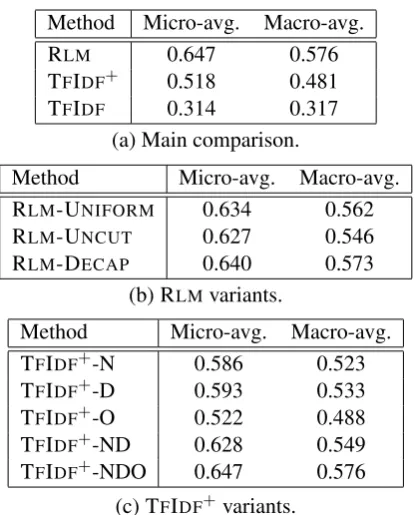
Method Micro-avg. Macro-avg.
RLM 0.647 0.576
TFIDF+ 0.518 0.481
TFIDF 0.314 0.317
(a) Main comparison.
Method Micro-avg. Macro-avg.
RLM-UNIFORM 0.634 0.562
RLM-UNCUT 0.627 0.546
RLM-DECAP 0.640 0.573
(b) RLMvariants.
Method Micro-avg. Macro-avg. TFIDF+-N 0.586 0.523
TFIDF+-D 0.593 0.533
TFIDF+-O 0.522 0.488
TFIDF+-ND 0.628 0.549
TFIDF+-NDO 0.647 0.576
[image:8.595.78.286.58.316.2](c) TFIDF+variants.
Table 1: Average accuracy of the top-1 prediction for various techniques. Micro-average computed over 11,217 reviews inRtest; macro-average
com-puted over 2,810 unique restaurants inRtest.
clearly outperforms the TFIDF+ baseline
mea-sured by either micro- or macro-average accuracy. The standard TFIDF, as predicted, performs the
worst.
Some reviews can be particularly difficult to match, which can be reflected in a low matching score. Nonetheless, we predict the most likely ob-ject. Suppose we impose a threshold and return the most likely object only when its score is above threshold, we can then compute precision and re-call at different thresholds. Figure 1 presents the precision–recall curve (using micro-average) for both RLM and TFIDF+. Again, RLM clearly
out-performs TFIDF+across the board.
We then generalize the definition of accuracy into accuracy@k: a review is considered as cor-rectly matched if one of the top-kobjects returned is the correct match. We plot accuracy@k as a function of k. While the gap between RLM and
TFIDF+ is smaller as k increases, RLM clearly
outperforms TFIDF+for allk∈ {1, . . . ,10}.
[image:8.595.305.516.71.234.2]One final comparison is accuracy@1 as a func-tion of the review length. Given our current set-ting, longer reviews might be more difficult to match since they may include more proper nouns such as dish names and related restaurants, and
[image:8.595.304.515.302.461.2]Figure 1: Precision–recall curve (of top one pre-diction): RLMvs. TFIDF+baseline.
Figure 2: Accuracy@k (percentage of reviews whose correct match is returned in one of its top-k
predictions): RLMvs. TFIDF+baseline.
Figure 3: Average accuracy of the top-1 prediction for reviews with different length (on test set): RLM
[image:8.595.304.515.542.703.2]yield a longer list of highly competitive candi-date objects. Interestingly, the gap between RLM
and TFIDF+ is much smaller for shorter reviews.
As reviews get longer, the performance of RLM
is relatively stable, whereas the performance of TFIDF+drops down significantly.
5.3 Experimental choices for RLM
We now examine the experimental choices we made for different components of RLM by
defin-ing the followdefin-ing variations of RLM.
RLM-UNIFORM: rather than setting g(w) =
log(1/fw)forPe, we use the uniform distribution
Pe(w) = 1/|text(e)|. From the third line of Table 1 (b), there is a slight accuracy drop of∼1.3%.
RLM-UNCUT: suppose we only have access to
a review corpus with no alignment totext(e), and thus have to approximate P(w) by estimating it on the set of original “un-cut” reviews, how much does that affect our performance? As indicated in the fourth row of Table 1 (b), this reduces accuracy by about 2% on our test data.
RLM-DECAP: as an alternative way to deal with
lack of aligned data, we consider a variation of the above algorithm by removing all the capital-ized words from un-annotated reviews. Clearly, this can result in both “over-cutting” and “under-cutting” of true restaurant name mentions. How-ever, as indicated in the fourth row of Table 1 (b), this is very close to the best accuracy achieved. Thus, an effective model can be learned even with-out aligned data.
5.4 RevisitingTFIDF+: what’s amiss?
In this section we revisit the main differences be-tween our model and the TFIDF+outlined in
Sec-tion 3.4, and investigate their empirical impor-tance by introducing these features into TFIDF+
and examine their effectiveness in that framework.
Object length normalization. We con-sider a modified TFIDF+ measure fM(w) =
Pe(w)/Q(w), which we call TFIDF+-N (normal-ized). As shown in Table 1 (c), this change alone can increase the average accuracy by nearly 7%.
Dampening. We consider a modified TFIDF+
measurefM(w) = 1 +β · df(Nw), which we call TFIDF+-D. Table 1 (c) reports the performance of
using this measure, withβ = 0.1(set on develop-ment data). Again, this measure alone can induce over 7% increase in accuracy. Indeed, combin-ing normalization and dampencombin-ing, (i.e.,fM(w) =
1 +β·Pe(w)·df(Nw)), denoted as TFIDF+-ND, we get comparable performance to RLM-UNCUT. Removing mentions of objects. Again, we can incorporate this in a heuristic way in TFIDF+,
which we denote by TFIDF+-O. Interestingly,
while using the original fB(w) function with
df(w) computed on the object-removed review collection does not yield a big improvement, this does bring the performance of the fully modified TFIDF+ to the same level of the standard RLM
(see line marked TFIDF+-NDO.)
Using term counts. Our investigation suggests that at least in practice, using Q(w) vs. P(w)is not a critical decision, as a fully modified TFIDF+
can achieve the same performance usingdf(w)to quantify frequency of the word. Our experiments on this dataset show that each of the other model-ing decisions incorporated in RLMis important.
6 Conclusions
We proposed a generative model for reviews where reviews are generated from the mixture of a distribution involving object terms and a generic review language model. The model provides us a principled way to match reviews to objects. Our evaluation on a real-world dataset shows that our techniques vastly outperforms standard tf-idf based techniques.
Acknowledgments
We thank Don Metzler for many discussions and the anonymous reviewers for their comments.
References
R. Ananthakrishna, S. Chaudhuri, and V. Ganti. 2002. Eliminating fuzzy duplicates in data warehouses. In Proc. 28th VLDB, pages 586–596.
L. Barbosa, R. Kumar, B. Pang, and A. Tomkins. 2009. For a few dollars less: Identifying review pages sans human labels. InProc. NAACL.
I. Bhattacharya and L. Getoor. 2007. Collective entity resolution in relational data.ACM TKDD, 1(1).
C. Cardie. 1997. Empirical methods in information extraction. AI Magazine, 18(4):65–80.
N. Dalvi, R. Kumar, B. Pang, and A. Tomkins. 2009. A translation model for matching reviews to objects. Manuscript.
I. P. Fellegi and A. B. Sunter. 1969. A theory for record linkage.JASIS, 64:1183–1210.
D. Hiemstra and W. Kraaij. 1998. Twenty-one at TREC7: Ad-hoc and cross-language track. InProc. 7th TREC, pages 174–185.
D. Hiemstra. 1998. A linguistically motivated prob-abilistic model of information retrieval. In Proc. ECDL, pages 569–584.
M. Hu and B. Liu. 2004. Mining opinion features in customer reviews. InProc. AAAI, pages 755–760. D. V. Kalashnikov, S. Mehrotra, and Z. Chen. 2005.
Exploiting relationships for domain-independent data cleaning. InProc. 5th SDM.
N. Kobayashi, K. Inui, Y. Matsumoto, K. Tateishi, and T. Fukushima. 2004. Collecting evaluative expres-sions for opinion extraction. InProc. 1st IJCNLP, pages 596–605.
J. Lafferty and C. Zhai. 2003. Probabilistic relevance models based on document and query generation. In W. B. Croft and J. Lafferty, editors,Language Mod-eling and Information Retrieval. Academic Publish-ers.
A. McCallum and B. Wellner. 2004. Conditional mod-els of identity uncertainty with application to noun coreference. InProc. 17th NIPS.
H. B. Newcombe, J. M. Kennedy, S. J. Axford, and A. P. James. 1959. Automatic linkage of vital records.Science, 130:954–959.
V. Ng, S. Dasgupta, and S. M. Niaz Arifin. 2006. Ex-amining the role of linguistic knowledge sources in
the automatic identification and classification of re-views. InProc. 21st COLING/44th ACL, pages 611– 618.
Bo Pang and Lillian Lee. 2008. Opinion mining and sentiment analysis. Foundations and Trends in In-formation Retrieval, 2(1-2):1–135.
J. M. Ponte and W. B. Croft. 1998. A language model-ing approach to information retrieval. InProc. 21st SIGIR, pages 275–281.
A.-M. Popescu and O. Etzioni. 2005. Extracting prod-uct features and opinions from reviews. In Proc. HLT/EMNLP.
G. Salton, A. Wong, and C. S. Yang. 1975. A vec-tor space model for automatic indexing. Commun. ACM, 18(11):613–620.
S. Sarawagi. 2008. Information extraction. Founda-tions and Trends in Databases, 1(3):261–377. F. Song and W. B. Croft. 1999. A general language
model for information retrieval. In Proc. 22nd SI-GIR, pages 279–280.
V. Stoyanov and C. Cardie. 2008. Topic identification for fine-grained opinion analysis. InProc. COLING. J. Yi, T. Nasukawa, R. Bunescu, and W. Niblack. 2003. Sentiment analyzer: Extrating sentiments about a given topic. InProc. 3rd ICDM, pages 427–434. C. Zhai and J. Lafferty. 2004. A study of smoothing
methods for language models applied to information retrieval.ACM TOIS, 22(2):179–214.