Generating Natural Language Question-Answer Pairs from a Knowledge
Graph Using a RNN Based Question Generation Model
Sathish Indurthi∗1, Dinesh Raghu2, Mitesh M. Khapra†3and Sachindra Joshi2 1Samsung Electronics, DMC R&D
2IBM Research India
3Indian Institute of Technology Madras
{diraghu1,jsachind}@in.ibm.com [email protected]
Abstract
In recent years, knowledge graphs such as Freebase that capture facts about enti-ties and relationships between them have been used actively for answering factoid questions. In this paper, we explore the problem of automatically generating ques-tion answer pairs from a given knowl-edge graph. The generated question an-swer (QA) pairs can be used in several downstream applications. For example, they could be used for training better QA systems. To generate such QA pairs, we first extract a set of keywords from enti-ties and relationships expressed in a triple stored in the knowledge graph. From each such set, we use a subset of keywords to generate a natural language question that has a unique answer. We treat this sub-set of keywords as a sequence and pro-pose a sequence to sequence model using RNN to generate a natural language ques-tion from it. Our RNN based model gen-erates QA pairs with an accuracy of 33.61 percent and performs 110.47 percent (rel-ative) better than a state-of-the-art tem-plate based method for generating natu-ral language question from keywords. We also do an extrinsic evaluation by using the generated QA pairs to train a QA sys-tem and observe that the F1-score of the QA system improves by 5.5 percent (rela-tive) when using automatically generated QA pairs in addition to manually gener-ated QA pairs available for training.
∗
This work was done while the author was a part of IBM Research India
†
This work was done while the author was a part of IBM Research India
1 Introduction
Knowledge graphs store information about mil-lions of things (or entities) and relationships be-tween them. Freebase1 is one such knowledge graph that describes and organizes more than 3 billion facts in a consistent ontology. Knowl-edge graphs usually capture relationships be-tween different things that can be viewed as triples (for example, CEO(Sundar Pichai, Google)). Such triples are often referred to as facts and can be used for answering factoid ques-tions. For example, the above triple can be used to answer the question “Who is the CEO of Google ?”. It is not surprising that knowledge graphs are increasingly used for building Question Answer-ing systems (Ferrucci, 2012; Yahya et al., 2013; He et al., 2014; Zou et al., 2014).
In this paper, we focus on exploiting knowledge graphs for a related but different purpose. We propose that such triples or facts can be used for automatically generating Question Answer (QA) pairs. The generated QA pairs can then be used in certain downstream applications. For example, if some domain-specific knowledge graphs are avail-able (such as History, Geography) then such QA pairs generated from them can be used for devel-oping quiz systems for educational purposes.
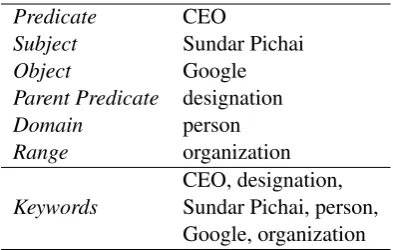
We now formally define the problem and then illustrate it with the help of an example. Consider a triple consisting of a subject, predicate and object. Typically, the predicate has a domain (subject type) and a range (object type) associated with it. The predicate may have zero or more parents in the knowledge graph. For the sake of simplicity let us assume that the predicate has a single parent. We define a set consisting of the subject, predicate, object, domain, range and predicate parent. We propose an approach
1https://www.freebase.com/
Predicate CEO
Subject Sundar Pichai
Object Google
Parent Predicate designation
Domain person
Range organization
CEO, designation,
Keywords Sundar Pichai, person,
[image:2.595.83.280.61.186.2]Google, organization
Table 1: An example set of keywords constructed from the tripleCEO(Sundar Pichai, Google)
to generate natural language factoid questions using a subset of this set such that the answer to the question also lies in the set. Given the set of keywords, as shown in Table 1, we could generate the following QA pairs (keywords are italicized):
Q: What is the designation of Sundar Pichai at Google?
A:CEO
Q: WhichorganizationisSundar PichaitheCEO of?
A:Google
The above problem is similar to the problem of generating questions from Web queries (in-stead of entities and relations) which was first sug-gested by Lin (Lin, 2008). However, unlike ex-isting works on query-to-questions which mainly rely on template based approaches, we formulate this as a sequence to sequence generation prob-lem wherein the ordered set of keywords is an in-put sequence and the natural language question is the output sequence. We use a Recurrent Neural Network (RNN) (Werbos, 1990; Rumelhart et al., 1988) based model with Long Short Term Mem-ory (LSTM) (Hochreiter and Schmidhuber, 1997) units to generate questions from the given set of keywords.
The input to our question generation model is a set of keywords extracted from triples in a knowl-edge graph. For this, it is important to first select a subset of triples from which interesting and mean-ingful questions can be constructed. For example, no interesting questions can be constructed from the triple wikipage page ID(Google, 57570) and hence we should eliminate such triples. Further, even for an interesting triple, it may be possible to use only certain subsets of keywords to construct
a meaningful question. For example, for the set of keywords shown in Table 1, it is not possible to use the subset{person, designation}to form an interesting question. Hence, we need to automati-cally identify the right set of keywords that should be used to form the question such that the answer also lies in the set. In addition to the question gen-eration model, we also propose a method for ex-tracting a meaningful subset of keywords from the triples represented in the knowledge graph.
While our goal in this paper is to generate a set of question answer pairs for a given entity in a knowledge graph, we train the RNN model for generating natural language questions from a se-quence of keywords using an open domain Com-munity Question Answering (CQA) data. This en-sures that the same trained RNN can be used with different knowledge graphs.
The main contributions of our work can be sum-marized as follows:
• We propose a method for extracting triples and keywords from a knowledge graph for constructing question keywords and answer pairs.
• We formulate the problem of generating nat-ural language questions from keywords as a sequence to sequence learning problem that performs 110.47 % (relative) better than ex-isting template based approaches.
• We train our model using 1M questions from WikiAnswers thereby ensuring that it is not tied to any specific knowledge graph.
• Finally, we show that appending the automat-ically generated QA pairs to existing training data for training a state of the art QA system (Jonathan Berant, 2014) improves the perfor-mance of the QA system by 5.5 percent (rel-ative).
2 Related Work
There is only very recent work around generation of question answer pairs from knowledge graph (Seyler et al., 2015). On the other hand, there are several works around question generation that have been proposed in past with different motiva-tions. We first present a brief overview of the ques-tion generaques-tion techniques proposed in the litera-ture along with their limitations and then discuss the work around generation of questions answer pairs from knowledge graph.
A number of papers have looked at the problem of generating vocabulary questions using Word-Net (Miller et al., 1990) and distributional sim-ilarity techniques (Brown et al., 2005; Heilman and Eskenazi, 2007). There are numerous works in automatic question generation from text. Many proposed methods aresyntax based methods that use the parse structure of sentences, identify key phrases and apply some known transformation rules to create questions (Ali et al., 2010; Kalady et al., 2010; Varga, 2010). Mannem et al. (2010) further use semantic role labeling for transforma-tion rules. There are also template based meth-ods proposed where a question template is a pdefined text with placeholder variables to be re-placed with content from source text. Cai et al. (2006) propose an XML markup language that is used to manually create question templates. This is sensitive to the performance of syntactic and se-mantic parsing. Heilman and Smith (2010) use a rule based approach to transform a declarative sentence into several candidate questions and then rank them using a logistic regression model. These approaches involve creating templates manually and thus require huge manual work and have low recall.
A problem that has been studied recently and is similar to our problem of generating questions using knowledge graph is that of generating ques-tions from Web queries. The motivation here is to automatically generate questions from queries for community-based question answering services such as Yahoo! Answers and WikiAnswers. The idea was first suggested by (Lin, 2008) and further developed by (Zhao et al., 2011) and (Zheng et al., 2011). Both of these approaches are template based approaches where the templates are learnt using a huge question corpus along with query logs. Dror et al. (2013) further proposed a learn-ing to rank based method to obtain grammatically
correct and diverse questions from a given query where the candidate questions are generated us-ing the approach proposed by (Zhao et al., 2011). These approaches use millions of query question pairs to learn question templates and thus have bet-ter generalization performance compared to earlier methods where templates were learnt manually.
Recently, Seyler et al. (2015) proposed a method to generate natural language questions from knowledge graphs given a topic of interest. They also provide a method to estimate difficulty of generated questions. The generation of ques-tion is done by manually created template patterns and therefore is limited in application. In con-trast we propose an RNN based method to learn generation of natural language questions from a set of keywords. The model can be trained using a dataset containing open domain keywords and question pairs.
3 Approach
In this section we propose an approach to generate Question Answer (QA) pairs for a given entityE. LetKG be the knowledge graph which contains information about various entities in the form of triples. A triple consists of a subject, a predicate and an object. Subjects and objects are nodes in theKG, which could represent a person, a place, an abstract concept or any physical entity. Pred-icates are edges in theKG. They define type of relationship between the subject and the object.
The framework to generate QA pairs consists two major modules. The first module,
Ques-tion Keywords and Answer Extractor, is
lan-guage independent and extracts required knowl-edge about the entityEfrom theKG. The second module is a language dependentRNN based
Nat-ural Language Question Generator. When fed
with the information extracted from the first part it generates natural language QA pairs.
3.1 Question Keywords and Answer Extractor
ƵĐŬŝŶŐŚĂŵ WĂůĂĐĞ
ĂƉŝƚĂů ŝƌƚŚWůĂĐĞ
ŽŶƚĂŝŶƐ >ŽŶĚŽŶ
hŶŝƚĞĚ <ŝŶŐĚŽŵ ^ƚĞƉŚĞŶ
[image:4.595.96.267.61.181.2]tŽůĨƌĂŵ
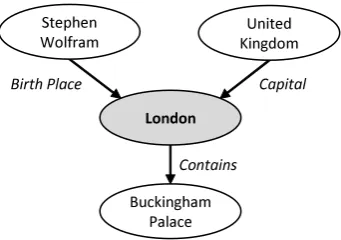
Figure 1: Triples with the entity London in a knowledge graph
since London is the answer to the above ques-tion,({Capital, City, United Kingdom}, London) together will form a Question Keyword and An-swer (QKA) pair. One important note is that Cap-ital, City, United Kingdom and London are the English labels of the node that represent these en-tities in theKG.
Column A Column B Column C Subject United Kingdom Stephen Wolfram London Domain Country Person Location
Predicate Capital Birth Place Contains
Object London London Buckingham Palace
Range City Location Location
Table 2: Examples of 5-tuples (subject, domain, predicate, object, range) for the entityLondon
In order to retrieve information about the given entityE, we need to first identify the nodenthat represents the entity E in the KG. One way to identify node n is to leverage the label (e.g, rdfs:label) property.
The next step is to retrieve all the neighbours of n. Let mi be a neighbour of n in KG, con-nected by a predicatepi. Hereiis the index over all predicates whose subject or object isn. Figure 1 shows the entityLondonwith three neighbours United Kingdom, Stephen Wolframand Bucking-ham Palace. Each of these neighbours are related to London by a predicate. For example, Stephen Wolfram is related to London as it is his Birth Place.
Given a predicatepi, letsub(pi)be the subject ofpiandobj(pi)be the object ofpi. A predicate is usually defined with a domain (subject type) and a range (object type) to provide better semantics. The domain and range defines the entity types that can be used as the subject and object of the predi-cate respectively. Letdomain(pi)andrange(pi) be the domain and range of pi respectively. Let
{sub(pi),domain(pi),pi,obj(pi),range(pi)}be the 5-tuple associated with everypi. Some exam-ples of 5-tuexam-ples are shown column wise in Table 2.
We now describe how QKA pairs are extracted from 5-tuple. LetQkbe the question keywords set andAk be the answer to the question to be gen-erated using Qk. (Qk, Ak) together will form a QKA pair. In this work, we consider only a single 5-tuple to generate a QKA pair. For example, we can generate QKA pair like({Capital, City, United Kingdom}, London) using Column Aof Table 2. But we will not generate QKA pair like({Capital, City, United Kingdom, Birth Place, Stephen Wol-fram}, London)using bothColumn A & Bof Table 2.
We use the following rules to generate QKA pairs from 5-tuples.
1. Unique Forward Relation : Ifpiis unique
for sub(pi) in KG, then Qk will include
sub(pi), pi and range(pi). Ak will be
obj(pi). Ifpi is not unique forsub(pi), then there could be multiple possible answers to the generated question includingobj(pi), and therefore we do not generate such a QKA pair. When this is applied to Column A of Table 2, we generate({Capital, City, United Kingdom}, London) as a QKA pair. There is no QKA pair generated forColumn C us-ing this rule as London contains many loca-tions like Buckingham Palace, City of West-minster, etc.
2. Unique Reverse Relation : Ifpi is unique
for obj(pi) in KG, then Qk will include
obj(pi), pi anddomain(pi). Ak issub(pi). Similar to unique forward relation, this rule can be applied toColumn Aof Table 2 and cannot be applied toColumn B & C.
3.2 RNN based Natural Language Question Generator
In the previous sub-section, we proposed an ap-proach for creating question keywords and an-swer pairs. Now we propose a model for gen-erating natural language questions from a given set of question keywords. We treat the keywords,
allows us to generate different semantically valid questions from the same setKbased on the order of the words in the set. For example, given the question keywords,QK ={King, Sweden}we can generate two semantically valid questions by changing the order of King and Sweden: (i) Who is the King of Sweden? and (ii) Does Sweden have a King?
We propose a Natural Language Question Gen-eration (NLQG) model that first encodes the in-put sequence using some distributed representa-tion and then decodes the output sequence from this encoded representation. Specifically, we use a RNN based encoder and decoder recently pro-posed for language processing tasks by number of groups (Cho et al., 2014; Sutskever et al., 2014). We now formally define the encoder and decoder models.
Let m be the number of keywords in the in-put sequence. We represent each keyword using a fixed size vectorxi ∈ <n. The function of the encoder is to map this sequence ofxi’s to a fixed size encoding. We use a RNN to computehm us-ing the followus-ing recursive equation:
hi = Φ(hi−1, xi), (1) where,hi ∈ <nis the hidden representation at po-sitioni.hmis the final encoded hidden state vector for this sequence. We use LSTM units (Hochreiter and Schmidhuber, 1997) as Φfor our implemen-tation based on its recent success in language pro-cessing tasks (Bahdanau et al., 2015).
The function of the decoder is to compute the probability of the output sequence Q =
{q1,· · ·, ql} given the encoded vector hm. Note thatlis the length of the output sequence and may be different fromm. This joint conditional proba-bility ofQis decomposed intolconditional prob-abilities:
p(q1,· · ·, ql|hm) = l Y
j=1
p(qj|{q1,· · ·, qj−1}, hm).
(2) Now we model p(qj|q<j, hm) at each position j by using a RNN decoder as follows:
p(qj|q<j, hm) = Θ(qj−1, gj, hm), (3)
whereΘis a non-linear function, that outputs the probability ofqj, andgj is the hidden state of the decoder RNN.
To train this RNN model, we use a keyword se-quence and question pairs generated from an open
domain Community Question Answering website. We provide more details on how the data is created and used for training in the experiments section.
At runtime, every permutation of the question keywords QK extracted is fed as input to the trained RNN. We pick the question Q with the highest probability of generation across all permu-tations, as the question generated from the ques-tion keywordsQK.
4 Experiments
In this section we perform experiments to demon-strate how the proposed approach outperforms the existing template based approach for generating questions from the keywords. We also evaluate the quality of the QA pairs generated from knowledge graph.
4.1 Datasets
For training the K2Q-RNN model we require a set of keywords and question pairs. We use a large collection of open-domain questions avail-able from WikiAnswers dataset2. This dataset has around 20M questions. We randomly selected 1M questions from this corpus for training and 5k questions for testing (the maximum length of a question was restricted to 50 words). We ex-tract keywords from the selected questions by re-taining only Nouns, Verbs and Adjectives in the question. The parts of speech tags were identified using Stanford Tagger (Toutanova et al., 2003). We form an ordered sequence of keywords by retaining these extracted words in the same or-der in which they appear in the original question. This sequence of keywords along with the original question forms one input-output sequence pair for training.
4.2 Methods
We evaluate and compare the following methods:
K2Q-RNN: This is our approach proposed in
the paper. For the encoder we use a bi-directional RNN containing one hidden layer of 1000 units. Each word in the input vocabulary is represented using a word vector which is randomly initialized and learnt during the training process. The de-coder also contains one hidden layer comprising of 1000 units. At the output layer of the decoder a softmax function gives the distribution over the entire target vocabulary. We use the top 30,000
most frequent words in the 1M training questions as the target vocabulary. If any sequence contains a word not belonging to this list then that word is mapped to a special token ([UNK]) that is also considered a part of the output vocabulary. We use a mini batch stochastic gradient descent al-gorithm together with Adadelta (Zeiler, 2012) to train our model. We used a mini-batch size of 50 and trained the model for 10 epochs. We used the beam search with the beam size to 12 to generate the question that approximately maximizes condi-tional probability defined in Equation 2.
K2Q-PBSMT: As mentioned earlier, we treat
the problem of generating questions from key-words as a sequence to sequence translation prob-lem. A Phrase Based Machine Translation Sys-tem (PBSMT) can also be employed for this task by considering that the keyword sequences be-long to a source language and the question se-quences belong to a target language. We compare our approach with a standard phrase-based MT system, MOSES (Koehn et al., 2007) trained us-ing the same 1M sequence pairs constructed from the WikiAnswers dataset. We used a 5-gram lan-guage model trained on the 1M target question se-quences and tuned the parameters of the decoder using 1000 held-out sequence (these were held out from the 1M training pairs).
K2Q-Template: For template based approach
we use the method proposed by (Zhao et al., 2011) along with the Word2Vec (Mikolov et al., 2015) ranking as proposed by (Raghu et al., 2015). The Word2Vec ranking provides better generalization than the ranking proposed by (Zhao et al., 2011). We learn the templates using the same 1M training pairs extracted from WikiAnswers.
4.3 Evaluation metrics
We evaluate the performance of K2Q RNN with other baselines to compare the K2Q approaches, we use BLEU score (Papineni et al., 2002) be-tween the generated question and the reference question. BLEU score is typically used in evaluat-ing the performance of MT systems and captures the average n-gram overlap between the generated sequence and the reference sequence. We consider n-grams upto length 4. BLEU score does not cap-ture the true performance of the system. For ex-ample, if the trained model simply reproduces all keywords in the generated question then also the unigram overlap will be high resulting in a higher
Method BLEU Score Human Judgment accuracy (%)
K2Q-Template 25.58 28.57
K2Q-PBSMT 50.90 44.29
[image:6.595.308.522.61.107.2]K2Q-RNN 50.14 60.13
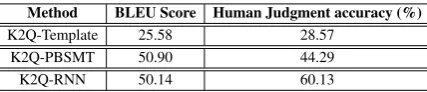
Table 3: Automatic Evaluation (column 2): The BLEU scores of generated questions for the test set. Human Evaluation (Column 3): Percentage of perfect questions generated by K2Q-Template, K2Q-PBSMT, and K2Q-RNN
BLEU score. Further, we had only one reference question (ground truth) per test instance which is not sufficient to capture the different ways of ex-pressing the question. In this case, BLEU score will be unnecessarily harsh on the model even if it generates a valid paraphrase of the reference ques-tion. To account for this we also perform a man-ual evaluation. We show the generated output to four human annotator and ask him/her to assign following ratings to the generated question, Rat-ing 4 : Perfect without error, RatRat-ing 3 : Good with one error, missing/addition of article or preposi-tion, but still meaningful, Rating 2 : Many errors, Rating 1 : Failure.
4.4 Results
4.4.1 RNN based Natural Language Question Generator
Ground truth K2Q-PBSMT K2Q-RNN pitching in baseball ? pitching in baseball ? what is pitching in baseball ?
difference between mergeracqs and amalgamation ? what is the difference between mergeracqs amalgamation ? what is the difference between mergeracqs and amalgamation ? did great britain control iraq ? great britain control in iraq ? how did the great britain control the iraq ? what is the critical analysis of the poem a river ? critical analysis of the poem a river ? what is the most critical analysis of the poem a river ?
[image:7.595.79.527.61.111.2]global warming affect population growth ? global warming affect the population growth ? can global warming affect the population growth ?
Table 4: Example questions fromGround truth, K2Q-PBSMT and K2Q-RNN
Entity Keyword Query Generated Question Answer
Alan Turing
birth place alan turing inventor lu decomposition tv episodes alan turing author mathematical logic
where is the birth place of alan turing ? ( ) who was the inventor of lu decomposition ? ( ) tv episodes of alan turing ? ( )
what is the author of the mathematical logic ? (x)
maida vale ( ) alan turing ( ) dangerous knowledge ( ) alan turing ( )
France
ioc code france capital france location lake annecy albin haller country
what is the ioc code for france ? ( ) what is the capital of france ? ( ) what is the location of lake annecy ? ( ) is albin haller a country ? (x)
fr ( ) paris ( ) france ( ) france (x)
Wimbledon wimbledon first date occurrencecurrent frequency wimbledon official website wimbledon
what was the wimbledon first date of occurrence ? ( ) what is the current frequency of wimbledon ? ( ) what is the official website for wimbledon ? ( )
1877-07-09 ( ) yearly ( )
[image:7.595.73.279.295.399.2]http://www.wimbledon.com/ ( )
Table 5: Example question-answer pairs extracted for different entities by usingFreebaseandK2Q-RNN. Question-Answer pairs are considered correct if and only if both are marked with by human judges.
K2Q-Template K2Q-PBSMT K2Q-RNN
0 50 100 150 200 250 300 350 400 450 500 550 600 650 700 750 800 No . o f qu est io ns w it h di ff er en t ra ti ng s
Rating 4 Rating 3 Rating 2 Rating 1
Figure 2: Ratings given by human judges for gen-erated questions forK2Q-Template, K2Q-PBSMT and K2Q-RNN( Best viewed in color).
method and calculate the accuracy, shown in Ta-ble 3. Figure 2 shows the distribution of ratings assigned by the annotators. Once gainK2Q-RNN andK2Q-PBSMT outperform the template based approach. Further, the human evaluation shows K2Q-RNNperforms better thanK2Q-PBSMT. Ta-ble 4 shows example questions that may have a high BLEU score for K2Q-PBSMT, however the K2Q-RNNhas a better human judgement.
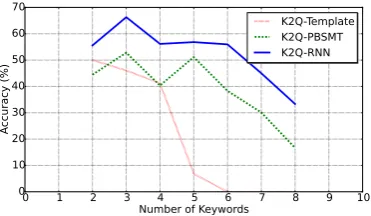
Next, we also compare the performance of these methods for input keyword sequences of different lengths. For this, we consider all test instances havingkkeywords and mark the generated ques-tion as correct if it was given a rating of 4 by the human annotator. The results of this experiment are plotted in Figure 3 where the x-axis represents number of keywords and y-axis represents the per-centage of test instances for which correct (rat-ing 4) questions were generated. Once again we see that K2Q-RNN clearly outperforms the other methods at all input sequence sizes.
0 1 2 3 Number4 5 6 7 8 9 10
of Keywords 0 10 20 30 40 50 60 70 A cc ur ac y (% ) K2Q-Template K2Q-PBSMT K2Q-RNN
Figure 3: The plot shows the performance of 3 methods Template, PBSMT, and K2Q-RNNas a functions of number of keywords.
4.4.2 Generating Question-Answers pairs from Freebase
[image:7.595.322.508.299.407.2]Train Sources Train Test F1-score(%)
WQ 3778 2032 39.9
WQ+GQA 11334 2032 42.1
WQ+GT 11334 2032 43.6
Table 6: PARASEMPRE Evaluation:
WQ=WebQuestions, GQA=Generated QA pairs from SimpleQuestions test dataset, GT=Ground truth data fromSimpleQuestionstest dataset.
in the 5-tuple. A few QA pairs were marked cor-rect by the annotators, even though the question was not grammatically correct but convey the right intent. Some examples of such questions are melt-ing point of propyl alcohol?, stanford university student radio station?. Overall,33.61%of the QA pairs generated by our method were annotated cor-rect. Table 5 shows some correct and incorrect QA pairs generated by our method.
4.4.3 Extrinsic Evaluation
As an extrinsic evaluation of the quality of our QA generation model, we use QA pairs gener-ated by our model to improve the performance of a state of the art QA system called PARASEM-PRE (Jonathan Berant, 2014). PARASEMPARASEM-PRE is a semantic parser, which maps natural language questions to intermediate logical forms which in turn are used to answer the question. The standard training set used for training PARASEMPRE is a part of the WebQuestionsand contains 3778 QA pairs. We appended this train with 7556 automat-ically generated QA pairs (resulting in tripling of the training set). Table 6 then compares the same system trained on the following different training sets: (i) Only Web Questions (WQ) dataset (ii) WQ + Generated Question Answers (GQA) and (iii) WQ + Ground Truth (GT) QA pairs. The GT QA pairs were obtained from theSimpleQuestions (Bordes et al., 2015) test data and have a one-to-one correspondence to the GQA data (hence the results are comparable). We see a relative im-provement of 5.5% in theF1-scoreof the system by adding GQA. Further, the performance gains are comparable to those obtained by using GT QA pairs.
4.4.4 Error analysis
We inspected all the QA pairs generated by our method to identify some common mistakes. We found that most errors corresponded to (i)
con-fusion between is/are and do/does (ii) incorrect use of determiners (missing articles, confusion be-tween a/the and addition of extra articles). An-other problem occurs when the extracted keyword sequence contains a stop word. This happens when dealing with triples such as ({also known as, Andre Agassi}, Agassi). Since, during train-ing we retain only content words (nouns, adjec-tives, verbs) in the input sequence, the model fails to deal with such stop words at test time and sim-ply produces unknown token (UNK) in the output. Another set of errors corresponds to mismatch be-tween the subject type and question type. For ex-ample, we observed that in a few cases, the model incorrectly generates awhat questioninstead of a who questionwhen the answer type is a person.
5 Conclusions
In this paper we propose a method for generat-ing QA pairs for an given entity usgenerat-ing a knowl-edge graph. We also propose an RNN based ap-proach for generating natural language questions from an input keyword sequence. The proposed method performs significantly better than previ-ously proposed template based method. We also do an extrinsic evaluation to show that the gener-ated QA pairs help in improving the performance of a downstream QA system. In future, we plan to extend this work to support predicates with stop words and support predicates in various tenses.
References
Husam Ali, Yllias Chali, and Sadid A Hasan. 2010. Automation of question generation from sentences. InProceedings of QG2010: The Third Workshop on Question Generation, pages 58–67.
Dzmitry Bahdanau, Kyunghyun Cho, and Yoshua Ben-gio. 2015. Neural machine translation by jointly learning to align and translate. InICLR.
Antoine Bordes, Nicolas Usunier, Sumit Chopra, and Jason Weston. 2015. Large-scale simple ques-tion answering with memory networks. CoRR, abs/1506.02075.
Jonathan C Brown, Gwen A Frishkoff, and Maxine Es-kenazi. 2005. Automatic question generation for vocabulary assessment. InProceedings of the con-ference on Human Language Technology and Em-pirical Methods in Natural Language Processing, pages 819–826. Association for Computational Lin-guistics.
Graesser. 2006. Nlgml: A markup language for question generation. In World Conference on E-Learning in Corporate, Government, Healthcare, and Higher Education, volume 2006, pages 2747– 2752.
KyungHyun Cho, Bart van Merrienboer, Dzmitry Bah-danau, and Yoshua Bengio. 2014. On the properties of neural machine translation: Encoder-decoder ap-proaches. InProceedings of SSST-8, Eighth Work-shop on Syntax, Semantics and Structure in Statisti-cal Translation.
Gideon Dror, Yoelle Maarek, Avihai Mejer, and Idan Szpektor. 2013. From query to question in one click: suggesting synthetic questions to searchers. InProceedings of the 22nd international conference on World Wide Web, pages 391–402. International World Wide Web Conferences Steering Committee. David A Ferrucci. 2012. Introduction to this is wat-son. IBM Journal of Research and Development, 56(3.4):1–1.
Shizhu He, Kang Liu, Yuanzhe Zhang, Liheng Xu, and Jun Zhao. 2014. Question answering over linked data using first-order logic. InProceedings of Em-pirical Methods in Natural Language Processing. Michael Heilman and Maxine Eskenazi. 2007.
Ap-plication of automatic thesaurus extraction for com-puter generation of vocabulary questions. InSLaTE, pages 65–68.
Michael Heilman and Noah A Smith. 2010. Good question! statistical ranking for question genera-tion. InHuman Language Technologies: The 2010 Annual Conference of the North American Chap-ter of the Association for Computational Linguistics, pages 609–617. Association for Computational Lin-guistics.
Sepp Hochreiter and J¨urgen Schmidhuber. 1997. Long short-term memory. Neural Computation, 9(8):1735–1780.
Percy Liang Jonathan Berant. 2014. Semantic parsing via paraphrasing. InACL.
Saidalavi Kalady, Ajeesh Elikkottil, and Rajarshi Das. 2010. Natural language question generation using syntax and keywords. InProceedings of QG2010: The Third Workshop on Question Generation, pages 1–10. questiongeneration. org.
Philipp Koehn, Hieu Hoang, Alexandra Birch, Chris Callison-Burch, Marcello Federico, Nicola Bertoldi, Brooke Cowan, Wade Shen, Christine Moran, Richard Zens, Chris Dyer, Ondˇrej Bojar, Alexandra Constantin, and Evan Herbst. 2007. Moses: Open source toolkit for statistical machine translation. In Proceedings of the 45th Annual Meeting of the ACL on Interactive Poster and Demonstration Sessions, ACL ’07, pages 177–180, Stroudsburg, PA, USA. Association for Computational Linguistics.
Chin-Yew Lin. 2008. Automatic question generation from queries. InWorkshop on the Question Genera-tion Shared Task, pages 156–164.
Prashanth Mannem, Rashmi Prasad, and Aravind Joshi. 2010. Question generation from paragraphs at upenn: Qgstec system description. InProceedings of QG2010: The Third Workshop on Question Gen-eration, pages 84–91.
Tomas Mikolov, Kai Chen, Greg Corrado, and Jeffrey Dean. 2015. Efficient estimation of word represen-tations in vector space. InICLR.
George A Miller, Richard Beckwith, Christiane Fell-baum, Derek Gross, and Katherine J Miller. 1990. Introduction to wordnet: An on-line lexical database*. International journal of lexicography, 3(4):235–244.
Kishore Papineni, Salim Roukos, Todd Ward, and Wei-Jing Zhu. 2002. Bleu: a method for automatic evaluation of machine translation. InProceedings of the 40th annual meeting on association for compu-tational linguistics, pages 311–318. Association for Computational Linguistics.
Dinesh Raghu, Sathish Indurthi, Jitendra Ajmera, and Sachindra Joshi. 2015. A statistical approach for non-sentential utterance resolution for interactive qa system. In16th Annual Meeting of the Special In-terest Group on Discourse and Dialogue, page 335. David E. Rumelhart, Geoffrey E. Hinton, and Ronald J. Williams. 1988. Neurocomputing: Foundations of research. pages 696–699.
Dominic Seyler, Mohamed Yahya, and Klaus Berberich. 2015. Generating quiz questions from knowledge graphs. In Proceedings of the 24th International Conference on World Wide Web Companion, pages 113–114. International World Wide Web Conferences Steering Committee. Ilya Sutskever, Oriol Vinyals, and Quoc V. Le. 2014.
Sequence to sequence learning with neural net-works. InAdvances in Neural Information Process-ing Systems 27: Annual Conference on Neural In-formation Processing Systems 2014, December 8-13 2014, Montreal, Quebec, Canada, pages 3104– 3112.
Kristina Toutanova, Dan Klein, Christopher D. Man-ning, and Yoram Singer. 2003. Feature-rich part-of-speech tagging with a cyclic dependency network. InHLT-NAACL.
Andrea Varga. 2010. Le an ha 2010 wlv: A ques-tion generaques-tion system for the qgstec 2010 task b. InProceedings of QG2010: The Third Workshop on Question Generation, pages 80–83.
Mohamed Yahya, Klaus Berberich, Shady Elbassuoni, and Gerhard Weikum. 2013. Robust question an-swering over the web of linked data. InProceedings of the 22nd ACM international conference on Con-ference on information & knowledge management, pages 1107–1116. ACM.
Matthew D. Zeiler. 2012. ADADELTA: an adaptive learning rate method. arxiv:, 1212.5701.
Shiqi Zhao, Haifeng Wang, Chao Li, Ting Liu, and Yi Guan. 2011. Automatically generating questions from queries for community-based question answer-ing. InIJCNLP, pages 929–937.
Zhicheng Zheng, Xiance Si, Edward Y Chang, and Xi-aoyan Zhu. 2011. K2q: Generating natural lan-guage questions from keywords with user refine-ments. InIJCNLP, pages 947–955.