58
Pre-training on High-Resource Speech Recognition
Improves Low-Resource Speech-to-Text Translation
Sameer Bansal1
Herman Kamper2
Karen Livescu3
Adam Lopez1
Sharon Goldwater1 1
School of Informatics, University of Edinburgh, UK 2
E&E Engineering, Stellenbosch University, South Africa 3
Toyota Technological Institute at Chicago, USA
{sameer.bansal, sgwater, alopez}@inf.ed.ac.uk [email protected]
Abstract
We present a simple approach to improve di-rect speech-to-text translation (ST) when the source language is low-resource: we pre-train the model on a high-resource automatic speech recognition (ASR) task, and then fine-tune its parameters for ST. We demonstrate that our approach is effective by pre-training on 300 hours of English ASR data to improve Spanish-English ST from 10.8 to 20.2 BLEU when only 20 hours of Spanish-English ST train-ing data are available. Through an ablation study, we find that the pre-trained encoder (acoustic model) accounts for most of the im-provement, despite the fact that the shared lan-guage in these tasks is the target lanlan-guage text, not the source language audio. Apply-ing this insight, we show that pre-trainApply-ing on ASR helps ST even when the ASR language differs from both source and target ST lan-guages: pre-training on French ASR also im-proves Spanish-English ST. Finally, we show that the approach improves performance on a true low-resource task: pre-training on a com-bination of English ASR and French ASR im-proves Mboshi-French ST, where only 4 hours of data are available, from 3.5 to 7.1 BLEU.
1 Introduction
Speech-to-text Translation (ST) has many potential applications for low-resource languages: for exam-ple in language documentation, where the source language is often unwritten or endangered ( Be-sacier et al.,2006;Martin et al.,2015;Adams et al.,
2016a,b; Anastasopoulos and Chiang, 2017); or in crisis relief, where emergency workers might need to respond to calls or requests in a foreign lan-guage (Munro,2010). Traditional ST is a pipeline of automatic speech recognition (ASR) and ma-chine translation (MT), and thus requires tran-scribed source audio to train ASR and parallel text to train MT. These resources are often unavailable
for low-resource languages, but for our potential applications, there may be some source language audio paired with target language text translations. In these scenarios, end-to-end ST is appealing.
Recently, Weiss et al.(2017) showed that end-to-end ST can be very effective, achieving an im-pressive BLEU score of 47.3 on Spanish-English ST. But this result required over 150 hours of trans-lated audio for training, still a substantial resource requirement. By comparison, a similar system trained on only 20 hours of data for the same task achieved a BLEU score of 5.3 (Bansal et al.,
2018). Other low-resource systems have similarly low accuracies (Anastasopoulos and Chiang,2018;
B´erard et al.,2018).
To improve end-to-end ST in low-resource set-tings, we can try to leverage other data resources. For example, if we have transcribed audio in the source language, we can use multi-task learning to improve ST (Anastasopoulos and Chiang,2018;
Weiss et al.,2017;B´erard et al.,2018). But source language transcriptions are unlikely to be available in our scenarios of interest.
Could we improve low-resource ST by lever-aging data from a high-resource language? For ASR, training a single model on multiple languages can be effective for all of them (Toshniwal et al.,
We first test our approach using Spanish as the source language and English as the target. After training an ASR system on 300 hours of English, fine-tuning on 20 hours of Spanish-English yields a BLEU score of 20.2, compared to only 10.8 for an ST model without ASR pre-training. Analyz-ing this result, we discover that the main benefit of pre-training arises from the transfer of the en-coderparameters, which model the input acoustic signal. In fact, this effect is so strong that we also obtain improvements by pre-training on a language that differs from both the source and the target: pre-training on French and fine-tuning on Spanish-English. We hypothesize that pre-training the en-coder parameters, even on a different language, allows the model to better learn about linguisti-cally meaningful phonetic variation while normal-izing over acoustic variability such as speaker and channel differences. We conclude that the acoustic-phonetic learning problem, rather than translation itself, is one of the main difficulties in low-resource ST. A final set of experiments confirm that ASR pre-training also helps on another language pair where the input is truly low-resource: Mboshi-French.
2 Method
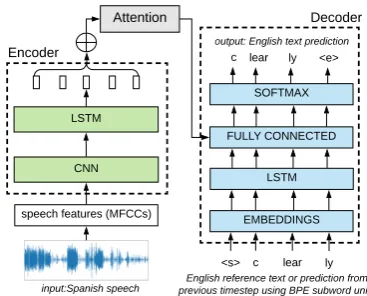
For both ASR and ST, we use an encoder-decoder model with attention adapted from Weiss et al.
(2017),B´erard et al.(2018) andBansal et al.(2018), as shown in Figure1. We use the same model ar-chitecture for all our models, allowing us to con-veniently transfer parameters between them. We also constrain the hyper-parameter search to fit a model into a single Titan X GPU, allowing us to maximize available compute resources.
We use a pre-trained English ASR model to ini-tialize training of Spanish-English ST models, and a pre-trained French ASR model to initialize ing of Mboshi-French ST models. During ST train-ing, all model parameters are updated. In these configurations, the decoder shares the same vocab-ulary across the ASR and ST tasks. This is practical for settings where the target text language is high-resource with ASR data available.
In settings where both ST languages are low-resource, ASR data may only be available in a third language. To test whether transfer learning will help in this setting, we use a pre-trained French ASR model to train Spanish-English ST models; and English ASR for Mboshi-French models. In these cases, the ST languages are different from the
Process
LSTM
CNN
speech features (MFCCs)
Attention
<s> c lear ly LSTM
EMBEDDINGS FULLY CONNECTED
SOFTMAX
input:Spanish speech
English reference text or prediction from previous timestep using BPE subword units
Decoder
Encoder c lear ly <e>
[image:2.595.319.503.68.216.2]output: English text prediction
Figure 1: Encoder-decoder with attention model archi-tecture for both ASR and ST. The encoder input is the
Spanish speech utteranceclaro, translated as clearly,
represented as BPE (subword) units.
ASR language, so we can only transfer the encoder parameters of the ASR model, since the dimensions of the decoder’s output softmax layer are indexed by the vocabulary, which is not shared.1 Sharing only the speech encoder parameters is much eas-ier, since the speech input can be preprocessed in the same manner for all languages. This form of transfer learning is more flexible, as there are no constraints on the ASR language used.
3 Experimental Setup
3.1 Data sets
English ASR.We use the Switchboard Telephone speech corpus (Godfrey and Holliman, 1993), which consists of around 300 hours of English speech and transcripts, split into 260k utterances. The development set consists of 5 hours that we removed from the training set, split into 4k utter-ances.
French ASR. We use the French speech corpus from the GlobalPhone collection (Schultz,2002), which consists of around 20 hours of high quality read speech and transcripts, split into 9k utterances. The development set consists of 2 hours, split into 800 utterances.
Spanish-English ST.We use the Fisher Spanish speech corpus (Graff et al.,2010), which consists of 160 hours of telephone speech in a variety of Span-ish dialects, split into 140K utterances. To simulate low-resource conditions, we construct smaller
train-1Using a shared vocabulary of characters or subwords is
ing corpora consisting of 50, 20, 10, 5, or 2.5 hours of data, selected at random from the full training data. The development and test sets each consist of around 4.5 hours of speech, split into 4K utter-ances. We do not use the corresponding Spanish transcripts; our target text consists of English trans-lations that were collected through crowdsourcing (Post et al.,2013,2014).
Mboshi-French ST.Mboshi is a Bantu language spoken in the Republic of Congo, with around 160,000 speakers.2We use the Mboshi-French
par-allel corpus (Godard et al.,2018), which consists of around 4 hours of Mboshi speech, split into a training set of 5K utterances and a development set of 500 utterances. Since this corpus does not include a designated test set, we randomly sam-pled and removed 200 utterances from training to use as a development set, and use the designated development data as a test set.
3.2 Preprocessing
Speech. We convert raw speech input to 13-dimensional MFCCs using Kaldi (Povey et al.,
2011).3 We also perform speaker-level mean and variance normalization.
Text. The target text of the Spanish-English data set contains 1.5M word tokens and 17K word types. If we model text as sequences of words, our model cannot produce any of the unseen word types in the test data and is penalized for this, but it can be trained very quickly (Bansal et al.,2018). If we instead model text as sequences of characters as done byWeiss et al. (2017), we would have 7M tokens and 100 types, resulting in a model that is open-vocabulary, but very slow to train (Bansal et al.,2018). As an effective middle ground, we use byte pair encoding (BPE;Sennrich et al.,2016) to segment each word into subwords, each of which is a character or a high-frequency sequence of characters—we use 1000 of these high-frequency sequences. Since the set of subwords includes the full set of characters, the model is still open vocab-ulary; but it results in a text with only 1.9M tokens and just over 1K types, which can be trained almost as fast as the word-level model.
The vocabulary for BPE depends on the
fre-2ethnologue.com/language/mdw
3In preliminary experiments, we did not find much
differ-ence between between MFCCs and more raw spectral repre-sentations like Mel filterbank features.
quency of character sequences, so it must be com-puted with respect to a specific corpus. For En-glish, we use the full 160-hour Spanish-English ST target training text. For French, we use the Mboshi-French ST target training text.
3.3 Model architecture for ASR and ST
Speech encoder. As shown schematically in Fig-ure 1, MFCC feature vectors, extracted using a window size of 25 ms and a step size of 10ms, are fed into a stack of two CNN layers, with 128 and 512 filters with a filter width of 9 frames each. In each CNN layer we stride with a factor of 2 along time, apply a ReLU activation (Nair and Hinton,
2010), and apply batch normalization (Ioffe and Szegedy, 2015). The output of the CNN layers is fed into a three-layer bi-directional long short term memory network (LSTM; Hochreiter and Schmidhuber, 1997); each hidden layer has 512 dimensions.
Text decoder. At each time step, the decoder chooses the most probable token from the output of a softmax layer produced by a fully-connected layer, which in turn receives the current state of a recurrent layer computed from previous time steps and an attention vector computed over the input. Attention is computed using theglobal atten-tional modelwithgeneralscore function and input-feeding, as described inLuong et al.(2015). The predicted token is then fed into a 128-dimensional embedding layer followed by a three-layer LSTM to update the recurrent state; each hidden state has 256 dimensions. While training, we use the pre-dicted token 20% of the time as input to the next decoder step and the training token for the remain-ing 80% of the time (Williams and Zipser,1989). At test time we use beam decoding with a beam size of 5 and length normalization (Wu et al.,2016) with a weight of 0.6.
Training and implementation. Parameters for the CNN and RNN layers are initialized using the scheme from (He et al., 2015). For the embedding and fully-connected layers, we use Chainer’s (Tokui et al.,2015) default initialition.
We regularize using dropout (Srivastava et al.,
Following some preliminary experimentation on our development set, we add Gaussian noise with standard deviation of 0.25 to the MFCC features during training, and drop frames with a probabil-ity of 0.10. After 20 epochs, we corrupt the true decoder labels by sampling a random output label with a probability of 0.3.
Our code is implemented in Chainer (Tokui et al.,
2015) and is freely available.4
3.4 Evaluation
Metrics.We report BLEU (Papineni et al.,2002) for all our models.5 In low-resource settings, BLEU scores tend to be low, difficult to interpret, and poorly correlated with model performance. This is because BLEU requires exact four-gram matches only, but low four-gram accuracy may ob-scure a high unigram accuracy and inexact transla-tions that partially capture the semantics of an utter-ance, and these can still be very useful in situations like language documentation and crisis response. Therefore, we also report word-level unigram preci-sion and recall, taking into accountstem,synonym, andparaphrasematches. To compute these scores, we use METEOR (Lavie and Agarwal,2007) with default settings for English and French.6For exam-ple, METEOR assigns “eat” a recall of 1 against reference “eat” and a recall of 0.8 against reference “feed”, which it considers a synonym match.
Naive baselines.We also include evaluation scores for a naive baseline model that predicts theKmost frequent words of the training set as a bag of words for each test utterance. We setKto be the value at which precision/recall are most similar, which is always between 5 and 20 words. This provides an empirical lower bound on precision and recall, since we would expect any usable model to out-perform a system that does not even depend on the input utterance. We do not compute BLEU for these baselines, since they do not predict sequences, only bags of words.
4 ASR results
Using the experimental setup of Section3, we pre-trained ASR models in English and French, and report their word error rates (WER) on
develop-4github.com/0xSameer/ast 5
We compute BLEU withmulti-bleu.plfrom the Moses toolkit (Koehn et al.,2007).
6
cs.cmu.edu/˜alavie/METEOR
en-100h en-300h fr-20h
WER 35.4 27.3 29.6
Table 1: Word Error Rate (WER, in %) for the ASR models used as pretraining, computed on Switchboard
train-devfor English and Globalphone dev for French.
ment data in Table1.7 We denote each ASR model byL-Nh, whereLis a language code andNis the size of the training set in hours. For example, en-300h denotes an English ASR model trained on 300 hours of data.
Training ASR models for state-of-the-art perfor-mance requires substantial hyper-parameter tuning and long training times. Since our goal is simply to see whether training is useful, we stopped pre-training our models after around 30 epochs (3 days) to focus on transfer experiments. As a consequence, our ASR results are far from state-of-the-art: cur-rent end-to-end Kaldi systems obtain 16% WER on Switchboardtrain-dev, and 22.7% WER on the French Globalphone dev set.8 We believe that bet-ter ASR pre-training may produce betbet-ter ST results, but we leave this for future work.
5 Spanish-English ST
In the following, we denote an ST model by S-T-Nh, whereSandTare source and target language codes, andNis the size of the training set in hours. For example,sp-en-20hdenotes a Spanish-English ST model trained using 20 hours of data. We use the codembfor Mboshi andfrfor French.
5.1 Using English ASR to improve ST
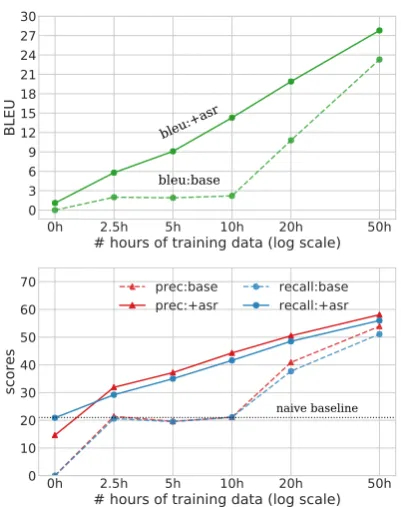
Figure 2 shows the BLEU and unigram preci-sion/recall scores on the development set for base-line Spanish-English ST models and those trained after initializing with theen-300hmodel. Corre-sponding results on the test set (Table2) reveal very similar patterns. The remainder of our analysis is confined to the development set. The naive base-line, which predicts the 15 most frequent English words in the training set, achieves a precision/recall of around 20%, setting a performance lower bound.
Low-resource: 20-50 hours of ST training data. Our baseline ST models substantially improve over
7
We computed WER with the NISTsclitescript.
8These WER results taken from respective Kaldi recipes
[image:4.595.315.515.66.102.2]0h 2.5h 5h 10h 20h 50h # hours of training data (log scale) 0
3 6 9 12 15 18 21 24 27 30
BLEU bleu:+asr
bleu:base
0h 2.5h 5h 10h 20h 50h
# hours of training data (log scale) 0
10 20 30 40 50 60 70
scores
naive baseline
prec:base prec:+asr
recall:base recall:+asr
Figure 2: (top) BLEU and (bottom) Unigram preci-sion/recall for Spanish-English ST models computed on Fisher dev set. base indicates no transfer learning;
+asr are models trained by fine-tuningen-300hmodel
parameters.naive baselineindicates the score when we
predict the 15 most frequent English words in the train-ing set.
previous results (Bansal et al.,2018) using the same train/test splits, primarily due to better regulariza-tion and modeling of subwords rather than words. Yet transfer learning still substantially improves over these strong baselines. Forsp-en-20h, transfer learning improves dev set BLEU from 10.8 to 19.9, precision from 41% to 51%, and recall from 38% to 49%. Forsp-en-50h, transfer learning improves BLEU from 23.3 to 27.8, precision from 54% to 58%, and recall from 51% to 56%.
Very low-resource: 10 hours or less of ST train-ing data. Figure 2 shows that without transfer learning, ST models trained on less than 10 hours of data struggle to learn, with precision/recall scores close to or below that of the naive baseline. But with transfer learning, we see gains in precision and recall of between 10 and 20 points.
We also see that with transfer learning, a model trained on only 5 hours of ST data achieves a BLEU of 9.1, nearly as good as the 10.8 of a model trained on 20 hours of ST data without transfer learning. In other words, fine-tuning an English ASR model— which is relatively easy to obtain—produces similar results to training an ST model on four times as
N = 0 2.5 5 10 20 50
base 0 2.1 1.8 2.1 10.8 22.7
[image:5.595.81.283.61.315.2]+asr 0.5 5.7 9.1 14.5 20.2 28.2
Table 2: BLEU scores for Spanish-English ST on the
Fisher test set, usingNhours of training data. base: no
transfer learning. +asr: using model parameters from English ASR (en-300h).
Spanish super caliente pero muy bonito
English super hot but very nice
20h you support it but it was very nice
20h+asr you can get alright but it’s very nice
50h super expensive but very nice
50h+asr super hot but it’s very nice
Spanish s´ı y usted hace mucho tiempo que que vive aqu´ı
English yes and have you been living here a long time
20h yes i’ve been a long time what did you come here
20h+asr yes and you have a long time that you live here
50h yes you are a long time that you live here
[image:5.595.305.525.63.115.2]50h+asr yes and have you been here long
Table 3: Example translations on selected sentences
from the Fisher development set, with stem-level n
-gram matches to the reference sentence underlined. 20h and 50h are Spanish-English models without pre-training; 20h+asr and 50h+asr are pre-trained on 300 hours of English ASR.
much data, which may be difficult to obtain. We even find that in the very low-resource setting of just 2.5 hours of ST data, with transfer learning the model achieves a precision/recall of around 30% and improves by more than 10 points over the naive baseline. In very low-resource scenarios with time constraints—such as in disaster relief—it is possible that even this level of performance may be useful, since it can be used to spot keywords in speech and can be trained in just three hours.
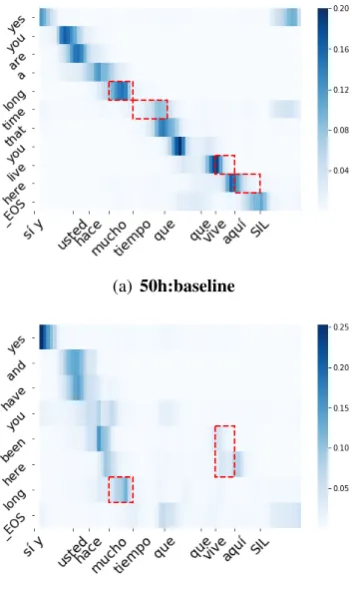
Sample translations. Table 3 shows example translations for modelssp-en-20hand sp-en-50h with and without transfer learning usingen-300h.
(a)50h:baseline
[image:6.595.94.273.63.359.2](b) 50h:asr
Figure 3: Attention plots for the final example in
Ta-ble3, using 50h models with and without pre-training.
Thex-axis shows the reference Spanish word positions
in the input; they-axis shows the predicted English
sub-words. In the reference,mucho tiempois translated to
long time, andvive aqu´ıtoliving here, but their order is reversed, and this is reflected in (b).
the English word order right. With transfer learn-ing, the model produces a shorter but still accurate translation in the correct word order.
5.2 Analysis
To understand the source of these improvements, we carried out a set of ablation experiments. For most of these experiments, we focus on Spanish-English ST with 20 hours of training data, with and without transfer learning.
Transfer learning with selected parameters. In our first set of experiments, we transferred all parameters of the en-300h model, including the speech encoder CNN and LSTM; the text decoder embedding, LSTM and output layer parameters; and attention parameters. To see which set of pa-rameters has the most impact, we train the sp-en-20hmodel by transferring only selected parameters fromen-300h, and randomly initializing the rest.
The results (Figure4) show that transferring all
1 10 20 30 40 50 60
training epochs 0
2 4 6 8 10 12 14 16 18 20
BLEU
+asr:all +asr:enc
+asr:dec +asr:cnn
base
Figure 4: Fisher development set training curves
(reported using BLEU) for sp-en-20h using selected
parameters from en-300h: none (base); encoder
CNN only (+asr:cnn); encoder CNN and LSTM only (+asr:enc); decoder only (+asr:dec); and all: encoder, attention, and decoder (+asr:all). These scores do not use beam search and are therefore lower than the best
scores reported in Figure2.
parameters is most effective, and that the speech encoder parameters account for most of the gains. We hypothesize that the encoder learns transferable low-level acoustic features that normalize across variability like speaker and channel differences to better capture meaningful phonetic differences, and that much of this learning is language-independent. This hypothesis is supported by other work show-ing the benefits of cross-lshow-ingual and multilshow-ingual training for speech technology in low-resource tar-get languages (Carlin et al., 2011; Jansen et al.,
2010;Deng et al.,2013;Vu et al.,2012;Thomas et al.,2012;Cui et al.,2015;Alum¨ae et al.,2016;
Yuan et al.,2016;Renshaw et al.,2015;Hermann and Goldwater,2018).
By contrast, transferring only decoder param-eters does not improve accuracy. Since decoder parameters help when used in tandem with encoder parameters, we suspect that the dependency in pa-rameter training order might explain this: the trans-ferred decoder parameters have been trained to ex-pect particular input representations from the en-coder, so transferring only the decoder parameters without the encoder might not be useful.
[image:6.595.317.514.63.190.2]0h 100h 300h # English ASR hours data used 0
3 6 9 12 15 18 21 24 27 30
BLEU sp-en-20h
[image:7.595.88.278.65.158.2]sp-en-50h
Figure 5: Spanish-to-English BLEU scores on Fisher dev set, with 0h (no transfer learning), 100h and 300h of English ASR data used.
time to deploy a working system must be mini-mized.
Amount of ASR data required. Figure5shows the impact of increasing the amount of English ASR data used on Spanish-English ST performance for two models: sp-en-20handsp-en-50h.
For sp-en-20h, we see that using en-100h im-proves performance by almost 6 BLEU points. By using more English ASR training data (en-300h) model, the BLEU score increases by almost 9 points. However, forsp-en-50h, we only see im-provements when usingen-300h. This implies that transfer learning is most useful when only a few tens of hours of training data are available for ST. As the amount of ST training data increases, the benefits of transfer learning tail off, although it’s possible that using even more monolingual data, or improving the training at the ASR step, could extend the benefits to larger ST data sets.
Impact of code-switching. We also tried using theen-300hASR model without any fine-tuning to translate Spanish audio to English text. This model achieved a BLEU score of 1.1, with a pre-cision of 15 and recall of 21. The non-zero BLEU score indicates that the model is matchingsome 4-grams in the reference. This seems to be due to code-switching in the Fisher-Spanish speech data set. Looking at the dev set utterances, we find several examples where the Spanish transcriptions match the English translations, indicating that the speaker switched into English. For example, there is an utterance whose Spanish transcription and English translation are both “right yeah”, and this English expression is indeed present in the source audio. The English ASR model correctly trans-lates this utterance, which is unsurprising since the phrase “right yeah” occurs nearly 500 times in Switchboard.
Overall, we find that in nearly 500 of the 4,000 development set utterances (14%), the Spanish transcription and English translations share more than half of their tokens, indicating likely code-switching. This suggests that transfer learning from English ASR models might help more than from other languages. To isolate this effect from transfer learning of language-independent speech features, we carried out a further experiment.
5.3 Using French ASR to improve Spanish-English ST
In this experiment, we pre-train using French ASR data for a Spanish-English translation task. Here, we can only transfer the speech encoder parameters, and there should be little if any benefit due to code-switching.
Because our French data set (20 hours) is much smaller than our English one (300 hours), for a fair comparison we used a 20 hour subset of the English data for pre-training in this experiment. For both the English and French models, we transferred only the encoder parameters.
Table4shows that both the English and French 20-hour pre-trained models improve performance on Spanish-English ST. The English model works slightly better, as would be predicted given our dis-cussion of code-switching, but the French model is also useful, improving BLEU from 10.8 to 12.5. This result strengthens the claim that ASR pre-training on a completely distinct third language can help low-resource ST. Presumably benefits would be much greater if we used a larger ASR data set, as we did with English above.
baseline +fr-20h +en-20h
sp-en-20h 10.8 12.5 13.2
Table 4: Fisher dev set BLEU scores for sp-en-20h.
baseline: model without transfer learning. Last two columns: Using encoder parameters from French ASR (+fr-20h), and English ASR (+en-20h).
model pretrain BLEU Pr. Rec.
fr-top-8w – 0 23.5 22.2 fr-top-10w – 0 20.6 24.5
en-300h – 0 0.2 5.7
fr-20h – 0 4.1 3.2
mb-fr-4h
– 3.5 18.6 19.4 fr-20h 5.9 23.6 20.9 en-300h 5.3 23.5 22.6
en + fr 7.1 26.7 23.1
Table 5: Mboshi-to-French translation scores, with and without ASR pre-training. Pr. is the precision, and Rec. the recall score. fr-top-8w and fr-top-10w are
naive baselines that, respectively, predict the 8 or 10 most frequent training words. For en + fr, we use
en-coder parameters fromen-300hand attention+decoder
parameters fromfr-20h
6 Mboshi-French ST
Our final set of experiments test our transfer method on ST for the low-resource language Mboshi, where we have only 4 hours of ST training data: Mboshi speech input paired with French text output.
Table5shows the ST model scores for Mboshi-French with and without using transfer learning. The first two rowsfr-top-8w,fr-top-10w, show pre-cision and recall scores for the naive baselines where we predict the top 8 or 10 most frequent French words in the Mboshi-French training set. These show that a precision/recall in the low 20s is easy to achieve, although with no n-gram matches (0 BLEU). The pre-trained ASR models by them-selves (next two lines) are much worse.
The baseline model trained only on ST data actu-ally has lower precision/recall than the naive base-line, although its non-zero BLEU score indicates that it is able to correctly predict some n-grams. We see comparable precision/recall to the naive baseline with improvements in BLEU by transfer-ring either French ASR parameters (both encoder
and decoder,fr-20h) or English ASR parameters (encoder only,en-300h).
Finally, to achieve the benefits of both the larger training set size for the encoder and the matching language of the decoder, we tried transferring the encoding parameters from theen-300hmodel and the decoding parameters from the fr-20h model. This configuration (en+fr) gives us the best evalua-tion scores on all metrics, and highlights the flexi-bility of our framework. Nevertheless, the 4-hour scenario is clearly a very challenging one.
7 Conclusion
This paper introduced the idea of pre-training an end-to-end speech translation system involving a low-resource language using ASR training data from a higher-resource language. We showed that large gains are possible: for example, we achieved an improvement of 9 BLEU points for a Spanish-English ST model with 20 hours of parallel data and 300 hours of English ASR data. Moreover, the pre-trained model trains faster than the baseline, achieving higher BLEU in only a couple of hours, while the baseline trains for more than a day.
We also showed that these methods can be used effectively on a real low-resource language, Mboshi, with only 4 hours of parallel data. The very small size of the data set makes the task chal-lenging, but by combining parameters from an English encoder and French decoder, we outper-formed baseline models to obtain a BLEU score of 7.1 and precision/recall of about 25%. We believe ours is the first paper to report word-level BLEU scores on this data set.
Our analysis indicates that, other things being equal, transferring both encoder and decoder pa-rameters works better than just transferring one or the other. However, transferring the encoder pa-rameters is where most of the benefit comes from. Pre-training using a large ASR corpus from a mis-matched language will therefore probably work bet-ter than using a smaller ASR corpus that matches the output language.
Our analysis suggests several avenues for further exploration. On the speech side, it might be even more effective to use multilingual training; or to replace the MFCC input features with pre-trained multilingual features, or features that are targeted to low-resource multispeaker settings (Kamper et al.,
2015,2017;Thomas et al.,2012;Cui et al.,2015;
the language modeling side, simply transferring decoder parameters from an ASR model did not work; it might work better to use pre-trained de-coder parameters from a language model, as pro-posed byRamachandran et al.(2017), orshallow fusion (G¨ulc¸ehre et al., 2015; Toshniwal et al.,
2018a), which interpolates a pre-trained language model during beam search. In these methods, the decoder parameters are independent, and can there-fore be used on their own. We plan to explore these strategies in future work.
Acknowledgments
We would like to thank the anonymous reviewers for their valuable feedback. This work was sup-ported in part by a James S McDonnell Foundation Scholar Award, a Google faculty research award, and NSF grant 1816627. We thank Ida Szubert and Clara Vania for helpful comments on previous drafts of this paper and Antonios Anastasopoulos for tips on experimental setup.
References
Oliver Adams, Graham Neubig, Trevor Cohn, and Steven Bird. 2016a. Learning a translation model
from word lattices. InProc. Interspeech.
Oliver Adams, Graham Neubig, Trevor Cohn, Steven Bird, Quoc Truong Do, and Satoshi Nakamura. 2016b. Learning a lexicon and translation model
from phoneme lattices. InProc. EMNLP.
Tanel Alum¨ae, Stavros Tsakalidis, and Richard M Schwartz. 2016. Improved multilingual training of stacked neural network acoustic models for low
re-source languages. InProc. Interspeech.
Antonios Anastasopoulos and David Chiang. 2017. A case study on using speech-to-translation alignments
for language documentation. InProc. ACL.
Antonios Anastasopoulos and David Chiang. 2018. Tied multitask learning for neural speech translation. InProc. NAACL HLT.
Sameer Bansal, Herman Kamper, Karen Livescu, Adam Lopez, and Sharon Goldwater. 2018.
Low-resource speech-to-text translation. InProc.
Inter-speech.
Alexandre B´erard, Laurent Besacier, Ali Can Ko-cabiyikoglu, and Olivier Pietquin. 2018. End-to-end
automatic speech translation of audiobooks. InProc.
ICASSP.
Laurent Besacier, Bowen Zhou, and Yuqing Gao. 2006. Towards speech translation of non written languages. InProc. SLT.
Michael A Carlin, Samuel Thomas, Aren Jansen, and
Hynek Hermansky. 2011. Rapid evaluation of
speech representations for spoken term discovery. In
Proc. Interspeech.
Jia Cui, Brian Kingsbury, Bhuvana Ramabhadran, Ab-hinav Sethy, Kartik Audhkhasi, Xiaodong Cui, Ellen Kislal, Lidia Mangu, Markus Nussbaum-Thom, Michael Picheny, et al. 2015. Multilingual repre-sentations for low resource speech recognition and
keyword search. InProc. ASRU.
Li Deng, Jinyu Li, Jui-Ting Huang, Kaisheng Yao, Dong Yu, Frank Seide, Mike Seltzer, Geoff Zweig, Xiaodong He, Jason Williams, Yifan Gong, and Alex Acero. 2013. Recent advances in deep learning
for speech research at Microsoft. InProc. ICASSP.
Yarin Gal. 2016. A theoretically grounded application
of dropout in recurrent neural networks. In Proc.
NIPS.
Pierre Godard, Gilles Adda, Martine Adda-Decker, Juan Benjumea, Laurent Besacier, Jamison Cooper-Leavitt, Guy-No¨el Kouarata, Lori Lamel, H´el`ene Maynard, Markus M¨uller, Annie Rialland, Sebastian St¨uker, Franc¸ois Yvon, and Marcely Zanon Boito.
2018. A very low resource language speech
cor-pus for computational language documentation
ex-periments. InProc. LREC.
John Godfrey and Edward Holliman. 1993.
Switchboard-1 Release 2 (LDC97S62). https:
//catalog.ldc.upenn.edu/ldc97s62.
David Graff, Shudong Huang, Ingrid Cartagena, Kevin Walker, and Christopher Cieri. 2010. Fisher
Span-ish Speech (LDC2010S01). https://catalog.
ldc.upenn.edu/ldc2010s01.
Caglar G¨ulc¸ehre, Orhan Firat, Kelvin Xu, Kyunghyun Cho, Loıc Barrault, Huei-Chi Lin, Fethi Bougares, Holger Schwenk, and Yoshua Bengio. 2015. On us-ing monolus-ingual corpora in neural machine
transla-tion. CoRR, abs/1503.03535.
Kaiming He, Xiangyu Zhang, Shaoqing Ren, and Jian Sun. 2015. Delving deep into rectifiers: Surpass-ing human-level performance on ImageNet
classifi-cation. InProc. ICCV.
Enno Hermann and Sharon Goldwater. 2018. Multi-lingual bottleneck features for subword modeling in
zero-resource languages. InProc. Interspeech.
Sepp Hochreiter and J¨urgen Schmidhuber. 1997. Long
short-term memory.Neural Comput.
Sergey Ioffe and Christian Szegedy. 2015. Batch nor-malization: Accelerating deep network training by
reducing internal covariate shift. InProc. ICML.
Aren Jansen, Kenneth Church, and Hynek Hermansky. 2010. Towards spoken term discovery at scale with
Melvin Johnson, Mike Schuster, Quoc V. Le, Maxim Krikun, Yonghui Wu, Zhifeng Chen, Nikhil Tho-rat, Fernanda B. Vi´egas, Martin Wattenberg, Gre-gory S. Corrado, Macduff Hughes, and Jeffrey Dean. 2017. Google’s multilingual neural machine
transla-tion system: Enabling zero-shot translatransla-tion. Trans.
ACL, 5:339–351.
Herman Kamper, Micha Elsner, Aren Jansen, and Sharon Goldwater. 2015. Unsupervised neural net-work based feature extraction using weak top-down
constraints. InProc. ICASSP.
Herman Kamper, Aren Jansen, and Sharon
Gold-water. 2017. A segmental framework for
fully-unsupervised large-vocabulary speech recognition.
Comput. Speech Lang., 46:154–174.
Diederik Kingma and Jimmy Ba. 2015. Adam: A
method for stochastic optimization. InProc. ICLR.
Philipp Koehn, Hieu Hoang, Alexandra Birch, Chris Callison-Burch, Marcello Federico, Nicola Bertoldi, Brooke Cowan, Wade Shen, Christine Moran,
Richard Zens, et al. 2007. Moses: Open source
toolkit for statistical machine translation. In Proc.
ACL.
Alon Lavie and Abhaya Agarwal. 2007. Meteor: An automatic metric for mt evaluation with high
lev-els of correlation with human judgments. In Proc.
WMT.
Minh-Thang Luong, Hieu Pham, and Christopher D Manning. 2015. Effective approaches to
attention-based neural machine translation. InProc. EMNLP.
Lara J Martin, Andrew Wilkinson, Sai Sumanth Miryala, Vivian Robison, and Alan W Black. 2015. Utterance classification in speech-to-speech transla-tion for zero-resource languages in the hospital
ad-ministration domain. InProc. ASRU.
Robert Munro. 2010. Crowdsourced translation for
emergency response in Haiti: The global
collabora-tion of local knowledge. InAMTA Workshop
Collab-orative Crowdsourcing Transl.
Vinod Nair and Geoffrey E. Hinton. 2010. Rectified linear units improve restricted Boltzmann machines. InProc. ICML.
Kishore Papineni, Salim Roukos, Todd Ward, and Wei-Jing Zhu. 2002. BLEU: a method for automatic
eval-uation of machine translation. InProc. ACL.
Matt Post, Gaurav Kumar, Adam Lopez, Damianos Karakos, Chris Callison-Burch, and Sanjeev
Khu-danpur. 2013. Improved speech-to-text
transla-tion with the Fisher and Callhome Spanish-English
speech translation corpus. InProc. IWSLT.
Matt Post, Gaurav Kumar, Adam Lopez, Damianos Karakos, Chris Callison-Burch, and Sanjeev Khu-danpur. 2014. Fisher and CALLHOME Spanish–
English Speech Translation. https://catalog.
ldc.upenn.edu/ldc2014t23.
Daniel Povey, Arnab Ghoshal, Gilles Boulianne, Lukas Burget, Ondrej Glembek, Nagendra Goel, Mirko Hannemann, Petr Motlicek, Yanmin Qian, Petr Schwarz, Jan Silovsky, Georg Stemmer, and Karel
Vesely. 2011. The Kaldi Speech Recognition
Toolkit. InProc. ASRU.
Prajit Ramachandran, Peter J Liu, and Quoc V Le. 2017. Unsupervised pretraining for sequence to
se-quence learning. InProc. EMNLP.
Daniel Renshaw, Herman Kamper, Aren Jansen, and
Sharon Goldwater. 2015. A comparison of
neu-ral network methods for unsupervised representation learning on the zero resource speech challenge. In
Proc. Interspeech.
Tanja Schultz. 2002. Globalphone: a multilingual
speech and text database developed at karlsruhe
uni-versity. InSeventh International Conference on
Spo-ken Language Processing.
Rico Sennrich, Barry Haddow, and Alexandra Birch. 2016. Neural machine translation of rare words with
subword units. InProc. ACL.
Nitish Srivastava, Geoffrey Hinton, Alex Krizhevsky, Ilya Sutskever, and Ruslan Salakhutdinov. 2014. Dropout: A simple way to prevent neural networks
from overfitting. J. Mach. Learn. Res.
Samuel Thomas, Sriram Ganapathy, and Hynek Her-mansky. 2012. Multilingual mlp features for
low-resource LVCSR systems. InProc. ICASSP.
Sebastian Thrun. 1995. Is learning the n-th thing any
easier than learning the first? InProc. NIPS.
Seiya Tokui, Kenta Oono, Shohei Hido, and Justin Clayton. 2015. Chainer: A next-generation open
source framework for deep learning. InProc.
Learn-ingSys.
Shubham Toshniwal, Anjuli Kannan, Chung-Cheng Chiu, Yonghui Wu, Tara N Sainath, and Karen Livescu. 2018a. A Comparison of Techniques for Language Model Integration in Encoder-Decoder
Speech Recognition. InProc. SLT.
Shubham Toshniwal, Tara N. Sainath, Ron J. Weiss, Bo Li, Pedro Moreno, Eugene Weinstein, and
Kan-ishka Rao. 2018b. Multilingual Speech
Recogni-tion with A Single End-To-End Model. In Proc.
ICASSP.
Ngoc Thang Vu, Wojtek Breiter, Florian Metze, and Tanja Schultz. 2012. An investigation on initializa-tion schemes for multilayer perceptron training us-ing multilus-ingual data and their effect on ASR
perfor-mance. InProc. Interspeech.
Ron J Weiss, Jan Chorowski, Navdeep Jaitly, Yonghui
Wu, and Zhifeng Chen. 2017.
Sequence-to-sequence models can directly transcribe foreign
Ronald J. Williams and David Zipser. 1989. A learn-ing algorithm for continually runnlearn-ing fully recurrent
neural networks. Neural Comput.
Yonghui Wu, Mike Schuster, Zhifeng Chen, Quoc V. Le, Mohammad Norouzi, Wolfgang Macherey,
Maxim Krikun, Yuan Cao, Qin Gao, Klaus
Macherey, Jeff Klingner, Apurva Shah, Melvin John-son, Xiaobing Liu, Lukasz Kaiser, Stephan Gouws, Yoshikiyo Kato, Taku Kudo, Hideto Kazawa, Keith Stevens, George Kurian, Nishant Patil, Wei Wang, Cliff Young, Jason Smith, Jason Riesa, Alex Rud-nick, Oriol Vinyals, Gregory S. Corrado, Macduff
Hughes, and Jeffrey Dean. 2016. Google’s
neu-ral machine translation system: Bridging the gap
between human and machine translation. CoRR,
abs/1609.08144.
Yougen Yuan, Cheung-Chi Leung, Lei Xie, Bin Ma, and Haizhou Li. 2016. Learning neural network rep-resentations using cross-lingual bottleneck features
with word-pair information. InProc. Interspeech.
Barret Zoph, Deniz Yuret, Jonathan May, and Kevin Knight. 2016. Transfer learning for low-resource