Abstract—Worker allocation problem of the manual labor factory consists in deciding who does what during the manual labor production. Manual labor factory has concern for reducing the production duration, human cost and overwork. A novel scheduling model of worker allocation problem for manual labor is proposed in this paper. Given a set of jobs and a set of workers, worker allocation problem is to assign the workers into these jobs to reduce human cost, to shorten production duration and control production overwork. Worker allocation problem is a very important issue in the production scheduling, since total budget and human resource involved must be managed optimally. Worker allocation problem is NP-Hard problem to find optimal solution as increasing worker number and enlarging production scale. Genetic algorithm (GA) is considered a promising method so in this paper worker allocation problem is solved by using genetic algorithm. This paper shows it is very flexible and accurate for finding near-optimal solutions in the short time.
Index Terms—Worker allocation, genetic algorithm, manual labor production scheduling.
I. INTRODUCTION
One problem manual labor factory must face is how to allocate human resource optimally to guarantee manual labor production more efficiently. The high complexity of worker allocation problem demands this research into computer aided tools to properly assign workers into jobs. Current manual labor production needs to control people and processes and allocate resources in order to achieve specific objectives while satisfying a variety of constraints. In short, worker allocation problem consists in defining who are assigned to perform which job. In manual labor factory, the objective is to minimize the production duration, human cost and production overwork, at the same time to maximize the production quality. But these goals are in conflict with each other. In the real factory, the production managers usually allocate workers to each job according their job experience. So they may delay the production duration or waste much money due to their random assignment. The
Manuscript received December 10, 2008.
Sicong Tan is with Graduate School of Information, Production and Systems,WasedaUniversity2-7 Hibikino, Wakamatsu-ku, Kitakyushu-shi, Fukuoka, 808-0135 Japan (phone: +81-80-3963-1598; e-mail: [email protected]).
Wei Weng is with Graduate School of Information, Production and Systems,WasedaUniversity2-7 Hibikino, Wakamatsu-ku, Kitakyushu-shi, Fukuoka, 808-0135 Japan (e-mail: [email protected]).
Shigeru Fujimura is with Graduate School of Information, Production and Systems, Waseda University 2-7 Hibikino, Wakamatsu-ku, Kitakyushu-shi, Fukuoka, 808-0135 Japan (e-mail: [email protected]).
manager wants an automatic scheduling which will reconcile these conflicting goals as far as possible.
To solve these problems, scheduling problem with worker allocation (SPWA) was presented, in Iima’s paper, workers skills level to each machine is all the same [1].However in fact each worker has a different skill level for each machine. So Osawa proposed a new model of SPWA consisting of the following three new procedures: shortening of ideal time, modifying infeasible solution to feasible solution and a new selection method of GA [2]. In recent years, modified scheduling problem with worker allocation is presented by Iima, in his proposal, a concept of Module Type GA
(MTGA) was proposed, and a design ofMTGA is proposed
for solving modified scheduling problems with the worker allocation [3] .All of these are related to worker allocation for machines. However, there hardly exists research on the scheduling problem with worker allocation for manual labor.
This paper focuses on the worker allocation for manual labor and proposes a new model which divides the whole production process into several jobs and assigns workers into these jobs according to their skills requirement.
This paper is organized as follows. In Section II the worker allocation problem is defined. Section III describes the genetic algorithm proposed and discusses the representation of the individuals. The experimental study and results are presented in Section IV. Finally, conclusions and future work are outlined in Section V.
II. SCHEDULING PROBLEM WITH WORKER
ALLOCATION FOR MANUAL LABOR
Scheduling problem with worker allocation for manual labor (SPWAML) considered in this research can be described as follows. The factory is able to manufacture PQ pieces of one product. PQ denotes the production quantity of it. For producing, there is a need to employ some workers who have skills which are necessary for the production.
A. Worker model
The resource considered is worker who is represented by a numerical identifier, a set of skills, and a salary. These workers have an effort for each job. The effort represents the degree of dedication for one job. Formally, each worker is denoted with
w
i where i ranges from 1 to W (i denotes thenumerical identifier of a worker). The workers have a set of skills. Let SK be the set of skills, and
s
n denotes the n th skill with n varying from 1 to N. The skills of workerw
iwill be denoted withwiskills⊆SK, and each worker has a salary. The hourly salary of workerw
idenotes with salaryi
w .
Scheduling of Worker Allocation in the Manual
Labor Environment with Genetic Algorithm
It is supposed that a garment factory receive an order which needs to manufacture a lot of embroidery clothes. This factory plans toassign five workers to finish the clothes order. In Fig (a), the different skills of the workers and their hourly salaries are shown. For example, in order to make these clothes, the workers must have five kinds of skills: cut skill, embroidery skill, sew skill, decorating seaming and iron skill.
Also for example, worker
w
1 who earns $1000 everyhour ,has cut skill and sew skill.
Fig(a): an example of worker information
1 1, 3
1
{ }
$1000
skill salary
w s s
w =
=
2 2, 4
2
{ }
$800
skill salary
w s s
w =
=
3 2, 3
3
{ }
$1200 skill salary
w s s
w = = 4 5 4 { } $700 skill salary w s w = =
5 1 4, 5
5
{ , }
$1500
skill salary
w s s s
w =
=
1, 2, 3, 4, 5
{ }
SK= s s s s s
s
1: cut skills
2: embroidery skill3
s
:sew skills
4: decorating seamings
5: iron skillB. Job model
To plan to manufacture products, the production process is divided into several jobs. Job is modeled as following. A job is represented by a numerical identifier and a set of properties. These properties are described in the following. Jobs are denoted with
j
mwhere m ranges from 1 to M (m denotes a numerical identifier of jobs). Each job jm has a set of required skills associated with it denoted by skillm
j and each job has production speed speed
m
j . Production speed represents how many products can be produced by one worker in an hour .To assign jobs, we need to know the precedence relation of jobs firstly .The jobs must be performed according to a Job Precedence Graph (JPG). A JPG indicates which jobs must be completed before a new job begins. The JPG is an acyclic
directed graph G (V, A) with a vertex set
V={ ,j j1 2...jM}and an arc set A, where (
j
n,
j
m) A if jobj
nmust be completed, with no other intervening jobs, before jobj
mcan start. Let us continue the garment factory example. The production sequence of these jobs is as below.1
j :cut out a clothes ,j2:sew the bosom of clothes, j3:sew the sleeve of clothes ,
j
4:make hats,j
5: seam clothes ,j
6: do embroidery,j
7: iron the clothes1 1 1 { } 20 skill speed j s j = =
2 3, 4
2
{
}
25
skillspeed
j
s s
j
=
=
3 3, 4
3
{
}
30
skill
speed
j
s s
j
=
=
4 1, 3
4
{
}
20
skill
speed
j
s s
j
=
=
5 3 5{ }
35
skill speedj
s
j
=
=
6 2, 4
6
{ }
15
skill
speed
j s s
j = = 7 5 7
{ }
25
skill speedj
s
j
=
=
Fig(b): Job precedence graph of manufacturing clothes The information of these jobs which include production speed of each job and the set of required skills are provided. For example jobj1needs cutting out the clothes in order to be used later by the workers, so this job needs to be assigned to workers with cut skill. And the cut speed is 20 pieces per hour per person. In Fig (b), the job precedence graph of the production is shown. According to this graph, the production sequence can be shown, such as after job j1 cutting out clothes is completed, job j2sewing the bosom of clothes, job j3 sewing the sleeve of clothes, and job j4 making hats can be started.C. Variable definition
Now the element of a solution to the worker allocation problem is described. A solution can be represented with a matrix of sizeW M× wherexim≥0. The elementximis the effort
of worker wifor job jm. The effort required to complete a job, measured in person-hours, must be known before workers can be assigned to the job .Then the work can be scheduled. If worker
w
i performs job jmwith a 0.5 effort, he spends half of his working day on this job. If a worker does not perform a job, he will have an effort of 0 for that job. If the worker has an effort of 1.0 for one job, he spends one working day on this job. The effort of a worker for job is used to compute the duration of each job. And the starting and finishing time of each job can be calculated, i.e., the time schedule of the jobs (Gantt diagram) can be made.A solution is expressed as a matrix whose element
im
x (denotes the effort of worker to job) has the value
between 0 and 1, i.e., xim∈[0,1].The assignment of personnel
to job is constrained to areas that are essential to the prototype. The percent of a worker’s labor that can be committed to any given job is constrained to a discrete set of values. The commitment quota is constrained to the set {0, 0.2, 0.4, 0.6, 0.8, 1} for each worker effort that can be assigned to any single job. An example of a solution which allocates the workers to jobs is given as fig(c).
j1 j2 j3 j4 j5 j6 j7
1
w
0.8 0.8 0.4 0 0.6 0.8 0.22
w
0.6 0.8 0 0.6 0.2 0.6 0.83
w
0 0.6 0.8 1 0.8 0 0.24
w
0.2 0.2 0.8 0.6 0 1 15
w
0.8 0.6 0 1 0.4 0 0.8Fig(c): a solution of assigning workers to jobs
D. Objective function
The objective is to minimize the human cost, the production duration and production overwork. In order to evaluate quality of a worker allocation solution, how to calculate production duration, human cost and overwork
j 2 j 3 j 4 j 6 j 5
should be thought firstly. To get the production duration, denoted by pduration , the duration of each job should be calculated firstly, denoted by duration
m
j . It can be calculate as
below.
1
*
duration
m w
speed im m i
PQ j
x j
= =
∑
(1)
For example, the garment factory plans to manufacture 1500pieces clothes. According to the worker allocation solution as Fig(c), as the sum of efforts of all workers for job
j
2is 3.0 and the production speed of jobj
2is 25 pieces per hour per person .The duration of jobj
2is calculated as following.2
1500
3.0* 25
durationj
=
=20According to the duration of each job, the starting time and the finish time of each jobare calculated. The production can be scheduled as Fig (d). The production duration which is the maximum finish time of the production also can be calculated.
job
time Fig(d): production schedule
The human cost denoted bywcostis the sum of fees paid to the workers for their efforts on production. These costs are computed by multiplying the salary of the employee by the time spent on the production. The time spent on the project is the sum of the efforts multiplied by the duration of each job. The human cost can be computed as below.
cos
1 1
*
*
W M
t salary duration
i im m
i m
w
w
x
j
= =
=
∑∑
(2)Finally, in order to compute the overwork
p
overwork, there is need to compute the working time (denoted with worki
w ) of
each worker previously. For each worker
w
i , maximumworking time aswimaxedis defined. If his working time is larger than the maximum working time, his overwork (denoted with overwork
i
w ) is calculated by the working time
subtract his maximum working time .If his working time is smaller than the maximum working time, his overwork is 0. And the production overwork is calculated as (denoted with
overwork
p )the sum of overwork of all workers.
1
*
M
work duration
i im m
m
w
x
j
=
=
∑
(3)
w
ioverwork=
max(
w
iwork−
w
imaxed, 0)
(4)1 W
overwork overwork i i
p
w
=
=
∑
(5)In order to find feasible solutions, it is checked whether all jobs can be completed. If no worker is assigned to a job, the job couldn’t be completed. If the skills of assigned workers for a job can’t satisfy skill requirements, the workers can’t finish this job. So there are the constrains that each job must be performed by at least one worker; Moreover the set of required skills of a job must be included in the union of the skills of the workers performing the job. It must be checked firstly that all jobs will be performed by somebody, i.e., no job is left undone. That is:
1
0
w im i
x
=
>
∑
∀ ∈
m
{1, 2,....,
M
}
(6) The second constraint of a feasible solution is that workers performing one job must have the skills required by that job:{ im 0} skill skill
m m
i x
j
w
>
⊆
∪
∀ ∈
m
{1, 2,....,
M
}
(7)Now the fitness function used in the genetic algorithm is discussed. Firstly, a solution defined is as a matrix whose elements
x
imis less than 1 and xim∈[0,1](actually assigned as discrete number from {0, 0.2, 0.4, 0.6, 0.8, 1}).From it, fitness value is calculated.The objective is to minimize production duration, human cost, and production overwork. According to this objective, the fitness function can be defined as below.
1/
fitness
=
f
(8)Here cos
cos
* duration * t * overwork
duration t overwork
f =v p +v w +v p (9)
The term is the weighted sum of the production duration, human cost and production overwork. In this term, vduration,
cost
v and
overeork
v are values weighting the importance of the three objectives. The minimum value of the term f can be found. i.e., find maximum fitness value.
III. GENETIC ALGORITHM
Generally speaking, the scheduling problem is NP complete, which means there are no known algorithms for finding optimal solutions [4]. Exhaustive search methods can be used to solve scheduling problems, but they require forbiddingly long execution times as the problem size increases. In this paper, a heuristic method is proposed, using genetic algorithm to solve above scheduling problem.
GA is a particular type of evolutionary algorithms introduced in the 1970s by John Holland [6]. Such algorithm attempts to simulate natural evolution and form a populous selection possible solutions by exploring the search space in an attempt to find near-optimal solutions to optimization problems. They do not exhaustively search the entire solution space, but instead start with a small population of possible solutions and then evolve towards better solutions. In the end, fairly good though not necessarily optimal solutions for the optimization problem will be produced. The outline of the algorithm is shown below:
1. Find representations of possible solutions, called genomes, which are composed of genes chosen so that by changing the genes, all possible solutions can be represented.
2. Map each genome to a real number using a fitness function. The goal is to find a genome that maximizes the fitness function.
3. Randomly generate a set of genomes called the initial 1
j
2
j
3
j
4
j
5
j
6
j
7
population.
4. Repeat the following steps until a stopping criterion is met: (a) Selection: select a subset of the population for use in the next steps.
(b) Mutation: produce a new genome from an older one by changing some of its genes.
(c) Crossover: produce a new genome by combining genes from two older ones.
(d) Combination: build a new population using some of the old and new genomes.
Some examples of stopping criteria are:
(a) A certain number of generations have been generated. (b) The best individual in the current generation has a high enough fitness value.
(c) The identity of the best individual has not changed for a number of consecutive generations. GA does not guarantee the discovery of the global optimum.
However in many applications, a near-optimal solution is often acceptable. The representation chosen for the genome is pivotal to the performance of GA [7].
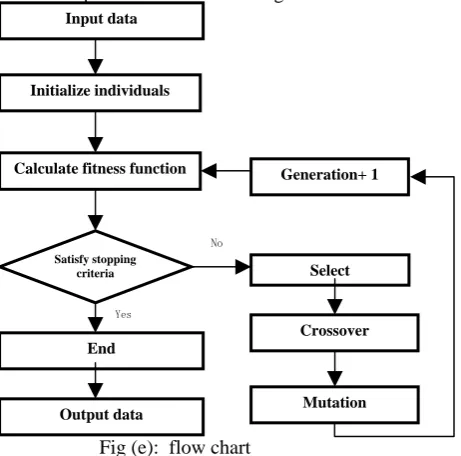
Now it is explained how to use genetic algorithm solving the worker allocation problem. Firstly, the individuals must be initialized. After creating an initial set of solutions, GA can apply a crossover operation to combine the contents of two parents forming a new solution. This will be modified later by the mutation operation which alters some of the contents of the individual. Not all the individuals participate in the reproduction, only the fittest ones are selected from the population by a selection operator such as binary tournament (each parent is selected as the best of two randomly taken individuals). The operators are applied in a stochastic way, thus each one has an associated probability of application in the iterative loop, each step is called a generation. Usually, the best individuals in the present and the newly created generation are combined in order that the best ones can be retained for use in the next step of the algorithm [5]. Fig (e) describes how to use genetic algorithms to solve worker allocation problem as the following flow chart.
Fig (e): flow chart
The crossover operator can be operated as Fig (f) shows. The two parent solutions create two new offsprings by combining their genes array randomly. Crossover uses both inheritance and variation to improve the performance of the population, while remaining a diverse population
1
j j2 j3 j4 j5 j1 j2 j3 j4 j5
1
w 0.8 0.6 0 1 0.8 w1 0.8 0.8 0.8 0.8 0.4 2
w 0.6 0.8 1 0.6 0.2 w2 0.6 0.6 0.4 0.8 0.8
3
w 0.6 0.6 0.4 0 1 w3 0 0 0.6 0.4 0.2
4
w 0.8 0.2 0.6 1 0 w4 0.2 0.4 0.6 0.8 1
5
w 0.6 0.8 1 0 0.2 w5 0.8 0.6 0 1 0.8
⇓
1
j j2 j3 j4 j5 j1 j2 j3 j4 j5
1
w 0.8 0.6 0 1 0.8 w1 0.8 0.8 0.8 0.8 0.4
2
w 0.6 0.6 0.4 0.8 0.2 w2 0.6 0.8 1 0.6 0.8
3
w 0.6 0 0.6 0.4 1 w3 0 0.6 0.4 0 0.2
4
w 0.8 0.4 0.6 0.8 0 w4 0.2 0.2 0.6 1 1
5
w 0.6 0.8 1 0 0.2 w5 0.8 0.6 0 1 0.8
Fig (f): crossover method
The offsprings may be mutated by the mutation operator as Fig (g) illustrates. This is done by modifying a set of values used to encode the offspring. Similar to random mutations in the biological world, this function is intended to preserve the diversity of the population, so as to expand the search space into regions that may contain better solutions.
Fig(g): mutation method
IV. EXPERIMENTAL STUDY AND RESULTS
The worker allocation model is implemented in java language using JGAP which is a relatively new toolkit of Genetic Algorithm. It provides basic genetic mechanisms that can be easily used to apply evolutionary principles to problem solutions. Several experiments were conducted to evaluate the correctness and performance of the worker allocation model.
To implement the worker allocation model, firstly fit parameters are turned such as the population, crossover rate, mutation rate and generation. Because these parameters not only influence the time required to perform GA but also affect the quality of the result. The influence of parameter on the near-optimal solutions are examined in order to determine if the algorithms exhibited any unexpected behaviors, as well as to determine the tests scale. According to the test, genetic algorithm parameters are set as Fig(h) shows.
1
j j2 j3 j4 j5 1
w 0.4 0.6 0 1 0.8
⇓
1
j j2 j3 j4 j5 1
w 0.4 0.6 1 1 0.8
Input data
Initialize individuals
Calculate fitness function
Satisfy stopping criteria
End
Generation+ 1
Select
Crossover
Mutation Yes
No
Output data
[image:4.595.302.575.61.298.2] [image:4.595.336.465.474.565.2] [image:4.595.47.278.496.724.2]Population 64
Crossover rate 0.35
Mutation rate 0.64
Generation 2000
Fig(h): genetic algorithms parameter
Sufficient experiments have been conducted. One consisted of 10 jobs for which 10 workers are available. The workers, in turn, each possess at least one skill. Each of the five skills is needed for at least one task and many tasks required multiple skills.
It can find feasible and near-optimal solutions immediately. In particular, it can be seen that the Genetic Algorithm always vastly improved the fitness of the solution from the beginning to the end, and the final solution can satisfy the skill restrictions. The detailed scenario and the results of this experiment are given as follows.
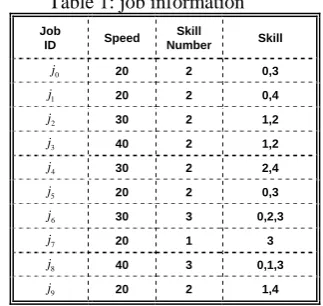
Simulate to manufacture 10000 pieces of products. The production process is divided into 10 jobs and 10 workers is assigned into these jobs. The related job information is shown in Table 1. The worker properties are shown in Table 2. The job precedence graph is shown in Fig(i). The algorithms using composite objectives which focus on finding satisfying solutions can be evaluated as below.
Table 1: job information
Job
ID Speed Skill
Number Skill
0
j 20 2 0,3
1
j 20 2 0,4
2
j 30 2 1,2
3
j 40 2 1,2
4
j 30 2 2,4
5
j 20 2 0,3
6
j 30 3 0,2,3
7
j 20 1 3
8
j 40 3 0,1,3
9
j 20 2 1,4
This proposal is tested according to above information. The objective is to find the optimum fitness which satisfies the minimum human cost, production duration and production overwork. According to the production order requirement, the weighted values are set as Table3.
Table 2: worker information
Worker ID
Skill Number Skill
Maximum Working
Time Salary
0
w 2 0,1 500 5600
1
w 2 0,3 500 4900
2
w 2 0,1 500 6200
3
w 2 0,4 500 4000
4
w 2 0,3 500 5100
5
w 3 0,1,3 500 6600
6
w 2 1,3 500 5800
7
w 2 0,3 500 4200
8
w 2 0,2 500 3500
9
w 2 0,4 500 6000
Table3: weighted value
cost
v
0.01overwork
v
0.001duration
v
810−
Fig(i): Job precedence graph
The test result is shown as Fig (j). The evolution of the solutions which assign 10 workers to 10 jobs is illustrated. The evolution process can reach its optimal level after around 500 generations. And the optimal fitness value is 0.2377.
10jobs-10workers-5skills
0.1 0.12 0.14 0.16 0.18 0.2 0.22 0.24 0.26
0 500 1000 1500 2000
generation
fi
tnes
s
系列1
Fig(j): genetic evolution of composite objective
Not only the composite fitness, but also the minimum value of duration ,human cost and production overwork can be found by setting the weighted value. To find the minimum production duration, the human cost weighted value equals to 0, and the production overwork weighted value equals to 0. The result is shown as fig(k).
10jobs-10workers-5skills
0 100 200 300 400 500 600 700 800
0 500 1000 1500 2000
generation
du
ra
tio
n
系列1
Fig(k): genetic evolution of duration as primary objective The minimum duration is 400 hours, and the evolution process reached its minimum level after around 400 generations. The minimum human cost and the minimum production overwork also can be gotten with setting the appropriate weighted value.
1
j j4
7
j
6
j
8
j
3
j
0
j
2
j
9
j
5
[image:5.595.60.222.355.508.2] [image:5.595.306.520.370.502.2] [image:5.595.64.249.578.727.2] [image:5.595.306.525.600.723.2]V. CONCLUSION
In this paper, the worker allocation problem has been tackled with genetic algorithm. This problem is essential for the manual labor manufacture nowadays and automatically finding optimal solutions to help factory save cost and time. A production manager can study different scenarios with such an automatic tool in order to make appropriate decisions on the optimal production. In addition, according to this approach, he can adjust the weighted value to adapting production requirements. The worker allocation is combinatorial optimization problem and any exhaustive search can take too much time to get a solution. The contribution to the worker allocation is an automated tool based on the genetic algorithms that can be used to assign people to jobs in a near optimal way.
The result shows that the proposed model could find effective solutions with shortening the project period, reducing the project cost and controlling the production overwork. In the future, new instances will be added to study the influence of the instance parameter .In addition; the algorithm will be applied to real world data in order to illustrate how to use this technique in a real production. Also extend the model to be used in the real manufacture factory.
REFERENCES
[1] H.Iima ,N.Sannomiya, “Proposition of Module Type Genetic
Algorithm and Its Application to Modified Scheduling Problems with Worker Allocation” IEEEJapan ,Vol.122-C, pp.409-416,2002 [2] A.Osawa , K. Ida ,“Scheduling Problem with Worker Allocation using
Genetic Algorithm” , Japan-Australia workshop on intelligent and evolutionary systems, pp.1-8 ,2005
[3] H. Iima ,N.Sannomiya, “Module Type Genetic Algorithm for Modified Scheduling Problems with Worker Allocation” Proceedings of the American Control Conference Arlington, VA, 2001
[4] C.Chang “Genetic Algorithms for Project Management” Annals of Software Engineering , Vol.11, pp 107-139,2001
[5] E.Alba , J. F. Chicano,“ software project management with GAs” Information Sciences, Vol.177, pp.2380-2401 , 2007
[6] J. Holland, “Adaptation in natural and artificial systems”, University of Michigan Press, Ann Arbor, 1975.
[7] D. A. Coley, “An Introduction to Genetic Algorithms for Scientists and Engineers”, New Jersey, 1999.