Combining Geometric, Textual and Visual Features for Predicting
Prepositions in Image Descriptions
Arnau Ramisa*1 Josiah Wang*2 Ying Lu3 Emmanuel Dellandrea3 Francesc Moreno-Noguer1 Robert Gaizauskas2
1Institut de Rob`otica i Inform`atica Industrial (UPC-CSIC), Barcelona, Spain 2 Department of Computer Science, University of Sheffield, UK
3 LIRIS, ´Ecole Centrale de Lyon, France
{aramisa, fmoreno}@iri.upc.edu {j.k.wang, r.gaizauskas}@sheffield.ac.uk
{ying.lu, emmanuel.dellandrea}@ec-lyon.fr Abstract
We investigate the role that geometric, tex-tual and visual features play in the task of predicting a preposition that links two visual entities depicted in an image. The task is an important part of the subsequent process of generating image descriptions. We explore the prediction of prepositions for a pair of entities, both in the case when the labels of such entities are known and unknown. In all situations we found clear evidence that all three features contribute to the prediction task.
1 Introduction
In recent years, there has been an increased in-terest in the task of automatic generation of natu-ral language image descriptions at sentence level, compared to earlier work that annotates images with a laundry list of terms (Duygulu et al., 2002). The task is important in that such detailed anno-tations are more informative and discriminative compared to isolated textual labels, and are essen-tial for improved text and image retrieval.
[image:1.595.313.519.203.375.2]The most standard approach to generating such descriptions involves first detecting instances of pre-defined concepts in the image, and then rea-soning about these concepts to generate image de-scriptions e.g. (Kulkarni et al., 2011; Yang et al., 2011). Our work is also based on this paradigm. However, we assume that object instances have already been pre-detected by visual recognisers, and concentrate on a specific subtask of descrip-tion generadescrip-tion. More specifically, given two vi-sual entity instances where one could potentially act as a modifier to the other, we address the prob-lem of identifying the appropriate preposition to connect these two entities (Figure 1). The inferred prepositional relations will subsequently act as an *A. Ramisa and J. Wang contributed equally to this work.
Figure 1: Given a subjectboyand an objectsled and their location in the image, what would the best preposition be to connect the two entities?
important intermediate representation towards the eventual goal of generating image descriptions.
The main contribution of this paper is therefore to learn to predict the most suitable preposition given its context, and to learn this jointly from im-ages and their descriptions. In particular, we con-centrate on learning from (i) geometric relations between two visual entities from image annota-tions; (ii) textual features from textual descrip-tions; (iii) visual features from images. Previous work exists (Yang et al., 2011) that uses text cor-pora to ‘guess’ the prepositions given the context without considering the appropriate spatial rela-tions between the entities in the image, signifying a gap between visual content and its correspond-ing description. For example, although person on horse might commonly occur in text corpora, a particular image might actually depict a person standing beside a horse. On the other hand, work that does consider the image content for generat-ing prepositions (Kulkarni et al., 2011; Elliott and Keller, 2013) map geometric relations to a limited set of prepositions using manually defined rules,
not as humans would naturally use them with a richer vocabulary. We would like to have the best of both worlds, by considering image content as well as textual information to select the preposi-tion best used to express the relapreposi-tion between two entities. Our hypothesis is that the combination of geometric, textual and visual features can help with the task of predicting the most appropriate preposition, since incorporating geometric and vi-sual information should help generate a relation that is consistent with the image content, whilst incorporating textual information should help gen-erate a description that is consistent with natural language.
2 Related Work
The Natural Language Processing Community has significant interest in different aspects of prepo-sitions. The Prepositions Project (Litkowski and Hargraves, 2005) analysed and produced a lex-icon of English prepositions and their senses, and subsequently used them in the Word Sense Disambiguation of Prepositions task in SemEval-2007 (Litkowski and Hargraves, SemEval-2007). In SemEval-2012, Kordjamshidi et al. (2012) intro-duce the more fine-grained task of spatial role labelling to detect and classify spatial relations expressed by triples (trajector, landmark, spa-tial indicator). In the latest edition of SemEval-2015, the SpaceEval task (Pustejovsky et al., 2015) introduce further tasks of identifying spatial and motion signals, as well as spatial configura-tions/orientation and motion relation.
In work that links prepositions more strongly to image content, Gupta and Davis (2008) model prepositions implicitly to disambiguate image re-gions, rather than for predicting prepositions. Their work also require manual annotation of prepositional relations. In image description gen-eration work, Kulkarni et al. (2011) manually map spatial relations to pre-defined prepositions, whilst Yang et al. (2011) predict prepositions from large-scale text corpora solely based on the complement term, with the prepositions constrained to describ-ing scenes (on the street). Elliott and Keller (2013) define a list of eight spatial relations and their cor-responding prepositional term for sentence gener-ation. Although they also present alternative mod-els that use text corpora for descriptions that are more human-like, they are limited to verbs and do not cover prepositions. Le et al. (2014)
exam-ine prepositions modifying human actions (verbs), and conclude that these relate to positional infor-mation to a certain extent. Other related work in-clude training classifiers for prepositions with spa-tial relation features to improve image segmenta-tion and detecsegmenta-tion (Fidler et al., 2013); this work is however limited to four prepositions.
3 Task Definition
We formally define the task of predicting prepo-sitions as follows: Let P be the set of possible prepositions. Let L be the set of possible land-markentities acting as the complement of a prepo-sition, and let T be the set of possible trajector entities modified by the prepositional phrase com-prising a preposition and its landmark1. For
exam-ple, for the phraseperson on bicycle,onwould be the preposition,bicyclethe landmark, andperson the trajector. For this paper, we constraintrajector andlandmarkto be entities that are visually iden-tifiable in an image since we are interested in dis-covering the role of visual features and geometric configurations between two entities in the prepo-sition prediction task.
Let D = {d1, d2, ..., dN} be the set of N ob-servations, where eachdi fori= 1,2..., N is rep-resented bydi = (xi, yi, ri), wherexi andyi are the feature representations for the trajector and the landmark entities respectively, and ri the relative geometric feature between the two visual entities.
Given di, the objective of the preposition pre-diction task is to produce a ranked list of preposi-tions(p1, p2, ...p|P|) according to how likely they are to express the appropriate spatial relation be-tween the given trajector and landmark entities that are either known (Section 6.1) or only repre-sented by visual features (Section 6.2).
4 Dataset
Bounding Box feature (number of dimensions)
• Vector(x, y)from centroid of trajector to centroid of landmark, normalised by the size of the bounding box enclosing both objects (2)
• Area of trajector bounding box relative to landmark (1) • Aspect ratio of each bounding box (2)
• Area of each bounding box w.r.t. enclosing box (2) • Intersection over union of the bounding boxes (1) • Euclidean distance between the trajector and landmark
bounding boxes, normalised by the image size (1) • Area of each bounding box w.r.t. the whole image (2)
Table 1: Geometric features derived from bound-ing boxes.
relations are retained where both the governor and its dependent overlap with the entity mentions in the descriptions, and where both mentions have corresponding bounding boxes. The MSCOCO validation set is further annotated to remove er-rors arising from dependency parsing (notably PP attachment errors), and is used as our clean test set. Our final dataset comprises 8,029 training and 3,431 test instances for MSCOCO, and 46,847 training and 20,010 test instances for Flickr30k. Details on how the triples were extracted from captions and matched to instances in images are available in the supplementary material.
We consider two variants of trajector and land-mark terms in our experiments: (i) using the provided high level categories as terms (80 for MSCOCO and 8 for Flickr30k); (ii) using the terms occurring in the sentence directly, which constitute a bigger and more realistic challenge. For Flickr30k, the descriptive phrases may cause data sparseness (the furry, black and white dog). Thus, we extracted the lemmatised head word of each phrase, using a ‘semantic head’ variant of the head finding rules of Collins (2003) in Stan-ford CoreNLP. Entities from the same coreference chain are denoted with a common head noun cho-sen by majority vote among the group, with ties broken by the most frequent head noun in the cor-pus, and further ties broken at random.
5 Features
Geometric Features: Geometric features
be-tween a trajector and a landmark entity are derived from bounding box annotations. We defined an 11-dimensional vector of bounding box features,
covering geometric relations such as distance, ori-entation, relative bounding box sizes and overlaps between bounding boxes (Table 1). We chose to use continuous features as we felt these may be more powerful and expressive compared to dis-crete, binned features. Despite some of these fea-tures being correlated, we left it to the classifier to determine the most useful features for discrimina-tion without having to withhold any unnecessarily.
Textual features: We consider two textual
fea-tures to encode the trajector and landmark terms
wt
i andwil. The first feature is a one-hot indica-tor vecindica-tor xI
i and yiI for the trajector and land-mark respectively, wherexI
i,t = 1if index t cor-responds to the trajector termwt
i and0elsewhere (and similarly for landmark). As data sparseness may be an issue, we also explore an alternative tex-tual feature which encodes the terms as word2vec embeddings (Mikolov et al., 2013). This encodes each term as a vector such that semantically re-lated terms are close in the vector space. This al-lows information to be transferred across seman-tically related terms during training (e.g. infor-mation fromperson on boat can help predict the preposition that mediatesmanandboat).
Image Features: While it is ideal to have
sion systems produce a firm decision about the vi-sual entity instance detected in an image, in real-ity it may be beneficial to defer the decision by allowing several possible interpretations of the in-stance being detected. In such cases, we will not have a single concept label for the entity, but in-stead a high-level visual representation. For this scenario, we extracted visual representations from the final layer of a Convolutional Neural Network trained on ImageNet (Krizhevsky et al., 2012), and used them as representations for entity instances in place of textual features.
6 Preposition Prediction
Here we highlight interesting findings from exper-iments performed for the task of predicting prepo-sitions for two different scenarios (Sections 6.1 and 6.2). Detailed results can be found in the sup-plementary material.
Evaluation metrics. As there may be more than
IND W2V GF IND+GF W2V+GF Baseline
Mean
rank MSCOCO (max rank 17)MSCOCO (balanced) 1.453.20 1.433.10 1.724.60 1.443.00 1.422.90 2.145.40 Flickr30k (max rank 52) 1.91 1.87 2.35 1.88 1.85 2.54 Flickr30k (balanced) 11.10 9.04 15.55 10.23 8.90 15.13
Accurac
y MSCOCO 79.7% 80.3% 68.4% 79.8% 80.4% 40.2%
MSCOCO (balanced) 52.5% 54.2% 31.5% 52.7% 53.9% 11.9%
Flickr30k 75.4% 75.2% 58.5% 75.8% 75.4% 53.7%
[image:4.595.87.514.64.203.2]Flickr30k (balanced) 24.6% 25.9% 9.0% 25.2% 26.9% 4.0%
Table 2: Top: Mean rank of the correct preposition (lower is better). Bottom: Accuracy with different feature configurations. All results are with the original trajector/landmark terms from descriptions. IND stands for Indicator Vectors, W2V for Word2Vec, and GF for Geometric Features. As baseline we rank the prepositions by their relative frequencies in the training dataset.
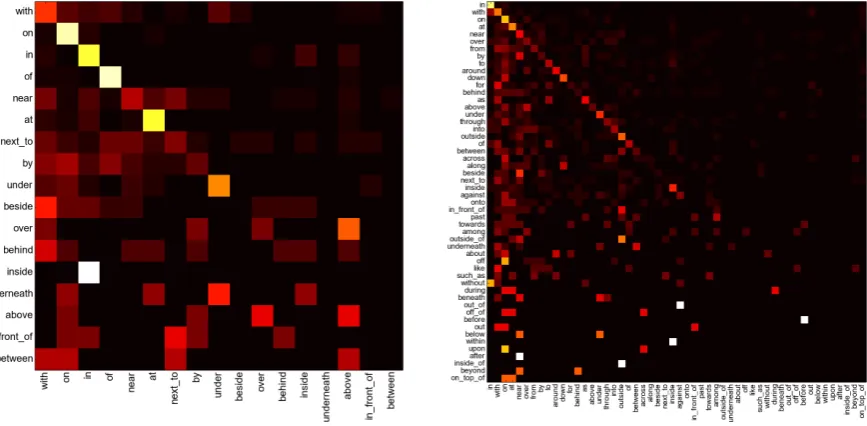
Figure 2: Normalised confusion matrices on the balanced test subsets for the two datasets (left: MSCOCO, right: Flickr30k), using geometric features and word2vec with the original terms.
multiple possible prepositions that may be equally valid. For completeness we also report classifica-tion accuracy results.
Baseline. As baseline, we rank the prepositions
by their relative frequencies in the training dataset. We found this to be a sufficiently strong baseline, as ubiquitous prepositions such aswithandintend to occur frequently in the dataset.
6.1 Ranking with known entity labels
In this section, we focus on predicting the best preposition given the geometric and textual fea-tures of the trajector and landmark entities. This simulates the scenario of a vision detector provid-ing a firm decision on the concept label for the
detected entities. We use a multi-class logistic regression classifier (Fan et al., 2008), and con-catenate multiple features into a single vector. We compare high-level categories and terms from de-scriptions as trajector/landmark labels. Preposi-tions are ranked in descending order of the clas-sifier output scores.
[image:4.595.86.520.280.493.2]Dataset Prep (known labels)acc rank accPrepositionrank accTrajectorrank accLandmarkrank
MSCOCO 79.8% 1.46 (17) 62.9% 1.92 (17) 65.6% 4.64 (74) 44.5% 7.30 (77) Flickr30k 67.1% 2.16 (52) 61.7% 2.28 (52) 77.3% 1.43 (8) 66.4% 1.64 (8)
Table 3: Accuracy (acc) and mean rank (rank, with max rank in parenthesis) for each variable of the CRF model, trained using the high-level concept labels. Columns underPrep (known labels) refer to the results of predicting prepositions with the trajector and landmark labels fixed to the correct values.
test sets are compared.
As shown in Table 2, the system performed sig-nificantly better than the baseline in most cases. In general, geometric features perform better than the baseline, and when combined with text features further improve the results. In a per-preposition analysis, the geometric features show up to 14% improvement in the mean rank for Flickr30k.
In feature ablation tests on MSCOCO (bal-anced), we found theycomponent of the trajector to landmark vector to be important to most prepo-sitions, especially forunder,aboveandon. Other important geometric features include the final two features in Table 1 (Euclidean distance and area).
The benefit of the word2vec text feature is clear when moving from high-level categories to origi-nal terms from descriptions, where it consistently improves the mean rank (up to 25%). In contrast, the indicator vectors resulted in a less significant improvement, if not worse performance, when us-ing the sparse original terms.
We also evaluated the relative importance of the trajector and the landmark, by withholding either from the textual feature vector. We found that the landmark plays a larger role in preposition predic-tion as omitting the trajector produces 10%-30% better results than omitting the landmark.
Figure 2 shows the confusion matrices of the best-performing systems. Note that many mis-takes arise from prepositions that are often equally valid (e.g. predictingnearinstead ofnext to).
6.2 Ranking with unknown entity labels
Here, we investigate the task of jointly predicting prepositions with the entity labels given geomet-ric and visual features (without the trajector and landmark labels). This simulates the scenario of a vision detector output. For this structured pre-diction task, we use a 3-node chain CRF model2,
2We used the toolbox by Mark Schmidt:http://www.
cs.ubc.ca/˜schmidtm/Software/UGM.html
with the centre node representing the preposition and the two end nodes representing the trajector and landmark. We useimage featuresfor the en-tity nodes, andgeometric featuresfor the preposi-tion node (Secpreposi-tion 5). Due to computapreposi-tional con-straints only high-level category labels are used, but as seen in Section 6.1, this may actually be hurtingthe performance.
Table 3 shows the results of the structured model used to predict the most likely (trajector, preposition, landmark) combination. To facili-tate comparison with Section 6.1, column Prep
(known labels)shows the results with the
trajec-tor and landmark labels as known conditions and fixed to the correct values, thus only needing to predict the preposition. The model achieved excel-lent performance considering the added difficulty of the task.
7 Conclusions and Future Work
We explored the role of geometric, textual and visual features in learning to predict a preposi-tion given two bounding box instances in an im-age, and found clear evidence that all three fea-tures play a part in the task. Our system per-forms well even with uncertainties surrounding the entity labels. Future work could include non-prepositional terms like verbs, having preposi-tions modify verbs, adding word2vec embeddings to the structured prediction model, and providing stronger features – whether textual, visual or geo-metric.
Acknowledgments
References
Danqi Chen and Christopher Manning. 2014. A fast and accurate dependency parser using neural net-works. InProceedings of the 2014 Conference on Empirical Methods in Natural Language Process-ing (EMNLP), pages 740–750, Doha, Qatar, Octo-ber. Association for Computational Linguistics.
Michael Collins. 2003. Head-driven statistical models for natural language parsing. Computational Lin-guistics, 29(4):589–637, December.
Pinar Duygulu, Kobus Barnard, Nando de Freitas, and David A. Forsyth. 2002. Object recognition as ma-chine translation: Learning a lexicon for a fixed im-age vocabulary. In Proceedings of the European Conference on Computer Vision, pages 97–112. Desmond Elliott and Frank Keller. 2013. Image
de-scription using visual dependency representations. In Proceedings of the 2013 Conference on Em-pirical Methods in Natural Language Processing, pages 1292–1302, Seattle, Washington, USA, Oc-tober. Association for Computational Linguistics.
Rong-En Fan, Kai-Wei Chang, Cho-Jui Hsieh, Xiang-Rui Wang, and Chih-Jen Lin. 2008. LIBLINEAR: A library for large linear classification. Journal of Machine Learning Research, 9:1871–1874.
Sanja Fidler, Abhishek Sharma, and Raquel Urtasun. 2013. A sentence is worth a thousand pixels. In Proceedings of the IEEE Conference on Computer Vision & Pattern Recognition.
Abhinav Gupta and Larry S. Davis. 2008. Beyond nouns: Exploiting prepositions and comparative ad-jectives for learning visual classifiers. In Proceed-ings of the European Conference on Computer Vi-sion, pages 16–29.
Parisa Kordjamshidi, Martijn van Otterlo, and Marie-Francine Moens. 2011. Spatial role labeling: To-wards extraction of spatial relations from natural language. ACM Transactions on Speech and Lan-guage Processing, 8(3):article 4, 36 p.
Parisa Kordjamshidi, Steven Bethard, and Marie-Francine Moens. 2012. Semeval-2012 task 3: Spa-tial role labeling. In *SEM 2012: The First Joint Conference on Lexical and Computational Seman-tics – Volume 1: Proceedings of the main conference and the shared task, and Volume 2: Proceedings of the Sixth International Workshop on Semantic Eval-uation (SemEval 2012), pages 365–373, Montr´eal, Canada, 7-8 June. Association for Computational Linguistics.
Alex Krizhevsky, Ilya Sutskever, and Geoffrey E. Hin-ton. 2012. Imagenet classification with deep con-volutional neural networks. In F. Pereira, C.J.C. Burges, L. Bottou, and K.Q. Weinberger, editors, Advances in Neural Information Processing Systems 25, pages 1097–1105.
Girish Kulkarni, Visruth Premraj, Sagnik Dhar, Siming Li, Yejin Choi, Alexander C. Berg, and Tamara L. Berg. 2011. Baby talk: Understanding and generat-ing image descriptions. InProceedings of the IEEE Conference on Computer Vision & Pattern Recogni-tion.
Dieu-Thu Le, Jasper Uijlings, and Raffaella Bernardi. 2014. TUHOI: Trento Universal Human Object In-teraction dataset. InProceedings of the Third Work-shop on Vision and Language, pages 17–24, Dublin, Ireland, August. Dublin City University and the As-sociation for Computational Linguistics.
Tsung-Yi Lin, Michael Maire, Serge Belongie, James Hays, Pietro Perona, Deva Ramanan, Piotr Doll´ar, and C. Lawrence Zitnick. 2014. Microsoft COCO: common objects in context. CoRR, abs/1405.0312. Kenneth C. Litkowski and Orin Hargraves. 2005.
The preposition project. InACL-SIGSEM Workshop on The Linguistic Dimensions of Prepositions and Their Use in Computational Linguistic Formalisms and Applications, pages 171–179.
Kenneth C. Litkowski and Orin Hargraves. 2007. Semeval-2007 task 06: Word-sense disambigua-tion of preposidisambigua-tions. In Proceedings of the Fourth International Workshop on Semantic Evaluations (SemEval-2007), pages 24–29, Prague, Czech Re-public, June. Association for Computational Lin-guistics.
Christopher D. Manning, Mihai Surdeanu, John Bauer, Jenny Finkel, Steven J. Bethard, and David Mc-Closky. 2014. The Stanford CoreNLP natural lan-guage processing toolkit. In Proceedings of 52nd Annual Meeting of the Association for Computa-tional Linguistics: System Demonstrations, pages 55–60, Baltimore, Maryland, June. Association for Computational Linguistics.
Tomas Mikolov, Ilya Sutskever, Kai Chen, Greg Cor-rado, and Jeffrey Dean. 2013. Distributed represen-tations of words and phrases and their composition-ality. InAdvances in Neural Information Processing Systems.
Bryan Plummer, Liwei Wang, Chris Cervantes, Juan Caicedo, Julia Hockenmaier, and Svetlana Lazeb-nik. 2015. Flickr30k entities: Collecting region-to-phrase correspondences for richer image-to-sentence models.CoRR, abs/1505.04870. James Pustejovsky, Parisa Kordjamshidi,
Marie-Francine Moens, Aaron Levine, Seth Dworman, and Zachary Yocum. 2015. Semeval-2015 task 8: Spaceeval. InProceedings of the 9th International Workshop on Semantic Evaluation (SemEval 2015), pages 884–894, Denver, Colorado, June. Associa-tion for ComputaAssocia-tional Linguistics.
Processing (EMNLP), pages 444–454. Association for Computational Linguistics.