Following a Robot using a Haptic Interface without Visual
Feedback
GHOSH, Ayan, ALBOUL, Lyuba <http://orcid.org/0000-0001-9605-7228>,
PENDERS, Jacques <http://orcid.org/0000-0002-6049-508X>, JONES, Peter
<http://orcid.org/0000-0002-1225-0192> and REED, Heath
<http://orcid.org/0000-0003-2615-3315>
Available from Sheffield Hallam University Research Archive (SHURA) at:
http://shura.shu.ac.uk/7966/
This document is the author deposited version. You are advised to consult the
publisher's version if you wish to cite from it.
Published version
GHOSH, Ayan, ALBOUL, Lyuba, PENDERS, Jacques, JONES, Peter and REED,
Heath (2014). Following a Robot using a Haptic Interface without Visual Feedback.
In: Seventh International Conference on Advances in Computer-Human Interactions,
ACHI 2014, Barcelona, Spain, 23-27 March 2014.
Copyright and re-use policy
See
http://shura.shu.ac.uk/information.html
Following a Robot using a Haptic Interface without Visual Feedback
Ayan Ghosh*, Jacques Penders*, Peter Jones* and Lyuba Alboul*
*Sheffield Hallam University [email protected], [email protected], [email protected],
Abstract— Search and rescue operations are often undertaken in dark and noisy environments in which rescue teams must rely on haptic feedback for navigation and safe exit. In this paper, we discuss designing and evaluating a haptic interface to enable a human being to follow a robot through an environment with no-visibility. We first briefly analyse the task at hand and discuss the considerations that have led to our current interface design. The second part of the paper describes our testing procedure and the results of our first informal tests. Based on these results we discuss future improvements of our design.
Keywords: human robot interaction, haptic interface, support in no-visibility/visually impaired
I. INTRODUCTION
In this paper we discuss designing an interface to enable a human being to follow a robot. A vital pre-condition for successful human-robot cooperation in such circumstances is that the human trusts and has confidence in the robot. Trust and confidence are complex matters which we have explored in more detail elsewhere [6]. In this paper we focus on designing interfaces for following a robot and make a first attempt to evaluate the designs.
A. No-visibility
Being guided along an unknown path without visual feedback poses several challenges to a human being, in particular if the guide is a robot.
Search and rescue operations are often undertaken in dark and noisy environments in which rescue teams must rely on haptic feedback for exploration, navigation and safe exit. However, because of the lack of visual (and auditory) feedback humans get easily disorientated and may get lost. Robots with a range of sensors on board might be helpful for such conditions. In addition to search and rescue, there are everyday situations where vision and audition are problematic, for instance, a visually impaired person trying to navigate a busy street. Though present day sensors are very promising, the issue of being guided by a robot is largely open and has not received much attention yet. Young et al. [1] describe walking a robot using a dog-leash. They note that leading a robot consists of a delicate interplay between the human leader and the robot requiring ongoing communication and interaction. This includes (for both the robot and the human) monitoring the other’s movement direction and speed [1]. The dog-leash is used in conditions of good visibility and a relatively low level of
environmental noise. The monitoring heavily relies on visual and audio feedback i.e. the eyes and ears of the human.
However, lacking visual and audio feedback hampers orientation and causes significant stress for rescue workers as well as for the visually impaired; in addition it constitutes a significant obstacle when aiming to cater for trust and confidence. Nevertheless, psychological research has demonstrated, contrary to early assumptions and common prejudice, ‘the presence of a comparable set of spatial abilities in people without vision as can be found in those with vision’ [3]. Bremner and Cowle [4] in [5, p33] note: the senses touch, proprioception, vision, and occasionally audition, ‘convey information about the environment and body in different neural codes and reference frames’. Research has also highlighted the extraordinary speed and sensitivity of the haptic sense [17]. Reasons enough to explore how better to make use of the haptic sense. Eventually, a well-designed haptic interface suitable for guidance in no-visibility conditions might also be useful in normal conditions and may free the visual sense and related mental resources so that they can be used for other tasks.
[image:2.612.362.516.406.524.2]
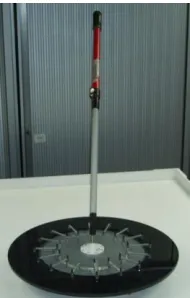
Figure 1, the handle.
B. Navigation and following
interface between dog and handler - that is a rigid handle held by handler and attached to the dog's harness.
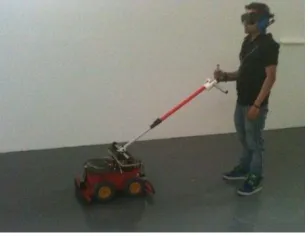
Figure 2, Handling a guide dog/robot; task analysis[6]
Inspired by this, the current paper has the focus on locomotion guidance or simply following a robot, and the central questions are whether the follower is lead safely and whether we can assess the (implicit) confidence of the follower.
II. LITERATURE OVERVIEW
Literature on experiences of human subjects with human-robot interaction in low-visibility is rather sparse. The Guardians project [2] pioneered a group of autonomous mobile robots assisting a human rescue worker operating within close range. Trials were held with fire fighters and it became clear that the subjects by no means were prepared to give up their procedural routine and the feel of security provided: they simply ignored instructions that contradicted their routines.
There are several works on robotic assistance to the visual impaired. Tachi et al. [7] developed a guide-dog robot for the visually impaired which leads the person. The robot tracks the follower using active sonar, and the follower wears a stereo headset which provides coded aural feedback to notify whether the follower is straying from the path. There is no means to communicate to the robot, and the follower must learn the new aural-feedback code: the robot serves as a mobile beacon that communicates with the headset.
Allan Melvin et al [8] developed a robot to replace a guide dog; however the paper does not extensively report trials with users. The GuideCane [9] is a cane like device running on unpowered wheels, it uses Ultra Sound to detect obstacles. The follower has to push the GuideCane - it has no powered wheels- however it has a steering mechanism that can be operated by the follower or operate autonomously. In autonomous mode, when detecting an obstacle the wheels are steering away to avoid the obstacle. The GuideCane has been tested with 10 subjects three of whom were blind and cane users, the other seven were sighted but blindfolded. Basic conclusion: ‘walking with the GuideCane was very intuitive and required little conscious effort’, unfortunately nothing more is reported on the subjects' experience.
The robotic shopping trolley developed by Gharpure and Kulyukin [10,11] is also aimed at the visual impaired. This
trolley guides the (blind) shopper - who is holding the trolley handle - along the aisles into the vicinity of the desired product. The locomotion guidance is fully robot driven but restricted to navigating the aisles; the emphasis is on instructing the shopper how to grab the product using voice instructions.
III. ROBOTIC GUIDE
A. Design presumptions
Our final aim is to design a system and interface that allows skilled and successful guidance, enhancing human trust and confidence. We expect that a key dimension of the skillset of the human follower is the ability to 'read' the whole situation in relation to the relevant programme of action [12, 13]. The aim is for transparent technology; technology that is so well fitted that it becomes almost invisible in use’ [14]. In contrast, an ‘opaque technology’ is ‘one that keeps tripping the user up, and remains the focus of attention even during routine problem-solving activity’ [14]. The classic illustration of ‘transparent technology’ in this sense, and of particular relevance to our own study, was the use of a cane by a blind person (or ‘cane traveler’) for navigational purposes [14].
B. Mechanical interface: design considerations and history
A first step towards this aim is to build an interface that will lead the follower along a safe path. The safest path for the follower is a path that the robot already has traversed; thus the follower should follow the trail of the robot exactly. Hence our experiments reported below, look at the following behaviour of the follower in terms of the ability to closely match the live path of the robot.
Obviously, in order to be able to follow the robot, the follower needs to know where the robot is relative to his/her current position and orientation. Initially our project looked at three distinct interfaces: a wirelessly connecting device for instance a Nintendo Wii, a short rope/rein or leash and a stiff handle. A major problem for any wireless device lies in how to indicate the position of the robot with respect to the follower. A rope does indicate the direction of the robot but only when there is no slack. Young et al. [1] use a spring-loaded retractable leash design (popular with dogs) which keeps the leash taut; the retracting mechanism however obscures the length of the leash and thus the distance between the robot and the follower. Our final choice has been for a stiff handle via which the position (direction and distance) of the robot is immediately clear to the follower.
C. Interaction with a Stiff interface:
subjects immediately put their second hand on the stick to compensate. Our observation of a lack of accuracy of a one handed hold is in line with experiences in using a white cane. Visually impaired people using a white cane do hold the cane in one hand but they also apply a special grip (for instance stretched the index finger) and/or keep the elbow touching the body. We note that manipulating our disc is not as easily as handling a white cane.
[image:4.612.379.495.70.193.2]From this we concluded that a crutch like design of the handle, in which the stick is fixed on the lower arm, is preferred.
Figure 3, Hand held stick on a disc with omni-directional wheels
D. Implementing the handle (stiff Rein) on the robot
Based on these conclusions, a simple crutch-like prototype with a ball-free mechanism at the base (refer to figure 4) was developed to enable some initial experimentation. The pilot studies have revealed that, there have been instances such as:
Figure 4, Ball-free mechanism at the base
The follower did not feel safe following the robot (refer to figure 5). We can judge the path as safe when there is high degree of congruence between the live path of the robot guide and the live path of the human follower.
The follower lost track of the orientation (heading) of the robot, though its position was clear. As a consequence, the follower did not feel comfortable following the robot at the turns. The handle delivered an abrupt tug to the follower at the point of the turns.
Figure 5, Unsafe path
These findings led to the design of a third prototype to ensure safety, comfort and rigidity. The prototype consists of a mechanical feedback spring system at the base, refer to figure 6. The spring system allows rotation of the handle on the horizontal plane. When the spring system has zero tension, the handle is aligned with the center line of the robot. When the handle is being rotated, the spring system induces tension on the handle, which increases with the rotation angle. The system also comes with a pin enabling to nullify the action of the springs when required. Thus, this handle provides two testing options:
1. The handle is attached in a fixed joint (rigid): meaning the handle is fixed at base using the pin.
[image:4.612.128.223.197.346.2]2. The handle is attached with a flexible joint (spring): meaning the handle can rotate in the horizontal plane, and rotation induces tension on the handle.
Figure 6, Handle with spring system
E. Robot and sensors
The handle has been mounted on a Pioneer-3AT 4-wheel robot. In the experiments reported below, the robot was autonomously navigating fixed trajectories while being supervised by an operator. The operator was able to stop/start the robot remotely using a developed Java application [18]. The robot operated with a linear speed of 0.6m/s and the angular speed was set at 0.5 rad/s.
[image:4.612.324.545.422.573.2]to the center line of the robot was being recorded using a Hokuyo Laser Range Finder, fixed exactly at the middle of robot's rear bumper. Data collection proceeded at a speed of 10Hz or 10 observations per second. The positions of the robot at every instance of time were measured by odometry sensors. The data was sent to the operator's workstation using a Lantronix 802.11g WiPort modem.
IV. EVALUATION ROBOTIC GUIDING
In designing and interpreting our preliminary experimental studies, we were guided by two main theoretical perspectives: 1) the integrationist perspective on language and communication developed by Roy Harris [13] the development of the robot guide as ‘transparent technology’, discussed and developed in the work of Andy Clark [14, 15]. The primary evaluation purpose was to test usability, whether a person could easily follow the robot.
A. Testing Protocol
We studied the effect of two different settings of the stiff interface on the following behaviour of a right-handed participant for a few days. On each of the trials, the subject was asked to use one of the following states of the stiff handle:
1. The handle attached in a fixed joint (rigid): 2. The handle attached with a flexible joint (spring):
The robot was made to move autonomously in one of the following pre-programmed trajectories below:
path A: Straight line (approximately 8 meters).
path B: Straight line (approximately 5 meters) + sharp turn + straight line (approximately 3 meters).
path C: Straight line (approximately 5 meters) + gentle turn + straight line (approximately 3 meters).
For all the trajectories, the robot is moved with a linear speed of 0.6 meters per second and an angular speed of 0.5 radians per second (at the turns). The subject was blindfolded and asked to put headphones on. Before the commencement of each trial, the handle was placed gently in the subject's hand and a pre-arranged haptic signal from the experimenter was used to indicate the start of each trial. For each trial we monitored the following:
the position coordinates (odometry sensors) of the robot in the experimental space every one tenth of a second .
the degree of displacement of the subject from the trajectory of the robot.
The objective data collected during the trials was used to examine the spatial correspondence of the robot's path and the follower's path - a measure for the following behaviour of the person.
B. Experimental results
Robot following path A:
Our first trial with each subject aimed to observe how the person follows the robot. The handle is mounted in the middle of the robot, while the crutch like part of the handle is attached to the right fore-arm of the follower (right-handed) thereby making him/her stand about 15-20 cm on the left of the center line of the robot (refer figure 7).
Figure 7, position of the follower at the start
[image:5.612.356.515.442.560.2]In figure 8 and the figure following below we show reconstructions of the paths of the robotand the follower across several trials. The reconstruction is based on the data collected (every 0.1 seconds) on board of the robot. The robot and follower move from left to right in the diagrams. The robot is around a meter (length of the handle) in front of the follower. So while the robot starts at time t0 at position (0,0) the follower is at time t0 at position (-1,0). Figure 8 shows a reconstruction of the straight path (path A). When the path is straight, there is no impact of handle settings (fixed or sprung joint) on the following behaviour. For both the cases we get a similar pattern of the follower following the robot, slightly (15-20 cm) off the robot's centre.
Figure 8, reconstruction of the paths of robot and follower moving in a straight-line
Robot following path B:
this effect is rather minimal and there is higher degree of congruence of paths (as Figure 10 shows).
[image:6.612.357.516.116.243.2]Figure 9, reconstruction of the paths of robot and follower with sharp turn (fixed-joint)
Figure 10, reconstruction of the paths of robot and follower with sharp turn (sprung-joint)
Robot following path C:
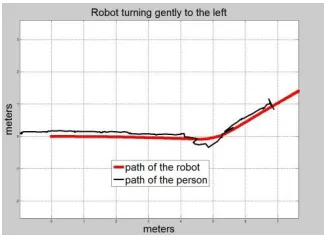
Figure 11 shows the reconstruction of the paths of both robot and follower, while the robot takes a gentle turn. In this case, when the robot turns, there is also a clear deviation of the follower's path from the path of the robot. But the deviation is less (because of the gentleness of the turn) in comparison to that of the sharp turn.
Figure 11, reconstruction of the paths of robot and follower with gentle turn (fixed-joint)
Turning right versus turning left
It became evident from our experiments that there is an acute difference in the following behaviour when the robot is turning right and when the robot is turning left. When the robot is turning right, the follower's path deviates considerably more from path of the robot (at the point of
[image:6.612.95.253.260.378.2]turn) than when the robot is turning left, compare Figure 9 with Figure 13.
Figure 12, the body posture of a person during left (left) and right (right) turn
[image:6.612.353.517.357.473.2]The follower is holding the handle in the right hand; when the robot is taking a right turn, the crutch like handle - which is fixed to the forearm - pushes the follower's arm towards the body of the follower. This is forcing the follower to step out; at the same time the initial 'inertia' of the follower cause slippage of the robot meaning that Figure 13 and Figure 14 also include a slippage error.
Figure 13, reconstruction of the paths of robot and follower with sharp right turn (sprung-joint)
[image:6.612.94.257.500.618.2]Contrarily, during a left turn the arm has much more freedom for movement and the following behaviour looks more comfortable. Figure 12 shows the body postures of a person when the robot starts turning right and left. These effects are persistent during gentle turns as well Figure 14.
[image:6.612.349.522.579.692.2]C. Discussion
The findings the experimental trials raise a number of issues about the design of the handle and user experience that deserve further investigation. First of all, it seems clear that when the handle is attached with a flexible joint (spring) the follower's path better matches the path of the robot; there is less displacement of the human follower from the robot's trail. For right turns deviations look very abrupt, but even the effect is less with sprung-joint.
The flexible handle setting allows for a build-up of tension within the spring mechanism in real time, meaning that the forces on the subject accumulate gradually, thereby affecting a temporal delay between the start of the robot's turn and the follower reacting to it (the start of the subject's turn). That slight time delay makes for a smoother turn and one that is more accurate spatially. But that leaves an open question that how immediately and accurately the follower would be alerted of the movements of the guiding robot through the haptic interface.
In terms of the subjective experience of the follower, our initial anecdotal evidence suggests that the flexible handle setting affords a smoother and more comfortable guided experience, although the firmer and more abrupt tug delivered by the inflexible handle may give the handler a keener awareness of spatial orientation and location. Future work will concentrate on refining the objective and subjective measures of path correspondence and examine to what extent following can be seen as a learnable skill, with the handle becoming 'transparent technology' and helping in 'human-technology symbiosis' [16].
D. Conclusion
In this paper we have presented a haptic interface attached to an autonomous robot for locomotion guidance. We have reported on a small scale experimental study of different settings of the interface. We have learned that the feedback spring mechanism at the base of the interface created a quite different feel to the task of following the robot without any visual and audio feedback, giving more safety and comfort.
REFERENCES
[1] Young, J.E., Kamiyama, Y., Reichenbach, J., Igarashi, T., Sharlin, E.: How to Walk a Robot: A Dog-Leash Human-Robot Interface. In: International Symposium on Robot and Human Interactive Communication, RO-MAN, pp. 376–382 (2011) [2]J. Penders, L. Alboul, U. Witkowski, A. Naghsh, J. Saez-Pons, S. Herrechtsmeier, and M. El-Habbal. A robot swarm assisting a human firefighter. Advanced Robotics, 25:93-117, 2011.
[3] R G Golledge, R L Klatzky & J M Loomis (1996) ‘Cognitive mapping and wayfinding by adults without vision’, in J Portugali (ed.) The Construction of Cognitive Maps. Kluwer Academic Publishers: 215-246.
[4] A.J. Bremner and D. Cowie Developmental Origins of the Hand in the Mind, and the Role of the Hand in the Development of the Mind (in [5], 2013)
[5] Z. Radman, The Hand, an Organ of the Mind,MIT Press 2013. [6] Enhancing trust and confidence in human robot interaction, PENDERS, Jacques, JONES, Peter, RANASINGHE, Anuradha and NANAYAKARA, Thrishantha (2013). Enhancing trust and confidence in human robot interaction. In: UKRE, Sheffield, 25-3-2013.
[7] S. Tachi, R. W. Mann, and D. Rowell, “Quantitative comparison of alternative soensory displays for mobility aids for the blind,” IEEE Trans. Biomedical Engineering, vol. 30, no. 9, pp. 571–577, Sep. 1983.
[8] Allan Melvin, A. Prabu, B. Nagarajan, R. Bukhari, Illia, ROVI: a robot for visually impaired for collision- free navigation Proceedings of the International Conference on Man-Machine Systems (ICoMMS 2009)
[9] Ulrich, I. and Borenstein, J., The GuideCane-applying mobile robot technologies to assist the visually impaired
Systems, Man and Cybernetics, Part A: Systems and Humans, IEEE Transactions on Issue Date: Mar 2001 Volume: 31 Issue:2
On page(s): 131 - 136 ISSN: 1083-4427
[10] Chaitanya P. Gharpure and Vladimir A. Kulyukin, Robot-assisted shopping for the blind: issues in spatial cognition and product selection Intelligent Service Robotics 2008) Volume 1, Number 3, 237-251, DOI: 10.1007/s11370-008-0020-9
[11] V. Kulyukin and A. Kutiyanawala. Accessible shopping systems for blind and visually impaired individuals: Design requirements and the state of the art. The Open Rehabilitation Journal, 2010.
[12] R Harris (1996) Signs, Language and Communication. London: Routledge.
[13]R Harris (2009) ‘The integrational conception of the sign’, in
Integrationist Notes and Papers 2006-2008. Sandy:Bright Pen, 61-81
[14] Andy Clark (2003) Natural Born Cyborgs:Mind,Technologies and The future of Human Intelligence. Oxford: Oxford University Press.
[15] A Clark (2011) Supersizing the Mind: Embodiment, Action, and Cognitive Extension. Oxford: Oxford University Press. [16]P.JONES,A. GHOSH, J.PENDERS and H.READ,(2013). Tow ards human technology symbiosis in the haptic
mode.In: International Conference on Communication, Media, Technology and Design, Famagusta, North Cyprus, 2-4 May 2013. 307-312.
[17] The Psychology of Touch, Morton A. Heller, William Schiff, Lawrence Erlbaum Inc. 1991
![Figure 2, Handling a guide dog/robot; task analysis[6]](https://thumb-us.123doks.com/thumbv2/123dok_us/736210.578286/3.612.66.293.111.191/figure-handling-a-guide-dog-robot-task-analysis.webp)