1468
http://dx.doi.org/10.1107/S2056989016014845 Acta Cryst.(2016). E72, 1468–1470research communications
Received 6 September 2016 Accepted 20 September 2016
Edited by W. T. A. Harrison, University of Aberdeen, Scotland
Keywords:crystal structure; sulfonylurea herbi-cide; azimsulfuron; dimorphism.
CCDC reference:1505302
Supporting information:this article has supporting information at journals.iucr.org/e
A second triclinic polymorph of azimsulfuron
Eunjin Kwon, Jineun Kim,* Hyunjin Park and Tae Ho Kim*
Department of Chemistry (BK21 plus) and Research Institute of Natural Sciences, Gyeongsang National University, Jinju 52828, Republic of Korea. *Correspondence e-mail: [email protected], [email protected]
The title compound, C13H16N10O5S (systematic name: 1-(4,6-dimethoxy-pyrimidin-2-yl)-3-{[1-methyl-4-(2-methyl-2H -tetrazol-5-yl)pyrazol-5-yl]sulfon-yl}urea), is a second triclinic polymorph of this crystal [for the other, see: Jeonet al., (2015).Acta Cryst. E71, o470–o471]. There are two molecules,AandB, in the asymmetric unit; the dihedral angles between the pyrazole ring and the tetrazole and dimethoxypyrimidine ring planes are 72.84 (10) and 37.24 (14), respectively (moleculeA) and 84.38 (9) and 26.09 (15), respectively (molecule
B). Each molecule features an intramolecular N—H N hydrogen bond. In the crystal, aromatic – stacking interactions [centroid–centroid separations = 3.9871 (16), 3.4487 (14) and 3.5455 (16) A˚ ] link the molecules into [001] chains. In addition, N—H N, N—H O, C—H O and C—H N hydrogen bonds occur, forming a three-dimensional architecture. We propose that the dimorphism results from differences in conformations and packing owing to different intermolecular interactions, especially aromatic–stacking.
1. Chemical context
2. Structural commentary
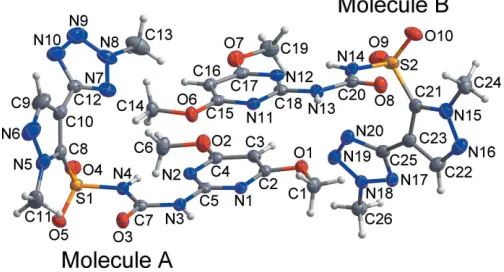
The asymmetric unit of the new dimorph II (Fig. 1), consists of two independent molecules, AandB, which are curved and form a ‘boxing glove’ shape around the pyrazole ring. The dihedral angles between the pyrazole ring and the tetrazole and dimethoxypyrimidine ring planes are 72.84 (10) and 37.24 (14), respectively, in molecule A and 84.38 (9) and 26.09 (15), respectively, in moleculeB. All bond lengths and bond angles are normal and comparable to those observed in similar crystal structures (Chopra et al., 2004; Kwon et al., 2015). Each molecule features an intramolecular N—H N hydrogen bond (Table 1), which closes anS(6) ring.
3. Supramolecular features
In the crystal, aromatic–stacking interactions,Cg1 Cg1iii = 3.9817 (16),Cg3 Cg6vii= 3.4487 (14) andCg4 Cg4viii = 3.5455 (16) A˚ occur [Cg1,Cg3,Cg4 andCg6 are the centroids of the N5/N6/C8–C10, N1/N2/C2–C5, N15/N16/C21–C23 and N11/N12/C15–C18 rings, respectively; symmetry codes: (vii)x, y,z, (viii)x+ 2,y,z+ 2]. Together, these link adjacent molecules, forming chains propagating along thecaxis. (Fig. 2). In addition, there are N—H N, N—H O, C—H O and C—H N hydrogen bonds in dimorph II (Table 1), which generate a three-dimensional architecture.
Figure 1
[image:2.610.45.297.74.210.2]The asymmetric unit of the title compound, with displacement ellipsoids drawn at the 50% probability level. H atoms are shown as small spheres of arbitrary radius.
Table 1
Hydrogen-bond geometry (A˚ ,).
D—H A D—H H A D A D—H A
N3—H3N N11i 0.88 2.65 3.494 (3) 162
N4—H4N N2 0.88 1.89 2.611 (3) 138 N13—H13N O3i 0.88 2.04 2.844 (2) 151
N14—H14N N12 0.88 1.95 2.636 (3) 134 C1—H1C O8ii 0.98 2.58 3.559 (3) 178
C11—H11B O3 0.98 2.38 3.236 (3) 146 C11—H11B O8i 0.98 2.57 3.278 (3) 129
C11—H11C N10iii 0.98 2.58 3.290 (4) 130
C13—H13A O9iv 0.98 2.40 3.374 (4) 175
C14—H14A O5v 0.98 2.39 3.335 (3) 162
C22—H22 N17vi 0.95 2.57 3.435 (3) 152
C24—H24B O8 0.98 2.33 3.080 (3) 133 C26—H26B N16vi 0.98 2.52 3.376 (3) 146
[image:2.610.110.504.447.724.2]The previous dimorph has only one – interaction between the tetrazole rings of neighboring molecules, while the present dimorph has three– interactions between di-methoxypyrimidine rings in the asymmetric unit, and between the pyrazole rings of neighboringAorBmolecules.
4. Synthesis and crystallization
In the previous report, crystals were obtained by using CH3CN solvent, whereas colourless needles of the title polymorph were prepared by slow evaporation of a methanol solution.
5. Refinement
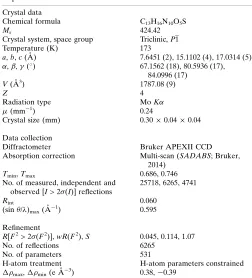
Crystal data, data collection and structure refinement details are summarized in Table 2. All H atoms were positioned geometrically and refined using a riding model withd(N—H) = 0.88 A˚ , Uiso = 1.2Ueq(C) for N—H groups, d(C—H) = 0.88 A˚ ,Uiso= 1.2Ueq(C) for Csp
2
—H andd(C—H) = 0.98 A˚ , Uiso= 1.5Ueq(C) for methyl groups.
Acknowledgements
This research was supported by the Basic Science Program through the National Research Foundation of Korea (NRF) funded by the Ministry of Education, Science and Technology (No. 2014R1A1A4A01009105).
References
Brandenburg, K. (2010).DIAMOND. Crystal Impact GbR, Bonn, Germany.
Bruker (2014). APEX2, SAINT and SADABS. Bruker AXS Inc., Madison, Wisconsin, USA.
Chopra, D., Mohan, T. P., Rao, K. S. & Guru Row, T. N. (2004).Acta Cryst.E60, o2418–o2420.
Ebenezer, S. & Muthiah, P. T. (2010).Acta Cryst.E66, o2574. Jeon, Y., Kim, J., Kwon, E. & Kim, T. H. (2015). Acta Cryst.E71,
o470–o471.
Kwon, E., Kim, J., Kang, G. & Kim, T. H. (2015). Acta Cryst.E71, o1033–o1034.
Schmidt, C. L. & Jansen, M. (2012).Z. Anorg. Allg. Chem.638, 275– 278.
Sheldrick, G. M. (2008).Acta Cryst.A64, 112–122. Sheldrick, G. M. (2015).Acta Cryst.C71, 3–8.
Valle, A., Boschin, G., Negri, M., Abbruscato, P., Sorlini, C., D’Agostina, A. & Zanardini, E. (2006).J. Appl. Microbiol.101, 443–452.
Venkatesh, P. M., Pardhasaradhi, V., Dhayanithi, V., Avinash, M., Palimkar, S., Subhash, K. R. & Mohan, H. R. (2016).Chem. Sci. Trans.5, 41–55.
Westrip, S. P. (2010).J. Appl. Cryst.43, 920–925.
1470
Kwonet al. C13H16N10O5S Acta Cryst.(2016). E72, 1468–1470
[image:3.610.312.564.88.366.2]research communications
Table 2
Experimental details.
Crystal data
Chemical formula C13H16N10O5S
Mr 424.42
Crystal system, space group Triclinic,P1 Temperature (K) 173
a,b,c(A˚ ) 7.6451 (2), 15.1102 (4), 17.0314 (5)
,,() 67.1562 (18), 80.5936 (17),
84.0996 (17)
V(A˚3) 1787.08 (9)
Z 4
Radiation type MoK
(mm1) 0.24
Crystal size (mm) 0.300.040.04 Data collection
Diffractometer Bruker APEXII CCD Absorption correction Multi-scan (SADABS; Bruker,
2014)
Tmin,Tmax 0.686, 0.746
No. of measured, independent and observed [I> 2(I)] reflections
25718, 6265, 4741
Rint 0.060
(sin/ )max(A˚1) 0.595
Refinement
R[F2> 2(F2)],wR(F2),S 0.045, 0.114, 1.07
No. of reflections 6265 No. of parameters 531
H-atom treatment H-atom parameters constrained
max,min(e A˚3) 0.38,0.39
Computer programs:APEX2andSAINT(Bruker, 2014),SHELXS97andSHELXTL
supporting information
Acta Cryst. (2016). E72, 1468-1470 [https://doi.org/10.1107/S2056989016014845]
A second triclinic polymorph of azimsulfuron
Eunjin Kwon, Jineun Kim, Hyunjin Park and Tae Ho Kim
Computing details
Data collection: APEX2 (Bruker, 2014); cell refinement: SAINT (Bruker, 2014); data reduction: SAINT (Bruker, 2014);
program(s) used to solve structure: SHELXS97 (Sheldrick, 2008); program(s) used to refine structure: SHELXL2014
(Sheldrick, 2015); molecular graphics: DIAMOND (Brandenburg, 2010); software used to prepare material for
publication: SHELXTL (Sheldrick, 2008) and publCIF (Westrip, 2010).
1-(4,6-Dimethoxypyrimidin-2-yl)-3-{[1-methyl-4-(2-methyl-2H-tetrazol-5-yl)pyrazol-5-yl]sulfonyl}urea
Crystal data
C13H16N10O5S
Mr = 424.42
Triclinic, P1 a = 7.6451 (2) Å b = 15.1102 (4) Å c = 17.0314 (5) Å α = 67.1562 (18)° β = 80.5936 (17)° γ = 84.0996 (17)° V = 1787.08 (9) Å3
Z = 4
F(000) = 880 Dx = 1.577 Mg m−3
Mo Kα radiation, λ = 0.71073 Å Cell parameters from 3336 reflections θ = 2.3–24.2°
µ = 0.24 mm−1
T = 173 K Needle, colourless 0.30 × 0.04 × 0.04 mm
Data collection
Bruker APEXII CCD diffractometer φ and ω scans
Absorption correction: multi-scan (SADABS; Bruker, 2014) Tmin = 0.686, Tmax = 0.746
25718 measured reflections
6265 independent reflections 4741 reflections with I > 2σ(I) Rint = 0.060
θmax = 25.0°, θmin = 1.5°
h = −8→9 k = −17→17 l = −20→20
Refinement
Refinement on F2
Least-squares matrix: full R[F2 > 2σ(F2)] = 0.045
wR(F2) = 0.114
S = 1.07 6265 reflections 531 parameters 0 restraints
Hydrogen site location: inferred from neighbouring sites
H-atom parameters constrained w = 1/[σ2(F
o2) + (0.0457P)2 + 0.2151P]
where P = (Fo2 + 2Fc2)/3
(Δ/σ)max < 0.001
Δρmax = 0.38 e Å−3
supporting information
sup-2
Acta Cryst. (2016). E72, 1468-1470 Special details
Geometry. All esds (except the esd in the dihedral angle between two l.s. planes) are estimated using the full covariance matrix. The cell esds are taken into account individually in the estimation of esds in distances, angles and torsion angles; correlations between esds in cell parameters are only used when they are defined by crystal symmetry. An approximate (isotropic) treatment of cell esds is used for estimating esds involving l.s. planes.
Fractional atomic coordinates and isotropic or equivalent isotropic displacement parameters (Å2)
x y z Uiso*/Ueq
supporting information
sup-4
Acta Cryst. (2016). E72, 1468-1470
H26A 0.4199 −0.1609 0.8065 0.044* H26B 0.3240 −0.1263 0.8811 0.044* H26C 0.4767 −0.2097 0.9009 0.044*
Atomic displacement parameters (Å2)
U11 U22 U33 U12 U13 U23
C10 0.0319 (17) 0.0302 (14) 0.0207 (13) −0.0044 (12) 0.0026 (12) −0.0098 (11) C11 0.047 (2) 0.0314 (15) 0.0322 (16) 0.0151 (13) −0.0080 (14) −0.0075 (13) C12 0.0226 (16) 0.0330 (14) 0.0294 (15) −0.0038 (11) 0.0002 (12) −0.0164 (12) C13 0.042 (2) 0.0348 (16) 0.085 (3) 0.0064 (14) −0.0173 (18) −0.0268 (17) C14 0.0323 (17) 0.0321 (14) 0.0224 (14) 0.0030 (12) −0.0082 (12) −0.0133 (11) C15 0.0157 (14) 0.0254 (13) 0.0256 (14) −0.0040 (10) 0.0009 (11) −0.0119 (11) C16 0.0229 (15) 0.0280 (13) 0.0238 (13) −0.0051 (11) 0.0001 (11) −0.0133 (11) C17 0.0185 (15) 0.0240 (13) 0.0304 (14) −0.0047 (10) 0.0028 (11) −0.0151 (11) C18 0.0177 (14) 0.0198 (12) 0.0241 (13) −0.0023 (10) 0.0003 (11) −0.0074 (10) C19 0.0363 (18) 0.0193 (13) 0.0460 (17) 0.0026 (11) −0.0045 (14) −0.0150 (12) C20 0.0192 (15) 0.0191 (12) 0.0249 (14) −0.0002 (10) 0.0002 (11) −0.0063 (11) C21 0.0276 (16) 0.0201 (12) 0.0225 (13) 0.0031 (11) −0.0040 (11) −0.0040 (10) C22 0.0332 (18) 0.0277 (14) 0.0291 (15) −0.0044 (12) 0.0031 (13) −0.0085 (12) C23 0.0269 (16) 0.0213 (12) 0.0249 (14) 0.0015 (11) −0.0010 (11) −0.0053 (11) C24 0.0420 (19) 0.0344 (15) 0.0341 (16) −0.0048 (13) −0.0132 (14) −0.0096 (13) C25 0.0243 (16) 0.0198 (12) 0.0245 (14) 0.0037 (11) −0.0008 (11) −0.0050 (11) C26 0.0312 (17) 0.0281 (14) 0.0329 (15) −0.0003 (12) −0.0039 (12) −0.0154 (12)
Geometric parameters (Å, º)
supporting information
sup-6
Acta Cryst. (2016). E72, 1468-1470
N5—C8 1.361 (3) C14—H14A 0.9800 N5—C11 1.465 (3) C14—H14B 0.9800 N6—C9 1.324 (4) C14—H14C 0.9800 N7—C12 1.328 (3) C15—C16 1.384 (3) N7—N8 1.344 (3) C16—C17 1.382 (3) N8—N9 1.310 (3) C16—H16 0.9500 N8—C13 1.458 (4) C19—H19A 0.9800 N9—N10 1.312 (3) C19—H19B 0.9800 N10—C12 1.350 (3) C19—H19C 0.9800 N11—C18 1.333 (3) C21—C23 1.393 (4) N11—C15 1.345 (3) C22—C23 1.400 (3) N12—C17 1.326 (3) C22—H22 0.9500 N12—C18 1.338 (3) C23—C25 1.449 (4) N13—C18 1.376 (3) C24—H24A 0.9800 N13—C20 1.384 (3) C24—H24B 0.9800 N13—H13N 0.8800 C24—H24C 0.9800 N14—C20 1.380 (3) C26—H26A 0.9800 N14—H14N 0.8800 C26—H26B 0.9800 N15—N16 1.343 (3) C26—H26C 0.9800
supporting information
sup-8
Acta Cryst. (2016). E72, 1468-1470
O3—C7—N4 122.6 (2) H26B—C26—H26C 109.5
O5—S1—C8—N5 16.9 (3) S2—C21—C23—C25 3.4 (4) O4—S1—C8—N5 148.5 (2) N16—C22—C23—C21 −0.3 (3) N4—S1—C8—N5 −101.5 (2) N16—C22—C23—C25 176.1 (2) O5—S1—C8—C10 −158.3 (2) N18—N17—C25—N20 −0.2 (3) O4—S1—C8—C10 −26.6 (3) N18—N17—C25—C23 179.0 (2) N4—S1—C8—C10 83.4 (3) N19—N20—C25—N17 0.1 (3) N5—N6—C9—C10 0.1 (3) N19—N20—C25—C23 −179.0 (2) N6—C9—C10—C8 0.5 (3) C21—C23—C25—N17 151.6 (3) N6—C9—C10—C12 −179.5 (3) C22—C23—C25—N17 −23.7 (4) N5—C8—C10—C9 −1.0 (3) C21—C23—C25—N20 −29.3 (4) S1—C8—C10—C9 174.8 (2) C22—C23—C25—N20 155.4 (2)
Hydrogen-bond geometry (Å, º)
D—H···A D—H H···A D···A D—H···A
N3—H3N···N11i 0.88 2.65 3.494 (3) 162
N4—H4N···N2 0.88 1.89 2.611 (3) 138 N13—H13N···O3i 0.88 2.04 2.844 (2) 151
N14—H14N···N12 0.88 1.95 2.636 (3) 134 C1—H1C···O8ii 0.98 2.58 3.559 (3) 178
C11—H11B···O3 0.98 2.38 3.236 (3) 146 C11—H11B···O8i 0.98 2.57 3.278 (3) 129
C11—H11C···N10iii 0.98 2.58 3.290 (4) 130
C13—H13A···O9iv 0.98 2.40 3.374 (4) 175
C14—H14A···O5v 0.98 2.39 3.335 (3) 162
C22—H22···N17vi 0.95 2.57 3.435 (3) 152
C24—H24B···O8 0.98 2.33 3.080 (3) 133 C26—H26B···N16vi 0.98 2.52 3.376 (3) 146