Dehydration kinetics of onion slices in osmotic
and air convective drying process
V.A. Revaskar
1, P.S. Pisalkar
2, P.B. Pathare
3, G.P. Sharma
11
Department of Processing & Food Engineering, Maharana Pratap University
of Agriculture and Technology, Udaipur, India
2
Dr. Panjabrao Deshmukh Krishi Vidyapeeth, Akola, India
3
Department of Process & Chemical Engineering, University College Cork, Ireland
Abstract
Revaskar V.A., PisalkarP.S., Pathare P.B., Sharma G.P., 2014. Dehydration kinetics of onion slices in osmotic and air convective drying process. Res. Agr. Eng., 60: 92–99.
The effect of different pre-treatments (i.e. osmotic dehydration in 10, 15 and 20°Brix NaCl solution and drying air temperature of 50, 60 and 70°C) on drying behaviour of onion slices were investigated. The onion slices were dried in a laboratory model tray dryer. Drying of onion slices occurred in falling rate period. Five thin-layer drying models (Ex-ponential, Page, Henderson and Pabis, Logarithmic and Power law) were fitted to the moisture ratio data. Among the drying models investigated, the Page model satisfactorily described the drying behaviour of onion slices. The effective moisture diffusivity of pre-treated samples was higher than that of non-treated samples.
Keywords: onion; drying; mathematical models; diffusivity; osmotic dehydration
Onion (Allium cepa), a very commonly used veg-etable, ranks third in the world production of major vegetables (Mitraet al. 2012). In the manufacture of processed foods such as soups, sauces, salad dressings, sausage and meat products, packet food and many other convenience foods, dehydrated onion is normally used as flavour additive, being preferred to the fresh product, because it has bet-ter storage properties and is easy to use (Rapusas, Driscoll 1995; Kaymak-Ertekin, Gedik 2005). Onion is an important vegetable to serve as ingre-dients in dishes, as toppings on burgers, in season-ings, as chip coatings etc. (Sharmaet al. 2005a).
Conventional air-drying is a simultaneous heat and mass transfer process, accompanied by phase change (Barbanti et al. 1994) being a high cost process. However, water removal using high tem-peratures and long drying times may cause
seri-ous decreases in nutritive and sensorial values, damaging mainly the flavour, colour and nutrients of dried products (Lenart 1996; Lin et al. 1998). Osmotic dehydration was used as pre-treatment to reduce air drying time and improve the product quality (Torreggiani 1993; Jayaraman, Gupta 1995; Karathanoset al. 1995; Serenoet al. 2001; Revaskar etal. 2007). Other advantages include limited heat damage, improved textural quality, vi-tamin retention, flavour enhancement and colour stabilization (Ade-Omowayeet al. 2003).
useful technique that involves the immersion of the fruit in a hypertonic aqueous solution leading to the loss of water through the cell wall membranes of the fruit and subsequent flow along the inter-cellular space before diffusing into the solution (Serenoet al. 2001). As a partial dehydration process, osmosis may be regarded as a simultaneous water and sol-ute diffusion operation, wherein the sample incurs a gain of solids and a simultaneous loss of moisture (McMinn, Magee 1999b). The shelf life quality of the final product is better than without such treat-ment due to the increase in sugar/acid ratio, the im-provement in texture and the stability of the colour pigment during storage (Lombardet al. 2008).
Osmotic dehydration combined with drying tech-nologies provides an opportunity to produce novel shelf stable types of high quality product. The dry-ing kinetics of food is a complex phenomenon and requires simple representations to predict the dry-ing behaviour, and to optimize the drydry-ing param-eters. Recently, studies were done on drying kinetics of fruits and vegetables (Togrul, Pehlivan 2002; Doymaz 2004; Jain, Pathare 2004; Akpinar, Bicer 2005; Sharmaet al. 2005a; Goyalet al. 2006; Mun-dada et al. 2010). However, very limited studies were found in the literature which relate to the influ-ence of pre-treatments, i.e. osmotic dehydration, on drying kinetics of onion. The objective of this study was (i) to investigate the influence of pre-treatments and drying air temperature on the drying behaviour of onion, (ii) to evaluate a suitable thin-layer drying model for describing the drying process, and (iii) to calculate the effective moisture diffusivity.
MATERIALS AND METHODS
Raw material. The fresh white onion bulbs (cv. V-12) were used in the present study. The white onion bulbs were stored in storage chamber main-tained at a temperature of 4 ± 1°C and 70% air rela-tive humidity until experiments were completed. Onions were taken from the storage and were al-lowed to equilibrate with ambient conditions for about 2 h followed by hand peeling. The peeled onions were cut into circular slices of thickness equal to 4 ± 0.1 mm using a manual stainless steel cutter. A sample size of about 200 g was used in each drying experiment. Initial moisture content of each sample was determined using the oven dry-ing method which ranged between 4.56 and 5.45 g H2O/g dry matter (DM).
Osmotic dehydration. The onion slices were par- tially dehydrated using osmotic drying technique. The slices were placed in different containers hold-ing 10, 15 and 20°Brix of NaCl solution at ambi-ent temperature (30°C) for 1 h; and stirring of the solution was done at regular intervals of 15 min-utes. Solution to sample ratio was kept as 2.5:1 in each experiment. After a period of 1 h, slices were removed quickly and blotted gently using a tissue paper to remove the surface moisture.
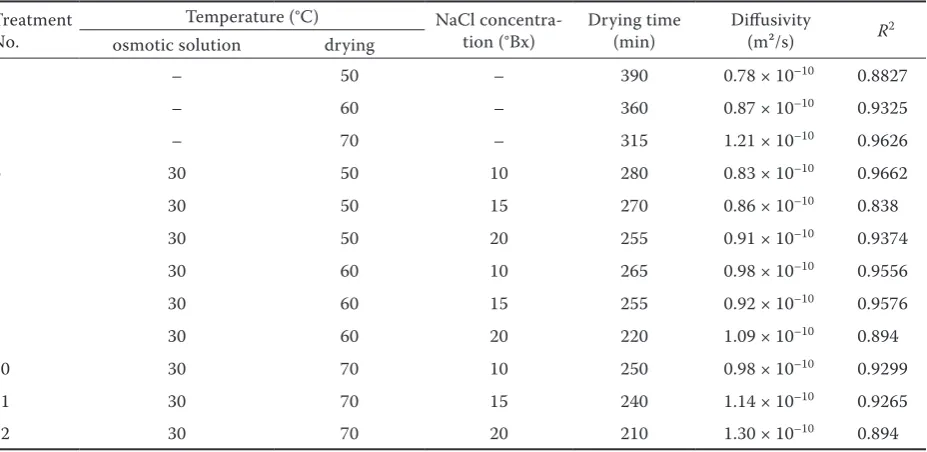
Hot air drying. Samples non-treated and pre-treated in osmotic solution (10, 15 and 20°Brix NaCl solution) were dried in a laboratory tray dryer. The dryer consisted of a drying chamber, electric heat-er, fan and a temperature controller. Experiments were conducted at 50, 60 and 70°C air tempera-ture and at a constant airflow velocity of 1.5 m/s. Slices of raw onion samples were uniformly spread in each trays and kept in dryer. Moisture loss was recorded in 5 min interval for an hour, then the weighing interval was increased to 10 min for next one hour; further readings were taken at 15 min in-terval by a digital balance of 0.01 g accuracy. The drying continued till the final moisture content of about 0.07 g water per g dry matter was reached in the dried product. Experiments were replicated three times. In total, 12 treatments combination as described in Table 1 were conducted.
Mathematical modelling. Mathematical model-ling is essential to predict and simulate the drying behaviour. It is also an important tool in dryer’s design, contributing to a better understanding of the drying mechanism. To select a suitable model for describing the drying process of onion slices, drying curves were fitted with five thin-layer dry-ing equations (Eqs 1–5), (Togrul, Pehlivan 2002; Doymaz 2004; Akpinar, Bicer 2005).
Exponential MR = exp(–kt) (1)
Page MR = exp(–ktn) (2)
Henderson-Pabis MR = aexp(–kt) (3)
Logarithmic MR = a + bln(t) (4)
Power law MR= AtB (5) where:
MR – moisture ratio (–)
t – time (s)
The acceptability of the model was determined by the coefficient of determination R². In addition to the coefficient of determination, the goodness of fit was determined by various statistical param-eters such as reduced mean square of the deviation χ², mean bias error EMB and root mean square er-ror ERMS. For quality fit, R² value should be higher, close to one, and χ², EMBand ERMS values should be lower (Sarsavadiaet al. 1999; Togrul, Pehlivan 2002; Demiret al. 2004; Erenturket al. 2004).
Moisture diffusivity. In drying, diffusivity is used to indicate the flow of moisture out of material. In falling rate period of drying, moisture transfer within the food is mainly by molecular diffusion. Moisture diffusivity is influenced by shrinkage, case hardening during drying, moisture content and temperature of material. The falling rate pe-riod of biological materials is best described by Fick’s second law of diffusion (Crank 1975). Uni-form initial moisture distribution throughout the sample, negligible external resistance to movement and onion slices releasing the moisture from top as well as from bottom surface are assumed. The solu-tion of the above mensolu-tioned equasolu-tion as proposed by Crank (1975) for plane sheet of half thickness (Sharmaet al. 2005b) is:
M−Me
M0−Me
= 8 π2 n∑=1
∞ 1
(2n−1)2 exp −(2n−1)2π2 Dt
L2
⎡
⎣⎢ ⎤⎦⎥ (6)
Simplifying this by considering only first term of the series, the equation reduced to:
MR= M−Me
M0−M
= 8
π2 exp⎡⎣⎢−π2DtL2 ⎤⎦⎥ (7)
where:
MR – moisture ratio (–)
Me – equilibrium moisture content (g H2O/g DM) M0 – initial moisture content (g H2O/g DM) M – moisture content at time t (g H2O/g DM) L – half thickness of slab (0.002 m)
t – time (s)
D – diffusivity coefficient (m2/s)
Rearranging the above mentioned Eq. (7):
ln(MR)=ln 8⎛⎝⎜π2⎞⎠⎟ − π⎛⎝⎜ 2DtL2 ⎞⎠⎟ (8)
The ln(MR) versus drying time (t) was plotted which would result in straight line and slope of the line would be used to estimate moisture diffusivity during the drying process.
RESULTS AND DISCUSSION
Effect of pre-treatments on drying behaviour of onion slices
Final moisture content of samples dried under different conditions ranged from 5 to 7% dry basis (d.b.). The effect of treatment and drying tempera-ture on time taken to reach the final moistempera-ture
con-Table 1. Drying time and effective moisture diffusivity for onion slices
Treatment No.
Temperature (°C) NaCl
concentra-tion (°Bx) Drying time (min) Diffusivity (m²/s) R2
osmotic solution drying
1 – 50 – 390 0.78 × 10⁻¹⁰ 0.8827
2 – 60 – 360 0.87 × 10⁻¹⁰ 0.9325
3 – 70 – 315 1.21 × 10⁻¹⁰ 0.9626
4 30 50 10 280 0.83 × 10⁻¹⁰ 0.9662
5 30 50 15 270 0.86 × 10⁻¹⁰ 0.838
6 30 50 20 255 0.91 × 10⁻¹⁰ 0.9374
7 30 60 10 265 0.98 × 10⁻¹⁰ 0.9556
8 30 60 15 255 0.92 × 10⁻¹⁰ 0.9576
9 30 60 20 220 1.09 × 10⁻¹⁰ 0.894
10 30 70 10 250 0.98 × 10⁻¹⁰ 0.9299
11 30 70 15 240 1.14 × 10⁻¹⁰ 0.9265
12 30 70 20 210 1.30 × 10⁻¹⁰ 0.894
[image:3.595.68.532.514.740.2]tent is presented in Table 1. Drying air temperature has an important effect on drying. At higher tem-perature, due to the quick removal of moisture, the drying time was shorter. Similar observations were reported for drying of garlic slices (Madambaet al. 1996), onion slices (Sarsavadia et al. 1999), and egg plants (Akpinar, Bicer 2005). In case of onion slices pre-treated with osmotic solution, dry-ing time at all air drydry-ing temperatures decreased with the increase in the concentration of NaCl in osmotic solution. The reason of it is that the treat-ment with the higher NaCl concentration resulted into removal of substantial amount of moisture from the onion slices.
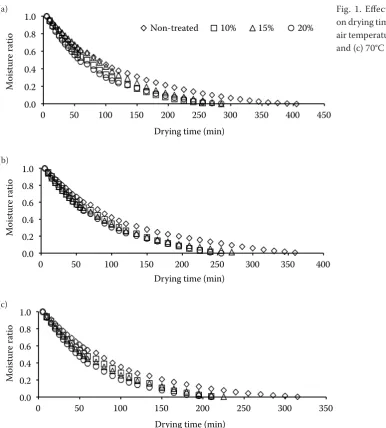
Fig. 1 shows the experimental data (moisture ra-tio versus drying time) obtained for air at tempera-tures ranging from 50 to 70°C, and a constant flow rate of 1.5 m/s. As it would be expected, during the
[image:4.595.66.453.80.509.2]initial stages of drying there was a rapid moisture removal from the product, which later decreased with an increase in drying time. From these figures it can be seen that the moisture ratio decreases continually with drying time. As expected, drying air temperatures had much stronger effect on the drying moisture content of onion. The temperature influence was higher at 70°C air temperature. The absence of a constant drying rate period may be due to the thin layer of product that did not pro-vide a constant supply of water for an applied pe-riod of time. Continuous decrease in moisture ratio indicates that diffusion has governed the internal mass transfer. This is in agreement with the results of study on onions (Mazza, Lemaguer 1980), let-tuce and cauliflower leaves (Lopezetal. 2000) and figs (Pigaet al. 2004). Onion slices did not exhibit a constant rate period of drying. The drying occurred
Fig. 1. Effect of pre-treatments on drying time at different drying air temperature (a) 50°C, (b) 60°C and (c) 70°C
0.0 0.2 0.4 0.6 0.8 1.0
0 50 100 150 200 250 300 350 400 450
M
oi
st
ur
e r
atio
Drying time (min)
Non-treated 10% 15% 20%
0.0 0.2 0.4 0.6 0.8 1.0
0 50 100 150 200 250 300 350 400
M
oi
st
ur
e r
atio
Drying time (min)
0.0 0.2 0.4 0.6 0.8 1.0
0 50 100 150 200 250 300 350
M
oi
st
ur
e r
atio
Drying time (min)
(a)
(b)
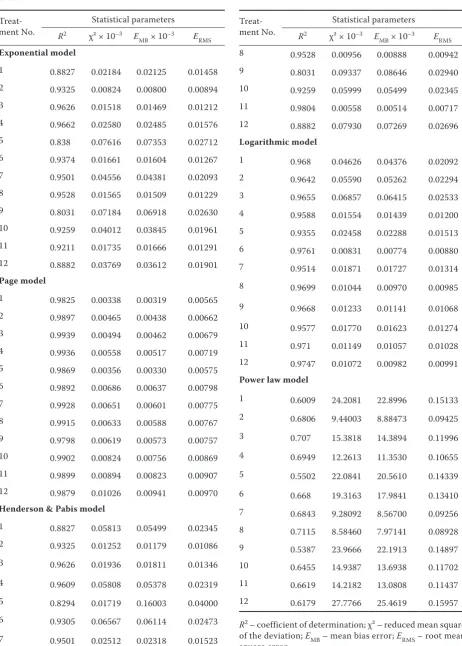
Table 2. Values of model constants and statistical param-eters
Treat-ment No.
Statistical parameters
R2 χ² × 10–3 E
MB ×10–3 ERMS Exponential model
1 0.8827 0.02184 0.02125 0.01458
2 0.9325 0.00824 0.00800 0.00894
3 0.9626 0.01518 0.01469 0.01212
4 0.9662 0.02580 0.02485 0.01576
5 0.838 0.07616 0.07353 0.02712
6 0.9374 0.01661 0.01604 0.01267
7 0.9501 0.04556 0.04381 0.02093
8 0.9528 0.01565 0.01509 0.01229
9 0.8031 0.07184 0.06918 0.02630
10 0.9259 0.04012 0.03845 0.01961
11 0.9211 0.01735 0.01666 0.01291
12 0.8882 0.03769 0.03612 0.01901
Page model
1 0.9825 0.00338 0.00319 0.00565
2 0.9897 0.00465 0.00438 0.00662
3 0.9939 0.00494 0.00462 0.00679
4 0.9936 0.00558 0.00517 0.00719
5 0.9869 0.00356 0.00330 0.00575
6 0.9892 0.00686 0.00637 0.00798
7 0.9928 0.00651 0.00601 0.00775
8 0.9915 0.00633 0.00588 0.00767
9 0.9798 0.00619 0.00573 0.00757
10 0.9902 0.00824 0.00756 0.00869
11 0.9899 0.00894 0.00823 0.00907
12 0.9879 0.01026 0.00941 0.00970
Henderson & Pabis model
1 0.8827 0.05813 0.05499 0.02345
2 0.9325 0.01252 0.01179 0.01086
3 0.9626 0.01936 0.01811 0.01346
4 0.9609 0.05808 0.05378 0.02319
5 0.8294 0.01719 0.16003 0.04000
6 0.9305 0.06567 0.06114 0.02473
7 0.9501 0.02512 0.02318 0.01523
Treat-ment No.
Statistical parameters
R2 χ² × 10–3 E
MB ×10–3 ERMS
8 0.9528 0.00956 0.00888 0.00942
9 0.8031 0.09337 0.08646 0.02940
10 0.9259 0.05999 0.05499 0.02345
11 0.9804 0.00558 0.00514 0.00717
12 0.8882 0.07930 0.07269 0.02696
Logarithmic model
1 0.968 0.04626 0.04376 0.02092
2 0.9642 0.05590 0.05262 0.02294
3 0.9655 0.06857 0.06415 0.02533
4 0.9588 0.01554 0.01439 0.01200
5 0.9355 0.02458 0.02288 0.01513
6 0.9761 0.00831 0.00774 0.00880
7 0.9514 0.01871 0.01727 0.01314
8 0.9699 0.01044 0.00970 0.00985
9 0.9668 0.01233 0.01141 0.01068
10 0.9577 0.01770 0.01623 0.01274
11 0.971 0.01149 0.01057 0.01028
12 0.9747 0.01072 0.00982 0.00991
Power law model
1 0.6009 24.2081 22.8996 0.15133
2 0.6806 9.44003 8.88473 0.09425
3 0.707 15.3818 14.3894 0.11996
4 0.6949 12.2613 11.3530 0.10655
5 0.5502 22.0841 20.5610 0.14339
6 0.668 19.3163 17.9841 0.13410
7 0.6843 9.28092 8.56700 0.09256
8 0.7115 8.58460 7.97141 0.08928
9 0.5387 23.9666 22.1913 0.14897
10 0.6455 14.9387 13.6938 0.11702
11 0.6619 14.2182 13.0808 0.11437
12 0.6179 27.7766 25.4619 0.15957
R2 – coefficient of determination; χ² – reduced mean square
of the deviation; EMB – mean bias error; ERMS – root mean square error
[image:5.595.295.525.113.714.2]under falling rate of drying period. Similar results were also reported for the drying studies on plum (Ibitwaret al. 2008) and apricots (Doymaz 2004).
Mathematical modelling of drying curves
The moisture ratio data of pre-treated and non-treated onion slices dried at various temperatures were fitted into the different thin-layer drying models listed above section and the values of (R2),
χ², EMB and ERMS, are summarized in Table 2. It was observed that in all cases, the values of R² were greater than 0.90, indicating a good fit (Mad-amba et al. 1996; Erenturk et al. 2004) except for power law model. However, the Page model gave comparatively higher R² values in all the dry-ing treatments (0.9825–0.9939) and also the χ² (0.0033–0.01026 × 10⁻³), E
MB(0.00319–0.00941 ×
10–3) and E
RMS (0.00565–0.00970) values were
lower. Hence, the Page model may be assumed to represent the thin-layer drying behaviour of onion slices. Demir et al. (2004) and Goyal et al. (2006) reported a similar result for air-drying of bay leaves and raw mango slices, respectively.
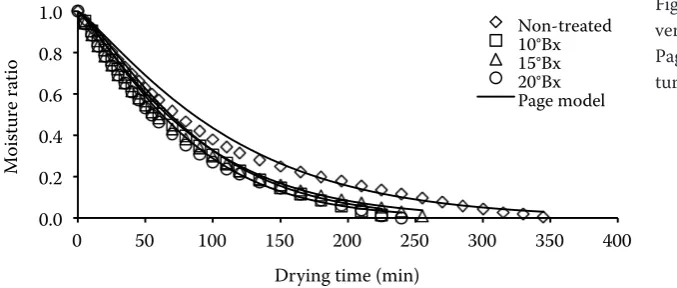
Fig. 2 suggests the experimental moisture ratios fitted with the page model at various air
tempera-tures for onion samples, also Fig. 3 shows a com-parison between both observed and predicted moisture values obtained using the Page model, which gave the best fit for the entire onion drying process. This means that the model has very high performance for describing the characteristics of drying curves.
Effective moisture diffusivity
The effective moisture diffusivity, Deff, was cal-culated using the slopes method (Doymaz 2004; Pathare, Sharma 2006) and its results are given in Table 1. The moisture diffusivity value of food material was affected by moisture content as well as temperature. At lower level of moisture content the diffusivity is less than that of high moisture con-tent. Also it was observed that moisture diffusivity increased with drying air temperature in both non-treated and pre-non-treated samples (Rahman, Lamb 1991; Pokharkar, Prasad 1998). The moisture diffusivity varied in the range of 0.78 to 1.21 × 10⁻¹⁰
m²/s and 0.83 to 1.30 × 10⁻¹⁰ m²/s for non-treated
[image:6.595.66.405.87.231.2]and pre-treated onion samples depending on the drying air temperature, respectively. These values are within the general range of 10–8 to 10–12 m²/s
Fig. 3. Comparison of observed and predicted dimensionless moisture ratio values by Page model
Fig. 2. Experimental moisture ratio versus drying time fitted with the Page model at drying air tempera-ture of 60°C
0.0 0.2 0.4 0.6 0.8 1.0
0 50 100 150 200 250 300 350 400
M
oi
st
ur
e r
atio
Drying time (min)
Non-treated 10°Bx 15°Bx 20°Bx Page model
0.0 0.2 0.4 0.6 0.8 1.0 1.2
0.0 0.2 0.4 0.6 0.8 1.0 1.2
Pr
edic
te
d
moi
st
ur
e ra
tio
[image:6.595.72.535.621.756.2]for drying of food materials (McMinn, Magee 1999a). The pre-treatment affected the internal mass transfer during drying. Table 1 also indi-cates that the effective moisture diffusivity during convective dehydration of osmosed samples was higher than untreated samples. Effective moisture diffusivity with osmotic pre-treatment can increase due to loosening of the surface cellular structure and leaching of some soluble components of the external cell layers of onion slices during soaking in osmotic solution. Similar results were reported in apricot cubes (Rivaet al. 2005), in melons (Rodri-gues, Fernandes 2007) and in pomegranate arils (Mundadaet al. 2010).
CONCLUSIONS
The effect of temperature and pre-treatment on drying behaviour of onion slices in tray dryer was investigated in this study. An increase in dry-ing air temperature decreased drydry-ing time. Pre-treated onion slices have shorter drying time than the untreated samples. The entire drying process occurred in falling rate period and constant rate period was not observed. Five thin-layer drying equations were investigated for their suitability to describe the drying behaviour of onion slices. The Page model shows the best fit with high values for the coefficient of determination and low χ², EMB
and ERMS values. The effective moisture diffusivity varied in the range of 0.78 to 1.21 × 10⁻¹⁰ m²/s and
0.83 to 1.30 × 10⁻¹⁰ m²/s for non-treated and
pre-treated onion samples depending on the drying air temperature, respectively.
References
Ade-Omowaye B., Talens P., Angersbach A., Knorr D., 2003. Kinetics of osmotic dehydration of red bell peppers as influenced by pulsed electric field pretreatment. Food Research International, 36: 475–483.
Akpinar E.K., Bicer Y., 2005. Modelling of the drying of eggplants in thin layers. International Journal of Food Science & Technology, 40: 273–281.
Barbanti D., Mastrocola D., Severine C., 1994. Drying of plums. A comparison among twelve cultivars. Sciences des Aliments, 14: 61–73.
Crank J., 1975. The Mathematics of Diffusion. London, Oxford University Press.
Demir V., Gunhan T., Yagcioglu A., Degirmencioglu A., 2004. Mathematical modelling and the determination of
some quality parameters of air-dried bay leaves. Biosystems Engineering, 88: 325–335.
Doymaz I., 2004. Effect of pre-treatments using potassium metabisulphide and alkaline ethyl oleate on the drying kinetics of apricots. Biosystems Engineering, 89: 281–287. Erenturk S., Gulaboglu M., Gultekin S., 2004, The
thin-layer drying characteristics of rosehip. Biosystems Engineering, 89: 159–166.
Goyal R., Kingsly A., Manikantan M., Ilyas S., 2006. Thin-layer drying kinetics of raw mango slices. Biosystems Engineering, 95: 43–49.
Ibitwar B., Kaur B., Arora S., Pathare P.B., 2008. Osmo-convective dehydration of plum (Prunus salicina L.). In-ternational Journal of Food Engineering, 4: 5.
Jain D., Pathare P.B., 2004. Selection and evaluation of thin layer drying models for infrared radiative and con-vective drying of onion slices. Biosystems Engineering,
89: 289–296.
Jayaraman K., Gupta D.K.D., 1995. Drying of fruits and vegetables. In: Mujumdar A.S. (ed.), Handbook of indus-trial Drying. 2nd Ed. New York, Marcel Dekker: 643–690.
Karathanos V., Kostaropoulos A., Saravacos G., 1995. Air-drying kinetics of osmotically dehydrated fruits. Dry-ing Technology, 13: 1503–1521.
Kaymak-Ertekin F., Gedik A., 2005. Kinetic modelling of quality deterioration in onions during drying and storage. Journal of Food Engineering, 68: 443–453.
Lenart A., 1996. Osmo-convective drying of fruits and vegetables: technology and application. Drying Technol-ogy, 14: 391–413.
Lin T.M., Durance D.T., Scaman C.H., 1998. Characteri-zation of vacuum microwave, air and freeze dried carrot slices. Food Research International, 31: 111–117.
Lombard G., Oliveira J., Fito P., Andrés A., 2008. Os-motic dehydration of pineapple as a pre-treatment for further drying. Journal of Food Engineering, 85: 277–284. Lopez A., Iguaz A., Esnoz A., Virseda P., 2000. Thin-layer
drying behaviour of vegetable wastes from wholesale mar-ket. Drying Technology, 18: 995–1006.
Madamba P.S., Driscoll R.H., Buckle K.A., 1996. The thin-layer drying characteristics of garlic slices. Journal of Food Engineering, 29: 75–97.
Mazza G., Lemaguer M., 1980. Dehydration of onion: some theoretical and practical considerations. International Journal of Food Science & Technology, 15: 181–194. McMinn W.A.M., Magee T.R.A., 1999a. Principles, methods
and applications of the convective drying of foodstuffs. Food and Bioproducts Processing, 77: 175–193.
Mitra J., Shrivastava S.L., Rao P.S., 2012. Onion dehy-dration: a review. Journal Food Science and Technology,
49: 267–277.
Mundada M., Hathan B. S., Maske S., 2010. Convective dehydration kinetics of osmotically pretreated pomegran-ate arils. Biosystems Engineering, 107: 307–316.
Pathare, P.B., Sharma G., 2006. Effective moisture diffusiv-ity of onion slices undergoing infrared convective drying. Biosystems Engineering, 93: 285–291.
Piga A., Pinna I., Özer K. B., Agabbio M., Aksoy U., 2004. Hot air dehydration of figs (Ficus carica L.): drying kinet-ics and quality loss. International Journal of Food Science & Technology, 39: 793–799.
Pokharkar S., Prasad S., 1998. Mass transfer during os-motic dehydration of banana slices. Journal of Food Science and Technology, 35: 336–338.
Rahman S., Lamb J., 1991. Air drying behavior of fresh and osmotically dehydrated pineapple. Journal of Food Process Engineering, 14: 163–171.
Rapusas R., Driscoll R., 1995. The Thin-layer drying characterstics of white onion slices. Drying Technology,
13: 1905–1931.
Revaskar V., Sharma G.P., Verma R.C., Jain S.K., Chahar V.K., 2007. Drying behaviour and energy requirement for dehydration of white onion slices. International Journal of Food Engineering, 3: 14.
Riva M., Campolongo S., Leva A.A., Maestrelli A., Torreggiani D., 2005. Structure-property relationships in osmo-air-dehydrated apricot cubes. Food Research International, 38: 533–542.
Rodrigues S., Fernandes F.A.N., 2007. Dehydration of melons in a ternary system followed by air-drying. Journal of Food Engineering, 80: 678–687.
Sarsavadia P., Sawhney R., Pangavhane D., Singh S., 1999. Drying behaviour of brined onion slices. Journal of Food Engineering, 40: 219–226.
Sereno A.M., Moreira R., Martinez E., 2001. Mass transfer coefficients during osmotic dehydration of apple in single and combined aqueous solutions of sugar and salt. Journal of Food Engineering, 47: 43–49.
Sharma G., Verma R., Pathare P., 2005a. Mathematical modeling of infrared radiation thin layer drying of onion slices. Journal of Food Engineering, 71: 282–286.
Sharma G., Verma R., Pathare P., 2005b. Thlayer in-frared radiation drying of onion slices. Journal of Food Engineering, 67: 361–366.
Togrul I. T., Pehlivan D., 2002, Mathematical modelling of solar drying of apricots in thin layers. Journal of Food Engineering, 55: 209–216.
Torreggiani D., 1993. Osmotic dehydration in fruit and veg-etable processing. Food Research International, 26: 59–68.
Received for publication May 1, 2012 Accepted after corrections October 2, 2012
Corresponding author:
Dr. Pankaj B. Pathare, Stellenbosch University, Faculty of AgriSciences, South African Research Chair in Postharvest Technology, South Africa 7602