COMPUTERS
AND
-AUTOMATION
CYBERNETICS
• ROBOTS • AUTOMATIC CONTROL
~
~
RIGHT: extensive instrumentation is used to test tube electrical qualities that closely affect operation in computer circuits. Zero-bias plate current; cut-off performance; any difference in cut-off between twin- ... triode sections-these are three of many characteristics checked. ,..
~ LEFT: G-E computer tubes undergo a cut-off life test. The tubes are operated for long intervals with their grids biased to cut-off. Period-ically the tubes are given a cathode interface check, to make sure no "sleeping sickness", or failure to respond to changed grid voltage, has developed during inactivity.
G-E Computer Tubes are specially tested for
qualities that safeguard computer reliability!
General Electric pioneered special tubes for computers ... also developed tests such as those above, which assure that G-E tubes in your computer circuit can be relied on to meet de-signers' aims in all respects.
The tests are specific in purpose. Each covers one or more tube characteristics important in computer use, and which closely influence the accuracy and reliapility of the equipment.
There is 110 slIbstitllte jor G-E compllter-tllbe
qllality, which starts with special tube
design-extends through precision manufacture-con-cludes with exhaustive tube tests that relate direct! y to computer service.
Also . . . there is no counterpart to G.E.'s range of special computer tubes now ill prodllc-ti011. You have a choice of proved G-E types
available for your present circuit needs, with new tubes constantly being added.
Ask for "G-E Computer Tubes And Their Applications" (ETD-1140). 54 pages-just off the press. A book every designer and builder will find useful! Tllbe Department, Gelleral Elec-tric Company, Schenectady 5, New York.
*
*
*
• G-E computer-tube development is a con-tinuing process, with new types being added regularly for faster, more advanced equipment, or to meet special customer requirements where volume warrants. Five types - proved, popular-already are in full production:
GL-5844 GL-6211
GL-5965
GL-5915A GL-6463
l+ogress
Is
Ovr
Mosf Imporfqnf
Pror/vd
G ENE R
A Le E LEe T R I
,~,
2
COMPUTERS AND AUTOMATION
CYBERNETICS
•
ROBOTS
•
AUTOMATIC CONTROL
Vol. 4, No. 4
April, 1955
- ESTABLISH.ED SEPTEMBER, 1951
-ARTICLES
Thinking Machines and Human Personality
Marginal Checking -- An Aid in Preventive
Maintenance of Computers
REFERENCE INFORMATION
••• Elliot L. Gruenberg
••• J. Melvin Jones
Association for Computing Machinery Meeting, Ann Arbor, June, 1954
--6
10
Titles of Papers and Abstracts
15
Products and Services in the Computer Field
37
Western Computer Conference and Exhibit, Los Angeles, March 1 - 3,
1955
Titles of Papers and Abstracts
38
Roster of Automatic Computers (supplement)
41
Books and Other Publications
Gordon Spenser
42
Patents
...
Hans Schroeder
46
FORUM
To Program or Not to Program
••• Bill Danch
50
The Editor's Notes
4
Index of Notices
40
Advertising Index
58
Editor~ Edmund C. Berkeley Advisory Committee: Samuel R. Williams, Assistant Editors: Eva Di Stefano, Neil Macdonald, Jack Herbert F. Mitchell, Jr., Justin
Moshman, Gordon Spenser, F. L. W a l k e r . ORpenheim
Contributing Editors: Andrew D. Booth, John M. Breen, John W. Carr, III, Alston S. Householder, Fletcher Pratt
Pub~isher: Berkeley Enter~rises, Inc.
36 West 11 St., New York 11, N.Y. -Algonquin 4 7675
815 Wa shington St. , Newton ville 60, Mass. - Decatur 2 5453 or 2 392R
Effective September I, 1954, COMPUTERS AND AUTOMATION is published monthly, twelve times a year: Copyright, 1955, by Edmund Callis Berkeley. Subscription rates: $4.50 for one year, $8.50 for two years, ~n the United States: $5.00 for one year, $9.50 for two years, in Canada; $5.50 for one year, S10.50 for two years else-Bulk subscription rates: see page 48. Advertising rates: see page 56.
THE EDITOR'S NOTES
FENCES
There are two kinds of people in t his
world: those who like to have settled routines,
follow standard procedures, conform to fixe d
ways of doing things; and those who 1 ike t
0change, experiment, tryout new ways-of doing
things, perhaps even go off on tangents.
We
confess, if it has not been obvious, that we
lean towards the second way of behaving. W e
like the kind of front cover we have for
a
while; then we change it. We put the magazine
together in a certain way for a while; then we
,change it. We put into an issue 36 or 40 pages
for a while; theq. we go to a 52 page iss u e •
Some people tell 'us that every issue
0f the
magazine should have at least something of
in-terest to every class of our readers; this is
probably a good standard procedure; but w e
doubt that we shall do this every time, since
this is a restriction, a confinement. We like
to change, to experiment, to branch
0u t, to
produce surprises. We don't like fences.
REFERENCES TO OTHER INFORMATION
In this issue of "Computers and Automation"
we publish for reference purposes abo u t 144
titles of papers and abstracts, taken from the
programs of two conferences. The proceedings
of one of these conferences willbe published;
in the case of the other conference, a search
will be necessary to find out where any
part-icular paper is published if it is published,
and we hope to be of help in carrying on the
search. In the January issue, we a Is
0p u
b-lished the titles and abstracts of ab
0u t 22
papers given at another computer conference.
In the department "Books and Other
Publi-cations", each notice of a reference consists
of the bibliographical citation and a few
com-ments; from Oct. 1952 to Feb. 1954, the total
number of such notices published amounts t
0about 160. In addition, quite a few of the
papers published in "Computers and Automation"
contain bibliographies; the longest
bibliogra-phy we have yet published (appearing in the
January, 1955, issue) contained 153 titles.
Therefore, if we count mentions of books,
reports, papers, publications, etc., appearing
in "Computers and Automation" since Oc t ob e r
1952, then an ass iduous reader of the magazine
would have learned of well over 500 references
to other information.
We shall continue to report the existence
and to some extent the nature of all references
we come across related to computers, in" orde r
to be of continuing service to our readers. Of
course, if any reference is specificmly stated
to be industrially confidential or militari I y
classified, we shall not report it.
WHO'S WHO IN THE COMPUTER FIELD
Having collated our punch card file s
0f
persons interested in the computing machinery
field, and after removing duplicates, we found
to our surprise not 4000 names but 8000. About
March 15, we mailed out to these persons Who's
Who Entry Forms. Please return your form to us
before April 20 in order to improve your
list-ing in the Who's Who.
COMPUTER DIRECTORY -- THIRD NOTICE
The June, 1955, is sue of "Computers and
Automation" will be a "Computer Directory".
Part 1 of the directory will be the second
edi tion of "Who's Who in the Computing Machinez:y
Field" which we published in 1953-54. It will
contain names and some information abou t a l l
persons whom we know of or can find who a r e.
really interested in computers. Entries will
be free.
If you are "really interested in comp u
t-ers" and des ire to have an up-to-date entry for
you in this directory, please send us your name
'and address and ask for a who's who entry form,
or else complete the "Identification"and''Who's
Who Entry Form" in the style that is published
in the magazine (see page
) and send the entry
form to us.
Part 2 of the directory will be a
cumula-tive "Roster of Organizations in the Computing
Machinery Field" based on the roster regularly
published in "Computers and Automation", wit h
entries expanded to some extent. Entries i n
this roster will also be free, in order t hat
it may be as complete as possible.
Ifyou know
of any changes, additions, or corrections, which
should appear in the Roster of Organiza t ion s
which" we publish, we would be grateful to you
for sending them to us.
Part 3 of the directory will be the first
edition of "The Computing Machinery Fie 1 d
<continued on page 48)
-'I
Sylvania
Power Transistors ...
Sylvania
Transislor.
1
- for military, industrial, and; , commercial applications. Avail-!
able in commercial quantities.
dissipate
2Y2
watts in free air,
have low thermal inertia
NEW
Sylvania design developments achieve low thermal
inertia and increased ratings in the Sylvania Power
Transistors 2N68 and 2N95. Dissipation of 2% watts in
free air reflects a full watt increase over previous ratings.
Power dissipation up to 5 watts is possible with an
external heat sink.
With Sylvania's new design heat
is
conducted quickly
away from active elements. Resulting low thermal
inertia improves performance stability over a wider
range of operating temperatures. Operated as a Class
A
amplifier the 2N68 or 2N95 provides a minimum power
gain of 20 db.
"Another reason why it pays to specify.Sylvanla"
SYLVANIA ELECTRIC PRODUCTS INC.
1740 Broadway, New York 19, N. Y.
In Canada: Sylvania Electric (Canada) Ltd.,
University Tower Building, St. Catherine Street, Montreal, P. Q.
,High .. Gain, Low Frequency-.2N35 (NPN)-2N34 (PNP)-low to medium
power-use as a high-gain audio amplifier-gains up to 40 in ground-ed emitter circuit.
High·Power, Low Frequency-: 2N68 (PNP)-2N95 (NPN) in-; creased power" ratings-use for ~ high current. low voltage appfi- ; cations (6-24 volts power: supplies).
High Frequency-2N94 (NPN) , -2N94A (NPN)-high alpha' (over O.95)-low base resistance: and collector capacitance-typi- : cally 1500 ohms uufd-gains up ;
to 40 db. .
Also available
in commercial quantities
Silicon Junction Diodes-1N137 A ' -lN138A and allied types--, high back resistance at high operating temperatures •.Silicon Point-Contact Diodes-: INI93, 1N194. IN195, INI96-specifically
de-signed for comput- ' er and high tem-perature general purpose applica" ti()ns. Excellent transient .response
(0.1 usee.)
For your semiconductor require-ments, check Sylvania first. Use this convenient form to indicate ; your interests and address it to <
Department C20R.
I
.---
Dept. C20RI
I
I
I
I
Sylvania Electric Products Inc. 1740 Broadway, New York 19, N. Y. Gentlemen: Please forward additional in· formation on the items checked below:
Transistors Silicon Diodes
o
High Power 0 Point Contacto High Gain 0 Junction'
o
High Frequency~SYLVANIA!
Nrune ______________________
---AdWre~ ______________________ _
City _______________________ _
Zonel _ _ _ _ _ _ ~State' ____________ _
THINKING MACHINES AND HUMAN PERSONALITY
Elliot L. Gruenberg
In the days before the electron, the
di-ode
tthe computer and magnetic tape, man" s
intellect appeared in every way unique.
N
0better explanation for thinking prowess
could-be brought forth than the existence
0f some
my~terious
and perhaps div-ine soul in man.
The modern computer has shaken the fa i t h
of-some of us that we are so God-like. Inde e d,
there is the chance that the highes t for m of
mental activity, that of reflective thinking,
might be imitated by machines.
Should we be depressed if it were granted
that right now machines could formulate
scien-tific hypotheses, test their conseq ue nee s,
analyze data and deduce principles upon which
to act? Would zest for living be lesse ned
if a thing of steel and mica, rather than flesh
and blood, were to discover a new theory
0f
relativity? Can we as humans compete wit h
mechanisms which may use a method for thinking
which is not so affected by animal fears and
drives as is 'our' human mentality? Will
0u r
world be debased by mechanical col d n e s s
0r
enriched by mechanical precision?
In short,
assuming "Giant Mechanical Brains" capable of'
reflective thinking (or at least of producing
results similar to the results of human
reflec-tion} , were a reality right now, would t his
prove humans have no soul, but are simil arl y
a somewhat intricate mechanism wi th no her e
-after to which to look forward?
In short, are thinking machines a threat
to human personality?
What is Human Personality?
We should come to some understanding
0f
human personality if we are to establish
wheth-er or not machines can threaten it.
Complka-tions abound when one seeks to resolve t his
question, because there is no general agre
e-ment as to the nature of human person ali ty.
Personali ty means the e'ssence of the individual.
What are the characteristics by which we can
identify this essence?
Human personality is characterized by a
drive to preserve a self or ego; by an aware-
,
ness of self, as related to a world; by an urge
,to survive. In addition, there is a capacity
to plan action, to talk about it, to him self
and others, and thus to reason. But beyon d
this, the human being has feeling, emotions.
Activities make him feel good or bad. Certain
- 6
sights also give rise to such feelings, and
certain sounds. There is a feeling
0f goo d
health hard to describe. A human being has a
positive feeling when he has created something
-
a new book; a musical composition, a report,
a new machine, a new room for the house. The
struggle of creation may not be pleasant, but
the results, if well done, give rise to happy
emotions.
Thinking plays an important part in the
expression of human personality; it cannot be
considered, however, to be the full essence of
it. It arises when sOloothing unsatisfac tor y
has occurred, like the pebble in the shoe. In
the words of a recent Broadway musical
--Pain makes one think;
Thinking makes one wise;
Wisdom makes life endurable.
Nor do men take too agreeably to thinking.
Fully half of the quotations on "Thin kin g "
contained in Bartlett's Familiar Quot at ion s
(Popular Edition) are antagonistic to the
prac-tice.
The reflective man is not' necessarily the
popular one. More than likely his brainy
rep-utation will cause people to distrust him, as
being too crafty or too doubting. Mol i ere
ridiculed philospher, poet, and scientist a s
the Age of Reason dawned.
All that these men
did, according to him, was to restate the
ob-vious in elegant terms. The brainy politician
finds it hard to get elected; witness Thoma s
Dewey and Adlai Stevenson, who went down t
0defeat to men more like regular folk.
Hamlet is described as the first
expres-sion 'of modern man.
Here again, we see a
pond-erer who goes through
~dozen soliloquies
be-fore he moves a muscle. This is hardly a
rec-ommendation of the thinking process, as a
fund-amental guide to proper human behavior.
This quotation from John Davidson see ms
to reinforce our point:
Dance and sing, we are eternal;
Let us still be mad with drinking:
'Tis a madness less infernal
Than the madness caused by thinking.
All the above serves to cast doubt th a t
thinking is the be-all and end-all
ofthe human
THINKING MACHINES
rewards and satisfactions for which w e a r e
energy. Now, some 200 billions of kilow a t t
searching. Some think that these rewards are
hours of electrical energy are used i n t h e
peace of mind, a sense of being val u e d for
Uni ted States in one year. The total is
con-oneself, a feeling of harmony and peace.
We
stantly mounting and is closely as soc i ate d
do not find these ideals during the thinking
with our high standard of living.
process. Most often thinking starts with
dis-satisfaction and progresses through stages of
distressful feelings. Only in those few cases
w!1ere a successful solution has been reac he d
do we find a feeling of mental reI i e f whi ch
might app'roximate'this peace of mind, which is
held as reward of human living.
By now our theme should be evident -- that
human personality centers upon something else
than rational thinking. We can dimly identify
this focus.
It is in the area of emot ion s,
feelings, aspirations, hopes, a sense of spirit,
perhaps the soul. We can give some evidenc e
for this. Modern psychiatry, dealing with ills
of the "mind", finds itself dealing with these
emotions, not the thought process, not the
ra-tional. Professor Tomars points out i n his
"Ethics in A Changing Society" that u r ban
living has focussed the individual on his
im-mediate family, because his contact with the
community has been cut off. What has the
re-suI t of this been? the intensifying
0f the
emotions, with a general increase in me n tal
disorders.
Some of us might consider that human
per-sonali ty would be threatened if a mac h i n e
could be made to duplicate a human personality.
Eut the machines of today are directed to
per-forming phases of the thinking process and
none has been made which can duplicate t h e
entire thought process. But even
IIone could
be so built, it appears certain that the machine
would not duplicate human personality because
we have seen that thinking is not the essence
of such personality.
How Real is the Threat?
Having thrown some doubt as to th e i
m-portance of thinking machines as a danger, we
might go a step further and explore the p
0s-sible "danger" that thinking machines mi g h t
soon be developed. A brief historical review
of developments in this field ought to thro w
some light on this point.
Man' has constantly been searching for ways
to lighten his burden. The strongest motive
for this has basically been that of survival
in the face of the pressure of increasmg
pop-ulation. One of the greatest steps forwardin
this struggle (from man's point of view) has
been the industrial revolution. The
revolu-tion essentially meant the wholesale applicarevolu-tion
of natural, as opposed to human, energy to
d0-ing humans' work.
Steam power, obtaining its
energy from coal, was the first source of such
As
more and more applications of mechan
-ical energy to human jobs were made, men began
to become increasingly aware of the prob
1e m
of controlling the energy.
If one mast ere d
control, he could go away and let the machine
run itself. Even the machine which
iscredited
wi th starting the industrial revolution, Watt
s
steam engine, had a governor on it to control
the flow of steam in such a way that the speed
of the engine remained fairly constant without
a human being doing anything about it. So the
problem of control was recognized from the very
start.
, But the problem of control is a
fundament-alone and has grown more complex wi t h the
years. Today our very
1i ves may depend up
0n
missiles which are guided automatically fro m
remote points. to targets. Sing Ie rna chi n e s ,
several blocks long, are now being made,'
con-trolled by a single man, which can turn
0u t
complete automobile engines!
But control of business
enterprises,them-selves interested in producing wonders of the
industrial age, has become proportiona te
1y
complicated. To keep track of whether s u c h
enterprises are economical now requires hosts
of business and accounting machines. The
lar-ger the enterprise, the greater the need for
faster operating adding machines.
Finally, electronic tubes and transistors,
the fastest operating devices known tom an,
have been pressed into service.
Th u s o u r
modern high speed computing machines have come
to be.
The evolution sketched above is· somewhat
over-simplified. The principles of high spe e d
computing machines were discovered over
0n e
hundred years ago by the Englishman, Ch arl es
Babbage, well before the pressure of modern
commerce would call it into being, and indeed,
well before technology had advanced enough to
make possible actual machines.
It is a 1 s
0true that the punched card techniquewasworked
out by the American, Dr. Herman Hollerith, as
a way of speeding the preparation of the U. S.
census. This happened in 1890. But w hi I e
necessity may· not haye been the mother of
in~vention, it was at least a more than willing
beneficiary. Modern business has seized upon
these inventions with a desperate app e t i t e,
and will similarly seize upon any improvement
which will
assis~in the ever present problem
of control.
THINKING MACHINES
have been directed to taking the d~udgery out Creativeness of bus iness control. Indeed, this has bee n
one of their greatest advantages.
In the field of science and engineering, relatively few practical engineering and phys-ical problems can be expressed in a n a 1 y t i c form, where by analytic is meant an equ a ti 0 n can be written so that an answer can be obtain-ed by simply substituting numbers for t h e known variables. Instead, many such problems require the use of "numerical analysis",which involves many additions, subtractions, multi-plications and divisions. However, the selec-tion of the operands and the sequence of the operations upon them must be carefully c 0 n-trolled to obtain the right answers. Computers can do the millions of operations in jig time, but it often takes weeks for setting up the sequence or "program".
In spite of the need to issue orders t 0 guide the machine almost every step of the way, many people have been encouraged by the p e r-formance of these computing machines to spec-ulate on the possibility that they may think or may be made to think. The writer has been one of these. Indeed, some have seen the an-alog between these machines and the brai n so vi vidly they have gone so far as to f 0 un d a school of mental healing upon this a n a log, called "Dianetics". It is not our pur p 0 s e here to debate the correctness of their view, but only to point out that they hold that the brain stores experiences on a time seq u en c e basis in much the same way as computing mach-ines store numbers for future operations.
Machines do perform logical op era ti ons, which can yield results important to human s.
Indeed, if the human brain could a~ys follow the rules of logic, it would have less trouble wi th the analytic phase of the thinki n g pro-cess. As it is, logical processes have to be learned by human beings -- they do no t com e naturally -- whereas these processes are built into the computers. The human being, thusv is
at a disadvantage analytically. But in creating hypotheses and·in sensing and correlatmg vast amounts of data, his skill is far superior to that of any machine yet known.
Thus there exists a glimmering view that a thing of mica, steel and electrons might be able to think. But we have seen that they do not really, do it yet, because someone has to think out a program of operations for i t t 0 solve a problem. They must be control I e d in this fashion. No true thinker needs to be con-trolled. If thinking machines are a th rea t, they are not one yet, because they do not yet think. But they have possibili~ies.
Most anti-mechanists emphasize th e i m-portance of creativeness as a distinguishing mark of human personality. But before we get carried away with the uniqueness of human per-sonality, let us examine creativity a little more closely.
Mothers who bear babies feel a sense 0 f creative power, and justifiably so. Ye t, in what sense does a mother create her c'h i I d ? Her control over the process once i t s ta r t s is no better than the control of an attendant moni toring the gauges in a chemical plant. In what sense are human beings responsible f o r the ideas which they generate? Do they h a v e much control over their thoughts? Or are their thoughts in large measure spontaneous confirm-at ions of the suggestions from the situconfirm-ations in which they find themselves?
Felix Adler is credited with sayi n g t "I
am thankful for the idea which has us e d me." Indeed t the artis t owes much of his suc c e s s
to 'the behavior of his musculature, over which he can exert only incomplete control. He must depend for his success on the talent or natural ability which was born in him.
Man appears to be a vehic Ie for creativi ty, rather than the center of it.
What About the Thinking of Animals?
Human beings do not feel too m~h concern that animals might possess thinking ahllity to a marked degree. Yet, should not evidence of thinking ability on the part of animals be at least as disturbing as that of machines?
Some of the most startling evidenc e 0 f animal thought is given in John Crompto n ' s book, "Life of the Spider". To understand one case he mentions, we must know that apparently ants are dis tasteful as food to mos t o t her species. Hence, it would be of advanta g e to another animal to "pass" as an ant t 0 a v 0 i d being eaten, especially, if he happened to be of a kind that is tasty, such as asp ide r. The startling thing is that there is a species of spider which mimics ants. It does this by putting the hollowed-out skeleton body of a dead ant over its own body! This certainly a t first glance appears to be something beyo.nd mere insti~ct, something approaching thought. Another evidence of animal thought i s t h e learning by a mud-wasp of the location of her nest, so that she can return again and ag ai n to the same nest and finish building i t wi th daubs of mud.
THINKING MACHINES
What About the Thinking of Machines?
We have pointed out in a previous paper
("Reflective Thinking in Machines", in
"Com-puters and Automation" for February, 1954),
that if we could define thinking in terms of
operations, a great step toward realizing such
machines would be made.
John Dewey's
defini-tion was suggested as a feasible operadefini-tional
definition. Dewey divides thinking into five
phases: (I) recognizing unsatisfactory
situ-ations; (2) formulating changes des ire d ;
(3) creating hypotheses; (4) choos ing the
best one; and, (5) taking trial action.
If we try to mechanize these, operations,
we find it possible to devise sensing elements
which would "recognize new or unsatisfactory
situations". However, before we can
"formu-late a desired change" (discover a problem),
we must have some objective in mind.
Wh y
change for the sake of the change? It is not
characteristic of the human mind, nor of the
animal mind either, to try aimlessly
onech~after the other. The change must be desired
by the human being or animal to help achieve
some goal. In the animal, for example, the
goal is mainly the urge to survive. In the
human being, more varied objectives exis t .
They may have arisen, if we probe dee ply
enough, from an urge to survive or an urge to
protect family or group.
The basic goals of men have guided them
to build up a civilization. In this social
matrix, they are able to focus bas i c human
drives into much more specific objectives.
The typesetter does not often think
0f his
family as he sits in front of the linotype
machine, but instead thinks that he must read
the copy and convert it into type. Th us he
can restrict the field of things whi c h h e
thinks about while at the machine too n 1 y
those things related to carrying out the
ob-jectives of his
wor~.We can picture a machine whic h cou Id
sense all the sights and all the sounds which
this typesetter experiences as he wor k s a t
the linotype. But could a machine sele ct
the proper sights and sounds to proceed with
the work? So far, no machine can possibly
do this. Therefore, if we want an automatic
linotyper, we must restrict the sens in g
0f
the machine to the copy and the acting of the
machine to the keys. By restricting the
si~uation, by giving the machine an objective,
we are able to make the machine do the work.
Only when human beings give mac hi n e s
purposes, objectives, can they ever think.
The objectives given to machines wi I I be
very linii ted in scope for years t
0com e,
even as machines make great strides. Th e y
will cover only small areas to which we will
direct the machines: the payroll voucher, the
corporate statement, the solution of
mathemat-ical problems.
We can hope however for much smarter
ma-chines than we have known to date.
An
auto-maton could be given a general objective such
as "This pile of papers contains all the data
on our oil leases. Your function, until
fur-ther notice, is to compute what we owe to the
lessors and write out checks."
It should be
expected that eventually with some g en era 1
command such as this, and with some dec ad e s
of "education of computers" behind it, the
ma-chine could be set to the work without an
ex-tensive change-over period of making up tapes,
changing switches, pushing buttons, or what-not.
The design of the machine should not have to
be specifically for that task, as would be the
case now.
The machine ought to be able to use what
it has learned over a reasonable past from
do-ing similar work.
In fact, the operatio n a 1
structure of the machine could be of a nature
very similar to the general purpose automatic
computers of today. The important difference
is that the machine will accommodate its e l f
to the task by a thinking-like process, onc e
the object and the data have been supplied to
it. It would then be able to recognize new
data, decide what should be changed, try
pos-sible changes in arrangements of data, select
the best one, and repeat the process over and
over, grinding out res ul ts as this pro c e s s
evolves.
Conclusion
All our speculations tend to lead us away
from any fear of a threat to human personality,
a threat to the essence of a human being,
a-rising from thinking machines.
Though we do
not understand our own essence, still we can
tell that we ourselves are not designed to be
solely thinking machines. Nor does there
ap-pear any reason to build thinking machines to
duplicate human personality. The ce n te r of
personality lies in the emotional life, wi t h
thinking and creativity as a means to an end.
We can expect thinking machines
0f the
MARGINAL CH,ECKING
An Aid in Preventive Maintenan,ce of
C'ompnt,ers
J. Melvin Jones
New York,
N. Y.
In the mass of information ava il able
(XJl-cerning electronic digital computers,much has
been written about correcting and
detecting
breakdowns in the machine circuits once they
have occurred. Less information is available,
however, about how such breakdowns may be
a-voided. ,The former process is termed
"cor-rective maintenance" whereas the latter is
termed "preventive maintenance", of which one
aspect will be considered in this article.
The Importance of Preventive Maintenance
One of the most important jobs of a
com-mercial digital computer installation is the
processing of large blocks of data requiring
continuous, repetitive calculations. For
in-stance, a
ty~icalcorporation with such an
in-stallation may issue paychecks weekly to one
thousand employees. The personnel operating
the computer would then introduce into the
machine such data as: employee number,
hour-ly wage, regular hours worked, overtime hours
worked, percentage deductions, etc.
T his
would be done for each of the thousand
employ-ees, and the total data, except for ho urs
work-ed, would probably be permanently stored i n
some medium like magnetic or punched tape.
The computer would then proceed to execute one
thousand mathematically identical calc ulations
and thus pro-duce results from which one
thou-sand paychecks might be written. In some
in-stallations, the paychecks might even be
auto-matically printed by the computer itself.
If the machine should break down during
the calculations, the results may be
disas-trous. If the failure is not detected,
incor-rect paychecks may be distributed to the
em-ployees; if the
fail~reis detected,
it is
necessary to correct the fault and
~rfonnmany
calculations over again, with consequent
de-lay.
The paths which have been taken by
com-puter designers to avoid the consequences of
computer failure lie in two directions. One
path involves the duplication of computer
com-ponents so that there will usually be an
oper-able component availoper-able to the machine if its
mate fails. In critical cases, thii has led
to the installation of two identical computers
so interconnected that one wil! pick up the
calculation if the other breaks down.
Also
included along this path is the extensive
re-search being conducted to improve the
reliabil-ity of all circuit components, such as vacuum
tubes, resistors, relays, etc.
The other path however goes off in the
opposite direction: it involves the
detec-tion and replacement of circuits which
are
still operating properly
b~tmay be expected
to fail at some
f~turedate close at, hand.
Circuits such as these are called "marginal"
circuits and their replacement greatly
en-hances the reliability of the computer from
which they are removed.
Marginal Circuits and Marginal
Ch~ckingAlthough the theory of preventive
maint~nance associated with the removal of marginal
circuits is rather simple, yet its practical
application is subject to all the
eccentrici-ties that commonly occur in applying basic
premises. Nevertheless, the fundamental
prob-lem may be summed up in two closely associated
questions:
1. How can a marginal circuit be
de-te"cted?
2. What measurable factors
distin-guish a marginal circuit from a
circuit with good future
reliabil-ity?
The answer to the second question will become
available as the first question is analysed.
The first question requires a quali ta t i v e
definition of a marginal circuit: a marginal
circuit may be defined as a presently working
circuit which nonetheless possesses defects
which give it a high probability of soon
break-ing down completely.
Basically, the way in which a marginal
circuit may be detected lies in the fact that
any circuit defect can be exaggerated, or made
more pronounced, by overloading. Overloading
may be defined as the process of causing a
.device to be subjected to conditions for
Wrlchit was not designed. For an electronic
cir-cuit, the overloading may be made- severe
en~MARGINAL CHECKING
in an electronic ciruit may be simulated by
. acceptable manner and does not produce wrong
changing the supply voltage to which itb con-
results. The action of a circuit with limited
mected~
Thus if a circuit has one of its sup-
defects is shown by the line marked B in the
ply voltages normally at 100 volts, the cir-
figure, characteristic of Circuit B.
Here
theeuit may be 'overloaded by changing that volt-
circuit operates properly at the
!40%
excur
-age to 120 or 80 volts. Such a volt-age shift
stion, but fails to respond when subjected to
is called an "excursion", and, in the example
the 4010 excursion. This example shows that a
cited, the excursion
is.i2(Jl~.A circuit in
circuit may fail at either a positive or
nega-good condition might be expected to operate
tive excursion, but may not necessarily fail
properly under an excursion of this
magnitud~at both. The circuit action is the crux a
-whereas in a circuit with a minor defect, the
round which the marginal checking procedure
excursion could be expected to so magnify the
will succeed or fail: the excursion limits
defect that the circuit would fail. The de-
must be set at a value at which a good circuft
tection of partially defective computer cir-
will function in its prescribed manner but a
cuits by this method, before they have failed
poor circuit will unconditionally fail. This
under normal operating conditions, is known
is the answer to question
2
mentioned before.
as "marginal checking".
The measurable factor is the proper
function-ing or malfunctionfunction-ing of the circuit befunction-ing
marginal-checked.
Circuit Operation During Marginal Checking
To illustrate the action' of
m
aryi
n
a
1checking, suppose we consider circuits whose
specifications state that each should operate
properly wi th a voltage excursion of
±4(Jl~at
one of its supply points. The assumed effect
of the excursion on one of these circuits is
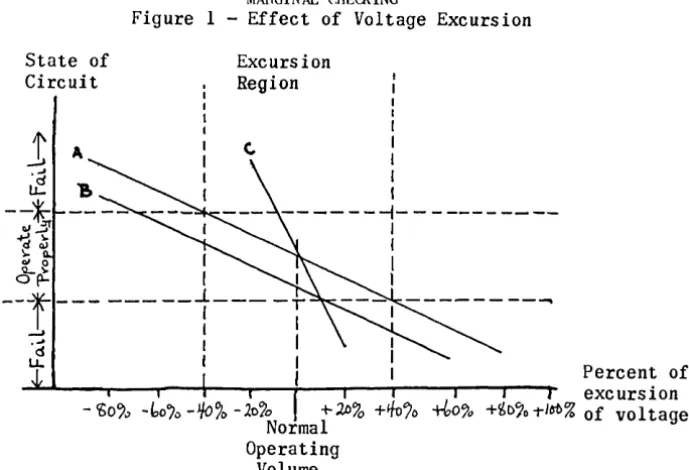
shown by the graph of Figure 1. The
percent-age of the excursion is given by the abscissa;
the success or failure of the circuit to
oper-ate during the excursion is indicoper-ated by the
ordinate. Assume that each of these thr
e e
different circuits
(A, B, and C), has
differ-ent states of "health":
Circuit A: In good condtion -- no
compon-en'!;. defects;
Circuit B: In poor condition -- has some
defects but still operates properly;
Circuit C: In bad condition -- has
se~defects; operates intermittently.
Now the marginal checking systems should
be so designed that Circuit A does not fail
when subjected to an excursion voltage, while
both Circuit
B and Circuit C do
~fail under
the excursion. (The state of Circuit C is
no-torious from a maintenance viewpoint: a
cir-cuit in this sort of condition is the most
difficult to locate with the usual troub
le-shooting techniques of corrective maintenance.
More than one computer engineer has discovered
that an intermittently operating circuit.will
consistently cause the results of a machine
calculation to be in error, but will operate
quite properly when he attempts to locate it.)
The line marked A in Figure 1 indicates
the action of Circuit
Awhen subjected to a
marginal checking excursion. At its -normal
operating voltage, the circuit operates
prop-erly, as indicated by the ordinate. At the
limits of the excursion, which for this type
"of circui t is set at
:l:4(Jl~,the circuit is on
the verge of failing but still operates in an
The action of Circuit C is illustrated
~line C in Figure
1.This is indicative of a
severely defective circuit which will fail
un-der only. slight variations from its normal
op-erating voltage. Although the operative
con-ditions are shown as straight lines in the
fig-ure, in practice a true plot of circuit
opera-tion against voltage excursion appears as a
curve. This is because certain types of
de-fects become more pronounced at. less than
nor-mal operating voltages, while other types
be-come more pronounced at higher than
normalop-erating voltages. It should be noted that the
magnitude of excursion voltage used to
margi-nal-check a circuit should never be
destruc-tive to the circuit. In other words, thevalue
of the excursion should never be so great as
to cause its components to be damaged.
This
necessity sometimes -involves a compromise
be-tween good marginal checking tests and
non-destructive excursions.
Criteria for Success or Failure
In most cases proper functioning or
mal-functioning of a circuit is not as clearly
re-solved as indicated by the region bounded by
the two horizontal dashed lines in Figure 1.
For instance, a circuit which performs the
usual YES or NO function in a computer, such
as a flip-flop, may sometimes be consideredas
operating correctly if it indicates YES or NO
at the proper time. But this criterion may
be insufficient, since the flip-flop may not
respond with the proper speed. The question
of proper functioning becomes even more
comp-licated in the case of amplifiers. For
examp~,MARGINAL CHECKING
given amplitude of the input pulse.
Despite all this, the above standards are
usually somewhat fictitious and suitable for
bench tests only, tests when the circuit
is
isolated from the other circuits in the
compu-ter. This is because the circuits to be
mar-ginal-checked are integrated with a maze of
adjacent circuits in the computer, and are not
readily available for individual
trouble-shoot-ing. The usual procedure is to marginal-check
certain selected circui ts in the com put e r ,
at the same time while putting the computer,
through its paces wi th a sample calculation for
which the correct 'result is known.
If the
cal-culated result agrees with the known result,
those circuits which are marginal-checked may
be assumed to be in good condition. ' However,
if the calculated result does not agree with
the known result\ it becomes clear that an
er-ror was introduced by the failure of a
margi-nal circuit during the checking process.
Detection of Marginal Circuits
A contemporary automatic digital computer
may have from several hundred to several
thou-sand vacuum tubes, and in addition tens
of
thousands of resistors, capacitors, diodes,
etc., Therefore, it becomes clear that the
knowledge of the existence of a marginal
cir-cuit is insufficient; it is also necessary to
determine its whereabouts in the computer. The
means by
whichthis is accomplished is best
il-lustrated by an example of the general
margin-al checking procedure followed in
detecting
and~locating
marginal circuits.
The preliminary step is to run a test
cal-culation with a known result through the
com-puter with all circuit voltages at their
nonn-al operating vnonn-alue.
If the machine produces
an incorrect result, the trouble must. be
loca-ted and remedied-by standard corrective
main-tenance techniques. Incidentally, it should
be noted that marginal checking is
never'use-ful on a broken down machine. There is no
lo-gical reason for causing an additional circuit
to fail and thus further complicate the
loca-tion of the o'riginal defunct circuit.
Only
after the machine is calculating properly with
no excursions applied, the process may be
in-sti tuted of detecting and locating margin a I
circuits before they fail during critical
op-erating times.
The first step is to apply an excursion
voltage to a portion of the computer circuits
while simultaneously running the test program
through the machine.
If the result of the
aU-culation is correct, it may be safely assumed
that the circuits in the marginal-checked
por-tion of the computer are in good condipor-tion and
may be expected to work properly in the future
The excursion ,is then applied to a different
section of the computer and the test
calcula-tion is run again. This progress is continued
until either an incorrect result is obtained,
or all the sections of the whole computer have
been successfully marginal-checked. When
an
error does occur, it shows that a marginal
cir-cuit exi,sts in that section of the computer
presently being marginal-checked. The
location of a marginal circuit may thus be nar
-rowed down to the group of circuits b ein g
checked when the error occurs.
Division of a Computer for Marginal Checkin g
The way in which ,a computer is divided
into groups of computer circuits to be
marg-inal-checked at the same time naturally varies
from computer to computer. In a small,
spreial-purpose computer there may be only a few such
groups, whereas in a large computer there may
be hundreds of groups. To fac
iIi tate the
se~·lectjon of a group of circuits, the computer
is lEually ititially divided into its main
lo-gical sections:
1. Memory Equipment
2. Control Equipment
3. Arithmetic Equipment
4. Input-output Equipment
These four large groups of circuits may be
called equipment groups. Each equipment grOlp
is now further subdivided into smaller groups
called logic groups. The most common
group-ing of circuits within a logic group gathers
together all those circuits which act
toget-her to coordinate or perform some particular
function. This type of breakdown is sketched
in Figure 2. Here, each equipment group has
been divided supposedly into six logic groups,
thus enabling the maintenance personnel to
se-'lect a portion of the computer equal to one
twenty-fourth of the total computer circuitry.
Although in the example given, each equipment
group has the same number of logic groups,tht
is not a necessity; in some computers it may
be desirable to have one equipment group
con-tain more logic groups than another due to
size or functional considerations.
A further breakdown within each logic
group is available due to the fundamental
na-ture of marginal checking. This condition
exists since different types of circuits are
marginal-checked on qifferent voltages. Thus
some types of computer circuits may be
check-ed on a 90 volt line, while other types of
circuits may be checked on a 150 or 250 volt
line, the exact values depending upon the
com-puter in question. By selecting only one
vol-tage with which to perform marginal checking,
the maintenance personnel may further confine
the location of a marginal circuit within a
single logic and· equipment group and restrict
MARGINAL OIECXING
Figure 1 - Effect of Voltage Excursion
State of
Circuit
Excursion
Region
(,
I
I
I
I
I
I I I I
1
A
~
--~
---1- -
---rJ3
~~
01 0
6-~ I I
---~ - - - 1 . - - - -
r
I
I I- J I
. J I
I
~
I II
I
I
I
I
-bo'"
-Jfo~o -2o~o +.20'0 +~?oNormal
Operating
Volume
Percent of
excursion
[image:13.617.156.501.51.286.2]+g07o
-rJot%of voltage
Figure
2 -
Marginal Checking Breakdown
Logic Groups
---~---~
1-
\
#1
~2 ~3 ~4 ~5 ~6I I I I I
,
MEMORlr
I
,
~
! I
I
,
II
I
CONT !')OL
II
,
1
I,
I I II I
I
,
I
I
JI
I
I,
II I
ARITHMETIC
II
,
I
1 I
I
)
,
I I
J !
I
INPUT-tOUTPUT
I
JI
,
i
,
I I
I
I \
I
MARGINAL CHECKING
its;tocation to only those circuits
checked on th.e selected vol tage.
Location of Marginal Circuits
which are
ary method of marginal checking,
which~usual-ly jerry-rigged, enables the maintenance
per-sonnel to find many circuits which have
de-teriorated to such an extent that
futuretroub-les may be anticipated.
After it has been ascertained that a
computer operates properly with no excursions,
the first step is to marginal-check a full
e-quipment group at a time on all of its
margi-nal checking voltages. If no errors in the
results of the test calculation are
discover-ed, the next equipment group may be checked.
When an error is discovered in the test
cal-culation, it will be knQwn that a margi nal
cireui t exists in the equipment group
towhich
the excursions are presently being applied.
TIe
problem is now to narrow down the location of
the marginal circuit within that equipment
group so that it may be found and replaced.
This is accomplished by checking
each
logic group within the equipment group
sepa-rately. In the computer of Figure 2 there are
six logic groups per equipment group. In
ord-er to narrow down the location of the
margi-nal circuit, logic group #1 is first
margina~checked while the test calculation is being
run.
If the error does not occur, this group
of circuits may be obviated as containing the
marginal circui t. Each of the six logic groups
is marginal-checked in its turn. When the
er-ror reoccurs, it will be known that the logic
group being checked contains the desired
mar-ginal circuit. The next step is to marmar-ginal-
marginal-check the circuits wi thin this logic g r
0u p
with one voltage at a time. When the error
occurs again, it will have been determined that
the marginal circui t is one of the circui t s
within the corresponding logic and equipment
groups which is checked on the
sel~ctedvolt-age. This procedure successively reduces the
the number of suspected circuits to a
reason-able value. The number of steps, or de g r e e
of subdivision of the computer, will be a
func-tion of the overall size of the com put e r
installation. In any case, the re d u c t ion
should be to a number of circuits small enough
to easily lend' themselves to manual and
exped-ient trouble-shooting techniques.
Marginal Checking Systems
The methods by which the marginal
check-ing of existcheck-ing computers is performed vary
from the exceedingly simple to the
astQnish-ingly complex. The simplest systems have no
integrated marginal checking facilities but
perform the function in the simplest and
cru-duest manner possible; by varying the voltages
and introducing the excursion directly at the
power supply. No provision for sectionalizhg
the computer is made, but even this
rudiment-The most complex marginal checking
sys-tem presently in existence provides an
amaz-ingly swift and exact method of locating
mar-ginal circuits. The excursion is introduced
by electro-mechanical coupling of an auxilimy
voltage to the various power supply
l~nestth~is accomplished through amplidynes), and all
controls are located at a central maintenance
panel. The application of excursions may be
manually controlled or automatically
control-led by the computer itself; and the automatic
control- of applying excursions is the first
step to a self-repairing machine. The
compu-ter has also been subdivided to a high degree;
a marginal circuit may be located to within
only a half dozen circuits.
The introduction of a marginal checking
system into existing and proposed digital
com-,puters should be seriously considered by tleir
design engineers. It is true that greatSbides
have been made in recent years in increasing
the reliability of automatic calculators (See,
as an example of typical failure rates:
Mac-donald, Neil) "Computer Failures -- Automatic
Internal Diagnosis" in COMPUTERS AND
AUTOMA-TION, Sept., 1954,
T~ble1.) Yet there still
exists a tremendous field for improvement.
It is perhaps ironic that whereas
relia-bility is more important in a computer than
in any other machine, an electronic computer
has a higher failure rate than any other
elec-tronic device. The ounce of prevention that
prevents the pound of cure may well be supplioo
by fifteen minutes utilization of a marginal
checking system for preventive maintenance to
circumvent hours of corrective '-maintenance.
END
-Association for Computing Machinery Meeting, Ann Arbor Michigan,
June 1954 -
Titles
'of
Papers and Abstracts
The Association for Computing Machinery
held a conference June 23-25, 1954, at Ann
Arbor, Michigan, at which 110 papers wer e
given. Their titles and abstracts were
pre-sented in the program. Three parallel
ses-sions took place; the scheduled time of each
paper was given in the. program and carefully
adhered to. Of course many computer people
however inevitably missed papers they would
have liked to hear; but the ACM quite
reason-ably felt that more could be. gained by
pre-senting the papers in this way, putting
com-plete abstracts in the program, and
no~nec-essarily publishing the papers -- than could
be gained in any other way. And they could
not commit themselves to an enormous
publish-ing task. The ACM also decided that the y
would print plenty of copies of the program,
but not reprint the program in the "J our nal
of the Association for Computing Machinery."
At this time it seems to the editors of
COMPUTERS AND AUTOMATION that we can- be
0f
help to people in the computer field by
do-ing two thdo-ings. The first is to reprint the
program of the gre(!.t Ann Arbor ACM m eetin g
in our pages so that it may be more
general-ly accessible for reference. The second is
to invite the author of each of these
0ra I
papers to tell us (for announcement) where
and with what title his paper has been or will
be printed. In this way, computer people
woo
desire to read these papers can either
now
or before long find them in print, and
there-by get information they might have
unwilling-ly missed.
In the case of any papers or
ar-ticles which are not to be published
else-where, COMPUTERS AND AUTOMATION may well be
interested in considering them for
publica-tion.
Copies of the separate Ann Arbor program
are at this time still available fro m the
Association for Computing Machinery, 2 East
63 St., New York 21, N. Y.
Editor
1
Management Aspects of an Electronic Computer
J. J.
McMAHON, ,General Electric Company, Louisville, Kentucky
In general, business has been considerably be-hind engineers, scientists, and mathematicians in the use of electronic tools. We should first analyze the reluctance of business executives to take forward steps in regard to the use of elec-tronic computers and some of the rumors which
have spread as to -their use. We have crystallized some of our ideas on how to use a computer. Our decision to apply electronic equipment to our business was due primarily to three basic concepts: 1. the limited perimeter approach to possible applications, 2. the data processing cen-ter plan which does not incen-terfere with decen-tralized management, and 3. the decision to consider the most versatile equipment possible which would not limit future achievements. This approach brought us to the point where a UNIVAC computer is in operation in our
Louisville plant. Our management has in its hands the most revolutionary tool yet -devised to improve business operations and is only limited by its ability to use it effectively.
2
Payroll Considerations Under a UNIVAC System
J.
K. SWEARINGEN,General Electric Company, Louisville, Kentucky
The objective of the payroll program was to arrive at a procedure for computing both salary and hourly payrolls which would meet the peculiar requirements of the federal govern-ment, the company, and each one of our five completely decentralized operating departments in the Major Appliance Division. Our particular approach was the assigning of certain definitive areas to various individuals in the program whose responsibility it was to investigate present procedures, design a computerized system, chart and code the problem for electronic processing. A description of each area will be given. Also included will be a discussion of some of the con-siderations necessary in the design of source documents and control reports for a payroll system.
3
A UNIVAC System of Material Control
M. E. RUSSELL,
General Electric Company, Louisville, Kentucky