© 2019, IRJET | Impact Factor value: 7.211 | ISO 9001:2008 Certified Journal | Page 8173
HOME AUTOMATION USING SMARTPLUG
Santhoshsivan N V
1,
Senthilkumar S
2, Arunkumar K
3,Umasankar S
4,Jagadeeshraja M
51,2,3,4 Student, Dept.of.Electrical & Electronics Engineering, 5Associate professor, Dept.of.Electrical & Electronics Engineering,
Knowledge Institute of Technology, Salem,Tamilnadu - 637 504
---***---Abstract
This paper presents a economical and easiestway out to control and supervise the home appliances using
the smart plug it is a control switch which can be accessed
through WiFi association. It coordinating current sensor and NodeMcu ESp8266. Clients can plug gadget into the existing control plug to remotely and automatically switching ON and OFF control, get data of device’s for control utilization. There are two ways to get access the smart Plug, that’s, either interfacing its specifically in WiFi remote or local client and terminal equipment, enabling the intelligent control of the home appliances.
Keywords: Smart Plug, Home Automation, Wi-Fi, BLE, Android Smartphone.
1.INTRODUCTION
An effective use of loT for Environmental Condition Monitoring and Controlling in Homes. We also provide fault detection and correction in any devices connected to this system automatically[1].All the devices within the home can be connected by the virtue of blooming automation industry and wireless connectivity. This improves the comfort, energy efficiency, indoor security, cost savings of the home. Small and constrained embedded devices are used to remotely monitor the conditions within home and control the home appliances[2].SMS-based control of home appliances using the GSM technology without trying to access other local networks. Also, it is affordable to all classes of people as the hardware used in it is inexpensive which helps to know and control the status of different home appliances [3].A smart home needs to be human-centric, where it tries to fulfill human needs given the devices it has. Various works are developed to provide homes with reasoning and planning capability to fulfill goals. A solution is to solve the planning problem the weighted CSP is used. Knowledge representation to help in generating planning rules is also proposed, as well as methods to improve performances[4].Smart Plug is a power monitoring and management system. It will target the problem of energy saving by enhancing the user's knowledge of energy consumed
by the appliance connected to the plug[5].This paper presents development of a Wi-Fi smart plug which is able to switch on/off remotely electrical appliances connected. It also monitors their energy consumption[6].A smart home appliance control system with positioning sensor which can connect home appliances with peripheral devices via wireless communication interface. Combining the GPS on smart phones, it enables location scenario control, making home appliance control easier[7].The use of the Internet of things (IoT) applied to a control of an actuator that works through temperature and approximation values[8].Smart home control system based on CoZNET to mitigate the effect of interference and reduces the energy consumption of the smart home appliances. The interference control system divides the wireless channels among the sensor nodes and the WIFI users based on Multi-Attribute Decision Modeling (MADM). Similarly, a smart light control system is used to tune the illumination level in a room by incorporating the natural light. A management station is designed to control the working time of the smart home appliances[9].The utility of individualized location determination for home automation. While current home automation systems provide localization at a GPS level, they do not identify users’ locations within a building[10].
The existing smart plugs focusing only on remotely switching ON and OFF and energy monitoring. smart plug is not extremely smart still it require control signal from human to operate. This paper will define an method in which we implement an Home automation using smart plug to control and monitor the various appliances.
2 .PROBLEM STATEMENT
© 2019, IRJET | Impact Factor value: 7.211 | ISO 9001:2008 Certified Journal | Page 8174 consumption for a home can be determined though
we cannot separately identify and observe the energy consumption of the different appliances. The Main objective of the smart plug is to control, automate and monitor the home appliances. This is achieved through the current sensor interfaced to cloud through a controller connected to internet. By doing this, we can fully automate the home without disturbing the existing control and also optimize the energy consumption.
3.PROPOSED METHODOLOGY
The proposed smart plug implemented in a plug and play Category and it has a low implementation cost and provides the ability to measure and record instantaneous energy consumption and also it automatically switching ON the appliances when the user get into the room by Bluetooth beacon. This device can directly get connected to existing home controller and turn out to be part of the system. The smart plug control which incorporates different control algorithms for controlling a specific category of appliances.
4.BLOCK DIAGRAM
The Esp32 in Fig-1 is one of the most popular board with inbuilt antenna, switches, and power amplifier. Esp32 contain power management modules, filters, and low noise receives amplifier. Esp32 is a low-cost device which supports both Wi-Fi and Bluetooth functionality. It specially designed for wearable electronics and IoT applications. Esp32 operated in ultra-low power with extra features like dynamic power scaling, power modes. Esp32 is capable of
functioning reliably in an industrial environment with -40◦C to+125◦C.
Fig -1: Esp32
The ACS712 in Fig2 is sensor to measure AC/DC current up to 20A. The sensor can even measure high AC mains current and is still isolated from the measuring part due to integrated hall sensor. The current sensor operates from 5V and outputs analog voltage proportional to current measured on the sensing terminals.
Fig-2: ACS712
The MOC3021 in Fig-3 is an very widely used opto-coupler and can be quite easily obtained from many sources. It comes in 6-pin DIP it can be used for triggering Traics They are normally connected to another power switch like a Triac in our case, this TRIAC will be able to provide enough current to drive the loads and will be controlled using the opto-coupler.
Fig-3: MOC3021
© 2019, IRJET | Impact Factor value: 7.211 | ISO 9001:2008 Certified Journal | Page 8175 in a variety of applications where power switching is
needed. BTA16-600 is 16Amp rating Triac. Its Gate trigger voltage is 1.5V and reverse voltage rating is 600V. Its operational temperature range is from -40 to 125 °C
[image:3.595.325.521.114.230.2]
Fig -4: BTA16
5. EXPERIMENTAL PROCEDURE FOR SETUP AND TESTING
This system measures the two most important parameters of current and nearness of user, the different steps for hardware and software implementation of Home automation using smart plug are described as below.
Step1: Connect current sensor to NodeMcu Esp32 using jumper wires.
Step2: Open Arduino Software ide, Click on Tools -> Board -> Board Manager
Step3: Install esp32 libraries
Step4: Select correct NodeMCU board and PORT number
Step5: Write code for interfacing sensor with NodeMcu Esp8266 in text editor of Arduino IDE.
Step6: Save the code and compile it. After compilation if any error occurs, debug it.
Step7: Connect the NodeMcu Esp32 module to Arduino IDE using USB connection.
Step8: Upload the code to NodeMcu Esps32.
The prototype of smart plug system has been tested by controlling the smart plug over internet and making smartphone near to the Esp32. Current sensor sense the current consumed by the load and voltage is taken as constant as per standard. After that ESP32 calculate the power consumed by load as per program send the data to the user.
Fig -5: Experimental setup
6. RESULT
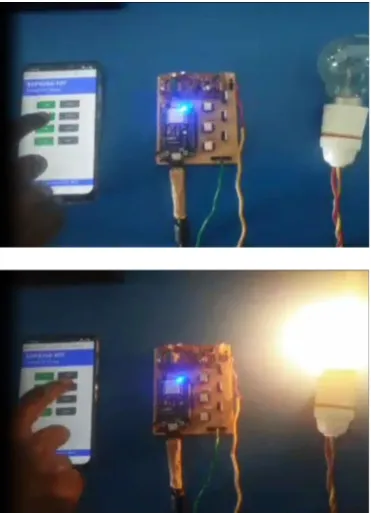
The system is working as per the requirement. The diagram below shows the complete prototype implementation of the proposed system.
Fig-6 : Light is Turned ON and OFF by
smartphone
[image:3.595.104.197.173.280.2] [image:3.595.344.530.325.582.2]
© 2019, IRJET | Impact Factor value: 7.211 | ISO 9001:2008 Certified Journal | Page 8176 7. CONCLUSIONS
There are number of designs are built in this automation field but this system Home automation using Smart plug has been experimentally proven to work it does not disturb the existing control instead of it by connecting appliances to the smart plug Automation can be achieved . Those appliances can be monitored and controlled successfully. The implemented system works according to the user expectation. which is operated in two different conditions either smart phone user present at home by that it can sense how much Bluetooth of smartphone near to the system then as per coding it automatically switching ON and OFF the appliances or other is manually controlled over smartphone both can be access and control the appliances.
REFERENCES
[1].Vishwajeet Hari Bhide, Dr, Sanjeev Wagh “i-Learning loT: An Intelligent Self “i-Learning System for Home Automation Using loT” International Conference on Communication and Signal Processing, April 2-4, 2015, India
[2].Ravi Kishore Kodali and SreeRamya Soratkal “MQTT based Home Automation System Using ESP8266” 2016 IEEE Region 10 Humanitarian Technology Conference (R10-HTC)
[3].V.L.K. Bharadwaj Manda, Voona Kushal, and N. Ramasubramanian “An elegant home automation system using GSM and ARM-based architecture” IEEE Potentials ( Volume: 37 , Issue: 5 , Sept.-Oct. 2018 )
[4].Noel Nuo Wi Tay, János Botzheim , Member, IEEE and Naoyuki Kubota “Human-Centric Automation and Optimization for Smart Homes” IEEE Transactions on Automation Science and Engineering ( Volume: 15 , Issue: 4 , Oct. 2018 )
[5].Ahmed S. Musleh1 , Mahdi Debouza1 , Mohamed Farook2 “Design and Implementation of Smart Plug: An Internet of Things (IoT) Approach” 2017
International Conference on Electrical and Computing Technologies and Applications (ICECTA)
[6].Yaowaluk Thongkhao,Wanchalerm Pora “A Low-cost Wi-Fi Smart Plug with On-off and Energy Metering Functions” 2016 13th International Conference on Electrical Engineering/Electronics, Computer, Telecommunications and Information Technology (ECTI-CON)
[7].Rung-Shiang Cheng, Chia-Peng Lin, Jiun-Yu Jhou “A Location-Aware Home Appliance Control System” 2014 Tenth International Conference on Intelligent Information Hiding and Multimedia Signal Processing
[8].Pablo Palacios, Andres C,ordova “Approximation and Temperature Control System via an Actuator and a Cloud: An Application Based on the IoT for Smart Houses” 2018 International Conference on eDemocracy & eGovernment (ICEDEG)
[9].Murad Khan, Bhagya Nathali Silva, Kijun Han “Internet of Things based Energy Aware Smart Home Control System” IEEE Access ( Volume: 4 )
[10].Hattie Clougherty, Alec Brown, Margaret Stonerock, Michael Trepte, Matthew Whitesell, Reid Bailey “Home Automation and Personalization Through Individual Location Determination” 2017 Systems and Information Engineering Design Symposium (SIEDS).
BIOGRAPHIES
Jagadeesh Raja M
Assistant professor of Electrical and Electronics Engineering, Knowledge institute of Technology, salem, Tamilnadu -637504
Santhoshsivan N V.
© 2019, IRJET | Impact Factor value: 7.211 | ISO 9001:2008 Certified Journal | Page 8177 Senthilkumar S
Student of Electrical and Electronics Engineering, Knowledge institute of Technology,salem,Tamilnadu-637504.
Arunkumar K
Student of Electrical and Electronics Engineering, Knowledge institute of Technology, salem, Tamilnadu -637504.
Umasankar S
Student of Electrical and Electronics Engineering, Knowledge institute of Technology, salem, Tamilnadu -637504.
2nd Author
Photo
3rd Author
Photo
4th Author