DATAMATIeN@
NOVEMBER 25, 1979/5.00 U.S.A.
14
PRICE/PERFORMANCE, SEMI·
CONDUCTORS & THE FUTURE
David L. SteinIBM is already telegraphing its it:J.tentions about its next generation of computer hardware. Despite the breakthroughs made with the 4300, word has it that we "ain't seen nothing yet!"
26
THE CHANGING ROLE OF THE
MIS EXECUTIVE
Joseph Ferreira and James F. Collins Jr. The traditional MIS bureaucracy is no longer a sacrosanct fiefdom. Its managers have a new mandate: push information services out to end users as far and fast as possible.
40
WHAT TO DO WHILE WAITING
FOR UTOPIA
Dr. Howard Frank
Most organizations will soon face the decision of whether to build private data communications networks or rely on the services of a public carrier. The decision is more difficult if the third choice is considered: waiting for the "utopian" services on the horizon.
VOLUME 25 NUMBER 13.
52
THE SURREALISTIC WORLD OF
WASHINGTON
John Eger
The emergence of an information-based economy is like the flow of a river; politicians and laws may influence its course but can never deter its movement. .
59
CALLING A SPADE A SPADE ...
A CHAT WITH MIS EXECUTIVES
Three corporate MIS executives help separate reality from rhetoric, fact from fiction. Even so, there is no one way to manage information.72
THE AUTOMATED OFFICE
MOVES IN
The pivotal management issues have moved . decisively past whether, to when and how.
84
HANGING IN
Marvin GrosswirthSo, everyone is now a dp expert. Dp managers need not worry. There are numerous ways to create new mystique and, confusion. Remember, respect is born of fear and suspicion.
95
A SURVEY: THE SMALL
SYSTEMS MARKET
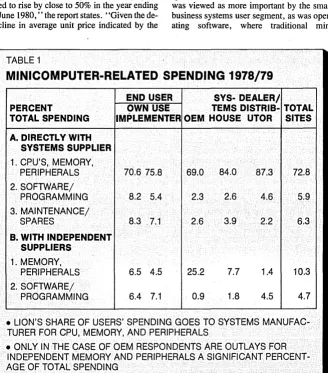
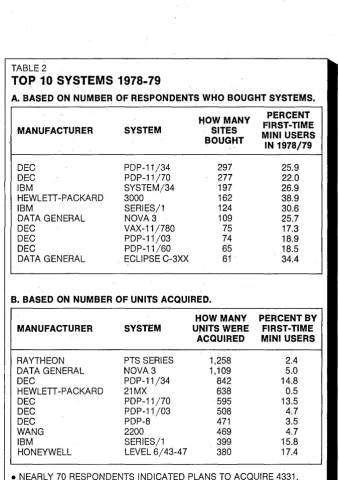
New user expansion of the minicomputer market shows no signs yet of flagging, DATAMATION survey indicates.
104
ADVANCED COMMERCIAL
APPLICATIONS IN THE
'80s.
Martin A. GoetzIt has been said that software is something you can't see, touch, or understand-but it often smells! Perhaps in the '80s there will be a more pleasant aroma.
7
EDITOR'S READOUT
112
ADVERTISERS' INDEX
COVER: PHOTOGRAPH BY PAT FIELD
YOU'RE LOOKING AT
ALL THE MINICOMPUTERS
THAT WON'T INTERFACE WITH
PRINTRONIX PRINTERS.
The fact is, there aren't any. For the simple reason that every
Printronix Distributor offers controllers and interfaces that make
Printronix matrix printers compatible with virtually all minicomputers.
And most mainframes, too.
So, no matter what your computer, you can have the best printer
available to get more from your system.
More service, for example, because a nationwide network of
Printronix Distributors backs up every sale with timely and responsive
delivery, installation and full after-service support.
More reliability, because Printronix printers have 50% fewer
components than mechanical font printers. So there's less to go wrong.
More quality, too, because uniform hammer energy prints one
dot row at a time, overlapping each dot to produce solid characters.
And you also get more versatility, because Printronix printers can
plot anything: drawings, graphs, bar codes, pie charts and labels.
So, complete the picture for your minicomputer with a Printronix
150, 300 or 600 line-per-minute printer: And put
us to the test. If there's a minicomputer
we can't support, we'd like
to know what it is. For
further information, call
your local Printronix
Distributor listed below.
PRINTRONIX
DISTRIBUTOR OROUP
Printronix interfaces with these
minicomputers and mainframes.
Digital Equipment Corporation, Data General,
Hewlett-Packard, Basic Four, Prime, DataPoint, MicroData, IBM,
ComputerAutomation, Varian-Univac, CDC, Burroughs, Honeywell.
Atlanta: (404) 455-1206; Baltimore: (301) 792-0021; Boston: (617) 729-5770; Chicago: (312) 394-3380; Connecticut: (203) 624-7800; Dallas: (214) 661-9633; Dayton: (513) 429-9040; Denver: (303) 355-2363; Detroit: (313) 227-7067; Creater washington D_t.: (301) 881-8430; Houston: (713) 681-0200; Kansas City: (913) 888-0215; LOng Island: (516) 487-4949; LOS Angeles: (213) 973-7844; Metro, NY: (201) 224-6911; Minneapolis: (612) 645-5816; Orlando: (305) 859-7450; Philadel-phia: (215) 542-9876; Pittsburgh: (412) 922-5110; Portland: (503) 292-3505; st. Louis: (314) 731-5400; san Juan, Puerto Rico: (809) 781-7880 or (809) 781-8747; Scottsdale: (602) 941-5646; seattle: (206) 641-6444; Sunnyvale: (408) 245-4392; upstate, NY: (315) 699-2651; Utah: (801) 292-8145.CIRCLE 6 ON READER CARD 4 DATAMATION
CRTRMRTIEIN
..
Editor John L. Kirkley
Managing Editor Laton McCartney Special Editions Editor Becky Barna Articles Editor. Wendy Reid Crisp International Editor Linda Runyan European Editor Ralph Emmett Products Editor Bill Musgrave Copy Editor Florence Lazar
Special Assignments Editor Becky Barna Articles Assistant Sarah Rolph
News Editor Tom McCusker Surveys Editor Louise Shaw Bureau Managers
San Francisco Edward K. Yasaki Los Angeles Edith D. Myers Boston Vin McLellan Correspondents .
Atlanta Lynn Ridlehuber Southwest Robert F. Alexander London Fred Lamond Paris Andrew Lloyd
Editorial Advisor Robert L. Patrick Technical Advisor Lowell Amdahl Contributing Editors Ralph G. Berglund,
Howard Bromberg, Philip H. Dorn, John M. Eger, Ron Frank, Martin A. Goetz, David Hebditch, Louis B. Marienthal, Angeline Pantages, Russell Pipe, Carl Reynolds, F. G. Withington
Design Director Steve Phillips EDITORIAL OFFICES
Headquarters: 666 Fifth Ave., New York, NY 10019. Phone (212) 489-2574. New England: 161 High St., Bos-ton, MA 02110 (617) 426-2487 Eastern: 35 Mason St., Greenwich, CT 06830, (203) 661-5400, Telex 996343. 420 Lexington Ave., New York, NY 10017, (212) 682-7760.6605 Burlington PI., Springfield, VA 22152. (703) 569-3383. Southwestern: 11500 Stemmons North, Suite 152, Dallas, TX 75299, (214) 247-5221. Western: 1801 S. La Cienega Blvd., Los Angeles, CA 90035, (213) 559-5111; 2680 Bayshore Frontage Rd., Suite 401, Mountain View, CA 94043, (415) 965-8222. Foreign: 20 Leaming-ton Road, Southend-on-Sea, Essex, SS1 2SN, England, phone: South end (0702) 611648. TELEX 996-343
Art & Editorial Production Director Kenneth Surabian
Advertising Production Mgr. Robert Gaydos Editorial/Production Assistant William Pohl CIRCULATION .
666 Fifth Avenue, New York, NY 10019 Circulation Manager Suzanne A. Ryan Marketing Research Mgr. Deborah Dwelley Publisher James M. Morris
TechnICal pubhshlng
DB ~~WB':!dstltttcorporatlOnWBPA
Circulation auditedby Business Publications Audit
*ABP
Member American Business Press, Inc.DATAMATION (USPS 148-800) Magazine is issued monthly on or about the first day of every month, plus one special issue in mid-May. Published by Technical Pub-lishing, a Dun and Bradstreet company, 1301 South Grove Ave., Barrington, Illinois 60010, James B. Tafel, Chairman; John K. Abely, President. Executive and Advertising offices, 35 Mason Street, Greenwich, CT 06830, (203) 661-5400. Editorial offices, 666 Fifth Ave., New York, NY 10019. Published at Chicago, III. DATAMA-TION is circulated without charge by name and title to certain qualified individuals in the United States and Canada who are employed by companies involved with automatic information handling equipment. Available to others by subscription at the rate of $32 (U.S. and Pos-sessions), $42 (Canadian). Reduced rate for qualified U.S. students:·$16. Foreign subscriptions: £33:50. Addi-tional charge for airmail: £30:00. Japan, Australia and New Zealand: £38:50 (air-shipped). Sole agent for all subscriptions outside the U.S.A. and Canada is J.B. Trat-sart, Ltd. 154 A. Greenford Road, Harrow, Middlesex HA 13QT, England. No subscription agency is authorized by us to solicit or take orders for subscriptions. Controlled circulation paid at Columbus, OH. C>Copyright by Techni-cal Publishing, A Division of Dun-Donnelley Publishing Corporation, a company of the Dun & Bradstreet Corpo-ration, 1979-all rights reserved. iII"Datamation" regis-tered trademark of Technical Publishing Company. Microfilm copies of DATAMATION may be obtained from University Microfilms, A Xerox Company, 300 No.·Zeeb Road, Ann Arbor, Michigan 48106. Printed by Beslow As-sociates, Inc.
RAMlSlr
stretches your software budget
In 1965, system development costswere fairly evenly divided between'software'and hardware. Today many sources indicate that 80o/~ of the cost. is software. And the trend is continuing. Why?, Because software technologies are not
I~eeping up with hardware in improving pro-ductivity. Software is now the major constraint restrictinge,ffective use of computers.
, .
With RAMIS
It
you just say what you want. You don(t have to tell the computer how toproduce it. A simple request givesyou information from any-where in the data base. And, you don't have tomal~e costly application changes every ,time you change theda,ta base.
There are 175 ways RAMIS II can improve your data, processing.We'dHI~e toteHyou about
,f:,~'
How ca0 you get morefrolTl ~~~~' them in ,our free RAMIS
\I
factbooK your software dollar?RAMISII.
~
RAMIS
\I
improves software produc-~l
0
J \ tivifY bydecreas~ng
the amount .ofmo~-
~.
ey spent on maintenance. And Increasing Ithe amount left for productive new systems. With RAMIS lI,new systems are developed in no ,more' than' one-fifth the time' required using conventional, means. That' s becauseRAMIS
\I
is both a data, base management systernand Q complete English-liI~e nonprocedural language.MATHEMATICA
The brOins behind ,RAMIS II
CIRCLE 7 ON READER CARD
We're Mathematica, a rechnicalconsultlng, policy research, and computer software
firm involved in the improvement of decision-mal~ing" techniques.
JerSE'V' 0E~540 IBOCJ257'9576
DASI, the nation's largest independent supplier
of data terminals for telecommunications, offers a full
line of state-of-the-art products from Texas
Instru-ments*, Lear Siegler, Digital Equipment Corporation,
Diablo, Teletype and DASI.
DASI can provide you with the right products
for your needs, including a wide range of printers, CRT
terminals and computer peripherals from stock
through a coast-to-coast network of sales and service
facilities. Whether you want terminals, couplers, or
complete distributed data processing systems, DASI
has the best at competitive prices.
Systems for today.
Service for tomorrow.
Nationwide Service. You save time and trouble
with DASI's free on-site 90-day warranty covering every
systems component they sell. When you need service,
DASI's own field engineers arrive within 24 hours with
the spares required to get you operational immediately.
Buy, lease, or rent equipment from DASI and
you'll have the systems you need today and the service
you'll.want tomorrow.
For more information on DASI's capabilities,
in-cluding extensive financing programs, equipment,
serv-ice or supplies, call your local district offserv-ice, or toll free:
(800) 631-9604 or 9605.
,nl'flls,
Data Access systems, Inc.
THE DATA TERMINAL
AND SYSTEMS PEOPLE Corporate Offices: 100 Route 46, Mountain Lakes,
New Jersey 07046 . (201) 335-3322
CIRCLE 8 ON READER CARD
*~ Authorized Distributor.
--by Becky Barna, Special Edition Editor
CORPORATE
COORDINATION
With this Special Edition, we look to the fu-ture and the promises and predicaments in store. It is possible that technological ad-vances will carry us as far in the next 10 years as we have traveled in the past 100.
The technology will be there. What is in doubt is management's ability to exploit it to the fullest. One problem that may stand in management's way is its relations with the data processing department. On~ of the more amusing antics in industry occurs when a corporation· goes in one direction and its dp department in another. It would be even funnier if so much time, money, and talent weren't being wasted.
Somehow we think we're too sophisti-cated today for this situation to occur, but obviously we aren't. We've long since passed the stage where data processing was eyed as some sort of black magic. But we've yet to realize fully that dp is an important part of an org,anization's bag of tricks.
Some interesting findings about man-agement's appreciation (or lack thereof) of the dp function are revealed in a recent re-port from Deutsch, Shea & Evans, a New York-based human resources consulting
firm.
According to DS&E'S nationwide sur-vey of 1,054 dp professionals, a common complaint of programmers, systems analysts, and dp managers alike is that corporate-level management remains igno-rant of the dp function and fails to include dp departments in major company deci-sions.EDITOR'S
READOUT·
Probing the subject of perceived man-agement attitudes, DS&E asked survey
respondents the following question: "Do you think your company's management adequately appreciates the contribution to overall company operations made by the edp department?"
A bare majority, 53%, answered this question affmnatively. Of the 357 respon-dents who had a negative view of manage-ment's attitude toward data processing, the top ranking reason was that upper level management lacks understanding of the
contribution of dp as an organizational function, of the work it involves, and of the potential it holds. (Typical comment: " . . . management is made up of former salesmen and Harvard MBAS with no edp background. ")
Next ranking was management's lack of support of the dp function (e.g., " . . . they ignore us for the most part, ex-cept when they need something"), fol-lowed by complaints about budgetary constraints (e.g., " . . . continual fight to justify large, needed expenditures").
We would no doubt get some equally critical comments if the tables were turned, but that's not the point. The point is that there is a failure to communicate, a lack of corporate coordination.
It's true that most corporations are not in business just to run their dp departments. Data processing is only one of the tools that allow a corporation to function, but plan-ning within the dp department must mirror planning within the corporation for the tool to be effective.
The ideal arrangement would be for dp managers to be promoted to positions in top management where they would participate in corporate planning. At the very least, dp managers 'should be involved in the initial phase of corporate decision-making.
Even now, most corporations have . extensive information services and systems at their disposal. The real challenge to the corporations is to manage and exploit the technology to the fullest. That requires inte-gration of dp planning with overall corpo-rate planning. Dp may be only a tool, but it's a tool that can help build a strong, com-petitive edge for the organization that
man-ages it well. ~
•
Do your big
~Iotter
work. At a small plotter
Thats practical!
price.
At Tektronix, we build
plotters that pay for
themselves.
Practicality is why Tektronix pioneered the smart small plotter. Why we led the move to more reliable, digital technol-ogy. We're proving that big plotter performance can take a small plotter price, with capabilities like those of our C-size (A2) 4663.
Economy. Instead of waiting in line for large plotter output, you can typically do two-thirds of your plotting on our 4663, with comparable quality. Faster turnaround. Tremendous cost savings.
Interactivity. Microprocessor intelligence not only makes the 4663 semi-independent, it lets
you draw real curve forms. Ro-tate characters. Digitize with
built-in joystick con-trol. All right at your workstation.
Versatility. The 4663 plots on paper, film or Mylar,Bi With felt tip, wet ink or ballpoint pens. In
j
up to nine colors with dual program-. mabIe pen control.~
;e;: iI,'~!r,'"'~~,:.,_.,~,,
'W~WWM ro*~ , /:": j ,', I
..,
~ , <
Compatibility. From its RS-232-C and GPIB (IEEE-488) interfaces, to options like foreign language fonts and circular interpolation, our plot-ters mesh with your present system and particular needs. Powerful, wide-ranging soft-ware routines are both inexpensive and easy to use. Simplicity. Our parameter entry card replaces rear panel straps and switches with a simple system for setting up to four sets of operating
CIRCLE 9 ON READER CARD
conditions right from the . front panel, so one plotter can instantly accommodate four totally different jobs.
Bring Tektronix into your bidding picture. It's the only practical thing to do. Next time you're shopping for plotters, let your local Tektronix representa-tive show you output samples and examples of what our Prac-tical Plotters can do for you. Call him directly, or call our toll-free automatic answering service at 1-800-547-1512. In Oregon, call 644-9051 collect. . Tektronix, Inc.
Information Display Division P.O. Box 500
Beaverton, OR 97077 Tektronix International, Inc. European Marketing Centre Postbox 827
1180 AV Amstelveen The Netherlands
The practical plotters
1ektron~
COMMITTED TO EXCELLENCE
Cipher puts
excitement back
-a::::J
t::::J
.E:J
£I:J
E:J
EJ
,·,·,·,1
in tape!
The industry's first microprocessor
controlled tape drives with integral diagnostics and
total tape control were developed by Cipher.
A 75% reduction in tape drive power .
consumption was achieved by Cipher
The only L-column vacuum drive for extra
gentle tape handling at high speeds was
designed by Cipher.
The first
1600/S00
bpi databoard featuring
digital deskew with only nine pot adjustments to
simplify service and sparing in all drives from 12.5
to 125 ips-again, from Cipher.
And now, Cipher has the Microstreamer
.Thpe Drive, the OEM's first!;2 inch streaming tape
drive for disk backup-l00 ips, auto-loading, 10!;2 inch
reels,
S%
inches high and less than $2,000.
But the excitement doesn't stop with ·new
technology. Customers are enthusiastic about
Cipher's total commitment to spares compatibility,
support documentation, responsive service and
on-time delivery of products that work the first time
- and keep on working.
Build- some excitement into your system.
Call or write Cipher Data Products, Inc.,
5630 Kearny Mesa Road, San Diego,
California 92111. (714) 279-6550.
clivi
Harry Wolford, Director of Compu ter Services
and Statistical Reports, Ohio State Department,
of Education, Columbus, Ohio.
Productivity.
"We do all the computing for
the State Department of Education
, in Ohio, plus some legislative
sup-port work for the Governor's office,
the Ohio General Assembly, and
other state agencies.
"When we switched from batch
to the DECSYSTEM-2050, the
pro-ductivityof our programmers went
up easily 50%. Programmers like
the 2050 so much that if we went
back to batch tomorrow, we'd
prob-ably lose 75 to 80 % of them.
" And for its price, the 2050' s
communications power is simply
unbeatable. "
, Software Compatability.
"Our applications include oil
and gas exploration and financial
planning using an economic model.
"We started with a
DECSYSTEM-2040, but people
found it so easy to use, they just
went wild over it-we were doing
five times the anticipated workload
in just four months. So we upgraded
to a DECSYSTEM-2050-another
250Kbytes, one
more disk and
.channel, and
cache memory.
"The
conver-sion took less
than an afternoon
-with absolutely
. no software
changes. We just
told the machine
it had more
mem-ory, and that was
all there was to it. "
H.
B.
Taylor, Director, Houston Computer
. Center, Allied Chemical Corporation,
Houston, Texas.
Ease of Use.
" As a service bureau, one of our
biggest concerns is ease of use for
our customers. We had been
accus-tomed to acorn petitor' s user
interface that we thought was
superb, but _
the TOPS-20
interface
was clearly
superior.
"Reliabil-ity has been
super. Our
2020 came up
in one-day
and has had
Dr. Paul Whalen, President,
Interactive Computing of
Vermont, South Burlington,
a mean time
Vermont.
between failures of over 300 hours.
" And since the 2020 is the start
of a whole family of software
com-patible machines, we have many
aven ues for expansion. "
1 - - - ,
. DECSYSTEM-20
The interactive computer
-for the big system jobs.
o
Please send your Interactive User Reports information packet.o
Please have a sales representative contaCt me. Name _ _ _ _ _ _ _ _ _ _ _ _ _TItle _ _ _ _ _ _ _ _ _ _ _ _
Company _ _ _ _ _ _ _ _ _ _ _
Address _ _ _ _ _ _ _ _ _ _ _
City State _ _ _
Zip Telephone _ _ _ _ _ _
Send to: Digital Equipment Corporation, MR1-VM55, 200 Forest St., Marlborough,
MA01752. Tel. 617-481-9511, Ext. 6885.
L ____________
--1
I
~DmDDmD
CIRCLE 11 ON READER CARD
The IBM 4300
set
astonishing price /
performance standards.
But
we "ain't
seen nothing
yet!"
PRICE/
PERFORMANCE,
SEMICONDUCTORS
AND THE FUTURE
by
David
L.
Stein
By the end of the next decade, the infonna-tion processing industry will have greatly altered the world in which we live and work. While many factors will be responsible, none will be more of a driving force behind this change than the continuing development of semiconductor technology.
To illustrate, the IBM 3033, presently the company's largest mainframe, has a per-fonnance rating of 5 MIPS (millions of instruc-tions per second) and a volume measured in cubic yards. In contrast, IBM has recently postulated a late- '80s machine with 70 MIPS
perfonnance and packaged in a 6-inch cube! The primary difference between the two ma-chines-the factor which accounts for the change in both size and perfonnance-is the difference in their semiconductor compo-nents.
The role of semiconductor technology has been deemed an important one in comput-er manufacturing evcomput-er since the invention of the transistor but, until recently, conventional wisdom held that the semiconductor industry was dependent upon the computer industry. This notion was popularized in the late '60s by consultants who advised semiconductor finns that they should "get into the computer business to be viable over the long pull!" (Note that HP and TI, to name two of the more successful, did precisely that.) Today, the . computer indu·stry is seen to be the
depend-14 DATAMATION
~
1m
~
~.
~
o
....I ....I
W
.0
a: ~
U
w
o < """')
.
>-II]
---~--~----
____
---~~----~~---~--~~~~---J1979 15
z o
~
a:
f-en
:J
By automating the design and manufacturing
processes, IBM has married computer manufacturing
to semiconductor manufacturing in an entirely new way_
ent, and the same consultants are probably admonishing computer manufacturing clients to "get into the semiconductor business to be viable . . . !"
Why this turnabout? What happened to precipitate this fundamental role reversal, which will eventually have a profound impact upon the strategies of most if not all computer manufacturers? Perhaps the only satisfactory answer is that semiconductor technology has just recently reached the point in its evolution where its full implications for vendors-though not obvious-are beginning to be understood.
4300 LEADS
One way to understand theTH E WAY
~mplicati~ns of the escalat-mg semIconductor tech-nology is to analyze today's state of the art in that technology. And the best product on which to base this analysis currently is IBM'S4300. It is, quite possibly, the most signifi-cant development to occur in the computer business in this decade!
In the new IBM systems, we perceive a dramatic departure-other than price/per-formance-from prior generation computer hardware. Of primary importance is IBM'S
new· computer manufacturing technology. What IBM calls a Computer Aided Design
System might just as accurately be called a Computer Aided Manufacturing System. The truth is, it is both. By automating the design and manufacturing processes, IBM has married computer manufacturing to semicon-ductor manufacturing in an entirely new way. The result is that IBM can now work "top down' , from an overall architectural scription of a computer system through de-tailed logic design of the computer subsystems to actual design of the custom semiconductor components required to opti-mally implement those subsystems. Along the way, IBM can incorporate supporting logic designed to enhance manufacturability and testability as well as performance and reli-ability, all the while making optimal use of printed circuit "real estate" at each level of the packaging hierarchy.
An example of this capability is the Level Sensitive Scan Design (LSSD) feature of
IBM'S custom LSI components. By using up to an additional 20% of the chip real estate for interfacing circuits, IBM has designed into its own computers an unprecedented testability. The LSSD feature permits nearly 100% static
(DC) testing at the component level and more
than 90% static testing at the system level. As significant as such features are, . they do not overshadow the fact that the principal motivation for integrating compo-nent design with computer design was to eliminate the waste that results from attempts to use so-called "microprocessors" or other "universal" LSI building blocks. Thus, the
[image:16.612.203.533.41.753.2]16 DATAMATION
TABLE 1
IBM TECHNOLOGY
CUSTOM LSI/VLSIINTEGRATED CIRCUITS (IC'S)
o
250 MILS SQUARE SILICON DICEo
OPEN PART NUMBER SETS/MASTERSLICES03 CUSTOM CIRCUIT OR "PERSONALIZATION" LAYERS
0700 GATES OR 7,000 "COMPONENTS"/IC FOR 3 NS TTL LOGIC 01,400 GATES OR 14,000 "COMPONENTS"/IC FOR 1.5 NS ECL
LOGIC
o
18K, 32K, 64K DYNAMIC SAMOS RAM WITH 140/280,285/470, 440/980 NS ACCESS/CYCLE SPEEDSo
132 SOLDER CONNECTIONS TO CHIP CARRIERTABLE 2
IBM TECHNOLOGY
HIGH DENSITY PACKAGING OF LOGIC AND MEMORY
o
.06-.16 INCH CERAMIC CHIP CARRIERS WITH UP TO 23 LAYERS OF PRINTED CIRCUITSo
1, 13/8, 2 INCH SQUARE MODULES FOR 1, 4, 9 IC'S WITH 116, 196, 361 INTERCONNECTING PINS PER MODULE, RESPECTIVELYo
4Ya X 7112 INCH PRINTED WIRING CARDS WITH UP TO 8 LAYERS AND 268 INTERCONNECTING PINSo
10 X 15 INCH PRINTED WIRING BOARDS WITH UP TO 16 LAYERSo
± .001 INCH TOLERANCE ON PRINTED WIRING LINE WIDTHSo
UP TO 10 TIMES THE DENSITY OF AVAILABLE OFF-THE-SHELF HARDWARETABLE 3
IBM NEXT-GENERATION TECHNOLOGY
(?)
SUPERCONDUCTING QUANTUM INTERFERENCE DEVIC~S (SQUIPlp) <
o
CUSTOM LSI/VLSIINTEGRATED CIRCUITS (IC'S)o
250 MILS SQUARE SILICON DICE0400 GATES/IC FOR .06 NS JOSEPHSON JUNCTION LOGIC (JJL)
o
2K "FAST" RAM WITH 1/2 NS ACCESS/CYCLE SPEEDS·o
16K "DENSE" RAM WITH 15/30 NS ACCESS/CYCLE SPEEDSo
UP TO 1,000 SOLDER CONNECTIONS TO CHIP CARRIER OR "CARD"TABLE 4
IBM NEXT-GENERATION TECHNOLOGY
(?)
SUPER DENSITYPACKAGING COUPLEDWITH SUPER PERFORMANCE
o
.6x1.2INCH SILICON"CARDS"FOR 4/8(LOGIC/MEMORY)IC'S WITH MORE THAN 300 INTERCONNECTING "MICRO" PINS PER "CARD"o
2.6 INCH SQUARE SILICON "BOARDS" FOR MOUNTING UP TO 64 "CARDS"VIA MORE THAN 1 0,000 INTERCONNECTING "MICRO" SOCKETSo
UP TO 2,500 PRINTED WIRING CHANNELS PER INCHo
UP TO 1 0 TIMES DENSITY OF NEW IBM 4341 HARDWAREBuilding a computer
facility is not a
do-it-yourself project.
It's too important. And you have too
rrw.,'''' .... :to do to coordinate the efforts of:
project managers
architects and installation and space planners contractors and
design engineers teams subcontractors power supply purchasing agents
But we do it all the time. And in the
last 1 0 years, we've planned or built
facilities for more than
400
customers:
Facilities for all sorts of computers.
We know computers. We know
construction. We know how to create
an environment for the efficient
operation of a computer center. And
we offer a full range of services, from
consultation to the entire job.
We're international, too. With 11 offices
vendors and decorators security specialists
in the United States and 15 in other
countries, we're ready to serve
customers around the world.
We'd like to show you what we can do
for you. For more information on our
full range of services, contact your
nearest Control Data office or write to:
Facility Planning and Construction
Control Data Corporation
HQN111, P.O.
Box 0
Minneapolis, MN,
55440
t:J
c:\
CONTROL DATA
~
r:!I
CO~PORATION
More than a computer company
IBM's competitors simply cannot rely on the
merchant semiconductor industry in the future; they'
must have that capability in-house.
savings from top-down custom component design are more than enough to pay for the new manufacturability and testability fea-tures.
An important side benefit of this verti-cally integrated approach to computer/ component design and manufacturing is the increased performance and reliability that re-sult from elimination of the unused circuit elements built into designs based on more universal components, to say nothing about wasted real estate at other levels of the pack-aging hierarchy and/or its manufacturing costs.
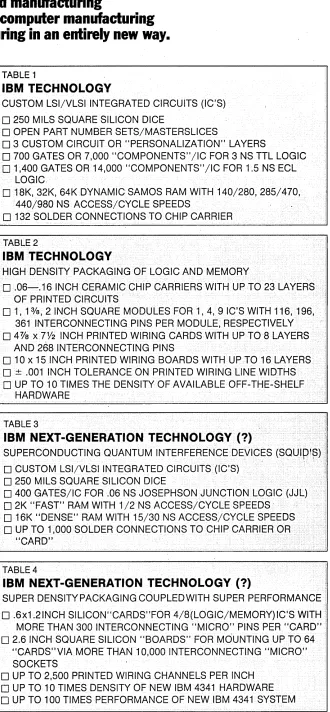
Some of the parameters of IBM'S new semiconductor technology are listed in Table 1. At first glance, there appears to be little in the way of density or performance break-throughs. Some would even argue that a die size of 250 mils is too large for high yields. Upon closer inspection, however, it can be seen that IBM has quite shrewdly achieved a new level of cost/performance without push-ing the state of the art in chip density or speed, thereby reserving significant cost/perform-ance improvement potential for future ·prod-uct enhancements.
By employing a larger die size, IBM is able to trade off material cost against manu-facturing yield. Thus, the 64K memory chip contains redundant storage arrays for' the pur-pose of replacing defective arrays detected in the manufacturing process. Similarly, by em-ploying this larger die size, IBM is able to incorporate a more complex interface func-tion on that same 64K memory chip. The complex interface is used in conjunction with a memory access pipeline in the larger com-puters to achieve significantly higher per-formance than would be possible without it. For example, in a computer supported by a high-speed buffer (cache) which accesses 4 or 8 consecutive words of storage at one time, the effective memory access time is reduced from 440 nanoseconds to 185 or 143 nanosec-onds, respectively, making the overall design superior from both cost and performance viewpoints.
PCMs,
BEWARE!
The implications for IBM'S
plug-compatible main-frame (PCM) competition are clear. The old way of simply copying IBM
designs, using "standard, off-the-shelf"
IC'S, is no longer viable. And even if a single
PCM could achieve' a relatively optimistic 10% penetration of IBM'S customer base, the cost of manufacturing custom circuits for that comparatively low volume would almost cer-tainly be higher than IBM'S corresponding cost.
Moreover, there is nothing to keep
18 DATAMATION
IBM from improving its own IC'S. After all,
IBM has succeeded in shortening its own development cycles as a direct result of its highly automated design and manufacturing processes. Furthermore, through the devel-opment of a proprietary "interconnect" or
, 'packaging" technology, IBM has achieved an extremely high degree of design flexibility for accommodating newer and more complex
IC'S as they become available.
Compare the number of interconnec-tions with those now available in off-the-shelf technology. IBM bonds each chip directly to a ceramic substrate or chip carrier with 132 sol-der connections. This provides for 38 power/ ground leads and 94 signal leads. The con-ventional Dual Inline Package (DIP), on the other hand, typically has from 16 to 40 leads fOf" both power/ground and signal connec-tions. Clearly, the DIP is no match for the IBM
chip carrier, and one can conclude without fear of being rash that the days of the DIP are numbered insofar as its application in com-puter mainframes is concerned. .
But this is not the end of IBM 's.current advantage; on the contrary, it is only the beginning. An examination of the remainder of IBM'S new packaging technology. (See Table 2) indicates that IBM enjoys a similar advantage in interconnectivity at every level of the packaging hierarchy. For example, em-ploying its largest chip carrier, IBM might well design a "superchip" made ~p of nine
LSI/vLSI chips interconnected through the printed circuits deposited directly on the carrier substrate and, in tum, connected to a circuit card or board through not 16 or 40 but 361 input/output pins.
It is not surprising that the System/38 processor is contained on a single 10" x 15" board. Nor is it surprising that the 4300 sys-tems are infinitesimal in size in comparison with the behemoths they are replacing. Fur-thermore, with,the numbers of pins available,
IBM can stack the chips in "piggyback" fash-ion on the same module, thus increasing densities even further. For example, IBM can stack four 64K RAM chips on a single
one-inch square module to achieve the equivalent density of a 256K RAM. Is this a new genera-tion of computer hardware or isn't it? We think it is!
"AIN'T SEEN
NOTHING
YET!"
In fact, IBM has introduced its first really new comput-er hardware technology since the introduction of the System 360/85 (the antecedent of the later System 370/Models 165 and 168), which was announced in March 1968. Thus, it has been a . full 11 years since IBM introduced a computer hardware technology as significant as that
embodied in the new 4300 systems. But all indications are that we '. 'ain't seen nothing yet. "
IBM is already telegraphing its inten-tions about the direction of its future comput-er technology. For example, Dr. Lewis M. Branscomb, an IBM vice president and chief scientist, has publicly stated that IBM consid-ers "Josephson Junction" circuit technology to be an emerging "base" technology on a par with electron-beam (or E-beam) lithogra-phy. His remarks were made during a keynote panel session at the IEEE Compcon '78 on Sept. 6, 1978. Those same remarks were re-cently published in the IBM Systems Journal.
Incidentally, he also pointed out that
IBM has repeatedly deinonstrated its ability to achieve a 25% compound annual rate of im-provement in cost/performance for comput-ers of equivalent or similar function during the past 25 years. As if to underscore the point, IBM recently published an article by Dr. Wilhelm Anacker, manager of the Ex-ploratory Cryogenic Technology Department at the IBM T.J. Watson Research Center in Yorktown Heights, N. Y ., in the IEEE Spec-trum, in which IBM described a
"hypotheti-cal" computer based on Josephson Junction technology. (While IBM was careful to point out that this was a "hypothetical" computer, the company is well known for its policy of
not speculating about "futures." Thus, we believe their remarks ought to be taken seri-ously.)
A few highlights taken from that IEEE
Spectrum article are listed in Table 3. While some of the other circuit parameters are not all that impressive (e.g., only 400gateslIc and 2K or 16K bitslIc), it is immediately apparent that the advent of circuits like these with switching speeds roughly 50 times as fast as those employed in the 4'300 would presage a whole new generation of ultrafast computers.
IBM FLIRTS
WITH THE
FUTURE
One might presume that the development of such high performance circuits would require exploitation of the small-geometry potential ofE-beam li-thography, but Dr. Anacker points out that, "The data and estimates presented in this arti-cle are based on experimental results. . . and submicron junctions made with electron-beam and/or X-ray lithographies . . . have not yet been assessed for circuit performance and density." Again, IBM is emphasizing "packaging" at all levels, not just at the chip. Table 4 indicates that the payoff potential is enormous.
I· ... ---..
I
!
I
t
I
i
I
!
!
fI
if
!
I
I
I
!
!
IBM has recently postulated a late-1980s machine
with 70 MIPS perfonnance and 16 Kbytes of intemal
memory-and packaged in a 6-inch cube!
if so, in what timeframe will such cryogenic computers become a reality? On the first question, IBM says only that, "The bestjudg-ment to date is that although substantial tech-nological improvements must still be made, no major breakthroughs are needed to make Josephson technology feasible. " On the sec-ond question, IBM says, "Likely not soon. " The next question, then, is what is "soon' '? Is 10 or 11 years a long enough
time? ApRarently the answer is yes, because it took that long for IBM to develop its 4300 hardware technology from the prior techno-logical milestone. Thus, it is not unreasona-ble to expect that IBM will persevere another 10 or 12 years and produce the next genera-tion of cryogenic computers for introducgenera-tion sometime near the end of the '80s for delivery in the 1990s.
What this means is that before the end
of the next decade, IBM will be able to build a mainframe with an internal performance rat-ing of 70 MIPS, 32 Kbytes of cache memory, and 16 Mbytes of main storage in a single 6-inch cube of carefully laminated silicon. That this mainframe will run only when immersed in a liquid helium bath will be of no greater consequence than the fact that the System 360/Modei 8 required a source of chilled water for its cooling.
That leaves only one major question - - - _ unanswered: where does all this leave IBM's
For the new generation of computers-IBM 303X series and 370/168; Amdahl 470V/5, 6, 7, 8; Control Data; and, Univac-a reliable, separate 415 Hz power source is required. More and more users of these newer, large-scale computers are selecting solid-state' uninterruptible power supply systems from Emerson. Emerson UPS systems are more reliable, less costly to operate, and more efficient than other types of power sources. Added Power Protection
You get an added benefit when you select Emerson UPS. In the event of a power failure or power outage, Emerson gives you reserve backup power or, if necessary, provides a means for an orderly shutdown of your computer operations. .
Free 303X Power Source Guide
For more information on the power behind every great computer, ask for our free 303X Power Source guide. Call or write Emerson today at:
Industrial Controls Division
3300 S. Standard Street. Santa Ana. CA 92702
714/545-5581. Telex 67-8460
__ l1l'"':I_.
Electric Industrial Controls, Ltd.EI~in Drive. Swindon. SN2 6DX .
_ . . . . . -• • _ ~J~2~~1'.a~~ex 449101
Sales Offices:
Charlotte. NC (704) 568-5525; Dallas. TX (214) 783-1831; Palisades Park. NJ (201) 224-6306;
I=MI=ASCN
Raleigh. NC (919) 872-6525;- - Richmond. VA (804) 264-2528; SI. Louis. MO (314) 291-4535. Canada: Toronto. OntariO (416) 278-5501;
CIRCLE 14 ON READER CARD
20 DATAMATION .
competitors, and particularly those who do not have their own semiconductor manufac-turing capability? It's a question of great interest to users and vendors alike.
ALL THINGS
GREAT AND
SMALL
The answer is still some-what dependent upon the particular market niche occupied by the competi-tor. But if IBM'S competitors hope to compete at the high-performance end of the computer spectrum, they simply cannot rely upon the merchant semiconductor industry in the fu-ture. On the other hand, the situation only im-proves gradually as one' moves down the performance spectrum towards the micro-computer, so that no one, except perhaps terminal manufacturers, is really immune from this threat.
The inescapable conclusion is that the need for in-house semiconductor manufactur-ing capability will become increasmanufactur-ingly com-pelling for nearly all computer manufacturing companies, with the pressures most intense for those building large-scale systems. Sure-ly, no company can compete with the all-sili-con computer unless it has a foothold in semiconductor manufacturing.
It took a 20-year investment by IBM, but the company has now successfully ex-ploited its own vertical integration with semi-conductor manufacturing. That gives IBM an important advantage over its competitors. ~
DAVID
L.
STEIN
---_ .. _--._--_ ... _ ..
-A
few
lines on increasing the
productivity of
your
computer.
•
You'd find it hard to be productive, too, if you were right in the middle of
manipUlating important data, and you suddenly received a request for
infor-mation you hadn't thought about for nanoseconds.
Yet, your very expen'sive, highly advanced
CPU
has to put up with
interruptions like that all day long.
If
your company had a Kodak IMT-150 microimage terminal,
how-ever, your computer could spend much more of its valuable time manipUlating
data. And a lot less time searching for it.
That's because the IMT-150 terminal has its own intelligence-a
built-in microprocessor that enables it to perfonn on-line lookUps in seconds.
At the touch of a button. Without tying up your mainframe.
The IMT-150 tenninal helps your people be more productive, too.
They can find needed data quicker and easier, resulting in more lookups
per hour/day.
And because source information stored in superdense microimages
can be linked to complementary indexes in your on-line data base, you can
reduce the cost of keeping non-dynamic infonnation in a dynamic state.
The choice, then, is a simple one.
You can increase the productivity of your computer by buying
nwre
expensive and sophisticated data-storage equipment, in order to handle
growing infonnation demands.
Or
you can buy a Kodak IMT-150
MI-microimage terminal.
1880
I I •1980
<e Eastman Kodak Company, 1979
r-~---Eastman Kodak Company Business Systems Markets Division Dept. DP9686, Rochester, NY 14650
o
Please send me more infonnation about the Kodak IMT·150 microimage tenninal.o
Please have a Kodak representative contact me.Name
Title
Company
Address
City
State Zip
1979 21
THEOOMPUTEROOMPANY
THAT GIVES BUSINESS
THE OOMPETITIVE EDGE
IS ABOUT
TO
DO THE SAME
FOR U.S.ATHLETES.
No matter how you compete, the difference between a good performance and a great one
comes from knowing a little more than the other person. That's the competitive edge.
N ow the computers that help people compete in the business and technical fields are out
to do the same on the athletic field.
Dr. Gideon Ariel, a former Olympian, has developed a unique .
athletic training aid using a Data General ECLIPSE® computer
system. What Dr. Ariel's device does, is employ our computer
to detect the slightest flaw in an athlete's form. First, high
.
speed movies of an athlete's performance are broken down
frame-by-frame to show the body in segments, then analyzed
for timing, speed and changes in center of gravity. The
informa-tion is fed into our computer, then played out on a screen allowing the complex moinforma-tion of,
say throwing the javelin, to be seen like no coach has seen it before.
Spotting shortcomings in an athlete's style is a new application for our Data General
ECLIPSE computer that has us incredibly excited.
In
fact this
, .
Th C flhECLIPSE system will be used by the Sports Medicine Committee
1
~ u.s~ol~:r;.i!i:ol:ls
eat the Olympic Training Camp in Colorado Springs.
~~'O<YM (J MedlclneCommllleeFrom the small
CS/20
Commercial S stem to
r---,
h 1
1
0 .b
0ECLIPSE
Y
M600
I
0 I want to compete better, too. Please send meI
t e arge, mu tI-user usmess
,
I
the article on Dr. Ariel and your business ECLIPSEI
Data General· computers are doing new things
I
brochure.I
every day to enhance people's performance and :
Name T i t l e :give them a more competitive edge. For a
I
I
Company Tel
reprint of an article on Dr. Ariel and his work,
I
.
I
plus a brochure on our Data General business
:
Address, .II
ECLIPSE
compu er, mal
t
01th
e coupon.
L _ _ _ _ _ _ _ _ _ _ _ _ _ _ _ _ _ _ _ _ City State ZipD119
~~.
Data
General
We make computers that make sense.
CIRCLE 16 ON READER CARDData General Corporation, Westboro, MA 01581, (617) 366-8911. Data General (Canada) Ltd., Ontario, Canada. Data General Europe, 61 rue de Courcelles, Paris, France. 766.51.78.
" " , ' " , ' ," " " , , ' , . , ' ,
~~ll~]J~1.~\lrij!1!~M~~2~~~L···,'
~ I
t"""'O>~~"'¢'I'o"'~~~~_","~¥'~Ii .... "'m"~.: ... ~~ __ ~""..,.~_,,,~~Jr
, . .
~~'--~.
What could anyone
possibly dOVlith
85,000
Dumb Terminals?
That's how many ADM-3A's there
are out in the field working right
now. And more being shipped each
day. Now just what accounts for
such remarkable popularity?
Sure, it's the definitive dumb
terminal, adaptable enough to
fit a host of applications.
It
has
a 12-inch diagonal screen. Full
or half duplex operation at 11
select-able data rates. 1920 easy-to-read
characters in 24 rows of 80 letters.
59 entry keys. An RS232C
inter-face extension port. And direct
cursor addressing.
But we wondered if all 85,000
Dumb Terminals were being used
for just everyday data entry. So
we checked around.
And found that people are using
Dumb Terminals for things even we
never thought of.
THE ADM-3A GOES INTO
BUSINESS.
More and more OEM's are
put-ting the Dumb Terminal into small
business systems. They assemble
a package that usually contains a
disk, memory, a printer, and a
video display terminal- the
adapt-able ADM-3A.
So the chances are that when you
buy a small business system from
someone, it'll contain, you guessed
it, the amazing Dumb Terminal.
IT TAKES STOCK OF THE
SITUATION.
Many businesses are using the
Dumb Terminal, along with a light
pen (Universal Product Code '
Decoder), to keep track of their
inventory. The decoder is interfaced
to the Dumb Terminal, and when
a piece of merchandise imprinted
with a Universal Product Code
passes under it, the item is entered
into a computer for tallying.
Simultaneously,. the item is also
displayed on the ADM -3A's screen.
- so it's instantly available for quick
double-checking.
PROGRAMMERS LIKE
IT, TOO.
Surprisingly enough, many
computer programmers use the
ADM-3A as an effective, portable
I/O device. They can take it into
a back room or, along with an
acous-tic coupler, to their homes if they
Wish, and compile programs nearly
anywhere.
By using telephone lines, they
can have direct access to a
compu-ter. Or, with the addition of an
inexpensive cassette, the
program-mer can store the program on
tape and enter it into the mainframe
at a later date - with no loss of data.
THE DUMB TERMINAL PUTS
ON A NEW FACE.'
Some of our more ambitious
customers have transformed their
ADM-3A's'into sophisticated
graph-ics terminals. Simply by installing
another PCB, they've enabled their
terminals to perform complex
plot-ting, graphics, and even draw charts.
And the Dumb Terminal is so
adaptable that these industrious
peo-ple had no trouble with installation
- the graphics PCB required not
the slightest cutting or soldering. It
simply slipped right in and started
working, all in a matter of minutes.
YOU CAN EVEN TAKE IT
HOME TO MEET THE FAMI,LY.
We discovered that many
com-puter buffs are using the Dumb
Terminal as an inexpensive way
to upgrade their systems. After
all, the equipment found on most
microcomputers leaves a lot to
be desired. Such as the tiny five
or six-inch screen, for instance.
By upgrading to the ADM-3A,
they get a full 12-inch screen that's
easy on the eyes. Not to mention
DUMB TERMINAL
SMARTBUV
.~
<EM."""''''
~I
DATAPROOUCTS DIVIS/ONa lot of capabilities they wanted, but
just didn't get on their systems.
All for only $895.
THE DUMB TERMINAL. THE
HALLMARK OF VERSATILITY.
When you get right down to
it, the Dumb Terminal's applications
are pretty amazing.
It
can be interfaced with a
stag-gering variety of RS232 devices.
Such as cassettes, disks, floppy disk
drives, printers, paper tapes, and
readers, to mention just a few.
In fact, the ADM-'3A is compatible
with just about any RS232 device
you can name. Even other video
terminals,
if
you wish.
And people call this a
IIdumb"
terminal?
WHAT WILL THEY THINK
OF NEXT?
Who knows? But it seems that as
long as there are Dumb Terminals,
people will find new, unsuspected
uses for them.
Of cdurse, the ADM-3A will
continue to be the same dependable
data entry terminal that's made it
an industry legend.
With. good, reliable features and
a minimum of frills. Nothing could
change that. The fact is, we think
that's probably the main reason that
so many people have come up
with so many uses for the ADM-3A.
Who said you can't teach a Dumb
Terminal new tricks?
Lear Siegler, Inc.!Data Products
Division, 714 N. Brookhurst Street,
Anaheim, CA 92803. (800)
854-3805. In California (714)
774-1010. TWX: 910-591-1157. Telex:
65-5444. Regional Sales Offices:
San Francisco (408) 263-0506. Los
Angeles (213) 454-9941. Chicago
(312) 279-5250. Houston (713)
, 780-2585. Philadelphia (215)
968-0112. New York (212) 594-6762.
Boston (617) 423-1510. Washington,
D.C. (301) 459-1826. England
(4867) 80666.
Dumb TerminallBi terminal is a registered trademark of Lear Siegler, Data Products Division.
1979 25
MIS management should be a
logical stepping-stone
to general top management positions.
THE CHANGING
ROLEOFTHE
MIS EXECUTIVE
by
Joseph Ferreira and
James F. Collins Jr.
"The future is coming. Are you ready?" This headline in recent national advertising by a large industrial corporation could well be directed to today's MIS execu-tive. For today, management infonnation ser-vices (MIS), the wide-encompassing corporate function created in a short 25 years by the spectacular achievements of data pro-cessing and communications technology, finds itself at a crucial turning point in its own further evolution. Nothing less than the professional status and organizational power base of the director of MIS operations is at stake.
Ironically, the career predicament in which the heads of large-scale MIS operations find themselves now, or will sortly be con-fronted with, arises from their very success in applying the new developments in data pro-cessing and communications technologies as fast as they appeared. They provided end users in operating departments with systems and equipment that are to a large extent user transparent. This has, in effect, made it possi-ble for operating managements to become MIS
managers in their own right, pressing to ex-tend applications to fit their particular needs. Easy-to-use minicomputers and satellite in-stallations, and the services of computer utili-ties, freed them to a large extent from dependency upon the technical expertise of the central computer staff. Advances in tech-nology made it possible for them actually to disregard technological details, and, by vir-tue of the flexibility of their "black boxes, " to concentrate upon their business needs.
26 DATAMATION
One result is that today many end users of data processing and communications technology are challenging the way the cen-tral MIS mission is carried out, as well as how its goals are set. It is important to note that their dissatisfaction transcends the mere com-petition for available resources: it involves an important change in the way
information-and not merely the processing of data-will be viewed in the period that lies ahead. This development will have a profound effect on
MIS philosophy, on the way the MIS function fits into the corporate structure, and on how its main mission is to be conceived and imple-mented.
The implication for MIS managers is clear: the wheels of change ~re turning rapid-ly, and those who do not tum with them are liable either to be run over or simply left be-hind.
EVOLUTION
The MIS function is noOF MIS
stranger to evolutionary development, and by and large it has adapted well to times of transition. The fact remains, however, that further change is now in the making, and the latest adaptive process may be traumatic for many. Ten to 15 years ago, the principal re-quirements for the direction of computer operations were outstanding technical competence and the ability to provide top-grade technical management. Basically, theMIS function-indeed, not yet called by that name-was that of a service, much like ac-counting, to aid in the processing of transac-tional data and in supplying collations and summaries of data that would be useful in management decision-making. The MIS func-tion was not, be it noted, to participate in the management decision-making process itself.
But as the function matured, the con-cept of "management information system" and, more broadly, "management informa-tion services" began to emerge, and the head of MIS came to be considered part of the man-agement team. Thus it became apparent about five years ago that top MIS managers had to be good business managers. In addition to
di-recting technical managers responsible for components of the MIS function, they were now expected to contribute to the business strategies and operational efficiencies of all corporate functions-manufacturing, fi-nance, marketing, sales, and even research and development. MIS management had to be-come broad-gauged in its perception of goals and procedures; it had to come outside of the technological cocoon.
The next progression, admittedly thus far achieved in only a minority of instances, is for MIS management to be considered a logi-cal stepping-stone to general top management positions-on an equal footing with other functions such as marketing, finance, manu-facturing, and sales. But this will occur only if MIS is accepted as part of the main line of business operations. The challenge to present
MIS management is to see to it that this poten-tial is realized.
Computer/communications technol-ogy itself has played an influential role in the organization of MIS functions. Each genera-tion of computers, because of its varying technical and economic characteristics, en-couraged particular organizational ap-proaches. The cycle of information processing, influenced by developments in data collection, processing, accessibility, and transmittal, has gone from decentralization to centralization, back to decentralization, and then again to centralization. But with each