·
.
10 0 0
€)
0 0
,JjJ
0 0
Q
0 0 0 0
e
€},Q
0 0 0 0 0 0 " 0 0 CD 0 0 0 0
,'00 0 0 GOO 0
@
e
@)
0 0 0 0
Q0000000©(}O<DOOO
@OOOOOQO
Q00000
OOOooo€Jeoeooooo
000000(f)eO()~Q000
0 0 0 0 0 0 0 0 0 0 0 0 0 0 0
OOOOOGOee@OOOOOO
00000000EJO@OOOOO
00000006ooeooqoo
0 0 0 0 0 0 0 0 0 0 0 0 0 0 0 0
@0000000El)<ZlOOOOO
~0000000e()OOOOO
Q
0 0 0 0
Q
@
0
€;
e ()
0
~JO
0
»
z
:n ?~
!'-}i~dmund
FEle in, Pro
j
E~$."
~
Natl Ca.sh Reg
~
ElectronicS Div
~
1401 E E1Segundo
~ .' ,,~'.:,d:(-,:·;·;~~1P, 0r:."1:ifn
»
-I
6
z
'a
D
CD
"
co"II ...
o
::c;:a -Z
n
==
o
l>3:
Q~
Z
... m m ...
;:a -n
~
""
"U -"U ...
... 3:
n '"
l>
...
(5
Z
'"
... .r~ ____ . -~ ->
j
~
o,:,·,;,;""t,,,F,,',~ ,., "
~
-
:~ : : ~ ','C,~ ~ ~ ~
---
a
~
~
o
~ ~ ~
11
~,,'.',
,
~
o
;H!ii/,!t(i
If~'I~l' ;1·~UI~,'i{'f'l" l:/II<'!'rW~:V~I!~;II( .", ,.!i;~: Ilf/),#r;,oJ!!di~ I,N~"':I:~i1!Jit.
~t)~:I,w!~.!,M!~,~rWI1~i~' '!I~:1(ijWl~' !!;~'~!l(~J"fi' ';"~,'f'~/~J i(~,~r";ll'~'.' ~·jFJ,.,~;I.'; ~i,'1 :?'~li;f:''''\'~ ,~,q~{/ ·fI·,:",,/~8,rr~: .• 1'~)·'yl~:~~/(~~·.,
II
I. I!
11
\!
I
/1
/1
!ltH!~Ujll ,1'11f!1",,!1
\H1rl!:/. 'iW,!!
'( T
·f -.-versatile TYPE RB random access core memory features an unlimited application range!
Type RB
memory
TMI presents a new memory unit for any application requiring intermediate high speed
storage and flexible input/output capabilities ... TYPE RB memories feature
address-able random access, sequential load and unload, or a combination of both as desired. Important new characteristics include 10 microsecond cycle time for complete read/write operation - 5 microsecond load and 5 microsecond unload when used as sequential buffer - information input and output may be either pulses or levels. These flexible units may be applied as random access memories or sequential load and unload buffers
for-• Data editing and format revision ...
• Multiplexing of data from several sources ...
• Random access storage with scanned sequential output ... • Sequential load with random output selection ...
The versatile TYPE RB memories are designed and engineered for speed and reliability
with a wide range of capacities from 128 to 1024 words of from 4 to 24 bits per word. Larger storage capacities available by combining units. Solid state active elements are utilized throughout. TYPE RB operate reliably over a wide temperature range and are
unaffected by humidity. In addition, the TYPE RB units cost less and do more!
Fllr Tl/ore ill/ortl/util)ll. I(rl/I' todoy. 011(' 0/ our f'llP;lfl('('r:; ll'i!! [I(' ,dud /0
disl'uss your application.
Circle 1 on Reader Service Card.
;'~X;(ijJ:fi~~·:}ltlh:~_t;:@d?)lt~:~~L~~J I~·~l~~~~Ssi;iE)if~[~FIf~nf,(;'~?;~~~;~i
Lt
;.~~ ~the automatic handling of
information
volume
5,
number
5
FRANK D. THOMPSON Publisher
GARDNER F. LANDON Vice President
SANTO A. LANZAROn A Editor
ETIENNE J. GUERIN European Editor
BEnE L. HOWE Production Manager
MARTHA KNOWLES Circulation M gr.
DANIEL D. McCRACKEN C. L. WAN LASS HERBERT R. J. GROSCH
Editorial Advisers
RICHARD W. NIELSON Sales Mgr.
WARREN A. TIBBmS
New England District Manager
434 Webster St., Manchester 4, N. H. NAtional 5-9498
RICHARD W. NIELSON
Eastern District Manager
141 E. 44th St., New York 17, N. Y. MUrray Hill 7-5180
ALBERT PUDV AN
Cleveland District Manager
3537 Lee Road, Shaker Heights 20, Ohio WAshington 1-9370
GILBERT THAYER
Midwest District Manager
201 N. Wells St., Chicago 6, III. Financial 6-1026
HAMILTON S. STYRON
Western District Manager
10373 W. Plco Blvd., Los Angeles 64, Cal. BRadshaw 2-2643
E. J. GUERIN
European Manager
Box 824
Stockholm 1, Sweden
Circulation audited by Business P'ublications Audit
September/October 1959
THIS ISSUE-26,900 COPIES
ARTICLES
8 Thin Magnetic Films for Computer Applications
11 Magnetic Film Memory in Operation at Lincoln Laboratory
15 All About Paper Tape; A Postscript
17 Is It Overhaul or Trade-in Time?
32 International Conference on Information Processing 32 A UTOMATH '59, Its Exhibits and Exhibitors
33 Japan Comes to the Party 34 Special/CIP Technical Report
46 The Biax Magnetic Element
DEPARTMENTS
2 to the editor . . .
28 People Moving Up m Datamation 31 Datamation in Business and Science
37 New Products in Datamation 45 Datamation News Briefs
52 New Datamation Literature
56 Advertisers' Index
A third editorial adviser has been added to the DATAMATION staff. HERBERT R. J. GROSCH~ now a private consultant, is a well-known figure in the industry. He is active in many scientific and engineering societies and has presented numerous papers on the organization and operation of large computing facilities. Grosch has been manager of Space Programs (advanced programming) for IBM; manager (applications) of the GE Computer Dept.; and organized the Washington
Technical Computing Bureau /orlBM in 1951. He was the first employee of and directed computing for Watson Scientific Computing Laboratory from 1945-50. Tentative plans call for Grosch to contribute a regular column to DATAMATION.
ON OUR COVER-Experimental magnetic film memory array of the type installed in the TX-2 computer at M.I.T. Lincoln Laboratory. Memory elements are circular spots of Permalloy film (82 percent nickel,
18 percent iron) 750 Angstroms thick, evaporated on a thin glass substrate. Each element is 1.6 millimeters in diameter; center-to-center
spacing is 2.5 millimeters. (See page 11.)
EDITORIAL OFFICES - 10373 W. PICO BLVD., LOS ANGelES 64, CALIF.
OVER 22,000 CIRCULATION
DATAMATION Is circulated without charge by name and title to the manufacturers and users of automatic, Information-handling equipment in all branches of business, industry, government and military Installations. Qualified Individuals in the United States and Canada are Invited to request this publication on their company letter-head, stating position and firm's business. Available to others by subscription at the rate of $5.00 annually; single issue, $1.00 when available. No subscription agency Is authorized by us to solicit or take orders for subscriptions
in the United States, Canada or overseas. DATAMATION will accept and consider articles dealing with small, medium and large electronic data processing systems; articles covering de-velopment and application of components, sub-systems and sub-systems; and other general arti-cles of Interest to those In the data processing industry. Material submitted should be
2
ii1~l] ~f@lJ][:,,~\,
Rapid, reliable implementation of a special purpose
digital system.
@);JiitMWj~1 <;'I@liJ!)r71@~
3C-P ACs, Series M or T, by Computer Control.
Both series of digital logical building blocks are
guaranteed to meet your exacting requirements
for reliability, compatibility,
q~alityengineering
and workmanship.
f~@I:..'fiU!.m~
a Complete intercircuit com-patibility. No external-to-the -package coupling cir-cuits required.
a
Solid-state components.a
Compact etched circuit boards with color-coded handles.o
Connector supplied with each aC-PAC. Guaranteed to have proper dimensional tolerances to eliminate con-nector headaches.o All aC-PACs are guaran-teed for one full year.
Write for complete descriptive literature
983 CONCORD STREET. • FRAMINGHAM. MASSACHUSETTS WESTERN DIVISION
2251 BARRY ~VENUE • LOS ANGELES 64 CALIFORNIA
to the
editor ...
Sir:
We never thought of DATAMATION as a humor magazine, but after read-ing the transcript of the panel dis-cussion on the perennial professional society question ("It it Overhaul or Trade-in Time?" July/August 1959 is-sue), we are beginning to wonder. We haven't laughed so hard in a decade. Are these guys kidding? Their search for ways in which members of the profession can gain acceptance is the same stumbling block over which countless other organizations have tripped, the N.M.A.A. among them. You won't solve this problem by self-interested conversation about it, nor is it solved by founding another or-ganization.
'We can hardly wait for completion of the article in the next issue, though hardly for reasons that the panel would appreciate.
Hilariously yours, Wolf J. Flywheel Camden, N.J.
(Pardon us for entering the fray, Mr. Flywheel, but we are forced to point out that yours seems to be a some· what negative approach to what you admit is a problem. If interested groups, however unofficial, do not dis-cuss these things, how will action of any kind be generated?-Ed.)
Sir:
You are to be commended on the complete coverage and fine treatment given by Mr. Etienne J. Guerin on the International Conference on Informa-tion Processing held in Paris, France, from June 15-20, '1959. Thank you also for the splendid coverage of the new International Federation of In-formation Processing Societies.
Very truly yours, Isaac L. Auerbach Past General Chairman U.S. Committee for the ICIP Narberth, Pa.
DATAMATION is published bi-monthly on or about the first day of every even-numbered month by F. D Thompson Publications, Inc., frank D. Thompson, president. Executive, Circulation and Advertising offices, 141 East 44th St., New' York 17, N. Y. (MUrray Hill 7-5180). Editorial offices, 10373 West Pico Blvd., Los Angeles 64, Calif. (BRadshaw 2-0817). Published at Chi-cago, Illinois, application as controlled circula-tion publicacircula-tion pending at Waseca, Minnesota. Copyright 1959, F. D. Thompson Publications, Inc.
PAPER-TAPE
PUNCHING
THE NEW DATA INSTRUMENTS HIGH-SPEED TAPE PERFORATOR
Here is the one that outperforms them alii !his new. high-speed. moderate
cost Tape Perforator accepts any tape width or code level up to 1 inch 8
channels - even up to 30 channels on request ... with a punching speed of
40 columns per second I Incorporates a simplified drive mechanism with
m.inimum mechanical motions for high -speed op~ration. long life. These
and many other unique design features of the Data Instrul'!1ents Tape Per-i
REQUIREMENTS
·forator make it the ideal choice of all paper-tape punching in the fieldsPioneers In Instrumentation For Data Analysis
September/October 1959.
of data handling. data reduction. data processing. and business systems.
Write. wire. or phone for complete information.
DATA INSTRUMENTS
DIVISION OF
TELECOMPUTING
CORPORATION
12838 SATICOY ST., NORTH HOLLYWOOD, CALIFORNIA, PHONE: TRIANGLE 7-8181
Circle 3 on Reader Service Card.
.. _ ... _.
__
..._
In the production of Norair's sleek new supersonic N-156 jet fighter, a low-cost computer
was required. It had to provide extreme accuracy and reliability, yet be easy for engineers
to program. And it would have to accept magnetic tape and punched paper tape.
"Only the Bendix G-15 digital computer could meet these requirements," said Mr. Eskelin.
4
Hundreds of other users, with applications
ranging from payroll accounting to the
design of nuclear power plants, happily
second Norair's choice.
Why so many pleased users? One reason
is price. The G-15 is a medium-scale
com-puter, yet costs no more than small-scale
machines. Another reason is versatility.
The G-15 will handle complex computing
jobs in every type of business or industry.
You can start with the basic '
G-15, a complete operating
computer in itself, with a
unique photo-electric paper
tape reader-punch and
electric typewriter.
Then, add magnetic tape units, punched
card equipment, multi-code paper tape
readers, and other accessories as your
work load expands and changes.
Simplified programming systems make
the G-15 usable by your present staff, and
hundreds of programs are available at no
cost. Naturally, fast nation-wide service
is available.
Complete details will be sent upon request.
Mention specific problems where the G-15
may be helpful, and we will be pleased
to advise you. Write to:
DIVISION
DEPT. E-15
LOS ANGELES 45, CALIFORNIA Circle 4 on Reader Service Card.
TI COMPLEMENTARY COMPUTER TRANSISTORS!
r---,
1-'
11
1
I'
I
I
, I
L~~A::~J
Now commercially available ... and
backed by more than 10,000,000 hours of
recorded life test reliability data ... eight types of
p'erformance-proved P-N-P and N-P-N alloy-junction
germanium computer transistors! Take advantage of
the high-reliability flow-cost benefits made possible by
manufacturing economies already realized in
Ilj2
years of high-volume production to the stringent
requirements of International Business Machines
Corporation. Mechanized production equipment has
been built . .. quality assurance controls and
tech'-niques have been perfected . .. and are in full use now,
making these high-volume/high-reliability flow-cost
units a reality today. Check the detailed specifications
below and call your TI distributor or sales engineer
for the low prices of these new computer transistors.
i
I
I
I
I
I
I
I
I
I
I
I
I
I
I
I
I
I
I
J
I
I
--~~--~~---
---
1MAXIMUM RATINGS AT 25°C ELECTRICAL CHARACTERISTICS AT 25°C
I
T STG Po I [80 t I ceo t hFd h FE t, fa co t Cae t 1 1
COMPLE·
Emitter· Collector· Collector· , I C IE Storage Total Emitter Collector Current Current Alpha OutputI
MENTARY
Voltage Base Voltage Base Voltage Emitter Collector Current Current Emitter Temper· ature Dissipation· Device Reverse Current Reverse Current Transfer Ratio Transfer Ratio Frequency Cutoff Capaci' tanceI
TI
COMPUTER
~ VE=25v, V c=25v, Ic =lOma, I c=200ma, V C8 =5v, V c8 =5v, IIc=O IE=O V CE =lv V CE =0.35v I[=-lma f=lmc
TRANSISTORS
Min Max Min Max Min Max Min Max Min Max Min Max2N1302 N·P·N 25 25 25 300 -300
..
~..
,.
6 6 20 10 3 202N1303 P·N·P -25 -30 -25 -300 300 -6 .;....6 20 10 3 20
2N1304 N-P-N 25 25 20 300 -300 6 6 40 200 15 5 20
2N1305 P-N-P -25 -30 -20 -300 300 -65 to 100 150 -6 -6 40 200 15 5 20
2N1306 N-P-N 25 25 15 300 -300 6 6 60 300 20 10 20
2N1307 P-N-P -25 -30 -15 -300 300 -6 -6 60 300 20 10 20
2N1308 N-P-N 25 25 15 300 -300 6 6 80 20 15 20
I 2N1309 P-N-P -25 -30 -15 -300 300 ~r ~p -6 -6 80 20 15 20
I
Units v v v rna rna
°C
rnw meI
i
I
·
Derate at 2.5 mwrC Increase In ambient temperature over 25°C. t Conditions listed apply to N·P·N. Negative values used for P·N·P.i
--"',,---~---...
---
---p'a p'a p.p.f
," ..
germanium and silicon transistors silicon diodes and rectifiers
'8~P solid tantalum capacitors precision carbon film resistors
sensktor silicon resistors
---v
TEXAS.~
Circle 5 on Reader Service Card.
INSTRUMENTS
INCORPORATED
SEMICONDUCTOR·COMPONENTS DIVISION 13500 N. CENTRAL EXPRESSWAY
-,,----
-the new
Burroughs -220
high speed
printer system
prints as fast
as it thinks
and can
select
what it says
Cut your volume printing jobs down to size with the new Burroughs 220 High Speed Printer System. Printing up
to 1500 lines per minute, this transistorized system operates on-line directly from the 220 Computer, or can be
fed off-line from one or two 220 magnetic tape files, freeing the computer for other tasks. Built-in magnetic core
memory automatically stores, edits and prints out data in whatever format you need. It selects, deletes or merges
information to produce neat, legible documents ...
reports, insurance premium notices, data reduction tabi.tlation$,
utility bills, labels, bank statements,
or whatever you require. All computer editing steps are eliminated, s,aving
you valuable computer hours in obtaining printed information. This new printer system makes the Burroughs
220, already the most advanced computer in the medium 'price class, an even faster, more versatile data process ..
ing system for business and scientific applications.
It
is only a part of Burroughs' complete line of advanced data
processing systems ... all in production ... now at work in hundreds of installations ... and supported by a nation ..
wide team of computer specialists. Write for Bulletin No. 5221, ElectroData Division, Pasadena, California.
Burroughs Corporation
~.
"NEW DIMENSIONS/in electronics and 001aproces.sing
systems".
~
Circle 6 on Reader Service Card.
••••••••••••••••
••••••••••••••••
••••••••••••••••
••••••••••••••••
••••••••••••••••
••••••••••••••••
••••••••••••••••
••••••••••••••••
••••••••••••••••
••••••••••••••••
thin
magnetic
filIUs
••••••••••••••••
••••••••••••••••
••••••••••••••••
••••••••••••••••
••••••••••••••••
••••••••••••••••
for
computer
applications
by A. J. KOLK,· Project Engineer
and JOHN T • DOHERTY, Research Specialist
THE NATIONAL CASH REGISTER COMPANY, Electronics Division (Solid State)
Throughout the information processing industry, the pos-sibility of using thin magnetic films as elements for storing binary information in digital computers has resulted in a considerable research effort. Extensive development of __ fabrication techniques for both electrodeposited and evaporated films has produced films in which high speed switching capabilities have been adequately demonstrated. Evolving from this work are devices such as the rod, the twistor and the bit wire which utilize electrodepositeq films, and flat thin film memory arrays, as well as magnetic and Curie-point writing, using evaporated films. Further development of such devices will undoubtedly follow cur-rent research in these fields.
Thin films of magnetic material show special properties which make them particularly suited for computer applica-tions. These films may be prepared by vacuum evapora-tion <?r by electrodeposievapora-tion.
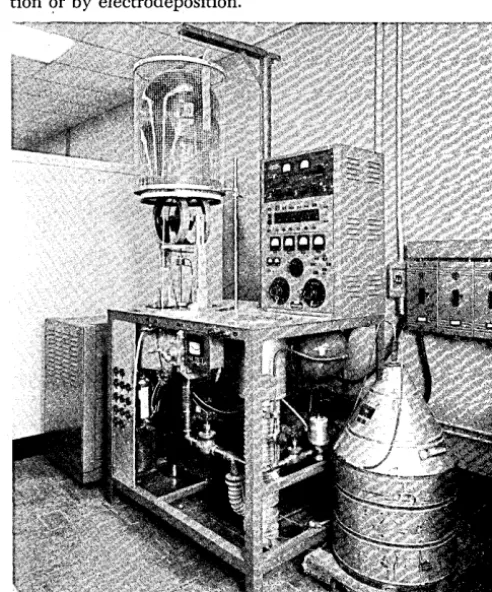
Figure 1-High vacuum equipment
8
More important applications of thin films to computer technology are described below. The thin film approach promises high speed in some configurations and lower cost and high density in others. .
Optical detection of the magnetic state of the thin films show promise for application in high-density magnetic storage devices.
evaporated films
The evaporation process permits fabrication of extreme-ly thin films having electrical characteristics considerabextreme-ly different from bulk properties. This section contains a de-scription of some of the properties and applications' of thin evaporated magnetic films.
Figure 1 shows the general arrangement of vacuum equipment used for evaporating magnetic films. In this picture the source is heated by induction heating. How-ever, resistance heating can also be used. The vacuum is ordinarily maintained at 2 to 3 X 10⁻⁵ mm Hg during
evaporation, and the substrates (usually glass microscope slides) are mounted on the underside of a heater in the upper part of the chamber. Desired film patterns are pro-vided by masking over the substrates. Film thicknesses may be monitored by resistance measurements or, in special cases, by optical means. A pair of Helmholtz coils, which are used to produce a DC magnetic field, may also be seen in Figure 1. Following the method outlined by Blois[l] in which it was shown that evaporation in a magnetic field produced films having directional properties, mu?h work has been done on films of approximately 82% nickel and
18% iron.
thin film memory
Magnetic properties of the thin films may be evaluated by measuring a hysteresis loop according to the method outlined by Crittenden[2]. Anisotropy is apparent when hysteresis loop measurements are made on the permalloy film. Figure 2 shows typical loops measured on the same film. The parallel loop was measured in the direction per-pendicular to the applied field.
Table I shows some switching characteristics of thin flat films. The switching characteristics of these films may be controlled by application of a transverse field. This per-mits the switching fields and the switching speeds to be controlled. Figure 3 shows the relationship between trans-verse and switching field, a relationship which has been experimentally verified[3]. The coordinates are normalized to the anisotropy field,. HK • It may be noted that the type of switching, i.e., either domain rotation or wall motion, can be controlled by application of a transverse field. Fig-ure 4 compares switching speeds of films with curves for ferrite cores and permalloy tape. When transverse fields
DRTRMRTION
[image:10.621.212.571.44.194.2] [image:10.621.48.294.438.734.2]!!!!!!!!
_I
=aiiiiI
I
I!~ /
i
t
I
5 IJ
Ii II II
II
parallel
transverse
Film 11-19
H
=
2.3 oerstedc
I~
Figure 2-'-Hysteresis loops o/evaporated (80 Ni 20 F(!/
films
1.0
.9
.8
.7
.6
.4
.3
.2
.1
H 1 Transverse Field During Switching H 1* Transverse Saturation Field H,. Switching Field
.5
H11H
j
1.0
Figure 3-Switching field vs transverse field
'Present Potential ,Opl}rating Speed Operaling,·Speea in ,Memory Cycle in,Mf!mory Cycle
0.25 usee(25)
0.25 usee
TwistDr 2.0 usee 1.0 usee
Bit Wire 2.0 usee 1.0 usec
Septerr:ber / October 1959
6.0
5.0
4.0
3.0
2.0
1.0
0.1 usee
0.05 usee
0.6 usee(23)
0.1 usec(24)
0.5 1.0 H - Hc (Oersteds)
20 Wra - 1/8 Mil Moly Permalloy
S-3
Core
1.5 2.0
Figure 4-Switching curves
Figure 5-Thin film memory element
~:;naiJe'·
:,
c~urr~~,t;
.,.;
:./p,.esent} , '?
?
,~?O
rna,intiJ,:,,:
40 ohms'
<100 ma(23)
ma into a solenoid drive(24)
[image:11.618.49.570.26.566.2]Figure 6-Kerr magneto optic apparatus
are applied, the switching curves for films are displaced to the left[4 J indicating higher speed for a given drive.
These directional properties and transverse field effects have caused workers/5•6 J to suggest that films may be used as memory elements for digital computers. Figure 5 shows how films may be used in a memory array.
By utilizing the Kerr magneto-optic effect, optical read-outs may also be obtained from thin films. Figure 6 is an illustration of an optical bench.
When plane polarized light is reflected from a mag-netic film, the plane of polarization is rotated either clock-,wise or counter clockwise depending upon the state of
magnetization of the film.
By properly adjusting the analyzer in th'e reflected beam, anti-parallel domains are observed. Figure 7 shows mag-netic domains in an evaporated permalloy film. For thin films, transmitted (Faraday effect) instead of reflected light may be usedP]. Figure 7 is a photograph of magnetic domains which were observed using reflected light. Ap-plication of magneto-optic effects include magnetic and Curie-point writing.
magnetic and curie-point writing
Magnetic writing is a method which has been proposed for high density storage. In this method either the Kerr or the Faraday effect is used to read out information. Input is accomplished by remagnetizing selected areas of the film by means of a magnetiC probe. Williams[sJ has sug-gested that 10" bits/cm2 can be attained by this technique. Another technique utilizing the Faraday effect is Curie-point writing[1l J. Evaporated manganese-bismuth films hav-ing a magnetization vector normal to the plane of the film are used. When a film is uniformly magnetized normal to the surface, and a portion of the film is raised above the Curie temperature, this portion will upon cooling have its magnetization vector anti-p.arallel to the surrounding film. The Kerr magneto-optic effect may then be used to de-tect this reverse domain. Thus, an electron beam may be used to put information into the system with an optical readout. Information may· be erased by providing a DC field strong enough to return the film to the original state of magnetization. .
Practical applications of evaporated films require that the films be as uniform as possible. Several factors may
10
Figure 7-Magnetic domains in thin films
contribute to non-uniformity of evaporated films. Behmdt and Maddocks[IO] have demonstrated that substrate prep-aration affects film uniformity, and suggest that proper cleaning including an ammonium bifluoride etch be em-ployed. The coercive force is also dependent upon film thickness. This has been established by Reimer[ll J for nickel films and by Tiller and Clark[12] for permalloy films. Surface roughness may be demonstrated either by inter-ferometer measurements or electron micrographs. Chem-ica) composition may also vary within a single film. Chu and Wolfe[laJ have reported that 3-4 percent variation in nickel content may be obtained for permalloy films. In-asmuch as angle of incidence of vapor on the substrate and rate of evaporation[14, 15, W, 17J influence film structure,
particularly in thin films, these factors also influence film uniformity.
Much of the current research effort on films is directly related to problems concerning film uniformity. Details vary in accordance with materials being used and the specific application.
electrodeposited thin magnetic films
electrode posited permalloy films
The. difficulties inherent in the vacuum deposition of uniform permalloy films for use in computer memories have led to the consideration of other methods of making thin permalloy films. One obvious alternative method is electrodeposition. There are several reports[IS, Ill, 2()] of the successful deposition of magnetically oriented films. These films show magnetic properties similar to vacuum de-posited films of the same composition.
A recent paper by Wolf, Katz and Brain[IS] reports the magnetic characteristics of electrodeposited films contain-ing 80% to 87%% nickel, the remainder becontain-ing iron. The thickness of the films showing best characteristics ranged from .530 A to 600 A; thicker films were reported to be less square.
The electroplating bath was stated to be composed of the sulfates of nickel and iron with some sodium chloride and boric acid added. Sodium lauryl sulfate was used as a surface active agent and saccharin was employed to reduce grain size and stress.
By controlling composition and the plating conditions, the anisotropy field was varied independently of the
[image:12.612.45.556.12.238.2]cive force in the easy direction. Hysteresis loops were presented to show the various ratios of the anisotropy field (H,J to the coercive force in the easy direction (H,.). The unusual result was obtained that HjH" could be made greater than unity. Reference to Figure 3 shows that this is not in accord with the simple rotational model for oriented thin magnetic films.
The films were 'deposited on a conducting layer of gold which was sputtered onto the surface of a microscope slide. The sputtered gold was chosen from a number of conduct-ing substrates because, after platconduct-ing, it yielded the best magnetic properties. The important factors in choosing a conducting layer were surface smoothness and the ab-sence of an appreciable surface oxide.
Other work on electrodeposited permalloy has been car-ried out on the surface of metallized Mylar r ll1 I. The surface
of the Mylar was metallized with chromium-copper laid down by vacuum deposition. The chromium and copper were laid down in two layers; the first layer was chromium about 2700 A in thickness, and the second layer consisted of about 1000 A of copper. Over the copper, nickel-iron alloys were deposited both with and without an applied magnetic field. It Was found that a field of 70 to 100 oer-steds applied during plating improved the magnetic
properties. .
In addition to the flat sheets of Mylar some other forms were tried. Toroids of 1.3 cm outside diameter were re-ported to have been made by electroplating.
While the process of electroplating offers another route to the preparation of thin permalloy films, there are also difficulties inherent in this technique for the preparation of planar matrices for computer applications. In the first place, the film must be deposited on a conductive sub-strate, which implies that eddy current damping is present.
If the conductive substrate is made very thin in order to minimize eddy current damping, then the resistance of the substrate causes a problem in the production of uniform coatings. The rate of electrochemical reaction is dependent on the voltage, and' quite small variations in the voltage may considerably alter the plating current. Thus, in order to deposit uniform layers, the voltage should be the same throughout the surface of the substrate. However, in-genuity in anode construction or cell construction will sometimes permit uniform layers to be deposited onto rela-tively low conductivity substrates.
In the area of oriented electroplated magnetic films there is also a report by some Russian workers[20] that a uniaxial anisotropy has been. produced in an electroplate of pure iron by the application of a magnetic field during the plating process.
the "rod"
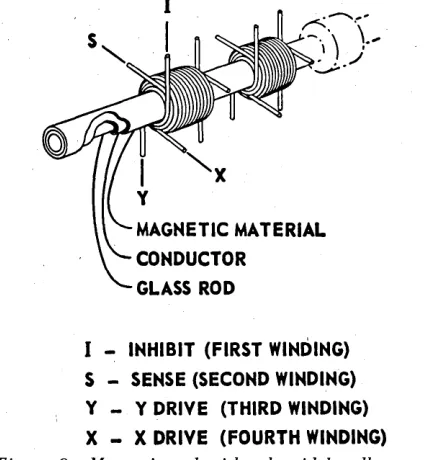
Another application of electrodeposited thin magnetic coatings consists ofa thin cylindrical configuration termed the "Rod"[21
J. The magnetic element called the Rod can be formed by laying down a conductive substrate on a thin piece of glass cane (preferably 15 mils or less), and then electroplating a magnetic coating over the metallized glass. A typical configuration is shown in Figure 8.
In the case of 98% Fe, 2% Ni alloy electroplate, an ele-ment possessing good squareness and a coercive force of approximately 14 oersteds is obtained. The switching characteristics of the 98 Fe-2 Ni alloy are fast enough so that one-haH-microsecond cycle times have been
demon-September jOctober 1959
First known operating magnetic-film computer mem-ory is pictured at MIT l:incoln Laboratmem-ory in Lex-ington, Massachusetts. With a capacity oj 32 ten-bit words and a read-and-write cycle time oj 0.8 micro-seconds, this memory has been in' satisjactory rou-tine operation in Lincoln's T X-2 computer since it was first installed in July 1959.
MAGNETIC FILM MEMORY
IN OPERATION AT -LINCOLN
A high-speed magnetic film memory is now in opera-tion as a part of the TX-2 digi~al computer at the M.I.T. Lincoln Laboratory. Its performance has been entirely satisfactory since its installation in July 1959. It has a capacity of 32 ten-bit words, suitable foi- evaluation testing, and serves as an experimental prototype for larger units. This new memory, and the TX-2 computer of which it is a part, were de-veloped by Lincoln Laboratory under Air Force con-tract, with the joint support of the Army, Navy, and Air Force.
The read-and-write cycle time of 0.8 microseconds is consistent with the speed of the computer itself, although bench tests demonstrated successful opera-tion at a cycle time as short as. 0.4 microseconds. Net driving current for writing is 1.50 milliamperes, and one-millivolt output signals are obtained from indi-vidual memory elements.
Each memory element is a circular spot of Perm-alloy film (82 percent nickel, 18 percent iron) 7.50 Angstroms thick, 1.6 millimeters in diameter, cen-tered 2.5 millimeters apart. The spots are deposited by evaporation on a flat glass substrate, 0.1 milli-meter thick, in 16 x 16 unit arrays. The complete memory unit as installed in TX-2 and one of the ex-perimental arrays are shown in the enclosed photo-graphs. The transistor drive and sense circuits can be seen surrounding the memory. '
A thin film memory has several potential advan-tages over the familiar ferrite toroidal core memory: faster cycle time, lower power dissipation, greater compactness, and simpler fabrication. The unit now in operation confirms these expectations, although none of these factors has been fully exploited in this first developmental model.
MAGNETIC MATERIAL CONDUCTOR
I
INHIBIT (FIRST WINDING) S SENSE (SECOND WINDING)Y
Y DRIVE (THIRD WINDING)X
X DRIVE (FOURTH WINDING)Figure 8-Magnetic rod with solenoid bundles wound in coincident-current memory mode
strated in a computer memory employing the Rod. While the Rod appears somewhat slower than Hat film matrices (10. vs 25 millimicrosecond) in switching speed, the difficulties in obtaining uniform evaporated or electro-deposited Hat films, together with the low signal output, at present limits large scale applications of the Hat film. To date, the fastest evaporated flat-film memory reported is intended to operate I at a cycle time of 0.5 microseconds, the same as the cycle time already obtained with the Rod.
the twistor and bit wire
The element called the "Twistor" utilizes a preferred helical direction of magnetization produced by a torsional stress around the axis of a wire. The Twistor concept has been used in homogeneous magnetic wires and in wires of nonmagnetic conductor wrapped or coated with a thin layer of magnetic materiaW2
, 23].
The method of preparing the Twistor which has been reported to give the most reproducibility consists of wrapping a permalloy strip measuring 0.25 mil by 2 mils around a 3-mil-diameter insulated copper wire.
A material which operates similarly to the Twistor but is formed by a direct electroplating procedure without ex-ternally creating a strain is called the "Bit Wire'T4]. To make this element, a 0.2 mil-layer ofa 78 Ni-22 Fe alloy is plated onto the surface of 3-mil beryllium-c~pper spring wire. Under certain plating conditions a helical easy axis is found to exist in the plated coating.
Although the magnetic "wrapping" or coatings of the Twistor and the Bit Wire are above the thickness region which is usually considered to be thin magnetic films, the elements are described in this review for comparison pur-poses. (The thickness region generally considered to be a "thin" film is under 10000 A.) A comparison of the Twistor, Bit Wire, the Hat film matrix, and the Rod is shown in Table 1. Although the strained types are somewhat slower in operating speed than the Rod or Hat film, for certain applications where high speed is not a major consideration the Bit Wire or Twistor may offer economic advantages.
LIST OF REFERENCES
1. Blois, M.S., "Preparation 0/ Thin Magnetic Films and Their Properties," J. Applied Physics, 26, p 975 (1955)
12
2. Crittenden, E. C., Hudimac, A. A. and Strough, R. I., "Mag-netization Hysteresis Loop Tracer for Long Specimens 0/ Ex-tremely Small Cross Section," Review of Scientific Institute, 22,
p 872 (J95I)
3. Smith, D.O., "Static and Dynamic Behavior 0/ Permalloy Films," J. Applied Physics, 29, No.3, p 264 (1958)
4. Olson, C. D. and Pohm, A. V., "Flux Reversal in Thin Films 0/ 82 percent Ni, 18 percent Fe," J. Applied Physics, 29, No.3, p
274 (1958)
5. Pohm, A. V. and Rubens, S. M., "A Compact Coincident-Current lWemory," Proceedings Eastern Joint Computer Conference, New York, p 120 (1956)
6. Raffel, J. I., "Operating Characteristics 0/ a Thin Film Mem-ory," Magnetism and Magnetic Materials Conference, Phila-delphia, Pa. (J958)
7. Fowler, C. A., Fryer, E. M., "Magnetic Domains in Thin Films by Faraday Effect," Phys. Rev., Vol. 104, No.2, Oct. 1956, p 552
8. Williams, H. J., Sherwood, F. G., Foster, F. G., and Kelley, E. M., "Magnetic Writing on Thin Films 0/ MnBi," J. Applied
Physics, Vol. 28, No. 10, Oct. 1957, p 1181
9. Mayer, L., "Curie-Point Writing on Magnetic Films," J. Applied
Physics, Vol. 29, No.6, June 1958, p 1003
10. Behrndt, K. H., and Maddocks, F. 5., "The Influences 0/ Sub-strate Processing on the Magnetic Properties and· Reproduci-bility 0/ Evaporated Nickel-Iron Films," Conference on
Mag-netism and Magnetic Materials, Nov. 1958
11. Reimer, L., "Magnetic Properties 0/ Electrohytically Deposited and Evaporated' Thin Films 0/ Nickel," Z. Naturforschung, p
550 (1957)
12. Tiller, C. O. and Clark, G. W., "Coercive Force vs. Thickness for
Thin Films 0/ Nickel-Iron," Phys. Rev., Vol.
no,
No.2, (1958). 13. Chu, W. W. L., and Wolfe, J. E., Wagner, B.c.,
"SomeOb-servations on Evaporated Permalloy Films," Conference on
Magnetism and Magnetic Materials, ,Nov. 1958.
14. Smith, D.O., "Anisotropy in Permalloy Films," Magnetism and
Magnetic Materials Conference, Philadelphia, Pa., (1958) 15. Knorr, T. G., and Hoffman, R. W., "Geometric Dependence 0/
Magnetic Anisotropy in Thin Iron Films," AEC Tech. Rep., No. 3, Contract AT (ii-I). Sept. 1958
16. Sennett, R. E., G. D., "The Structure 0/ Evaporated Metal Films and Their Optical Properties," 1. Opt. Soc. Amer., 40, No.
4, p. 203 (l950)
17. Aziz, R. A., Scott, G. D., "Effect 0/ Incident Atomic Velocity on Structure 0/ Evaporated Silver Films," Can. J. Phys., 34, No.8,
f) 731 (1956)
18. Wolf, I. W., Katz, H. W. and Brain, A. E., "The Fabrication and Propertif!s 0/ Memory Elements Using Electrodeposited Thin Magnetic Films 0/ 82-18 Nickel Iron," Proceedings 1959
Elec-tronic Components Conference, pp 15-20
19. Edelman, F. H., et al., "The Preparation and Characteristics 0/ Thin Ferromagnetic Films," Final Engineering Report, Contract AF 19(604)-2659, ASTIA Doc. AD 160845
20. Katel'mikov. N. V., "The Creation 0/ a Magnetic Texture in Thin Iron Electrodeposits by the Application 0/ a Magnetic Field," (In Russian) Fiz. metalov i metallovedenie, Vol VI, No.
2, pp 222-228 (J958)
21. Meier, D. A., "Millimicrosecond Magnetic Switching and Stor-age Element," J. App. Phys., 30, No.4, pp 455-465 (l959) 22. Bobeck, A. H., "A New Storage Element Suitable for
Large-Sized Memory Array-The Twistor," The Bell System Technical
Journal,36, 1319-40, (I 957}
23. Bobeck, A. H. and Title, R. 5., "The Twistor-Its Use in a Memory Array," Nonlinear Magnetics and Magnetic Amplifiers
Proceedings, Special Conference, 1958, pp 234-242
24. Schwartz, S. J., and Sallo, J. 5., "Electrodeposited Twistor and Bit Wire Components," Presented at 1959 Solid State Circuits
Conference, Feb. 12-13, 1959, Philadelphia, Pa.
25. Smith, D.O., "Thin Magnetic Films for Digital Computer Mem-ories," Electronics, June 26, 1959, pp 44-45
26. Meier, D .A., (paper to be published) •
[image:14.612.51.265.28.258.2] [image:14.612.304.563.35.744.2]with
EAI
portable
X-Y
plotter-you can convert data to graphic form
quickly ... accurately .•. reliably
With Electronic Associates' new Variplotter ModelllOOE, data can be converted immediately to graphic form for quick, easy interpretation and understanding. Graphic display adds life to performance data-makes X and Y . relationships instantly, unmistakably clear . . . provides
permanent picture-like records of performance.
With the addition of accessories, versatile Variplotter will operate as a function generator, or will plot digital information from a keyboard. Its small size (23" L by 17%" W by 9%" H) and light weight (43Ibs.) make it a convenient laboratory tool.
The Variplotter combines high dynamic and static accuracy with a wide range of input sensitivities. Its
rugged construction assures dependable, low-mainte-nance performance.
For name of our nearest representative write Dept. D.
I VARIPLOTTER MODEL 1100E FEATURES:
• Portable table top size • Vacuum hold down
• Wide range of input sensitivities • High dynamic and static accuracy • Rugged construction
• Ease of maintenance • Differential inputs
EA I
ELECTRONIC ASSOCIATES, INC.
Long Branch. New JerseyFor complate apaclflcatlona write for Bc»oklet AP-810D
Circle 7 on Reader Service Card.
September/October 1959 13
-Join the
l~ader
of the new generation of computers!
METHODS ANALYSTS
FOIIONEYWEll
800
Make your big move now.
All-transistorized· Honeywell 800 is rapidly
winning customers coast to coast. Make a
name for yourself now, working with this'
most .advanced data processing system in
the medium to large-scale field.
Enjoy management's full
sup-port.
Honeywell is dedicated to continuing
progress in computer design and service.
All data processing efforts are solidly
sup-ported right down the line.
Advance in your own field.
Honeywell offers you a chance for high
advancement in your chosen field. No need
to transfer to another department to' get
ahead.
Can you qualify?
*
BS or MS in any science, math, statistics,
accounting or business
*
3
to
5
years computer and applications
exper~ence
*
Willingness to relocate, if necessary
Complete training on Honeywell 800 in
Boston precedes assignment to locations in
N ew York, Boston, Washington, Chicago,
Detroit, Los
Ang~lesand other major cities.
Write in confidence and send resume to:
'J
ohn A. Koenig
Professional' Employment Supervisor
Minneapolis-Honeywell, Datamatic Div.
Newton Highlands 61, Mass.
8 ways to identify the leader of the new generation of computers'
Circle 70 on Reader Service Card.
ALL ABOUT PAPER TAPE
a postscript
To accommodate late entries, DATAMATION presents this final installment of a survey article covering paper tape equipment.
2
3
September/October 1959
WANG LABS
I
Series TR Punched Tape Block Reader is an input de-vice designed especially for digital control, program-ming and other similar applications. It is made for paper, paper-Mylar, Mylar or other insulating tapes from 0.687 to 1.000 inch wide with standard hole-spacing and hole-diam-eter. One of the chief advantages of this reader is that it can read from 6 to. 24 lines of codes along the feed direction of the tape in addition to the regular 5 to 8 level trans-verse code holes of the tape. Consequently, up to a total of 192 bits of code information can be read off simultan-eously from the tape and is available as contact closures for control or programming use.Circle 100 on Reader Service Card.
DIGITAL SERVICE LABS
2
Model 244 punch-verifier features 10-key decimal keyboard mounted in separate console for ease of operation and convenience of operator. It has four verifi-cation checks: keyboard locks if key depressed and tape in verifier do not agree; key remains depressed as indica-tion of error; if keyboard is correct - override switch per-mits punching of digit; if incorrect - reset button permits operator to try again. Other· features of the 244 - auto-matic leader between blocks, least significant zeroes may be automatically punched, complete reproducing facilities, and all codes are compatible with Bendix G-15 code.Circle 101 on Reader Service Card.
SOROBAN ENGINEERING
3
FR-2 tape reader is designed for operation under military environmental conditions. These conditions include operation at -65°F., with. shock and vibration forces up to 20 G's. The reader is capable of passing a 50 hour salt spray test. It is explosion proof. The reader is capable of operation at rates up to 60 codes per second. Drive is through a Gilmer timing belt. Reverse reading can be achieved by reversing the drive shaft rotation. The reader's cam drive system and· tape transport linkages are immersed in a splash oil bath. The design uses a latch-interlocked cam system for read and feed, thus reliable long life is accommodated whether character-by-character or continuous reading is employed.Circle 102 on Reader Service Card.
Soroban's GP-2 tape perforator, which is about the· same size and weight of a standard press camera, can punch up to 300 coded characters per second in standard com-munication paper or Mylar tape. This speed is at least five times faster than is provided by other commercially avail-able tape perforators, according to the manufacturer. All internal parts of the punch are lubricated by a splash oil bath system. Manual lubrication intervals are in the order of several months. The basic recording cycle allots one-third of a cycle to tape transport and two-one-thirds to punch . pin penetration of the tape. •
Circle 103 on Reader Service Card.
lS
AIRBORNE RADAR ...
The APS-67 Airborne Radar ... designed and
developed by
The Magnavox Company
in
con-junction with the Navy Department, gives
eyes that see by. both day and night to the
Crusader.
The APS-67 delivers the utmost in performance
and reliability for this Navy Fighter ... clearly
demonstrating
The Magnavox Company's
ability to produce and work as prime
con-tractor on a complex electronics project.
MAGNA VOX capabilities are in The Fields Of Air-borne Radar, ASW, Communications, Navigation Equipments, Fusing and Data Handling . . . your ' inquiries are invited.
RADAR DATA HANDLING
PRODUCTS
THAT SEE BY
THEMSELVES
"
-l~
err
ASW
Jl
MISSILESTHE MAGNAVOX
co . •
DEPT.l 0 0 . Government and In'dustrial Division. FORT WAYNE. IND. Circle 8 on Reader Service Card.--- -~---_ ... _-... _
-IS IT OVERHAUL OR TRADE-IN TIME?
computer specialists conclude discussion
of perennial professional society question
On March 2, a day prior to the 1959 W fCC, a group ac-tive in computing met at the RAND Corporation to dis-cuss some of the problems plaguing the industry. The discussion was recorded and printed copies were prepared and submitted to each individual for editing of his own remarks.
Among the topics covered was one dealing with what many of those attending felt was a lack of a unifying or-ganization in the information processing industry.
DATAMATION agreed that publication of remarks covering this subject might benefit the industry. In our last issue, we presented approximately half of this section. The remaining half is presented here.
Those attending the 1959 session were Herb Grosch, IBM; Morris RubinofJ, Philco;
C.
B. Tompkins, UCLA; Charlie Phillips, Dept. of Defense; Herb Bright, Westing-house; Saul Gorn, Moore School; Al Zipf, Bank of Amer-ica; E. E. Minett, Remington Rand; Don Madden, System Development Corp.; Ed Cann~n, Bureau of Standards; Bill Gunning, Epsco-West; Fred Way III, Case Institute; Walt Bauer, Space Technology Labs.; Oliver Selfridge, Lincoln Laboratories; fackson Granholm, COMPUTING NEWS; Paul Armer, Fred Gruenberger, and Willis Ware, RAND.Again we remind our readers that the opinions ex-pressed here are those of the individuals concerned and do not necessarily reflect the views of DATAMATION or any of the organizations and companies mentioned.
Mr. Tompkins has the floor . ..
Tompkins: We have a group here which has some sort of cohesion; it has some sort of opinion which undoubtedly could be sharpened with some thought on the subject, and it has a gallant secretarial staff. If the members of the group have any good ideas, plus any forceful remarks that may have slipped into this record, these could probably be put together and addressed in the form of a letter to a small number of organizations that we've· been discussing. The group could say to each of these organizations that it feels that there is a considerable need for expanded activity (joint activities of the type that the JCC was first put together' to do) and point out that one needs a little bit more authority to do this and so forth and so forth.
Gorn: Tommy, what is this group's official name?
Tompkins: This is an informal group meeting at RAND and that's all.
Rubinoff: But, that's the point, we came here agreeing to have an informal discussion. Nevertheless, I don't think you
September/October 1959
have to worry because we have in this room a key man from all four organization's, one from NJCC, one from ACM, one from IRE, and one from AlEE. There is no fear that the spirit of this discussion will not get back to those four or-ganizations. Formally, I don't think we should go on record with anything.
Grosch: I would suggest that the reluctance of this group to take any action be memorialized in a name: Maximum Utilization of Logical Equipment, or Mule for short.
Gorn: Would the host be interested in taking any action on behalf of the group?
Gruenberger: It seems to me the best action we can take is to publish the expurgated transcript.
Grosch: What we need are ideas. There is no lack of ac-tion if you have objectives. We could always send Paul out with this banner flying if we only know what the banner should say. He's already told us what the incumbents are planning to do, and it sounds awful.
Gorn: Paul is scarred from several previous excursions. Grosch: I know, I know!
GOl'n: Morris and I and a few others have been making noises within various organizations for some time:
Gorn: One 'thing that RAND courct do immediately is submit an expurgated version of the transcript of this meet-ing for publication.
Gruenberger: If we wanted to submit a letter it would take us at least until 8 o'clock tonight just to compose the first paragraph.
Grosch: If we really had something that we all wanted to push, anyone of us could write an umpteen-page letter which could be published in any number of places. The point is, we don't know what to put in the letter.
Gorn: I think if we gathered together for the specific pur-pose of making such plans, that we could.
Grosch: I wish we would then. . Tompkins: I don't think we have to get together to do it. Zipf: You gentlemen drew an analogy between the as-sociation you're talking about and the American Medical Association. It seems to me there's a basic difference. The AMA has a common customer, if you please; since everyone gets sick at some stage in the game. Maybe, collectively we are sick. One thing that has impressed me about all these societies is that none of them has attempted to cultivate representation from users. If this is their intent, then that's fine. But it seems to me that many of the problems we have talked about today are simpler than that (we started out by spending a great deal of time trying to design a more sophisticated computer system this morning) . . . I think we have to start by getting more people to be able to use what we have in order to expand the plan; and get the money from the "money places" to make it interesting to improve upon what we have.
Grosch: AI, I would like to comment on one thing you mentioned-the users not being in the Medical Association.
Radar Tracking Computers
High Speed Repetitive
Display
MC·5900 Process Master Analog Computer
Some people can prove man and mouse are identical
MC·3302 Transistorized
Data Plotting Board
It's all according to the points of similarity you choose. Differences
are what really prove the superiority of man over mouse. Computers have differences, too. In fact, it's in these differences that the CSI-designed MC-5800 obsoletes every other Analog Computer. The best proof lies in
cold hard Specifications
• Exclusive dynamic memory makes automatic iterative solution of statistical or optimization problems a reality.
• Stable amplifier operation over the entire feed-back range from zero to infinity.
MC-5800 Precision Master Analog Computer
• Lowest amplifier grid-current <10-9 ampere. _
I
• Amplifiers provide lowest noise level output-less than one milli-
~
1(..."
volt at unity gain.• Amplifier frequency response-flat to 10,000 cps and only 3 db down at 28 kc.
• Real·time precision @ speeds to 60 solutions/sec.
• Exclusive electronic generators of the function of two·or-more variables may be programmed at patch-board in same time required for setup of single-variable generators.
• Will program 134 amplifiers, 30 electronic multipliers, 18 diode function generators, 2 time-delay generators, 8 relay amplifiers, and 6 servos from one 2128-hole patchboard.
• Highest performance electronic multiplier-flat to 10,000 cps and only 3 db down at 20 kc. '
• Dynamic memory
+
high-speed quick-reset rep·op provide practi· cal approach to solution of simultaneous partial differential equations. ' . Dynamic memory with time-base accuracy of ± 10 f,Lsec provides automatic parameter searching by iteration-an exclusive capability. • Solution of problems with up to 15 amplifiers in closed loops. • Plug-in dynamic components ease maintenance.• Lowest computer cross-talk-rejection greater than 2,000 to 1.
• Selection of real-time, expanded-time or high-speed compressed-time without reprogramming.
• Passive networks stabilized at < I°C above room ambient-no oven required.
• EVERY SPECIFICATION IS GUARANTEED TO BE TRUE PERFORMANCE STANDARD-IN SUSTAINED OPERATION.
• Only ,diode function generators utilizing resistors, potentiometers, and diodes of equal quality to those in computing networks. • Only diode function generators with individual hi-Io gain positions for each segment.
• Lowest function generator drift < 5 mv/8 hrs. • Lowest servo step-function overshoot-less than 1%. • DC tachometer feedback on all servos.
• Complete control of all amplifiers, multipliers, dividers, and non-linear equipment at patchboard. ~ ... , • Exclusive equipment-door packaging for free access and quick maintenance without shutdown.
• Insulated patchboard prevents costly shorting accidents. • Power supplies eliminated from console--:clowest, most stable operating temperatures-rise
<
3°C.• Field expandable without mechanical rework or rewiring. There are many more differences (over a hundred, in fact). Before you buy or lease your next analog computer, compare them all ... and we think you'll agree with us when we say: The MC-5800 obso-letes every other analog computer made.
Computer Systems, Inc.- designers and manufacturers of the
high-est precision analog computers and computer accessories.
MC·701 Electronic
Multiplier Linear Programming Computer
~
COMPUTER SYSTEMS, INC.,
611 BROADWAY. NEW YORK 12, N. Y •• SP 7-4016A Schlumberger Subsidiary • jor'merly Mid-Century Instrumatic Corp.
Circle 9 on Reader Service Card.