- -~---. . - - - -.---~.---. - - - . . .
-October
0-
.-- ...!
r .
:{
1
I
,l , . . - - - ,
I
1
i
,
I
I
RAND SYMPOSIUM
Who knows enough about memories to make this and 39 other models? AMPEX.
Only Ampex brings you such a wide range of core
memories-with cycle times from 24 to 1.5
micro-seconds and capacities from 128 to 32,000 words.
cycle in 6 microseconds. The RQL, RQA and LQ' each
with a 32,768 word capacity and memory cycles in 6,
5 and
l. 5 microseconds respectively. These are only
five of the 40 models of memories from
Ampex. And still more are yet to come. For
data write the only company providing tape
, and
recorde~sfor every application: Ampex
Corp., 934 Charter St., Redwood City, Calif.
These memories have the flexibility needed
for random access applications or high speed
sequential or buffer operation. Examples?
The RB with a capacity of 1024 words and a
memory cycle in 8 microseconds. The RVQ
with a capacity of 4096 words and memory
=
____
;;;;;§&HI=
Sales, service engineers throughout the world.
o
o
o
But even the light source in a Digitronics photo-electric per-forated tape reader has extra-ordinary life. A source under test is still burning after 18 months. All's to say that you'll need very few replacement parts ever in a Digitronics reader. High derat-ing factors on all parts and careful design insure continuous use. The number of moving parts has been reduced to a mini-mum. Ball bearings are double-shielded, so dust can't filter in. All of the metal parts are made of corrosion-resisting stainless
•
DlGITRONICS
steel or aluminum anodized to a sapphire-hard finish. And, the circ,,!itry is all solid state.
To meet any of your perforated tape reading requi~ements,
Digitronics photo-electric units are designed on the f!1odular principle. These readers are ~apab'e of accommodatin~ ~ to 8 level tape interchangeably at 60 to 5000 ~ps. Tape han~lers are also available for 5 to 8 level tape up to 1000 cps.
For information, write Digitronics Corp., Albertso~1 N. Y .
TAPE READERS
Mechanical simplicity ... which yields a degree of reliability unattainable by any other paper tape reader! Simplicity made possible through the utili-zation of the revolutionary PMI printed motor direct drive servo. Movement of the tape through the read head is achieved by merely starting and stopping a printed motor. The brakes, clutches and pinch rollers that cause big trouble and down time in conventional tape transports are completely eliminated.
Line by line cycle: movement of tape (A) over read head . (B) is controlled by drive capstan (C)-attached directly to shaft of PMI printed motor* (D); spring-loaded rollers (E) hold tape gently against capstan, keeping tape move-ment in exact accord with capstan rotation; advance command pulse accelerates motor, capstan, and tape; as read head detects next sprocket hole, a reverse pulse to motor halts capstan and tape with next character perfectly aligned in read head.
"U.S. Patents of Printed Motors, Inc. Pending.
Photocircuits' 1000/0 solid state readers perform posi-tive line-by-line reading at up to 300
cis;
can change speed and alter it infinitely from 0 to 300cis
without mechanical adj ustment; are easily loaded; will trans-port and read crude splices; and can be clock syn-chronized with a computer up to 300cis,
eliminating the need for buffer storage.Console, rack-mounted, reel-servoed, uni- or bi-directional transports in a low (up to 60
cis)
and high (free-running at up to 400cis)
speed range are available. Strip readers and separate spoolers, vari-ous tape widths, block type reading, special input-output ratings, militarized units, and remote control can be supplied.Phone, wire or write for complete information.
C O R P O R A T I O N
u£C9>[E
rP1!E£[Q)[Elm
[Q)D~D~D@G'J
~
at
@)O@OIJ[TI@[R]O@0
they chose
PC:>TTER
for the Dial-o-verterSystem
The Digitronics Dial.;o-verter System link,s computer and data
processing centers' from coast-to-coast bytr~nsmitting data
at high speed over voice grade telephone lines, broadband or microwave facilities, complete with error detection and· correc-tion features. It also offers interchangeability of media (mag-netic tape to paper tape, etc.).
Key to this highly reliable system is the Potter M906 IT Magnetic Tape Transport. Thishigh';speedrecord/playback transport is equipped with all solid~state electronics mounted on individual plug-in circuit boards. Atensioll arm slack loop system com-bined with patented dual vacuum buffer provides smooth cycling of the tape at stepping rates of 200 per second.
In addition toits application in telephone line transmission sys-tems, the versatile M906 IT is extremely useful in modern high density recording systems,providing data transfer rates of up to500kc.
To learn how Potter Magnetic Tape • Transports. can be applied to your data processing problems, write for details today.
POTTER INSTRUMENT CO., INC.
Sunnyside Boulevard • Plainview, New York
o
o
voiume8,
numberJl ((})
o
Staff
Publisher FRANK D. THOMPSON
Vice President & General Manager
GARDNER F. LANDON
Vice President & Publication Manager
RICHARD W. NIELSON
Editor HAROLD BERGSTEIN
Managing Editor & Art Director
CLEVE MARIE BOUTELL
Assistant Editor IRWIN SCHORR
News Editor VALERIE ROCKMAEL
Contributing Editor
H. R. J. GROSCH
Technical Consultant DON B. PRELL
Production Manage;
MARILEE PITMAN
Circulatibn M gr. ALGENE TRAINA
Editorial Advisers
DANIEL D. McCRACKEN ROBERT L. PATRICK
Eastern District Manager & Vice President
RICHARD W. NIELSON 141 E. 44th St., New York 17, N.Y. MUrray Hill 7·5180
New England District Manager
WARREN A. TIBBETTS 112 West Haven Rd., Manchester, N.H., NAtional 5·9498
Midwest District Manager
JOHN BRENNAN 201 N. Wells St., Chicago 6, III. Financial 6·1026
Western District Manager & Vice President
HAMILTON S. STYRON 10373 W. Plea Blvd., Los Angeles 64, Cal. BRadshaw 2·0817 Southeastern Representative
GUS KRIMSIER 495 Dogwood Valley Drive, N.E., Atlanta 5, Ga.
EDITORIAL OFFICES 10373 W. PICO BLVD., LOS ANGELES 64, CALIF.
the automatic hand.ling of information
Feature Articles
25 The RAND Symposium: 1962
33 Benchmarks in Artificial Intelligence, by Fred Gruenberger
36 Preliminary Discussion of the Logical Design of an Electronic Comput-ing Instrument, Part Two, by Arthur W. Burks, Herman H. Goldstine,
and John von Neumann
42 IFIP Revisited, by Harold Bergstein
47 Proposed: An R&D Center for Educational Data Processing, by Alvin Grossman
49 ACM's 17th Annual, A Review
57 RCA and EDP, based on a taped interview with E. S. McCollister 60 The Konscience of a Komputer Konservative, by I. V. Goody
Departments
8 Important Dates in Datamation 10 Letters to the Editor
17 Datamation in Business and Science 23 The Editor's Readout
65 News Briefs in Datamation 75 New Products in Datamation 79 People in Datamation
87 New Literature in Datamation
89 New Firms and Mergers in Datamation 97 Book Capsules
100 Advertisers' Index
TIHS ISSUE-41,198 COPIES
October
Cover
An annual event of major scope in the com-puting profession, DATAMATION is pleased to offer part one of The RAND Symposium. Participants in this year's session point their verbal gambits at programming languages. Cover design is by Jim Brooke of Playa del Rey, California.
Circulation audited by Business Publications Audit
Memb'er, National Business Publications
InV41
DATAMATION Is published monthly on or about the tenth day of every month by F. D. Thompson Publica· tions, Inc., Frank D. Thompson, president. Executive Circulation and Advertising offices, 141 East 44th St., Now York 17, N.Y. (MUrray Hill 7-5180). Edi-torial offices, 10373 West Pico Blvd., Los Angeles 64, Calif. (BRadshaw 2·0817). Published at Chicago, III. Accepted as controlled circulation at Columbus, O. Form 3579 to be sent to F. D. Thompson Publications, Inc" 201 N. Wells St., Chicago 6, III. Copyright 1962, P. D. Thompson Publications, Inc.
o
- - _ .. _-.
__
.... _-Only the new Philco 1000 implements system conversion so quickly, so economically. For the Philco 1000 inputs information from any system's word size that is a multiple of 6 data bits (12, 24, 36, 48, 54), and outputs the same information in any multiple of 6 bits. The secret is in the Philco 1000's exclusive N-register.
Turns up the volume of the Philco 212
Fast, economical system conversion is just one example of easy transition to a host of new Philco processing ec~nomies. The Philco 1000 h~ndles Input/Output conversion (binary-to-decimal and decimal-to-bin8:ry) and relieves the Philco 212 Central Processor of input formating and verification, file searching, and output editing. Result: 212 computation and 1000 I/O processing jobs proceed simultaneously ... they are not merely time-interlaced. And the combination of the 212/1000 provides even greater capacity for data volume.
Only
th~
Philco 1000 delivers all these
. satellite computing capabilities:
Communicates with all types of input-output devices. Reason: 3 microsecond memory satis~ies the speed
re-. quirements of known devices.
Communicates directly with the Phi/co 212 system. Reason: Can be linked directly to the Philco 212
mag-netic core memory and all tapes within the 212 system.
Capable of autonomous action and decision.
Reason: Stored program design, with arithmetic and logical ability.
Can be used as an independent processor at a remote location.
Reason: Contains complete processing ~bility, including binary arithmetic feature for scientific jobs, and ch'aracter orientation for commercial-type jobs.
SiElE THlE
I?HD~CO 100~IrJ OIPIERATION Ai
TD~lEFALLJOarJY COr.1I?UilEll1.COrJfFlElJ1r::rJCr.::
PHILeo
A SUBSIDIARY OF ~~.otorY!l~
NO"" ...
YOU
CAN ORDER ALL YOUR
PREDESJ:GNE'D OR CUSTOMJ:ZED
~~O~
'GENER.;r.. ELECTRJ:C
~eneral Electric offers a: series of magnetic Shift Registers for the exacting requirements of every advan~ed computer and data processing system. These rugged, encapsulated modular units are available in three distinct designs, or can ,be custom-built to your specifications.
OUR SHJ:FT
~EGJ:STERSGIVE YQU ...
• Reduced size and weight • High reliability
• Stable operation over wide temperature ranges • Low peak and average shift-p!Jlse power
'VOLTAGE CONTROLLED UNIT
· •. off~ring shift speeds to 700 KC's for, printed wire-board mounting, G-~ voltage-controlled shift register elements are characterized by their high reliability and tolerance to wide variations in the shift pulse width.
SERJ:AL DRJ:VEN, GATED TRANSFER
.•• combines the advantages of low shift-pulse power requirements with the reliability feature of tolerance to wide variations in shift pulse width. and amplitude. · .. standard serial-driven, gated-transfer shift regis-ters are available in designs to' 500 KC's. Specially wafered, 'multi-bit models, deve~oped by General Electric for maximum miniaturization, provide a new in-line stacked arrange~ent and can be obtained in multiples of up to 25 bits.
SERIAL DRXVEN, CORE DJ:ODE
· . . ideally suited to diverse applications where, because of low speeds or relatively low duty factors, shift pulse power requirements are not excessive. Operational to 100 KC's, each of Gene~al Electric's three core-di~de models offers a simplified circuitry design, 'packaged for ready adaptability to compact and flexible mounting arrangements.
Let us tell you about them in more detail. Full information may be obtained by writing to: Section El71-04, General Electric Company, Schenectady, N. Y.
S PEe I
A'L
T Y D E V ICE SOP ERA T ION
DEFENSE ELECTRONICS PIVISIONGENERAL
e
ELECTRIC
• Armour Research Foundation is sponsoring the 1962 Computer Ap-plications Symposium, to be held Oct. 24-25 at the Morrison Hotel, Chicago. • The Ninth Institute on Electronics in Management, sponsored by the American University, Washington, D. C., will be held October 29-No:-vember 2, at the International Inn, Thomas Circle, Washington.
• The 15th annual Internatioflal Sys-tems meeting is scheduled for Oct. 29-31 at the Hotels Statler Hilton and Sheraton Plaza, Boston, Mass.
• A Conference on Spaceborne Com-puter Engineering will be held Oct. 30-31 at the Disneyland Hotel,
Ana-heim, California. '
• The Operations Research Society of America will meet from Nov. 8-10 at the Sheraton Hotel, Philadelphia, Penna.
• The 1962 Fall Joint Computer Con-ference will be held on Dec. 4, 5 and 6th ,at the Sheraton Hotel, Philadel-phia, Pennsylvania.
• The AlEE Winter General Meet-ing, Jan. 27-Feb. 1, 1963, will feature special sessions on Artificial Intelli-gence. The meeting is scheduled for New York City.
• The AlEE/IRE International Con-ference on Nonlinear Magnetics will
be held at the Shoreham Hotel, Wash-ington, D.C., April 17-19, 1963. • The 1963 Spring Joint Computer Conference will be held May 21, 22 and 23rd, 1963, at the Cobo Hall, Detroit, Michigan.
• The 1963 ACM National Confer-ence will be held Aug. 28, 29, and 30th in Denver, Colorado.
• The 1963 Fall Joint Computer Con-ference will be held in the Las Vegas, Nev., CoU:vention Center, Nov. 12-14, 1963. '
• The 1964 ACM National Confer-ence will be held in Philadelphia, Penna., Aug. 25-28, 1964.
• The IFIP Congress 65 is scheduled for New York City in May, 1965. It
,is the first International Congress scheduled for the United States.
o
o
o
· " .
.~
M
rn
D
~A
another first from
MClgnClV"ox.
J
list 60 seconds to retrieve and inake hard
copy of anyone of 30,000,000 documents
This new, high speed, electronically controlled filing system provides an entirely new concept in docu-ment storage and retrieval.
Automatic purging of obsolete documents, ran-domupdating, and low cost d~piicate files are some of the mahy additional advantages offered by MEDIA
For complete information on equipment and prices, please fill out and mail coupon belmv.
Called MEDIA (Magnavox ~:Iectronic !?ata
Image ~pparatus) it locates and produces a full size black and white hard copy of any page in a file of 30,000,000 pages or more, in less than a minute. As a result, you can realize substantial savings in time, floor space and office overhead.
Material is filed in an absolute minimum of space since each tiny metal capsule holds up to 600 pages. Documents are never removed from the system which consequently assures you of a com-pletely inviolate file, and entirely eliminates the problem of lost documents and refiling errors.
r7~---~-~~~--~---~--~
I .
The Magnavox Company,. Dept. 31102Mag
nCl"C»~
Half a century of excellence in electronics
I
MEDIA Sales Department • Fort Wayne, IndianaI
I
I
I
I
I
I
I
I
I
Send me complete information and prices on MEDIA. My requirements will involve the filirig of approximately _ _ " documents, averaging pages per document. These pages are a maximum of inches in size and are printed on the front only 0 front and back 0
Name, ________________________________ _
Titlec _______________________________ _
F~m ______________________________ ___
AdMess, ______________________________ ___
I
City " . zo,,~_State-,--_ _Which tape.will produce
more reliable data?
The reel at right, of course . . . a smoothly - wound roll of tape will give optimum performance in your computer operation.
Uneven high-speed rewinding on computer tape units (as seen unretouched at left) r~sults in protruding tape edges that are easily crushed during reel handling and mounting. Exposed tape ridges trap dropout-producing dirt. And . . . rough winding methods induce permanent tape skew.
But, even when tapes are smoothly wound, commonly-used tension pat-terns produce non-uniform stresses in the roll. These forces later cause rup-ture of the roll and slippage of the tape as plastic flow occurs during storage.
The answer: General Kinetics' new Model WT-183 Programmed Tension Tape Winder, a product of GKI tape research. This instrument quickly produces smooth, compact, stable rolls (as seen unretouched at right)
through precision guiding and programmed servo control of tape tension.
Learn more about the Programmed Tension Tape Winder-why it is needed and how it operates- and about GIG's other equipments . for the only complete T P M (Tape Preven-tive Maintenance) system available. Write
or call today for further information.
General Kinetics Incorporated
2611 Shirlington Road. Arlington 6, Virginia Telephone: JAckson 5-4055
Model WT-183 Programmed Tension Tape Winder
0 0 0 0 0 0
0 0 0 0
0 0 0
0 0
debugging a term
Dear Sir:
\Vhile wishing iIi no way to quarrel with the essence of Harry Cantrell's remarks . on "Where Are Compiler Languages Going?" in the August issue of DATAMATION, I do believe he has used the term "source lan-guage debugging" improperly. I am sure many readers would agree that the facility which Harry describes is "Symbolic Modification" and that "Source Language Debugging" is that feature of a Compiler and/or Oper-ating System which enables it to re-turn to the programmer in source language form. diagnostic informa-tion generated during a checkout run.
The latter may also include the facility for stating debugging requests in the source language, i.e.,
a
special application of symbolic modification!THOMAS G. SANBORN
Associate Manager Data Systems Dept. Computation and Data Reduction Center Space Technology Laboratories
Redondo Beach, Calif.
skenekadee
Dear Sir:
Eye wil' not mispel Schenectady. Eye wil not mispell Schenectady. Eye wil not misspell Schenectady. Eye will not misspell Schenectady. Aye will not misspell. Schenectady. I will not misspell Schenectady.
A CAREFUL READER
Warren, Michigan
the need to learn
Dear Sir:
I would like to make a comment on Mr. Cantrell's excellent article in the August issue, "Where Ate Compiler Languages Going?" The requirements for ease of learning are quite realistic! But, why should it be necessary iiJ most instances for people to learn to
read the language without learning
to really use it (this is often danger-ous)? If we remove the restriction that anyone be able to quickly assimilate
o
the language enough to read it, we
C
can abandon the verbosity and other " drawbacks of modeling it after Eng-lish or even algebra and pick the best language for the purpose. It is of interest to note that the simplerself-(
o
o
compiling compilers (see NELIAC and JOVIAL, etc.) look not too different from modern assemblers (see UNI-VAC-CSC's UTMOST and also the suggestions of George Mealy in the July ACM letters).
We have a lot to learn before stand-ardizing computer languages. But when the day comes, I suspect the language(s) will be as incompre-hensible to the layman as a text in higher mathematics is today.
fan mail
Dear Sir:
CHARLES SWIFT
Computer Sciences Corp. Palos Verdes, Calif.
How many other readers do you sup-pose are bearing in silence the heavy-handed attempts at humor of
J.
W. Granholm? Granted, that a touch of humor is desirable to relieve the seriousness of DATAMATION. But can't you find something better than Granholm? This man really isn't very funny. His humor is not only forced, but is nowhere near an adult level. The latest attempt, "How to Hire a Programmer," seems to rely for humor on the single device of maligning the intelligence and actions of every sort of individual connected with com-puters from the purchaser to the equipment supplier and coder.May I repeat, there must be better humor around.
THOMAS L. GERBER
White Plains, N.Y.
(Editor's Note: Frankly, we have in-quired in and around your geograph-ical area with only limited success. To be truthful, we feel Granholm is just fine.)
myopia
Sir:
In your editorial "A Long View of a
Myopic Problem" you mention that " . . . discontent with one's job and working conditions is increasingly evident . . . and the quality of individual productivity has suffered proportionately." Your ads in the back of your publication verify that the industry knows this and tells you why.
Take a look at some of these quotes: " ( He) soon began to feel tied down by little things . . . what with all the magnetic red tape, he couldn't seem to get his career off the ground . . . and what he'd hoped would be a job with broad horizons proved too con-fining," and "Our engineer scientist oriented management has taken every step toward providing the type of en-vironment that increases technical creativity."
CRAIG BELK
Douglas Aircraft Santa Monica, California
a problem
who did It
Friden
The Northwestern Bell Telephone Company of Minneapolis, Minnesota had a paperwork problem: too much time was being spent on the constant up-dating of their switchboard posi-tion bulletins, route sheets, and re-lated records.
Friden had the solution: the Friden Flexowriter®. Says Northwestern . Bell: "All records are now typed once
on the Flexowriter, and stored in
punched paper tape form. When a change comes in, the girl takes the tape, inserts it in the machine, and presses the ON button. The Flexo-writer automatically types the form. When the up-dated part comes up the girl stops and types it in manually. We end up with an error-free offset master plus another up-dated tape. All auto:' matically, at the speed of 100 words a minute."
The Friden Flexowriter is the corner-stone of automated data processing. For full details on how you can put one (or one dozen) to work on your paperwork problems, call your local Friden Systems man. Or write: Friden, Inc., San Leandro, California.
This is practical alltomation by Friden - for business and industry.
5-WIRE COINCIDENT 64X 64 MATRIX (ACTUAL SIZE)
It takes big minds to think this small
... good, sound engineering minds with that
added spark of boldness that frequently solves
the seemingly unworkable problem. The core
memory frame above is a case in point. A 5-wire
coincident,' 4,096-core matrix less than 2 inches
square seemed impossible to make on a
pro-duction basis. But Fabri-Tek engineers devised
special production aids and techniques, and we
now produce them in volume.
>Fabri-Tek engineers fit core memory frames
and stacks to your systems. Cores from any
quality manufacturer can be used to match your
speed and environmental requirements. You
get exact electronic and physical fit.
Complete memory systems from Fabri-Tek
have been designed with simplified, standard
circuits for reliability, ruggedness and easy
maintenance. Other features include solderless
connections on all inner wiring, test points on
printed circuit modules, address and data
infor-mation indicators, matched input, output and
control levels, and optional self-testing features.
New color brochures describe printed circuits,
memory frames, memory stacks and complete
memory systems. Write today for your free
copies. Fabri-Tek, Inc.,' P. O. Box 8046,
Minne-apolis 16, Minnesota.
'FAB~II==TEI~®
o
II,
!
o
o
OUR SPECIALTY
Since
7952,
EAI plotting equipment has been applied to
a.
steadily lengthening list
of
data reduction
applica-tions
~from simple, manual point plotting to high-speed magnetic tape input contour plotting. Again and
again, the flexibility, speed and extreme accuracies
of
EAI plotters have dictated their selection over
compet-ing instruments.
0EAI standard plotters include
11"
x 17", 30" x 30",
and
45"
x 60"
boards. Operation can
be
either off-line from punched cards, punched tape and magnetic tape,
or
on-line with various computers. Output
modes include point, line, symbol, and contour plotting. Plotting speeds up to
4500
line segments per minute
can
be
provided. Reliability is assured
by
solid-state circuitry and superior mechanical design.
0You can draw
upon EAt's wide application and design knowledge
by
describing your requirements. Write for information,
detailing your needs, today.
EAI
See this product demonstrated at our booth No. 1372 at the ISA Show in New York City, October 15-18.t
r
it'
1
r
1,
every· Brush
magnetic head
is 100% tested
I
b.r
t
rf rm
Detailed mechanical and electrical test data is on file for every head manufactured. Complete production
drawings allow duplication at any time. Modern quality control and production facilities are unequaled
in the Industry. Couple this with the largest full time technical staff concentrating on magnetic heads
and you'll understand why Brush cannot be matched in the sum total of capabilities necessary to stay
in advance of your system requirements. Visit Brush and see for yourself, or write for full details.
---/r,rush
INSTRUMENTSDIVISION OF ICLEVITE I 37TH AND' PERKINS, CLEVelAND 14, OHIO
c
o
(
(
o
o
SIMULATION
EAI HYDAC Computer, Series 2000, introduces a new dimension to computer simulation by combining analog and digital operation into one integrated system. HYDAC achieves a. computational efficiericy well beyond the limits of either analog or
digital computers alone. Moreover, it offers an economical alternative to tying a complete data processing computer to an analog computer for hybrid computation.
HYDAC combines two major sub-systems; the well-known PACE® Series 231 R General Purpose Analog Computer and the new Series 350 Digital Console. The normal analog operations of summation, inversion, continuous integration, multiplication, division and function generation are performed by the analog computer while the digital system provides high-speed logic, switching and
memory capability. All digital operations are accomplished by solid-state, general purpose, modular building blocks
inter-'connected by the proven prepatch panel system. HYDAC programming follows simple analog principles, making extensive retraining of analog programmers unnecessary.
HYDAC vastly increases the range of dynamic simulations that can be performed by computers. Such applications include itera-tion and optimizaitera-tion studies, partial differential equaitera-tion soluitera-tions, simulaitera-tion of logic functions, transport delay and other
I
,auxiliary mathematical functions as well as high-speed incremental computation. Full information on HYDAC, the new computer for dynamic simulation, can be obtained by writing for Bufletin HC 6238. HYDAC is a trademark of fAI.
uO=={](Q)~@tuJ@o=a
~(Q)~ ~/il\~
0
~@
[j\!]
is
all we
ask
Our ASI-210 computer can stand on Its own merits. We ask
only a full, honest evaluation of the ASI-21 0 and other
lead-ing general purpose computers in the same price and size
class.
.
Compare
~ctual,
useful computation capacity per dollar
invested. Base your comparison on all faCtors involved: the
basic memory cycle time of each computer, the word length
and memory capacity, the total time for typical operations
you require, the completeness and convenience of built-in
instructions, the time it takes to compile and program, the
ease of communication with external devices, the overall
convenierice of operatiori.
Compare the computer's potential 'value as part of a
larger system, its capability for controlling analog
equip-'ments in real time systems. Compare tymperature arid
humidity control requirements, power consumption; and the
visible quality of manufacture.
Compare price in terms of how much real capacity you
actually get from each computer.
We'll tell you ,about our computer honestly and frankly.
Write for ASI-210 bulletin or ask for an ASI representative
to discuss your specific requirements. Address Computer
Sales Department, Advanced Scientific Instruments, Inc.,
5249 Hanson Court, Minneapolis 22, Minnesota, or phone
, KEllogg 3-2501.
ASI-210 FEATURES: Completely solid state, 2-microsecond total memory cycle, parallel operation, 21-bit words, 4096-word raridomly addressable core memory expandable in modules to 32,768 words, 6-microsecond add time, 50-microsecond multiply time, high speed I/O simultaneous with computation. Trapped program interrupt, indirect addressing, multiple index registers, built-in multiply and divide, Fortran compiler, assembler and complete diagnostic routines, paper tape system included.
Power consumption under 1750 watts, standard 110/220 volt 60 cycle AC. No special temperature or humidity control needed. IBM compatible.
PERIPHERAL EQUIPMENT: Options in-clude magnetic tape units, typewriters, punch card units, line printers, additional assembly registers, con-verters and piotting equipment.
EXCITING OPPORTUNITIES jor computer-oriented projessionals continue to exist in our rapidly grow'ing organization. Write or caU today.
MORE COMPUTATION PER DOLLAR
o
(
•
•
•
•
•
•
•
•
•
•
•
•
-o 6 2 B 3 7•
4•
•
•
•
•
•
-•
•
•
•
•
iii ;5 !!•
""~ :: :: ii ~ !!
!
-5!•••••••••••••••
Let's cut
the cards
[like
out)
o
•
•
•
•
•
•
•
•
•
•
•
•
•
•
•
•
•
•
•
•
•
; EECO'S computer tape :
9
-
5!=
Ei
conversion service
•
converts directly from :
tape to tape
•
-...
•
iii EECO'S Computer Tape Conversion •
i
Service converts data directly from • format to format at one-eighth the •iii
cost of conversion via cards! And it's •iii
as fast as moving paperwork from • your IN to your OUT tray! Eliminates •=
the needless cost and time of punch- • • ing and reading cards. EECO is •i
equipped to accept tapes from any of •=
the following computers and directly •i convert them fast and economically • iii to a format designed for any of the •
!! others: •
i
IBM 650/705, 704, 705, 7070, 709, 7090, •1401, 1410 •
iii
Burroughs •E3 205, 220, B5000 •
~ RCA 501, 301/501 compatible, •
~ 601/501 cqmpatible •
!!! Remington Rand •
Univac I, II, 1103 Scientific • Series, 1105, Solid-state 80 and 90 •
Paper Tape •
=
5-, 6-, 7-, or 8-level tape, includ- • • ing Friden-Flexowriter, Teletype, • :: NCR and IBM 1620 Paper Tape. •=
(Any coding can be reador punched.) •
•
iii
!!! Of course, we can accept and
~ generate IBM 80-column cards with •
iii
Hollerith coding, too. ••
W. R. McQuiston, Sales Manager, is • iii the man to call, wire or write to for • further information-at this address: :
~
e
Electronic Engineering Company :
; e of Calzforma •
- 1601 E. Chestnut Avenue • Santa Ana, Cali- • :; fornia. Phone: 547·5501 P.O. Box 58 • Rep-• resentative in Western Europe and Israel: •
~ Electronic Engineering S.A., C.P. 142 Fri- • : bourg, Switzerland.
;:::;
...
=-!!
=
EE 2.5711I111ill. III 1 I II IIIIB 111111 1 11111111111111111111
DATAMATION
BUSINESS
&
SCIENCE
CONGRESSMEN QUERY
NAVY ADOPTION OF JOVIAL
Despite the Navy's recent adoption of JOVIAL
for
Command and Control (See Datamation, p. 17, August,
1962), the issue is hardly at rest; in fact, it may
s,oon develop into a poli tical hassle of maj or scope.
The Navy's position has been questioned through
inquiries lodged with Senator Clair Engle and
Representative Jeffery Cohelan, and based on the
following contentions:
1. The adoption of JOVIAL occurred as one of the
results of a meeting chaired by an applicant for a
Civil Service position with NAVCOSSACT who was on a
vendor'S payroll at the time of the meeting.
2. Navy officials did not pay sufficient attention
to a $22,000 study they commissioned in which Computer
Usage Corp. concluded that NELIAC operated at
con-siderably faster compiling and executing speeds
than JOVIAL.
3. The question was raised as to the present
operational state of the JOVIAL compiler and the
cost of its maintenance to the Navy. NELIAC advocates
argue that their compiler was completed under Navy
funds and is, in fact, currently in use at the Naval
Electronics Lab in San Diego.
4. The initial results of a still-to-be-completed
Air Force compiler test (see below) indicate that
compile times for NELIAC are about eight times faster
than JOVIAL.
The Navy's reply to these inquiries stated that
their new technical director was officially employed
by the Navy on April 17, after a deciSion had been
reached to adopt JOVIAL. His relationship in the
decision-making process or his affiliation with the
vendor is not discussed in the Navy reply. Two of
the Navy's reasons for adopting JOVIAL are that
JOVIAL may be used as part of the standard language
to be adopted for a unified command, and that JOVIAL
is a more powerful compiler than NELIAC. The cost of
maintenance for JOVIAL was not volunteered in
the Navy reply.
AIR FORCE
OTO REDO COMPILER TEST
SMALL
PRINTER
COST
For banking, commercial, control and scientific applications ..• designed for use with small to medium range computers.
... Printirig rate 300 lines per minute ... Accommodates single or multiple part fanfold forms 3" to 19" wide and 22" deep ... Handles heat transfer and pressure sensitive papers; also card stock ... Prints up to 136 columns, 10 columns per inch; 26 letters, 10 digits and 12 symbols per column Provides a choice of line spacing 6 or 8 per inch ... Solid state circuitry used throughout ... Soundproofed housing contains Print Head, Power Supplies, Buffers and Logic
Further Information Available on Reauest
ANELEX CORPORATION
155 Causeway St., Boston 14, Massachusetts
SYMBOL OF QUALITY
CIRCLE 16 ON READER CARD
c
I am a sad computer. You'd be sad too if someone told you to do a job and didn't explain what it was all about. That's the problem a lot of us computers have. Some people just don't understand us. They don't realize that three very important steps ... Consulting, Systems
De-sign, Pro~ramming ... must be
successfully completed before we can possibly go to work effectively. It's not that we're temperamental or anything like that; these are just the facts of life. I've heard via the "grape line" that all of the computers at the McDonnell Auto-mation Center are always happy. I know my boss won't let me go there to live, but maybe he'll write them or call them up and ask how they can make me happy too.
Call or write today for literature on Consulting, Systems Design. Programming and Data Processing.
NlCDONNEL.L.
0
(J
AUTONIATION
DMslon of
::a';!~!=T
G
St. Louis, Missouri Phone: PErshing 1-2121
-
NT
e
A
e
--
PR 1 1019 28 37 46 55 64 73
1--Nt
TIT
ec
A[
ell
--
PRO1 10 1
)
)
~/-.. -.-.-.---.--. - - - _ . _ - - - - _ .. _._--- ---_ .. -.. _-
-BUSINESS &. SCIENCE
o
A C-E-I-R COST CUTTER
REQUIEM FOR
~LIGHTWEIGHT
0'
that execution times were not entirely meaningful.
The same algorithm'was not used in preparing all of
the programs for the test although the same flow chart
~~s
used for all
l~ng~a~es exc~~t~L-l.' . '
The following resul ts were not released by the Air
Forc~
but by a
memb~rof the committee
partiriipat-ing in the
~est.'It has been pointed out that readers should be
care-ful in drawing conclusions from the following 'results
since 'the ability of the individual programmer was
felt to carry more significant weight'thap the
language itself.
.
SCAT
CL-l>',o:<
FORTRAN*>:~':<
JOVIAL*
AIR FORCE
COMPILER TEST
7090
Compile time
40 secs.
5 mins.
54 secs.
1 min.
30 sees.
3 mins.
47 secs.
#
of source
statemerits
p:ro~uced
1,750
500
380
484
#
of object
instructions
produge~
.
2,309
(macro
capabilities
used)
2,003
2,480
1,362
MAD
q2 secs.
353
3, +53
NELIAC':~
29 secs.
2~91,020
*
Obj~ctspeeds of
~oth JOVI~Land NELIAC were
50/60th of a sec.
':0:<
The' same, flow chart was used for all languafSes
except CL-l.
>:o:<>:~
For'
FORT~ANprogramming about 7% was written in
assembly language.
Others
~erewritten 98-190% in the compiler
langu~ge specified~
P~intedly
aimed at cutting overhead expenses,
C-E-I-R has realigned its
seven:maj~roffices into
three,'b~dget-cons6ious distriot~. T~e n~wCWestern
region includes Los Angeles and San Francisco.
It' is,
h~adeq,by
J
~Paul Walsh. Houston is included
with
Wa~hingtonin 'the
So~theastern'r~gionto be '
managed by Jack_Moshtnan.· New York', Boston and
Har't-fqrd'fia-v'e'-b-e-~n
joined into the Northeastern region
managed
by:GeorgeWu~fing..
-
,
General Mills, never a major contender in the
com-puter industry, has'thrown in the towel. 'Limited to
a few preliminary encounters--a few sales to
govern~ ment"ag~n6ies~-theMinneapolis';firm
~oes no~intend
to'deli~er
any more
machin~s'from inventory, rior is it
plannipg any' future production. 'The stance which
Gerieral Miils wili
ta~ewill'be one of "re-evaluation
of qur position in the, computer market"--a somewhat
plaintive utterance, usually heard' following the'
UNPRECEDENTED' RELIABILITY!
Here is the first
plotter ever
bu~lt
to operate
a~ound
the clock-non-stop!
Sure, Gerber's new plotter is as accurate as any you've ever seen. Plots to ±.002". Repeats to ±.001".
But even more important, the Model GP-30-D operates at pinpoint ~. dcision 24 hours a 'day, seven days a week. No inaccurate plots, no need for test decks every few hours. Absolutely no drift.
In
short. the GP-30-D will plot your data as fast and as long as your computer turns it out! And reliability is just one of the many new features built into this new plotter. Here are a few more: Maximum slewing speed: 20" per second. Plotting. speeds: ' •. 50 points per minute withpoints spaced up to 4%" apart from I BM cards • • 42 points per minute when plotting at
random. '
• 80 points per minute with paper tape input. Digital Logic: No digital to analogue conversion .' used. The digital logic is all solid state, plug-in cards, which actually make up a special pur-pose computer.
No potentiometers: Magnetic-type discreet shaft encoders eliminate all drift and warm-up time; Drive system: Precision ball screws driven by
%
hp. motors. '
Choice of tables: Plotter available with a vertical' table as well as the horizontal table shown.
For plotting accuracy and reliability, there is no "or equal." Write for f':lll details.
Six printing wheels, each with twelve . positio~s.
Prints any combination up to six digits, letters or symbols side by side.
(Seo
THE GERBER SCIENTIFIC INSTRUMENT CO.
P. O. Box 305 •
Hartford, Conn.
Branch sales and service offices at: Washington, D.C. RE 7·6992 • Los' Angeles. Calif. MU 1·5745 • Toronto. Canada AX 3·7011
o
I - - I
) 0
)
0
DIOTAPEExtraprecise.An unscientific term but
an accurate one. We' know EPComputer Audiotape is extra precise(which>is what EP stands for)
because every ;;tep in its production is directed toward that end. From raw material to sealed
con-tainer, this computer tape is measured, checked, controlled,
insp~cted, tested~Automatic Certifiers
record and play back every inch of every reel and if just one test pulse out of 40 million doesn't
reproduce.
prop~rlyoutgoes the entire reel. On" highdensitylapes, it takes 112 million perfect
pulses to qualify. Is it unreasonable to call this extra precision? Try EP Computer Audiotape.
Not "people talk," of course. It's "machine
talk"-made possible by Bell System
DATA - PHONEservice.
This new service gives business machines a "voice."
It converts machine data (like that on the tape) into a
tone language which is sent over telephone lines, then
is reconverted instantly into its original form at the
receiving end.
Vast quantities of business data can be transmitted
this way - billing information, inventories, sales orders,
payroll and production figures - at Incredible speed.
Data handled in 10 minutes by
DATA-PHONEservice
would take the average secretary seven hours to type!
What's more,
DATA-PHONEservice enables you to
send business data over regular telephone lines at
reg-ular telephone rates.
This dramatic, new service is saving time and cutting'
costs for companies all over the country. Could it do
as much for your firm? Talk with one' of our
Communi-cations Consultants and find out. Just call your Bell
Telephone Business Office and ask for him.
BELL TELEPHONE 'SYSTEM
o (
)
o
)
o
DATAMATION
D~
O~
EDITORS' READOUT
THE GAME OF LIMITED EXCHANGE
Having recently concluded a brief, eight-day visit to the Soviet Union,
Datamation
was permitted to view only a limited cross section of Russiancomputer technology. A more comprehensive report on this August trip will be published after translation and interpretation of collected materials has been completed.
However, one conclusion which was reached as a direct result of preparations for the trip as well as experiences inside Russia, should be made known during this interim period.
Simply stated, an awareness of Soviet computing technology is vastly limited in this country by the Russians' obvious timidity at broadcasting details of their specific scientific attainments and certainly, their prob-lem areas. The converse however, is not true; in fact, it may be pre-sumed that the Russians have a rather complete dossier on computing in this country from the comparatively free access which they presently have to a proliferation of technical papers, magazines and reports published.
As proof of this pudding, the Soviet willingness to communicate with Western observers on computing development is noticeably limited. This conclusion is a rather obvious one: the "game" or "balance" of free exchange is very definitely tilted in favor of the Soviets. Unfortunately, obvious conclusions are rather easily overlooked particularly when they present a thorny problem with a rather difficult, but necessary solution. In May, 1959, a delegation of U.S. computer technologists visited the Soviet Union and the following year their report was published in the
IRE Transactions. In searching available literature for
Datamation's
recent visit to the USSR, it was surprising to find that this report rep-resents the latest survey of the Soviet computing art available in the U.S. It is
almost three years old.
In the interim, occasional U.S. observers have been able to visit the Soviet Union and obtain a series of interviews in specialized areas within the general field of automatic information processing. Ed Feigenbaum's report on Soviet cybernetics is one such instance and was published
last year in ACM
Communications.
InDatamation's
August issue, abrief, updated report from Czechoslovakia was ptesented as the most current source on Soviet computing.
On the whole, however, the dearth of information is appalling. To be sure, there have been numerous articles and speeches purporting to survey this area but their actual content level has been shockingly low and even the kindest evaluation of this form of reporting suggests misrepresen ta tion.
Of course, these facts could hardly be of much concern to the Soviets except that they are probably pleased by them. Their position with regard to releasing information is immeasurably strengthened by the continued, virtually unrestricted input from U.S. and other Western sources and the well-publicized lack of information entering this country.
EDITOR' 5 READOUT
IC::::===================::::=======================================:JJ
from a heavy incidence of summer vacations to the surprisingly frank
statement, "It is now not the practice of our institute to grant
interviews." Many of our letters remained, unanswered.
Upon arriving in the USSR, the situation proved far worse than may have been presumed from the preceding correspondence. Unfortunately, the timing of this trip coincided with the recent flight of two Soviet cosmonauts and to some extent, a measure of credibility may be ,attached to their excuses. But in general it seemed curious indeed, that
all
com-puting technologists were suddenly on vacation or in state committee meetings and that all computing facilities were closed.One incident may be worth relating. At a public exhibit of a small transistorized machine, the Russians were asked for a sample of paper tape from an operating perforator. Their reply was that this request must be approved by the workers of the factory. When we pOinted to a waste basket containing both paper and mag tape and obviously awaiting in-cineration or similar disposition, the same reply was forthcoming. . At the Munich Congress, less than half of the expected Russian
dele-gation was able to attend. Many of their scheduled papers were cancelled.
In a screening of what little Russian literature is available, we have found reports of U.S. programming languages copied verbatim without even the implication of credit.
Finally, on several occasions during
Datamation's
visit to the USSR, it ,was noticed that copies had been made of several elements of U.S. peripheral equipment including card readers, sorters, key punches, etc. What can be done to tilt the information flow in an opposite direc-tion? In a free society, probably very little. Magazines will continue to be published, papers written and reprinted, conferences held and Rus-sians invitftd; in fact, in most instances, acceptances by RusRus-sians will be reflected as rare accomplishments by the conference planners.The solution is not an easy one and at best, may be only partially effective. But an effort must be made and in this respect, we would suggest the following:
1. For publications, circulation lists should be screened and copies sent
behind the iron curtain only when there is a direct return of a
.com-parable publication.
Datamation
is now employing this policy.2. For conferences, invitations should be extended only for legitimate contributions to knowledge rather than a polite skirtin'g of academic fringes. In addition, invitations to, Soviet delegates should be offered only if and when a similar invitation is extended to the Western world for a Soviet conference (such as a recent Fall conference in :Moscow on automatic programming to which no Western delegates had been invited or a similar conference in Warsaw last year to which no invi-tations were extended outside of iron curtain countries.)
3. If an exchange delegation is to be 'arranged, we could insist that America be first to particip~te, rather than last, as was the case in 1959 when the Soviets visited the U.S. and our return visit was purportedly based on what they had been shown here.
4. Manufacturers and societies should be asked not to engage in a "friendly" exchange unless there is some actual substance to the exchange and it is bi-directional in fact as well as in expectation.
5. In general, we should refrain from holding the Soviets in a posi-tion of awe and recognize their unwillingness to communicate for pre-cisely what it is, rather than as an attractive halo at the end of a dark tunnel.
It is unlikely that even a determined, planned effort of limiting our output to the USSR will have a serious effect on Russia's ability to obtain this information. It would be virtually impossible nor would it be desirable to place as tight a band of secrecy about the Western world as presently exists for Iron Curtain countries. However, a firmer atti-tude "may" induce a greater willingness to communicate' on the part of the Russians or at least might serve as recognition on our part, that
the game of limited exchange cah be a two-sided one. •
)
o
o
The RAND Symposium convened in Santa Monica, Califor-nia, for the fifth successive year one day before the Spring (formerly Western) Joint Computer Conference. Departing from the previous year's format, where the participants were free to select a series of topics, the 1962 Symposium was limited to a single subject: programming languages. The Symposium, while having no legislative effect, is a meeting of individuals prominent in the industry who spend a day at RAND· in the sharing of ideas.
The all-day session was tape recorded, a 20B-page man-uscript prepared, expurgated by participants and further edited by DATAMATION to me,et space requirements.
Chairman of the session was Robert l. Patrick, a RAND consultant. Other participants included: Paul Armer, RAND; George Armerding, RAND; Phil Bagley, MITRE; Howard Bromberg, RCA; Tom Cheatham, Computer Associates; Dick Clippinger, Honeyw~lI; Joe Cunningham, USAF; Bill Dob-r·usky, SDC;Bernie Galler, Univ. of Mich.; Barry Gordon, IBM; Fred Gruenberger, RAND; Jerry Koory, SDC; Jack little, RAND; Brad MacKenzie, Burroughs; Dan McCracken, consultant; Ascher Opler, Computer Usage; Charles Phillips, BEMA;· and Dick Talmadge, IBM. Opl~ions expressed do not reflect individual corporate viewpoints.
THE
part one - on programming, languages
RAND·
SYMPOSIUM:
1962
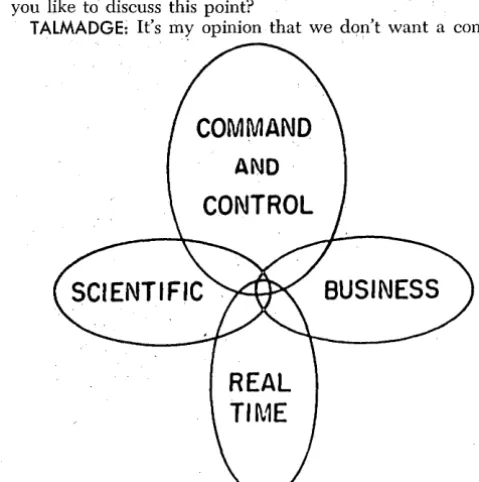
PATRICK: The object of today's discussion is enlighten-ment on the subject of common'ianguages. Let's look at Figure 1. This chart will indicate why we should all be concerned. It is rumored that the DOD Intends· to stand-ardize on a language for Command and Control. This chart shows an area characterized by the name, Business, usually characterized by a high ratio of input and output to com-puting. On the left we also have Scientific jobs which are characterized by just the inverse. We have all heard of the famous Los Alamos job in which you read one card in the morning, compute all day, and print one line in the after-noon. Of course, this job doesn't exist; in fact neither of these areas exist in pure form; but sections and subsections of jobs do fall into these categories. There is an overlap of the two as indicated hy this Venn diagram intersect. This overlap is seen in areas like data reduction and heavy actu-arial work~ In these area you may think of it as scientific, but it has many characteristics of a business job. Command and Control has characteristics which are common to these two and also many characterisics' of is own. Real time ap-plications have characteristics common to Command and Control anci also characteristics unique to real time prob-: lems. Consequently, if anything were to happen such as a
standardi~ed language for Command and Control,' it would affect the entire field.
, The lower portion of the chart shows a simple equatio~. The equation is an expression for total cost. (A similar ex-pression could be written for time.) As the equation shows, total cost is, made up of q,ollat amounts spent for training, programming, coding, compilation, assembly, testing, pro-duction, maintenance, and documentation. All of these fac-tors are involved in every single job that is done on
a
com-puter. (In some cases the coefficient of a given term may be zero. For example, if you have the facility for compile-and-go, then the assembly phase does not appear.) But for most' problems, all the terms exist with non-trivial coeffi-cients.Sales literature and some . of the "technical" literature that we read implies that we can reduce, some of these terms without at the same time· increasing some of the other tenns. 'Gullible citizens believe these statements. I believe that we will be doing' ourselves and our country serious damage if we fail to see through these claims.
Now, would anyone like to open up the informal discus-sion with a fact?
OPLER: I would rather ope)). with a question. Do you distinguish between a common language and 'a standard
lang~age?
PATRICK: 'I think we would like to i{you would care to
describe them for' us. '
. OPLER: A common language is one that would be ac-ceptable to two or more disparate machines. A standard language is one maintained· and enforced as a standard language which requires some sort of committee agree-ment. '
Some manufacturers had developed languages which could be processed on several of their machines. These would be common languages, but they would not be stand-ard languages.
LITTLE: Are we saying that a common language may not be the standard, but a standard language, by definition, must be common?
BROMBERG:, I feel it is unnecessary to labor this tinction. For our purposes here, it seems to me we can dis-cuss only common languages, by which we mean those which can function on' more than one machine type.
PATRICK: Maybe it would be appropriate' to discuss whether we want one. I think there are some of us who do, but then there are also some of us who don't. Dick, would you like to discuss this point?
TALMADGE: It's my opinion that we don't want a
com-Figure 1