warwick.ac.uk/lib-publications
Original citation:Khatri, Chetan, Ahmed, Imran, Parsons, Helen, Smith, Nicholas A., Lawrence , Tom, Modi, Chetan, Drew, Steve, Bhabra, Gev, Parsons, Nicholas R., Underwood, Martin and Metcalfe, Andrew (2018) The Natural History of Full-Thickness Rotator Cuff Tears in Randomized Controlled Trials: A Systematic Review and Meta-analysis. American Journal of Sports Medicine . doi:10.1177/0363546518780694
Permanent WRAP URL:
http://wrap.warwick.ac.uk/104280
Copyright and reuse:
The Warwick Research Archive Portal (WRAP) makes this work by researchers of the University of Warwick available open access under the following conditions. Copyright © and all moral rights to the version of the paper presented here belong to the individual author(s) and/or other copyright owners. To the extent reasonable and practicable the material made available in WRAP has been checked for eligibility before being made available.
Copies of full items can be used for personal research or study, educational, or not-for profit purposes without prior permission or charge. Provided that the authors, title and full bibliographic details are credited, a hyperlink and/or URL is given for the original metadata page and the content is not changed in any way.
Publisher’s statement:
Citation: Khatri, Chetan, Ahmed, Imran, Parsons, Helen, Smith, Nicholas A., Lawrence , Tom, Modi, Chetan, Drew, Steve, Bhabra, Gev, Parsons, Nicholas R., Underwood, Martin and Metcalfe, Andrew (2018) The Natural History of Full-Thickness Rotator Cuff Tears in
Randomized Controlled Trials: A Systematic Review and Meta-analysis. American Journal of Sports Medicine . doi:10.1177/0363546518780694
Copyright © The Author(s) 2018. Reprinted by permission of SAGE Publications.
Published version: https://doi.org/10.1177/0363546518780694
A note on versions:
The version presented here may differ from the published version or, version of record, if you wish to cite this item you are advised to consult the publisher’s version. Please see the ‘permanent WRAP url’ above for details on accessing the published version and note that access may require a subscription.
The Natural History of Full Thickness Rotator Cuff Tears in
1Randomised Controlled Trials: A Systematic Review &
Meta-2Analysis of Operative and Nonoperative Treatments
34 5 6 7 8 9 10 11 12 13 14 15 16 17 18 19 20 21 22 23 24 25 26 27 28 29 30
Declarations 31
32
Running title: Natural History of Full Thickness Rotator Cuff Tears 33
Funding: No funding was received for the completion of this 34
project. 35
Competing interests: We declare that we have no conflicts of interest in the 36
authorship or the publication of this contribution 37
Acknowledgments: Nil 38
Ethical Approval: There was no ethics needed for this paper 39
Data sharing statement: All data is presented in this paper. There is no 40
additional unpublished data 41
Abstract
43 44
Background: Rotator cuff tears are the commonest tendon injury in the adult 45
population, resulting in substantial morbidity. The optimum management for these 46
patients is not known. 47
48
Purpose: To assess the overall treatment response to all interventions in full-49
thickness rotator cuff tears in patients enrolled in randomised clinical trials. 50
51
Study Design: Systematic review and meta-analysis. 52
53
Methods: Randomised controlled trials (RCTs) were identified from a systematic 54
search of Medline, Embase and CINAHL databases. Patients
aged
18 or over with 55full-thickness rotator cuff tear. The primary outcome measure was change of 56
Constant shoulder score from baseline at 52 weeks. A meta-analysis to assess 57
treatment response was calculated using the standardised mean change in scores. 58
59
Results: We included 57 RCTs. The pooled standardised mean change, compared to 60
baseline was: 1.42 (95% CI 0.80-2.04) at 3 months, 2.73 (95% CI 1.06-4.40) at 6 61
months and 3.18 (95% CI 1.64-4.71) at 12 months. Graphical plots of treatment 62
response demonstrate a sustained improvement in outcomes in both non-operative 63
trial arms and all operative sub-group arms. 64
65
Conclusions: Patients with full-thickness rotator cuff tears demonstrated a consistent 66
pattern of improvement in Constant score with both conservative and operative care. 67
The natural history of patients with rotator cuff tears included in RCTs is to improve 68
over time, whether treated operatively or non-operatively. 69
What is known about the subject: Rotator cuff tears represent the commonest tendon 71
injury in the adult population, however the optimum management of these patients is 72
not known. In other chronic musculoskeletal conditions, it has been shown that there 73
is improvement in clinical outcome measures with all treatments over time. However, 74
it is not known if this is also true for rotator cuff tears. 75
76
What this study adds to existing knowledge: This review found there is consistent 77
improvement in Constant score, irrespective of intervention given whether it is 78
operative, or non-operative treatments. Patient outcomes at 12 months are highly 79
predictive of outcomes at 24 months, suggesting that 12-month should be used as a 80
primary outcome time point for future randomised controlled trials in full-thickness 81
MAIN TEXT
83
Introduction
84
85
Rotator cuff tears are the commonest tendon injury in the adult population, affecting 86
approximately 30% of the population above the age of 60 82. The prevalence
87
increases with age. Risk factors for development include male gender, employment 88
consisting of manual labour and previous trauma 96. Whilst many tears are
89
asymptomatic, up to 35% of patients will then progress to develop pain and inability 90
to perform activities of daily living 70,95. For patients with full-thickness rotator cuff
91
tears there is debate about the optimum management, including the use of different 92
operative techniques, operative adjuncts, and non-operative management 25,56.
93
Nevertheless, there has been a trend to provide more surgical treatments for these 94
injuries. The number of rotator cuff repairs performed in the UK increased by 238% 95
over 14 years to 2009 27.
96
97
Over recent years there has been a substantial growth in the number of randomised 98
controlled trials and systematic reviews of shoulder treatments 38,40,41,66. However,
99
most studies show, at best, a modest additional improvement in patient reported 100
outcomes over time, with no clear superiority of one treatment modality over the 101
other 38,40,41,66.
102
103
In other chronic, painful conditions, it has been noted that outcomes improve over 104
time in patients in randomised trials, regardless of their treatment 3,4,90. This may be
105
due to the natural history of chronic musculoskeletal conditions, regression to the 106
mean or other unrecognised mechanisms. As a result, it presents a challenge for the 107
interpretation of outcomes in studies of patients with rotator cuff tears. Randomised 108
they have well defined entry criteria, are prospective by definition, and typically have 110
well defined follow-up time points. In addition, the natural history of patients with 111
rotator cuff pathologies in randomised controlled trials needs to be better understood 112
to improve the planning and conduct of further trials in this area. 113
114
115
Aims: To assess the outcomes and trajectories over time amongst patients with full-116
Methods
118
119
This study was reported in accordance with the PRISMA statement for reporting 120
systematic reviews. The systematic review protocol was pre-defined and can be 121
found at http://www.crd.york.ac.uk/PROSPERO (CRD42016047715). 122
123
Inclusion Criteria 124
125
Inclusion criteria were: (i) full text, randomised controlled trials in English language, 126
(ii) any humans of any age with isolated full thickness rotator cuff tears, (iii) studies 127
comparing both operative and non-operative interventions and (iv) reporting clinical 128
outcome measures chosen for this review were included. 129
130
Exclusion Criteria 131
132
Exclusion criteria were: (i) non-randomised studies, (ii) studies reporting 133
biomechanical and radiological outcomes, (iii) studies not reporting clinical outcomes 134
selected for this review and (iv) abstract publication only. 135
136
Studies including patients with partial-thickness tears or examining treatments for 137
shoulder disorders other than full-thickness tears were also excluded. 138
139
Up to three attempts were made to contact the corresponding author for additional 140
information if; (i) further information was required about study design to confirm 141
inclusion, (ii) there were missing data for unreported or partially unreported outcomes 142
or (iii) outcomes were for the full-thickness sub-population where the study 143
population was mixed (full thickness and other pathologies). 144
Outcome measures 146
147
The primary outcome measure was the Constant shoulder score 20 at 52 weeks. The
148
Constant score is the most widely used shoulder evaluation score in Europe 51 and
149
has been described as the most efficient outcome measure for patients with rotator 150
cuff tears 61. It is a composite core measuring a combination of physical examination
151
and subjective assessments from the patient. 152
153
The secondary outcome measures included: (i) the American Shoulder and Elbow 154
Score (ASES) 83 at all time points, (ii) the University California-Los Angeles (UCLA) 2
155
score at all time points, (iii) the Disabilities of the Arm, Shoulder and Hand (DASH) 39
156
and (iv) Constant score (including modifications of the Constant score) 20 at all time
157
points. 158
159
Search Strategy and quality assessment 160
161
We searched Medline, Embase, The Cochrane central register of controlled trials 162
and CINAHL databases from inception to 14th September 2016 and imported
163
citations into EndNote X7 (New York, USA) reference management software. A full 164
search strategy can be found in the supplementary material. Following removal of 165
duplicates, citations were screened using title and abstract with the inclusion criteria 166
described above applied. To reduce the risk of publication bias, if multiple studies 167
reported the same, or an overlapping population, only the study with the longest 168
follow up was included. For those studies that potentially met eligibility criteria, full 169
texts were obtained. Two authors (CK & IA) independently assessed each paper, 170
with any discrepancies being resolved with discussion with the senior authors (NS & 171
AM). 172
We did a qualitative risk of bias assessment using Cochrane guidelines 37. Where the
174
main paper did not include sufficient information to complete risk of bias assessment 175
any published protocols were also examined. 176
177
Statistical analysis 178
179
We extracted outcome data from each study according to follow up time period. As 180
there was often a wide heterogeneity in follow up time points, the exact time point 181
was recorded, even if different for study arms. As performed in a similar meta-182
analysis by Artus et al. 3, we developed a data analysis plan, including a descriptive
183
analysis, assessment of the variation of size of response and finally the overall 184
pattern of response prior to data extraction. 185
186
Extracting data 187
188
We extracted the number of patients in each arm, the intervention type for each arm, 189
which was defined as repair, acromioplasty alone or conservative. In addition, the 190
mean and standard deviation (SD) of Constant score (standard and modified), 191
gender, dominant hand and the time point assessed were extracted for each study. If 192
a study did not report one of these statistics, then estimates of missing values were 193
calculated from other reported values, such as the test statistic or p-value using 194
standard methods as described in the Cochrane Handbook 34. Where data in studies
195
was not represented in numerical format, data were extracted from graphs by two 196
authors (CK & IA) to improve accuracy of data. 197
198
Assessing the general response of treatment 199
Outcome scores were graphically plotted against time using Microsoft Excel 201
(Microsoft Excel for Mac 2011, Washington, USA) to describe change from baseline 202
to all follow up points reported in all treatment arms from included studies. Data were 203
explored visually for a descriptive analysis of response. As a visual response trend 204
was required, studies using modified versions of Constant score were included. 205
206
Assessing variation of size of response 207
208
To determine variation in size of response we analysed the change in outcome score 209
by calculating the bias-corrected standardised mean change (SMC) at three, six, 12 210
and 24 months). This technique is used frequently when studies report efficacy in 211
terms of a continuous measurement. For example, it could be used when comparing 212
the outcome of a new analgesic drug using visual analogue pain scales as an 213
outcome, comparing intervention and placebo. The SMC could be interpreted as the 214
‘standardised’ measure of outcome, where (assuming high scores denote more 215
severe pain) if there were no difference between the interventions, the SMC would 216
be zero, whilst a negative SMC would represent a reduction in pain. The SMC score 217
is calculated by subtracting the follow up mean score in chosen outcome measure 218
from the baseline mean score. This is then divided by its pooled SD, multiplied by a 219
bias correction factor based on the group size 71. If the pooled SD was not reported,
220
the baseline SD was used, or the SD at follow up. Estimates of the variance of the 221
SMC were also calculated 72 and used to construct 95% confidence intervals. To
222
allow for the repeated measures design, the within-group correlation was set at 0.5 223
for all studies 17.
224
225
Summarising the overall response to treatment 226
As the SMC standardises the measurement of change over time, studies using 228
slightly different scales can be pooled together for comparison. As such, studies 229
using modified or adjusted Constant scores were combined alongside those that 230
reported unmodified scales. As for similar meta-analyses 3, one arm was then
231
randomly selected per trial. This was because changes in outcome over time were of 232
interest, rather than between arms comparison (e.g. to demonstrate superiority of 233
one type of intervention). Intervention arms from each study are likely to be further 234
correlated since participants recruited to each trial are likely to have similar 235
characteristics and therefore have a similar response to treatment, which means that 236
observations from different study arms would not be independent. Furthermore, the 237
objective of this review was to describe the effect of treatments and not to estimate 238
effect sizes between intervention groups. 239
240
We calculated a combined pooled estimate of SMC for each time point using a 241
random effects model. Studies were subcategorised according to treatment given to: 242
(i) where primary repair was performed (ii) where acromioplasty was performed only 243
iii) conservative (non-operative) treatment. If patients had a primary repair and 244
another treatment adjunct was applied (such as the application of platelet rich protein 245
or acromioplasty) the study arm was allocated to repair group. We did a simple 246
correlation analysis (using Pearson’s correlation coefficient) on the SMCs between 247
each time point to assess the relationship between each subsequent time point. 248
249
Analyses were conducted in R (Vienna, Austria) 80 and using the metafor package 92.
250
Results
252
253
A total of 1033 citations were received from our search strategy. After removal of 254
duplicates and screening of studies by title and abstract, 100 full text papers were 255
retrieved. Out of these, 57 studies met our inclusion criteria from which 43 studies 256
used the Constant score as an outcome measure (Figure 1). Of the 57 studies 257
selected, 14 study authors were contacted for further information, however no 258
[image:12.595.48.462.82.756.2]responses were received. 259
Figure 1: Flow diagram detailing inclusion of studies into the review. 260
261
Description of studies included 262
263
With respect to studies reporting the Constant score; there were 39 studies with 73 264
arms that described treatment response for operative interventions of which eight 265
studies with eight arms had repair and acromioplasty performed; two studies with two 266
arms for acromioplasty only; five studies with seven arms were described for non-267
with 40 treatment arms reported the UCLA score. The DASH was the least frequently 269
reported score, with seven studies reporting 14 different treatment arms. A 270
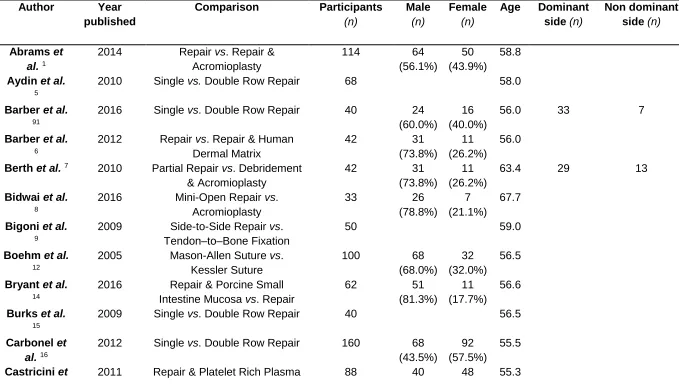
description of included studies is available in Table 1. 271
272
Description of patient population included 273
274
We included data from 4542 participants in this review, with study populations 275
ranging from a minimum of 20 to 248 patients. Within the included studies, eight did 276
not report gender. Of those that did report gender of patients included, 48% of 277
participants were male. Four studies out of 57 did not report age; in those that did, 278
the median of the mean reported age of participants was 59.0 (IQR 5.3). Of those 279
studies included, 27 did not report dominant hand of included patients. From those 280
studies reporting, 71% of participants had a full-thickness tear of their dominant side. 281
282
Risk of bias assessment 283
284
Studies included in this review had a low risk of bias for all domains apart from 285
blinding of participants and personal (performance bias); 42% (24/57) of studies had 286
a low risk of performance bias: 47% (27/57) of studies had an unclear risk of bias 287
(Figure 2). 288
Figure 2: Summary Table of Risk of Bias Assessment for Studies Included 289
290
The general response to treatment 291
Figure 2: Summary Table of Risk of Bias Assessment for Studies Included
292
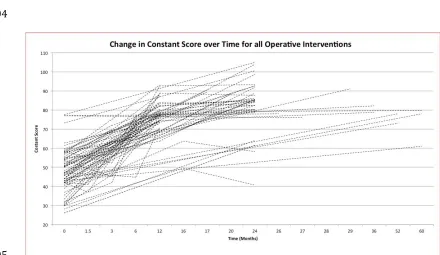
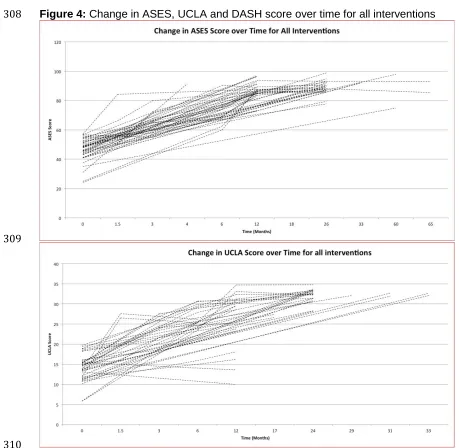
There was an overall improvement in all arms from baseline for studies reporting 293
Constant score (Figure 3). When exploring differences between operative and non-294
operative arms, this effect was sustained, with all study arms showing positive 295
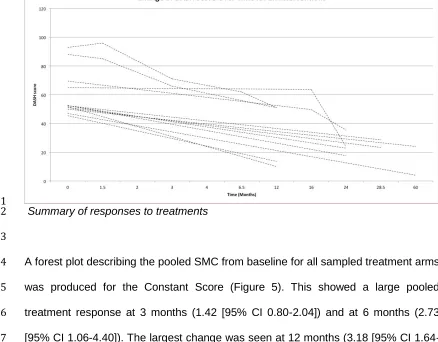
change. Treatment response in all outcome measures (ASES, UCLA and DASH) 296
showed an improvement in functional outcomes regardless of treatment intervention 297
applied (Figure 4). Studies that followed up patients at multiple time points indicate 298
an improvement in outcome in the first 12 months, following which the rate of 299
improvement stabilised. This pattern was consistent irrespective of treatment type 300
[image:14.595.65.505.369.624.2]given (primary repair, acromioplasty only, or non-operative intervention). 301
Figure 3: Change in Constant score for all operative and non-operative interventions 302
over time (includes modified Constant score) 303
304
[image:15.595.51.510.282.730.2]
306 307
Figure 4: Change in ASES, UCLA and DASH score over time for all interventions 308
309
311
Summary of responses to treatments 312
313
A forest plot describing the pooled SMC from baseline for all sampled treatment arms 314
was produced for the Constant Score (Figure 5). This showed a large pooled 315
treatment response at 3 months (1.42 [95% CI 0.80-2.04]) and at 6 months (2.73 316
[95% CI 1.06-4.40]). The largest change was seen at 12 months (3.18 [95% CI 1.64-317
[image:16.595.66.504.86.428.2]4.71], which then reduced slightly at 24 months (2.98 [95% CI 1.40-4.55]). 318
Figure 5: SMC for Constant score for one arm randomly selected from each trial arm 319
at 3, 6, 12 and 24 months. 320
322
In the sub-group analysis, the greatest effects were seen in patients undergoing 323
rotator cuff repair, although a meta-analysis of papers directly comparing the two was 324
not performed and therefore this should not be taken as direct evidence of benefit for 325
repair. Trends in the effects followed the same pattern as observed in the main 326
analysis, with the largest effects observed at 12 months with a SMC of 3.65 (95% CI 327
1.74-5.56) for patients undergoing repair compared to 1.78 (95% CI 1.10-2.46) for 328
conservative and 0.27 (95% CI 0.01-0.53) for acromioplasty patients. 329
330
There was strong correlation in SMCs for each time point, which increased as the 331
studies progressed. The Pearson’s correlation coefficients were 0.816 (n=11, 95% CI 332
0.424 to 0.951) between 3 months and 6 months, 0.987 (n=13, 95% CI 0.957 to 333
0.996) between 6 months and 12 months and 0.999 (n=9, 95% CI 0.996 to 1.00) 334
between 12 months and 24 months. 335
Discussion
337
338
We aimed to collate the evidence on the short-term natural history of patients with 339
symptomatic full-thickness rotator cuff tears, regardless of the treatment they 340
received. The studies included in this review examined a wide variety of treatment 341
modalities, including a variety of operative techniques as well as non-operative 342
interventions. This review found that treatment response follows a similar pattern of 343
rapid improvement in the first 12 months after an intervention, after which the 344
recovery plateaus. This pattern was found in all treatment arms irrespective of 345
intervention applied, including either surgical or non-surgical care. 346
347
Whilst assessing the natural history of a condition using randomised trial data alone 348
may seem counter-intuitive, there are a number of good reasons for doing so. 349
Randomised trials typically have well organised follow-up arrangements at fixed time 350
periods from randomisation, which are usually pre-defined. By definition, they are 351
prospective studies in well-defined populations. A well-constructed cohort study can 352
achieve all of these things but this is harder to detect and assess when reviewing a 353
paper, and many cohort studies suffer from being conducted with cross-sectional 354
sampling, meaning that follow-up times vary considerably from the intervention. This 355
may be valuable in a long-term follow up study, but the purpose of this study was to 356
examine short to medium-term outcomes (that is, in the first few months and years 357
after the intervention) and as such, randomised trials provide a wealth of prospective 358
data with fixed time points for follow up. 359
360
In determining an explanation for the patterns that were observed, consideration 361
must be given to the natural history of rotator cuff tears. Previously conducted 362
systematic reviews have commented on the scarcity of studies investigating the topic 363
26. A cohort study by Safran and colleagues assessing the natural history in
symptomatic, full-thickness rotator cuff tears who were treated non-operatively found 365
that patients often had progression in tear size which was linked to a deterioration in 366
pain 86. This is different to our findings, where we found non-operatively treated
367
patients improve in outcome measures. In the above study, it is not explained why 368
their cohort was treated non-operatively, as perhaps these patients may have been 369
unsuitable for operative intervention. On comparison, in half of the studies included in 370
this review with a non-operative arm, participants would have been suitable for an 371
operative intervention. In addition, people included in studies with only non-operative 372
arms may not have had significant disability to seek operative intervention. As such 373
this may represent two different sub-sections of the population. 374
375
Moosmayer found that patients with asymptomatic rotator cuff tears often progressed 376
to become symptomatic, representing a structural deterioration of the rotator cuff 70.
377
However, this patient cohort differs from those entered into randomised controlled 378
trials, as asymptomatic patients are unlikely to actively seek healthcare. In contrast, 379
patients seeking surgical treatment are likely to represent a sub-section of the 380
population with the worst symptoms, leading to lower baseline outcome scores. As 381
such, these patients also represent those who have the potential for larger reductions 382
in symptoms and therefore the greatest treatment response. 383
384
The phenomenon of regression to the mean is a ubiquitous statistical occurrence in 385
repeated data. This suggests that if a variable is extreme on its first measurement, it 386
will tend to be closer to the population mean on subsequent measurements 73. In
387
other words, if a patient’s pain varies, they will typically see a specialist and be 388
entered for treatment (or into a study) when the pain is at its peak, and in future 389
measurements it will be reduced as the pain then falls from that previous peak. As 390
such, patients with worse baseline outcome measures represent those with greater 391
who present with pain and symptoms will recover with time and patient care, as 393
implied by these studies where there is a large effect and regression to the mean 394
may seem to be unlikely. In reality, it is difficult to separate the effects of regression 395
to the mean from the true natural history of full-thickness tears. 396
397
Thought must also be given to non-specific factors for change in outcomes. Indeed, 398
there is evidence to suggest participation in randomised controlled trials may itself 399
confer benefit to patients 13. This effect is particularly seen in situations where
400
effective treatments are included in the trial protocol 13, such as for many studies
401
included in this review. Other factors, such as trust in health care professional 402
delivering treatment 10 and the manner in which patients expectations for treatment
403
response is enhanced by positive information 11 all significantly contribute to the
404
improvement of health outcomes. In addition, attributes from the patient including 405
their expectation, emotions and psychological conditioning have been found to be of 406
positive influence 52,79. Perhaps the best recognised is the role of the placebo in
407
influencing outcomes. Whilst its influence within drug trials is well established, there 408
is evidence for its use as an effective treatment in other chronic musculoskeletal 409
conditions 97. Furthermore, the placebo can be augmented with previously mentioned
410
factors such as clinician warmth 45. Again it is difficult to estimate the effect of these
411
factors into the trials included in this study. 412
413
One other consideration is the timing of outcomes in randomised studies. It is 414
common for reviewers to insist on 24-month outcomes, however we found that they 415
add little value beyond 12 months. After 12 months in all treatment arms, the 416
improvement stabilised, and correlations in scores at different time points were very 417
high. In other words, once the 12-month outcomes were known then the 24-month 418
outcomes were highly predictable. We recommend a 12-month primary outcome 419
trials, which are often expensive and time consuming, and reporting at 12 rather then 421
24 months would save substantial cost as well as time in producing an answer that 422
can be delivered to improved clinical care for patients, whereas waiting for a 24 423
month follow-up adds little. This is not to say that later follow-up (say, five or ten 424
year) does not add different or valuable information, but in terms of short to medium-425
term outcomes, a primary outcome at 12 months can be recommended based on our 426
findings. 427
428
Surgical treatments may be effective, although their true effect over non-operative 429
treatment is likely to be much less than the effect that seen in uncontrolled case-430
series. Our data show that such an improvement may also be seen with conservative 431
treatments. The overall effect of surgery can only be assessed by comparing surgery 432
to conservative treatment, and consideration should also be given sham or placebo 433
controlled trials of surgery 31,94. When assessing the results of surgical procedures,
434
and surgeons should be aware of the natural history of symptomatic cuff tears in the 435
short term to improve substantially with conservative care alone when they assess 436
the result of other treatments or procedures. 437
438
Strengths and Limitations 439
440
This study was conducted and reported in accordance with the PRISMA guidelines 441
67. It was conducted with a pre-defined and published study protocol.
442
443
We used the Constant score as its primary outcome measure. It is the most widely 444
used assessment tool 51 and was the most frequently outcome measure in studies
445
included in this review thus giving the greatest volume of data to pool. Other 446
measures used in this review including ASES, UCLA score and the DASH score 447
outcome measures. A small number of trials used other measures such as change in 449
visual analogue score, or purely radiological outcome measures, which were 450
therefore not included. As these were so infrequently reported and varied in their 451
definitions, any meaningful pooling of this data would not have been possible. 452
453
Only trials with fully published outcome measures were included. Thus, there is a risk 454
of publication bias from studies with incomplete outcome data, which were excluded 455
from the study analysis. In line with Cochrane guidelines, authors of the papers were 456
contacted with reasonable efforts in order to minimise this. A further limitation is that 457
only English language studies were included. However, this results in only two 458
studies being excluded and those that were included were from a wide distribution 459
geographically. The large number of included studies showing consistent results 460
suggests is unlikely that our conclusions would be changed if any other such studies 461
had been included. 462
463
This study has not been designed as a meta-analysis to directly compare rotator cuff 464
repair, acromioplasty or physiotherapy, and rather is a description of the natural 465
history of each treatment. Conclusions on the relative merits of the treatments should 466
not be directly inferred from these findings. Different studies are included which may 467
have had different populations in them. An example of this is the apparent worse 468
performance of acromioplasty relative to repair or conservative care. Whilst the study 469
did adjust for baseline scores, the different studies are not necessarily the same 470
population of patients or types of tear, so care should be taken in over-interpreting 471
our findings. However, it makes an important statement about the likely outcome of 472
patients with symptomatic cuff tears over time, and this needs to be considered when 473
interventions such as surgery are being considered, or when other treatments are 474
being evaluated. 475
We did not assess the long-term outcomes of these patients. Certainly, it is 477
established that massive rotator cuff tears can lead to the development of rotator cuff 478
arthropathy 24. This may then result in a deterioration of outcomes and there is
479
evidence to suggest early repair of rotator cuff tears can prevent progression into 480
rotator cuff arthropathy 19,74. Unfortunately long term outcomes were beyond the
481
scope of this review as it was based on trial data, which typically does not extend 482
Conclusions 484
485
We have shown that patients with symptomatic full-thickness rotator cuff tears 486
demonstrate a consistent and considerable response to treatment, even with 487
conservative management. The largest improvement occurs in the first 12 months, 488
after which the response stabilises. When assessing the treatment effect of invasive 489
surgery, consideration must be given to the natural history of patients with rotator cuff 490
tears to improve over time with non-operative care as well. 491
492
493
Funding 494
495
References
497
1. Abrams GD, Gupta AK, Hussey KE, et al. Arthroscopic Repair of Full-498
Thickness Rotator Cuff Tears With and Without Acromioplasty: Randomized 499
Prospective Trial With 2-Year Follow-up. Am J Sports Med. 2014;42(6):1296-500
1303. 501
2. Amstutz HC, Sew Hoy AL, Clarke IC. UCLA anatomic total shoulder 502
arthroplasty. Clin Orthop Relat Res. (155):7-20. 503
3. Artus M, van der Windt DA, Jordan KP, Hay EM. Low back pain symptoms 504
show a similar pattern of improvement following a wide range of primary care 505
treatments: A systematic review of randomized clinical trials. Rheumatology. 506
2010;49(12):2346-2356. 507
4. Artus M, van der Windt D, Jordan KP, Croft PR. The clinical course of low 508
back pain: a meta-analysis comparing outcomes in randomised clinical trials 509
(RCTs) and observational studies. BMC Musculoskelet Disord. 2014;15(1):68.. 510
5. Aydin N, Kocaoglu B, Guven O. Single-row versus double-row arthroscopic 511
rotator cuff repair in small- to medium-sized tears. J Shoulder Elb Surg. 512
2010;19(5):722-725. 513
6. Barber F a, Burns JP, Deutsch a, Labbe MR, Litchfield RB. A prospective, 514
randomized evaluation of acellular human dermal matrix augmentation for 515
arthroscopic rotator cuff repair. Arthrosc J Arthrosc Relat Surg. 2012;28(1):8-516
15.. 517
7. Berth A, Neumann W, Awiszus F, Pap G. Massive rotator cuff tears: functional 518
outcome after debridement or arthroscopic partial repair. J Orthop Traumatol. 519
2010;11(1):13-20. 520
8. Bidwai ASC, Birch A, Temperley D, et al. Medium- to long-term results of a 521
randomized controlled trial to assess the efficacy of arthoscopic-subacromial 522
decompression versus mini-open repair for the treatment of medium-sized 523
rotator cuff tears. Shoulder Elb. 2016;8(2):101-105. 524
9. Bigoni M, Gorla M, Guerrasio S, et al. Shoulder evaluation with isokinetic 525
strength testing after arthroscopic rotator cuff repairs. J Shoulder Elbow Surg. 526
2009;18(2):178-183. 527
10. Birkhäuer J, Gaab J, Kossowsky J, et al. Trust in the health care professional 528
and health outcome: A meta-analysis. PLoS One. 2017;12(2):e0170988. 529
11. Blasi Z Di, Harkness E, Ernst E, Georgiou A, Kleijnen J. Influence of context 530
effects on health outcomes: a systematic review. Lancet. 2001;357(9258):757-531
762. 532
12. Boehm TD, Werner A, Radtke S, Mueller T, Kirschner S, Gohlke F. The effect 533
of suture materials and techniques on the outcome of repair of the rotator cuff. 534
J Bone Jt Surg - Ser B. 2005;87(6):819-823. 535
13. Braunholtz DA, Edwards SJL, Lilford RJ. Are randomized clinical trials good 536
for us (in the short term)? Evidence for a “trial effect.” J Clin Epidemiol. 537
2001;54(3):217-224. 538
14. Bryant D, Holtby R, Willits K, et al. A randomized clinical trial to compare the 539
effectiveness of rotator cuff repair with or without augmentation using porcine 540
small intestine submucosa for patients with moderate to large rotator cuff 541
tears: a pilot study. J Shoulder Elbow Surg. 2016. 542
15. Burks RT, Crim J, Brown N, Fink B, Greis PE. A prospective randomized 543
clinical trial comparing arthroscopic single- and double-row rotator cuff repair: 544
magnetic resonance imaging and early clinical evaluation. Am J Sports Med. 545
2009;37(4):674-682. 546
16. Carbonel I, Martinez A, Calvo A, Ripalda J, Herrera A. Single-row versus 547
double-row arthroscopic repair in the treatment of rotator cuff tears: A 548
prospective randomized clinical study. Int Orthop. 2012;36(9):1877-1883. 549
17. Carr AJ, Cooper CD, Campbell MK, et al. Clinical effectiveness and cost-550
Surgery (UKUFF) randomised trial]. Health Technol Assess. 2015;19(80):1-552
218. 553
18. Castricini R, Longo UG, De Benedetto M, et al. Platelet-rich plasma 554
augmentation for arthroscopic rotator cuff repair: a randomized controlled trial. 555
Am J Sports Med. 2011;39(2):258-265.
556
19. Clement ND, Nie YX, McBirnie JM. Management of degenerative rotator cuff 557
tears: a review and treatment strategy. Sports Med Arthrosc Rehabil Ther 558
Technol. 2012;4(1):48. 559
20. Constant CR, Murley AH. A clinical method of functional assessment of the 560
shoulder. Clin Orthop Relat Res. 1987;(214):160-164. 561
21. Cuff DJ, Pupello DR. Prospective randomized study of arthroscopic rotator cuff 562
repair using an early versus delayed postoperative physical therapy protocol. J 563
Shoulder Elbow Surg. 2012;21(11):1450-1455.
564
22. Dezaly C, Sirveaux F, Philippe R, et al. Arthroscopic treatment of rotator cuff 565
tear in the over-60s: Repair is preferable to isolated acromioplasty-tenotomy in 566
the short term. Orthop Traumatol Surg Res. 2011;97(6 SUPPL.):S125-S130. 567
23. Duzgun I, Baltaci G, Atay OA. Comparison of slow and accelerated 568
rehabilitation protocol after arthroscopic rotator cuff repair: pain and functional 569
activity. Acta Orthop Traumatol Turc. 2011;45(1):23-33. 570
24. Ecklund KJ, Lee TQ, Tibone J, Gupta R. Rotator cuff tear arthropathy. J Am 571
Acad Orthop Surg. 2007;15(6):340-349.
572
25. Edwards P, Ebert J, Joss B, Bhabra G, Ackland T, Wang A. Excercise 573
rehabilitation in the non-operative management of rotator cuff tears: A review 574
of the literature. Int J Sports Phys Ther. 2016;11(2):279-301. 575
26. Eljabu W, Klinger HM, von Knoch M. The natural history of rotator cuff tears: a 576
systematic review. Arch Orthop Trauma Surg. 2015;135(8):1055-1061. 577
27. Ensor KL, Kwon YW, DiBeneditto MR, Zuckerman JD, Rokito AS. The rising 578
incidence of rotator cuff repairs. J Shoulder Elb Surg. 2013;22(12):1628-1632. 579
28. Flurin P-H, Hardy P, Abadie P, et al. Rotator cuff tears after 70years of age: A 580
prospective, randomized, comparative study between decompression and 581
arthroscopic repair in 154 patients. Orthop Traumatol Surg Res. 2013;99(8 582
S):S371-S378. 583
29. Franceschi F, Ruzzini L, UG L, et al. Equivalent clinical results of arthroscopic 584
single-row and double-row suture anchor repair for rotator cuff tears: a 585
randomized controlled trial. Am J Sports Med. 2007;35(8):1254-1260. 586
30. Gartsman GM, O’connor DP. Arthroscopic rotator cuff repair with and without 587
arthroscopic subacromial decompression: a prospective, randomized study of 588
one-year outcomes. J Shoulder Elbow Surg. 2004;13(4):424-426. 589
31. George A, Collett C, Carr A, et al. When should placebo surgery as a control 590
in clinical trials be carried out? Bull R Coll Surg Engl. 2016;98(2):75-79. 591
32. Gialanella B, Prometti P. Effects of Corticosteroids Injection in Rotator Cuff 592
Tears. Pain Med. 2011;12(10):1559-1565. 593
33. Grasso A, Milano G, Salvatore M, Falcone G, Deriu L, Fabbriciani C. Single-594
row versus double-row arthroscopic rotator cuff repair: a prospective 595
randomized clinical study. Arthrosc J Arthrosc Relat Surg. 2009;25(1):4-12. 596
34. Green edited by JPTH and S. Cochrane Handbook for Systematic Reviews of 597
Interventions. Chichester, West Sussex ; Hoboken NJ : John Wiley & 598
Sons, [2008]. 599
35. Greiner S, Schmidt C, Herrmann S, Pauly S, Perka C. Clinical performance of 600
lateralized versus non-lateralized reverse shoulder arthroplasty: A prospective 601
randomized study. J Shoulder Elb Surg. 2015;24(9):1397-1404. 602
36. Gumina S, Campagna V, Ferrazza G, et al. Use of platelet-leukocyte 603
membrane in arthroscopic repair of large rotator cuff tears: A prospective 604
randomized study. J Bone Jt Surg - Ser A. 2012;94(15):1345-1352. 605
tool for assessing risk of bias in randomised trials. . Br Med J. 2011;343:889-607
893. 608
38. Huang R, Wang S, Wang Y, Qin X, Sun Y. Systematic Review of All-609
Arthroscopic Versus Mini-Open Repair of Rotator Cuff Tears: A Meta-Analysis. 610
Sci Rep. 2016;6:22857. 611
39. Hudak PL, Amadio PC, Bombardier C, et al. Development of an upper 612
extremity outcome measure: The DASH (disabilities of the arm, shoulder, and 613
head). Am J Ind Med. 1996;29(6):602-608. 614
40. Huisstede BMA, Koes BW, Gebremariam L, Keijsers E, Verhaar JAN. Current 615
evidence for effectiveness of interventions to treat rotator cuff tears. Man Ther. 616
2011;16(3):217-230. 617
41. JA C, Buchbinder R, Green S, RV J, SN B. Surgery for rotator cuff disease. 618
Cochrane Database Syst Rev. January 2008:N.PAG-N.PAG.
619
42. Jacquot A, Dezaly C, Goetzmann T, Roche O, Sirveaux F, Molé D. Is rotator 620
cuffrepair appropriate in patients older than 60years of age? Prospective, 621
randomised trial in 103 patients with a mean four-year follow-up. Orthop 622
Traumatol Surg Res. 2014;100(6):S333-S338.
623
43. Jo CH, Shin JS, Lee YG, et al. Platelet-Rich Plasma for Arthroscopic Repair of 624
Large to Massive Rotator Cuff Tears: A Randomized, Single-Blind, Parallel-625
Group Trial. Am J Sports Med. 2013;41(10):2240-2248. 626
44. Jo CH, Shin JS, Shin WH, Lee SY, Yoon KS, Shin S. Platelet-Rich Plasma for 627
Arthroscopic Repair of Medium to Large Rotator Cuff Tears: A Randomized 628
Controlled Trial. Am J Sports Med. 2015;43(9):2102-2110. 629
45. Kaptchuk TJ, Kelley JM, Conboy LA, et al. Components of placebo effect: 630
randomised controlled trial in patients with irritable bowel syndrome. Br Med J. 631
2008;336(7651):999-1003. 632
46. Keener JD, Galatz LM, Stobbs-Cucchi G, Patton R, Yamaguchi K. 633
Rehabilitation following arthroscopic rotator cuff repair: a prospective 634
randomized trial of immobilization compared with early motion. J Bone Joint 635
Surg Am. 2014;96(1):11-19.
636
47. Kim J, Chung J, Ok H. Asymptomatic acromioclavicular joint arthritis in 637
arthroscopic rotator cuff tendon repair: a prospective randomized comparison 638
study. Arch Orthop Trauma Surg. 2011;131(3):363-369. 639
48. Kim JY, Lee JS, Park CW. Extracorporeal shock wave therapy is not useful 640
after arthroscopic rotator cuff repair. Knee Surgery, Sport Traumatol Arthrosc. 641
2012;20(12):2567-2572. 642
49. Kim Y-S, Chung SW, Kim JY, Ok J-H, Park I, Oh JH. Is Early Passive Motion 643
Exercise Necessary After Arthroscopic Rotator Cuff Repair? Am J Sports Med. 644
2012;40(4):815-821. 645
50. Kim Y-S, Lee H-J, Jin H-K, Kim S-E, Lee J-W. Conventional En Masse Repair 646
Versus Separate Double-Layer Double-Row Repair for the Treatment of 647
Delaminated Rotator Cuff Tears. Am J Sports Med. 2016. 648
51. Kirkley A, Griffin S, Dainty K. Scoring Systems for the Functional Assessment 649
of the Shoulder. Arthrosc - J Arthrosc Relat Surg. 2003;19(10):1109-1120. 650
52. Klinger R, Soost S, Flor H, Worm M. Classical conditioning and expectancy in 651
placebo hypoalgesia: A randomized controlled study in patients with atopic 652
dermatitis and persons with healthy skin. Pain. 2007;128(1-2):31-39. 653
53. Koh KH, Lim TK, Shon MS, Park YE, Lee SW, Yoo JC. Effect of 654
immobilization without passive exercise after rotator cuff repair: randomized 655
clinical trial comparing four and eight weeks of immobilization. J Bone Joint 656
Surg Am. 2014;96(6):e44.
657
54. Krischak G, Gebhard F, Reichel H, et al. A prospective randomized controlled 658
trial comparing occupational therapy with home-based exercises in 659
conservative treatment of rotator cuff tears. J Shoulder Elb Surg. 660
55. Kukkonen J, Joukainen A, Lehtinen J, et al. Treatment of nontraumatic rotator 662
cuff tears: A randomized controlled trial with two years of clinical and imaging 663
follow-up. J Bone Jt Surg - Am Vol. 2015;97(21):1729-1737. 664
56. Kukkonen J, Joukainen A, Lehtinen J, et al. Treatment of Nontraumatic 665
Rotator Cuff Tears: A Randomized Controlled Trial with Two Years of Clinical 666
and Imaging Follow-up. J Bone Joint Surg Am. 2015;97(21):1729-1737. 667
57. Lambers Heerspink FO, van Raay JJAM, Koorevaar RCT, et al. Comparing 668
surgical repair with conservative treatment for degenerative rotator cuff tears: 669
Arandomized controlled trial. J Shoulder Elb Surg. 2015;24(8):1274-1281. 670
58. Lapner PLC, Sabri E, Rakhra K, et al. A multicenter randomized controlled trial 671
comparing single-row with double-row fixation in arthroscopic rotator cuff 672
repair. J Bone Jt Surg - Ser A. 2012;94(14):1249-1257. 673
59. Ma HL, Chiang ER, Wu HTH, et al. Clinical outcome and imaging of 674
arthroscopic single-row and double-row rotator cuff repair: A prospective 675
randomized trial. Arthrosc - J Arthrosc Relat Surg. 2012;28(1):16-24. 676
60. MacDonald P, McRae S, Leiter J, Mascarenhas R, Lapner P. Arthroscopic 677
rotator cuff repair with and without acromioplasty in the treatment of full-678
thickness rotator cuff tears: a multicenter, randomized controlled trial. J Bone 679
Joint Surg Am. 2011;93(21):1953-1960.
680
61. Makhni EC, Hamamoto JT, Higgins JD, et al. How Comprehensive and 681
Efficient Are Patient-Reported Outcomes for Rotator Cuff Tears? Orthop J 682
Sport Med. 2017;5(3):232596711769322.
683
62. Malavolta EA, Gracitelli MEC, Ferreira Neto AA, et al. Platelet-Rich Plasma in 684
Rotator Cuff Repair: A Prospective Randomized Study. Am J Sports Med. 685
2014;42(10):2446-2454. 686
63. Merolla G, Dellabiancia F, Ingardia A, Paladini P, Porcellini G. Co-analgesic 687
therapy for arthroscopic supraspinatus tendon repair pain using a dietary 688
supplement containing Boswellia serrata and Curcuma longa: a prospective 689
randomized placebo-controlled study. Musculoskelet Surg. 2015;99:43-52. 690
64. Milano G, Grasso A, Salvatore M, Saccomanno MF, Deriu L, Fabbriciani C. 691
Arthroscopic Rotator Cuff Repair With Metal and Biodegradable Suture 692
Anchors: A Prospective Randomized Study. Arthrosc J Arthrosc Relat Surg. 693
2010;26(9):S112-S119. 694
65. Milano G, Saccomanno MF, Careri S, Taccardo G, De Vitis R, Fabbriciani C. 695
Efficacy of marrow-stimulating technique in arthroscopic rotator cuff repair: a 696
prospective randomized study. Arthroscopy. 2013;29(5):802-810. 697
66. Mj P, Green S, Mcbain B, et al. Manual therapy and exercise for rotator cuff 698
disease (Review). Cochrane Database Syst Rev. 2016;(6). 699
67. Moher D, Liberati A, Tetzlaff J, Altman DG, Altman D. Preferred Reporting 700
Items for Systematic Reviews and Meta-Analyses: The PRISMA Statement. 701
PLoS Med. 2009;6(7):e1000097.
702
68. Mohtadi NG, Hollinshead RM, Sasyniuk TM, Fletcher JA, Chan DS, Li FX. A 703
randomized clinical trial comparing open to arthroscopic acromioplasty with 704
mini-open rotator cuff repair for full-thickness rotator cuff tears: Disease-705
specific quality of life outcome at an average 2-year follow-up. Am J Sports 706
Med. 2008;36(6):1043-1051. 707
69. Moosmayer S, Lund G, Seljom US, et al. Tendon repair compared with 708
physiotherapy in the treatment of rotator cuff tears: a randomized controlled 709
study in 103 cases with a five-year follow-up. J Bone Joint Surg Am. 710
2014;96(18):1504-1514. 711
70. Moosmayer S, Tariq R, Stiris M, Smith H-J. The Natural History of 712
Asymptomatic Rotator Cuff Tears. J Bone Jt Surg Am. 2013;95(14):1249-713
1255. 714
71. Morris SB. Estimating Effect Sizes From Pretest-Posttest-Control Group 715
72. Morris SB. Estimating Effect Sizes From Pretest-Posttest-Control Group 717
Designs. Organ Res Methods. 2008;11(2):364-386. 718
73. Morton V, Torgerson DJ. Regression to the mean: treatment effect without the 719
intervention. J Eval Clin Pract. 2005;11(1):59-65. 720
74. Neer CS, Craig E V, Fukuda H. Cuff-tear arthropathy. J Bone Joint Surg Am. 721
1983;65(9):1232-1244. 722
75. Osti L, Del Buono A, Maffulli N. Microfractures at the rotator cuff footprint: a 723
randomised controlled study. Int Orthop. 2013;37(11):2165-2171. 1. 724
76. Osti L, Buono A Del, Maffulli N. Pulsed electromagnetic fields after rotator cuff 725
repair: a randomized, controlled study. Orthopedics. 2015;38(3):e223-8. 726
77. P van der Z, BJ T, MJ N, Lindenburg R, JW S, ER van A. Clinical Outcome in 727
All-Arthroscopic Versus Mini-Open Rotator Cuff Repair in Small to Medium-728
Sized Tears: A Randomized Controlled Trial in 100 Patients With 1-Year 729
Follow-up. Arthrosc J Arthrosc Relat Surg. 2013;29(2):266-273.. 730
78. Pandey V, Bandi A, Madi S, et al. Does application of moderately 731
concentrated platelet-rich plasma improve clinical and structural outcome after 732
arthroscopic repair of medium-sized to large rotator cuff tear? A randomized 733
controlled trial. J Shoulder Elbow Surg. 2016;25(8):1312-1322. 734
79. Price DD, Chung SK, Robinson ME. Conditioning, expectation, and desire for 735
relief in placebo analgesia. Semin Pain Med. 2005;3(1 SPEC. ISS.):15-21. 736
80. R Core Team. R: A language and environment for statistical computing. 737
https://www.r-project.org/. 738
81. Randelli P, Arrigoni P, Ragone V, Aliprandi A, Cabitza P. Platelet rich plasma 739
in arthroscopic rotator cuff repair: a prospective RCT study, 2-year follow-up. J 740
Shoulder Elbow Surg. 2011;20(4):518-528..
741
82. Reilly P, Macleod I, Macfarlane R, Windley J, Emery RJH. Dead men and 742
radiologists don’t lie: A review of cadaveric and radiological studies of rotator 743
cuff tear prevalence. Ann R Coll Surg Engl. 2006;88(2):116-121. 744
83. Richards RR, An K-N, Bigliani LU, et al. A standardized method for the 745
assessment of shoulder function. J Shoulder Elb Surg. 1994;3(6):347-352. 746
84. Rodeo SA, Delos D, Williams RJ, Adler RS, Pearle A, Warren RF. The effect 747
of platelet-rich fibrin matrix on rotator cuff tendon healing: a prospective, 748
randomized clinical study. Am J Sports Med. 2012;40(6):1234-1241. 749
85. Ruiz-Moneo P, Molano-Munoz J, Prieto E, Algorta J. Plasma rich in growth 750
factors in arthroscopic rotator cuff repair: A randomized, double-blind, 751
controlled clinical trial. Arthrosc - J Arthrosc Relat Surg. 2013;29(1):2-9. 752
86. Safran O, Schroeder J, Bloom R, Weil Y, Milgrom C. Natural History of 753
Nonoperatively Treated Symptomatic Rotator Cuff Tears in Patients 60 Years 754
Old or Younger. Am J Sports Med. 2011;39(4):710-714. 755
87. SH K, CC L, Friedman D, KB P, JJ W. Arthroscopic single-row supraspinatus 756
tendon repair with a modified mattress locking stitch: a prospective, 757
randomized controlled comparison with a simple stitch. Arthrosc J Arthrosc 758
Relat Surg. 2008;24(9):1005-1012.
759
88. Shibata Y, Midorikawa K, Emoto G, Naito M. Clinical evaluation of sodium 760
hyaluronate for the treatment of patients with rotator cuff tear. J Shoulder 761
Elbow Surg. 2001;10(3):209-216.
762
89. Shin SJ, Oh JH, Chung SW, Song MH. The efficacy of acromioplasty in the 763
arthroscopic repair of small- to medium-sized rotator cuff tears without 764
acromial spur: Prospective comparative study. Arthrosc - J Arthrosc Relat 765
Surg. 2012;28(5):628-635. 766
90. Thorlund JB, Juhl CB, Roos EM, Lohmander LS. Arthroscopic surgery for 767
degenerative knee: systematic review and meta-analysis of benefits and 768
harms. Br J Sports Med. 2015;49(19):1229-1235. 769
91. Triple-Loaded Single-Row Versus Suture-Bridge Double-Row Rotator Cuff 770
Controlled Trial. Arthrosc - J Arthrosc Relat Surg. 2016;32(5):753-761. 772
92. Viechtbauer W. Conducting Meta-Analyses in R with the metafor Package. J 773
Stat Softw. 2010;36(3):1-48. doi:10.18637/jss.v036.i03. 774
93. Wang E, Wang L, Gao P, Li Z, Zhou X, Wang S. Single-versus double-row 775
arthroscopic rotator cuff repair in massive tears. Med Sci Monit. 2015;21:1556-776
1561. 777
94. Wartolowska KA, Collins GS, Hopewell S, et al. Feasibility of Surgical 778
Randomised Controlled Trials with a Placebo Arm: A Systematic Review. BMJ 779
Open. 2016;6(3):e010194. 780
95. Yamaguchi K, Tetro AM, Blam O, Evanoff BA, Teefey SA, Middleton WD. 781
Natural history of asymptomatic rotator cuff tears: A longitudinal analysis of 782
asymptomatic tears detected sonographically. J Shoulder Elb Surg. 783
2001;10(3):199-203. 784
96. Yamamoto A, Takagishi K, Osawa T, et al. Prevalence and risk factors of a 785
rotator cuff tear in the general population. J Shoulder Elb Surg. 786
2010;19(1):116-120. 787
97. Zhang W, Robertson J, Jones a C, Dieppe P a, Doherty M. The placebo effect 788
and its determinants in osteoarthritis: meta-analysis of randomised controlled 789
trials. Ann Rheum Dis. 2008;67(12):1716-1723. doi:10.1136/ard.2008.092015. 790
98. Zhang Z, Gu B, Zhu W, Zhu L, Li Q. Arthroscopic versus mini-open rotator cuff 791
repair: a prospective, randomized study with 24-month follow-up. Eur J Orthop 792
Surg Traumatol. 2014;24(6):845-850.
793
99. Zumstein MA, Rumian A, Lesbats V, Schaer M, Boileau P. Increased 794
vascularization during early healing after biologic augmentation in repair of 795
chronic rotator cuff tears using autologous leukocyte- and platelet-rich fibrin (L-796
PRF): a prospective randomized controlled pilot trial. J Shoulder Elbow Surg. 797
2014;23(1):3-12. 798
Table 1:
Study Characteristics
Author Year published
Comparison Participants (n)
Male (n)
Female (n)
Age Dominant side (n)
Non dominant side (n)
Abrams et al. 1
2014 Repair vs. Repair & Acromioplasty
114 64
(56.1%)
50 (43.9%)
58.8
Aydin et al.
5
2010 Single vs. Double Row Repair 68 58.0
Barber et al.
91
2016 Single vs. Double Row Repair 40 24 (60.0%)
16 (40.0%)
56.0 33 7
Barber et al.
6
2012 Repair vs. Repair & Human Dermal Matrix
42 31
(73.8%)
11 (26.2%)
56.0
Berth et al. 7 2010 Partial Repair vs. Debridement
& Acromioplasty
42 31
(73.8%)
11 (26.2%)
63.4 29 13
Bidwai et al.
8
2016 Mini-Open Repair vs. Acromioplasty
33 26
(78.8%)
7 (21.1%)
67.7
Bigoni et al.
9
2009 Side-to-Side Repair vs. Tendon–to–Bone Fixation
50 59.0
Boehm et al.
12
2005 Mason-Allen Suture vs. Kessler Suture
100 68
(68.0%)
32 (32.0%)
56.5
Bryant et al.
14
2016 Repair & Porcine Small Intestine Mucosa vs. Repair
62 51
(81.3%)
11 (17.7%)
56.6
Burks et al.
15
2009 Single vs. Double Row Repair 40 56.5
Carbonel et al. 16
2012 Single vs. Double Row Repair 160 68 (43.5%)
92 (57.5%)
55.5
al. 18 vs. Repair (45.5%) (55.5%)
Cuff et al. 21 2012 Early Physiotherapy vs. Late
Physiotherapy
68 38
(55.9%)
30 (44.1%)
63.2
Dezaly et al.
22
2011 Repair & Acromioplasty vs. Acromioplasty
127 58
(45.7%)
69 (54.3%)
67.8
Duzgun et al. 23
2011 Early Rehabilitation vs. Late Rehabilitation
29 3
(10.3%)
26 (89.7%)
56.3
Flurin et al.
28
2013 Repair vs. Repair & Acromioplasty
154 60
(39.0%)
94 (61.0%)
74.3
Franceschi et al. 29
2007 Single vs. Double Row Repair 60
Gartsman et al. 30
2004 Repair & Acromioplasty vs. Repair
93 42
(45.2%)
51 (55.8%)
59.7
Gialanella et al. 32
2011 Steroid Injection vs. Steroid injection vs. No Treatment
(Control)
60 5
(8.3%)
55 (91.7%)
78.7
Grasso et al. 33
2009 Single vs. Double Row Repair 80 34 (42.5%)
46 (57.5%)
56.8 56 24
Greiner et al. 35
2015 Lateralised Reverse Shoulder Arthroplasty vs. Reverse
Shoulder Arthroplasty
34 12
(35.3%)
22 (64.7%)
75.4
Gumina et al. 36
2012 Repair & Platelet/Leucocyte Membrane vs. Single Row
Repair
80 41
(51.3%)
39 (48.8%)
61.0 58 22
Jacquot et al. 42
2014 Arthroplasty & Tenotomy vs. Arthroplasty, Tenotomy &
Tendon Suture
103 50
(48.5%)
53 (51.5%)
68.0 75 28
vs. Repair (50.0%) (50.0%) Jo et al. 44 2015 Repair & Platelet Rich Plasma
vs. Repair
74 17
(30.0%)
57 (77.0%)
60.4 57 17
Keener et al.
46
2014 Repair & Traditional Rehabilitation vs. Repair &
Immobilisation
124
Kim et al. 47 2011 Distal Clavicle Resection vs.
Repair
83 40
(48.5%)
43 (42.5%)
56.9
Kim et al. 48 2012 Repair & Extracorporeal
Shockwave Therapy vs. Repair
71 32
(45.1%)
39 (54.9%)
59.0 40 31
Kim et al. 49 2012 Early Passive Motion vs.
Immobilisation
105 44
(41.9%)
61 (58.1%)
60.0 69 36
Kim et al. 50 2016 En Masse Repair vs. Double
Layer Repair
82 27
(32.9%)
55 (67.0%)
65.3
Ko et al. 87 2008 Modified Mattress Suture vs.
Simple Stitch
78 53.2
Koh et al. 53 2014 Repair & Four Weeks
Immobilisation vs. Repair & Eight Weeks Immobilisation
100
Krischak et al. 54
2013 Occupational Therapy vs. Home Based Therapy
38 24
(63.2%)
14 (36.8%)
55.0 24 14
Kukkonen et al. 55
2015 Physiotherapy vs. Acromioplasty & Physiotherapy
vs. Repair, Acromioplasty & Physiotherapy
167 80
(47.9%)
87 (52.1%)
65.0 111 56
Lambers et al. 57
2015 Repair vs. Physiotherapy 56 35
(62.5%)
21 (37.5%)
60.6 46 10
58 (71.1%) (28.9%)
Ma et al. 59 2012 Single vs. Double Row Repair 53 29
(54.7%)
24 (45.3%)
61.2 34 19
MacDonald et al. 60
2011 Repair vs. Repair & Acromioplasty
86 56
(65.1%)
30 (34.9%)
56.8
Malavolta et al. 62
2014 Repair & Platelet Rich Plasma vs. Repair
54 17
(31.5%)
37 (68.5%)
54.6 42 12
Merolla et al. 63
2015 Repair & Tendisulfar vs. Repair
100 55
(55.0%)
45 (45.0%)
54.3 82 18
Milano et al.
64
2010 Metal Anchors vs. Biodegradable Anchors
110 66
(60.0%)
44 (40.0%)
61.6 70 40
Milano et al.
65
2013 Repair & Microfracture vs. Repair
73 41
(51.2%)
32 (43.8%)
61.8 54 19
Mohtadi et al. 68
2008 Mini-open Repair vs. Open Repair
63 42
(66.7%)
21 (33.3%)
56.6 55 8
Moosmayer et al. 69
2014 Repair vs. Physiotherapy 103 73
(70.9%)
30 (29.1%)
60.0 64 39
Osti et al. 76 2015 Repair & Electromagnetic
Fields vs. Repair
66 62.0
Osti et al. 75 2013 Repair & Microfracture vs.
Repair
57
Pandey et al. 78
2016 Repair & Platelet Rich Plasma vs. Repair
102 74
(72.5%)
28 (27.5%)
54.0 65 37
Randelli et al. 81
2013 Repair & Platelet Rich Plasma vs. Repair
53 21
(39.6%)
32 (43.8%)
60.0 41 12
Rodeo et al.84
2012 Repair & Platelet Rich Plasma vs. Repair
79 44
(55.7%)
35 (44.3%)
58.0
et al. 85 Growth Factor vs. Repair (36.2%) (63.8%)
Shibata et al. 88
2001 Sodium Hyaluronate Injection vs. Steroid Injection
78 55
(70.5%)
23 (29.5%)
61.5 50 28
Shin et al. 89 2012 Repair & Acromioplasty vs.
Repair
120 67
(55.8%)
53 (44.2%)
56.8 87 33
van der Zwaal et al.
77
2013 Arthroscopic Repair vs. Mini – Open Repair
95 57
(60.0%)
38 (40.0%)
57.6 72 23
Wang et al.
93
2015 Single vs. Double Row Repair 248 67 (27.0%)
95 (38.3%)
58.0 79 88
Zhang et al.
98
2014 Mini-Open Repair vs. Arthroscopic Repair
108 55
(50.9%)
53 (49.0%)
54.1 84 24
Zumstein et al. 99
2015 Repair & Platelet Rich Plasma vs. Repair
20 10
(50.0%)
10 (50.0%)